1984 Dime Error List with Pictures

Letters from the back can appear around Roosevelt’s portrait on a strongly clashed 1984-P dime. Other mistakes are larger still: a 1984-D struck fifty-five percent off-center sold for $164 in June 2025.
The 1984 Roosevelt Dime errors below span estimated ranges of $1–$750. They include missing metal, extra impressions, uneven edges, and small blocked details.
Read on to find the specific features that distinguish each mistake from an ordinary damaged dime.
1. 1984 Roosevelt Dime Slightly Shifted Front
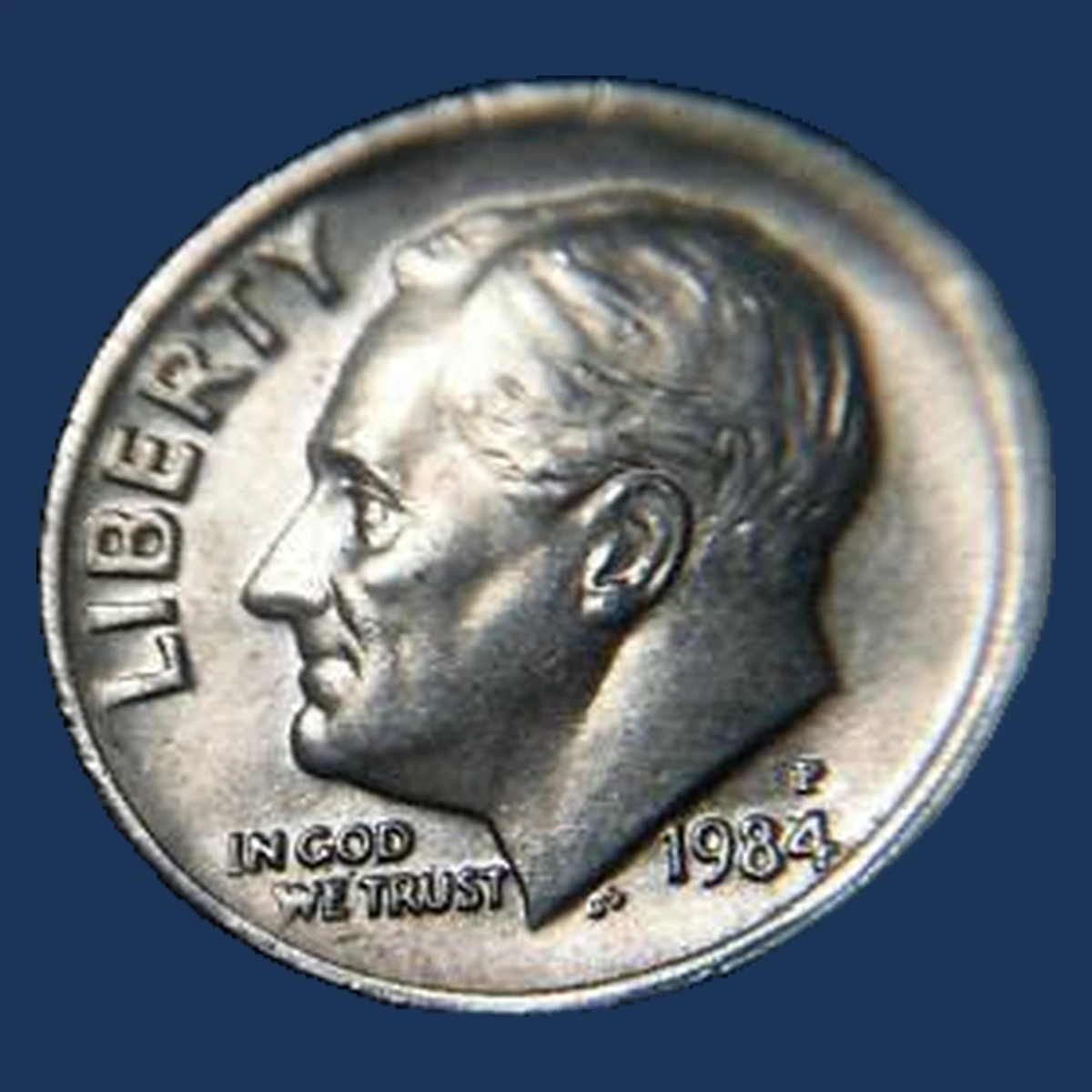
A narrow border on one side of Roosevelt and a wider border opposite can reflect a shifted front stamping tool. The back can remain centered because its tool did not move the same way.
This is called die misalignment; a die is the steel tool that stamps the design. It differs from moving the entire metal disk out of position.
A 1984-P example was described this way in a collector discussion. A slight shift need not make the coin larger or valuable.
Both faces are needed for the comparison. An uneven front border by itself is only the starting clue.
Estimated Value
A slight genuine front misalignment is estimated at $1–$25, with the smallest shifts bringing little collector premium. This range is for the modest effect described, not a major off-center strike.
Coins with an obvious shift are easier to sell than examples that need measurement. Small differences in border width are fairly common.
Clear photographs of both faces help show whether the shift is worth collecting. Damage that pushes the rim inward should not be valued as the same Mint mistake.
How to Identify
Check the back first: its design should remain more centered if only the front tool shifted. Now compare the narrow and wide borders around Roosevelt without assuming the disk itself moved.
Use a 10× magnifier to inspect the rim for dents or scraping that changed its width. Measure a loose coin with calipers against 17.91 millimeters and weigh it on a scale against 2.268 grams.
Inspect the grooves around the edge for flattening as you compare the two faces. A modest front-only displacement with a substantially centered back is the useful test; a large blank crescent on both faces points to a different error.
2. 1984 Roosevelt Dime Tilted Partial-Collar Edge
The edge step changes height around this 1984-P dime. It was struck while sitting unevenly in the ring that normally controls its size and forms the edge grooves.
Only part of the metal disk met that ring, or collar. The exposed portion could spread farther than the confined portion.
ANACS graded the recorded coin MS63, an unworn grade that permits noticeable marks. Its tilted edge is more specific than simply calling the coin wide.
A beaten or ground edge can also look uneven. The genuine feature is a step produced as metal met the collar at different heights.
Estimated Value
For a genuine tilted partial-collar 1984-P dime, estimate $15–$200. A clearer change in edge height and better surface preservation can improve its appeal.
The recorded ANACS MS63 coin shows the tilted edge to look for. As a different-year comparison, a 1988-P ordinary partial-collar dime graded ICG MS65 sold for $11 in December 2008.
That modest result shows why grade alone does not set the price. The edge error’s visibility remains important.
How to Identify
Hold the coin by its edges and turn it slowly under light. Follow where the grooved edge changes into the expanded portion, checking whether that boundary rises and falls.
The recorded 1984-P example is tilted, so an even ledge all the way around would be a different pattern.
A 10× magnifier can reveal grooves formed beside the step rather than grooves crushed by an impact. Check the faces for nearby dents that would explain later edge distortion.
On a loose coin, a scale should show roughly 2.268 grams and calipers can compare the width with 17.91 millimeters. Match the changing height of the collar-contact boundary, not merely an irregular outer rim.
3. 1984 Roosevelt Dime Material Blocking the Front Design
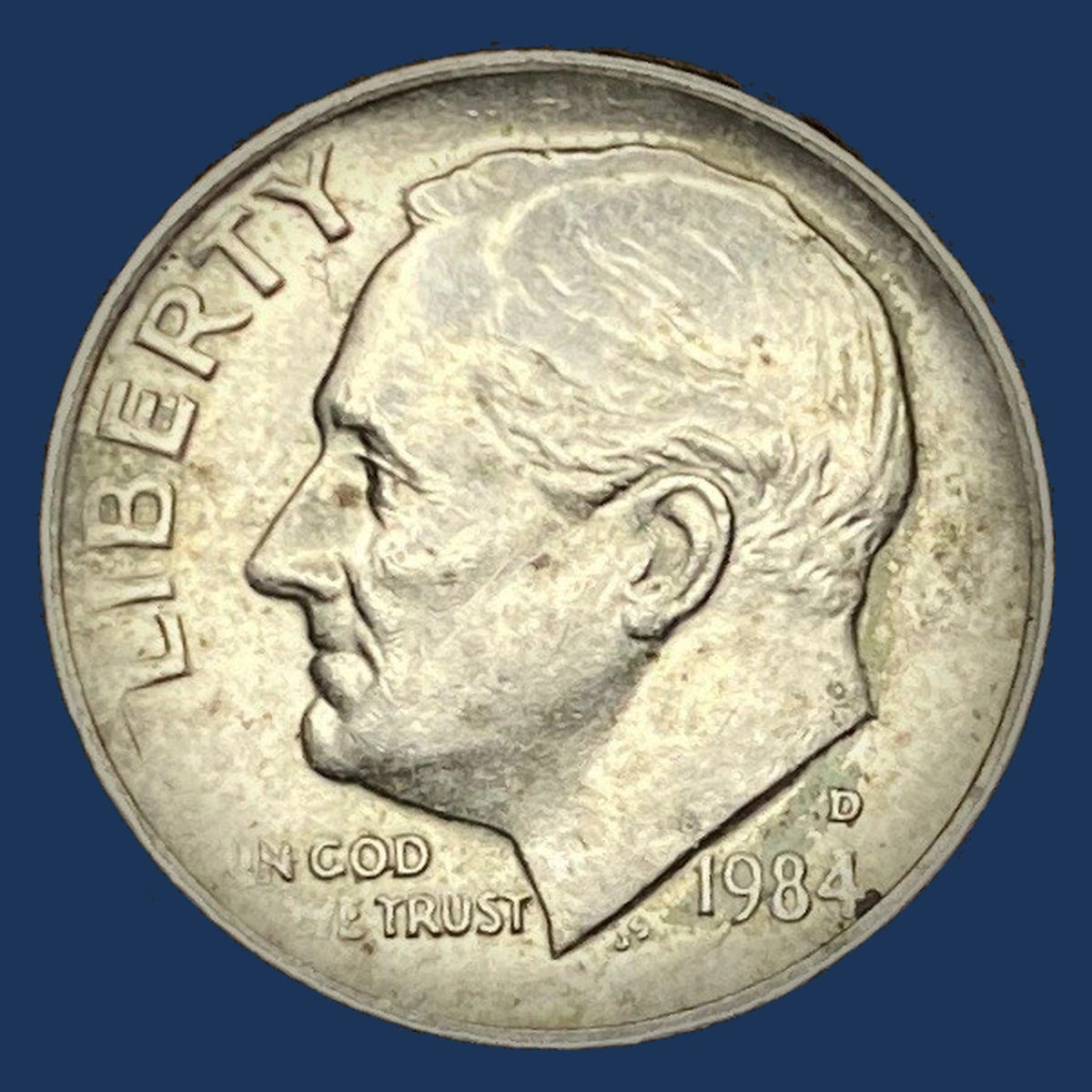
A shallow missing patch can form when material blocks the front stamping tool. A recorded 1984-D dime was identified by NGC with this struck-through effect.
The object’s material and exact shape are not specified. It should not automatically be called a wire or cloth impression.
Other 1984 reports describe filled date details and a weak inner stroke in the G of GOD. A G missing that stroke can look like C, although the original inscription still reads GOD.
These are separate examples of interrupted detail. Wear or deliberate rubbing can create similar appearances without any obstruction in the press.
Estimated Value
Genuine blocked-design examples are estimated at $5–$250, from minor missing strokes to a clearer struck-through area. The faintest missing strokes belong near the lower end, while a large, distinct impression can attract more interest.
A dramatic impression with a recognizable shape needs a different comparison from one faint part of a letter. Neither automatically identifies the blocking substance.
The nickname involving COD does not establish a new inscription. Its value depends on an actual Mint-caused loss of detail.
How to Identify
For a G that resembles C, examine the missing inner stroke with a 10× magnifier before reading the word aloud. Compare the nearby letters for wear at the same height.
For a filled date, inspect the digit openings and surrounding surface instead. The Denver struck-through specimen needs its own front photograph; do not assign it either reported letter pattern.
A loose dime normally weighs 2.268 grams and measures 17.91 millimeters on a scale and calipers. Check its grooved edge for damage associated with a scraped or flattened face.
Normal detail bordering a localized weak area supports obstruction more than generally worn lettering. Look for that undamaged transition rather than treating the nickname as identification.
4. 1984 Roosevelt Dime Reported Doubled Eyelid
An extra outline at Roosevelt’s eye can be small enough to miss without magnification. A 1984-P report describes this as a doubled front design.
A genuine doubled die carries duplicate detail on the stamping tool itself. The coin can receive that extra outline in a single strike.
The reported eye feature is not assigned a specific catalog number here. Its exact direction and separation must be matched to an identified example.
A flat shelf or worn eye contour can imitate doubling. The doubled-ear Lincoln cent of the same year is a different coin and provides no identification for this dime.
Estimated Value
Allow an estimated $15–$300 for a genuine 1984-P doubled-eyelid variety, depending on visibility and preservation. This is a comparison with minor modern doubled designs, not a sale record for an assigned catalog number.
The extra outline needs to be part of the stamping tool’s design. A blurred photograph or shelf-like mechanical doubling should not be priced at the same level.
Clear eye detail can help demonstrate the difference, but condition alone does not establish a valuable doubled die.
How to Identify
Photograph the eye with light from more than one direction, keeping the camera square to the coin. A shadow that disappears with a slight lighting change can look like an extra eyelid.
Examine the outline with a 10× magnifier for formed detail rather than a flattened shelf. Compare it with an ordinary 1984-P eye before assigning doubling.
The general report does not establish an exact direction or catalog number.
Check a loose coin’s normal 2.268 grams and 17.91 millimeters with a scale and calipers, plus the edge grooves for damage. Those checks help establish the coin’s condition but cannot confirm a doubled tool.
The needed match is a repeatable extra eye outline on an identified doubled-die example.
5. 1984 Roosevelt Dime Curved and Straight Missing Metal
A curved bite or a straight missing edge can both begin with an incomplete metal disk. That disk, called a blank, lacks part of its outline before the design is struck.
The two shapes arise from different relationships between the punch and the available metal strip. Neither means someone cut a finished coin.
Both curved and straight clips are reported for 1984 dimes. Their mint marks, sizes, and positions are not fixed by the general reports.
The rim should have formed around the shortage. A later saw cut or ground edge can imitate the outline but leave different surface clues.
Estimated Value
Genuine 1984 curved and straight clips are estimated at $20–$350. Larger, clearly formed shortages can attract more interest, especially when the date and mint remain readable.
An actual cross-denomination comparison is a 1997-P nickel with a twenty-percent clip that sold for $124 in March 2025. That amount is not a direct sale price for either 1984 dime shape.
A small straight shortage and a broad curved bite require different visual comparisons. Damage that removed metal later is excluded.
How to Identify
Place the gap beside a normal dime’s outline and decide whether it is curved or straight. Then inspect its ends with a 10× magnifier to see how the struck rim meets the missing section.
Filing marks, an abruptly severed rim, or lettering sliced through after striking suggest later removal. Weakness opposite a genuine clip can help, but it is not mandatory on every specimen.
Weigh a loose coin against 2.268 grams and use calipers on intact spans against 17.91 millimeters. Examine the remaining grooves around the edge, then judge the rim’s natural formation around the gap rather than accepting its shape alone.
6. 1984 Roosevelt Dime Front Struck Through a Worn Coin Covering
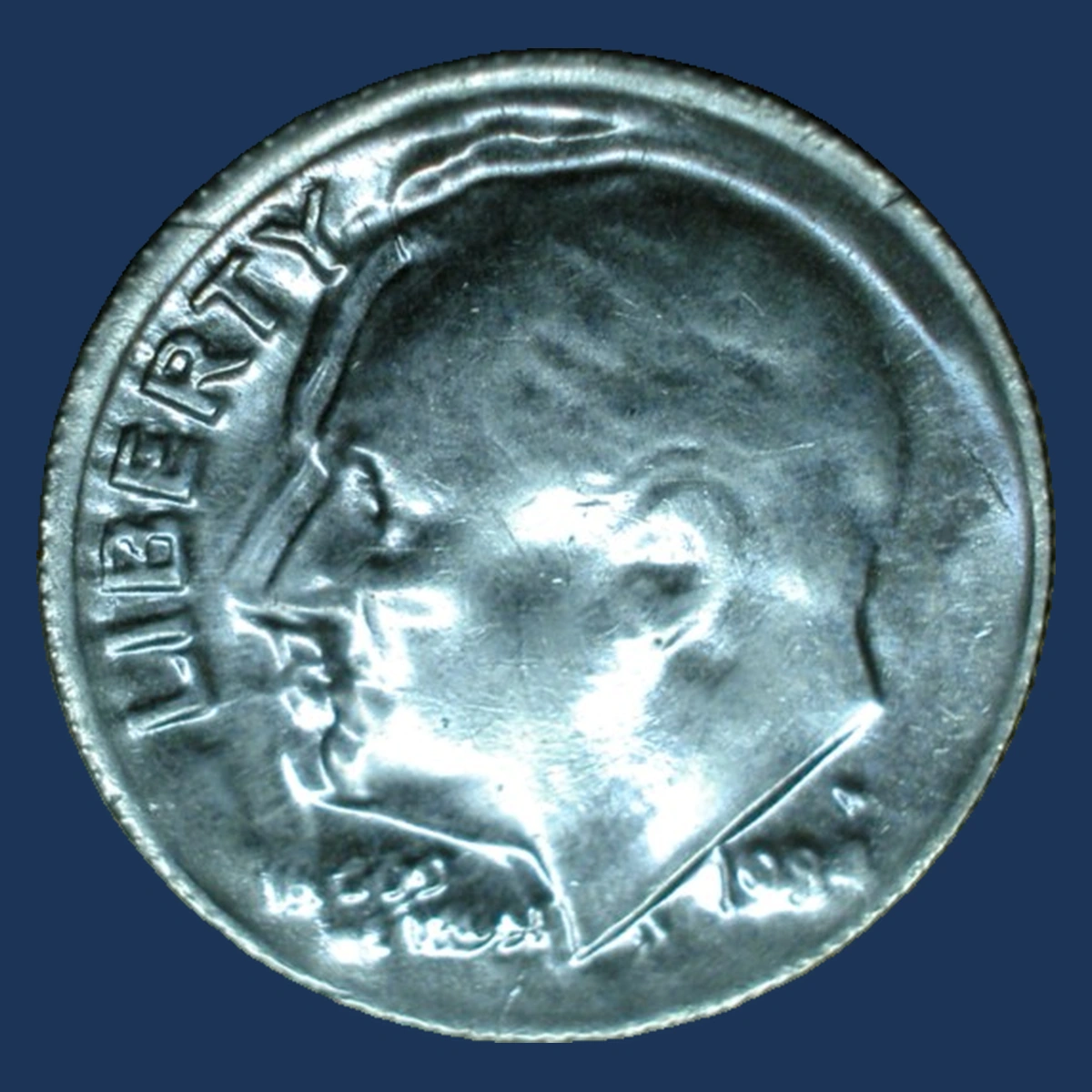
A covering coin can prevent the front tool from transferring a normal sharp portrait. Repeated strikes thin that covering until later coins receive a weak or spread-out image through it.
The covering is called a die cap. The dime struck underneath it is a separate coin, not necessarily a cup-shaped cap itself.
A 1984-P NGC MS64 auction example was described with a late-stage struck-through front. The abbreviated title does not fully name the covering.
Its label and appearance should be compared before applying the cap explanation. An ordinarily worn portrait alone does not show that a coin covered the tool.
Estimated Value
The NGC MS64 example sold for $45 in January 2023. Estimate $30–$400 for genuine comparable late-stage cap strikes, depending on how recognizable the altered design is.
The estimate concerns the receiving dime, not the separate coin that remained over the tool. A more dramatic cap-shaped object would need another comparison.
Because weak detail can have several causes, the particular surface pattern matters. The sale does not turn every soft-looking 1984 portrait into the same error.
How to Identify
Compare the front’s weak design with the back’s level of preservation. A covering over one tool can change one face while the other still receives an ordinary impression.
Read the full holder description for the NGC MS64 specimen instead of relying on the shortened auction heading. Use a 10× magnifier to follow the softened or spread-out design across the affected front.
For a loose coin, check 2.268 grams and 17.91 millimeters with a scale and calipers. Inspect the grooved edge for crushing that might explain damage after striking.
The receiving dime need not be cup-shaped. Match the broad altered front pattern to a confirmed cap-struck coin rather than judging from a worn cheek alone.
7. 1984 Roosevelt Dime Wide Strike Outside the Collar
A dime can spread wider than normal while retaining its complete design. That combination points toward a strike outside the restraining ring around the metal disk.
The ring, called a collar, normally limits the diameter and creates the edge grooves. Missing that restraint allows outward expansion.
Both Philadelphia and Denver broadstrikes appear in the 1984 reports. No single measured diameter is supplied for those examples.
A smooth edge alone is not enough. A coin that spent years being battered can lose its grooves, while an off-center strike can leave a blank crescent and cut off part of the design.
Estimated Value
An estimated range of $25–$400 suits genuine ordinary 1984 broadstrikes, depending on expansion and condition. A small spread and a dramatic enlarged outline should not be compared as equal examples.
For context, a 1988-P dime with overlapping double strikes and an expanded second strike sold for $80.50 in May 2005. That later-year coin combined two features.
The comparison does not establish a 1984 sale. Additional impressions must be valued with the whole coin rather than added as separate full prices.
How to Identify
Measure the coin in several directions using calipers before judging how large its border looks. Compare the readings with the normal 17.91-millimeter diameter.
Weigh a loose example on a scale against 2.268 grams; a wider strike need not lose metal.
Trace the lettering around both faces with a 10× magnifier and check that the design remains on struck metal. A large unstruck crescent cutting off the design points toward an off-center strike instead.
Inspect the edge for outward spreading and reduced grooves that agree with the wider faces. Later hammering may flatten the design or batter the rim.
The identifying combination is a complete design carried by a truly expanded coin.
8. 1984 Roosevelt Dime Strong Opposite-Design Traces
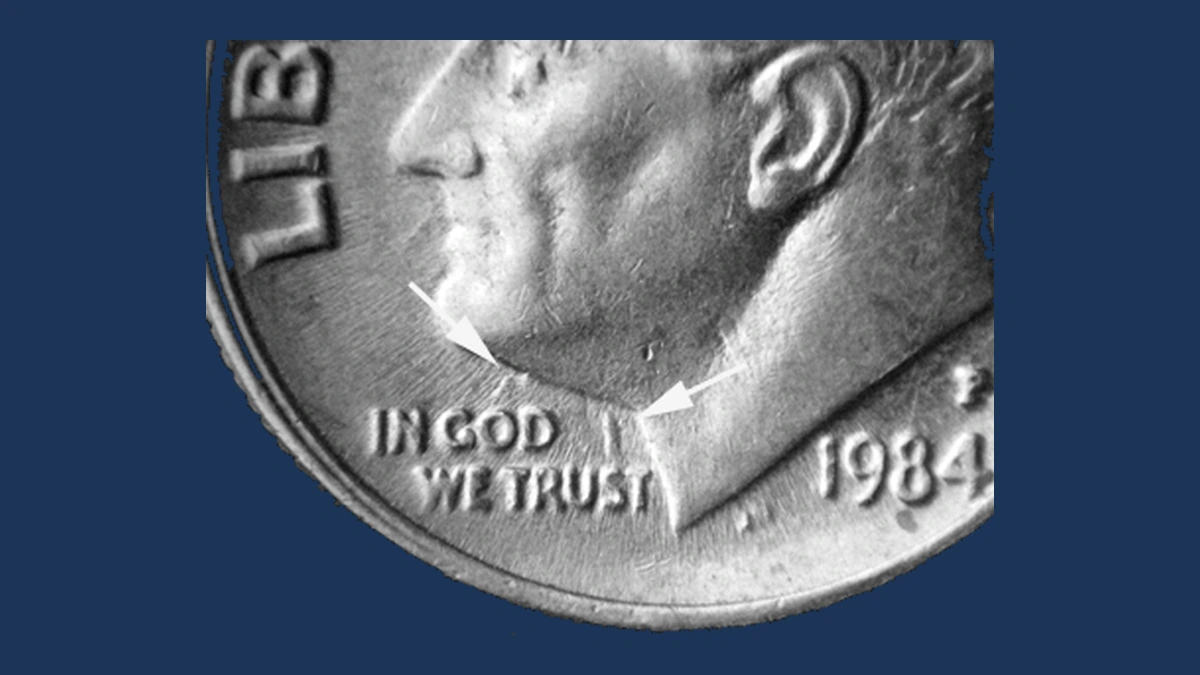
Parts of the torch, branches, and back lettering appear around Roosevelt on a particularly strong 1984-P example. The back also carries traces of the portrait outline and front lettering.
These marks formed after the two stamping tools struck each other without a blank between them. Later coins picked up the transferred details.
This is a die clash, not a second design deliberately engraved onto the coin. Strong examples can be visible without magnification.
The recognizable shapes matter more than the number of extra lines. Scratches and tool-polishing marks do not become clashes merely because they lie near the portrait.
Estimated Value
For 1984-P clashes, estimate $15–$450, from light traces to a strong combination like the published example. Preservation and the clarity of recognizable opposite-design shapes influence the value.
A separate 1993-P dime with clash marks and front misalignment sold for $63 in April 2021. It provides context, but its shift is an additional feature and its clash strength may differ.
Clear transferred shapes make a stronger collecting example than many faint lines. Scratches that hide those shapes can reduce its appeal.
How to Identify
Use the published 1984-P comparison to locate E PLU, branches, torch traces, and parts of ONE and AMERICA on the front. These are pieces of the back design appearing where they do not normally belong.
On the back, look for GOD TRUST, the date, and Roosevelt’s head outline under a 10× magnifier. Several matching shapes help distinguish a clash from unrelated scratches.
Inspect the grooved edge and measure a loose coin against 2.268 grams and 17.91 millimeters using a scale and calipers. Neither size nor weight alone confirms these tool marks.
Match identifiable parts of the opposite design on both faces rather than calling every extra line a clash.
9. 1984 Roosevelt Dime Interior and Rim Tool Breaks
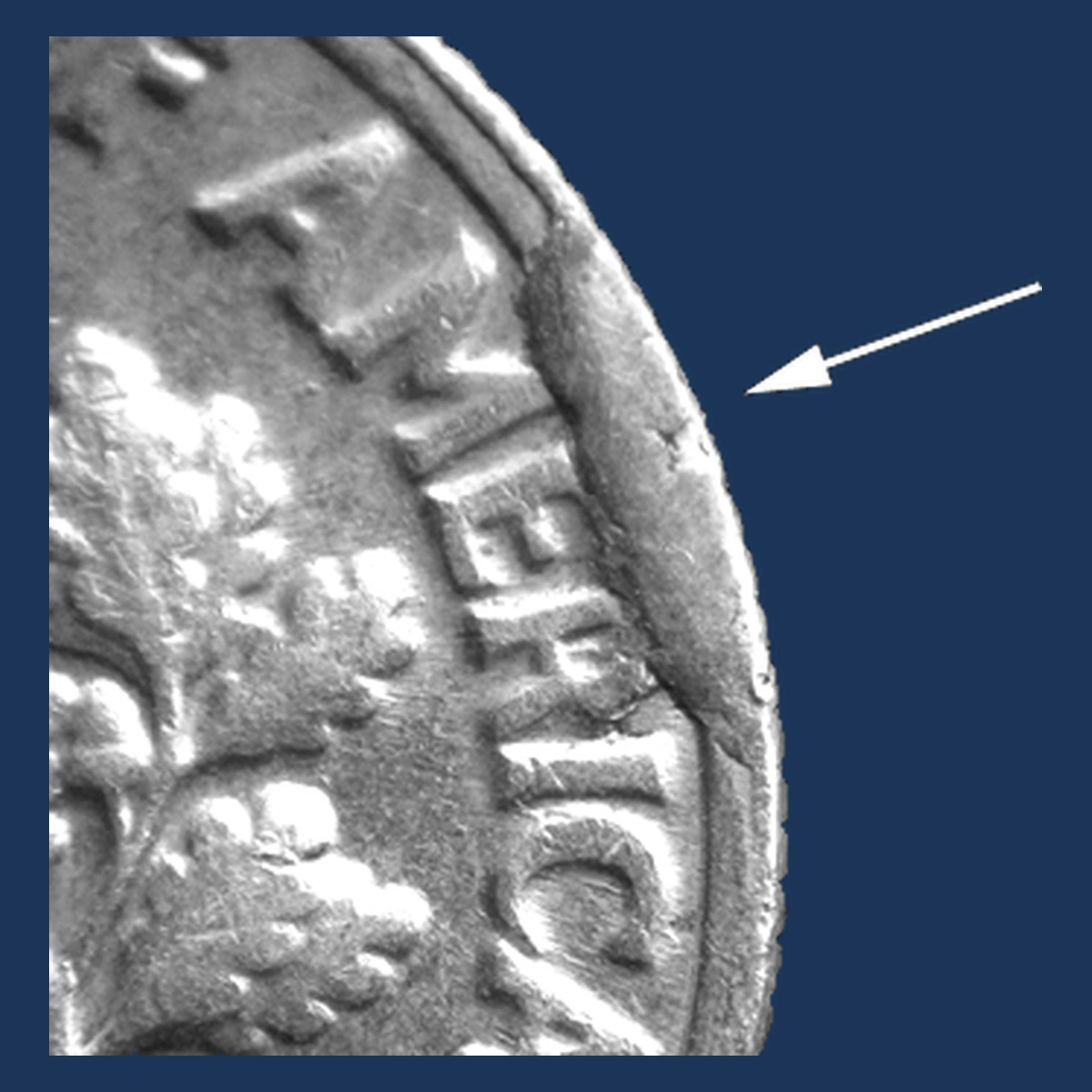
A raised patch sits between the straight lower edge of Roosevelt’s neck, the date, and the P. The documented 1984-P example does not connect directly to the rim.
It formed when part of the stamping tool broke away inside the design. Metal entered the opening during striking and produced the raised area.
Two other cataloged 1984-P breaks concern the rim. A rim-connected tool break is often called a cud.
These features should not be placed on one imagined coin. The interior patch has a stated location, while each rim break must be matched to its own catalog photographs.
Estimated Value
Genuine interior breaks and rim-connected cuds are estimated at $15–$500, depending on size, visibility, and preservation. A small raised patch normally needs a different comparison from a large rim blob.
A well-preserved coin lets buyers see where the raised area meets the original design. Each example should be priced as a complete coin, even when several breaks appear together.
An attached lump or a rim impact that pushed metal upward is not the same Mint defect.
How to Identify
For the interior example, start between the neck’s straight lower edge, the date, and the P. A 10× magnifier should show a raised struck patch in that space without a direct rim connection.
The two rim-break records require a different test: follow the raised area until it meets the rim. Their catalog suffixes alone do not establish which face or clock position to inspect.
A scale and calipers can check a loose coin against 2.268 grams and 17.91 millimeters. Examine its grooved edge for a dent that displaced metal onto a face.
Match the interior patch to its documented location, or a rim break to its own illustrated outline; do not substitute one for another.
10. 1984 Roosevelt Dime Large Off-Center Strikes
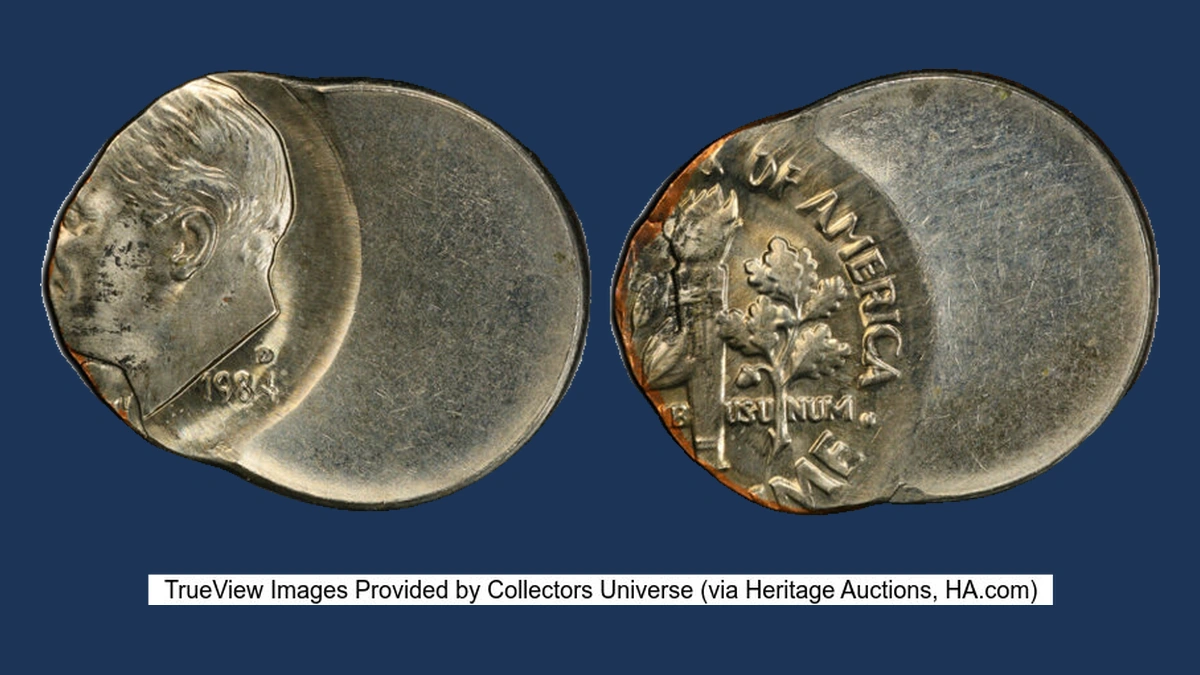
Much of the metal remains blank on two strongly displaced 1984-D dimes. The stamped design occupies only part of the disk because it entered the press off-center.
One example was struck sixty-five percent off-center toward nine o’clock and graded ANACS MS63. It appeared in a group with dimes from other years.
A separate PCGS MS63 specimen is fifty-five percent off-center. Its direction should not be borrowed from the first coin.
Both are unworn-grade examples of the same basic press mistake. They are not clips, since the unstamped area still contains metal rather than an actual missing section.
Estimated Value
The fifty-five-percent example sold for $164 in June 2025. Estimate $50–$600 for comparable genuine 1984 off-center dimes, depending on displacement, readable identification, and condition.
The sixty-five-percent example belongs to a different three-coin lot. Its individual value cannot be obtained by assigning or dividing the group’s total price.
A readable year and mint make a heavily displaced coin easier to collect. Do not transfer the documented $164 sale to another coin solely because its blank area looks similar.
How to Identify
Look for the actual 1984 date and D before comparing how much of the design is missing. The two recorded examples differ in both displacement and grading holder.
The sixty-five-percent ANACS coin points toward nine o’clock; no direction is assigned here to the fifty-five-percent PCGS coin. Keep those examples separate.
Use a 10× magnifier to follow the transition from struck design to blank metal on both faces. A single shifted face with a centered back calls for a different explanation.
Weigh a loose example against 2.268 grams and check its outline with calipers against 17.91 millimeters. Examine the remaining edge grooves and confirm that the apparently blank area contains original metal, not a cut-away gap.
11. 1984 Roosevelt Dime Two Separate Strikes
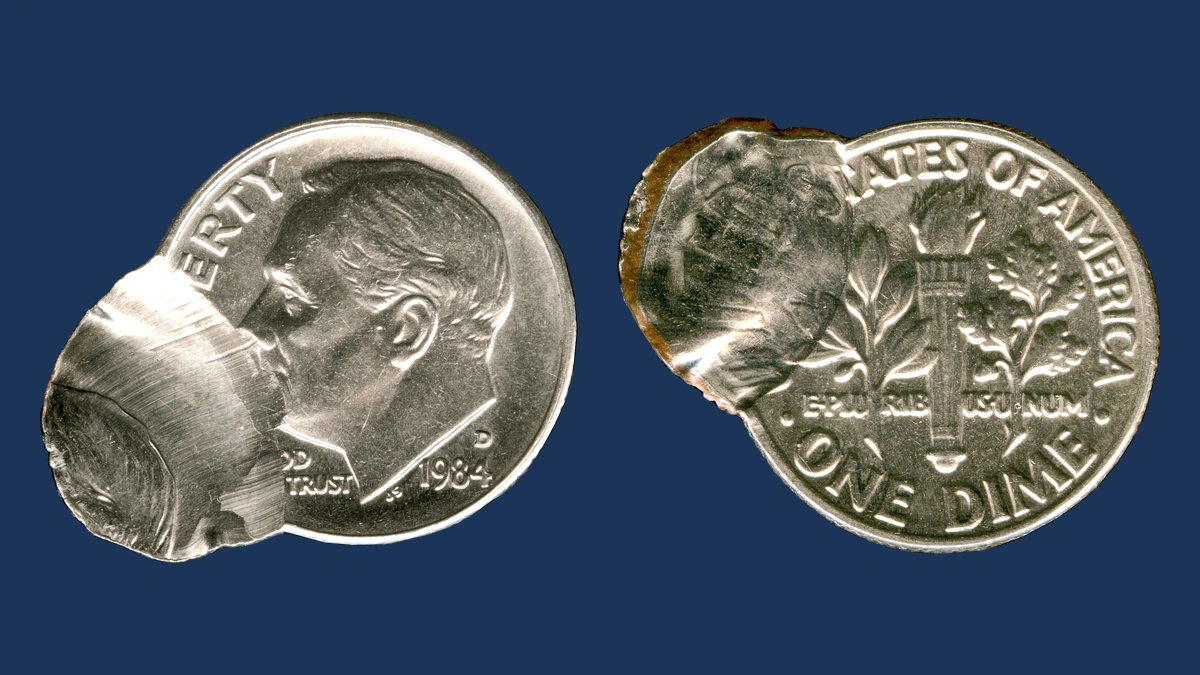
Two sets of design details can remain when a dime stays in the press for another blow. The later impression may partly erase or overlap the first.
A 1984 report lists this double-strike type without identifying the mint or a second-strike direction. Those details must come from the actual coin.
This differs from the doubled eyelid discussed earlier. A doubled tool can create its extra eye detail in one strike, while a double strike involves two blows to the coin.
The strongest evidence is a second design position. A tiny shelf beside one letter does not demonstrate the full sequence.
Estimated Value
Estimate $60–$700 for genuine 1984 double strikes, allowing for the separation of impressions and the coin’s condition. A second readable date or portrait can make the extra blow easier to appreciate.
A 1988-P close-overlap double-strike dime graded PCGS MS65 sold for $80.50 in May 2005. That different-year example also spread outward during its second strike.
A widely separated second impression may need a higher comparison than close overlap. No particular angle or off-center percentage is assumed for the 1984 report.
How to Identify
Find two design positions that can be followed across more than one small feature. Under a 10× magnifier, trace an earlier letter or outline into an area overlapped by the later impression.
Do not require the coin to have flipped between blows; no flip or rotation is established for this report.
Inspect both faces for crushing that would suggest a later vise impression. A true extra strike must agree with the way the original metal and designs meet.
For a loose coin, compare its weight with 2.268 grams on a scale and its width with 17.91 millimeters using calipers. Check the edge grooves for changes consistent with the extra blow.
Two traceable struck positions distinguish repeated striking from a small doubled eyelid.
12. 1984 Roosevelt Dime One Missing Outer Layer
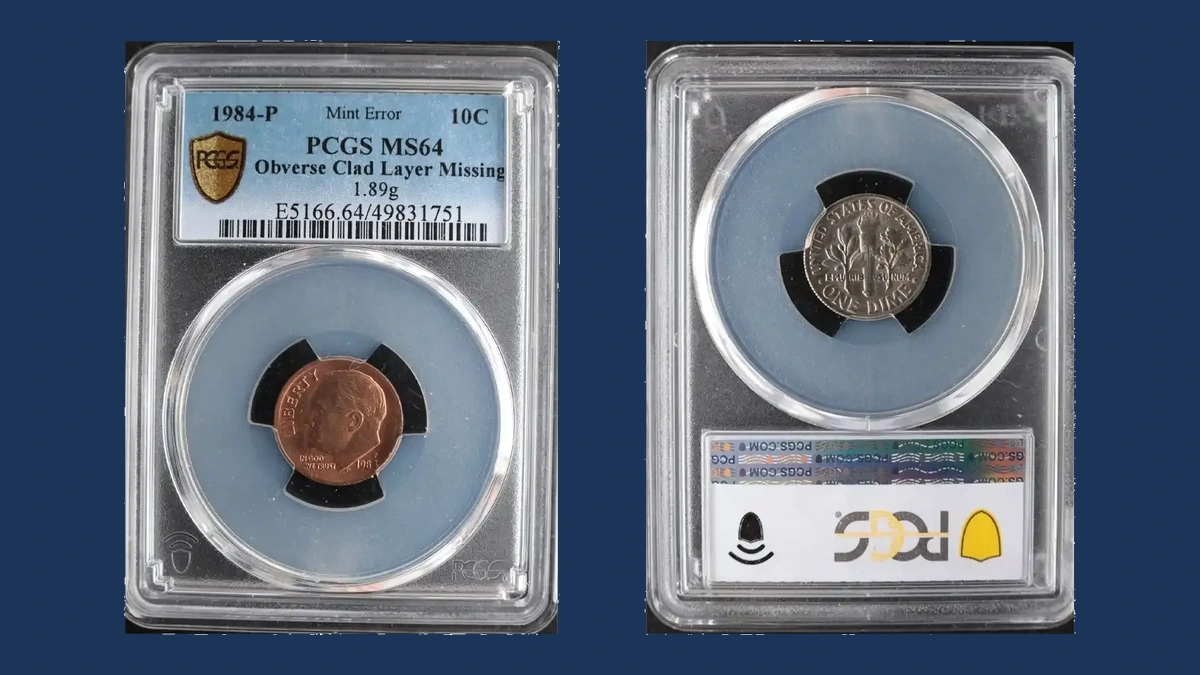
A copper-colored face can reveal the center of the dime when an outer layer is absent. Normal 1984 dimes use bonded layers, called clad metal, around a copper core.
Reports describe single-face missing layers on Philadelphia and Denver coins. The affected front or back must be established for each specimen.
This does not mean both outer layers are missing from one coin. Nor does it show whether separation occurred before or after striking without further surface evidence.
Plating, chemical attack, and ordinary discoloration can imitate copper exposure. The edge structure and weight need to support a real loss of metal.
Estimated Value
An estimated range of $100–$750 applies to genuine 1984 single-face missing-layer dimes, depending on preservation and the exposed surface. A copper-colored stain does not receive the same estimate.
As a later-year comparison, a 1988-D dime missing its front layer weighed 1.9 grams and sold for $360 in June 2024. NGC graded that separate coin MS65.
The comparison does not supply an actual weight or grade for the 1984 reports. Each coin’s physical construction must be checked on its own.
How to Identify
Examine the edge layers before deciding what the copper-colored face represents. An added surface film can leave the original construction intact, whereas a missing outer layer removes metal.
Use a scale on a loose coin to check for weight below the ordinary 2.268 grams. Calipers should compare the diameter with the normal 17.91 millimeters, rather than treating those standard figures as measurements of a particular error.
A 10× magnifier can reveal the exposed surface, its boundary, and surviving grooves around the edge. Check for chemical damage or later stripping as well.
Compare the actual affected face and reduced metal structure together; a reddish photograph alone cannot establish a missing layer.
Conclusion
Estimated values across these 1984 Roosevelt Dime errors range from $1 to $750. Start with the visible feature: an uneven edge, a missing layer, opposite-design traces, or a second struck position each asks a different question.
The $164 off-center sale belongs to one identified Denver coin. Keep separate specimens and their prices separate, and compare the complete coin before assigning an error name to one unusual letter.