1924 Dime Error List with Pictures

The complete design still fits on a 1924-S broadstrike, even though its border is unusually wide and uneven. An example sold for $840 at Heritage in 2018.
These 1924 dime errors also include missing edge metal, an attached split, and small repeated design details. Estimated values run from $30 to $3,000.
Read on to compare the shapes and see why a wide rim is different from a partly missing design.
1. 1924 Mercury Dime Clipped Planchet (Estimated Up to $600)
With the front upright, the Teich Collection dime has a missing edge section near four o’clock. The gap formed before the design was stamped onto the coin.
A punch cut an incomplete blank from the metal strip. The remaining silver then received the usual dime design.
NGC graded this Philadelphia coin MS66 Full Bands, meaning no circulation wear, few marks, and sharply separated central reverse bands. Those bands wrap around the bundle shown on the back.
The strong design can coexist with a clip. Full Bands describes the strike quality, not a second error or the size of the gap.
Estimated Value
The MS66 Full Bands example sold for $305.50 in June 2013. Estimate $30–$600 from worn coins with small clips through attractive unworn examples.
For comparison, a clipped 1942 dime graded PCGS MS66 sold for $192 in March 2025. That is a later-year coin with the same general error.
Both results show that a recognizable clip can remain moderately priced. Missing edge metal alone does not guarantee a four-figure value.
How to Identify
Locate the four-o’clock gap when comparing with the Teich coin. Use a 10× magnifier to follow the rim and design as they approach each end of the missing section.
A genuine clip can also leave weakness on the opposite rim, though that clue varies. Tool lines or metal pushed up by a cut suggest later damage instead.
Weigh a loose coin on a scale against the original 2.50 g standard, allowing for the clip and wear. A very small loss may be difficult to measure precisely.
Calipers across an undamaged span should be compared with 17.90 mm. Follow the remaining edge grooves into the gap; naturally formed ends without cutting marks are the useful first check.
2. 1924 Mercury Dime Doubled Die Obverse (Estimated Up to $700)
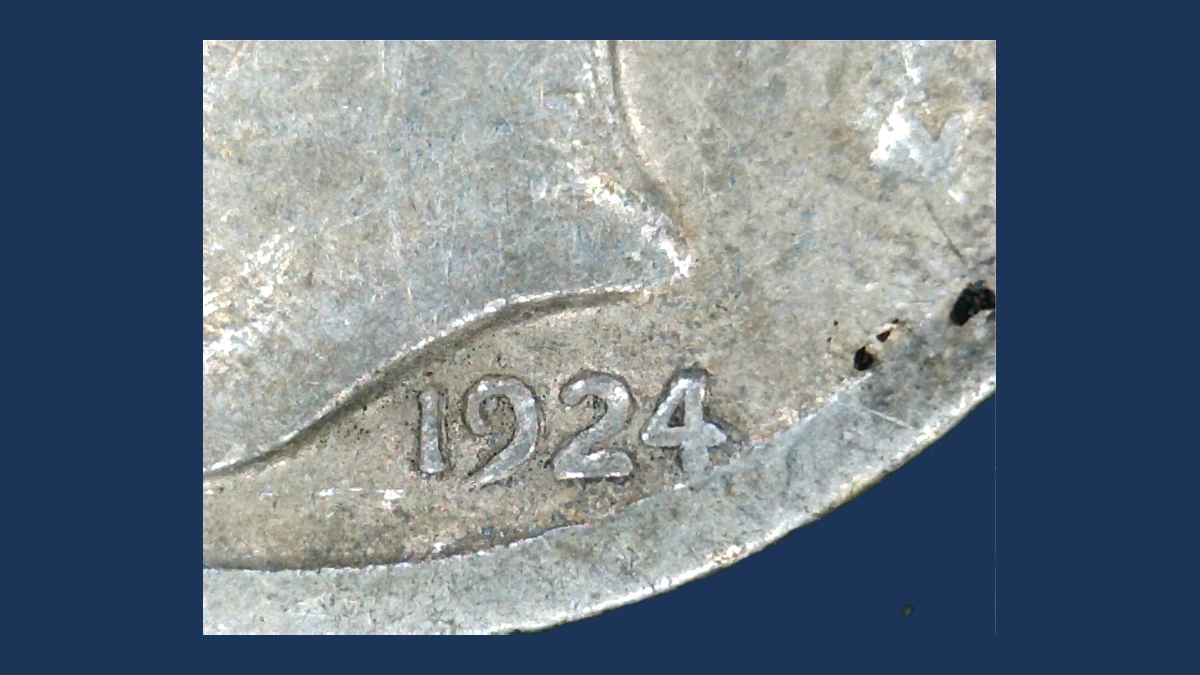
A small second outline beside a letter can come from a doubled stamping tool. Collectors call this a doubled die; the die is the steel tool that makes the coin’s design.
The 1924 guide includes this category and suggests examining LIBERTY and the date. It does not give one confirmed pattern shared by every letter or number.
Those are places to search, not proof that any thick letter is doubled. Movement during striking can also leave a flat shelf beside a design.
The important difference is a rounded repeated shape created in the tool, rather than flattened metal.
Estimated Value
Estimate $100–$700 for clearly identified examples from circulated condition through coins without circulation wear and with some marks. The range follows the year guide’s assessment of roughly a hundred to several hundred dollars.
It is not an auction result for a named variety. Clear, separated detail is usually more appealing than a barely visible outline.
A flat shelf made during striking is a different effect. It should not be priced as this doubled-die variety simply because it looks similar.
How to Identify
Place a normal 1924 dime beside the candidate under the same light. Examine LIBERTY and the date with a 10× magnifier, looking for a rounded second outline rather than a thin shelf.
Move across several suspected features instead of enlarging one shadow. Reflections and dark surface color can make an ordinary edge seem doubled.
A normal dime measures 17.90 mm and weighs 2.50 g before wear, with a grooved edge. Check a loose example with calipers and a scale; use recorded measurements if it is sealed.
The guide does not give an exact pattern to borrow from another year. Seek a stable, rounded extra shape that remains visible when the light changes.
3. 1924-D Mercury Dime Lamination and Retained Split Planchet (Estimated Up to $900)
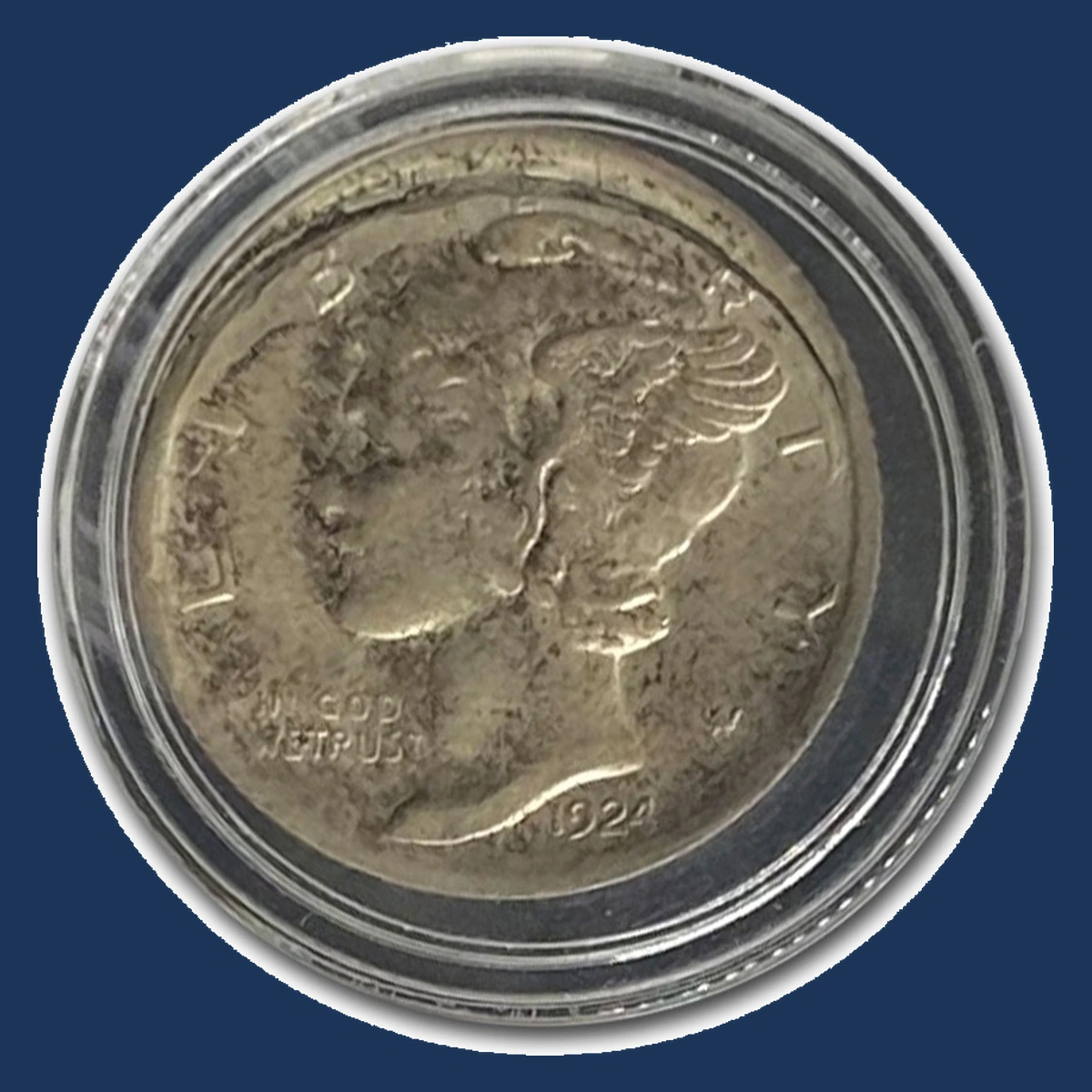
A separated layer still attached to the coin is called a retained split. The word retained simply means it has not fallen away.
APMEX lists a 1924-D dime with this error graded NGC AU58, indicating slight circulation wear. Its silver-copper alloy separated within the body of the blank.
This belongs to the same broad group as smaller peeling flaws called laminations. The split can be much more extensive than a small surface flake.
An attached sheet should be metal from the coin itself. Glue, tape residue, or another substance sitting on an intact surface has a different cause.
Estimated Value
Estimate $40–$900 for genuine laminations and retained splits. Extensive separation on an attractive coin can command more than a small peeling spot.
The listed 1924-D example establishes an AU58 coin, but no sale price is used here. A different-year 1921-D reverse lamination graded NGC VG8 sold for $74 in 2013.
VG8 describes heavy wear, making that a lower-condition comparison. The amount of attached metal and the 1924-D coin’s own preservation determine how useful the comparison is.
How to Identify
View the edge first to see whether the split connects to the coin’s body. A surface deposit lies on top of intact metal instead.
Follow the connection with a 10× magnifier and side lighting, leaving every flap untouched. The listed Denver example has an attached split, unlike a completely detached fragment.
A scale can compare weight with the normal 2.50 g; an attached layer may leave that weight nearly unchanged. Calipers can compare width with 17.90 mm and record unusual thickness.
Inspect the grooved edge for marks from prying. The clearest sign is a separated sheet of the original silver still joined to the coin underneath.
4. 1924-D and 1924-S Mercury Dime Repunched Mintmark (Estimated Up to $1,200)
An extra piece of D or S can remain beside the small mint letter on the back. It comes from a repeated punch used while preparing the stamping tool.
The worker added the mintmark separately from the main design. If the punch moved between blows, parts of its earlier position could survive.
The 1924 year guide reports examples for both Denver and San Francisco. Each letter needs its own matching comparison.
A repeated mintmark affects that tiny area. It does not mean the entire back was doubled, and another year’s familiar D or S shape does not identify this one.
Estimated Value
An estimated $30–$1,200 covers worn examples through coins with no circulation wear and some marks. The earlier letter must be clear enough to match a genuine variety.
This is the value of the complete dime, including its mint and condition. It is not a fixed amount added to every odd-looking D or S.
Compare ordinary coins of the same mint, grade, and strike quality first. Especially sharp Full Bands coins can have much higher values for reasons beyond the mintmark.
How to Identify
Find the small D or S low on the back, beside the bundle near E in ONE. Under a 10× magnifier, examine the top and bottom of the letter together.
An earlier punch should leave a piece that fits another D or S. A dot of corrosion or metal moved by a nick may not follow a letter shape at all.
Check the surrounding silver for added metal or disturbed texture. Normal dimensions are 2.50 g and 17.90 mm, with a grooved edge, measurable on a loose coin with a scale and calipers.
Use the specific variety’s photographs for direction. The fastest useful clue is a connected extra letter curve, not an isolated bump beside the mintmark.
5. 1924 Mercury Dime Off-Center Strike (Estimated Up to $1,800)
A true off-center strike loses some design beyond the edge of the blank. Across from that missing design, part of the silver remains untouched.
The blank was in the wrong position when the stamping tools closed. Both faces should reflect that misplaced strike.
The 1924 guide reports this category without giving a confirmed percentage for one particular coin. A percentage describes an individual example, not every off-center dime from the year.
The known 1924-S uncentered broadstrike is different. Its uneven border does not make it an off-center example because its designs remain complete.
Estimated Value
Use an estimated $100–$1,800 range from worn minor shifts through attractive, strongly displaced examples with readable dates. The amount of missing design and the coin’s condition both matter.
A 1944 dime struck 10% off center sold for $360 at Heritage in December 2025. Its PCGS AU58 grade indicates slight wear.
That later-year sale supports a general Mercury dime comparison. It does not establish a 1924 auction price or the mint and shift of an unspecified example.
How to Identify
Look for outer design actually missing beyond the blank’s edge. If all the lettering and other details remain present inside expanded metal, check for a broadstrike instead.
Use equal-size photographs of both faces and a 10× magnifier at the boundary of blank silver and struck design. A shift on only one face can come from a moved stamping tool.
Weigh a loose coin against 2.50 g on a scale and measure its outline against 17.90 mm with calipers. A displaced strike does not itself require metal loss.
Inspect the surviving edge grooves and blank margin together. The immediate clue is missing design at one side paired with original untouched silver at the other.
6. 1924-S Mercury Dime Uncentered Broadstrike (Estimated Up to $3,000)
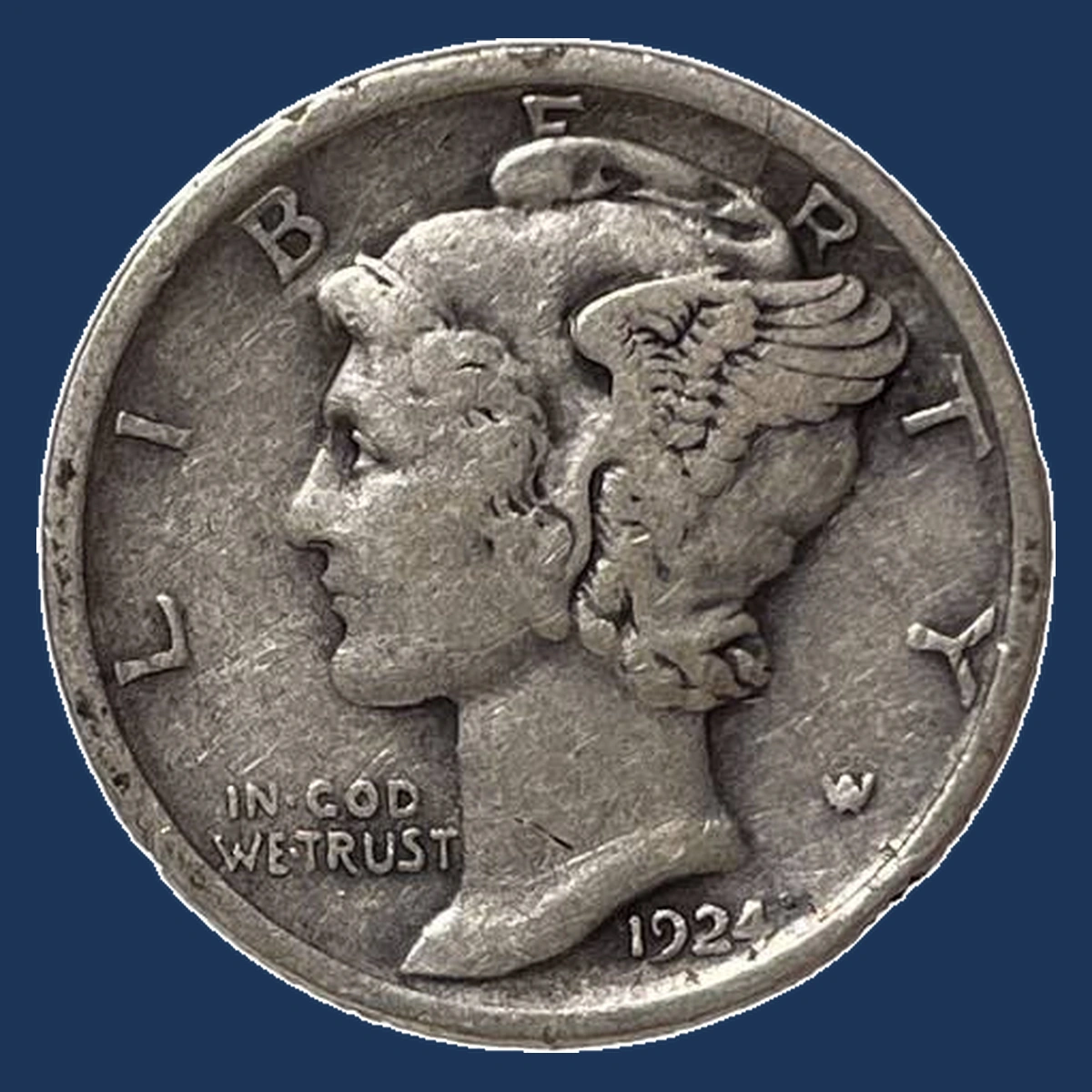
Extra metal spreads near six-thirty on a cataloged 1924-S dime, but the designs remain complete. The outline is uneven because the blank was not centered during the strike.
It also lacked normal support from the collar, the ring that controls width and forms edge grooves. The silver could spread outward instead of stopping at the usual border.
This combination is called an uncentered broadstrike. It differs from an off-center coin with missing design.
The described example is MS64 Full Bands, combining no circulation wear and relatively few marks with clear separation of the central reverse bands.
Estimated Value
Estimate $400–$3,000 for circulated through attractive unworn 1924-S uncentered broadstrikes. A PCGS MS64 Full Bands example sold for $840 at Heritage on April 29, 2018.
A different-year 1945 broadstrike graded NGC MS66 Full Bands brought $3,416 in September 2026. Its higher grade means better preservation.
That later coin helps show why condition matters, but does not set a price for every 1924-S example. Compare the complete design, surfaces, and expansion together.
How to Identify
Trace all the outer lettering and the back design. Their completeness is more useful than the uneven width of the border.
For the cataloged example, hold the front upright and compare the extra silver near six-thirty. Use a 10× magnifier to inspect how the struck details meet that wider area.
Calipers should show outward spread beyond the normal 17.90 mm diameter. A scale may still read near 2.50 g because spreading metal does not remove it.
Check the edge for missing normal grooves, and reject flattening from later hammering. A full design sitting inside a wider, uneven outline is the simplest visible distinction from an off-center strike.
Conclusion
These 1924 dimes span estimated values of $30–$3,000. A clip leaves missing metal, a retained split leaves an attached layer, and a broadstrike spreads the outline while preserving the design.
Smaller date and mintmark features need a magnifier and a matching example. Keep condition and Full Bands status separate from the cause of the error, since a sharply struck back does not explain a damaged-looking edge.