1920 Dime Error List with Pictures

A 1920-S dime struck 20% off center sold for $1,860 in October 2020. Part of its design missed the blank, leaving untouched silver beside the picture.
The six 1920 dime errors below have estimated whole-coin values from $10 to $3,000. Some change the outline, while others leave small marks in the lettering or mint letter.
Begin with the shape of the coin, then use the close-up checks to examine the finer details.
1. 1920 Mercury Dime Obverse Doubling (Estimated Up to $300)
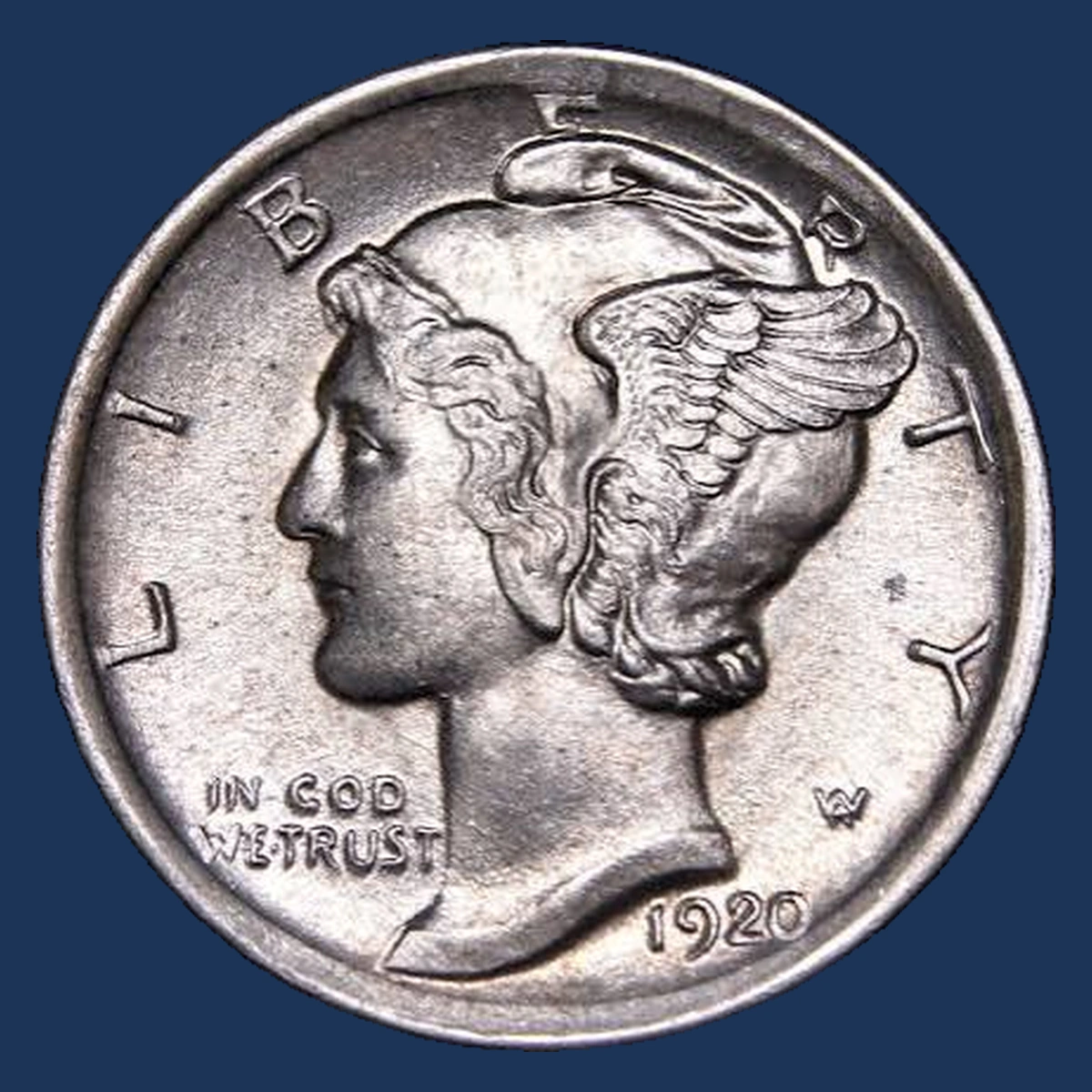
An extra outline around LIBERTY or the date can have more than one cause. The 1920 report uses both doubled-die and mechanical-doubling language, which describe different events.
A die is the steel tool that stamps coins. A repeated design formed in that tool can appear on every coin it makes.
Movement during striking can instead flatten an edge and leave a shallow shelf. That effect does not prove the tool carried a doubled picture.
Examine the actual outline on the 1920 coin. The well-known 1919 doubled-die variety should not be used to identify or price a different year.
Estimated Value
The estimated range is $10–$300 for worn through lower unworn Philadelphia examples with this reported appearance. Mechanical doubling generally adds little value.
An ordinary NGC MS64 Full Bands coin brought $192 in July 2025. MS64 means unworn with some marks; Full Bands means clear separation in the horizontal bands on the back’s bundle.
That sale reflects condition and strike detail, not a doubled-die bonus. A major variety from another year is not a direct price comparison.
How to Identify
Photograph LIBERTY and the date with the same light and camera angle. Use a 10× magnifier to compare the extra edge with the rounded main stroke.
A low flat shelf that narrows the original letter points toward movement during striking. Move the light to see whether an apparent outline is only glare.
Do not scrape dirt away to expose a detail. Compare with a normal 1920 dime first.
When safely accessible, use calipers and a scale against 17.90 mm and 2.50 g, allowing for wear. Inspect the edge grooves for alteration.
The important distinction is between a flattened ledge and a separate raised design contour. A blurred doubled-looking edge alone cannot establish a doubled die.
2. 1920 Mercury Dime Clipped Planchet (Estimated Up to $450)
A missing section can begin before the blank receives its design. The cutting punch may overlap a previous hole in the metal strip or extend beyond the strip’s edge.
The incomplete blank then enters the press and receives the coin design. Collectors call the resulting error a clipped planchet, with planchet meaning the blank ready for striking.
The 1920 report does not identify one particular mint. Its most useful feature is how the surrounding rim formed beside the missing section.
A later cut removes finished metal. It does not recreate the same rim response produced by striking an incomplete blank.
Estimated Value
The estimated whole-coin range is $40–$450, from modest worn clips to well-preserved coins with larger clear gaps. Mint and surface condition still matter.
A 1942 clipped dime graded PCGS MS66 sold for $192 in March 2025. MS66 is a high unworn grade.
That is a different-year comparison, not a sale of the reported 1920 coin. It shows why a genuine clip can be collectible without making every missing section expensive.
How to Identify
Weigh an accessible coin before accepting a dramatic missing section. Compare the result with 2.50 g, allowing for the absent metal and ordinary wear.
Use calipers across an unaffected part against 17.90 mm. Then inspect the gap and its endpoints with a 10× magnifier.
Saw marks, fresh cuts, or crushed metal suggest a later alteration. Look at the edge grooves where they approach the opening.
A weak rim opposite a curved clip can support the identification. It is not required on every genuine example.
The most useful check is the way the whole rim responds around the missing area. A naturally formed gap with compatible nearby detail is stronger evidence than a neat notch or low weight alone.
3. 1920-D Mercury Dime Die Cracks and Breaks (Estimated Up to $600)
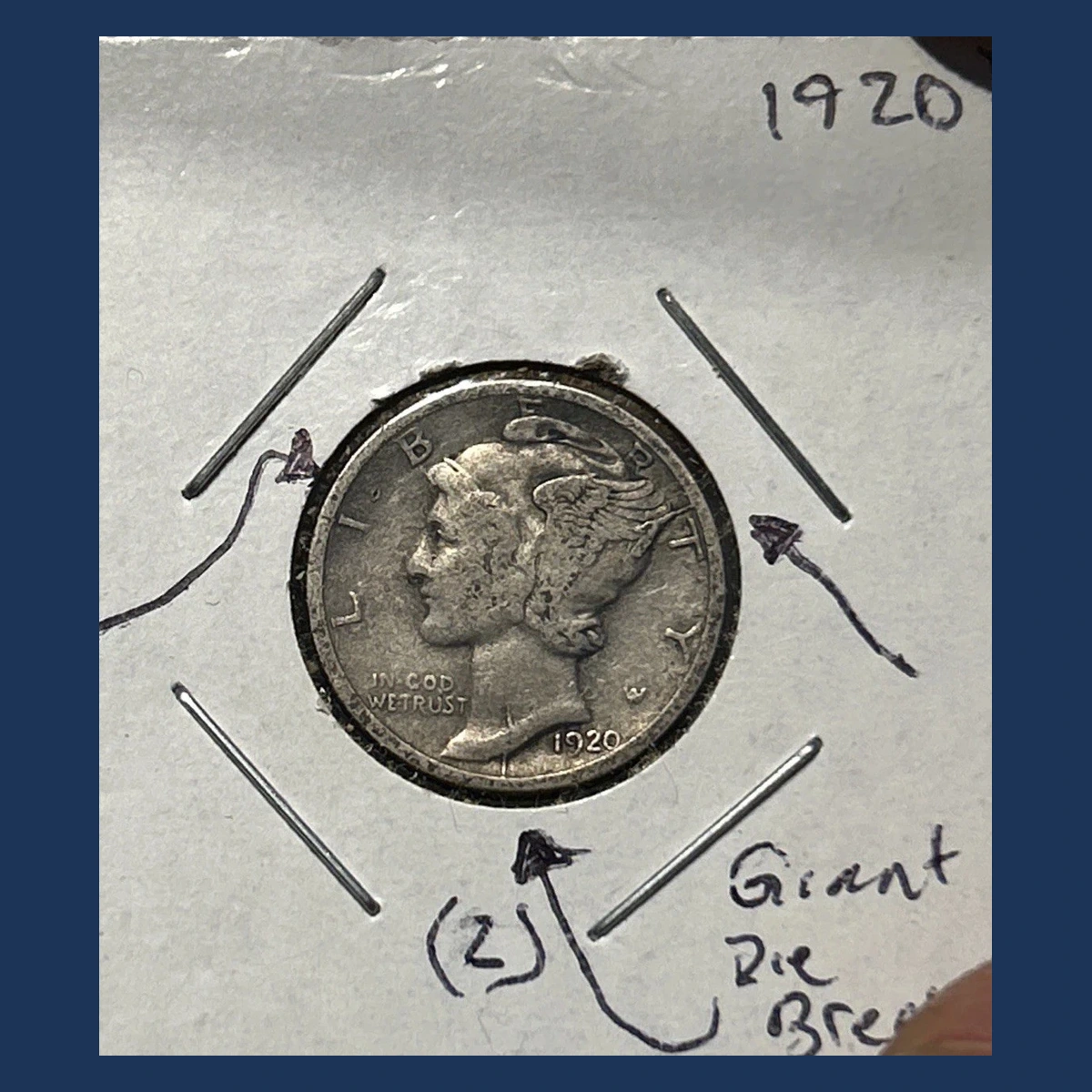
A raised break behind Liberty’s neck and toward the date remains visible on a reported heavily worn 1920-D. The coin was described as Good, a low condition grade.
A clear mint feature can survive after much of the portrait wears away. The break belongs to the Denver report, not to every 1920 dime.
Silver entered a crack in the stamping tool and formed a ridge or thicker patch. Its route can cross parts of the normal design.
A circulation scratch cuts into the finished surface instead. Raised metal beside a scratch must not be mistaken for the same break.
Estimated Value
The estimated whole-coin range is $10–$600 for worn through lower unworn Denver examples with visible cracks. Small lines usually add only modest interest.
Ordinary 1920-D coins provide comparisons: a PCGS AU55 brought $154 in March 2025, and an MS65 brought $564 that June. AU55 has slight wear; MS65 is unworn with relatively few marks.
Those are not crack sales. A clearly visible break attracts more attention than a line requiring extreme enlargement.
How to Identify
Begin behind Liberty’s neck and follow the reported feature toward the date. Use a 10× magnifier and low light to check that the line rises above the surrounding surface.
A bright line inside a groove is a scratch. A faint trace resembling part of the opposite design may have another cause as well.
Confirm the D on the back before using the Denver comparison. Keep both sides in your photographs.
Check an accessible coin with a scale and calipers against 2.50 g and 17.90 mm. Inspect the edge grooves for filing or other changes.
Wear can reduce the weight without removing a genuine raised break. The useful match is the raised neck-to-date feature on the same coin as the Denver mint letter.
4. 1920-D and 1920-S Mercury Dime Repunched Mintmark (Estimated Up to $750)
A small extra stroke beside the D or S can remain from an earlier mint-letter position. At this time, the letters were punched by hand into the stamping tools.
If another punch impression did not fully overlap the first, part of the earlier letter could remain. Later coins copied those surviving shapes.
Year-specific reports list both Denver and San Francisco examples without one reliable catalog identification covering them together. Each mint therefore needs its own comparison.
An extra D outline does not determine the shape or direction of an S remnant. A clear picture of the actual letter is essential.
Estimated Value
The estimated whole-coin range is $20–$750, from worn coins with visible remnants to attractive lower unworn examples. Much depends on the underlying mint and condition.
Ordinary 1920-D AU55 and MS65 coins sold for $154 and $564 in 2025. Those prices do not establish a separate bonus for a repeated mint letter.
A higher estimate needs a clear extra letter segment matching a documented example. A thick-looking D or S alone should not carry the same weight.
How to Identify
Find the mint letter beside the lower part of the bundle on the back. Decide whether the main letter is D or S before studying extra strokes.
Use a 10× magnifier to follow a second curve or straight piece toward the main letter. Do not assign a direction from an unclear image.
Compare nearby lettering for similar flat shelves. Movement during striking can flatten several edges, while a repeated punch should leave part of another letter.
When safely accessible, compare scale and caliper readings with 2.50 g and 17.90 mm. Inspect the edge grooves and the letter’s base for added metal.
The useful match is an extra D or S segment in the same position as a properly identified example of that mint.
5. 1920-S Mercury Dime Broadstrike (Estimated Up to $1,500)
A coin can spread wider when the collar fails to hold it during striking. The collar is the ring that normally controls width and forms the edge grooves.
Without that restraint, the same silver moves outward. The resulting broadstrike should keep the full design, even if it sits unevenly inside the larger outline.
Northeast Numismatics lists a 1920-S graded NGC AU58, meaning only slight wear. It gives a specific San Francisco example for comparison.
The altered edge is part of the evidence. A complete, normally grooved edge on an unusually wide coin would call for a closer explanation.
Estimated Value
The estimated range is $250–$1,500 for worn through lower unworn 1920-S broadstrikes. The NGC AU58 dealer example has a $725 asking price, not a completed sale.
A 1945 broadstrike graded NGC MS66 Full Bands sold for $3,416 in September 2026. That different-year coin has a much higher condition grade.
Its price should not be transferred to AU58. The actual spread, surviving detail, and original surface determine the closer comparison.
How to Identify
Compare its outline with a normal Mercury dime without letting the surfaces touch. Both the front and back designs should remain complete.
If part of the picture is missing, consider an off-center strike instead. A broadstrike spreads the blank beyond its usual width.
Use calipers when safely accessible to compare with 17.90 mm, and a scale against 2.50 g. Outward flow changes shape without necessarily removing silver.
Inspect the edge with a 10× magnifier for incomplete grooves or other signs the retaining ring did not fully contain it. Later flattening can also widen a coin, but often crushes existing detail.
The stronger identification combines the widened outline, complete struck design, and compatible edge, rather than diameter alone.
6. 1920 Mercury Dime Off-Center Strike (Estimated Up to $3,000)
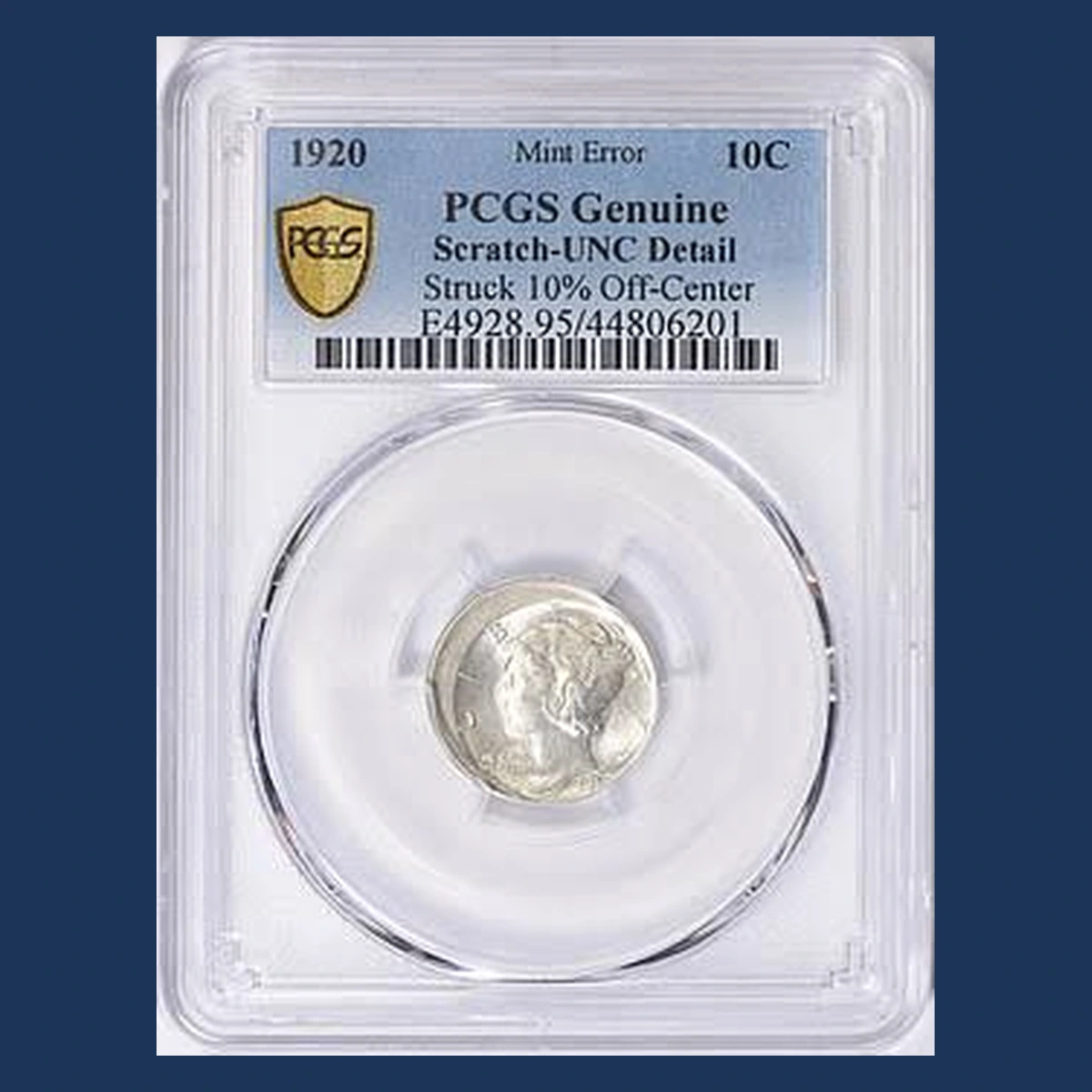
A blank crescent makes a misplaced strike easy to see. The reported Philadelphia PCGS MS63 example is described as 40% off center.
A separate San Francisco coin, graded PCGS MS64 Full Bands, was struck 20% off center. Its percentage belongs to that coin, not the Philadelphia example.
The blank sat outside its intended position, so part of each design missed the available metal. Unstruck silver remained beside the displaced picture.
Full Bands describes the separated horizontal bands on the back’s bundle. It does not measure how far the strike moved or turn the coin into a second type of error.
Estimated Value
The estimated range is $100–$3,000, with readable dates, original surfaces, and strong appearance supporting higher prices. The 1920-S PCGS MS64 Full Bands coin struck 20% off center sold for $1,860 in October 2020.
That is an actual same-year sale. Minor worn offsets can cost much less.
A dramatic coin with the date fully visible may sit higher in the range. Compare the complete appearance rather than treating percentage as a price formula.
How to Identify
Find the readable 1920 date and include the entire blank crescent in a photograph. Then turn the coin over and compare the back design’s position.
Both designs should be displaced consistently within the same blank. A single shifted border can have a different cause, such as a misplaced stamping tool.
Use a 10× magnifier along the boundary between struck detail and untouched silver. Check for later grinding or trimming.
Compare weight with 2.50 g on a scale and record the outline with calipers against the usual 17.90 mm when accessible. The edge may keep only part of its normal grooves.
The matching struck and blank areas on both sides identify the misplaced strike more directly than a seller’s percentage alone.
Conclusion
Estimated values for these 1920 errors range from $10 to $3,000. A clip removes part of the blank, a broadstrike spreads it, and an off-center strike leaves some metal unstruck.
Smaller repeated letters and raised cracks need magnification and a comparison from the correct mint. Keep the $725 broadstrike asking price separate from the $1,860 completed off-center sale.
The coin’s condition belongs in every comparison, whatever its error looks like.