1903 Dime Error List with Pictures

A 1903 dime with repeated date marks sold for $748 at GreatCollections in July 2013. PCGS graded it AU50, meaning light wear.
This 1903 dime error list reaches beyond small numeral remnants to a second strike that pressed a backward image into the coin. Estimated whole-coin values span $30–$4,000.
Check the mint letter before comparing date features, then follow the surface and edge clues below for the larger striking errors.
1. 1903-O Barber Dime Repunched Mintmark (Estimated Up to $800)
The reported feature is an extra outline beside the O below the wreath. Collectors call a repeated mint-letter impression a repunched mintmark, or O-over-O in this case.
The mint-letter punch entered the die, the steel tool that stamps coins, before production. An earlier position can remain beside the final O and appear on later coins.
The 1903 report does not give a reliable direction for the extra outline. A pictured coin must supply that detail.
A thick or uneven O is not enough by itself. Look for a shape that actually resembles part of another O.
Estimated Value
The estimated whole-coin range is $30–$800, from worn examples through lower unworn grades with readable repunching. Much of the upper value comes from the New Orleans coin’s condition.
An auction index lists an ordinary 1903-O NGC MS63 at $636 in March 2026. MS63 describes an unworn coin with noticeable marks.
That is a comparison for the date and mint, not a repunched-O sale. The extra curved outline must be examined separately before adding value for it.
How to Identify
Start at the O on the back rather than the date. Photograph the complete back, then inspect the mint letter with a 10× magnifier.
Light it from opposite sides and look for a second curved stroke that remains in the metal. A reflection can move or disappear as the lamp moves.
Examine the base of the letter for a joint or disturbed surface from an added mint letter. Corrosion can also create an irregular outline.
When safely accessible, use a scale and calipers against 2.50 g and 17.90 mm. Inspect the edge grooves for signs of alteration.
The useful feature is a matching extra O-shaped arc joined naturally to the original surface, rather than an assumed direction inferred from a blurry picture.
2. 1903 Barber Dime Broadstrike (Estimated Up to $1,200)
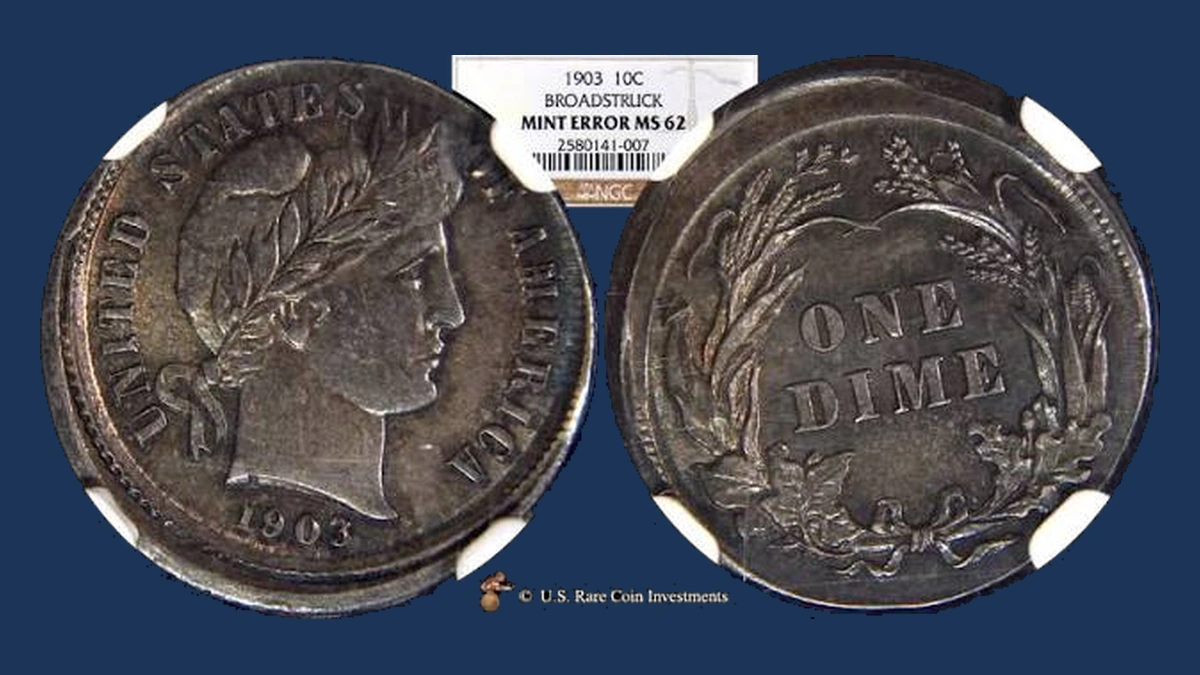
A broadstrike has extra metal spread around a complete design. It forms when the collar, the ring that normally controls the coin’s width, fails to hold the blank properly.
Striking pressure pushes metal outward, changing the outline and edge. Unlike an off-center strike, the whole design remains on the coin.
Reports for 1903 include a Philadelphia example described as AU Details. That description indicates slight wear with a condition problem.
A wide border alone does not settle the identification. An uneven strike, an altered rim, or a misleading photograph can also make a dime look unusually broad.
Estimated Value
The estimated range is $200–$1,200 for genuine 1903 broadstrikes. Obvious expansion and original surfaces support stronger prices.
This is an estimate, not a claimed sale of the reported AU Details example. A 1900-S broadstrike graded NGC VF30 is indexed at $342 in March 2026.
VF30 indicates wear with clear remaining detail. That different-year Barber dime offers a comparison, while a better-preserved coin with a more visible spread can justify a higher estimate.
How to Identify
Measure several directions with calipers when the coin is safely accessible. Compare the width with the normal 17.90 mm and weight on a scale with 2.50 g.
A wider coin need not contain extra metal. The strike can spread the original blank outward.
Inspect the complete outer design with a 10× magnifier, then look along the edge. Failure of the retaining ring can leave incomplete or missing normal grooves.
Filing removes metal, while hammering often crushes the design as it widens the coin. Check for those signs before accepting the spread as original.
The clearest combination is a complete design inside an expanded outline, supported by the changed width and edge. Missing design would call for a different explanation.
3. 1903 Barber Dime Off-Center Strike (Estimated Up to $1,500)
A small shift can still produce a real off-center strike. The recorded Philadelphia example is only 3% off center toward eight o’clock.
Heritage described it as PCGS XF45, a worn grade with much detail remaining. Its modest displacement is still visible in the design’s position.
The blank sat outside its intended place between the stamping tools. Some design missed the silver, leaving untouched metal at the opposite side.
Larger offsets can make the blank crescent easier to see. The readable date remains important, because it ties the shifted design to 1903 rather than merely to an unidentified Barber dime.
Estimated Value
The estimated range is $150–$1,500, from minor worn offsets to larger, attractive examples retaining the date. The 3% PCGS XF45 brought $195.50 at Heritage in June 2005.
A different-year 1902 off-center dime graded ANACS AU50 sold for $561.20 in June 2026. That coin had less wear.
More visible displacement and better surfaces can support higher prices. The percentage alone does not guarantee where a particular coin belongs within the range.
How to Identify
Compare both sides before treating an uneven rim as proof of an off-center strike. A misplaced front stamping tool can leave the back centered, which is a different error.
The auction coin’s eight-o’clock direction belongs to that specimen. Another genuine off-center dime can shift in a different direction.
With a 10× magnifier, check the complete date and the boundary between struck detail and untouched metal. Include the whole outline in the photograph.
Use calipers and a scale when safely accessible against 17.90 mm and 2.50 g. Inspect the surviving edge grooves for cutting or filing.
The practical match is a genuine blank crescent opposite design cut off by the edge, with both faces showing the same displaced blank.
4. 1903 Barber Dime Repunched Date (Estimated Up to $3,500)
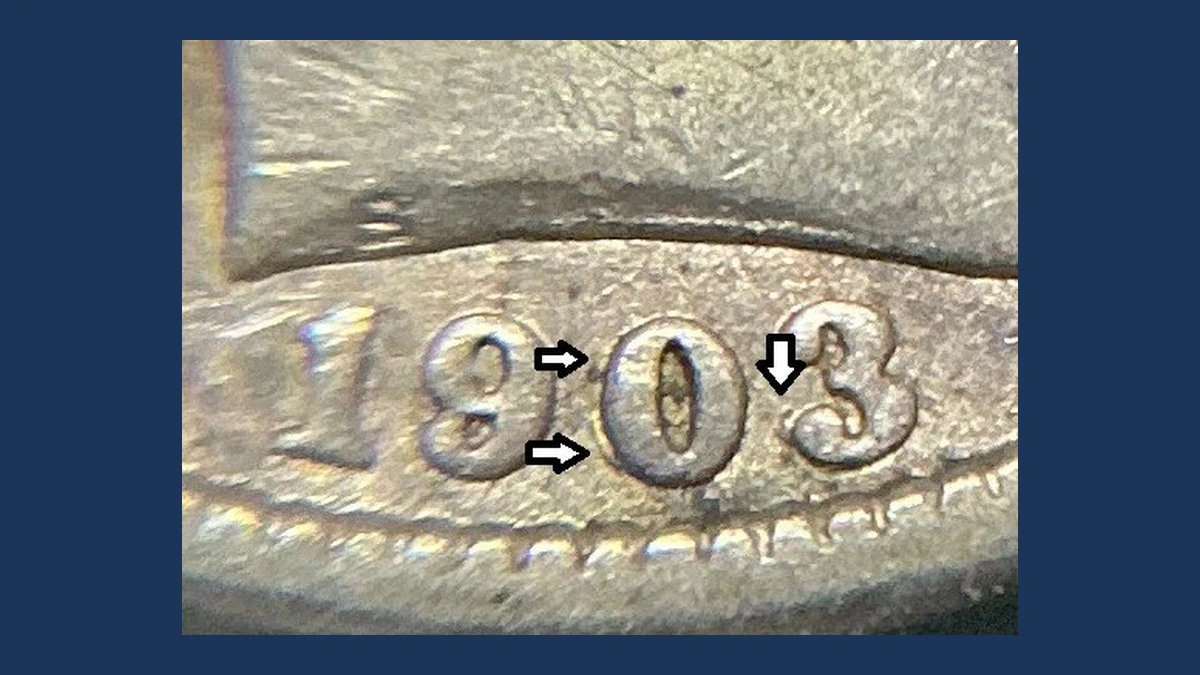
The same catalog number can describe different date features at different mints. Philadelphia’s FS-301 has a repeated 1, while New Orleans’ FS-301 has a repeated 3.
Both began when a date punch entered a stamping tool more than once. The earlier marks remained beside the final date.
NGC’s catalog also lists a Philadelphia 1903-over-3 and a New Orleans repeated full date. Those entries need their own picture comparisons.
Do not assume all the labels refer to one pattern. First establish the mint, then match the affected numerals on that coin.
Estimated Value
Estimated whole-coin values are $35–$900 for Philadelphia and $40–$3,500 for New Orleans. These span worn through attractive unworn examples with clear date remnants.
PCGS records $748 for the Philadelphia AU50 sold in July 2013. That is a historical sale for the Philadelphia variety.
It is not a current minimum or a price for New Orleans’ different date marks. Surface quality and the clarity of the matching numerals still determine the useful comparison.
How to Identify
Turn to the back first. Philadelphia has no mint letter, while New Orleans has an O below the wreath.
Use a 10× magnifier on the relevant date digits. Philadelphia comparisons concern the 1 or 3; New Orleans examples require the matching 3 or full-date pattern.
Look for remnants shaped like parts of the numerals. A flat shelf around unrelated pictures or letters can come from movement during striking instead.
Check an accessible coin with a scale and calipers against 2.50 g and 17.90 mm, then inspect its edge grooves. A date-punch feature does not change those normal specifications.
Choose the picture for the same mint and exact numeral pattern. That paired match is more useful than a generic claim of a double date.
5. 1903 Barber Dime Second Strike with Partial Brockage (Estimated Up to $4,000)
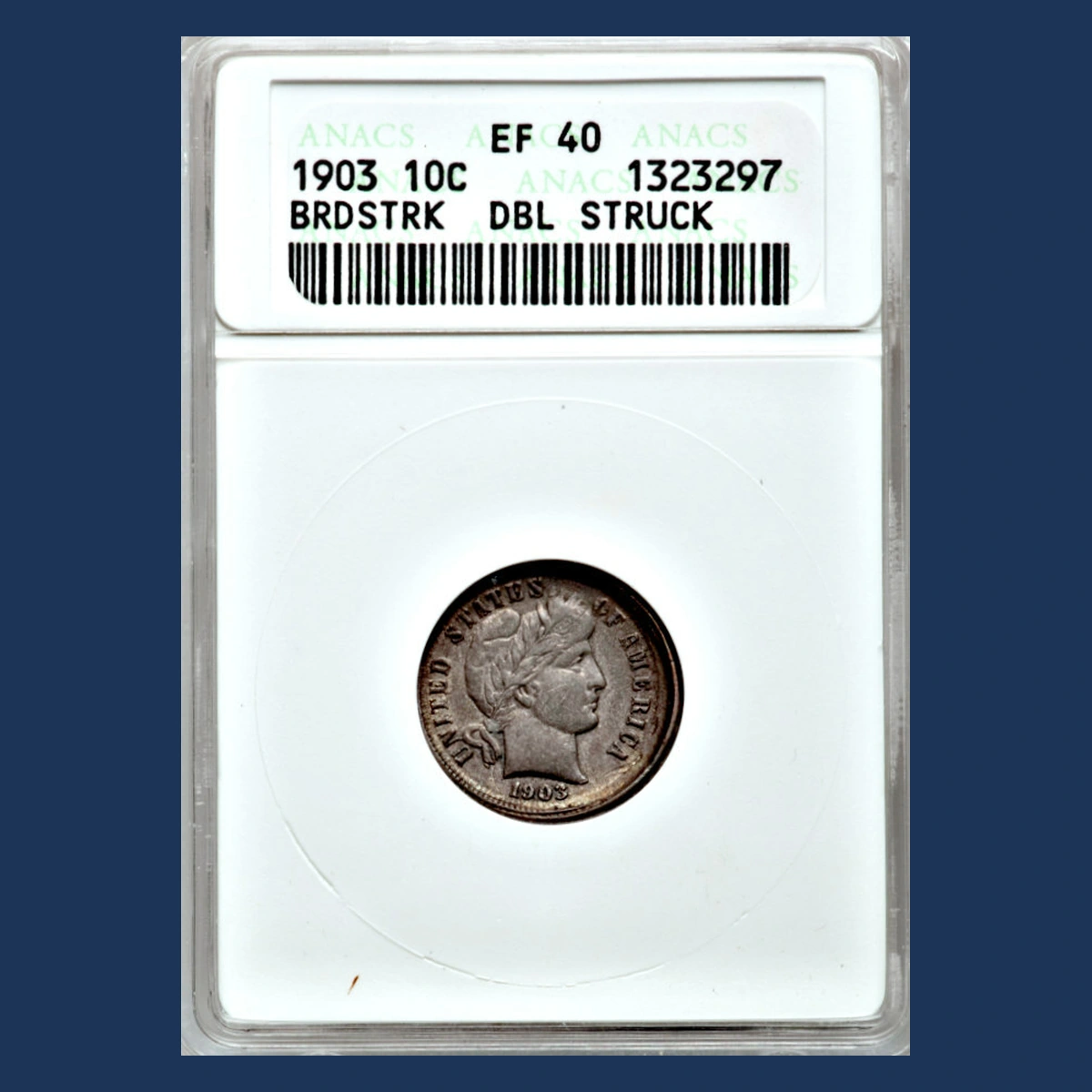
Part of this dime received a backward, sunken picture over its first design. Another already struck coin pressed that image into it during a second blow.
The transferred impression is called a brockage. It differs from normal raised design because it sinks into the surface and reads backward.
Fred Weinberg’s inventory described this example as PCGS AU58, with about 40% of the front affected. AU58 means only slight wear.
The extra blow and transferred picture belong to the same coin. They should not be treated as ordinary doubled lettering or as two separately priced specimens.
Estimated Value
The estimated range is $1,500–$4,000 for a dated Barber dime with this combined error in comparable worn condition. A clear backward impression and surviving first design both matter.
The Spring 2016 Weinberg price list offered the PCGS AU58 example at $1,800. That was a dealer’s asking price, not a completed auction.
The estimate allows for condition and market differences. It should not be described as proof that the coin sold for $1,800.
How to Identify
Move the light across the affected area and use a 10× magnifier to check its depth. The transferred picture should be sunken and backward, with normal first-strike detail surviving elsewhere.
Compare the direction of its lettering with unaffected raised lettering. A later vise impression can also make a sunken image, so that alone is not enough.
Inspect the opposite side and edge for crushing or flat pressure marks. Expert error authentication is useful for a coin with overlapping strikes.
When safely accessible, compare weight with 2.50 g and record width with calipers against the usual 17.90 mm. Check the remaining edge grooves without expecting perfect symmetry.
The defining visible combination is a partial backward impression over a surviving earlier design on the same coin.
Conclusion
Estimated whole-coin values for these 1903 errors run from $30 to $4,000. The mint letter guides the search for small date features, while the complete outline helps distinguish wider strikes from off-center ones.
For the combined second strike and brockage, look for a sunken backward image over the first design. Its $1,800 historical offering remains an asking price, so keep that separate from the recorded auction comparisons.