1830 Dime Error List with Pictures

The Pogue 1830/29 dime sold for $64,625 in February 2016. Its MS67 grade describes exceptional preservation without circulation wear, helping explain the high price.
These 1830 dime errors also include a small edge clip, raised breaks, and a turned back. Estimated whole-coin values run from $75 to $70,000 across very different conditions and finishes.
Read on to locate each feature and keep ordinary coins separate from specially made Proof collector coins.
1. 1830 Capped Bust Dime Die Cracks and Cuds (Estimated Up to $1,200)
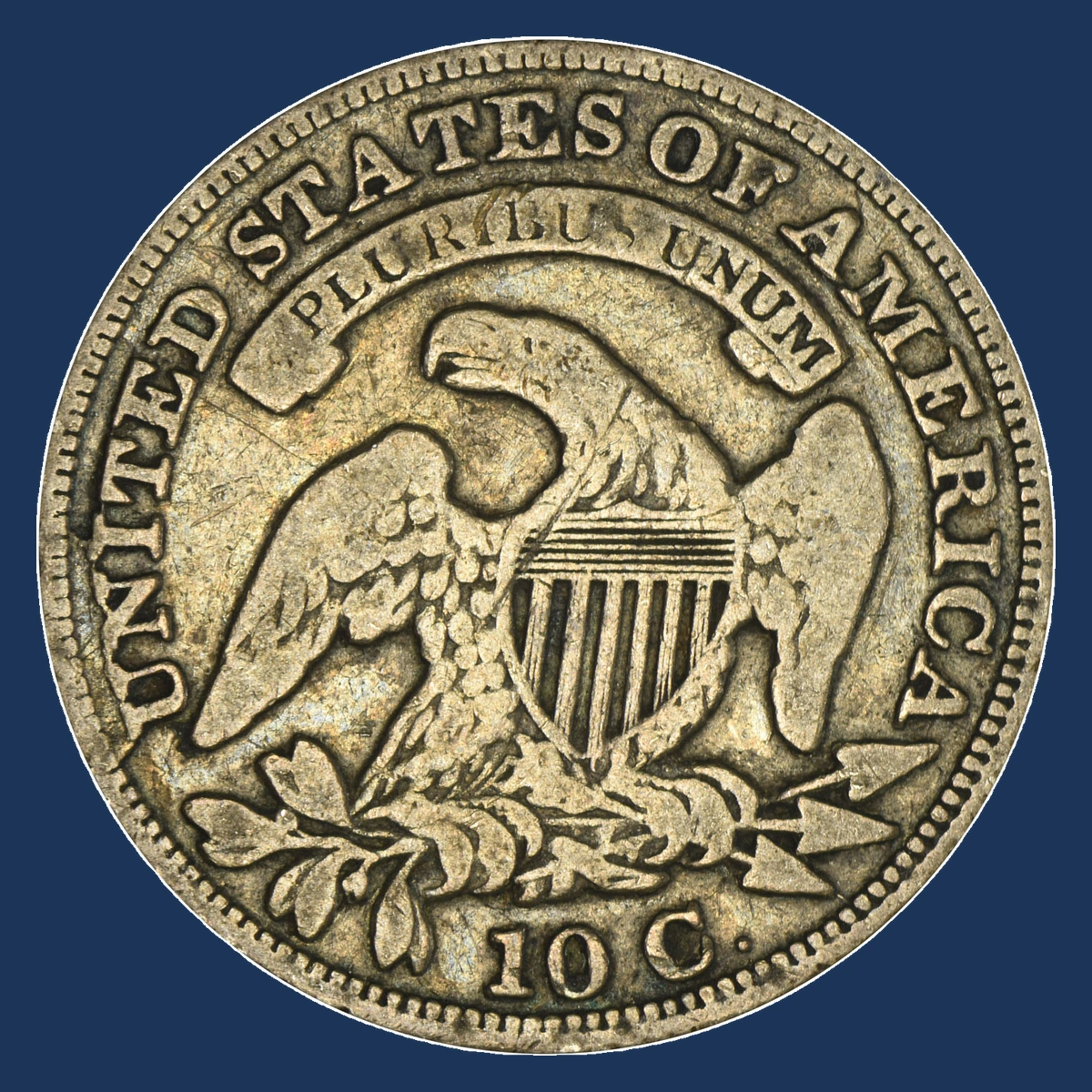
Raised breaks appear above Liberty’s cap on the JR-3 dime. The back also shows a raised patch with a clear boundary over NITE and a crack above IC.
JR-3 names a pair of dies, the tools that stamp the designs. Cracks or missing pieces in those tools let coin metal form extra raised areas.
A retained break means the cracked tool piece stayed in place. It can still leave some design, unlike a gap left by a piece that fell away.
The specialist showcase also lists JR-1, but does not specify its local feature. Its locations cannot be assumed.
Estimated Value
Estimate $100–$1,200 for circulated 1830 dimes with these cracks or larger breaks. Original surfaces and clear raised features usually support more interest than a faint edge line.
A different-year 1832 JR-3 with a retained break sold for $139 in February 2022. Its AU Details grade noted whizzing, mechanical brushing that changes the surface.
That damaged coin gives a modest comparison for the mechanism. It is not a sale of the illustrated 1830 example or a price for each crack.
How to Identify
Compare both complete faces with the JR-3 photographs. With a magnifier, locate the breaks above the cap, the raised patch over NITE, and the line above IC.
Check what design remains inside the retained break. Do not assume that every cracked tool piece had already fallen away.
The normal dime is about 89.2% silver, originally 2.70 grams and 18.5 mm across. A scale and calipers check those basics, while the grooved edge needs inspection for later damage.
Solder or a folded rim can imitate a lump. Begin with the specific front-and-back set of raised features, rather than a random patch.
2. 1830 Capped Bust Dime Small Planchet Clip (Estimated Up to $1,500)
A notch near 8 o’clock appears on a dime from the John W. McCloskey Collection. The auction catalog described it as a clip in the blank.
The coin is a Medium 10C JR-7 graded NGC AU58, with only slight circulation wear. Much of its design and original shine remain.
The missing metal was absent before the portrait and eagle were struck. Nearby rim details can therefore show how the incomplete blank received its design.
The catalog gives no clip percentage or geometric type. The feature should remain a small notch, rather than becoming a large missing section in its description.
Estimated Value
The AU58 JR-7 sold for $1,080 on February 6, 2022. Estimate $300–$1,500 for collectible circulated through lightly worn examples with an original clip.
The strong sale does not isolate the value of that tiny notch. The well-preserved JR-7 itself is an important part of the price.
A heavily worn example needs a different comparison. So does a coin with later edge cuts, which cannot earn an original Mint-clip premium.
How to Identify
Hold the front upright and find the notch near 8 o’clock. Photograph both ends and use a magnifier to check how the rim meets the missing section.
A later cut may slice through finished lettering or leave fresh tool marks. An original clip should show a rim formed around the incomplete blank.
The dime began near 2.70 grams and 18.5 mm, with about 89.2% silver. A scale and calipers can check surviving weight and width; inspect the remaining grooved edge too.
Opposite-rim weakness may help but is not required. Start with the notch’s original rim boundary beside the cataloged JR-7 photograph, rather than guessing a percentage.
3. 1830 Capped Bust Dime Rotated Reverse (Estimated Up to $30,000 for Proof Examples)
A Proof’s eagle can finish tilted even when the coin was specially made for collectors. A 2013 catalog describes an 1830/29 JR-4 Proof with its back about 25 degrees clockwise from normal.
That angle concerns the positions of the two stamping tools. The overdate concerns the numbers punched into the front tool.
Both features can occur on one coin without requiring two separate off-center blows. They tell different parts of its manufacture.
A regular-strike 1830 rotation is also reported, but without a measured angle. It cannot be given the Proof’s 25-degree figure simply because the year matches.
Estimated Value
Regular circulated dimes with a moderate rotation are estimated at $75–$1,000. The much scarcer Proof type has a separate whole-coin range of $5,000–$30,000.
That is not a $30,000 fee for a tilted back. Special manufacture, condition, and correct identity all contribute to a Proof’s value.
No separate sale is established here for the cataloged angle. The exceptional MS67 overdate price belongs to an ordinary strike and is not a Proof or rotation result.
How to Identify
Hold Liberty upright against a vertical guide and flip the coin top to bottom without correcting the back’s tilt. Compare the eagle with the same guide, repeat the movement, and measure the angle with a protractor.
The JR-4 Proof description gives about 25 degrees clockwise, but the Proof finish still needs its own match. A magnifier can inspect the edge for seams or later work.
Scale and caliper comparisons are about 2.70 grams and 18.5 mm, with roughly 89.2% silver and a grooved edge. Begin with the same tilted eagle appearing after every controlled flip, keeping the viewing direction fixed.
4. 1830 Capped Bust Dime 1830/29 Overdate (Estimated Up to $70,000)
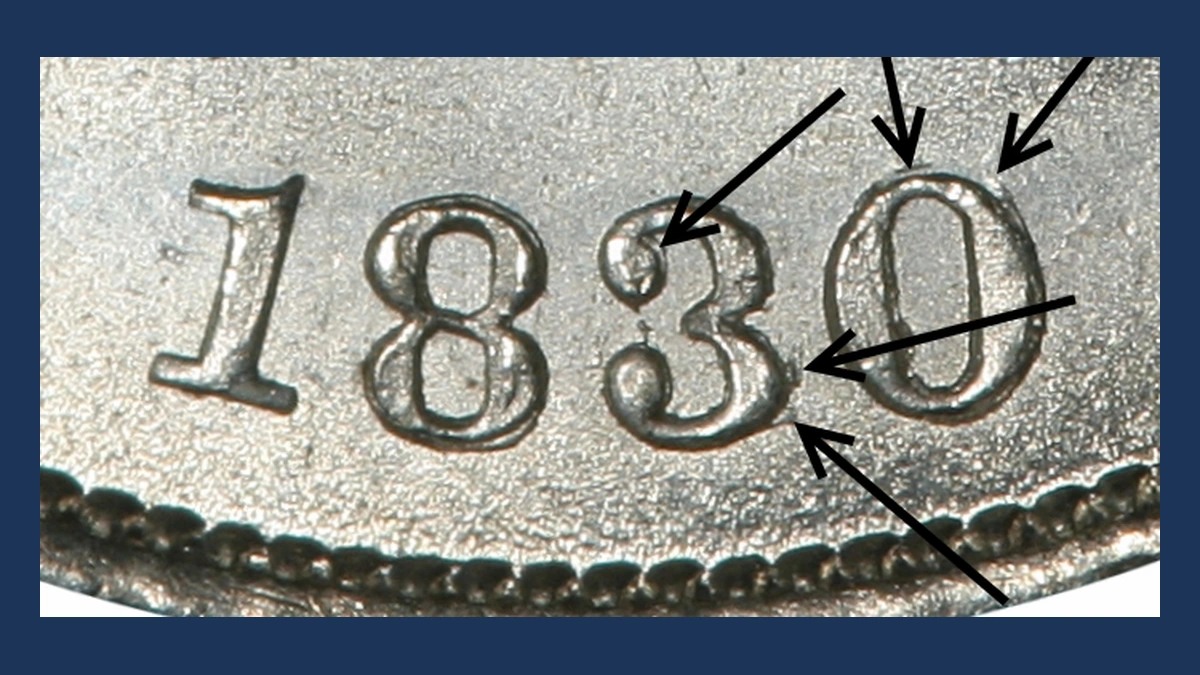
The last two numbers changed when an 1829-dated tool was reused for 1830. A 3 was punched over 2, and a 0 over 9.
Parts of the earlier 29 remained where the newer punches did not cover them completely. Coins made with that tool can show those extra strokes.
The front tool worked with more than one back tool. Both ordinary strikes and specially made Proofs are reported.
Later polishing of the tool can weaken the old number traces, especially in the Proof descriptions. A real example need not show a conveniently complete, easily read 29 underneath the final date.
Estimated Value
Circulated overdates are estimated at $100–$2,500. Unworn examples range roughly from $3,000–$70,000, with the exceptional Pogue PCGS MS67 selling for $64,625 in February 2016.
That ordinary strike supports the high-condition end, not a routine price for faint extra date strokes. Proofs belong to their separate $5,000–$30,000 estimate here.
A polished shiny surface is not proof of Proof manufacture. Match the coin’s finish and full design before using either price tier.
How to Identify
Enlarge the date and compare the surviving old strokes with a clear 1830/29 example. Look around the final 0 for parts of the earlier 9, rather than expecting a complete number.
A magnifier and changing light help separate raised remnants from scratches or corrosion. Do not add an imagined stroke where the surface shows none.
Check the whole front and its matching back, especially when tool polishing has weakened the date evidence. The normal dime starts near 2.70 grams and 18.5 mm, with about 89.2% silver and a grooved edge.
Use a scale and calipers for those checks. Begin with actual surviving 29 strokes supported by the correct full-coin comparison.
Conclusion
Estimated whole-coin values for these 1830 dimes range from $75 to $70,000. Ordinary worn coins, scarce Proofs, and exceptional unworn examples require very different comparisons.
Find the actual feature first: raised breaks, a tiny edge notch, a repeatable tilt, or older date strokes. Several may occur together without creating separate prices.
The $1,080 clipped JR-7 and $64,625 Pogue overdate each sold as a complete coin with its own condition and identity.