1989 Half Dollar Error List with Pictures

One extra strike sent a 1989-P half dollar to $2,400 at auction in July 2022. The second impression landed 65% off center, leaving parts of both designs visible.
This 1989 Kennedy half dollar error list covers much smaller features too, including a doubled D and a missing star. Estimated values span $1 to $3,500.
Read on to compare the visible marks and learn which simple checks fit each type.
1. 1989 Kennedy Half Dollar Repunched Mintmark RPM-001 (Estimated Up to $125)
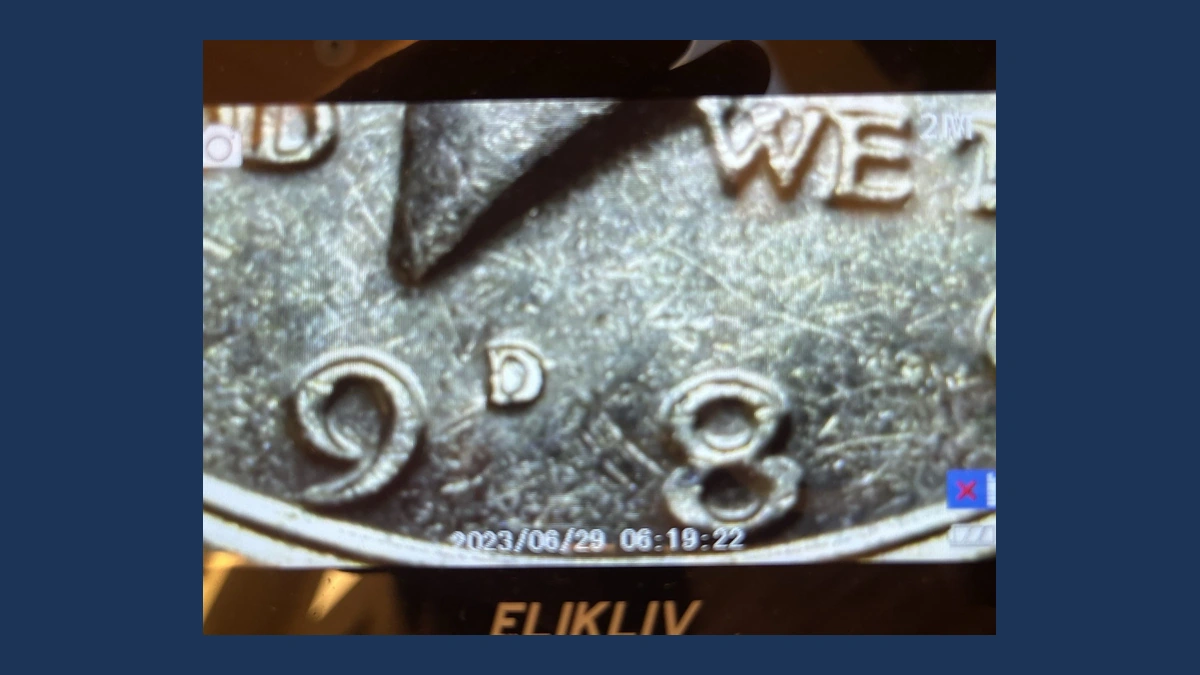
An extra edge around the D can come from a mintmark punched into the die more than once. A die is the steel tool that stamps the coin’s design.
For 1989-D RPM-001, the earlier D is turned slightly counterclockwise compared with the final letter. CONECA, a specialist variety organization, lists this pattern.
Examples have appeared in official mint sets. Those sets contain ordinary coins without circulation wear, not specially made Proof collector coins.
The tool changed slightly as it wore, so early and later examples can differ in small ways. The same overlapping D pattern identifies the variety.
Estimated Value
A clearly matched RPM-001 has an estimated value of $20–$125. Sharp mintmark details and attractive surfaces support the higher end.
A guide for minor 1986-D repunched mintmarks gives $15–$60 for ungraded examples. That different-year guide range is a modest comparison, not a completed auction sale.
The 1989 catalog listing identifies what to look for. It does not set a sale price, and a vague lump beside the D does not qualify.
How to Identify
Enlarge the D with a 10× magnifier and compare it with CONECA’s RPM-001 photographs. Follow the extra curve around the main letter to see its slight counterclockwise turn.
A flat shelf or corroded lump is different from a recognizable earlier D outline. Move the lamp to check the shape, then photograph it without cleaning the coin.
A loose half should weigh about 11.34 grams and measure 30.61 mm across. Use a scale and calipers, and look at the edge for damage.
Mint-set packaging is not the test for this variety. Match the small rotated D outline in the comparison photographs first.
2. 1989 Kennedy Half Dollar Misaligned Obverse Die Error (Estimated Up to $150)
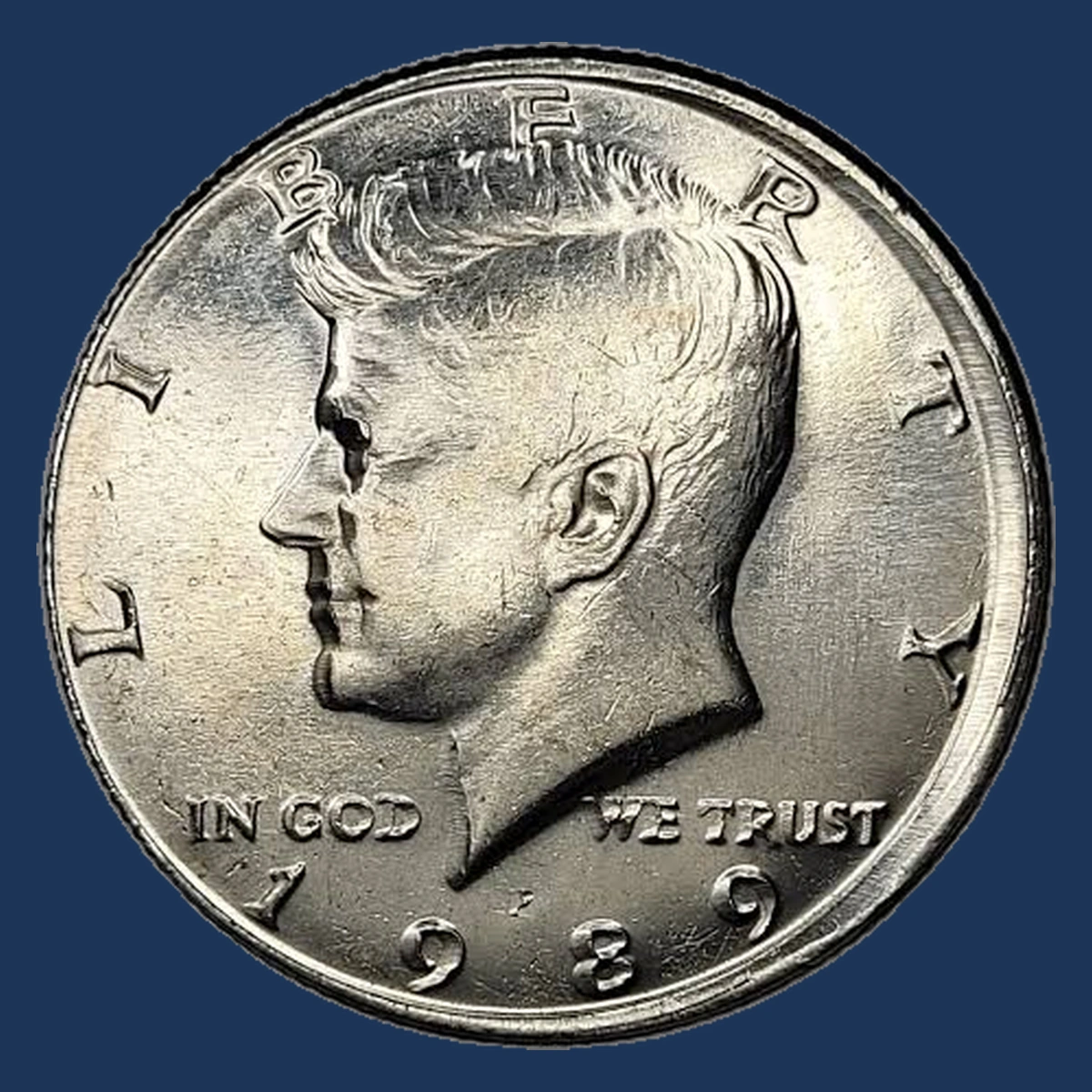
The border can look wider on one side of Kennedy while the back remains centered. That points to a front stamping tool that sat slightly out of position.
A reported Denver example has this appearance. Although it was presented with an off-center label, its description fits a misaligned front die.
The difference matters. If the blank itself sits off center, both faces usually show shifted designs and untouched blank metal.
One front photograph cannot settle the question. Comparing both faces separates a modest uneven border from a more dramatic strike that missed part of the blank.
Estimated Value
Visible front-die misalignment has an estimated range of $10–$150. Small border differences generally sit near the lower end, while a stronger shift may attract more interest.
A genuine 1989-P strike 15% off center sold for $240 in October 2021. That NGC MS65 coin has a different error affecting both faces.
Its sale helps show why the smaller one-face shift should not simply receive the price of a clear off-center strike.
How to Identify
Take straight-on photographs of both faces with the coin’s outline fully visible. Compare the width of the border on each side of Kennedy, then do the same around the eagle.
For this error, the front should be shifted while the back stays centered. A tilted photograph can create a false impression, so adjust the camera before judging the border.
With a magnifier, inspect the edge for squeezing, filing, or a joining seam. Check the normal 11.34 grams and 30.61 mm with a scale and calipers if the coin is loose.
The quickest useful comparison is simply one shifted face beside one centered face.
3. 1989 Kennedy Half Dollar Die Crack Error (Estimated Up to $200)
A thin raised line may cross part of Kennedy or the eagle’s wing. A 1989 guide names these areas when discussing cracks, but it does not map a particular known example.
The line forms when a stamping tool cracks. Soft coin metal enters the opening under pressure and leaves a raised seam on the finished coin.
A scratch does the opposite: it cuts down into metal that was already there. Dirt or corrosion can also create misleading lines.
Look at the actual height of the mark. Its location alone cannot prove that a cracked tool made it.
Estimated Value
Faint cracks usually have modest value within an estimated $5–$200 range. Larger, clear lines on clean surfaces can attract more attention.
A much stronger back die break on a 1976-D half dollar sold for $256 in June 2026. That NGC MS65 example is a different-year comparison for a more substantial failure.
It does not establish a sale for any reported 1989 line. The size and appearance of the actual raised mark still matter.
How to Identify
A digital scale and calipers can check the normal 11.34-gram weight and 30.61 mm width, but they cannot identify a crack. The important test is at the surface.
Use low side lighting and a magnifier to see whether the line rises above the coin. A scratch forms a trench and may push tiny ridges along its sides.
Follow only the visible line through the portrait or wing area. Do not count a normal feather edge as part of the crack.
Leave dirt and suspicious deposits untouched, since cleaning can remove useful clues. Look first for a continuous raised seam that belongs to the original coin metal.
4. 1989 Kennedy Half Dollar Rotated Dies Error (Estimated Up to $300)
A tilted eagle after a careful flip can reveal that the two stamping tools were not lined up correctly. The 1989 report lists this error without naming a mint or measuring a particular coin’s angle.
On a normal half dollar, Kennedy starts upright. Flip the coin top to bottom and the eagle should also finish upright.
A turned tool changes that final position. Simply spinning a normal coin between photographs can imitate the same result.
Two separately straightened pictures therefore hide the key evidence. The way the coin is held matters as much as the two designs.
Estimated Value
Use an estimated $30–$300 range for genuine rotation. Larger turns and better surfaces usually create more interest than a slight tilt.
A 2000-P coin with a 75-degree turn brought $79 in March 2025. It was graded PCGS MS61.
Two 1988-P halves with a 180-degree turn sold together for $288 in July 2021. That total paid for both NGC MS65 coins; neither comparison supplies an angle or sale for the reported 1989 example.
How to Identify
Hold Kennedy upright and flip the coin top to bottom without allowing it to swivel between your fingers. Repeat the same movement with a normal half dollar beside it, so you can compare where each eagle finishes.
A short continuous video can show whether the tilted back appears every time, rather than only after repositioning the coin. Inspect the edge with a magnifier for a seam or tool marks that might reveal joined pieces.
A scale should show about 11.34 grams and calipers about 30.61 mm, though correct size alone cannot rule out alteration. Begin with the repeated controlled flip: the eagle must keep landing at the same unusual angle.
5. 1989 Kennedy Half Dollar Curved Clipped Planchet Error (Estimated Up to $350)
A curved bite may be missing from the coin because the blank cutter overlapped an earlier hole in the metal strip. The incomplete blank then went through the press.
A 1989 guide reports curved clips, but it does not connect its example with a specific auction coin. The mintmark, missing percentage, and exact position are not established there.
The gap itself holds the useful clues. Its edges should show how the rim formed around missing metal during striking.
A weak area across the coin can help support a clip. A smooth curve alone cannot rule out later cutting.
Estimated Value
A small curved clip on a 1993-D half dollar brought $34.74 including the auction fee in August 2025. That ANACS MS64 coin provides a different-year comparison near the modest end.
For a genuine 1989 curved clip, estimate $25–$350. A clear date, attractive surfaces, and a well-shaped gap can improve demand.
The upper estimate allows for more striking examples. It does not describe a known 1989 auction result or a particular missing percentage.
How to Identify
Start at the two ends of the missing arc. A magnifier may show the rim becoming weak or bending toward the shortage, rather than ending at a fresh cut.
Check the curved edge for burrs, saw marks, and filing. Then inspect the opposite rim for possible weakness, remembering that not every genuine clip shows it.
Weigh the coin against the intact 11.34-gram standard. Missing metal lowers the weight, whether it disappeared before striking or was removed later.
Calipers can compare surviving widths with 30.61 mm. The most useful first clue is a natural-looking rim transition at both ends of the curve, supported by an unaltered edge.
6. 1989 Kennedy Half Dollar Reported Doubled Die Obverse Variety (Estimated Up to $400)
LIBERTY and IN GOD WE TRUST are the places named in a report of front doubling. However, other year references dispute whether an established cataloged 1989 variety is known.
The report therefore does not identify a specific mint or recognized variety number. A doubled-looking letter still needs a clear visual match.
For a true doubled die, the stamping tool itself carries a doubled design. Movement during striking can instead leave a flat shelf beside a letter.
These effects can look similar at first glance. A shiny edge around Kennedy’s portrait does not settle which one you have.
Estimated Value
Estimate $25–$400 only for a genuine, clearly identified doubled front design. A flat shelf caused during striking does not receive that variety premium.
A recognized 1974-D doubled die graded ANACS MS64 sold for $49 in May 2026. It offers a recent comparison for a modest variety from a different year.
That sale does not confirm the disputed 1989 report. A stronger price needs clear extra letter shapes and a reliable variety match.
How to Identify
Look closely at the ends of LIBERTY and IN GOD WE TRUST through a magnifier. A rounded second outline or split tip is more useful than an overall thick appearance.
Move the lamp. Reflections change or disappear, while actual raised metal stays in the same place.
Compare with a clearly identified example before using a variety number. A flat shelf that leaves the main letter narrower suggests movement during striking instead.
Normal 1989 halves, including the Proofs, weigh 11.34 grams and measure 30.61 mm. A scale and calipers check the coin, but the first useful doubling test remains a genuine split letter tip that stays visible as the lighting changes.
7. 1989 Kennedy Half Dollar Broadstrike Error (Estimated Up to $500)
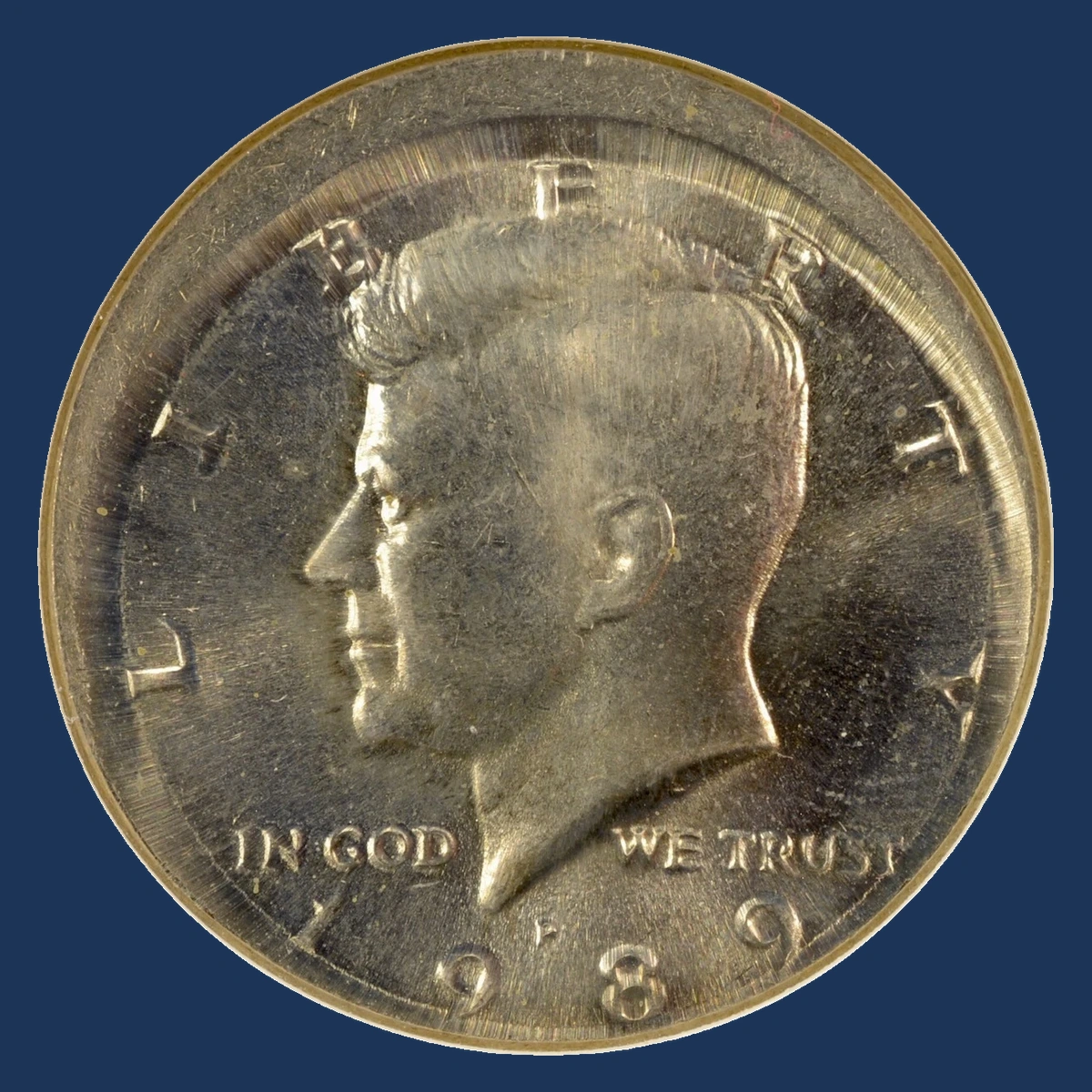
Complete designs sit inside a wide border on a 1989-P broadstrike graded NGC MS66, meaning unworn with few marks. Metal spread beyond its usual outline when the surrounding ring failed to hold the blank.
The coin gained width, not extra metal. Its design still fits because both stamping tools covered the blank.
This differs from an off-center strike, where part of the design misses the blank. The whole outline must be considered, not just the widest border.
This MS66 is also separate from the more complicated coin described later with several strikes and a backward eagle impression.
Estimated Value
The 1989-P NGC MS66 broadstrike sold for $69 in December 2009. For present comparisons, the estimated range is $75–$500, depending on spreading and surface appeal.
A 1990-P broadstrike graded ANACS MS61 brought $192 in March 2025. That different-year coin shows why the grade alone cannot determine an error’s price.
The old $69 result is a completed historical sale. It is not a current dealer offer for the 1989 example.
How to Identify
Are all the outer letters present? Follow the inscriptions on both faces with a magnifier before judging how far the border has spread.
Measure several widths with calipers against the normal 30.61 mm diameter. The scale should still read near 11.34 grams if all the original metal remains.
Look along the edge for free spreading and missing or incomplete grooves. Later squeezing can also enlarge a coin, but it may crush the lettering and change the surface shine.
The plain MS66 example should not acquire extra impressions from the separate multiple-strike coin. Complete, uncrushed designs within an oversized outline provide the clearest first check for a broadstrike.
8. 1989 Kennedy Half Dollar Partial Brockage and Partial Collar Error (Estimated Up to $650)
A tiny backward design and a stepped edge occur together on one 1989-P half dollar. The PCGS MS62 coin is described as having 4% brockage and a partial collar error.
Brockage means another struck coin pressed a reversed, sunken copy of its design into this one. A plain dent is not the same thing.
The partial collar affects the edge. One part expanded freely while another part stayed inside the ring used during striking.
The two features need different viewing angles. The listing does not establish the brockage’s exact face or position for this account.
Estimated Value
The combined error sold for $119 on March 31, 2025. Comparable genuine combinations have an estimated range of $100–$650.
A readable backward impression and a clear edge step can improve appeal. Marks and wear still matter.
The sale price covers both features on one PCGS MS62 coin. It should not be counted twice, and its small 4% impression should not be priced like a large, complete backward design just because both are called brockage.
How to Identify
Find recognizable backward lettering or design through a magnifier. The transferred details should sink into the surface, rather than rise like the normal design.
A smooth dent with no copied design is not enough to identify brockage. Do not assign the reported 4% figure to an unrelated depression.
Next, turn the coin sideways and follow the edge. Look for the step between the portion held by the ring and the portion that spread beyond it.
A scale and calipers can compare the coin with the usual 11.34 grams and 30.61 mm. Check both features directly: backward sunken details on a face and an original step around the edge.
9. 1989 Kennedy Half Dollar Off-Center Strike Error (Estimated Up to $850)
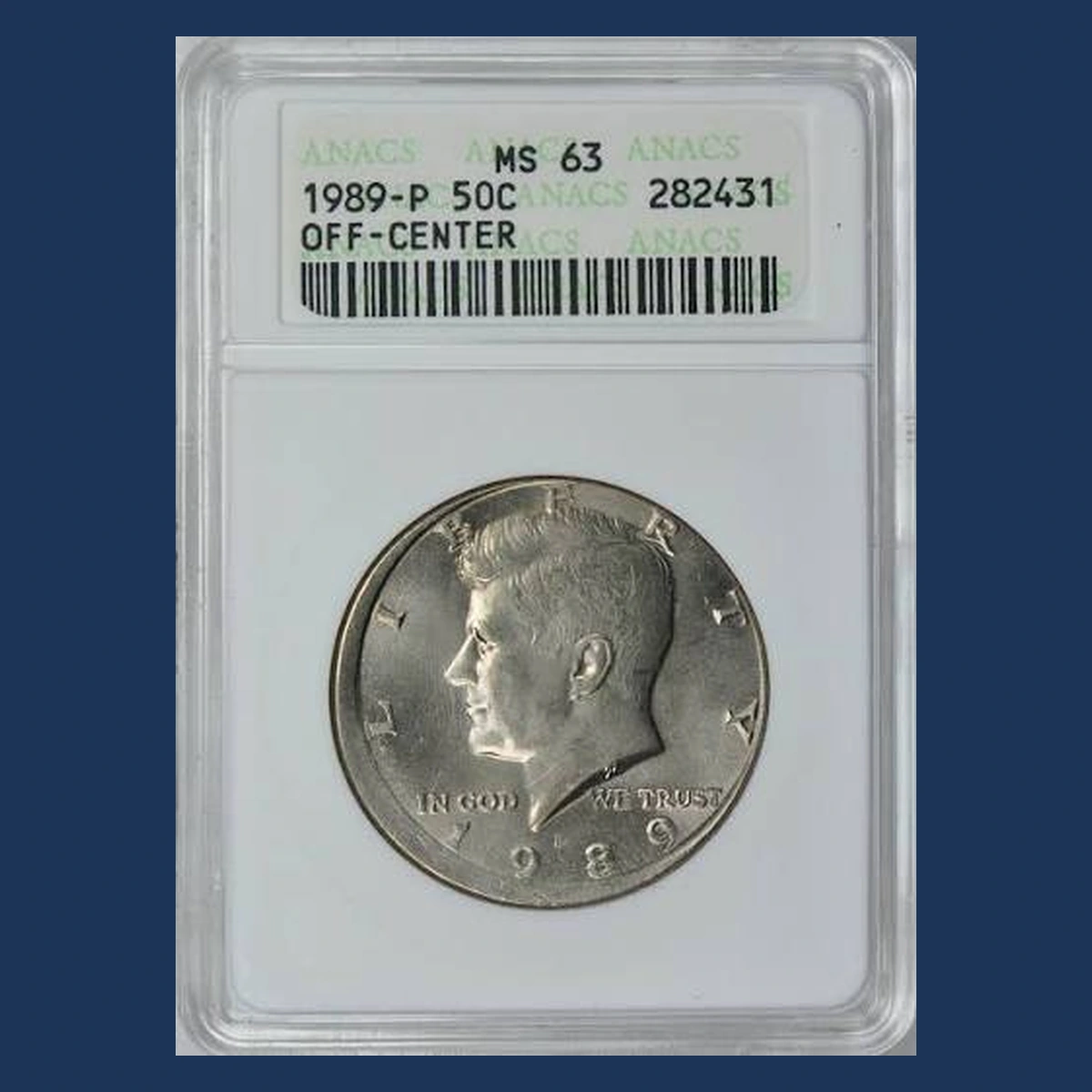
Three Philadelphia auction coins show genuine off-center strikes. They include an NGC MS63, an NGC MS65 struck 15% off center, and a PCGS MS64 struck 10% off center.
On the last coin, the shift points toward about 4:30 on a clock face. That direction does not describe all three examples.
Part of each blank sat outside the stamping tools. The finished coin therefore has incomplete designs beside a blank crescent on both faces.
This is different from the reported Denver coin with only its front design shifted. That coin belongs to the misaligned-die section.
Estimated Value
The 15% NGC MS65 sold for $240 in October 2021. The 10% PCGS MS64 brought $115 in June 2005, while the separate NGC MS63 brought $69 in October 2010.
Use an estimated $75–$850 range for genuine examples, from moderate shifts to more dramatic coins with a clear date. For a newer comparison, a 1990-P half struck 10% off center sold for $198 in September 2025; it was graded NGC MS66.
How to Identify
The blank crescent should be visible on both faces. Photograph the whole coin straight on, with its date and P mintmark still connected to the visible outline.
Check the boundary with a magnifier. Original blank metal should sit beside the struck portion without grinding marks that suggest a finished design was removed.
A scale reading near 11.34 grams helps show that the blank remains intact. Calipers record its changed outline against the usual 30.61 mm width.
Keep the two numbered examples distinct: the 10% coin shifts toward 4:30, while the 15% coin has its own position. Start by confirming corresponding blank areas and incomplete designs on both faces.
10. 1989 Kennedy Half Dollar Struck Through and Filled Die Errors (Estimated Up to $1,200)
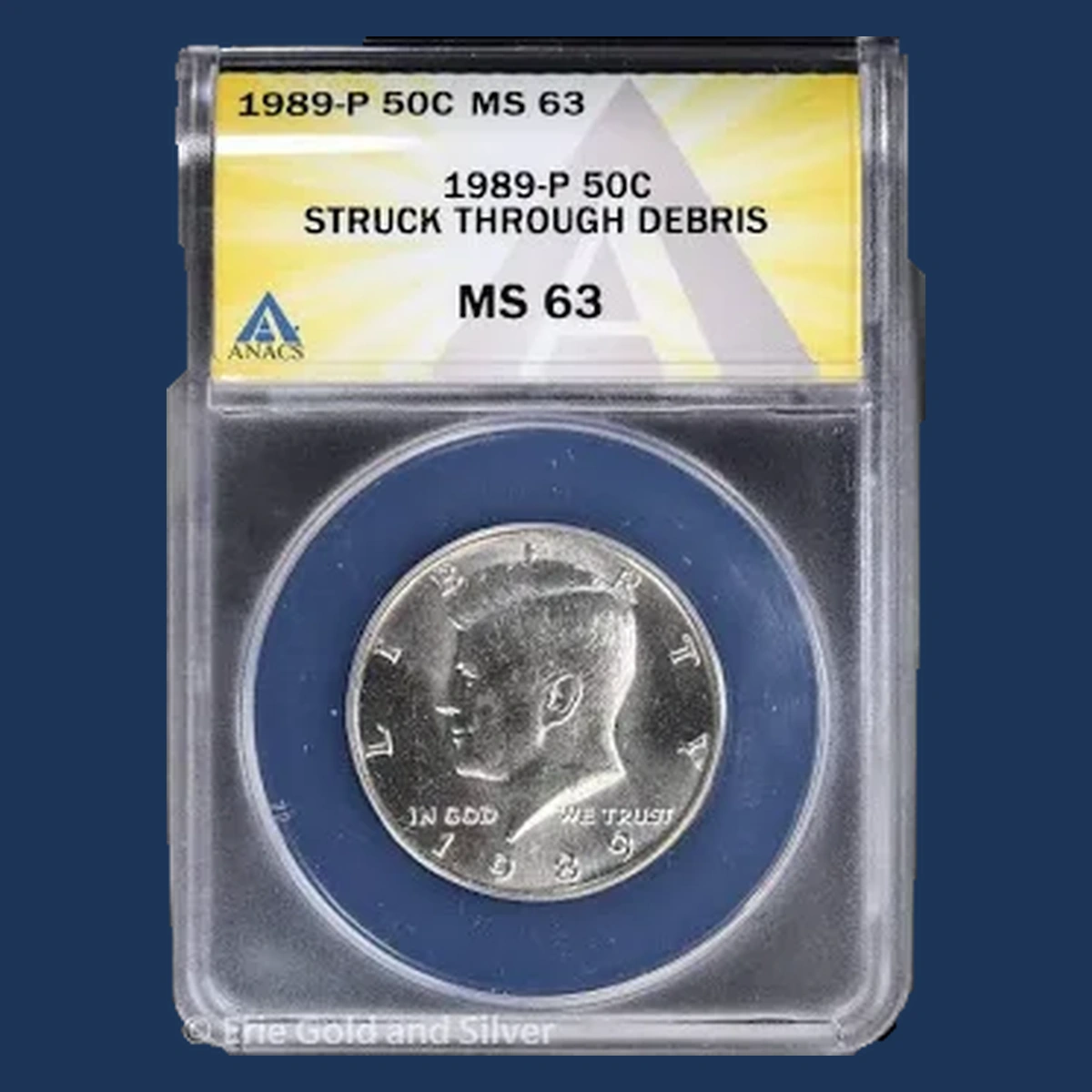
A star below the eagle’s tail is missing on a 1989-D coin shown in a collector discussion. Specialist Fred Weinberg judged the photos as showing a small area blocked during striking.
The explanation was filled die: material clogged the stamping tool and prevented that star from forming. It was not a new back design with fewer stars.
Other reports describe cloth and metal-layer fragments caught in the press. Those claims lack matched grading records.
A missing star, woven texture, and metal-fragment impression need different evidence. They should not be treated as one coin with one known obstruction.
Estimated Value
Estimate $1–$20 for minor filling such as the missing-star appearance, or $25–$300 for clear ordinary strikethroughs. Strongly supported cloth or metal-fragment impressions may fall around $200–$1,200.
For different-year comparisons, a 1988-D front strikethrough graded NGC MS67 brought $59 in July 2021. A 1976-D half affected on both sides sold for $114 in March 2025.
The higher material-specific estimates require a recognizable impression, not just an unusual patch.
How to Identify
For the Denver missing-star report, compare the spot below the tail with a normal back. A magnifier should also show whether the nearby feathers and stars remain sharp.
Scratches where the star should sit can suggest later removal. The collector’s opinion came from photos, so a closer inspection still matters.
For a cloth claim, seek a repeated woven texture. A metal-fragment claim needs its own clear impression or remaining material; a generic depression identifies neither.
Ordinary intact coins measure 30.61 mm and weigh 11.34 grams, checked with calipers and a scale. Start with the actual missing star or object texture, rather than naming the obstruction from an empty patch.
11. 1989 Kennedy Half Dollar Double and Multiple Strike Errors (Estimated Up to $3,500)
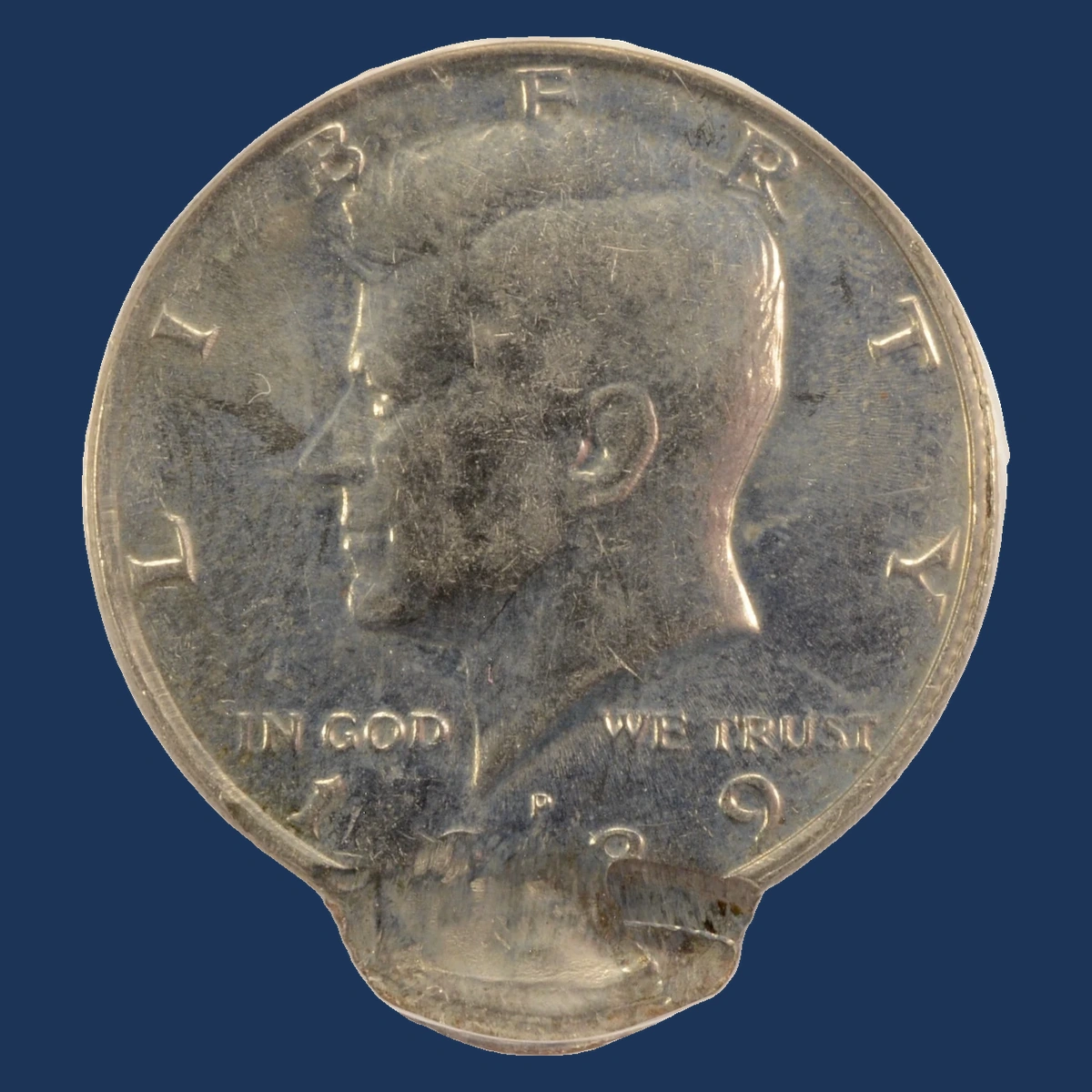
Two sets of design details show where a half dollar returned to the press. Known 1989-P examples have second strikes 65% and 60% off center.
Another flipped over before a second strike landed 95% off center.
The 60% example turned about a quarter-turn between blows. It shows two P mintmarks and one complete date plus part of another.
A separate MS65 coin has several strikes, a broad outline, a backward eagle impression, and a small split. Heritage suggested that another coin had stuck to a stamping tool during the sequence.
That sequence is the cataloger’s explanation, not a witnessed event.
Estimated Value
The estimated range is $250–$3,500. The 65% second-strike MS62 sold for $2,400 in July 2022, while the 95% flipover MS62 brought $252 in July 2021.
A larger shift clearly did not guarantee a higher price. The 60% second-strike MS64 sold for $1,610 in January 2008.
The separate complex MS65 brought $2,012.50 in August 2007; its backward eagle, expanded outline, and split belong to that one coin.
How to Identify
Follow one design at a time with a magnifier. The 60% example has its second strike toward 3 o’clock, while the 95% flipover needs visible evidence of the opposite-side design.
On the complex MS65, look for the backward eagle between 9 and 1:30. Also inspect sunken back details near 3, the split near 9, and the remaining 89 and P.
A scale should approach 11.34 grams when the original metal remains. Calipers can compare any spreading with the normal 30.61 mm width.
Do not count every line as another strike. Begin by tracing two recognizable, overlapping sets of design details and checking where the later blow flattened the earlier one.
Conclusion
Estimated 1989 half-dollar error values run from $1 to $3,500. A blocked star can be inexpensive, while clear overlapping strikes may bring thousands.
Keep the checks simple and specific. Look for an extra D curve, compare both faces for a shifted strike, or trace the separate designs on a double strike.
The coin’s visible features and condition make a better price guide than its grade or error percentage alone.