1944 Half Dollar Error List with Pictures

A 1944 half dollar struck 30% off-center sold for $5,760 in November 2022. Graded PCGS XF40, it still showed substantial detail despite wear.
This 1944 Walking Liberty half dollar error list includes smaller clues too, such as an upside-down S and changed designer initials. Estimated values run from $50 to $60,000, with the highest range covering an undated steel-blank comparison.
Read on to find the right feature without assigning a missing date or borrowed price to your coin.
1. 1944 S Walking Liberty Half Dollar Clipped Planchet (Estimated Up to $350)
A small gap beside LIBERTY’s I appears on a San Francisco half illustrated by ToughCoins. ANACS graded it AU50, meaning lightly worn with much of its detail remaining.
The clip began before stamping. The blank metal disc was already missing a section when it received the coin’s picture.
Nearby silver then formed the rim and design around the gap. A notch cut afterward can sit in the same place but leaves different surfaces.
The description does not give a missing-metal percentage. Its location helps find the feature, but the picture and edge must explain whether the gap is original.
Estimated Value
Estimate $50–$350 for collectible genuine clips. The size of the gap, remaining detail, and original surfaces affect the price.
The known AU50 identifies a 1944-S example without providing an auction result here. A 1942-S ANACS MS62 rim clip brought $81.90 including fees in May 2025.
That is a different-year, unworn comparison. Its grade and particular gap should not be transferred to the worn 1944 coin when judging value.
How to Identify
Find LIBERTY’s I on the front, then inspect the nearby gap through a 10× magnifier. Follow both ends where the missing section meets the normal rim.
Look for silver shaped beside an old gap rather than a fresh cut through completed details. Inspect the surviving edge grooves for filing.
A normal silver half weighs 12.50 grams and measures about 30.6 millimeters. Use a scale and calipers across intact areas when safely accessible, and photograph the S on the back.
The opposite rim may be weak, though this is not required. The main clue is naturally stamped detail beside the shortage, without sharp cutting marks.
2. 1944 Walking Liberty Half Dollar Reported Lamination (Estimated Up to $500)
A thin piece of silver can peel from the coin’s surface. Collectors call this a lamination.
The 1944 year report includes the error without naming a mint or certified example. It concerns a weakness within the silver-copper mixture.
This coin does not use the modern construction of separate outer skins around a copper middle. A local layer within the alloy can still lift, stay attached, or fall away.
The actual candidate must show where the separation lies. A photograph from another year can explain peeling, but cannot supply the location or mint of an unidentified 1944 example.
Estimated Value
Estimate $60–$500 for a genuine collectible lamination. Small flakes on worn coins generally fit below clearer attached layers on attractive examples.
Northeast Numismatics offers a 1947 NGC MS65 with front-side peeling for $275. That is a retail asking price, not a completed sale.
The coin provides a same-series comparison for defective metal. Its definite grade and different date keep it separate from the general 1944 report used here.
How to Identify
Leave a lifting flake untouched. Looking underneath by bending it can break original silver and destroy useful evidence.
Use a 10× magnifier and low light along the layer’s boundary. Check whether the design continues onto an attached piece or meets the exposed patch naturally.
The normal coin contains 90% silver, weighs 12.50 grams, and measures about 30.6 millimeters. Use a scale and calipers when safely accessible, without squeezing the layer, and inspect the edge grooves.
Weight may remain nearly normal if nothing fell away. Look for a thin separated layer beside original stamped detail, rather than scrape tracks, corrosion pits, or a dent that explains later metal loss.
3. 1944 Walking Liberty Half Dollar Struck Through Foreign Material (Estimated Up to $700)
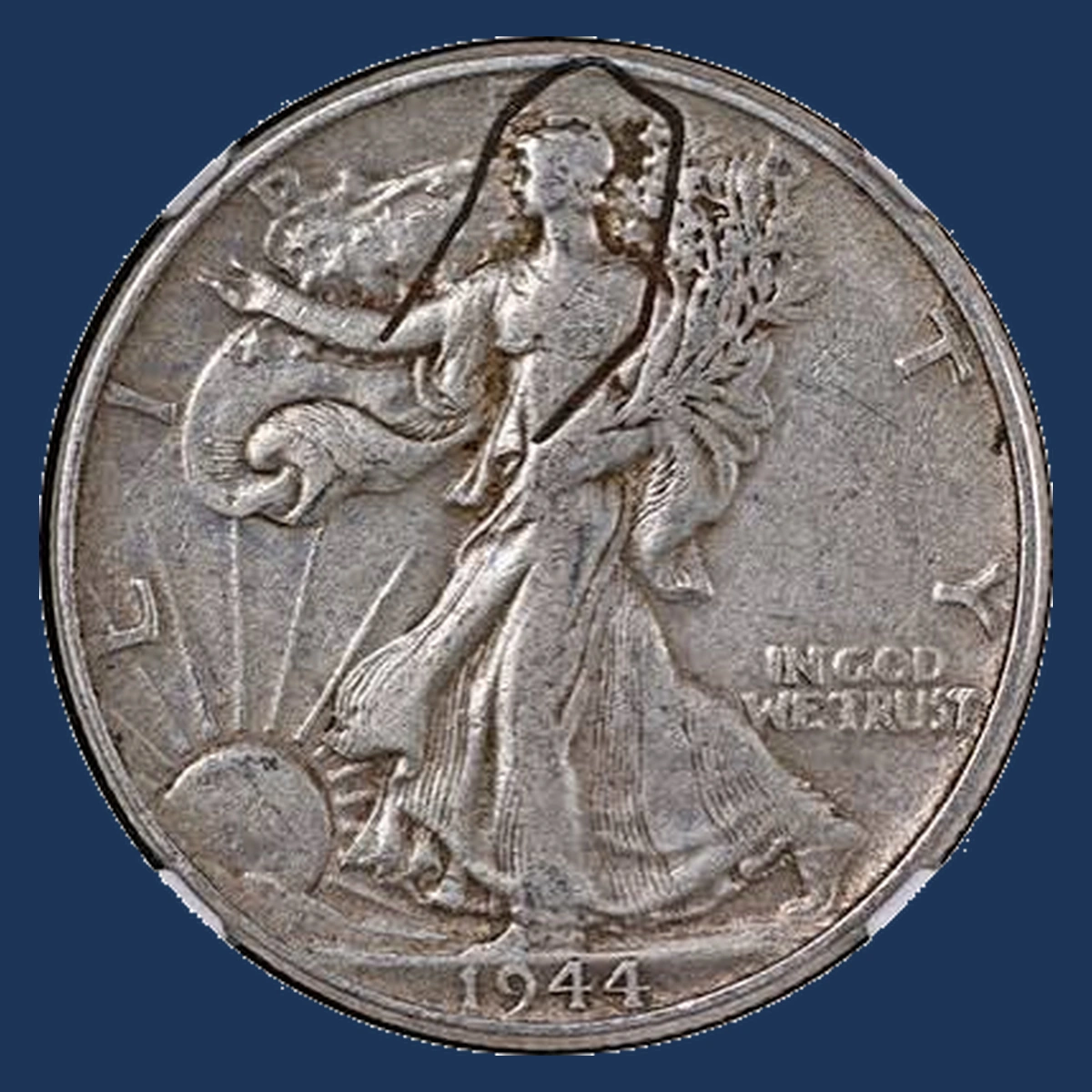
Part of the picture can fail to form when material blocks the stamping tool. It may leave a hollow or the outline of an object.
An auction index identifies a Denver NGC MS65 with this error on the front. MS65 means an unworn coin with limited marks.
A general 1944 account also reports strike-throughs without those specific details. It does not give every candidate the Denver coin’s mint, face, or grade.
Neither report identifies wire, cloth, or grease at a fixed spot. The actual impression needs to show a recognizable shape or texture before naming the material that caused it.
Estimated Value
Estimate $75–$700 for small original interruptions through larger, clearly understood impressions. The Denver MS65 should be judged by its actual mark as well as its condition.
A 1951-S Franklin graded NGC MS64 with a strike-through is indexed at $134 in April 2026. It provides a recent silver-half comparison.
That is a different coin design and possibly a different obstruction. Its sale helps compare prices without becoming a 1944 transaction.
How to Identify
Begin where sharp design ends beside the affected patch. Under a 10× magnifier, examine whether the picture failed to form or was cut after stamping.
A later scrape can push silver to the sides and leave trails across finished detail. Check the opposite face for a related pressure mark.
Use a scale and calipers when safely accessible against 12.50 grams and about 30.6 millimeters. Inspect the edge grooves and keep the full date and mintmark in photographs.
Keep the photographed mark connected with the same coin’s date and mintmark. Look for a local impression surrounded by naturally stamped surfaces, without torn metal or an impact lip from later damage.
4. 1944 Walking Liberty Half Dollar Reported Cracked Planchet (Estimated Up to $800)
A crack through the coin is an opening in its metal. A crack in a die, the steel stamping tool, usually makes a raised ridge instead.
The 1944 report describes a cracked planchet, meaning a cracked metal blank. It does not fix the mint, location, or certified specimen.
A weak area can open before or during stamping. Nearby silver may show how the tools pressed it around the gap.
A later fracture cuts through a picture that was already complete. The surfaces must show which sequence fits; a dark line in a photograph cannot by itself prove an open crack.
Estimated Value
Estimate $100–$800 for a confirmed mint-made blank crack. Depth, visibility, and the remaining coin’s condition affect where it fits.
A 1947 NGC MS65 with front-side peeling has a $275 asking price. That offers nearby context for defective silver.
Peeling along a layer differs from a crack through the coin. The offer therefore helps set a general scale, rather than supplying a direct sale price for the reported 1944 opening.
How to Identify
View the mark from the edge as well as the face. A 10× magnifier and low light can show whether it opens into the coin or rises above it.
Never force the coin apart. Look for bending, dents, or fresh broken surfaces that might explain a later fracture.
When safely accessible, compare scale weight with 12.50 grams and caliper width with about 30.6 millimeters. Check the edge grooves and remember that a crack may retain almost all the silver.
Normal weight therefore does not settle the question. Examine the gap for original picture details compressed around it, rather than finished details split by a later blow.
5. 1944 S Walking Liberty Half Dollar Doubled Die Reverse (Estimated Up to $1,200)
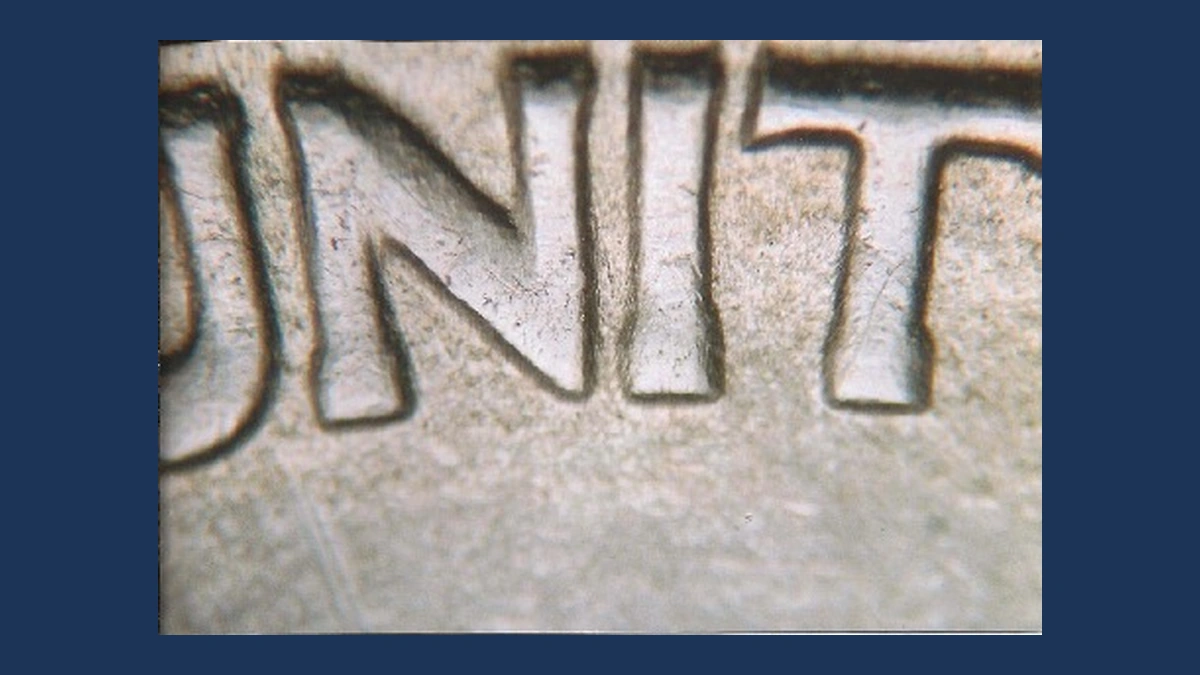
The lettering can look unusually thick on this San Francisco back variety. The reported areas include the national inscription, E PLURIBUS UNUM, denomination, punctuation, and branches.
The added design formed in the stamping tool. It does not mean the finished coin received two separate blows.
Small marks beneath part of UNITED’s T, near AMERICA’s first A, and among feathers above AW help match the tool. AW is the designer’s small joined-letter signature.
This variety need not show two widely separated letters. Compare its particular thickness and nearby marks instead of demanding the stronger appearance of a different doubled coin.
Estimated Value
Estimate $60–$1,200 for recognized examples in ordinary collector grades. Better preservation and a clear photograph match help support the upper portion.
A more obvious 1946 back variety graded NGC MS65 sold for $2,040 in November 2024. That is a different-year comparison near the stronger end of the series.
Its greater separation and collector demand do not automatically transfer to this subtler 1944-S. Thick-looking letters still need the correct matching pattern.
How to Identify
Place a normal back beside the candidate at the same enlargement. Through a 10× magnifier, compare the named letters and branches while changing the light.
Check the smaller marks near T, A, and the feathers above AW afterward. One random scratch or gouge cannot replace the main design match.
Use a scale and calipers when safely accessible against 12.50 grams and about 30.6 millimeters. Photograph the S and inspect the edge grooves for alteration.
Wear and reflections can change apparent width, while flat striking shelves reduce the normal outline. Look for the same extra thickness across several named design areas, reinforced by the matching small marks.
6. 1944 Walking Liberty Half Dollar Repunched Mintmarks (Estimated Up to $1,500)
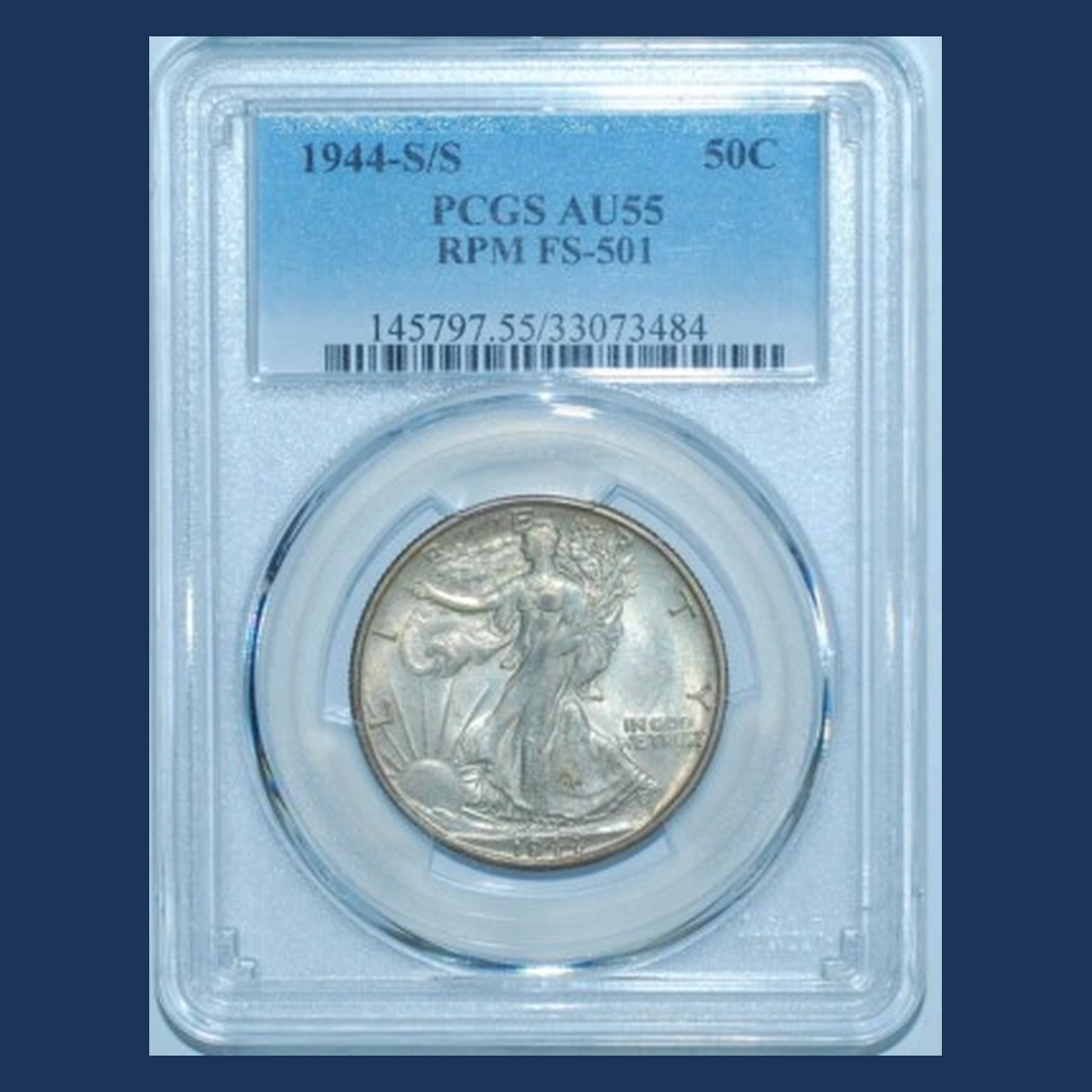
San Francisco FS-502 has pieces of four overlapping S impressions. FS-501 instead shows an earlier S above the main letter.
Other reported S varieties have extra strokes to the right, left, or at an angle. The Denver example has an extra D to the left.
Workers punched mintmarks into the stamping tool by hand. Repeating the punch in different positions could leave pieces of earlier letters.
The tool then passed those shapes to coins. Four S punch positions do not mean four strikes on the coin.
Compare the actual mintmark shape when reference books use different numbering systems.
Estimated Value
Estimate $60–$1,500 across recognized repunched mintmarks. Worn minor examples need different comparisons from attractive, widely collected varieties.
PCGS records an FS-501 MS62 at $588 in September 2017. A separate FS-502 MS66 brought $893 in November 2013.
Those are different varieties and specimens, not two grades on one universal price list. Other Denver and San Francisco examples depend on their own extra letter shapes, remaining detail, and collector interest.
How to Identify
Find the mintmark at the lower left on the back. Follow its inside and outside contours through a 10× magnifier.
For FS-501, look above the main S. FS-502 needs comparison with all its overlapping punch positions, not just one stray stroke.
Check other varieties by their actual direction and nearby marks rather than matching catalog numbers alone. An accessible silver half should be compared with 12.50 grams on a scale and about 30.6 millimeters with calipers.
Inspect the edge grooves and nearby flat area for alteration. The useful mark is a rounded piece of an earlier D or S, rather than a flat shelf or damage beside the letter.
7. 1944 S Walking Liberty Half Dollar Inverted Mintmark (Estimated Up to $1,600)
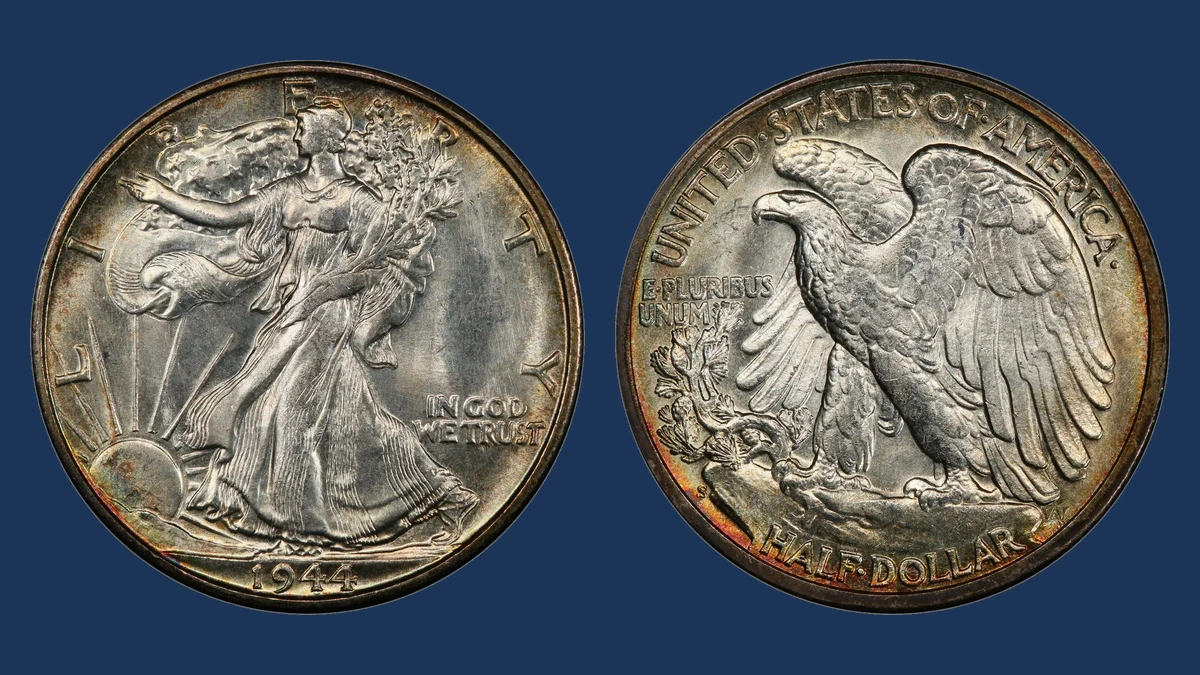
The S punch was upside down relative to the surrounding back picture on this recognized variety. Turning an ordinary photograph upside down does not create the same feature.
PCGS names the 1944-S variety FS-511. An S looks fairly balanced, so its two ends and upper and lower loops need close comparison.
A normal S made with a different punch style can also look unfamiliar. The correct comparison uses the normal version of the same letter style.
Extra strokes from repunching are another issue. They may change the outline without showing that the entire punch was upside down.
Estimated Value
Estimate $100–$1,600 for recognized examples from worn condition through attractive unworn coins. Clear letter shape and overall preservation affect the comparison.
PCGS records $1,320 for an MS66+ in June 2025. That is a recent result for a very well-preserved example.
It is not a fixed surcharge for an odd-looking S. The whole coin and a convincing match to the inverted letter must support an upper-end price.
How to Identify
Keep the back upright in both photographs. Compare the S ends and upper and lower loops through a 10× magnifier with a recognized FS-511 image.
Do not rotate only the close-up to make it match. A normal S of another style may look different without being inverted.
Examine extra punch strokes separately and look for tooling beside the letter. When safely accessible, use a scale and calipers against 12.50 grams and about 30.6 millimeters, and inspect the edge grooves.
The surrounding picture must keep its normal direction. Look for the correct upside-down relationship between the S’s unequal ends while the eagle remains upright, rather than mere letter tilt.
8. 1944 Walking Liberty Half Dollar Reported Missing AW Initials (Estimated Up to $2,500)
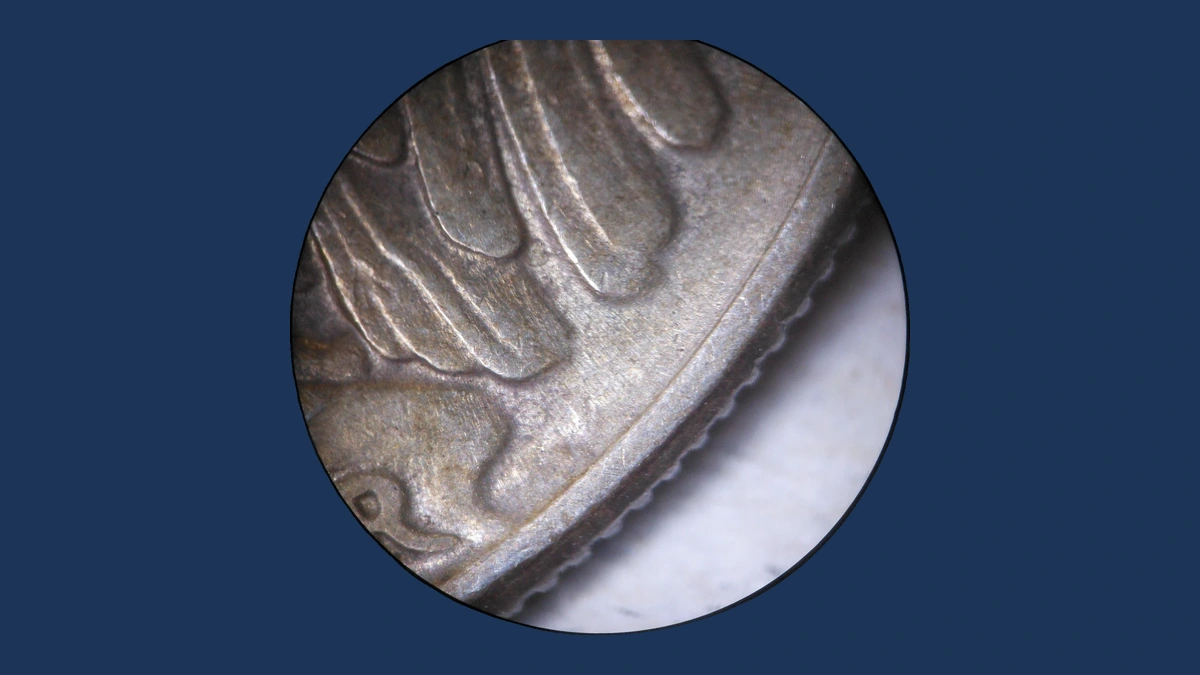
AW normally sits below the eagle’s wingtip on the viewer’s right. The Philadelphia report describes its absence, not Denver’s differently shaped replacement initials.
Polishing a stamping tool can remove shallow letters from it. Later coins would then miss those letters even though nearby details still appear.
Wear or rubbing on a finished coin can leave a similar empty patch. Those are different causes.
The 1944 year listing supplies a Philadelphia report without a confirmed professional catalog match here. It should not borrow the recognized 1945 variety’s number or photograph simply because both descriptions mention missing initials.
Estimated Value
Estimate $75–$2,500 for a confirmed mint-made omission on a collectible example. Undisturbed nearby detail and overall condition must support the range.
The recognized 1945 Philadelphia Missing Initials variety reached $6,000 in PCGS MS66 in October 2019. That is a different-year, exceptionally preserved comparison.
The result does not price the reported 1944 coin directly. It also does not give faint or partly visible initials the same status as a confirmed complete omission.
How to Identify
Use a normal coin to find the exact AW position before checking the candidate. View it through a 10× magnifier with light from more than one direction.
Any surviving stroke means the initials are weak or partial rather than completely absent. Compare nearby feathers and flat areas for rubbing, scratches, or disturbed color.
The normal coin contains 90% silver, weighs 12.50 grams, and spans about 30.6 millimeters. Use a scale and calipers when safely accessible, and inspect the edge grooves and Philadelphia mintmark area.
Do not clean the signature or substitute a 1945 photograph. Look for absent strokes beside original surrounding detail, without a locally smoothed patch.
9. 1944 D Walking Liberty Half Dollar Hand-Engraved Initials (Estimated Up to $3,500)
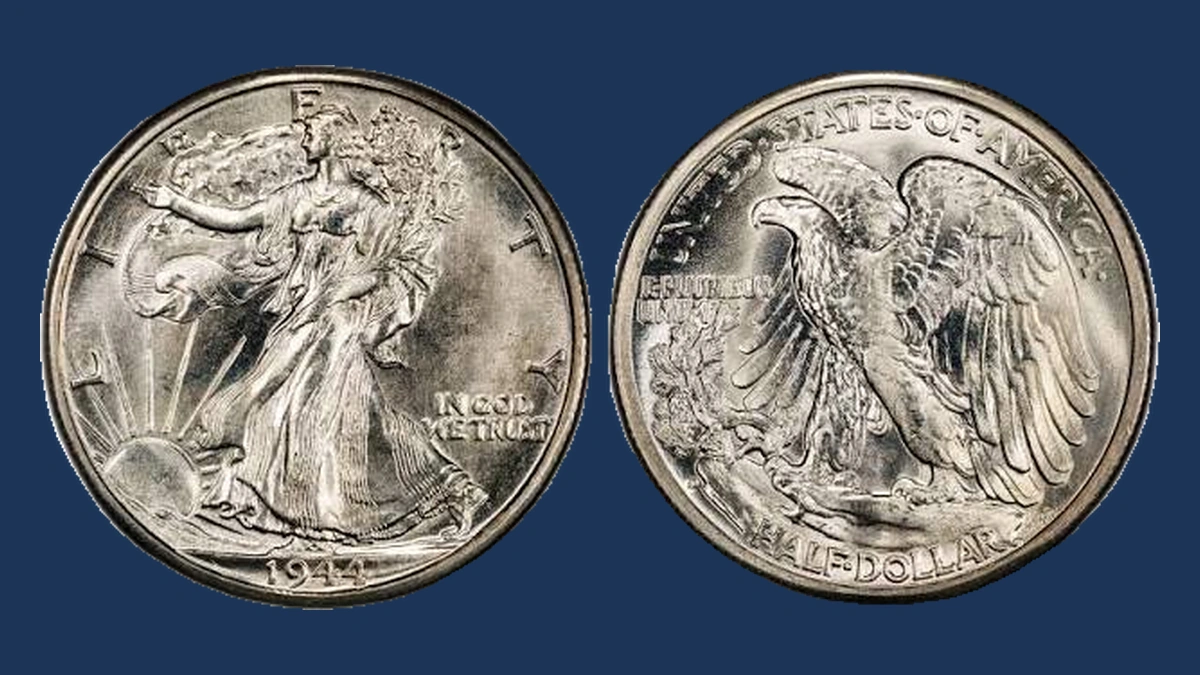
The AW letters look broader and less regular on Denver’s FS-901. Workers replaced the original initials by engraving new strokes into the steel stamping tool.
The replacement cut into the tool became raised lettering on coins. It appears below the wingtip on the viewer’s right.
This is different from the Philadelphia report of missing initials. It preserves replacement letters rather than an empty space.
It also differs from someone scratching AW into a finished coin. Such cuts sink into the silver and disturb the surface, so both the shape and height of the letters must match the recognized Denver variety.
Estimated Value
Estimate $100–$3,500 for recognized examples, from worn coins through exceptional unworn pieces. The unusual signature is one part of the whole coin’s value.
PCGS records $3,290 for an MS67+ sold by Heritage in August 2014. That high-grade result depends on outstanding preservation.
A worn coin with readable replacement strokes can still be collectible. It does not automatically approach the price of an example with unusually clean surfaces and strong visual appeal.
How to Identify
Check whether the letters rise or sink first. Low light and a 10× magnifier should show raised replacement strokes on the genuine variety.
Letters scratched directly into a coin leave cuts and disturbed silver instead. Compare the broad, uneven shapes with a recognized FS-901 and a normal AW.
Confirm the D at the lower left on the back. An accessible coin should be checked with a scale against 12.50 grams and calipers against about 30.6 millimeters, including the edge grooves.
Keep the wing feathers and nearby surface visible in close-ups. Look for the matching broad raised AW, without fresh cuts or rubbed metal hidden beside the letters.
10. 1944 Walking Liberty Half Dollar Double Strike (Estimated Up to $6,500)
A second off-center blow can leave pieces of the first picture beneath a new shifted one. Heritage cataloged this combination on a Philadelphia 1944 graded NGC MS62.
The description gives no exact percentage or clock direction. Those details must come from this coin rather than a different year’s example.
The overlapping pictures belong to one half dollar. A doubled stamping tool instead repeats an altered design during one strike.
Later squeezing or joined pieces can also produce confusing shapes. The surfaces need to show how a real second blow changed the original picture, rather than merely presenting several unusual lines.
Estimated Value
The NGC MS62 sold for $4,320 in December 2022. Estimate $2,500–$6,500 for comparable recognized examples with differing surface quality and picture clarity.
That values one coin with a combined striking error. It is not an off-center price added to another full double-strike price.
A more dramatic second picture or better original surfaces may attract stronger bidding. Heavy alteration can reduce interest even when the coin is described with the same error name.
How to Identify
Find surviving parts of the first picture before counting a second blow. Use a 10× magnifier to follow the newer design and how it flattened earlier details.
Compare both faces and the edge. Do not call every extra line another strike or assume the coin flipped between blows.
The original silver blank was 12.50 grams and about 30.6 millimeters across. Use a scale and calipers when safely accessible to record the retained weight and changed outline.
Inspect the remaining edge grooves for seams, squeezing, or assembly. Look for two separate sets of genuine stamped details that explain the same second blow, rather than disconnected marks or joined pieces.
11. 1944 Walking Liberty Half Dollar Uncentered Broadstrike (Estimated Up to $7,000)
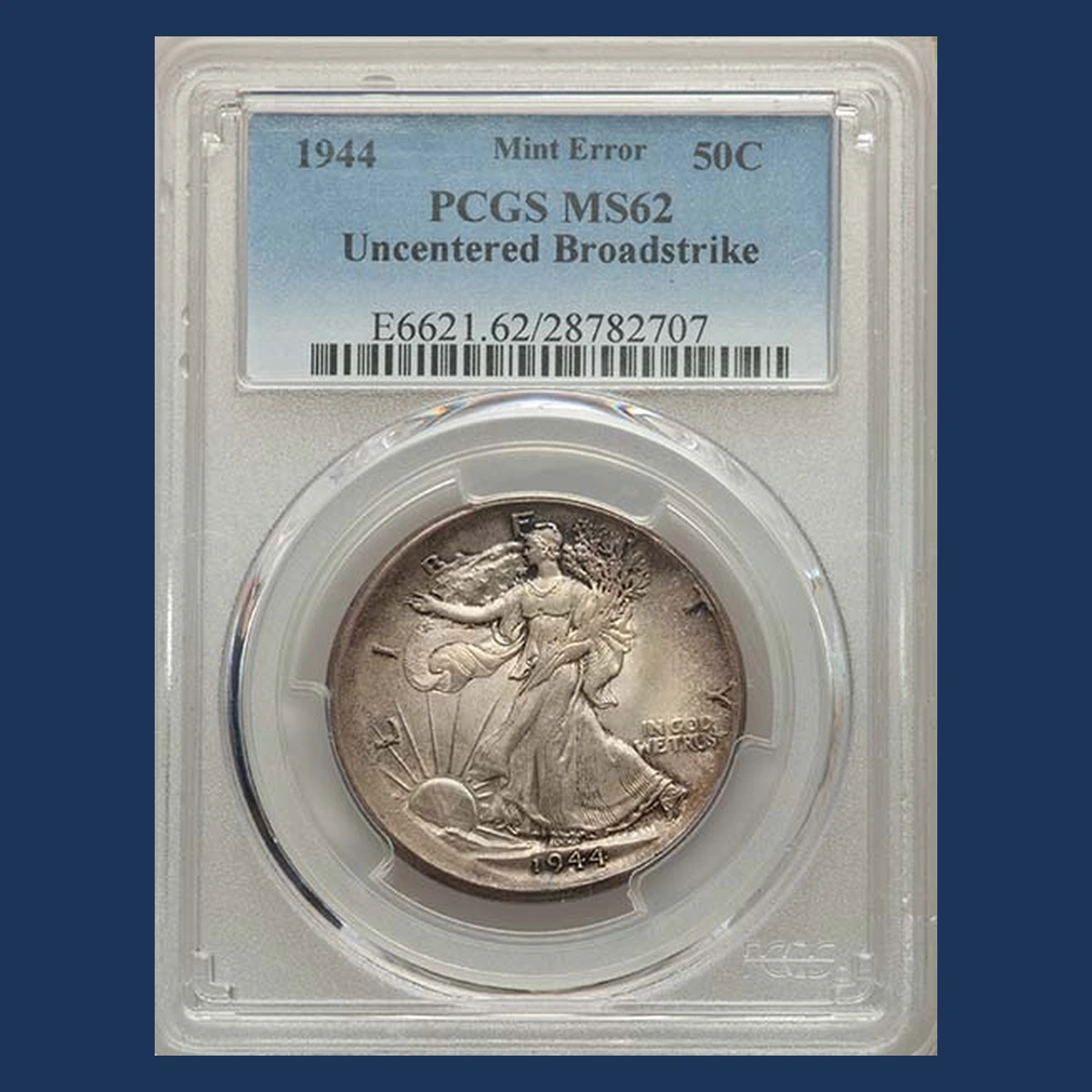
The picture is not centered within the extra metal on this PCGS MS62. Its catalog calls it an uncentered broadstrike.
The collar, a ring controlling width during stamping, did not hold the blank normally. Metal spread outward and left an uneven border.
A specialist suggested that a slightly oversized starting blank might have contributed. That is a proposed explanation, not a measured weight or proof of unusual thickness.
The visible spreading is the recorded feature. It should stay separate from the hypothesis about its cause, and from the missing-picture percentage of the different 30% off-center coin below.
Estimated Value
Estimate $2,000–$7,000 for a genuine unworn uncentered broadstrike in this series. No unreported auction amount is assigned to the PCGS MS62 here.
A separate 1944 half struck 30% off-center sold for $5,760 in November 2022. That coin was graded PCGS XF40 and showed wear.
It demonstrates interest in dramatic Walking Liberty striking errors. Its incomplete design and worn surfaces differ from this expanded unworn broadstrike, so the comparison is not exact.
How to Identify
Photograph both faces straight on and include an edge view. Use calipers across several widths against the normal 30.6 millimeters and a scale against 12.50 grams when safely accessible.
Follow the outer letters and border with a 10× magnifier. Check for metal spreading during stamping rather than finished details crushed by later flattening.
Inspect the edge grooves together with any areas the ring did not hold. The published MS62 discussion provides photographs for comparison.
Extra width does not prove the blank began oversized. Look for the naturally expanded border around an unevenly placed picture, while keeping the proposed starting-blank explanation separate.
12. 1944 Walking Liberty Half Dollar 30% Off-Center Strike (Estimated Up to $8,000)
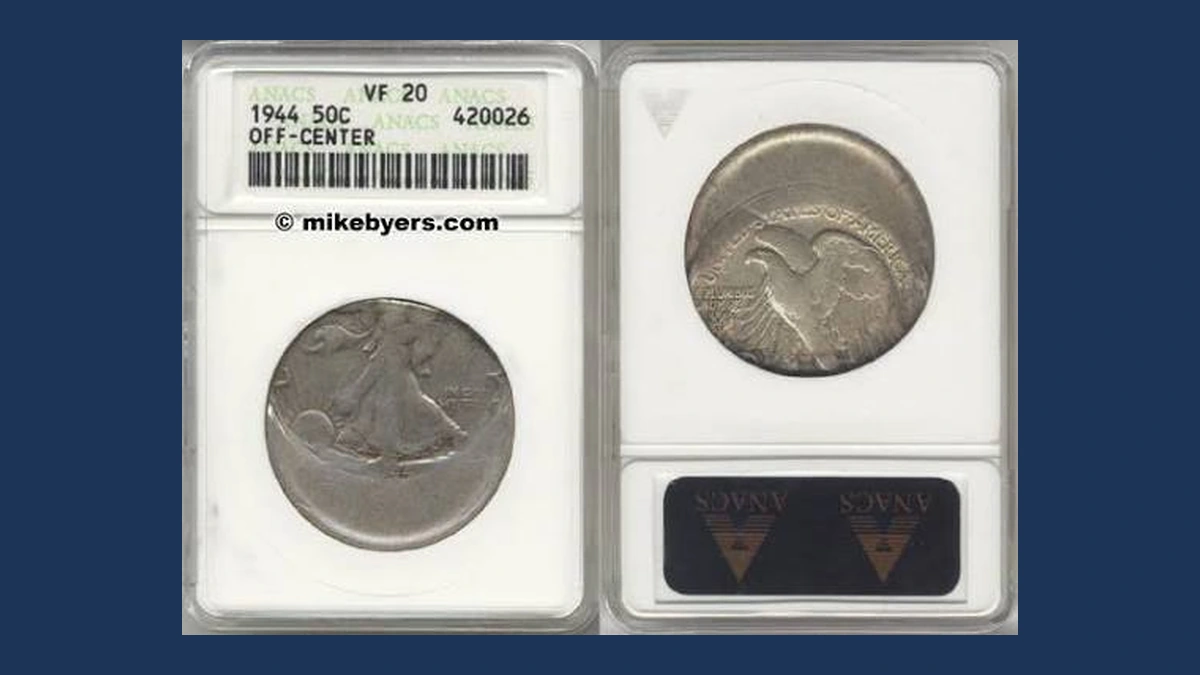
The picture is shifted 30% on this Philadelphia half dollar. It is much more displaced than a coin with a slightly uneven rim.
Part of the blank lay outside the stamping area. That metal remains present, but never received its intended picture.
Heritage describes original gray surfaces with wear and no impairments on the PCGS XF40. Those observations belong to this specific example.
A clip would actually remove part of the metal. Here, the untouched area and incomplete design must fit the same displaced strike on both faces, with the remaining date still belonging to the coin.
Estimated Value
The PCGS XF40 brought $5,760 in November 2022. Estimate $3,500–$8,000 for comparable dramatic, identifiable Walking Liberty off-center errors.
The sale shows that wear does not erase the appeal of a major error. It does not make every uneven rim worth thousands.
Date visibility, amount of displacement, and original surfaces all affect comparison. A much smaller shift, uncertain year, or later damage needs a different assessment from this clearly dated specimen.
How to Identify
Keep both faces aligned in photographs and include the remaining date. A genuine misplaced blank should leave corresponding unstamped areas on both faces.
One shifted stamping tool can make only one side look uneven. Compare the designs together before deciding which event occurred.
Use a 10× magnifier along the boundary for grinding or cutting. A cut-out crescent removes metal, whereas this error leaves it present and unstamped.
When safely accessible, compare scale weight with 12.50 grams and record the outline with calipers against about 30.6 millimeters. Inspect surviving edge grooves, then look for matching shifted pictures beside original blank metal; the recorded 30% belongs specifically to this example.
13. 1944 Walking Liberty Half Dollar Wrong Planchets and Undated Steel Candidate (Estimated Up to $60,000)
Upper parts of the 1944 digits survive on the silver-quarter-blank PCGS MS65. The smaller disc could not hold the entire half-dollar picture.
A separate PCGS MS64 was stamped on a steel cent blank. Its date and mintmark positions lie outside the available metal.
Heritage proposed 1943 or 1944 as its likely period without choosing either year. That coin remains an undated comparison, not a proven 1944 steel half.
The two pieces have different metals and surviving pictures. A small outline alone cannot tell which blank was used, and the dated quarter example cannot supply the steel coin’s missing year.
Estimated Value
Estimate $12,000–$25,000 for the dated silver-quarter form. An undated Walker on a quarter blank brought $15,000 in May 2022 as a related comparison.
The steel-cent candidate has a separate estimated $30,000–$60,000 range. Its 2013 lot shows $44,062.50 with an owner-repurchase notice.
That is not an ordinary sale to an independent buyer. Neither the qualified result nor the proposed period provides a missing 1944 date.
How to Identify
A silver quarter blank normally starts at 6.25 grams. That is a standard, not a supplied measurement of this MS65.
Use a scale and calipers to compare an accessible example with the normal half-dollar 12.50 grams and about 30.6 millimeters. Inspect the surviving date and edge through a 10× magnifier for later trimming.
The smaller blank should have original metal and a half-dollar picture ending naturally at its boundary. Do not expect a cut-down normal coin to show the same relationship.
The steel example needs professional metal testing, and its date remains only a proposed 1943 or 1944. Match the tested metal and naturally struck edge to the smaller blank, without assigning a date that is not visible.
Conclusion
The reverse gives several useful clues on a 1944 half: extra mintmark strokes, an inverted S, or changed AW initials. Find the exact feature before comparing prices.
Estimated values span $50 to $60,000. The highest range concerns an undated steel-blank candidate.
Its date is only proposed as 1943 or 1944, unlike the confirmed 1944 quarter-blank coin. Compare their different metals and sale histories separately.