1990 Half Dollar Error List with Pictures

A 1974-D half dollar missing its front outer layer sold for $432 in March 2023. That different-year sale helps price a similar error reported for 1990.
This 1990 Kennedy half dollar error list covers estimated values from $10 to $850. Known 1990 coins also show shifted strikes, expanded borders, and overlapping designs.
Read on to see which features you can spot and which need a closer check with simple tools.
1. 1990 Kennedy Half Dollar Obverse Grease Strike-Through (Estimated Up to $150)
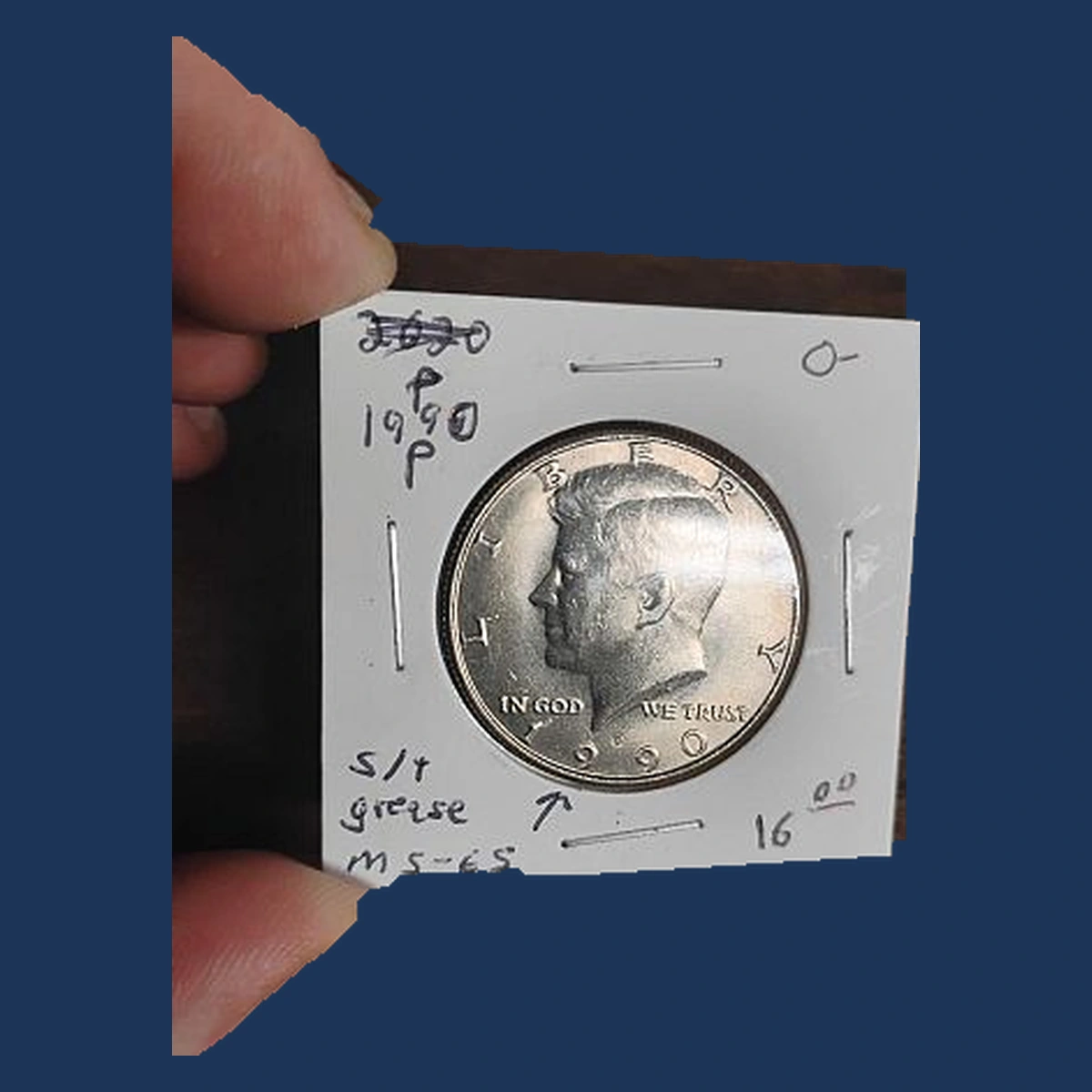
The bottom of Kennedy’s portrait looks weak on this reported 1990-P example. Its seller describes grease blocking the design during striking.
Grease can clog small recesses in the die, the steel tool that stamps the coin. Metal then fails to fill those spaces, leaving selected details shallow or absent.
That can differ from wear, which usually affects exposed high points across the coin. The reported location here is the base of the portrait.
The seller calls the coin MS65, meaning attractive and unworn, but it has no independent grading-service opinion.
Estimated Value
The 1990-P listing asks $9.99 before shipping. That is an asking price, not a completed sale.
An estimated $10–$150 covers minor through clearly visible, confirmed grease-related weakness. A large loss of detail can attract more interest than a small soft patch.
The listed coin’s MS65 grade is the seller’s opinion. Buyers should not give it the same weight as an independent grade when comparing prices.
How to Identify
Look at the high points of Kennedy’s hair and face before studying the weak spot. Widespread smoothing suggests normal wear rather than a single blocked area.
Use a magnifier at the bottom of the portrait. Compare its surface with nearby lettering and open metal, checking for polishing lines that run through the weak patch.
Confirm the 1990 date and P mintmark. A digital scale should read roughly 11.34 g, and calipers should show about 30.61 mm.
Inspect the grooves around the edge for unrelated damage. A normal edge does not prove the cause of the weakness.
The first useful comparison is a locally weak portrait edge beside otherwise sharp, untouched detail.
2. 1990 Kennedy Half Dollar Missing FG Initials (Estimated Up to $150)
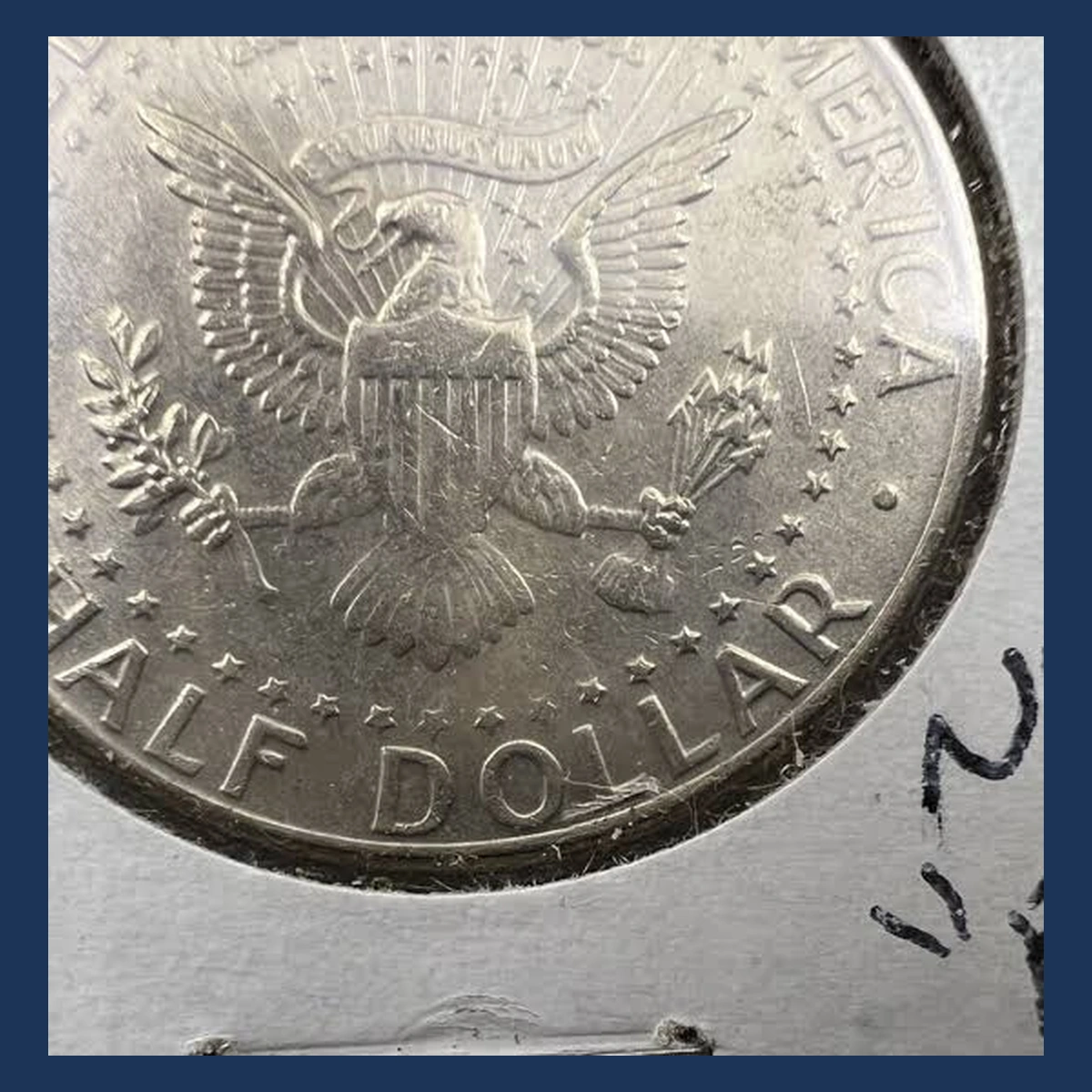
The tiny FG letters beside the eagle’s tail identify designer Frank Gasparro. Reported 1990-P examples have these letters missing or difficult to see.
A completely empty spot differs from faint surviving letters. Light can hide a shallow stroke, so one photograph may not tell the whole story.
Polishing the steel stamping tool can remove shallow design details before coins are made. Wear, dirt, or later rubbing can also hide letters on a finished coin.
The surrounding surface matters just as much as the empty space. Clear nearby details help show whether the whole area has worn down.
Estimated Value
The year guide gives an estimated $50–$150 for unworn No FG examples. This is a guide-based range, not a verified sale price for a particular 1990 coin.
Completely absent initials and original surfaces matter more than a seller’s name for the variety. Faint letters should not be priced as though they were entirely missing.
A rubbed patch or residue hiding the letters calls for a different explanation. Neither automatically adds an error premium.
How to Identify
Find FG on a normal half dollar first. Then use a magnifier at the same spot on your coin, changing the light several times.
Look at the eagle’s nearby leg and tail. If those details are worn flat too, the missing letters may be part of ordinary wear.
Check for parallel polishing lines or a dull patch around the initials. Do not clean the coin to reveal hidden strokes.
Use a scale for the usual 11.34 g and calipers for about 30.61 mm. Inspect the grooved edge for signs of alteration as well.
Before calling it No FG, make one final light-angle check: any surviving letter stroke means the initials are not completely absent.
3. 1990 Kennedy Half Dollar Clipped Planchet Error (Estimated Up to $250)
A clipped coin has a piece missing from its outline before the design is stamped. Its blank, the round metal disc used to make it, was already incomplete.
The strike then shapes the remaining metal around that gap. This can soften the nearby rim or lettering rather than cutting sharply through a finished design.
Clips are reported for 1990, but no particular mint, gap shape, or location is established here. Each coin needs its own examination.
A curved gap and a straight missing section can have different cutting-stage causes. Either shape can also be imitated by later damage.
Estimated Value
Estimate $25–$250 for ordinary confirmed examples. The amount of missing metal and the clarity of the original strike help narrow that range.
A 1993-D curved clip graded ANACS MS64 sold for $34.74 including the buyer’s fee in August 2025. That was an unworn coin with some marks.
It is a nearby-year comparison, not a 1990 sale. A larger gap does not automatically bring more money if it removes important details or accompanies damage.
How to Identify
Examine the metal layers exposed inside the gap with a magnifier. Compare the rim at both ends with the untouched edge around the rest of the coin.
Look for soft transitions or lettering that weakens near the opening. Saw marks, sharp burrs, or a clean slice through finished detail can indicate later cutting.
The opposite rim may also look weak, although this clue is not obvious on every genuine clip. Check the surviving edge grooves too.
Calipers across intact metal should approach 30.61 mm. A scale may read below 11.34 g depending on how much metal is missing.
Start with the gap’s two ends: original rim detail fading into them is more useful than the gap’s shape alone.
4. 1990 Kennedy Half Dollar Doubled Die Obverse (Estimated Up to $300)
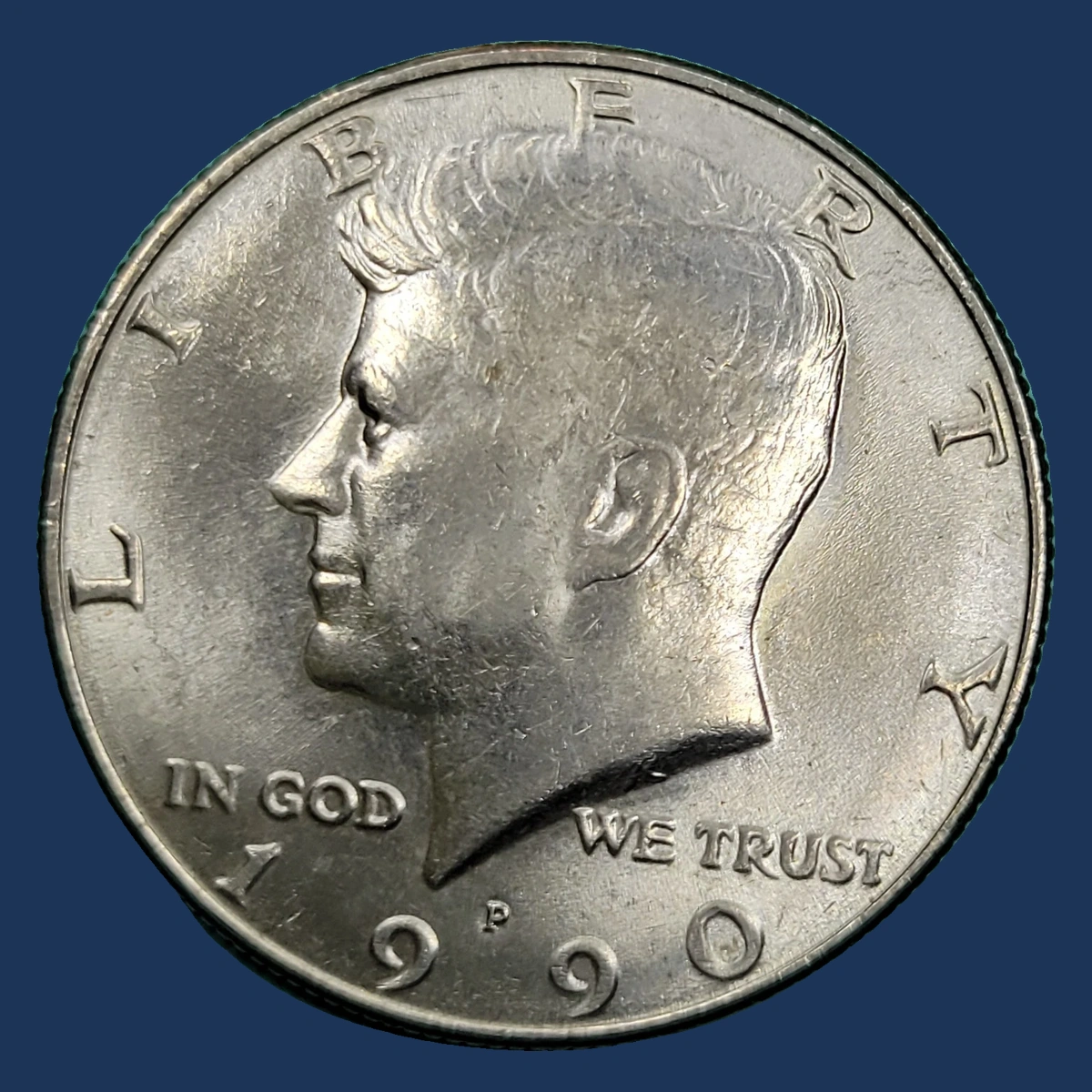
A letter with an extra rounded outline can suggest a doubled die. That means the steel stamping tool carried a repeated design before the coin was struck.
Other coins made with that same tool should show the same pattern. A scratch or a flat shelf created during striking need not repeat that way.
Front doubling is reported for 1990, but no numbered variety is established here. The date and inscriptions are places to inspect, not a claim that every area doubles together.
One thick digit is therefore a starting point, not proof of this error.
Estimated Value
A confirmed minor variety on an ordinary collector coin has an estimated range of $25–$300. Clear separated outlines and a match to a recognized pattern support the stronger end.
A 1974-D FS-101 graded ANACS MS64 sold for $49 at Heritage in May 2026. MS64 describes an unworn coin with some visible marks.
That recent sale is a different-year comparison. It does not establish a variety name, certification, or sale price for 1990.
How to Identify
Place an ordinary coin from the same mint beside your candidate. Use a magnifier to compare several letters, including where their strokes meet.
Small splits and rounded extra edges can be useful. A flat shelf along one side of a letter often has a different striking cause.
Check the date separately under changing light, since reflections can make numeral edges seem doubled. Record the P or D mintmark rather than relying on a cropped picture.
Inspect the edge grooves and confirm roughly 11.34 g with a scale and 30.61 mm with calipers.
For the first reliable test, find matching extra shapes in several letters instead of judging one thick numeral.
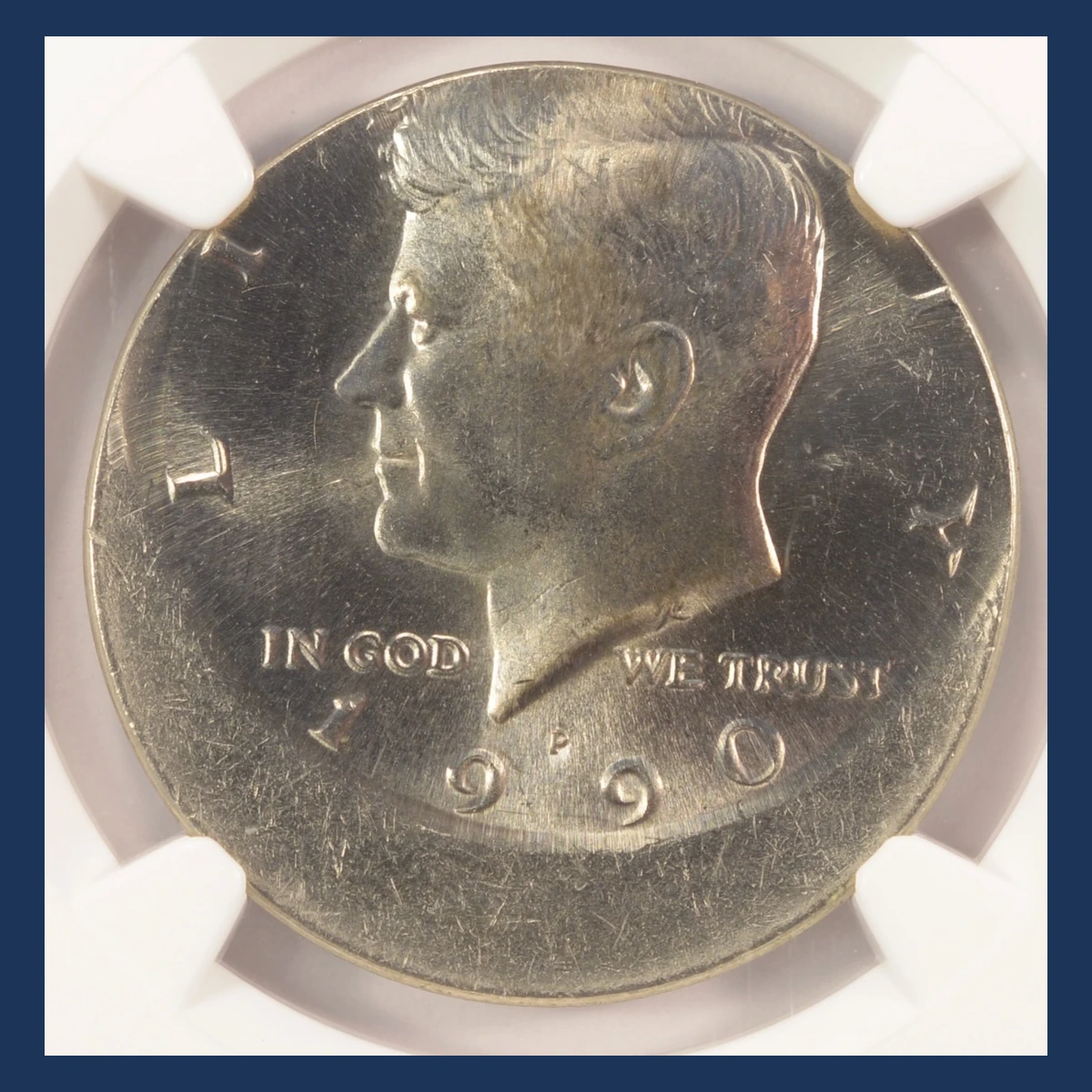
5. 1990 Kennedy Half Dollar Broadstrike Error (Estimated Up to $500)
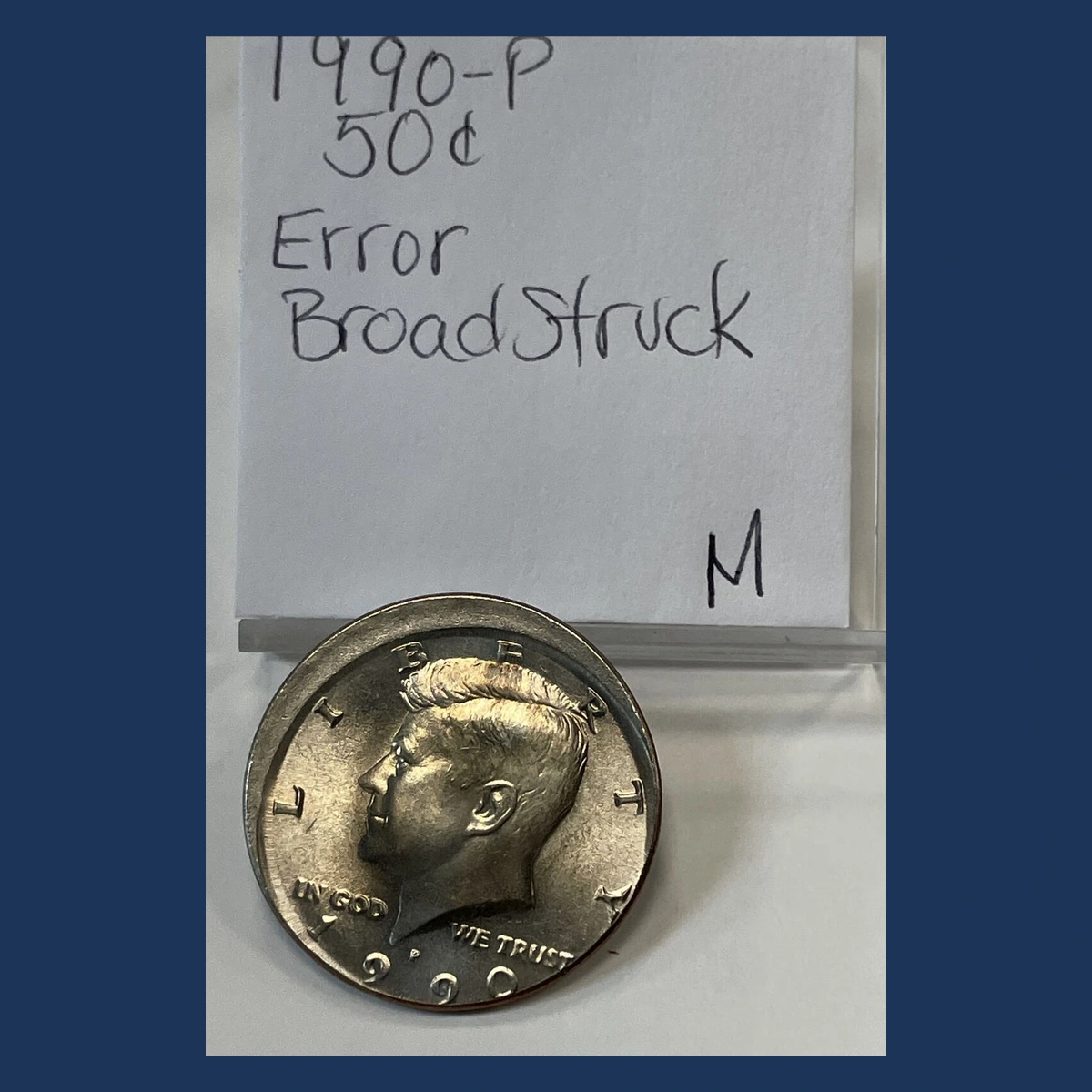
A broadstrike can show a complete design with extra metal spread around it. A 1990-P example graded ANACS MS61 gives this category a confirmed same-year coin.
The retaining ring normally stops the metal from spreading too far. Without that restraint, the stamping tools can press the disc wider than its intended size.
The design may look unevenly placed within the expanded shape. That alone does not mean a portion of it was missed.
Another known 1990-P coin was both broadened and struck twice. A plain broadstrike does not automatically have that second mistake.
Estimated Value
The ANACS MS61 1990-P broadstrike sold for $192 at Heritage on March 31, 2025. Another graded MS65 brought $119 in January 2023.
Both grades describe unworn coins, with MS65 generally allowing fewer marks. The differing prices show that grade alone does not decide an error coin’s appeal.
Use an estimated $100–$500 for similar examples. The amount of spreading, attractive surfaces, and overall appearance also affect what collectors will pay.
How to Identify
Read the outer lettering on both sides and check that every part of the design remains present. Use a magnifier where the picture approaches the widened border.
Missing outer detail may instead point to an off-center strike. A broadstrike should retain the full intended design.
Measure several directions with calipers against the usual 30.61 mm. Weigh the coin against 11.34 g, since spreading changes shape without necessarily removing metal.
Check where the normal edge grooves stop or disappear. Grinding and hammering leave different surfaces from original spreading during a strike.
The quickest first check pairs the complete design with an expanded, naturally struck edge; repeated pictures need a separate double-strike check.
6. 1990 Kennedy Half Dollar Missing Clad Layer Error (Estimated Up to $600)
One copper-colored face can point to a missing outer layer. A normal 1990 half has copper-nickel covering both sides of a copper core.
If one covering separates during production, the copper underneath becomes exposed. The edge can show where that layer should have continued.
This error is reported for 1990 without a specific coin’s weight, mint, or affected side established here. Those details must be checked on the actual example.
Color alone cannot prove a missing layer. Heat, chemicals, plating, or scraping can also change the appearance of a finished coin.
Estimated Value
The year guide lists $150–$300, while the broader comparison-based estimate is $150–$600 for a confirmed example. Attractive original surfaces and a complete missing layer can support greater interest.
A 1974-D missing its front outer layer sold for $432 at Heritage in March 2023. NGC graded it MS64, meaning unworn with some marks, and recorded 9.34 g.
That weight belongs to the 1974-D coin. It is not a measurement of a 1990 example.
How to Identify
Put the coin on a scale before judging its color. A missing layer should lower the weight below the usual 11.34 g.
Calipers should still show a diameter near 30.61 mm. Use a magnifier to inspect the edge grooves and the boundary between the exposed core and remaining covering.
Compare the two faces for original struck detail. Scraping can remove weight and expose copper, but it also damages the surface.
All regular 1990 halves, including specially made S collector proofs, use this layered construction. A silver-proof explanation does not fit the year.
A clear layer gap, reduced weight, and undamaged struck detail on the copper face together give the quickest strong check.
7. 1990 Kennedy Half Dollar Close-Overlap Double Strike with Broadstrike (Estimated Up to $800)
Two closely overlapping designs appear on the known 1990-P example graded PCGS MS62. The second strike stayed near the first, so a large extra portrait is not required.
The coin also spread beyond its normal border. This shows that the retaining ring failed to limit the metal’s movement.
These are two different features on one coin: repeated stamping and outward spreading. Neither feature alone proves the other.
MS62 describes an unworn coin with noticeable marks. Its catalog gives no exact turning angle or shift percentage, so those measurements should not be guessed.
Estimated Value
A 1998-P double strike with a broadened second impression sold for $317.20 in June 2026. CACG graded that different-year coin MS64, or unworn with some marks.
The estimated range for the 1990 combination is $90–$800. Visibility and condition affect its appeal.
A separate 1990-P double strike, with both impressions broadened, sold for $94 in December 2009. That older sale shows why two strikes do not automatically mean a price in the thousands.
How to Identify
Use a magnifier to find remnants of one picture beside or beneath the other. Follow several features to check that they show the same movement.
An isolated shelf beside a letter does not prove a second strike. The Stack’s Bowers example shows the close-overlap combination without an assigned angle.
Next, inspect the broadened edge and changes to its normal grooves. Calipers can record the expansion beyond the usual 30.61 mm.
A scale should usually stay near 11.34 g because another strike adds no metal. Check for later damage that could confuse the picture.
Start with two overlapping designs, then confirm the widened edge separately to identify both parts of the error.
8. 1990 Kennedy Half Dollar Off-Center Strike Error (Estimated Up to $850)
A 1990-P example cataloged as fifteen percent off center has a visibly shifted design. Other auctioned coins show different amounts of movement.
The mistake happens when a metal disc sits partly outside the stamping tools. Part of the picture misses the metal, leaving plain space on the other side.
Both faces should fit that same shifted position. A slightly uneven rim on only one side may have a different cause.
A readable date matters when identifying the year. Look for the mintmark on the coin itself, rather than assuming every similar example came from Philadelphia.
Estimated Value
A 1990-P struck ten percent off center sold for $198 in September 2025, according to Heritage’s record. NGC graded it MS66, meaning well-preserved and unworn.
Estimate $75–$850 across modest shifts through particularly attractive examples with more noticeable displacement. The amount of movement alone does not set the price.
Condition, surviving date detail, and the balance between blank metal and stamped design all matter. Compare the actual coin rather than a general high-price claim.
How to Identify
Find the 1990 date and mintmark on the coin before checking how far the picture moved. Then examine both faces with a magnifier.
Follow the boundary where stamped detail meets untouched metal. The plain area should explain the missing outer design on each side.
Use a scale to compare the weight with 11.34 g. Calipers can record its actual outline against the normal 30.61 mm diameter.
Inspect remaining edge grooves and smooth sections for original texture. Filing or cutting leaves different marks, while a one-sided uneven rim may come from a shifted stamping tool.
Matching displacement on both faces beside genuine untouched metal is the quickest useful check for an off-center strike.
Conclusion
The 1990 errors here have estimated values from $10 to $850. A weak portrait edge, absent initials, and an exposed copper face need different checks, even though each involves missing detail.
For striking errors, compare both sides and the edge. A complete design inside a wide border differs from a shifted, partly missing picture.
Match those visible features and the coin’s condition before using another example’s price.