1967 Half Dollar Error List with Pictures

A 1967 half dollar with extra raised outlines in its lettering brought $935 at auction. It came from a Special Mint Set, or SMS, made for collectors, and received the high unworn grade SP67.
Other 1967 half dollar errors include missing rim pieces, split layers, and coins stamped on smaller blanks. Estimated prices here range from $50 to $3,000.
Read on to spot the differences, using the correct 40% silver coin as your starting point.
1. 1967 Half Dollar Curved Clip (Estimated Up to $350)
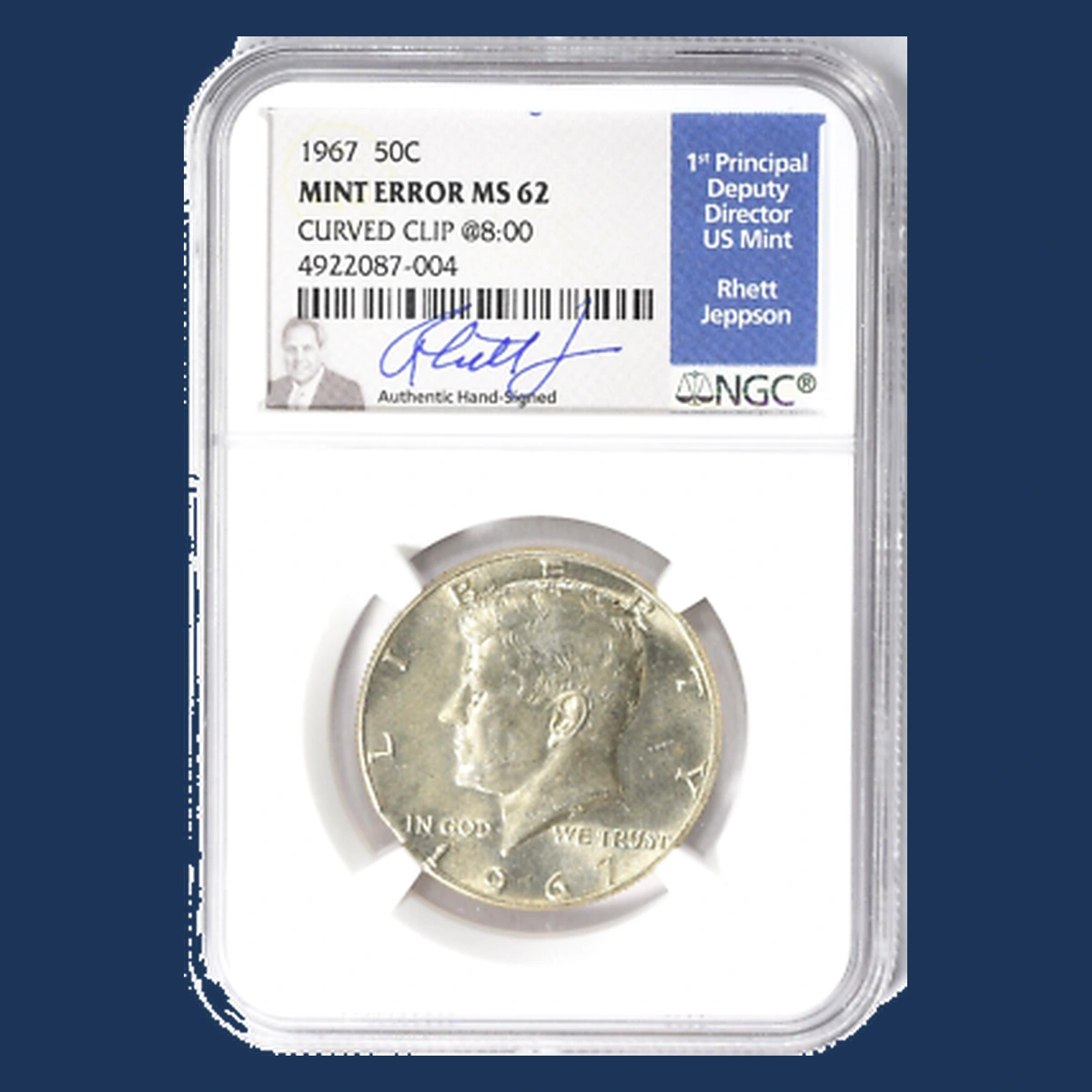
A crescent-shaped piece is missing from the rim of a known 1967 SMS half dollar. Heritage described the gap at 1 o’clock and listed the coin as NGC MS68.
That is an exceptionally well-preserved unworn grade. The missing metal, however, began before the coin received its picture.
A punch cutting discs from a metal strip overlapped a hole already in the strip. The incomplete disc then passed through the coin press.
The design formed around the curved space. Its border should look naturally stamped, rather than sharply cut after the finished coin left the mint.
Estimated Value
Small genuine clips are estimated at $50–$350. Excellent Special Mint Set condition can help place a coin near the top.
A dealer asks $90 for a different 1971-D graded PCGS MS64 with a 10% clip. That later coin has different metal and is not an SMS example.
The $90 is an asking price, not a sale. Compare the missing area, remaining rim, and condition before using it to judge a 1967 clip.
How to Identify
Use calipers across the intact part of the coin, comparing with the normal 30.61 millimeters. A scale should show less than the original 11.50 grams if metal is missing.
A low weight does not prove a clip. Grinding or cutting can also remove silver.
Through a 10× magnifier, follow the normal edge grooves into the curved gap. Look for nearby details that softened as the metal spread during stamping.
The opposite rim may also be weak, but that is only a supporting clue. On the known SMS example, examine the gap at 1 o’clock for an undisturbed stamped border without saw marks or a freshly cut wall.
2. 1967 Half Dollar Struck Through (Estimated Up to $500)
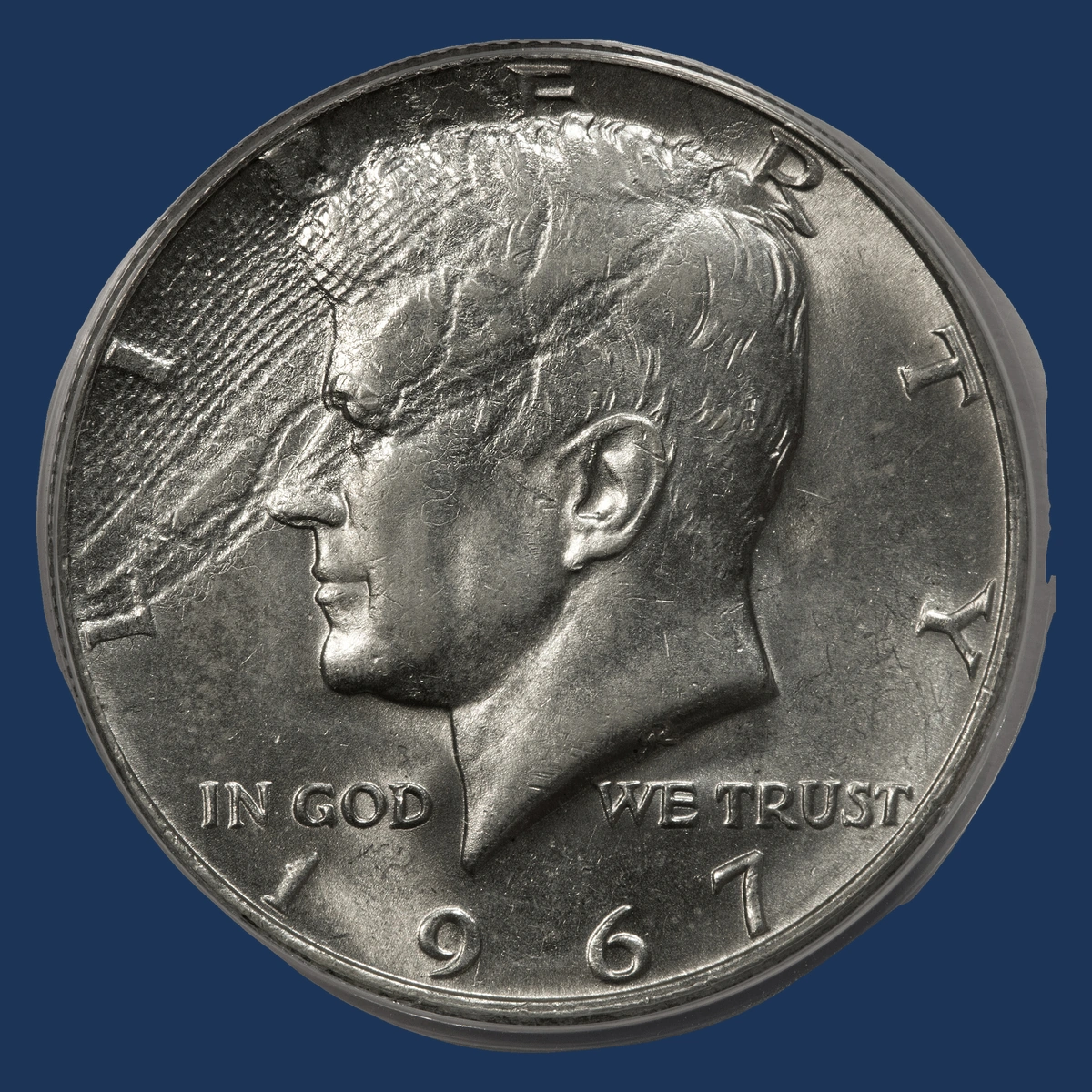
A small hollow can interrupt an otherwise sharp picture of Kennedy. Something lay between the blank and a die, the steel tool that stamps the coin.
The object blocked the design or left its own shape in the metal. This is called a strike-through.
Heritage listed two SMS examples graded MS66 and another graded MS67 Cameo. Cameo describes a frosted portrait standing out against smoother areas.
A cloth impression is separately reported on a regular circulation coin. The SMS descriptions do not name cloth, so a smooth hollow on one of those coins should not automatically be called fabric.
Estimated Value
Estimate $75–$500 for small visible impressions through larger examples on attractive SMS coins. Clear patterns usually appeal more than faint, shapeless hollows.
Sullivan Numismatics asks $125 for an undated Kennedy half graded PCGS AU58 with strike-throughs on both faces. AU58 means nearly unworn.
That offer is not a dated 1967 sale or an SMS comparison. A larger pattern and well-preserved collector finish may support a higher price within the estimate.
How to Identify
Keep the surface clean by leaving it alone; rubbing can erase fine texture. Move a low lamp across the mark and inspect it through a 10× magnifier.
A cloth impression should show a repeated woven pattern pressed into the metal. A smooth hollow may have another cause.
Check the surrounding portrait, lettering, and edge grooves for impact damage. An intact coin should measure near 30.61 millimeters with calipers and weigh near 11.50 grams on a scale.
Wear may lighten a patch without pressing it inward. Look for a depressed pattern below the normal surface, with missing design inside it and no raised lip pushed up by a later blow.
3. 1967 Half Dollar Underweight Planchet (Estimated Up to $600)
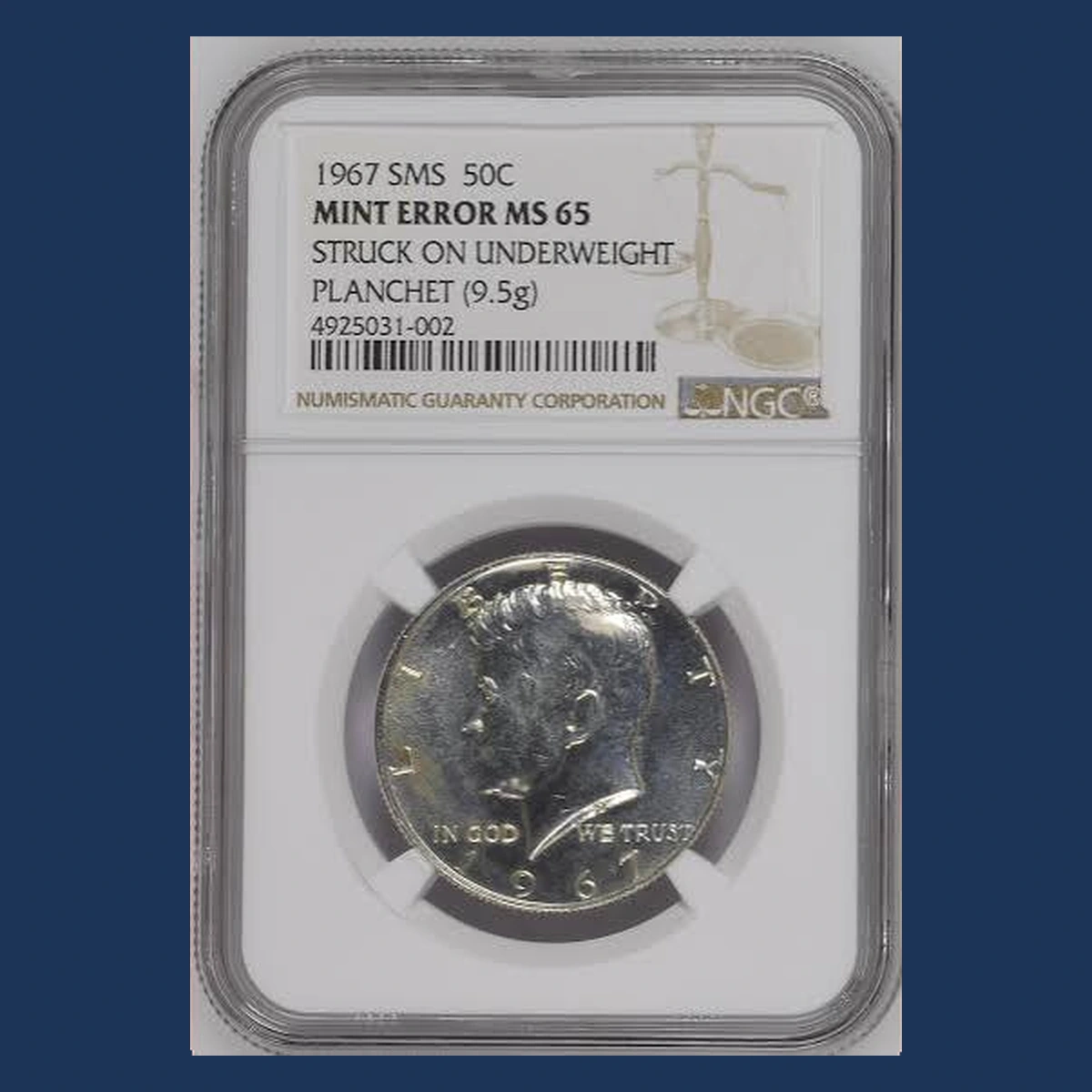
The scale reading is the unusual feature on this SMS half dollar. Heritage described the NGC MS65 coin as weighing 9.5 grams, well below the normal 11.50 grams.
It was called an underweight planchet error. Planchet means the metal blank before stamping.
This description does not identify a blank intended for a smaller coin. Nor does it prove that an outer layer fell off.
A separate missing-layer 1967 coin weighs almost the same amount. To tell them apart, examine how much design is present, how thick the coin is, and whether its outer layers remain intact.
Estimated Value
Estimate $150–$600 for a confirmed thin or otherwise underweight blank. A different 1967 MS62 with a defective blank weighed 10.8 grams and sold for $161 in 2010.
A missing-layer 1967 MS63 has also been offered for $250. That is an asking price for a different metal problem.
The 9.5-gram SMS example has a larger weight shortfall and a higher grade. Those features help compare it with the less dramatic examples.
How to Identify
Check the scale with a known calibration weight before weighing the coin. The cataloged SMS example reads 9.5 grams instead of the usual 11.50 grams.
Use calipers across the width and thickness when safely accessible. A width near 30.61 millimeters with reduced thickness could fit a thin half-dollar blank.
Now examine both faces and the edge grooves through a 10× magnifier. Look for grinding marks, rough acid damage, or the exposed surface left by a missing layer.
The low weight alone cannot tell these causes apart. Check that the coin still has its original stamped surfaces and outer layers despite being thinner and lighter than a normal half.
4. 1967 Half Dollar Split or Missing Clad Layer (Estimated Up to $900)
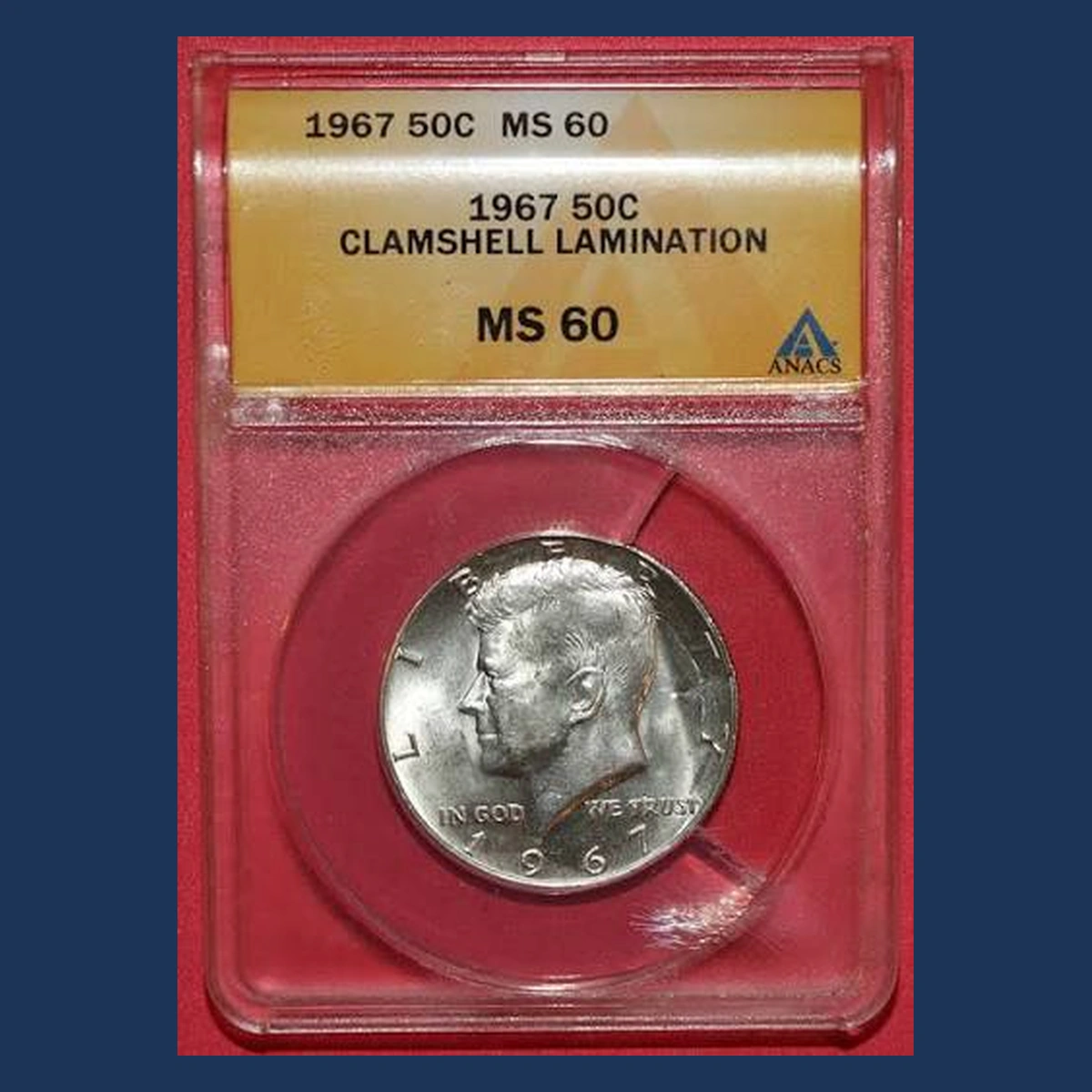
The 1967 half dollar has silver-rich outer layers around a core that also contains silver. Altogether, the coin contains 40% silver.
A weak bond can let an outer layer fall away, remain as a flap, or open like a clamshell. One auction offered two matching pieces from the same split coin.
Other listed examples include a hinged MS64, an attached-layer MS62, and a nearly unworn AU58 with a faulty front layer. They are separate coins.
A PCGS MS63 missing its front layer weighs 9.53 grams. Its exposed middle is not pure copper, even if the color looks different.
Estimated Value
The two matching pieces of one 1967 coin sold for $671 in June 2026. Sullivan Numismatics offered a missing-front-layer MS63 for $250.
These support an estimated $200–$900 range across the illustrated layer errors. The dealer’s amount is an asking price.
A matching pair can be more informative than one loose layer. The other hinged and attached-layer examples do not have individual sale prices assigned here.
How to Identify
Keep matching pieces together, and never pull an attached flap farther open. View a hinged split from the edge under a 10× magnifier.
For separated pieces, compare the inner surfaces and the picture remaining on the outside. Their shapes should fit as parts of one coin.
Weigh each safely accessible piece on a scale; the complete coin began at 11.50 grams. Calipers can compare the diameter with 30.61 millimeters, while surviving edge grooves help reveal trimming.
A 9.53-gram reading alone does not identify a missing layer. Look for the exposed inner surface and its layer boundary, or matching broken surfaces on the two pieces.
5. 1967 Half Dollar SMS Doubled Die Obverse (Estimated Up to $1,000)
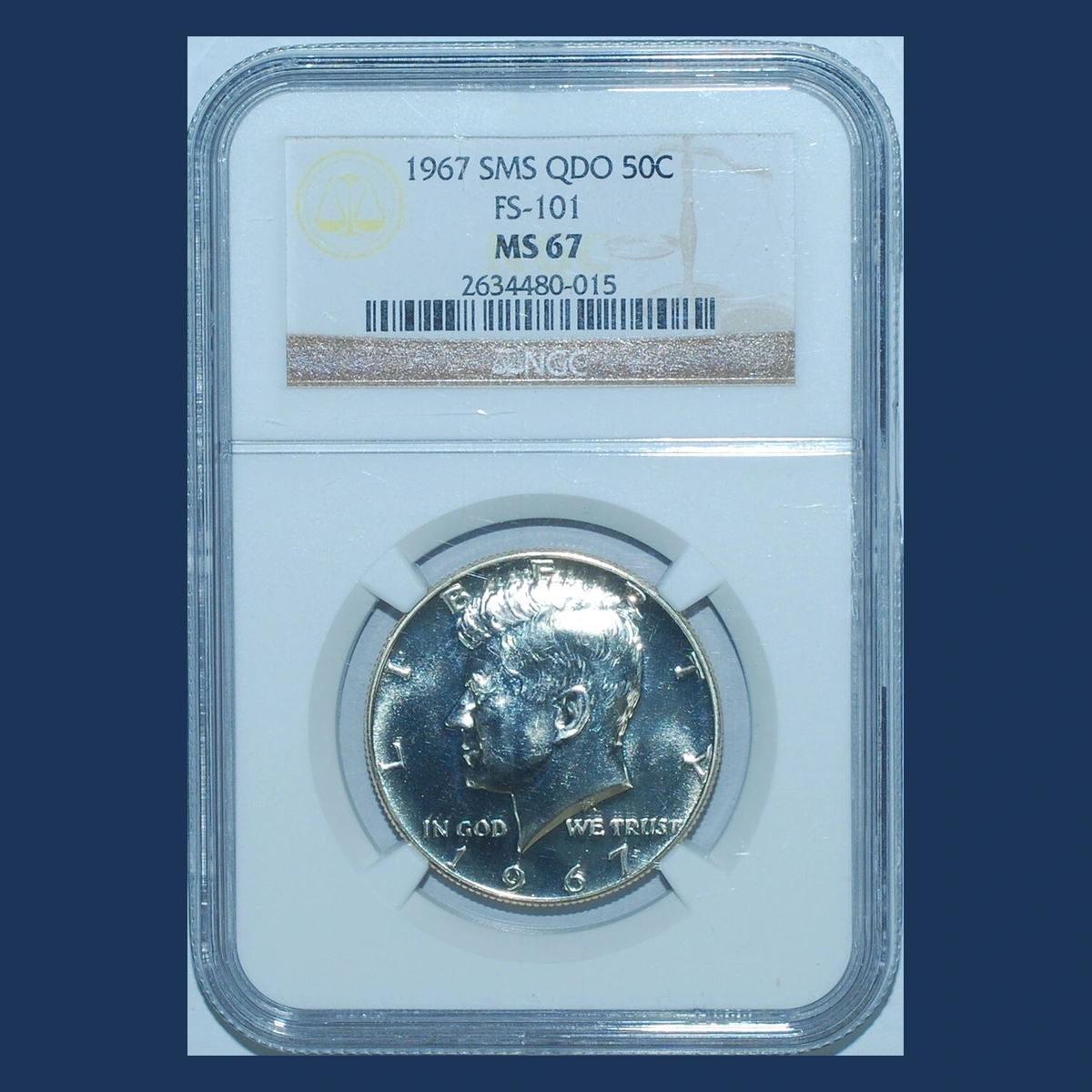
The letters can look crowded with several narrow outlines on the 1967 SMS FS-101 variety. Look especially at LIBERTY, TRUST, the upper hair, and parts of the date.
The repeated picture was already in the steel stamping tool. Each coin made with it could receive the same extra outlines.
Catalogs call the variety doubled, quadrupled, or quintupled, referring to the overlapping impressions. These names do not mean the individual coin was struck off-center several times.
Rounded extra edges and small notches at letter corners are useful clues. Thick-looking letters alone can also come from light, wear, or ordinary striking effects.
Estimated Value
An ANACS MS65 example illustrated in a specialist book sold for $159 in March 2024. Estimate $100–$1,000 for recognized examples of this SMS variety.
PCGS records $935 for an SP67 at GreatCollections in August 2014. That price belongs to one exceptionally well-preserved coin.
Visible separation between the extra outlines and overall condition both matter. A thick-looking inscription without the matching pattern should not receive the same variety price.
How to Identify
Begin at the corners of TRUST and LIBERTY rather than the broad middle of each letter. A 10× magnifier and moving light can reveal small notches and rounded extra edges.
Compare all the marked areas with clear FS-101 photographs. A date that looks doubled is not enough if the letters do not match.
When safely accessible, check with a scale and calipers against 11.50 grams and about 30.61 millimeters. Inspect the edge grooves and preserve the SMS surface.
A flat shelf that cuts into a letter’s shape can come from movement during striking. Look instead for the same rounded, raised separations across several letters and the date.
6. 1967 Half Dollar on a Wrong Planchet (Estimated Up to $3,000)
Kennedy’s picture does not fit on a blank meant for a smaller coin. Parts of the outer lettering miss the metal entirely.
A known SMS example was found in a sealed set and graded NGC MS62. It weighs 5.6 grams and was stamped on a quarter-dollar blank.
A published 1967 error list also reports a nickel-blank half dollar. That would use different metal and a different standard weight.
The sealed-set discovery belongs only to the quarter example. It does not show that the reported nickel-blank coin also came from a Special Mint Set.
Estimated Value
Heritage’s SMS quarter-blank example sold for $840 in August 2019. Estimate $600–$3,000 across confirmed wrong-blank examples.
The quarter sale helps judge the lower part of that range. The upper allowance includes the more unusual reported nickel-blank form.
It is not an auction price for the nickel example. Readable date details, the actual blank type, and remaining surface quality affect how much a collector may pay.
How to Identify
A normal 1967 half weighs 11.50 grams and spans 30.61 millimeters. Compare a safely accessible example using a scale and calipers.
A clad quarter blank starts near 5.67 grams and 24.3 millimeters. A nickel blank starts near 5.00 grams and 21.21 millimeters.
Stamping can spread either blank beyond its starting width. Under magnification, examine the edge for the quarter’s layered metal, any remaining grooves, and cuts from later trimming.
A small coin is not automatically a wrong-blank error. Look for the large half-dollar picture ending naturally at the available metal, with weight and edge metal that fit the smaller blank rather than a shaved normal half.
Conclusion
Look closely at the edge before deciding what makes a 1967 half dollar unusual. A missing piece, a lifted layer, and a smaller blank leave different clues.
The estimated range runs from $50 to $3,000. Use 11.50 grams as the normal starting weight, and compare collector-set coins with similar examples; a lack of mintmark alone does not tell you which mint made a 1967 half.