1986 Half Dollar Error List with Pictures

A broad, uneven border can tell an unusual story on 1986 Kennedy half dollar errors. One listed 1986-P was struck on a blank that skipped a normal rim-forming step.
Estimates for the errors below run from $15–$800. For comparison, a strongly clashed 1973-S Proof, a specially made collector coin, sold for $720 in October 2022; that is a different year and finish.
Other clues are much smaller, including an extra D outline or a peeling surface. Read on to see where to look and what each feature means.
1. 1986 Kennedy Half Dollar Repunched D Mintmark (Estimated Up to $60)
An extra curve beside the D may look like a second mintmark. A repunched mintmark forms when a letter punch enters the steel stamping tool, called a die, more than once.
An earlier impression can remain beside the final D. The tool then passes both outlines onto the coins it strikes.
A year guide reports this feature on 1986-D half dollars, although a matching numbered variety has not been established. Look for part of another D, rather than a thick letter or a flat step beside it.
Estimated Value
The guide estimate for a minor 1986-D repunched mintmark is $15–$60. This is a suggested collector range, not the result of a confirmed auction sale.
A clear extra curve usually helps more than a barely visible bump. Wear and scratches around the D can make the feature harder to see.
The range assumes a genuine repunched letter; ordinary doubling caused during striking does not earn the same premium.
How to Identify
Find the D below Kennedy’s portrait. With a 10× magnifier, follow its straight stem and curved outer edge, looking for a second recognizable part of the letter.
Try a second light angle before deciding. A thin, flat ledge can come from movement during striking and is different from an earlier punched D.
Compare photographs of half dollars, since a 1986-D cent with a similar feature proves nothing about this coin. Include the full date in your photograph.
A scale should show about 11.34 g, and calipers should measure about 30.61 mm across an ordinary example. Check the ridged edge too; the key mintmark clue is an extra D-shaped outline that matches a known half-dollar example.
2. 1986 Kennedy Half Dollar Clashed Dies Error (Estimated Up to $80)
A faint eagle shape on Kennedy’s portrait may seem out of place. It can appear after the two stamping tools hit each other with no coin blank between them.
That contact leaves marks on the tools, which can then transfer them to later coins. Collectors call these marks a die clash.
Reports about a 1986-D describe possible wing or shield outlines on the portrait side. A collector discussion also suggested clashing, but the reported coin has no established grading-service identification for this feature; a scratch can still look surprisingly similar.
Estimated Value
A modest clash on a regular 1986 half dollar has an estimated value of $30–$80. Clear eagle details are easier to recognize and generally more appealing than faint lines.
A 1973-S strong-clash proof, a specially made collector coin, sold for $720 in October 2022. Its PCGS PR68 Deep Cameo grade describes excellent surfaces and strong contrast between frosted designs and mirrorlike backgrounds; that different coin is not a direct price match.
How to Identify
Compare the eagle on the back with the suspicious marks on the front. Use a 10× magnifier to look for parts of a wing or shield, rather than one isolated line.
An outline overlay can help you check where the eagle would meet the portrait when the tools touch. A shape in the wrong position is not explained by this clash.
Look for scratches and crushed metal on both sides, since pressing two finished coins together can leave misleading marks. The normal ridged edge should not have a seam.
Clashing does not remove metal, so check about 11.34 g with a scale and 30.61 mm with calipers. Start with the eagle outline: its shape and position must agree with the design on the opposite side.
3. 1986 Kennedy Half Dollar Local Lamination Error (Estimated Up to $100)
Peeling metal can interrupt the smooth surface of a half dollar. This is called a lamination when a small layer separates because of a flaw in the metal.
A Kennedy half has outer metal layers bonded around a copper core. The copper stripe normally visible along its edge is part of that construction, not an error.
The 1986 guide reports local peeling without identifying a particular mint or spot on a photographed coin. A small loose flake is also different from losing an entire outer layer, and corrosion can create another misleading appearance.
Estimated Value
The estimated range for a local lamination is $15–$100, following the year guide’s figures for defective blanks. The amount covers the whole coin.
A retained flake crossing a recognizable part of the design may attract more interest than a short seam near the edge. Condition matters as well.
This range applies to a genuine metal flaw from production, not corrosion or a surface deliberately peeled after the coin was made.
How to Identify
Leave any loose flake alone. Pulling it away destroys part of the evidence and can damage the coin further.
Use a 10× magnifier to follow the seam around the flake. Check whether a thin layer is separating, or whether a scrape has pushed metal into sharp ridges.
Look along the ridged edge for the normal copper stripe, then trace any unusual split onto the face. A copper-colored stain by itself does not show that metal has peeled.
Measure the diameter with calipers against the normal 30.61 mm. A scale may read below 11.34 g if part of the surface has fallen away, though wear also reduces weight.
Look first for an actual lifting layer or split, with the surrounding design continuing up to its boundary.
4. 1986 Kennedy Half Dollar Doubled Die Obverse (Estimated Up to $200)
Small splits in LIBERTY or IN GOD WE TRUST are worth a closer look. A doubled die is a stamping tool that already carries two slightly different versions of part of the design.
It can leave matching extra outlines on many coins. That differs from a tool moving while it strikes a single coin.
Reports for 1986 Philadelphia and Denver halves mention the lettering and date, but do not establish a specific numbered variety. An apparently doubled edge needs comparison with the rest of the design before it earns this name.
Estimated Value
Use $50–$200 as an estimate for a convincing example, with clearer doubling and better condition helping its value. The available year reports do not establish a confirmed sale for a particular 1986 variety.
For comparison, a recognized 1974-D FS-101 doubled die sold for $49 in May 2026. ANACS graded it MS64, meaning no circulation wear and relatively few marks; that earlier coin does not confirm the identity of a 1986 find.
How to Identify
Check several letters before focusing on the date. Under a 10× magnifier, inspect letter corners for small splits and look for two rounded outlines where one normally appears.
A flat shelf that cuts into a letter often points to movement during striking. Soft, swollen lettering may instead come from a worn stamping tool.
Use a normal coin from the same mint as your comparison. Photograph LIBERTY, the motto, the full date, and the mintmark clearly enough to compare the shapes.
The usual weight is 11.34 g on a scale, with a 30.61 mm diameter measured by calipers and a ridged edge. The strongest first clue is the same pattern of extra outlines appearing in several letters, rather than one bright edge.
5. 1986 Kennedy Half Dollar Clipped Planchet Error (Estimated Up to $250)
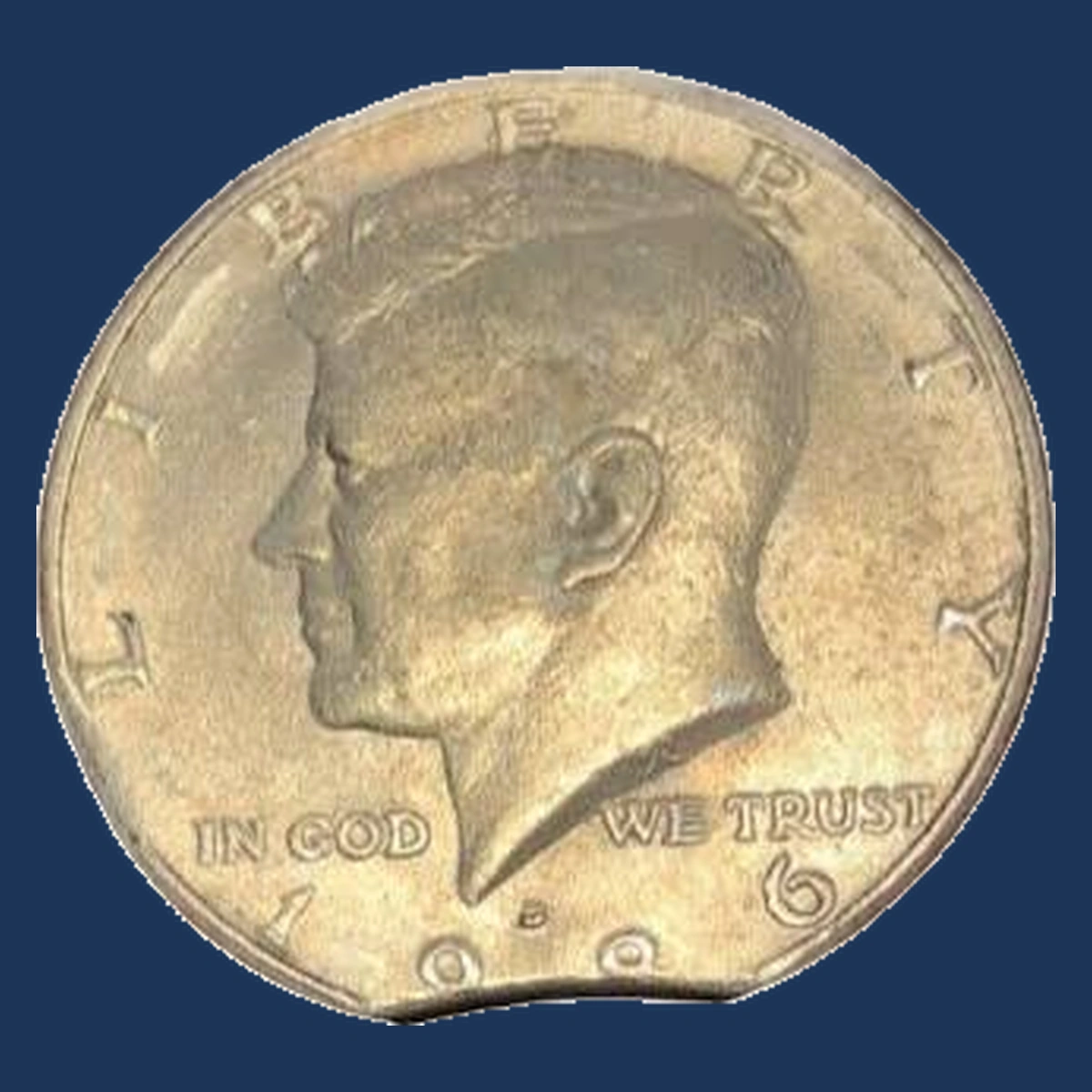
A missing bite along the edge may have been there before the coin was struck. This happens when the machine cutting round blanks overlaps an earlier opening in the metal strip.
The missing section is often curved. A blank cut across the strip’s outer boundary can have a different shape.
The 1986 reports do not identify a particular clip shape or size. Because less metal was available during striking, the nearby design may be weak; the rim opposite the opening can also be weak, although this does not appear on every genuine clip.
Estimated Value
An estimated $15–$250 covers small through conspicuous genuine clips on ordinary 1986 halves. A clear missing section, readable date, and pleasing surfaces all help collectors compare examples.
The lower end suits minor clips, while larger, attractive examples can reach higher levels. These are estimates rather than documented 1986 auction results.
Do not assign a price from a claimed percentage alone; the shape, surviving design, and evidence of original manufacture matter together.
How to Identify
Turn the coin so you can see both ends of the missing section. Examine those meeting points with a 10× magnifier, checking how the rim and nearby letters approach the opening.
The cut wall should show the coin’s bonded layers around its copper core. Fresh burrs, parallel file marks, or sharp new cuts suggest metal removed after striking.
Weigh the coin on a scale against the normal 11.34 g. Use calipers across undamaged metal to compare with 30.61 mm; a low weight alone does not prove a clip.
Weakness opposite the opening can help, but it is not required on every example. Check the two ends first: a convincing curve with freshly cut ends is still a damaged coin.
6. 1986 Kennedy Half Dollar Off-Center Strike Error (Estimated Up to $400)
An off-center strike leaves part of the blank empty while some of the design runs off the other side. The metal blank was in the wrong position when the stamping tools came together.
Both faces should show the effect. If only one side has an uneven border, a shifted tool may be the better explanation.
Year guides list off-center 1986 halves, but do not identify a particular auctioned example or a measured percentage. Judge the coin in front of you; a large smooth patch is not enough to establish this error.
Estimated Value
The guide-based estimate is $30–$400, covering small shifts through more obvious examples with useful identifying details. A full date and mintmark often make a coin easier to collect.
More blank space does not always mean a better coin. Heavy damage or a missing date can reduce interest, even when the shift is dramatic.
These figures combine published guide estimates; they are not prices from a series of confirmed 1986 auction sales.
How to Identify
First turn the coin over. The front and back should both show a partly missing design and a related area that never received the design.
Use a 10× magnifier to inspect that empty metal. Polishing can erase details after striking, but it leaves a different surface from an untouched blank.
Check the complete date and the P or D mintmark wherever they survive. A partial number should not be assumed to say 1986.
A scale can compare the weight with the normal 11.34 g, while calipers record the actual width against a normal 30.61 mm coin. Expansion can change the outline and interrupt the usual edge ridges.
The quickest useful comparison is between the two faces: both should support the same off-center strike.
7. 1986 Kennedy Half Dollar Struck-Through Error (Estimated Up to $600)
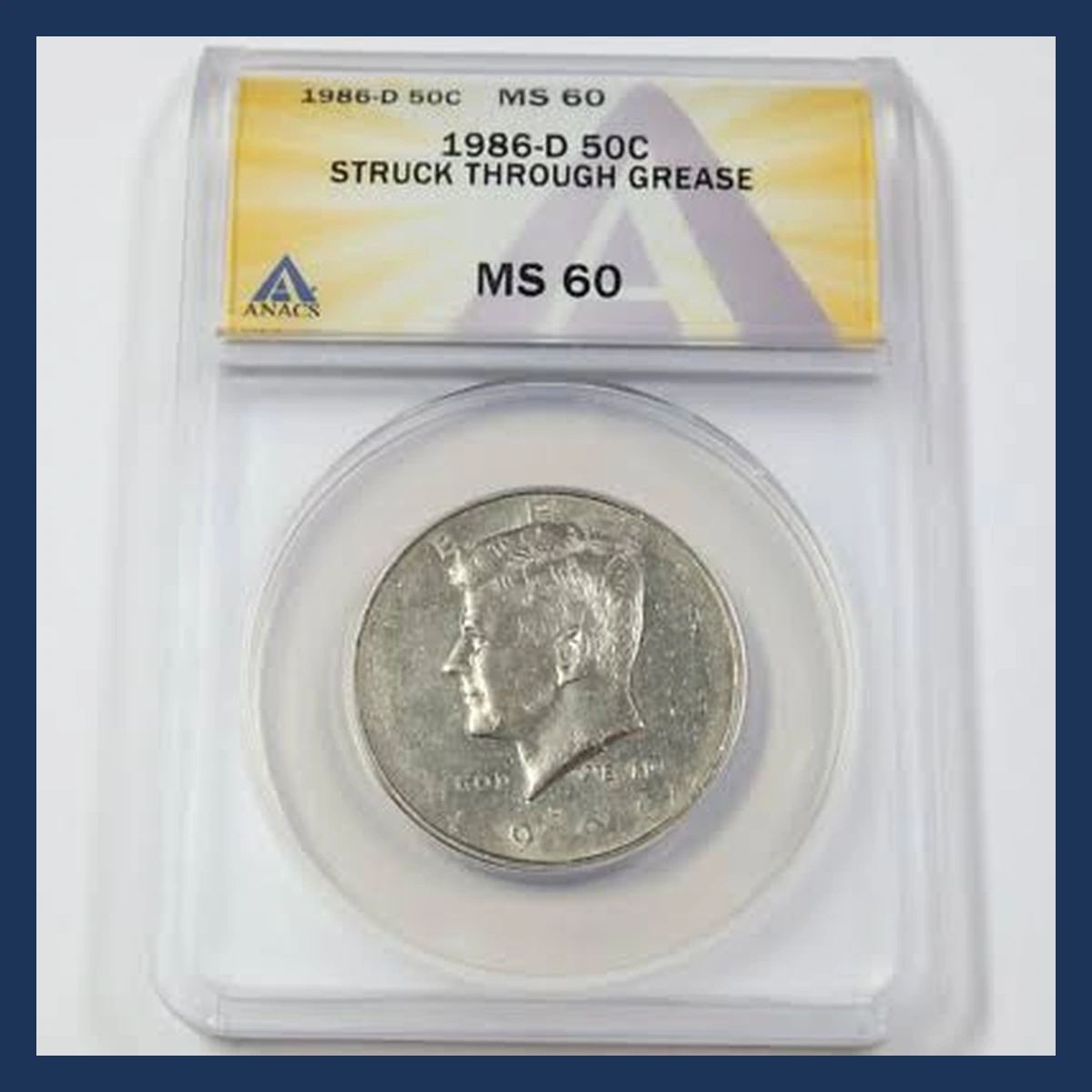
A faint first digit is one reported 1986-P feature; another Philadelphia coin has an impression left by debris. Grease can block small design details, while a harder object can leave a deeper mark.
The debris example has an ANACS Details label noting scratches. Those scratches are separate damage.
A proof-set listing reports another mark near the short rays above the olive branch on the back, around nine o’clock. A proof is a specially made collector coin; the set suggests an S-mint coin, but its own mintmark must support that identification.
Estimated Value
Weak details fall around $25–$150 in the year guide. A clearer debris impression or notable collector proof supports the broader estimated range of $25–$600.
A clad 1976-D half dollar struck through material on both sides sold for $114 at Heritage in March 2025. It provides a different-year comparison, not a sale price for any of these 1986 reports.
Scratches on the reported ANACS coin should lower its appeal compared with an otherwise similar undamaged example.
How to Identify
For the weak date, use a 10× magnifier around the missing first digit. Seeing only “986” does not prove either the full date or grease as the cause.
On the debris example, separate the sunken impression from scratches crossing the surface. A scratch can push metal up along its sides, while an obstruction during striking interrupts the design differently.
Check the proof’s actual S mintmark and look through the plastic from several angles. A line on the holder can appear to be on the coin.
All 1986 halves use bonded metal layers, including proofs. Check recorded measurements for sealed coins, or use a scale and calipers for the normal 11.34 g and 30.61 mm.
Focus on the boundary of the weak or sunken area, then compare the untouched design immediately beside it.
8. 1986 Kennedy Half Dollar Broadstrike on a Type 1 Blank (Estimated Up to $800)
A wide border surrounds the design on the 1986-P example listed in the Calkins error collection. PCGS graded it MS62, meaning no circulation wear but noticeable marks.
The coin was struck on a Type 1 blank. This is a metal disc that skipped the usual step of squeezing its edge to form a raised rim.
It also spread outward during striking because the surrounding restraining ring did not hold it in place. That makes it a broadstrike on an unfinished half-dollar blank, rather than a coin made on another denomination’s metal.
Estimated Value
The estimated range is $150–$800 for a genuine example, depending on condition and a firm identification of the unfinished blank. The collection listing gives no sale price for its 1986-P.
An ordinary 1990-P broadstrike sold for $192 at Heritage in March 2025. Its ANACS MS61 grade means no circulation wear but numerous marks; that different-year coin helps compare broadstrikes, although it was not listed as a Type 1 blank.
How to Identify
Look for the complete design inside an unusually wide outline. Missing parts of the design may point toward an off-center strike instead.
Compare the perimeter with the listed Type 1 example using a 10× magnifier. A wide border alone cannot prove that the blank skipped the rim-forming step.
Calipers can show expansion beyond the normal 30.61 mm width, while a scale should usually remain near 11.34 g. Use recorded measurements if the coin is sealed in a grading holder.
Check altered or absent edge ridges and reject borders flattened by hammering. The P and full date should also remain readable.
Begin with the complete design and expanded edge, then compare that edge with the identified unfinished-blank example.
Conclusion
Start with the visible clue: an extra letter outline, a peeling layer, or a border wider than usual. These features come from different steps in making a coin, so they need different checks.
The estimated $15–$800 range covers the examples discussed here. Keep the date, mintmark, and both faces visible in your photographs, and leave loose metal untouched while you compare your find.