1833 Quarter Error List with Pictures

The small word OF can lead you to one of the most interesting 1833 quarter errors. Other examples carry rough spots or faint extra outlines from damaged stamping tools.
A sharply preserved 1834 quarter sharing the unusual lettering sold for $11,400 in March 2019. That is a different-year comparison, not an 1833 sale.
Estimated whole-coin values below run from $75 to $12,000. Start with surface texture, then compare transferred shapes and the lettering beside the eagle.
1. 1833 Capped Bust Quarter Raised Roughness from Rusted Dies
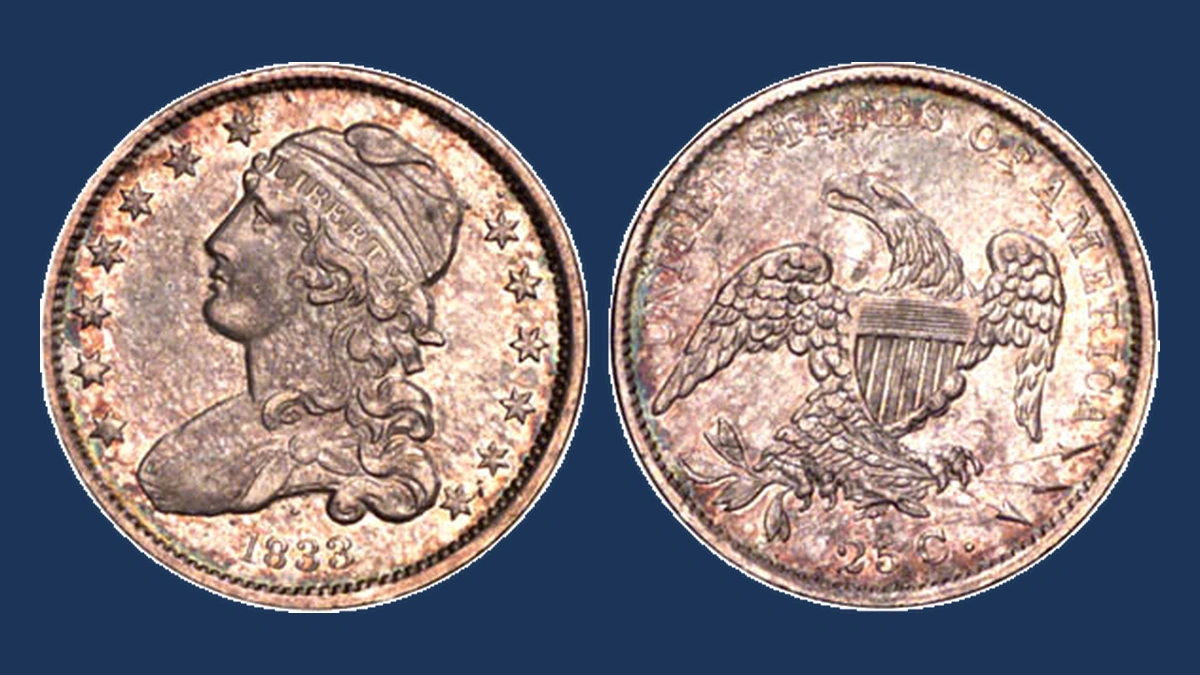
A patch of small raised bumps can begin with damage to the tool rather than damage to the silver coin. Rust eats pits into a die, the steel tool that stamps a coin.
Silver pushed into those pits leaves raised spots on later coins. Small pieces breaking away from the tool can also leave rough patches.
This surface damage is reported on later examples of the 1833 B-1 variety. B-1 identifies a particular pair of stamping tools.
The roughness must be distinguished from corrosion that attacked a finished coin after it left the mint.
Estimated Value
Estimate $75 to $2,000 for worn through lightly worn 1833 examples with convincing raised roughness. A small patch adds less interest when heavy wear has already blurred the design.
An older comparison is the $1,380 January 2006 sale of an 1837 quarter with clash traces and a crack. It illustrates the value of a well-preserved early quarter, not a price for rust alone.
Corrosion on the coin itself can reduce its appeal.
How to Identify
Tilt the coin under a single light and watch the suspected rough patch. Raised bumps cast shadows differently from pits sunk into the silver.
Do not scrape the surface. Photograph the patch from two lighting directions, keeping nearby letters or portrait details in view.
Next inspect the surrounding metal for corrosion, crust, or scratches. Damage after minting often interrupts the original surface, while roughness copied from a tool can repeat on other coins.
A matched B-1 example is especially helpful because the reported patches do not have a published location in this account. Compare their shapes and positions, not simply whether both coins look rough.
2. 1833 Capped Bust Quarter Faint Designs Left by Clashing Dies
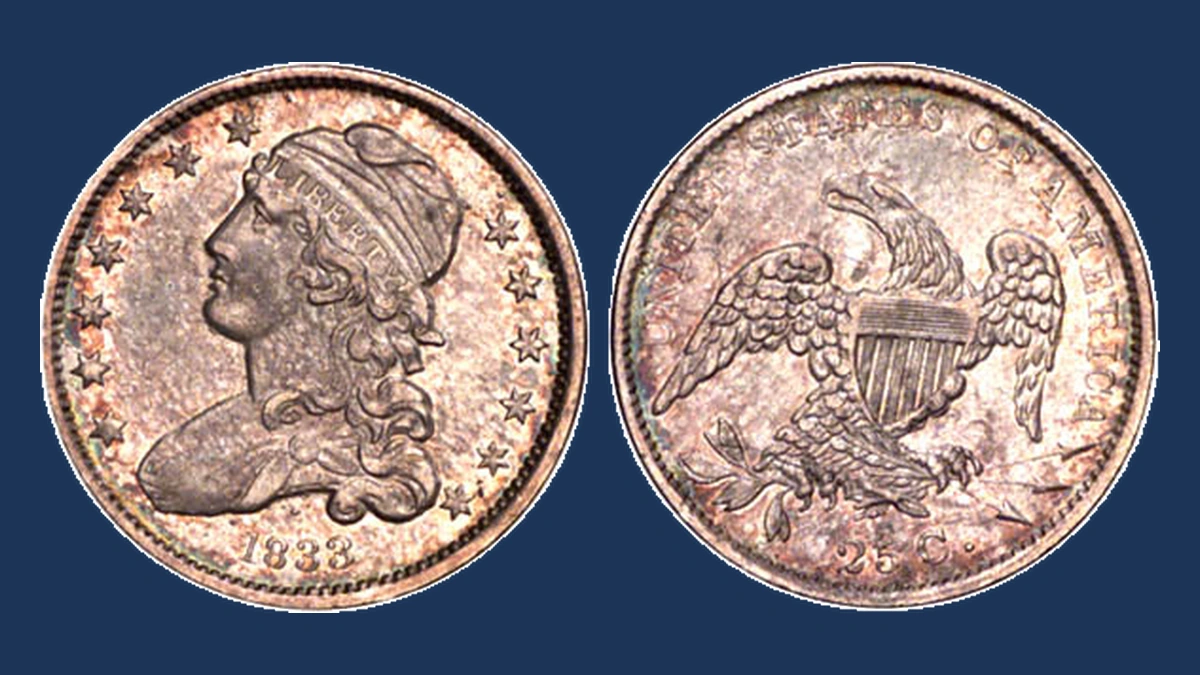
A faint extra outline can appear where the ordinary design has no matching feature. An 1833 B-1 collector record reports visible marks from clashing dies.
This happens when the two stamping tools strike each other without a silver blank between them. Part of one design can mark the opposing tool.
Later coins then pick up that unwanted outline alongside the intended portrait or eagle. The extra shape may be weak and incomplete.
A coin can show both clash traces and roughness from tool damage. Those features have different causes even when they appear together.
Estimated Value
For a genuine 1833 clash on a worn through lightly worn coin, allow an estimated $100 to $2,500. Larger, recognizable transferred shapes are easier for buyers to appreciate than isolated faint lines.
The $1,380 1837 comparison combines a clash, a crack, and attractive preservation. It is not an 1833 transaction.
If your coin also has raised rough patches, assess the complete example once. Adding separate maximum estimates would overstate the value of that single coin.
How to Identify
Start with photographs of both faces, keeping the date upright in the front view. Mark where the extra outline lies without tracing anything on the actual coin.
Compare that outline with the opposite design at the same size. A partial match to a real design shape is more useful than a lone straight line.
The 1833 report does not name a particular feather, letter, or curl as the transferred feature. A specialist image comparison should establish that detail before a label is assigned.
Use changing light to separate the mark from a fresh cut. A scratch can cross letters and leave pushed-up silver along its sides; those edges do not turn it into a clash.
3. 1833 Capped Bust Quarter O/F Lettering Variety
Look at OF above the eagle, especially the upper-right part of O. The familiar O/F name describes an unusual letter feature on the 1833 B-2 quarter.
Additional traces around the nearby lettering, including A in AMERICA, help place it within the correct design. The name does not mean that every outline forms a clear, complete F.
A collector study describes an engraving anomaly rather than firmly identifying a doubled die. That distinction matters because several minting processes can leave apparently repeated letter edges.
Estimated Value
Estimated values of $100 to $12,000 cover worn examples through attractive unworn coins with this lettering. Heavy wear can make the small traces difficult to judge.
A different-year 1834 example sold for $11,400 in March 2019. Its back was struck with the same tool previously used for 1833 B-2.
That coin was graded MS65, meaning unworn with strong overall preservation. Its price reflects the complete coin and condition, not an added charge for O alone.
How to Identify
Locate OF between the surrounding back lettering and the eagle. With a 10× magnifier, inspect the upper-right edge of O before moving to F and the A of AMERICA.
A clear close-up should include all three letters. A tiny crop of O can hide whether it belongs to the correct coin or has been altered.
Compare the shapes with a recognized 1833 B-2 example rather than expecting a fully formed F inside O. The O/F name is a convenient label, not a drawing instruction.
Finally, keep ordinary shield details out of the error count. Differences in the number of lines within the shield belong to the design and do not by themselves establish another minting mistake.
Conclusion
Tiny bumps, transferred outlines, and unusual lettering call for different checks on an 1833 quarter. A rough surface alone does not prove that the mint caused it.
The estimated range is $75 to $12,000, including the value of the entire early silver coin. Sharp lettering and undisturbed surfaces help make each feature convincing.
Photograph both faces before enlarging the mark, so its position remains clear.