1938 Quarter Error List with Pictures

Could a piece of string leave a collectible mark on silver? A 1938-S quarter carrying just such an impression sold for $312 in June 2025.
That find is one of several 1938 quarter errors worth recognizing, from doubled lettering to an incomplete metal disk. Estimated values here stretch from $20 to $3,500.
The following guide shows what each feature looks like and which comparisons help explain its value.
1. 1938 Washington Quarter Lamination
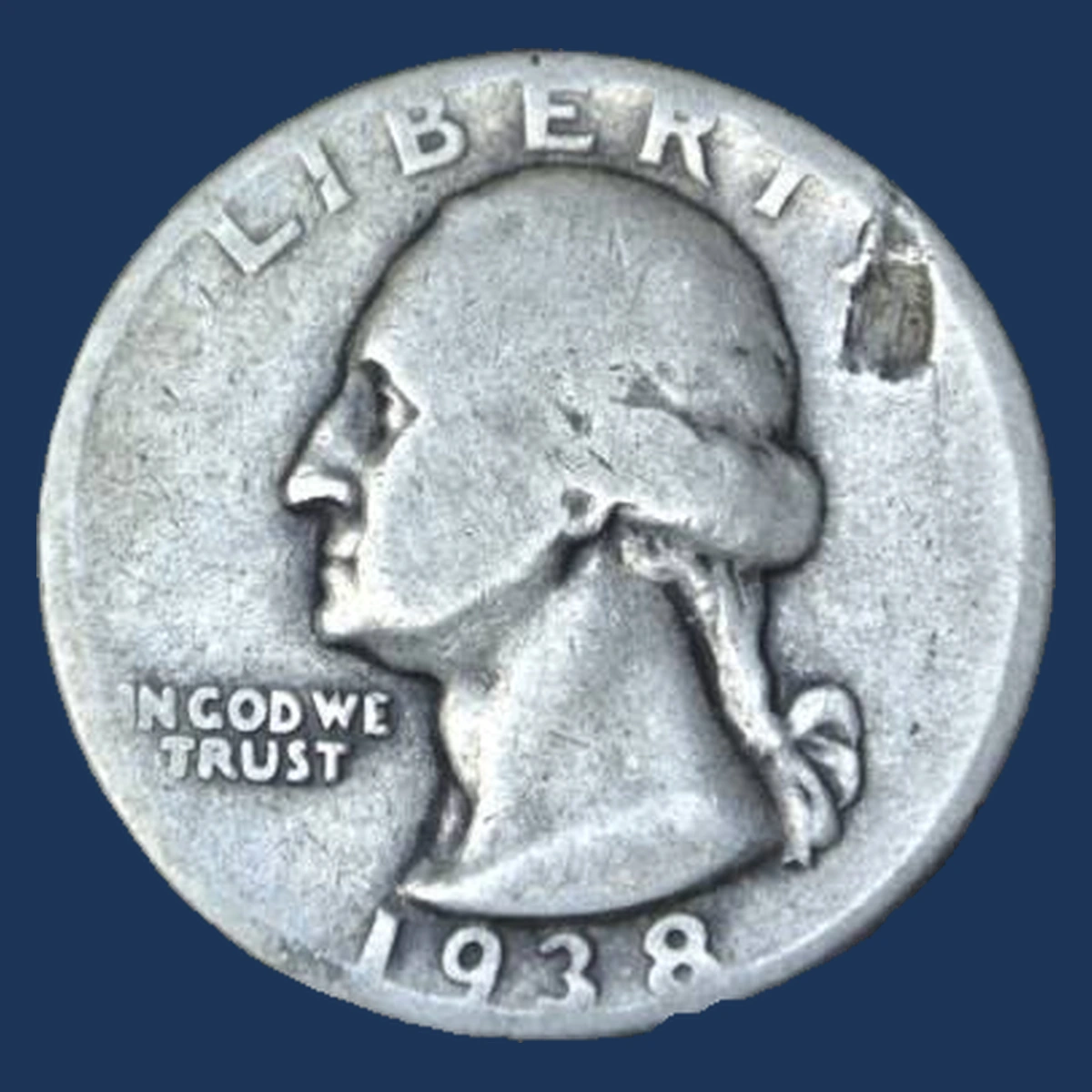
A flake of the coin’s own silver can separate and leave a rough patch behind. Collectors describe this peeling-metal defect as lamination.
A marketplace listing reports a 1938 silver quarter with this feature. The listing alone does not identify where the metal split or establish the mint letter.
The problem begins with a weak area inside the alloy. That weakness may open before or after the design is struck.
Timing affects the appearance: some flakes carry struck detail, while an earlier separation can leave a surface that later receives the design.
Estimated Value
For an authentic 1938 lamination, estimate $20 to $300. A small patch on a worn coin usually adds less than a prominent attached flake on an attractive example.
A clear separation across recognizable design is easier to appreciate than scattered roughness. The latter may simply reflect corrosion or old damage.
An error does not erase the value effects of cleaning, scratches, or heavy wear. Judge those condition problems alongside the size of the original metal defect.
How to Identify
Do not test a raised flake with a fingernail. Begin with photographs that show whether it is still connected to the coin.
Look along the exposed edge of the layer for a continuous separation within the silver. Then examine the design crossing it: detail on the flap can help show that the metal was present during striking.
A missing patch needs a different comparison. Look for a peeling boundary rather than numerous isolated corrosion pits, and check for scratches from someone trying to remove metal.
If the coin is loose, record its weight without pressing against a fragile flap. The normal 6.25-gram weight is only a guide, since an attached layer has not yet removed metal from the coin.
2. 1938 Washington Quarter Clipped Blank
The reported 1938 clipped quarter has missing metal near the rim above and left of IN GOD WE TRUST. Its outline should be studied from both faces, not judged by touch.
A clip begins while plain coin disks are being cut from a metal strip. If a cut overlaps an earlier hole or the strip’s edge, the new disk is incomplete.
The press can still stamp that disk with a quarter design. Metal near the missing section may flow differently, changing the nearby rim and letters.
The report does not establish a precise missing percentage.
Estimated Value
An estimated $25 to $350 covers ordinary genuine 1938 clipped examples. A readily visible gap with an intact date generally attracts more attention than a tiny edge irregularity.
For comparison, a later 1966 quarter with a straight clip brought $124 in June 2024. Its shape and metal differ from the reported 1938 piece.
Use the comparison for scale, then judge the actual gap, wear, and condition of the surrounding rim.
How to Identify
The report places the missing metal above and left of the motto. Find that area in a full front photograph, then request the corresponding back and edge views.
Pay particular attention to the two ends of the gap. A cut made after striking may slice cleanly through fully formed rim detail or leave tool marks along the exposed metal.
A genuine incomplete disk can develop softened rim detail beside the gap. The opposite rim may also be weak, though that feature is not required on every clip.
Weigh a loose example and compare the lost mass with the visible missing area. A suspicious cut remains suspicious even if it makes the coin lighter; the surrounding struck detail must explain when the gap formed.
3. 1938 Washington Quarter Reported S-over-S Mint Mark
A second curved outline around the S would point to a repeated mint-letter punch. The 1938 year lists report S-over-S quarters, although a particular coin still needs a matching example.
The S sits below the wreath on the back. It identifies San Francisco.
At that time, a worker punched the mint letter into the die, the steel tool that stamps coins. A shifted second punch could leave traces of the earlier S.
A thick letter alone does not prove this happened. Wear, small dents, and shadows can all make an ordinary S look irregular.
Estimated Value
A genuine, identified 1938-S repunched mint mark is estimated at $30 to $600. A distinct second letter on an unworn coin belongs above a faint remnant on a worn example.
The same feature must be visible in photographs taken with different lighting. An apparent extra curve that disappears when the light moves is a poor basis for a premium.
This range applies to a verified repeated S, not every quarter with a thick or damaged mint letter.
How to Identify
Before tracing the S, photograph the complete coin and its date. A catalog match must belong to a 1938 Washington quarter, not another denomination bearing the same year.
Enlarge the letter below the wreath and follow its normal upper curve, middle, and lower curve. Draw those edges on a copy of the photograph.
Now try to connect the extra raised portion into another recognizable S. A lone blob is not enough.
Move the lamp and take another photograph. A dark border that vanishes with its shadow is different from a raised punch remnant.
Ask a mint-variety specialist to compare the repeated shape with an identified example. Keep the original surface untouched so small dents and die chips can be separated from actual letter outlines.
4. 1938 Washington Quarter Struck Through String or Filled Die
A narrow impression and a softly missing letter can both result from material interrupting a strike. Their shapes tell different stories.
Heritage sold a 1938-S quarter identified as struck through string. It was graded MS66 by PCGS, meaning an unworn coin with very few marks.
Other 1938 reports describe weak detail attributed to a filled die. Grease or debris can block the recessed parts of the steel tool and prevent letters from forming fully.
A soft patch does not reveal the exact blocking material. The identified string coin is a separate example, not proof that weak areas came from string.
Estimated Value
The 1938-S string-impression quarter sold for $312 on June 23, 2025. That price includes its attractive MS66 condition.
For this group, estimate $20 to $800. Minor soft detail on worn coins occupies the lower end, while a clear, unusually shaped impression can command more.
Compare the visibility of the feature as well as the overall condition. A broad weak patch on a heavily worn coin should not inherit the string example’s certified grade or price.
How to Identify
Decide whether you are looking at a shaped depression or merely weak design. For a suspected string impression, follow the whole recessed path and compare it with photographs of the identified 1938-S coin.
For weak letters, inspect nearby detail at a similar height. A blocked part of the die can leave one area weak while adjacent lettering remains sharp.
Wear usually affects exposed high points more broadly. Scraping may also remove detail, but it leaves disturbed metal or scratches across the affected area.
Inspect both faces before drawing a conclusion from one missing letter. Do not clean the weak patch or pull out material that may remain in a recess.
If the original holder identifies string, preserve it and photograph the complete label together with the coin.
5. 1938 Washington Quarter Doubled Dies
The letters in IN GOD WE TRUST are the place to examine the known 1938 front-doubled variety. Extra raised edges can make those letters appear wider or split.
NGC’s description also notes lighter doubling on the back. These Philadelphia varieties are separate from the reported S-over-S mint letter.
A doubled die acquires a repeated design during its manufacture. The same doubled feature then appears on the coins it strikes.
Front and back varieties do not have to occur together. An identified doubled motto should not lead you to assume that the eagle is doubled too.
Estimated Value
Estimate $50 to $2,000 for an identified 1938 doubled-die quarter, with the strongest prices requiring clear doubling and excellent condition. Less obvious back doubling can add much less than a strong front variety.
A 1942 Philadelphia back-doubled quarter graded MS64 sold for $517.50 in February 2009. It offers a silver-quarter comparison, not a price record for the 1938 motto variety.
Compare the actual strength of the repeated design before applying a large premium.
How to Identify
An enlarged photograph of a known 1938 motto variety is more useful than a general picture of a doubled coin. Compare its letter ends and corners with your coin, keeping both photographs upright at similar magnification.
Check several neighboring letters in IN GOD WE TRUST for matching split raised outlines. Change the lighting to separate actual relief from shadows, and watch for flat shelf-like edges caused by movement during striking.
Treat back doubling as a separate identification question, even after the front has been matched. Obtain an identified back-variety photograph before choosing details to compare, because the general report does not specify a particular doubled feather, arrow, or letter.
6. 1938 Washington Quarter Off-Center Strike
An off-center quarter keeps part of its metal blank while part of its design disappears beyond the edge. The disk was sitting in the wrong place when the tools struck it.
Year guides report this error for both Philadelphia and San Francisco in 1938. Each coin still needs its visible date and mint identification.
The amount of blank metal can vary greatly. A slightly shifted design and a large half-empty disk therefore belong to very different price levels.
An uneven rim on just one face can have another cause. Both sides must show how the disk met the striking tools.
Estimated Value
A dated, genuine 1938 off-center quarter is estimated at $150 to $3,500. The upper portion is for dramatic, attractive examples retaining enough design to establish the year.
A different silver-era example, a 1943-S quarter struck 35% off center, sold for $2,640 in July 2022. It demonstrates demand for a substantial visible shift.
A small displacement on a worn 1938 coin would normally sit well below that comparison, even with a readable date.
How to Identify
An uneven border alone is not enough: some shifted strikes lose design, while others retain every outer detail. Compare full photographs of both faces and check whether the missing image continues beyond the metal’s outer edge.
Trace the empty area to make sure the metal is present but unstruck. A gap where metal is absent points toward a clipped disk and needs a different edge examination.
Read all surviving date digits, then look below the wreath for an S if San Francisco is claimed. The mint cannot be guessed merely because the letter falls outside the struck portion.
If the opposite face remains normally centered, have a specialist investigate die alignment. Both images must fit the proposed position of the disk inside the press.
Conclusion
The $20 to $3,500 estimated range covers both subtle surface features and large striking mistakes. The $312 string-impression sale shows how an ordinary-looking mark can interest collectors when its mint origin is clear.
Study the affected feature before comparing grades or prices. Keep the small S, complete date, and both faces in your photographs, and leave loose silver flakes or trapped material untouched.