1969 Quarter Error List with Pictures
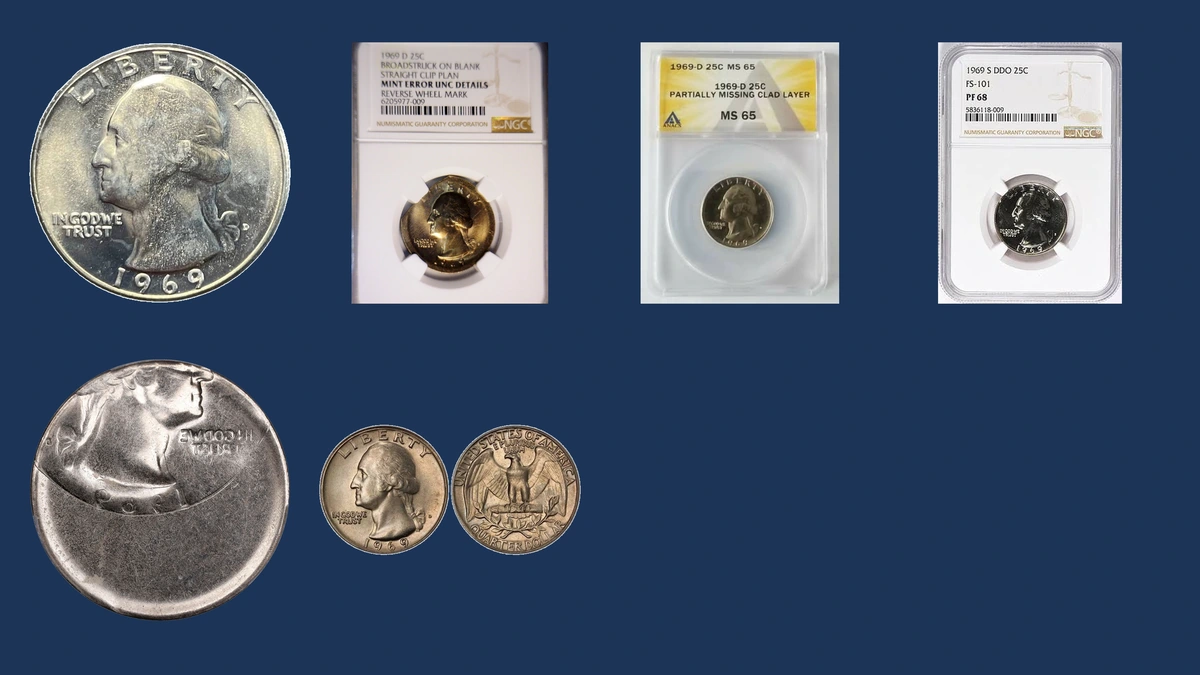
Two blank faces tell the story of an unusual 1969-S quarter pair: the coins were trapped together when struck. The pair, with both coins graded NGC PR67, sold for $2,760 in August 2020.
Most 1969 quarter errors are single coins, including repunched mint letters, missing layers, and designs struck on the wrong metal. Estimated prices in this guide range from $10 to $4,000.
Read on to learn which visible features explain the error and which measurements are actually useful.
1. 1969 Washington Quarter Uneven Outer Layer
An outer metal layer can vary in thickness instead of covering the coin evenly. A 1969-S Proof was cataloged with an uneven clad layer and graded ANACS PR66.
Clad describes the bonded layers used to make the quarter: silver-colored outer metal covers a copper center. A Proof is a specially prepared collector coin, which makes surface differences easier to notice under good light.
Uneven layering is not the same as an entirely missing layer. Nor does a dark patch alone prove that the metal thickness changed during manufacture.
Estimated Value
An estimated $10–$100 suits a modest, confirmed uneven-layer Proof, with the strength of the visible feature and overall preservation affecting its value. The recorded PR66 example was reported sold for $14 in April 2006.
That old, low-priced result shows why an unusual label need not imply a major premium. Haze, spotting, or scratches can reduce appeal, while a clear layer boundary and attractive original surfaces make the feature easier to appreciate.
How to Identify
View the edge as well as the face under soft light, looking for where the bonded outer metal becomes uneven. Turn the coin slowly to separate a physical boundary from a reflection moving across the Proof’s shiny surface.
Use a 10× magnifier to examine that boundary for pitting, scratches, or material sitting on top of the original surface. A patch of toning or residue can change color without changing the thickness of the metal beneath it.
Compare the area with a reliably identified uneven-layer example, keeping the viewing angle similar. Do not rub or polish the spot; establish that the actual outer metal varies rather than treating every patch of color as a layer error.
2. 1969 Washington Quarter Unusual Color from Annealing
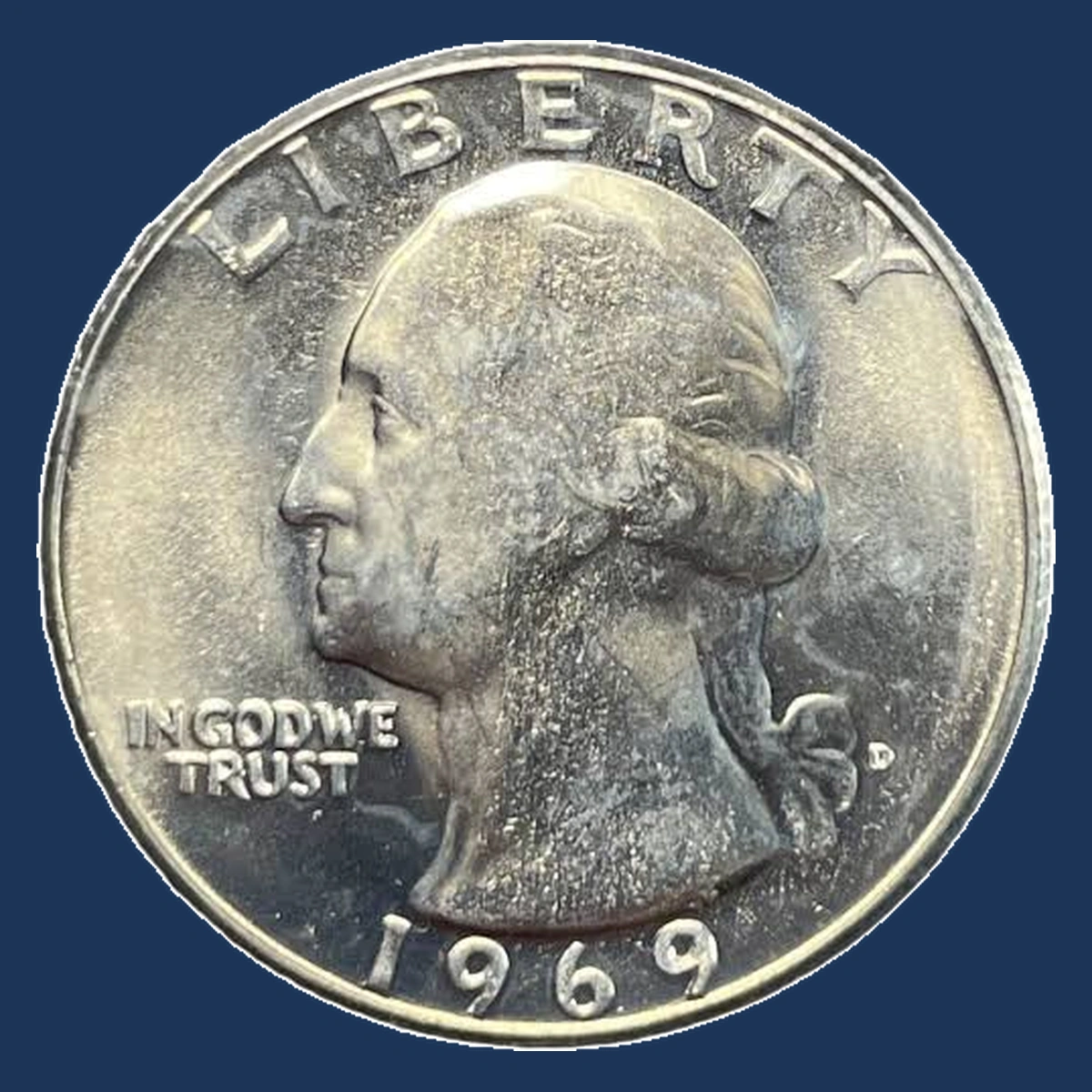
Coppery or blotchy color can appear when the blank’s heating process goes wrong. Annealing is the heating step used to soften metal before the design is struck.
This error is reported for 1969 quarters, but color alone cannot establish it. Ordinary toning, chemicals, corrosion, or a fire after the coin left the Mint can produce similar shades.
A heating error may keep its outer metal layers rather than exposing an entire copper face. The original surface and the condition of those layers therefore matter more than how unusual the color looks.
Estimated Value
Estimate $30–$200 for a confirmed heating error with reasonably attractive surfaces. A dark or copper-colored quarter without evidence of its cause should not automatically receive that premium.
A related 1978-D example graded NGC MS66 sold for $99.88 in August 2015. That different-year result gives a practical comparison for a well-preserved heating error, while stains, heavy wear, or later burning can make an unusual-looking 1969 quarter far less desirable.
How to Identify
Look between the letters and around Washington’s hair for surviving original shine. A genuine heating-related color change should be evaluated as part of that struck surface, not just as a brown patch.
Use a 10× magnifier to check for corrosion pits or blistering, and compare front with back under neutral white light. Do not polish a test area or try chemicals to reveal the underlying metal.
An edge view should help show whether the normal bonded outer layers remain present. If a whole face lacks its outer layer, that is a different problem from color caused by heating.
Compare the surface texture with a professionally identified heating error. Color, intact layers, and original struck surfaces need to support the same explanation before an error premium makes sense.
3. 1969 Washington Quarter Curved Clip
A curved gap can be present in the metal before the design is struck. The blank-cutting machine may overlap a hole already punched from the strip, leaving part of the next blank missing.
The quarter then receives its design around that incomplete outline. This is a clipped blank, not a finished coin with a piece cut away afterward.
Reports list curved clips for 1969. A weak rim opposite the gap can support the identification, but it is only one possible clue and does not need to appear on every genuine example.
Estimated Value
A genuine 1969 curved clip has an estimated value of $20–$250. The size of the gap, readable date, and condition matter more than simply calling the outline incomplete.
A 1978 quarter with three curved clips sold for $180 in March 2025. That later multiple-gap example is a useful comparison, while a small single clip on a worn 1969 coin would generally occupy the lower part of the estimated range.
How to Identify
Examine where the curved gap joins the rim, using a 10× magnifier to follow the nearby lettering. A natural clip can soften or draw the design toward its edge, unlike a fresh cut through completed letters.
A scale should show less than the ordinary 5.67 g if metal is missing. Calipers across surviving full edges can compare the coin with its normal 24.26 mm diameter.
Inspect the remaining edge grooves and the gap for file strokes, saw teeth, or a sharp tool lip. Later cutting also lowers weight, so a light coin is not sufficient evidence by itself.
Check the opposite rim for weakness as an additional clue. Base the identification on the natural boundary and surrounding struck design, not on that single rim feature alone.
4. 1969 Washington Quarter Broadstrike with a Straight Clip
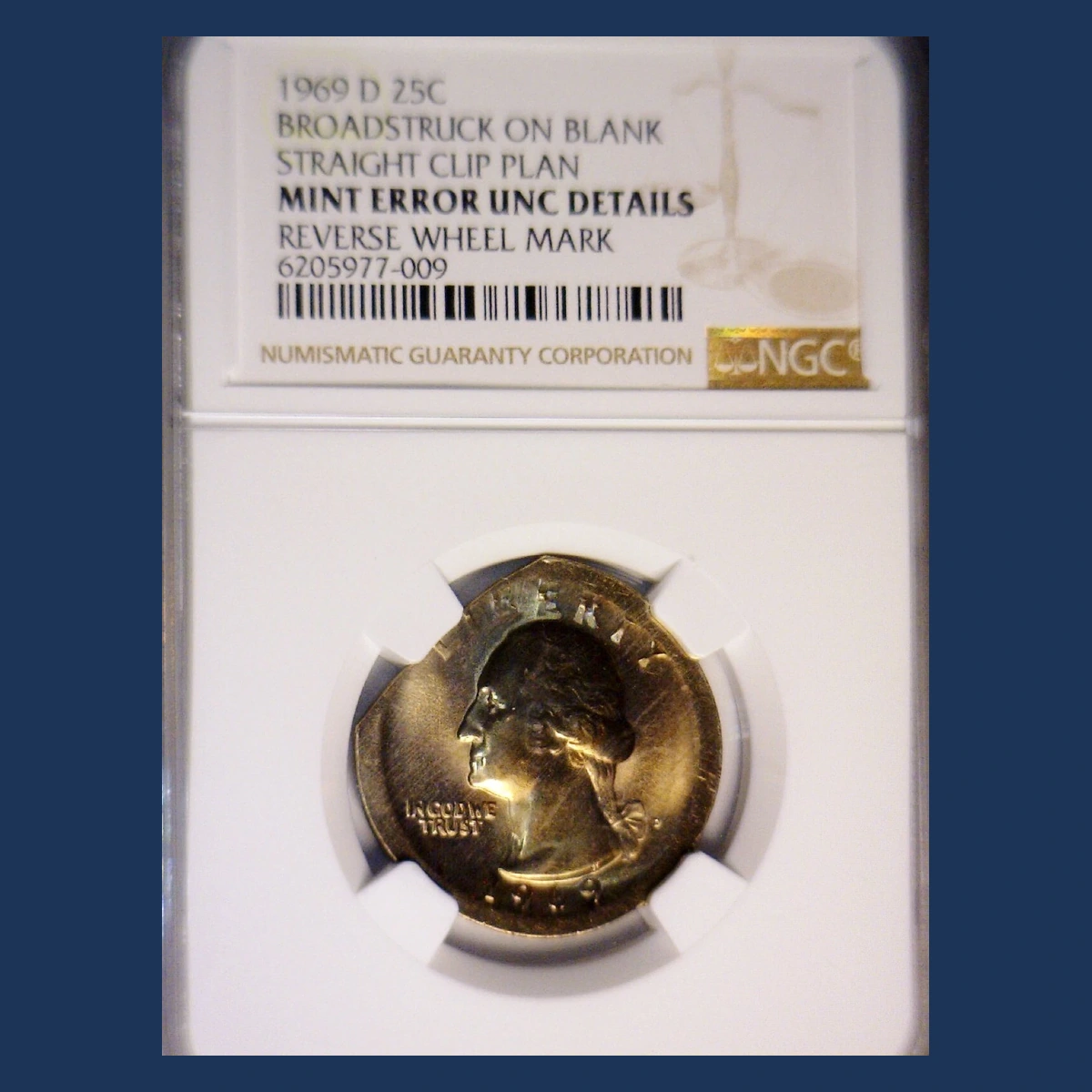
A 1969-D example combines an unusually wide strike with a straight missing section of the blank. An early dealer catalog also identifies it as a Type I blank, meaning its starting rim had not been raised.
The broad shape developed when the surrounding collar failed to confine the metal during striking. The straight clip was already present before that blow.
All three features belong to one coin. The widened shape does not mean that every 1969 broadstrike also has a clip or began with an unprepared rim.
Estimated Value
Estimate $40–$350 for comparable 1969 broadstrikes, allowing more for a clear straight clip and a documented Type I blank. Strong outward spread and a readable date make the combination easier to display.
As a different-year comparison, two ordinary 1990 Philadelphia broadstrikes sold together for $101 in July 2021. That combined total illustrates a more modest part of the market and should not be treated as the individual price of a clipped 1969-D example.
How to Identify
Separate the two visible boundaries: one is metal spread outward, while the other is the straight missing section. View both faces together so a normal wide rim is not mistaken for the full combination.
Calipers can compare the expanded parts with the normal 24.26 mm diameter. The clip can reduce weight below 5.67 g, so the scale reading needs to be considered alongside the missing metal.
Use a 10× magnifier at the straight boundary to look for natural design flow instead of sawing or filing. On the spread edge, inspect how the usual grooves failed to form.
An unprepared starting rim requires more than an unusually flat edge. Match the recorded combination of wide strike, straight clip, and original blank characteristics rather than assuming all broadstrikes are Type I.
5. 1969 Washington Quarter Thin Blank Cut from Dime Stock
Some 1969-D quarters were made from metal strip intended to have dime thickness. The blank was cut to quarter size, so the resulting coin is thin without being a tiny dime-sized quarter.
One recorded example graded NGC AU50 weighs 4.32 g. A separate ANACS AU58 example weighs 4.28 g, both below the ordinary quarter’s 5.67 g standard.
The different weights belong to different coins. They should not be confused with the roughly 2.27 g standard of an actual dime blank, which is also much smaller in diameter.
Estimated Value
A confirmed thin-stock 1969-D quarter has an estimated value of $60–$400. The ANACS AU58 example was reported sold for $91 in December 2012, providing an older comparison within that range.
Preservation and convincing original surfaces matter, because grinding can also make a quarter thin and light. A complete design on naturally thin metal is more desirable than an altered coin, and reliable identification helps separate this error from an ordinary low-weight curiosity.
How to Identify
Measure the diameter with calipers first. A thin-stock quarter should remain near 24.26 mm, rather than having the much smaller outline of a dime blank.
Now use a scale and record the weight. The separate documented results of 4.32 g and 4.28 g show how far these examples fall below the ordinary 5.67 g quarter.
Low weight can also come from grinding. Look across both faces under a 10× magnifier for parallel scratches, flattened design, or an unnaturally smooth surface.
Check the thickness and edge grooves all around the coin, rather than measuring one unusually thin point.
Identify quarter-sized diameter together with naturally thin metal and undisturbed struck details, instead of accepting a low scale reading by itself.
6. 1969 Washington Quarter Missing Metal Layer
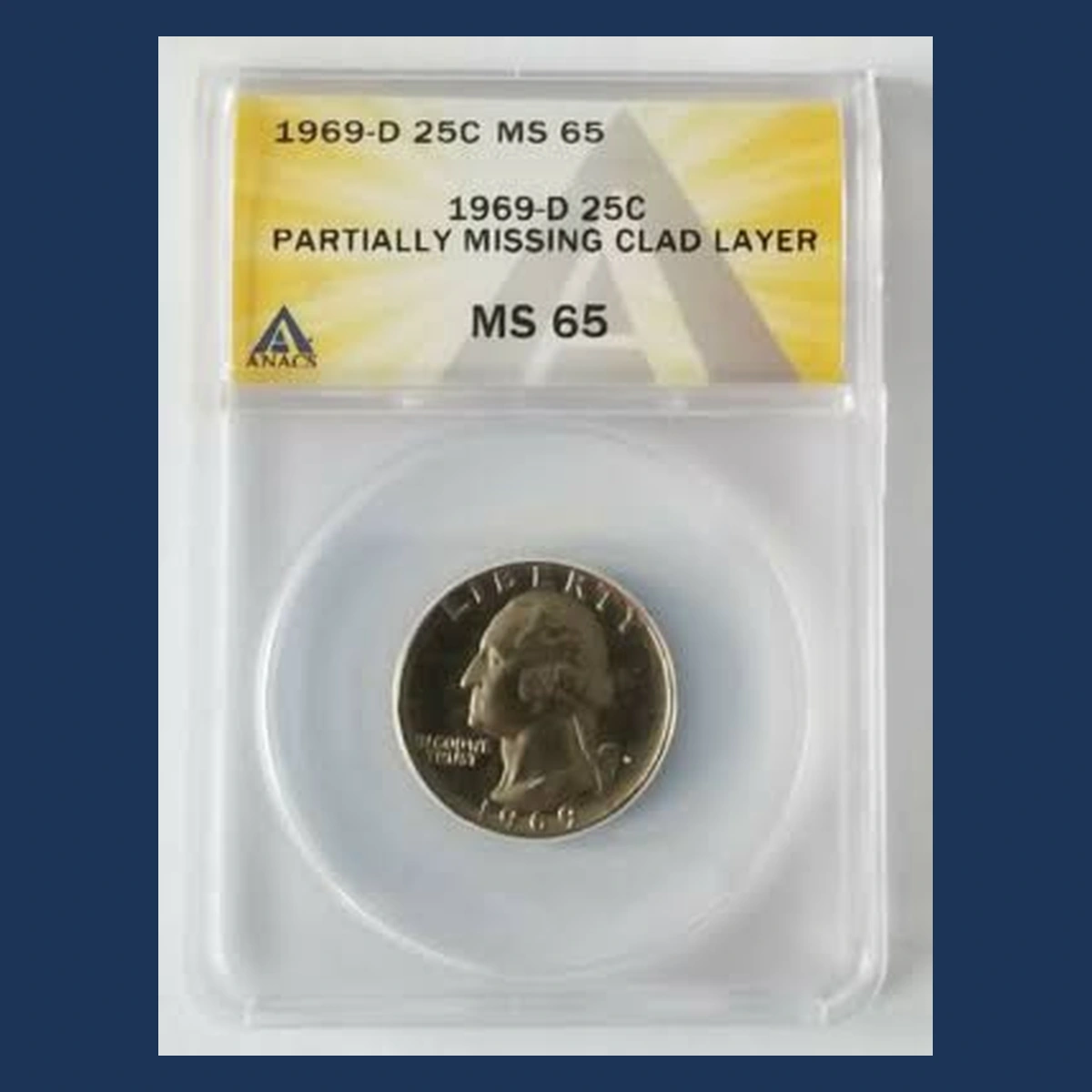
A missing outer layer exposes the copper inside a quarter. The normal coin has silver-colored outer metal bonded to both sides of a copper center.
Denver reports include a back-layer example weighing 4.6 g and a separate coin with only partial layer loss. Another cataloged coin has later scratches, which are damage rather than part of the original error.
A PCGS MS64 example carries a “95% Obverse Clad Layer” label. That wording alone does not say how much metal is missing, so its actual front must be inspected before assigning a percentage.
Estimated Value
Estimate $40–$600 for comparable 1969-D layer errors, depending on the area affected, condition, and clarity of the exposed copper. The scratched example sold for $37 in April 2006, illustrating the effect of later damage.
For a more recent related comparison, a 1973 front-layer-missing quarter graded NGC MS64 sold for $384 in January 2022. Its stronger condition should not be treated as the same price level as a scratched 1969 coin.
How to Identify
Inspect the exposed area from the edge inward rather than judging brown color by itself. A 10× magnifier should show the boundary between copper and any remaining outer metal.
Record weight with a scale and compare it with 5.67 g. The reported back-layer specimen is 4.6 g, but partial loss and different specimens can give other results.
Calipers should show roughly the normal 24.26 mm diameter unless another error changes the outline. Look across the affected design for scraping, corrosion, or plating that could imitate the color.
The normal edge has grooves, with bonded layers visible in a side view. Follow the actual missing area around its boundary instead of turning an unclear percentage on a label into a measurement.
7. 1969 Washington Quarter Doubled Design
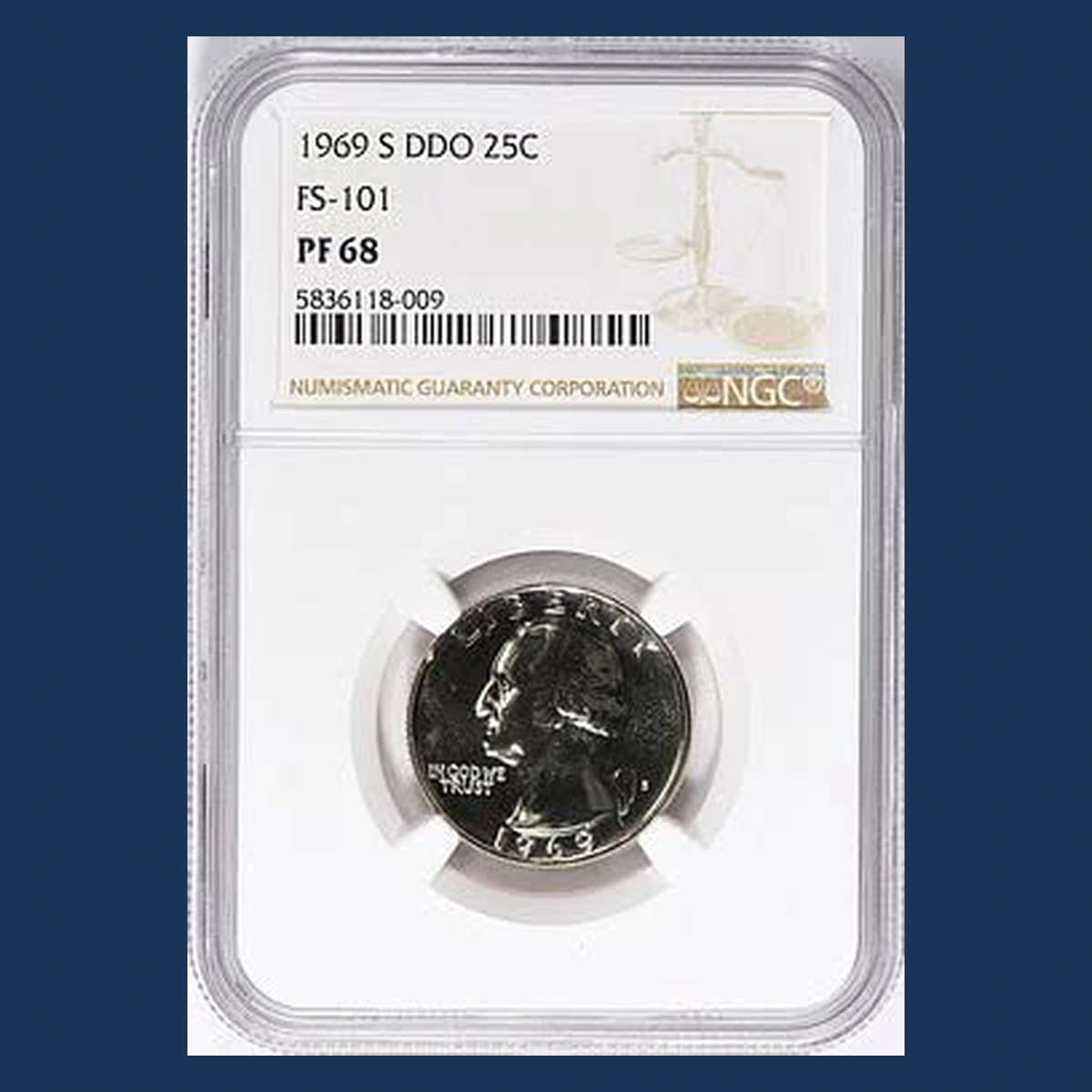
An extra raised outline can be built into the stamping tool before it makes any coins. Collectors call that tool a doubled die, even when some details show three overlapping impressions.
The 1969-S FS-101 Proof variety has strong counterclockwise separation. A different Proof variety, DDO-002, shows an irregular tripled motto and occurs with an S mint mark punched three times.
That combined variety belongs to one tool and one type of coin. Ordinary-strike doubling is also reported for 1969, but it should not be given the Proof’s catalog number or exact pattern.
Estimated Value
Estimate $25–$700 for confirmed 1969 doubled-die quarters, with the strongest recognized Proof varieties generally bringing more than minor ordinary-strike reports. Clear separation and an attractive surface support the upper part of that range.
A PCGS PR67 FS-101 Proof was reported sold for $312 in March 2018. That result concerns the specific FS-101 variety, so it should not be assigned automatically to the different tripled-motto combination or an unidentified thick letter on a circulating coin.
How to Identify
Select the correct reference before inspecting the letters: FS-101 and the tripled-motto combination have different patterns. A 1969-S Proof carries an S and a specially prepared surface, unlike an ordinary Philadelphia quarter with no mint letter.
Under a 10× magnifier, follow several doubled details instead of one isolated thick letter. The FS-101 pattern should show consistent counterclockwise separation rather than a flat shelf from movement during the strike.
For DDO-002, inspect the irregular three-part motto, then the S for its two extra northward impressions. Compare with the cataloged combination, keeping both features on the same coin.
An ordinary-strike report needs its own matching example. Identify a repeated raised pattern before attaching a number or a Proof-level price.
8. 1969 Washington Quarter Off-Center Strike
A large blank crescent beside the struck design shows that the metal was misplaced in the press. The quarter received only the portion of the design that overlapped the blank.
A recorded 1969-D example is about 45% off center toward ten o’clock and was graded ANACS MS63. Its missing design and empty metal are two parts of the same striking error.
This ordinary Denver example should not be extended to an assumed San Francisco Proof version. The date, mint mark, and finish need to belong to the coin actually being examined.
Estimated Value
Estimate $50–$800 for 1969 off-center quarters with readable dates and clear displacement. A large shift can add interest, but wear, damage, and how much identity survives can change the price substantially.
A later 1978 quarter struck 15% off center sold for $154 in September 2025. That smaller-displacement example provides a comparison, while the 1969-D coin’s much larger blank area and its own preservation must be judged separately.
How to Identify
Read the date and look for the D before estimating how far the design moved. An unreadable or missing mint-mark area cannot identify Philadelphia, and a photograph of another coin cannot supply the missing date.
Turn the coin over and compare the shifted design on both faces under a 10× magnifier. A genuine off-center strike leaves blank metal corresponding to lost outer design, while a wider rim on one face alone suggests a different problem.
Check the blank crescent for later hammering or flattening, and inspect the boundary where lettering runs off the metal. The recorded Denver example places the design toward ten o’clock; its natural struck boundary and empty opposite side should explain that displacement together.
9. 1969 Washington Quarter Repeated Strike or Split-Eagle Appearance
A 1969-S Proof can show two positions of its front design when it receives an extra strike with rotation. An NGC PR62 example is specifically cataloged with that combination.
Another recorded Proof has widespread front doubling from an in-collar restrike. These are different from correctly aligned repeated blows normally used to make Proof coins.
The name “Split Eagle” also appears in 1969 reports, but it does not establish one proven mechanism. A divided-looking eagle needs examination for a repeated design, rotation, or damage rather than an automatic double-strike identification.
Estimated Value
The NGC PR62 rotated-front double strike sold for $660 in August 2024. Estimate $200–$1,200 for comparable confirmed extra-strike Proof errors, depending on separation and surface preservation.
The same estimated range applies to a split-eagle appearance only if it proves to be a genuine extra-strike error of comparable quality. An unexplained line or damaged eagle does not inherit that price simply because a seller uses an unusual name for it.
How to Identify
Treat a “Split Eagle” name as a starting description, then inspect what actually divides the bird. A scratch cutting through the design differs from two raised versions of the design overlapping at different positions.
On the confirmed Proof type, use a 10× magnifier to follow the rotated front impression across several details. Repeated letters and portrait parts should fit one additional position rather than unrelated isolated lines.
Compare the back as well, without assuming it shows the same rotation as the front. Normal Proof production can involve multiple aligned blows, so the fact that a coin was struck twice is not enough.
Look for a displaced design that survives from a separate blow. That visible second position is more useful than the dramatic name attached to the coin.
10. 1969 Washington Quarter Off-Center Mirror Impression
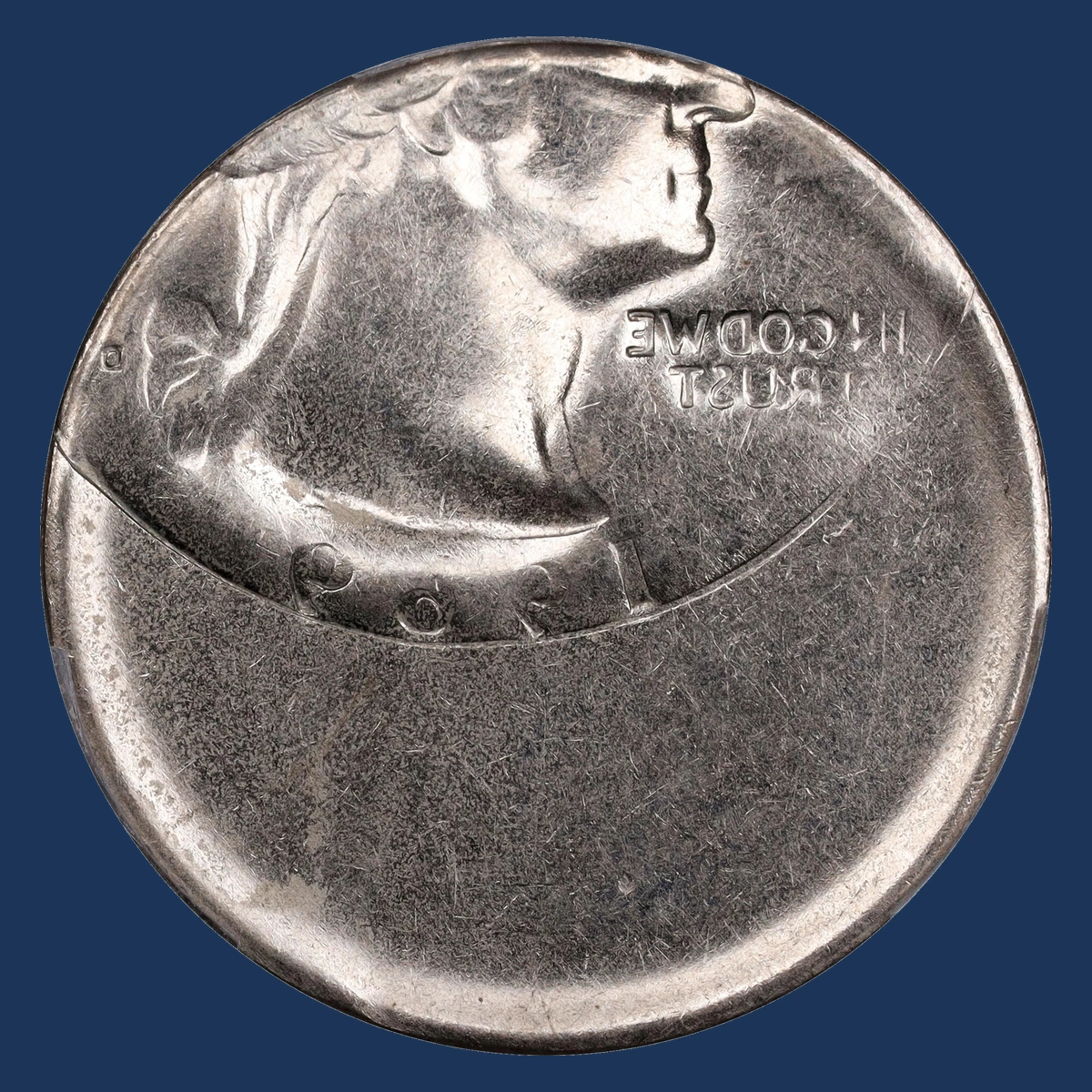
The recorded 1969-D example combines a 55% off-center strike with a mirror brockage. PCGS graded it AU58, a grade indicating slight wear.
A brockage is a sunken, backward design pressed into a coin by another already struck coin. Here that reversed impression appears on a piece whose normal strike was also far off center.
Both features belong to one specimen. The large blank area explains its uneven shape, while the reversed image explains a separate-looking pattern within the struck metal; neither should be counted as another physical coin.
Estimated Value
An estimated $250–$1,500 covers a comparable authenticated 1969-D off-center brockage. A recognizable mirror image and readable date can support strong collector interest even when the coin has some wear.
As a later comparison, a 1999-P New Jersey quarter with an 80% brockage and broadstrike sold for $312 in December 2024. That different combination helps frame the estimate without turning an off-center percentage into a fixed price or assuming all backward impressions are equally clear.
How to Identify
Start by reversing a photograph of the unusual design, or viewing it in a mirror. Transferred letters should become readable this way; ordinary raised lettering at a different angle will not need to be reversed.
Use side lighting and a 10× magnifier to establish that the image sinks into the surface. Then inspect the blank crescent and the design’s outer boundary, which should agree with the large off-center shift.
Look for crushed rims or damaged surfaces that could come from squeezing two finished coins together. The genuine combination needs a backward, sunken design within naturally struck metal, together with the off-center shape; neither a strange hollow nor an incomplete outline proves both features.
11. 1969 Washington Quarter Partial Collar, Indent, and Thin Raised Rim
One 1969-S Proof combines a stepped edge, a small front depression, and a thin raised rim. The recorded PCGS PR66 example was described with a full partial collar and an approximately 5% front indent.
The collar is the surrounding steel ring that controls the coin’s diameter. Incomplete engagement leaves an edge step, while another object blocking the strike can produce an indent.
A fin is the thin metal standing above the usual rim level. These three visible features occur on the same Proof, so its description needs both face and edge views.
Estimated Value
Estimate $300–$1,800 for a comparable confirmed Proof with this combination. The reflective surfaces, clarity of the edge step, and preserved thin rim all influence how attractive the error looks.
For context, the different 1969-S rotated double-strike Proof sold for $660 in August 2024. That sale shows the collectible price level of a substantial Proof striking error, but it does not price each part of the collar-and-indent combination separately.
How to Identify
Start with a side view, because the thin fin and collar step can be hard to judge from the front. Keep the rim free of pressure so the delicate raised metal is not bent.
Rotate the coin under soft light and inspect the different edge levels with a 10× magnifier. The normal quarter diameter is 24.26 mm, but metal beyond the collar can spread farther.
Next locate the small front indent and follow its boundary into the struck design. A sharp impact lip or cut through completed details can suggest damage after the coin left the Mint.
Compare all three features on this one Proof. The recorded combination needs the stepped edge, original raised fin, and approximately 5% front hollow to remain distinguishable from later rim damage.
12. 1969 Washington Quarter Wrong Blank or Metal Fragment
A smaller blank can cut off the quarter’s outer design, while an irregular metal fragment produces a less familiar outline. These errors begin with the wrong piece of metal entering the press.
Recorded examples include Philadelphia and Denver cent blanks, a San Francisco Proof cent blank, and Denver nickel blanks. One nickel-blank coin also received two strikes.
A separate ANACS MS62 example was struck on a 2.01 g fragment. Its irregular shape must have existed before striking; a finished quarter broken into pieces afterward does not become the same kind of error.
Estimated Value
Estimate $150–$2,500 for these wrong-blank and fragment errors, allowing for metal, condition, and visible design. A Philadelphia cent-blank NGC MS65 Brown coin sold for $805 in August 2011.
A Denver nickel-blank PCGS MS65 piece brought $862.50 in March 2004, while a worn, double-struck nickel-blank example sold for $264 in November 2020. These different results show why an extra striking feature does not automatically outweigh wear or surface quality.
How to Identify
Sort the metal type before comparing prices. A normal quarter weighs 5.67 g and measures 24.26 mm, while a cent blank normally begins near 3.11 g and a nickel blank near 5.0 g.
Recorded specimens include the Philadelphia cent at 3.11 g, the Proof cent at 3.1 g, and the double-struck Denver nickel blank at 4.9 g. Use a scale and calipers to record the actual coin, allowing for outward spreading during striking.
Inspect the edge under a 10× magnifier for filing, plating, or a fresh break. The 2.01 g fragment needs design flowing naturally to an already irregular edge.
On a cent blank, check that the surviving date and outer lettering fit its smaller size. On the fragment, distinguish original struck boundaries from a quarter broken after manufacture.
13. 1969 Washington Quarter Repunched Mint Mark
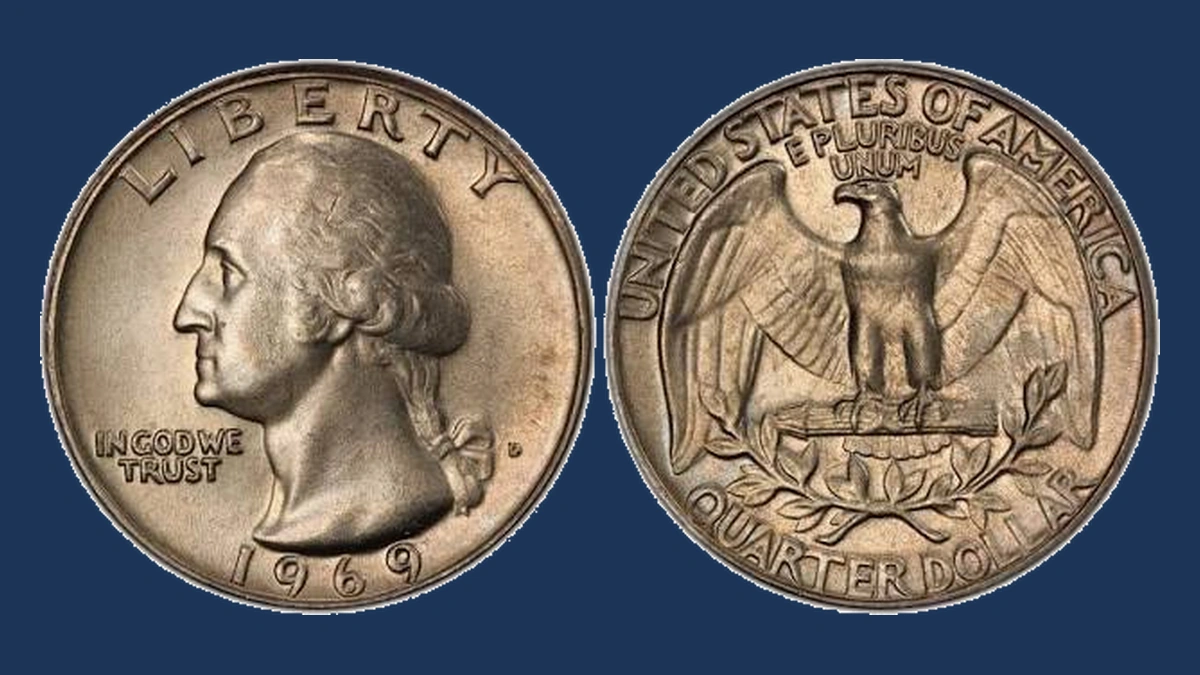
A second curve beside a D or S can come from punching the mint letter into the stamping tool more than once. Each resulting pattern belongs to a particular variety.
Denver RPM-001 has a tilted extra D at the left, RPM-002 shows a lower D, and RPM-003 has an upright extra D to the left. The first and third are known as FS-501 and FS-502.
San Francisco RPM-002 shows extra S impressions above and below, while RPM-003 has one at the left. These positions should not be combined into one imagined mint mark.
Estimated Value
Estimate $25–$3,000 for confirmed repunched mint marks, with most modest examples far below the upper end. Strong separation, a recognized variety, and exceptional preservation can change the price sharply.
A Denver FS-502 graded MS66 sold for $2,640 in August 2022. That high-grade result belongs to one variety and condition level, not to every doubled-looking D or to the separate San Francisco Proof mint marks.
How to Identify
Choose Denver or San Francisco photographs before comparing the extra letter. A D on an ordinary coin and an S on a Proof have different recorded patterns.
Under a 10× magnifier, follow enough of the extra curve to recognize another mint letter. An isolated scratch or flat shelf is less useful than a rounded repeated impression.
For a second D at the left, ask whether it tilts or stays upright. That separates RPM-001 from RPM-003 instead of treating both as one D/D variety.
On the S, compare the individual north, south, or west positions without combining different catalog photographs.
Match both direction and letter shape to the same reference coin before using its FS number or its high-grade auction price.
14. 1969 Washington Quarter Matching Pair Struck Together
Two blanks can enter the press together and shield their touching faces from the stamping tools. The resulting pair preserves one normally struck face on each coin and a blank contact face opposite it.
In the recorded NGC PR67 pair, one coin received the eagle back and the other Washington’s front. Their contact faces are slightly dished, with higher edges.
The front-struck coin is somewhat oval and has a broad rim below the date. A separate PCGS PR64 and PR62 pair is also recorded, so the grades should not be combined into one set.
Estimated Value
The NGC PR67 pair sold for $2,760 in August 2020. The separate PCGS PR64 and PR62 pair brought $2,640 in July 2021.
Estimate $2,000–$4,000 for a comparable authenticated two-coin set, depending on condition and how clearly the pieces fit the same accident. Both prices are whole-pair totals; a single blank-faced coin should not automatically be priced at half, because the matching relationship is part of the collector appeal.
How to Identify
Place photographs of both coins side by side, with the normal front visible on one and the normal back on the other. Their opposite, blank faces should explain how the two pieces blocked each other during the strike.
Inspect those contact faces under a 10× magnifier without pressing the actual Proof surfaces together. The NGC PR67 pair has dished contact areas and higher edges, while its front-struck coin is slightly oval with a broad rim below the date.
Compare the outline of each contact area with its partner and keep the separately graded PCGS pair distinct. A single plain face can have other causes, so the complementary shapes and surviving designs must support one shared striking accident.
Conclusion
Estimated 1969 quarter error values run from $10 for modest layer irregularities to $4,000 for a well-preserved matching pair. Strong mint-mark varieties and unusual wrong blanks can also bring substantial premiums.
Identify the visible feature before comparing prices. Keep different specimens and measurements separate, and remember that a named variety needs a matching design detail, not simply a coin that looks a little unusual.