1974 Quarter Error List with Pictures

A quarter need not stay flat. One 1974-D became a cap over a stamping tool and carried a backward impression on its back; it sold for $1,265 in April 2006.
That striking accident is one of the 1974 quarter errors below, with estimated values from $2 to $4,000. Others lost part of their blank, received extra strikes, or began on metal intended for another coin.
Start with the shape you can see, then use the matching checks to examine the details.
1. 1974 Washington Quarter Die Cracks and Rim Cuds
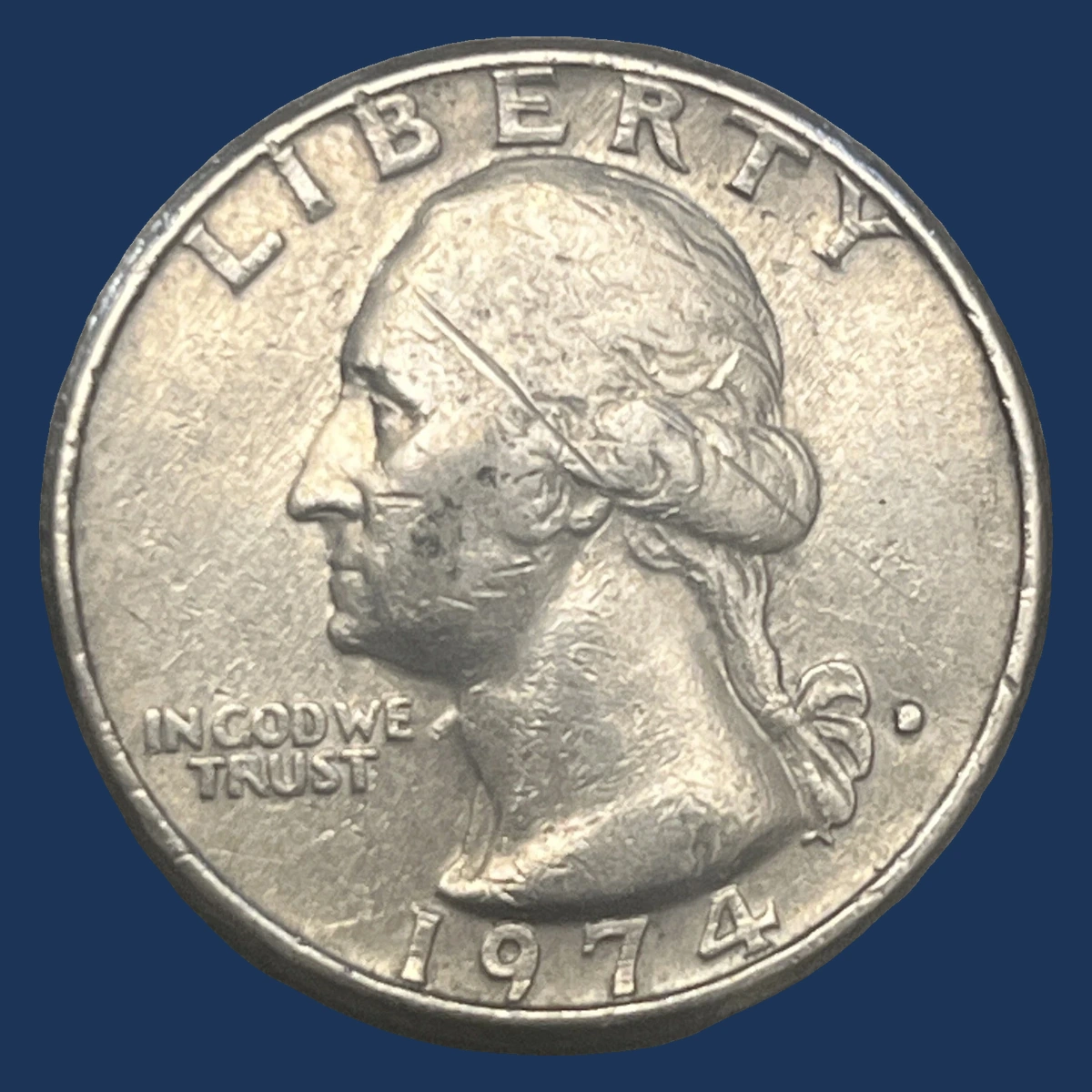
A thin line rising above the eagle side can come from a crack in a die, the steel tool that stamps the design. Soft coin metal enters that opening during striking.
A larger piece breaking from the tool’s edge can leave a raised lump joined to the rim. Collectors call that feature a cud.
Both forms are reported for 1974, without a fixed mint or exact position for the examples. Their shared clue is extra metal above the normal surface, rather than a scratch or dent cut into the coin.
Estimated Value
For confirmed examples, allow about $2 to $25 for small cracks and $15 to $150 for clearer rim cuds. A larger, well-defined raised area is generally easier to display.
Wear may soften a thin line until it becomes difficult to recognize. Damage around the rim can also reduce the appeal of a genuine break.
Prices within these estimates depend on the actual shape and condition, rather than the year or an impressive seller nickname alone.
How to Identify
Follow the suspected line through the surrounding eagle-side details under light from the side. A ridge casts a different shadow from a groove, so change the light direction before deciding which one you see.
For a possible cud, check whether the raised lump joins the original rim. A separate interior bump may instead be a small chip from the tool.
Inspect nearby metal for a dent that could have pushed up a lip. Added solder or a deposit may also sit above the surface, but it will not reproduce an original struck break.
Photograph the whole affected face after taking the close-up. Its position among the letters and design makes a much stronger comparison than an isolated enlarged bump.
2. 1974 Washington Quarter Broadstrike
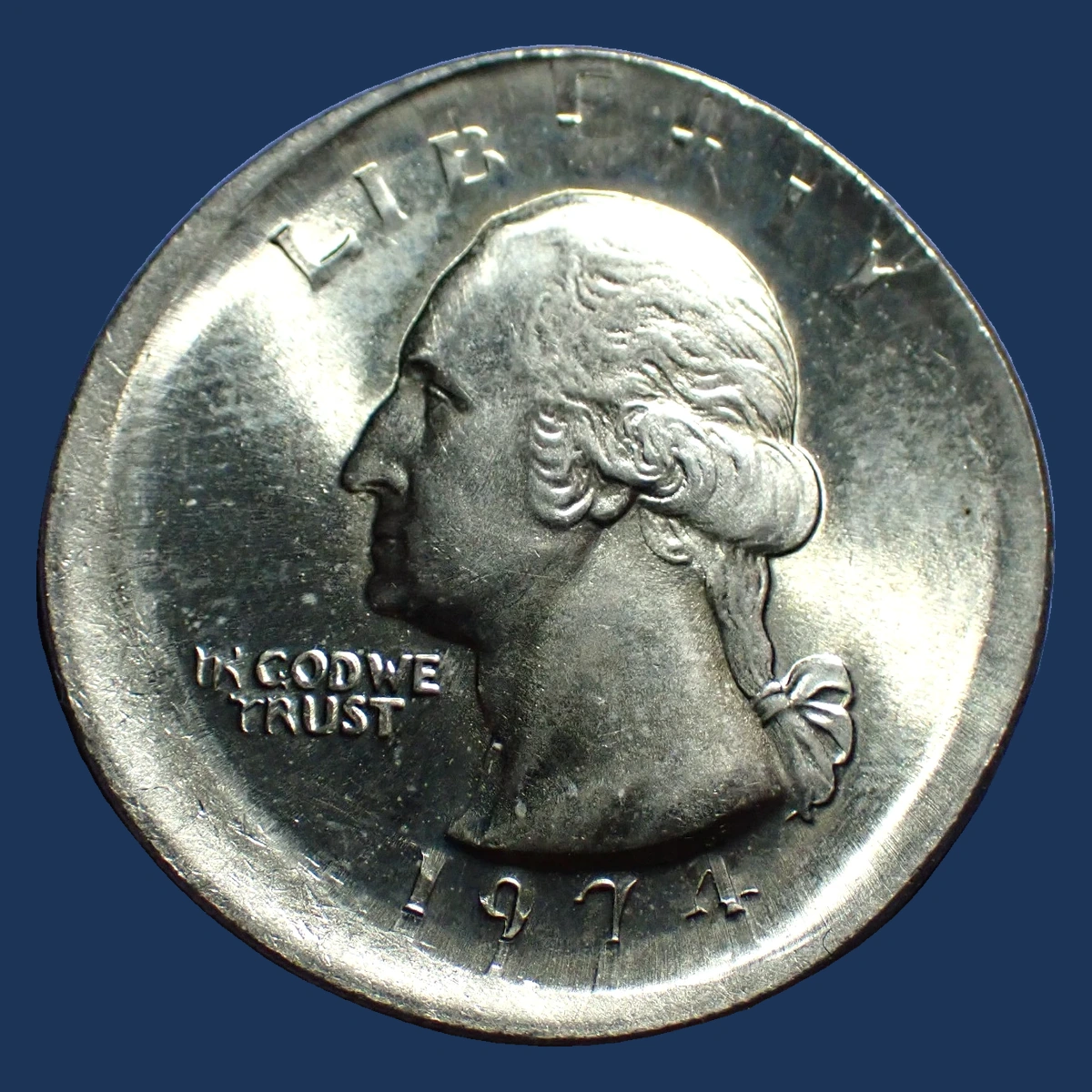
The design can remain complete even when a quarter spreads beyond its normal width. This happens when the collar, the ring surrounding the blank, fails to contain the metal.
The resulting broadstrike often has an expanded border and an edge without the usual full band of grooves. Its wider shape does not require another strike.
A 1974 example appears in an auction-image archive with an MS62 grade, meaning an unworn coin with noticeable marks. Other repeated-strike coins also spread outward, but their extra impressions tell a more complicated story.
Estimated Value
A straightforward broadstrike has an estimated value of $20 to $200. A clean, expanded border around a complete design makes a better display than a slight or damaged distortion.
For a nearby-year comparison, a 1979 broadstruck quarter graded MS63 sold for $49 in July 2022. That result shows the affordable end of this type.
Collectors may pay more for a dramatic original outline, especially when the date and outer lettering remain easy to read.
How to Identify
Outline the outermost letters on both sides of the coin. If part of the intended design is missing beyond the metal, consider an off-center strike instead of a simple broadstrike.
Compare the complete outline with a normal quarter at the same image scale. For a loose coin, calipers can test whether it exceeds the usual diameter of about 24.3 millimeters.
Inspect the edge where the metal has spread. The change should belong to the original strike rather than a flattened patch from a later blow.
Next examine the portrait for crushing and search for repeated design fragments. An intact single design supports the simple broadstrike; separate extra images would require examining the repeated-strike examples as well.
3. 1974 Washington Quarter Underweight and Rolled-Thin Blanks
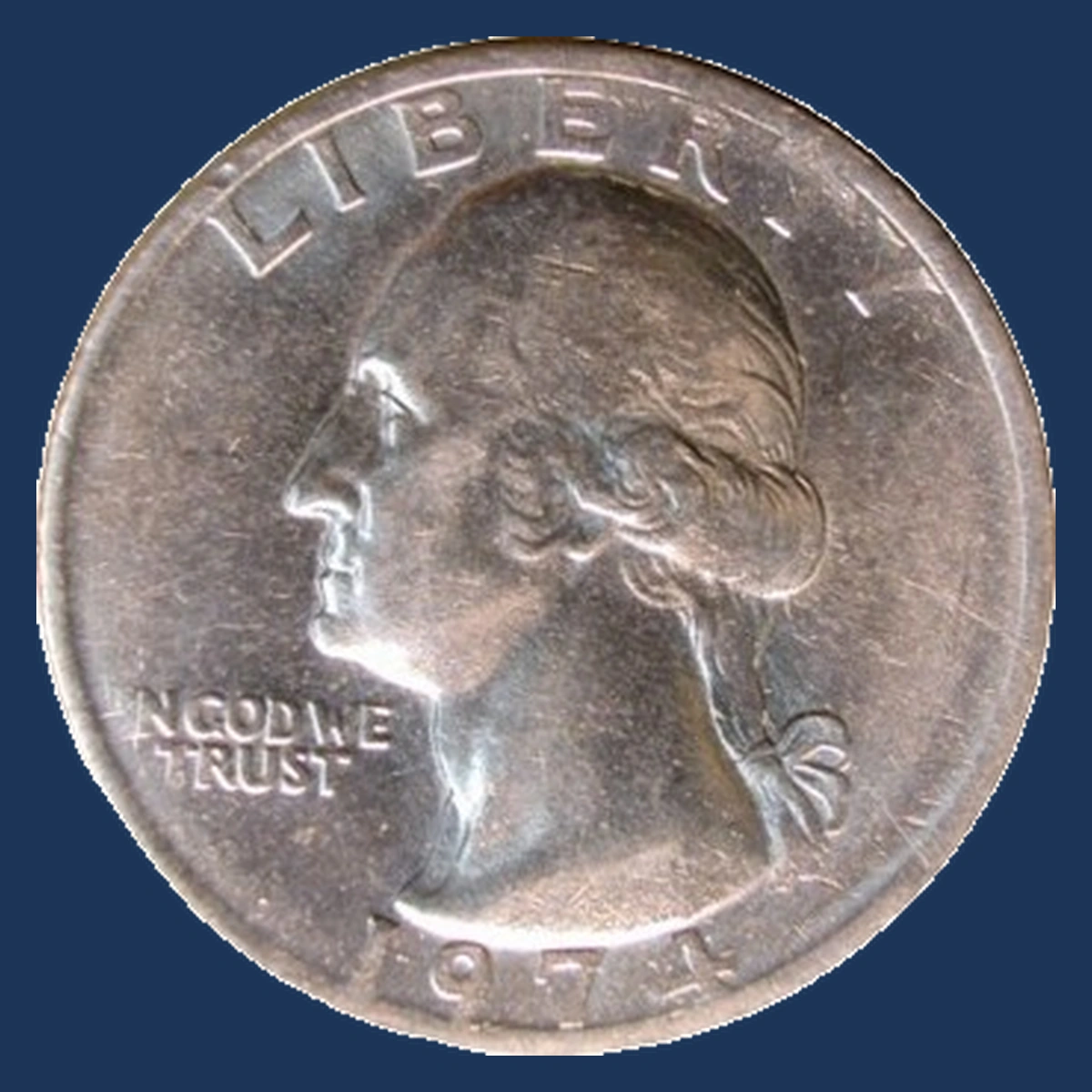
A thin quarter can retain its full diameter and both outer metal layers. The shortage lies in the thickness of the blank rather than a clipped-out gap.
Mike Diamond described a 1974 example weighing 4.92 grams as struck from quarter strip rolled too thin. It is too heavy to be called a dime-stock quarter.
A separate underweight example weighs 4.7 grams, without a specific cause established. Another coin was cataloged as a thin-blank strike, so the thickness and weight must be checked on each specimen instead of transferred between them.
Estimated Value
These thin or underweight examples have an estimated range of $40 to $300. The 4.7-gram coin graded AU53 sold for $69 in December 2020.
A different thin-blank example graded AU55 brought $84 in December 2024. Both AU grades indicate some circulation wear rather than an untouched surface.
A more attractive coin with a clear, original thickness change can command more. Later grinding, corrosion, or loss of an outer layer requires a different comparison.
How to Identify
For a loose coin, record the weight, diameter, and thickness without squeezing its rim. Compare those measurements with an ordinary 5.67-gram quarter, keeping the scale reading attached to the actual coin photographed.
Follow the pale outer layers and copper center around the edge to see whether both coverings remain. Then inspect the faces for grinding or corrosion that could have removed metal after minting.
The 4.92-gram example explained by Mike Diamond retains the full quarter-sized outline but is too heavy for dime stock. Identify where the thickness is reduced before assigning a cause; a small number on the scale does not name the kind of blank.
4. 1974 Washington Quarter Curved and Double Clips
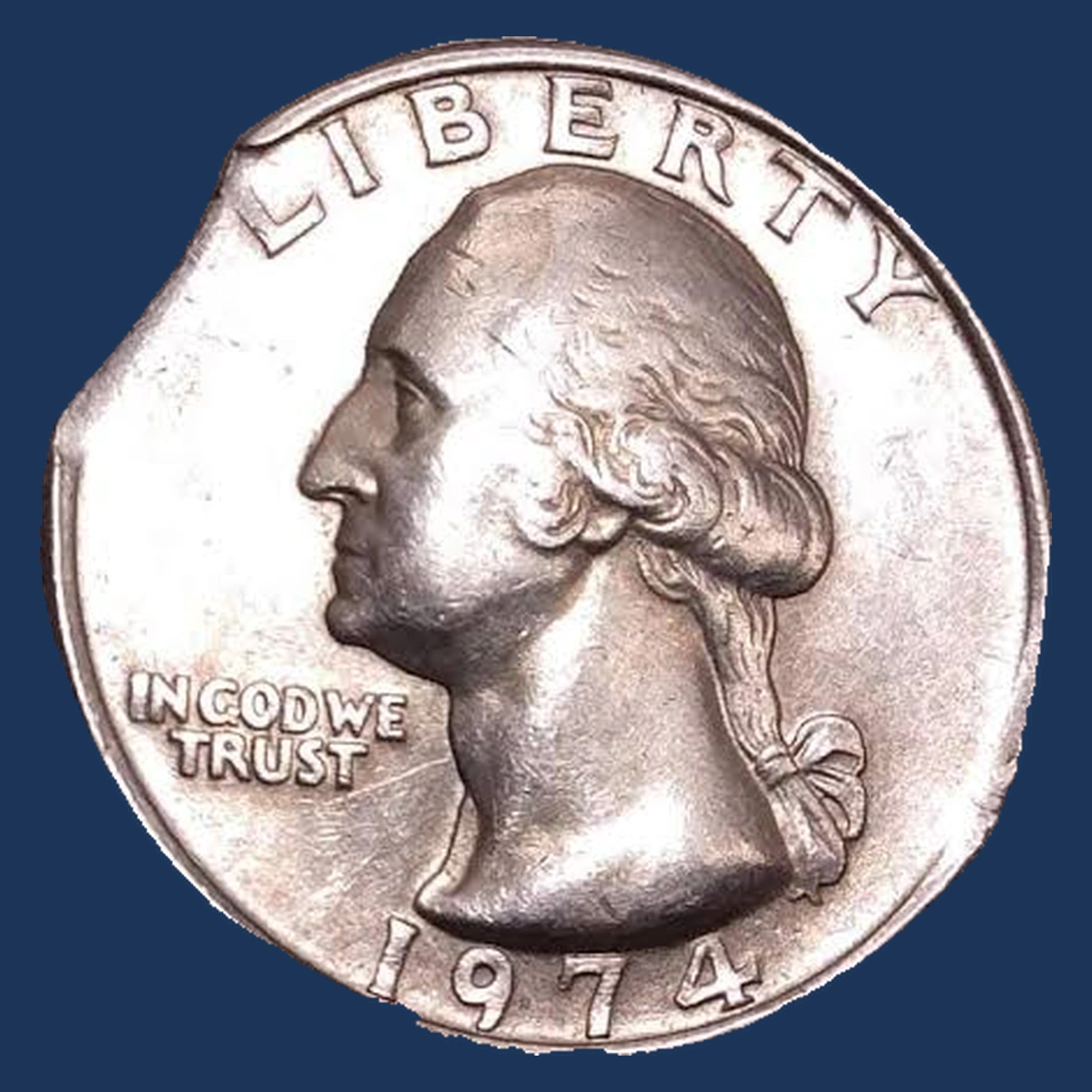
Nearly half the metal is absent from one striking 1974-D quarter. Its curved clip formed before the design was stamped into the remaining three-gram blank.
The error begins during blank cutting when a punch overlaps an earlier opening in the metal strip. The resulting incomplete disk can continue through the presses.
A separate no-mintmark quarter has two curved clips and slight circulation wear. Both examples involve missing metal, unlike an off-center strike that leaves a plain but still solid area beside its design on the same intact blank.
Estimated Value
Estimate $15 to $500 across genuine curved and double clips. The Denver coin with a 50% curved clip, graded MS65, brought $132 in July 2021.
The double-clip AU58 example appeared in a six-coin lot sold for $99.88 in November 2015. That total cannot be assigned to its 1974 quarter alone.
Large gaps can make compelling displays, but a readable date and undamaged surfaces remain important. Smaller clear clips can be inexpensive additions to a collection.
How to Identify
Use the three-gram Denver example to compare a real gap with the plain crescent of an off-center coin. The gap contains no metal; the crescent does.
Examine the curved boundary from the front and from the edge. Nearby letters may be distorted as metal flowed toward the incomplete edge during striking.
Look for filing, saw marks, or sharp later cuts. A weakened rim opposite the gap can help support a clip, but its absence alone does not disprove one.
On the double-clip example, study each opening separately and keep the full date in the photographs. Do not copy the size or position of a gap from a different coin in the six-piece auction group.
5. 1974 Washington Quarter Off-Center Strike
A 1974 quarter struck 45% off center leaves a large part of its blank without the normal design. The recorded example shifts toward twelve-thirty when Washington is upright.
The blank sat partly outside the area reached by the stamping tools. Both faces therefore show the consequences of that misplaced disk.
ANACS graded this no-mintmark example MS64, an unworn coin with visible marks. It is not the Denver quarter with a 50% curved clip, whose outline actually lacks a substantial piece of metal rather than leaving a plain crescent.
Estimated Value
The documented 45% off-center example sold for $94 in January 2022. A practical estimate for comparable 1974 errors is $40 to $500.
A readable date is especially helpful when much of the design missed the blank. Clear original metal in the untouched area also strengthens the coin’s display.
Heavy marks, an incomplete year, or later flattening can reduce appeal. A large percentage describes the shift, but it does not guarantee a large selling price.
How to Identify
Begin with the boundary between the design and the plain crescent. Both areas should belong to one solid disk.
Follow that boundary on the back as well. A centered back paired with a shifted front suggests a moved stamping tool instead of an off-center blank.
Keep Washington upright when comparing the recorded twelve-thirty direction. Read the surviving date directly, without completing missing digits from another photograph.
Examine the plain area under magnification for marks left by grinding or later flattening. Remains of a removed design would contradict an untouched blank surface.
An edge-on view can help separate a solid crescent from a clipped-out gap. These shapes may look similar in a small photograph, but only one still contains metal.
6. 1974 Washington Quarter Missing Clad Layer
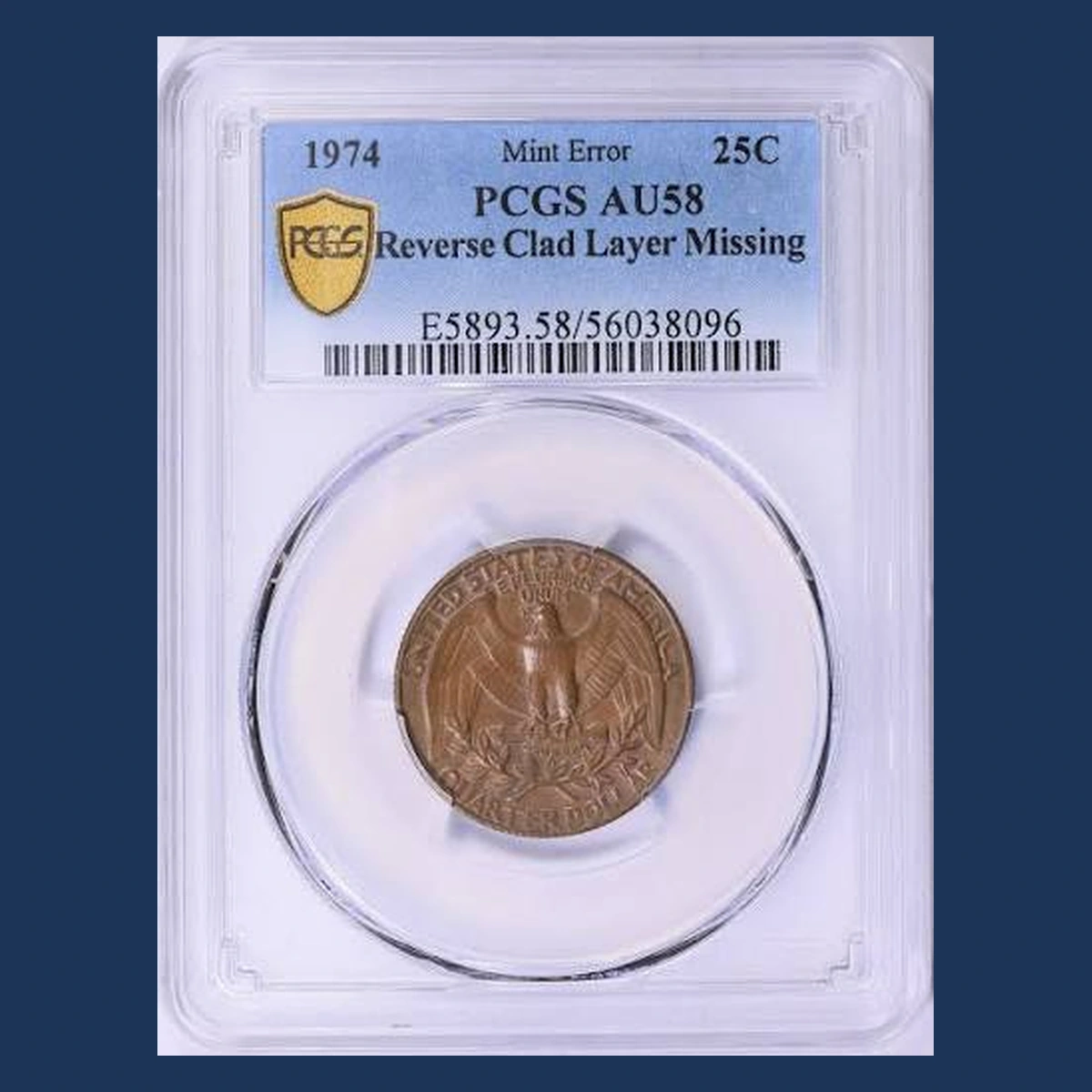
The pale skin of a normal quarter covers a copper center. If an outer layer separates before striking, the finished coin can show its design on exposed copper.
One no-mintmark 1974 example is specifically identified as missing its front covering. PCGS graded that coin AU58, indicating only slight circulation wear.
A different ANACS MS63 example also lacks an outer layer, but its catalog does not identify the affected face. A brown appearance should therefore be checked against the actual coin’s layered edge and surface, rather than used alone to name the error.
Estimated Value
Missing-layer 1974 quarters have an estimated range of $50 to $600. The ANACS MS63 example sold for $80.50 in September 2006.
The separate PCGS AU58 coin with its front layer missing brought $79 in March 2025. Those results describe different coins, not changing prices for a single known specimen.
An attractive copper surface with clear original detail generally displays better than a stained or damaged one. The remaining pale face can make the contrast particularly clear.
How to Identify
Compare both faces under the same neutral light. A copper-colored side beside a pale side is worth examining, but staining can imitate that contrast.
Look along the edge to see where the remaining outer layer meets the copper center. Check that the exposed face fits this metal structure.
For a loose quarter, record its weight with a precise scale. Missing covering should reduce the normal 5.67 grams, but weighing alone cannot distinguish a mint error from metal removed later.
Inspect letters and open areas for scraping, pitting, or an added coating. An intact design stamped into the exposed copper supports a different history from a finished face stripped by grinding or chemicals.
7. 1974 Washington Quarter Struck Through a Capped Front Die
A coin stuck to a stamping tool can block the design from reaching the next blank. The next coin then receives weak or altered detail through that covering.
This covering is called a die cap. A no-mintmark 1974 quarter graded NGC MS66 is recorded as struck through a capped front die.
The coin described here received the affected strike; it was not itself the cup-shaped cap. Its front should be examined for the surviving design and the area softened by the obstruction, rather than assumed to have a high wall around its edge.
Estimated Value
The MS66 example sold for $288 in October 2019. Confirmed comparable strikes have an estimated range of $100 to $1,200.
How much design survives and how clearly the obstruction changed it can influence appeal. An unusual but understandable portrait often displays better than a vaguely weak, heavily marked surface.
MS66 describes an unworn coin with few marks. A worn or damaged piece should not receive the same condition premium merely because its front looks soft.
How to Identify
Compare the two faces before judging the weak portrait. A blocked front tool can soften that side while leaving the back much more clearly struck.
Use magnification to inspect the transition between stronger and weaker detail. Local wear follows exposed high points; an obstruction during striking can alter the design in a different pattern.
Look for scratches or polishing that might have removed an already finished portrait. Do not assume a smooth-looking area was necessarily created at the Mint.
Match the complete front pattern with an authenticated capped-die strike, including any surviving letters and the shape of its border. The relevant coin is the one that received the blocked strike, so a cup-shaped edge is not a required feature.
8. 1974 Washington Quarter Struck on a Nickel Blank
A nickel blank gives Washington’s larger design less room than a normal quarter blank. Outer lettering can be cut short at the smaller edge.
The blank also differs in composition: it is solid copper-nickel alloy, rather than pale layers surrounding a copper core. Its normal starting weight is about five grams.
A Denver 1974 example graded NGC MS62 weighs 4.9 grams. A separate no-mintmark example carries a PCGS AU58 grade, so the recorded Denver weight should not be presented as a measurement of that other coin as well.
Estimated Value
For comparable nickel-blank errors, estimate $150 to $1,200. The Denver MS62 example brought $240 in June 2019, while the separate no-mintmark AU58 coin sold for $207 in September 2006.
The higher number is not automatically attached to the higher condition grade in every sale. Remaining design, surface quality, and collector interest all matter.
A readable year and a clear wrong-metal identification help establish what the buyer is getting, especially when outer details are cut off.
How to Identify
Check the edge for the copper-center stripe found on a normal quarter. A nickel blank should instead have the same basic alloy throughout its thickness.
For a loose coin, record both diameter and weight. An unused nickel blank is about 21.2 millimeters wide and five grams, though it can spread during the quarter strike.
Then examine the outer lettering for details lost beyond the smaller blank. Keep any visible mint letter and the date in the photographs.
Look between the quarter’s features for an earlier Jefferson design. Such remnants would indicate a finished nickel used as the host, which is different from an unused nickel blank.
The recorded 4.9-gram measurement belongs specifically to the Denver MS62 example.
9. 1974 Washington Quarter Non-Copper-Core Blank
The absence of a normal copper center can point to unusual metal rather than a missing surface layer. One 1974 quarter was cataloged as struck on a non-copper-core blank.
Its recorded weight is 91 grains, or about 5.90 grams. That is heavier than a normal quarter, not the reduced weight expected from losing a covering.
PCGS graded the coin XF45, which indicates circulation wear. The description does not establish a specific alloy, so the piece should not be promoted as silver simply because its edge lacks the familiar copper-colored stripe.
Estimated Value
The documented example sold for $230 in March 2011. A comparable authenticated unusual-core quarter has an estimated range of $200 to $1,200.
Clear identification of the metal matters more than a silver-colored appearance. A laboratory-supported composition can give buyers a firmer basis for comparing an unusual blank.
Wear, cleaning, and surface damage also influence the price. The original XF45 result concerns one circulated coin and does not establish a record for a confirmed silver quarter.
How to Identify
Check the units beside any reported weight. The documented 91 grains converts to approximately 5.90 grams; it does not mean a coin weighing 91 grams.
Inspect the edge under neutral light for the normal layered structure. A plated edge or dirt can hide a copper stripe without changing the metal inside.
If the coin is loose, verify the weight and compare its diameter with the usual 24.3 millimeters. Keep the measurements with photographs of both faces.
Have a qualified specialist examine the composition without damaging the surface. Appearance and weight can identify an unusual candidate, but neither test alone names its alloy or proves that it is silver.
10. 1974 Washington Quarter Double and Multiple Strikes
An extra strike can rotate, shift, or spread a quarter’s design. One 1974 coin turned about 80 degrees counterclockwise between two strikes inside the collar.
Another received a second strike 80% off center. Denver examples include two off-center strikes with a smooth depression, and multiple strikes with a broadly expanded edge.
A flip-over strike is also reported for 1974: the coin turns over between blows, bringing front and back designs together. That process differs from folding the metal, and it does not automatically produce the sunken mirror image called a brockage.
Estimated Value
Estimated values span $150 to $2,000. The rotated double strike brought $253 in May 2005, while the coin with an 80% displaced second strike sold for $336 in October 2021.
The Denver double strike with a depression brought $460 in January 2012. Its broadly spread, multiply struck counterpart sold for $690 in May 2021.
Each amount covers one complete coin, including its combined features. Readable overlapping images and clean surfaces usually improve its display.
How to Identify
Map the surviving images before trying to count strikes. Follow one portrait or group of letters until you can separate it from another position of the design.
The rotated example keeps both strikes within the collar but changes their angle. Its back also has weak patches above the eagle’s head and beside the leg on the viewer’s left, caused by grease.
A displaced strike instead leaves part of the later impression near the edge. On the Denver indented coin, distinguish its smooth hollow from those repeated design fragments.
For a possible flip-over example, locate front and back features on the same face. Check whether they are normal raised designs rather than a recessed mirror image transferred by another coin.
11. 1974 Washington Quarter Cataloged Fold-Over Double Strike
Folding and flipping describe different movements. A folded piece has bent metal, while a flipped coin has simply turned over before another strike.
Heritage cataloged one 1974 quarter as a “Fold Over Double Strike in Collar,” graded PCGS MS64. The short description names the event without explaining the exact shape of the fold.
That makes the edge and the relationship between the impressions especially important when matching a candidate. A fold-over identification needs evidence in the coin’s physical form, rather than being inferred from two designs that happen to overlap.
Estimated Value
The cataloged MS64 example sold for $376 in January 2016. For a comparable authenticated fold-over double strike, allow an estimated $250 to $2,000.
Visible folded metal with clear surviving impressions can make a more convincing display than a shape that is difficult to explain. Later damage can reduce that appeal considerably.
This estimate assumes a fold created during the minting accident. A quarter bent after circulation does not receive the same premium just because it has an unusual outline.
How to Identify
Request side views before interpreting overlapping portraits. The coin’s thickness and edge shape must help explain a fold, not merely a second image in a different position.
Follow the design into and around any bent portion. A genuine minting sequence should account for the way later pressure affected both the folded metal and the earlier impression.
Compare the candidate with the cataloged MS64 example rather than assuming its short title describes every double strike.
Do not bend a coin to test the idea. If the metal remains flat and front-and-back features share one face, examine a possible flip-over strike instead; that involves turning over, not folding.
12. 1974 Washington Quarter Struck on a Cent Blank
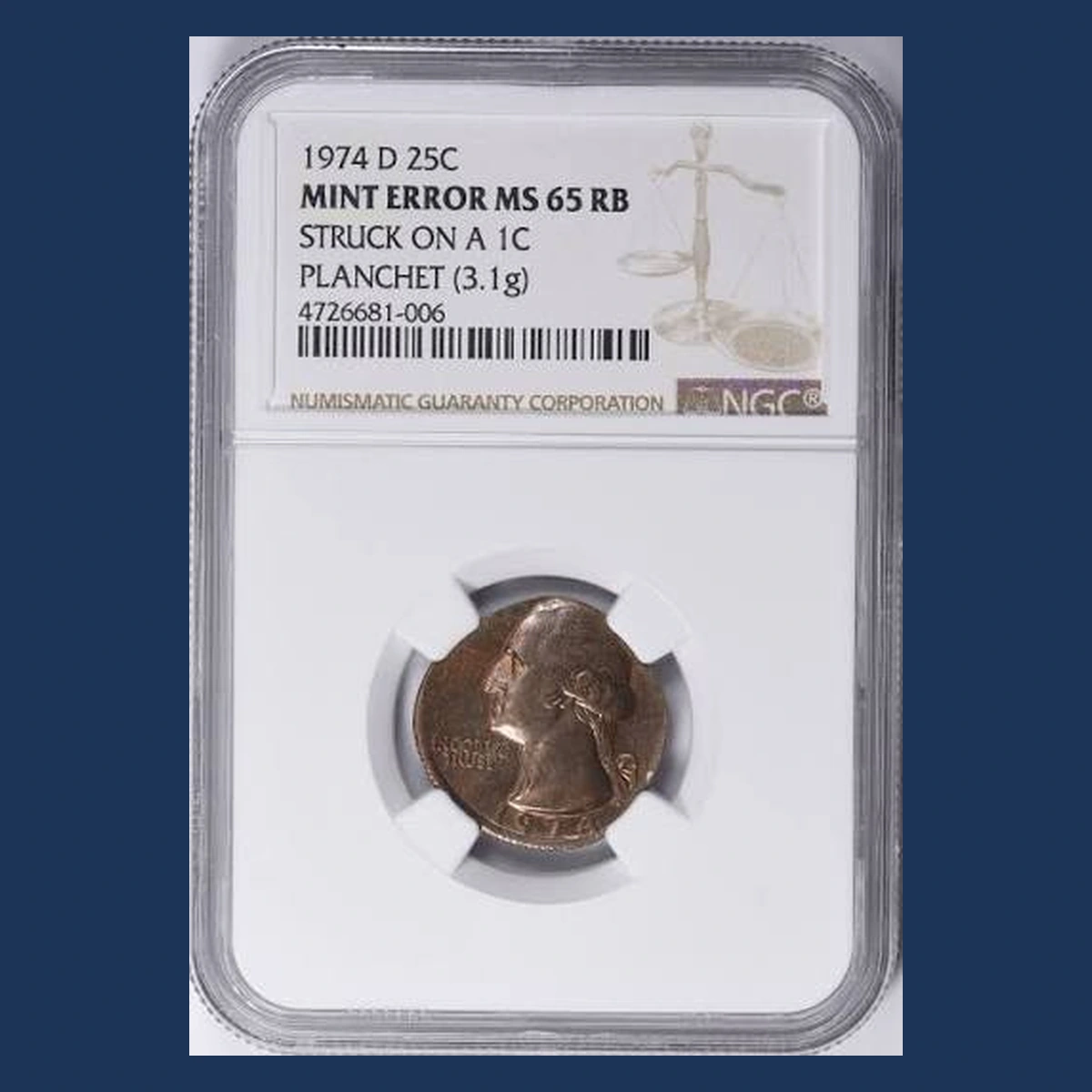
Washington’s portrait on a copper-colored, undersized disk can signal that a cent blank entered a quarter press. The larger quarter design does not fit comfortably within the smaller piece of metal.
A Denver example was graded PCGS MS64. Another no-mintmark coin received an NGC MS64 Red and Brown grade, describing its remaining copper color.
On that second example, the strike cuts off upper front details and lower back details. Its gray, rose, and green surface colors belong to that particular coin, rather than being required signs of every cent-blank quarter.
Estimated Value
Comparable cent-blank errors have an estimated range of $500 to $2,500. The Denver MS64 example sold for $977.50 in January 2010, while the no-mintmark MS64 Red and Brown coin brought $833.75 in September 2002.
A more recent no-mintmark MS62 example sold for $540 in December 2024. Its lower grade describes an unworn coin with more marks.
How much of the date survives and how clearly the quarter design fits the wrong blank influence collector interest.
How to Identify
Look first for a quarter design on metal with the size and color of a cent. Color alone is insufficient because a normal quarter can be plated or chemically altered.
For a loose candidate, check the weight and edge. A standard 1974 cent blank weighs 3.11 grams and lacks the quarter’s pale outer layers around a copper center.
Inspect the design near the edge to see which details ran beyond the small blank. On the documented no-mintmark example, the upper front and lower back are cut short.
Read the date and any surviving mintmark independently of those lost details. A photograph of a copper-colored disk without recognizable quarter features cannot establish this wrong-blank error.
13. 1974 Washington Quarter Struck on a Liberia Twenty-Five-Cent Blank
Two countries can use a twenty-five-cent denomination without using the same blank. A 1974-D Washington quarter was struck on one intended for Liberia’s twenty-five-cent coin.
The recorded blank is slightly smaller than a normal United States quarter blank and weighs 4.6 grams. Its smaller size limits the space available for Washington’s design.
NGC graded the coin AU58, meaning only slight circulation wear. The error concerns the blank’s intended use, not a Liberian design stamped onto the quarter, and it requires more than a low weight to identify the foreign metal correctly.
Estimated Value
The Liberia-blank example sold for $276 in April 2006. A comparable authenticated foreign-blank quarter has an estimated range of $250 to $2,500.
A clear date and mintmark help collectors connect the unusual metal with the United States strike. The quality of the remaining design also affects how well the error displays.
An established foreign-blank identification is important at the higher end. A light quarter with no explanation for its metal should not be priced as this specific error.
How to Identify
Check that the design is Washington’s quarter design and that the D belongs to the actual coin. The foreign connection concerns the unused blank, not an earlier Liberian coin image.
Compare the outer details with the smaller blank’s boundary. Then record the weight and diameter if the coin is loose, keeping those measurements tied to its photographs.
The known example weighs 4.6 grams, but a missing-layer quarter can weigh about the same. Examine the edge structure and surfaces before drawing a conclusion from the scale.
A specialist can compare the metal and dimensions with the identified Liberia blank. Matching only one number is not enough to distinguish this foreign blank from other light or damaged quarters.
14. 1974 Washington Quarter Die Cap with Back Brockage
A coin that sticks to a stamping tool can develop a raised wall as further strikes force metal around the tool. The resulting cup-shaped piece is called a die cap.
A 1974-D example also carries back-side brockage, a sunken mirror image transferred from a struck coin. Both features belong to the same unusual piece.
PCGS graded it MS66, an unworn coin with few marks. This is the cap itself, rather than a later quarter whose portrait became weak because a cap covered the tool above it during the strike.
Estimated Value
The PCGS auction record shows $1,265 in April 2006 for the MS66 cap with back brockage. Estimate $500 to $4,000 for comparable authenticated examples.
The height and preservation of the wall, the clarity of the backward impression, and the remaining date all influence appeal. A damaged rim can make the original cap shape harder to appreciate.
The cup and its brockage form one collectible object. Their values should not be added as though they were separate coins.
How to Identify
Keep a certified cap inside its holder. A loose one needs support that does not press on its raised wall.
Examine the profile for metal shaped around the stamping tool. A rim folded inward by later impacts has a different history from a cap growing outward during repeated strikes.
Now turn to the back and look for recognizable details that are both backward and sunken. Side lighting helps distinguish that transferred impression from ordinary raised lettering.
Check the surviving date and D in the same photographs. Compare the actual wall profile rather than assuming a particular height from the MS66 condition grade.
Do not try to flatten an unusual piece. The wall, base, and transferred image need to remain together to explain the minting accident.
Conclusion
The estimated $2 to $4,000 range covers very different objects, from modest raised cracks to a cup-shaped cap. Matching the actual shape is more useful than searching for a large price attached to the year.
Treat weight as evidence, not a name for an error. A thin quarter, a missing layer, and a foreign blank can all weigh less than normal for different reasons.