1992 Dime Error List with Pictures

Three strikes do not always mean a four-figure price. A 1992-D dime graded NGC MS66, unworn with few marks, sold for $129 in June 2023 after three blows in the press.
The 1992 dime errors below also include missing layers, clipped metal, and a Denver coin made from an unusual solid alloy. Estimated values span $2–$3,000.
Begin with what changed on the coin: its picture, outline, surface, or metal. Each clue calls for a different check.
1. 1992 Roosevelt Dime Weakly Formed Design
A coin can leave the press with shallow details that never formed completely. Roosevelt’s highest points and the torch may look soft even before circulation begins.
This is a weak strike, a reported category for 1992. The available report does not identify one particular mint or a fixed pattern shared by every example.
Wear can also make a dime look smooth, but it removes design after the coin has been made. Original surface texture around the weak areas helps separate incomplete formation from years of rubbing against other objects in circulation.
Estimated Value
Noticeable original strike weakness has an estimated value of $2–$75. Mild softness can be common, so a barely weak detail usually attracts limited interest.
A clear weak area on an otherwise fresh surface makes the difference easier to show. Heavy circulation wear can hide that evidence and reduce the useful comparison.
The estimate concerns a manufacturing feature rather than a smooth worn dime. A seller’s “weak strike” label does not replace examination of the remaining surface.
How to Identify
Compare Roosevelt’s cheek and hair with the deeper spaces inside the lettering, using a magnifier under a movable lamp. Wear often flattens the exposed high points while leaving more original texture in the protected areas.
Turn the coin over and examine the torch in the same way, rather than judging one soft photograph. Change the light angle to see whether faint details retain their original texture or show polishing scratches.
If only a few letters are weak beside sharply formed details, material blocking the tool is another possibility. Look for preserved original surface in the shallow areas, not merely a smooth portrait that has lost detail through circulation.
2. 1992 Roosevelt Dime Raised Cracks and Chips
A line standing above the surface can come from a crack in the tool that stamps the design. Coin metal enters the opening and copies its shape.
That steel stamping tool is called a die. If a small piece breaks away, the resulting coin can carry a raised lump instead of a thin line.
Cracks and chips are reported for 1992 without a fixed mint or location. A large lump connected to the outer rim needs its own examination before being called a cud, rather than assuming every internal chip reaches the edge.
Estimated Value
Genuine modest cracks and chips fit an estimated $2–$100 range. A clear raised feature can be more interesting than a tiny line that disappears among normal design details.
The size, visibility, and condition of the whole coin affect the comparison. Several small bumps do not each earn a separate full premium.
Dirt, corrosion, and metal pushed up by an impact need different explanations. The range assumes the extra metal formed during the original strike.
How to Identify
Choose a light angle that shows the feature’s height, and inspect it through a 5× magnifier. A tool crack leaves a raised ridge, while a scratch cuts into the finished coin.
Follow the entire line or lump and inspect the surface beside it. A raised lip bordering a dent may have been pushed upward by later damage.
For a claimed cud, trace a continuous connection to the coin’s outer rim. A bump surrounded by ordinary design is an internal chip instead.
Keep a normal dime nearby to compare the torch, branches, and portrait details. Photograph the unusual feature with those landmarks visible; a tightly cropped bright spot can hide the very boundaries needed to identify it.
3. 1992 Roosevelt Dime Reported Double Rim
Two lines around a dime’s border do not explain themselves. A shifted stamping tool, incomplete contact with the retaining ring called a collar, or later damage can create extra lines.
A double-rim appearance is reported for 1992 without enough detail to choose one cause. The affected face and mint are not established for the general report.
A partial collar leaves a step through the edge’s thickness, while a shifted tool changes where one design sits. Neither should be confused with proof of two separate blows merely because the border looks doubled from above.
Estimated Value
For a confirmed modest minting-related alignment or collar feature, use an estimated $5–$150 range. The value depends on identifying the process that produced the extra rim line.
A slight shift generally attracts less interest than a clear original edge step. Later dents, folding, or wear do not qualify for the same premium.
This estimate does not turn every doubled-looking border into an error. Compare the complete edge and both designs before choosing the relevant category.
How to Identify
Start with a side view, where a true edge step can be distinguished from two lines seen only on the face. Follow it around the entire coin.
Next compare the centering of the front and back. One shifted design beside a centered design points toward a different process from a displaced blank.
Look for folded metal, dents, or repeated knocks along the rim. These can create an extra border after minting.
If a repeated strike is proposed, find a second coherent position of letters or portrait detail. The rim alone is insufficient.
Take a side photograph with the step visible, then compare it with the front and back. A step through the edge’s thickness is different from an extra line confined to one face.
4. 1992 Roosevelt Dime Color Change from Blank Heating
A blank is heated before striking to make the metal easier to shape. Collectors call this preparation step annealing.
Problems during heating can change the surface, and this error category is reported for 1992. The report does not establish a particular mint or one required color pattern.
Dark or copper-colored metal can also result from chemicals, soil, or heat applied after a coin leaves the Mint. Color should lead to a closer look at the original surface, rather than serve as proof that the blank’s heat treatment went wrong.
Estimated Value
An identified annealing error has an estimated value of $20–$150. A visible original color effect on a well-preserved coin can be easier to display than a dull patch obscured by scratches.
For a different-year comparison, a 2000-D dime graded NGC MS63 sold for $51 in October 2022. That sale illustrates a modest price for this type of surface error.
It does not authenticate another dark dime or establish when its color developed.
How to Identify
View the coin beside a normal dime under neutral light. Colored lamps and phone filters can exaggerate a difference that is much smaller in person.
Use a magnifier to inspect protected lettering and the open background. Look for pits, crust, or scratches that may point to later treatment.
Inspect the edge to see whether both outer metal layers remain. A missing layer exposes copper for a different reason.
A normal weight cannot establish when the color formed. Keep the finish untouched for comparison with an identified annealing example.
If the coin is loose, record its weight with a 0.01-gram scale before seeking an expert examination. Look for intact struck surfaces without pits or crust, rather than choosing an error label from the shade alone.
5. 1992 Roosevelt Dime Clipped Blank
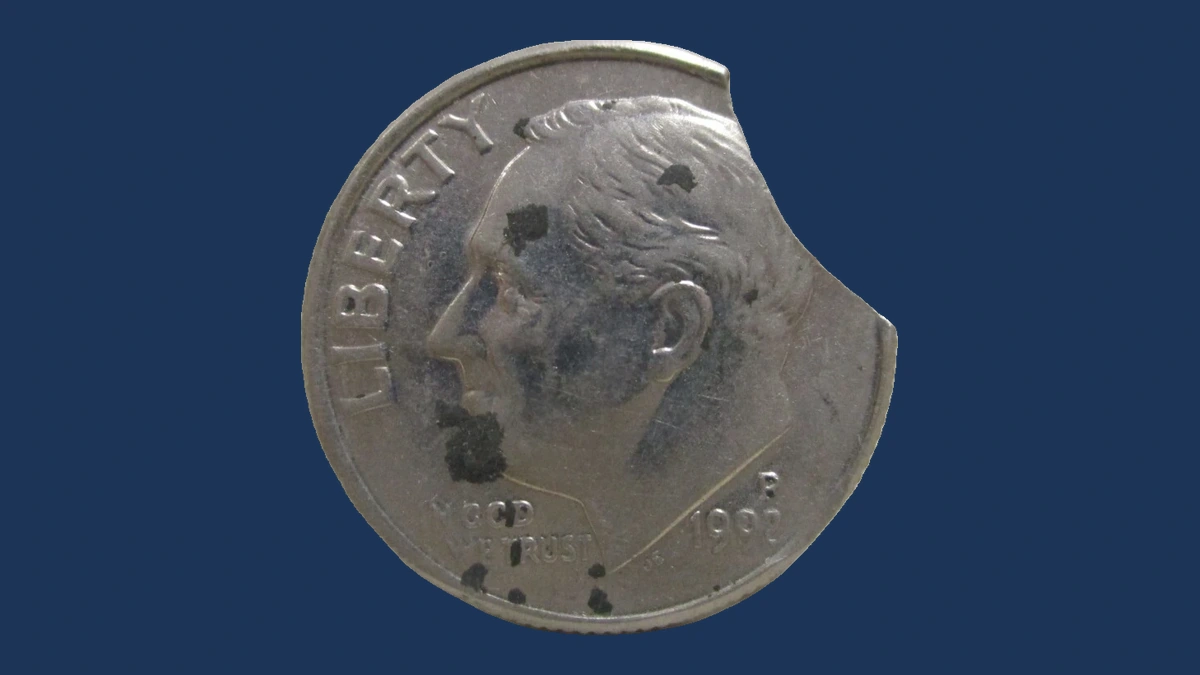
A blank can be incomplete before either side receives the dime design. The later strike places Roosevelt and the torch on the metal that remains.
This is called a clipped blank. A curved gap can form when the cutting punch overlaps an earlier opening in the metal strip; other incomplete edges can have different outlines.
Clips are reported for 1992 without a specified shape, percentage, or mint. A particular candidate therefore needs its own outline examined, rather than borrowing the gap position or missing amount from another year’s photograph.
Estimated Value
For genuine 1992 clipped dimes, estimate $20–$300. A clear gap with a readable date can make a stronger display than a small missing edge on a badly marked coin.
The amount of metal lost is only part of the comparison. Surface condition and evidence that the gap existed before striking matter too.
This range concerns incomplete blanks. A finished dime cut with tools afterward has a different origin, even if its outline resembles a familiar clip.
How to Identify
Use a magnifier to inspect the missing section from the side, where fresh file marks or a saw cut may be visible. A face-on photograph can hide those tool marks in the exposed wall.
Follow the rim and lettering toward both ends of the gap, looking for stretching or weakness from the original strike. Weakness at the opposite rim is another possible clue, although its absence does not disprove a genuine clip.
Weigh a loose candidate on a 0.01-gram scale against the normal clad standard of 2.268 grams. Later cutting also lowers weight, so the softer original details beside the gap are more helpful than weight alone.
6. 1992 Roosevelt Dime Broadstrike with an Expanded Border
When the retaining ring fails to contain a blank, the metal can spread beyond the normal circular boundary. The main dime design may still remain complete.
The ring is called a collar, and this result is a broadstrike. Its outline can be uneven without the same loss of design seen on an off-center coin.
Broadstrikes are reported for 1992 without a measured diameter or fixed mint. The coin’s own edge and design should establish how it spread, rather than treating every wide-looking rim as the same known specimen.
Estimated Value
Genuine simple broadstrikes have an estimated range of $25–$300. More visible spreading can improve their appeal when the date and main design remain clear.
A slight uneven border may attract little interest. Heavy scratches or a crushed portrait can also reduce the comparison or suggest later damage.
Use the coin’s actual shape and surface condition to judge it. A large diameter alone does not justify the high end if the design cannot support an original broadstrike.
How to Identify
Examine the complete outline of both faces, tracing the outer lettering before concentrating on a wide rim. A broadstrike should retain the main design within the expanded metal, rather than cut off a portion of it.
Use calipers on a loose example to compare several widths with the normal dime diameter of 17.91 millimeters. With a magnifier, examine where the edge spread and whether the normal grooves gave way to a smoother area.
Look back at Roosevelt and the torch for hammer marks or crushed details that could explain later enlargement. A naturally spread border around a preserved struck design differs from a finished dime flattened by outside pressure.
7. 1992 Roosevelt Dime Design Blocked by Material
A small object between a blank and the stamping tool can keep part of the design from forming. The coin may show a hollow or a patch of interrupted detail.
Collectors call this a struck-through error. Soft grease can produce a different appearance from a hard object, even though both block contact during striking.
This category is reported for 1992 without a particular mint, material, or position established. The actual shape needs examination before it is described as wire, cloth, or another object, and a weak patch alone does not identify what caused it.
Estimated Value
Genuine modest blocked-detail effects fit an estimated $10–$75 range. A larger, clearly formed original impression can support an estimated $75–$500, depending on condition.
A 1986-P nickel struck through material sold for $204 in June 2023, providing a different-year and different-denomination comparison. It does not identify the obstruction on a 1992 dime.
Judge the visible interruption and surrounding surface together. A later dent should not receive the same premium merely because it also forms a hollow.
How to Identify
Follow a portrait line or letter toward the missing area with a magnifier. Note where the design becomes weak or ends at the depression’s boundary.
Change the light angle to examine a hollow’s edges. A later blow can leave a battered lip or cut through already finished details.
For softly missing letters, inspect nearby high points for wear. A locally weak patch beside sharp details is different from a dime worn smooth all over.
A narrow line alone does not identify wire, and a rough patch does not prove cloth. Keep the surface uncleaned and photograph the depression together with the surrounding design so its original boundary remains easy to judge.
8. 1992 Roosevelt Dime Missing Outer Metal Layer
A normal clad dime contains a copper center between two pale outer sheets. If an outer sheet is missing, the affected face can show copper beneath the design.
Missing-layer errors are reported for 1992 without a specific face or mint identified. Those details need to come from the coin itself.
The ordinary copper stripe along the edge is normal and does not indicate an error. Brown staining or added copper can also change a face’s color, so the edge structure and original design matter as much as the shade.
Estimated Value
For an authenticated comparable missing-layer dime, estimate $50–$600. A clear exposed face with attractive original detail is generally easier to collect than a small damaged patch.
As separate different-year examples, 2000-D dimes missing a back layer or a front layer sold for $132 and $104. Those results occurred in November 2020 and December 2022 respectively.
Each sale concerns its own coin. Neither specifies the affected face, weight, or value of a reported 1992 candidate.
How to Identify
First identify the normal version of the coin. San Francisco made both clad Proofs and ninety-percent-silver Proofs, which are specially made collector coins.
The silver version has no copper center to expose. An S mintmark alone therefore does not settle which metal should be present.
On a clad candidate, follow the edge beside the copper-colored face using a magnifier. A real missing layer should explain that edge structure, not just a brown stain.
Weigh a loose coin on a 0.01-gram scale: the normal clad standard is 2.268 grams, compared with 2.50 grams for a silver Proof.
Look for original struck detail on the exposed metal. Scraping and chemical pits can reveal later removal, which also reduces weight.
9. 1992 Roosevelt Dime Off-Center Strike
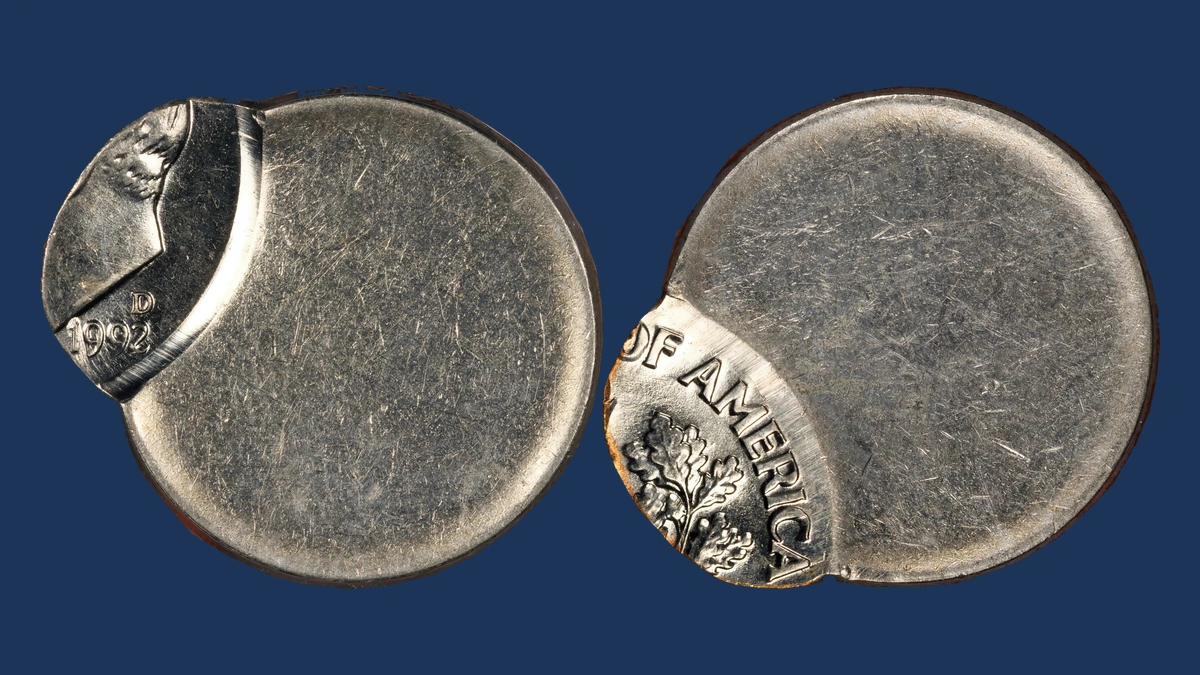
The design on one Philadelphia dime moves toward the upper right, leaving a large area without an image. Its catalog describes a thirty-five-percent off-center strike toward one o’clock.
ANACS graded the coin MS63, meaning it is unworn but has noticeable marks. It was offered together with separate off-center dimes dated 1988 and 1993.
Only the 1992 example has this particular date, grade, and displacement. The blank remained in one piece while part of the intended design missed its edge, so the unused area is not missing metal.
Estimated Value
The three-dime lot sold for $75 in January 2022. That amount covered the 1988-P, 1992-P, and 1993-P coins together, with different shifts and grades.
Individual genuine dated 1992 off-center dimes have an estimated range of $30–$750. Clear identity, a visible original blank area, and good condition help support stronger interest.
The group result does not establish a separate price for its 1992 member. Compare the individual coin’s shape and preservation before using the range.
How to Identify
Place Roosevelt upright and locate the displaced image toward the upper right. The documented coin’s one-o’clock direction belongs to the 1992 specimen.
Look at the boundary between the struck part and plain metal, then turn to the back. Both faces should explain a single blank that sat partly beyond the tools.
Keep the date and mint letter visible before comparing percentages. A larger shift can remove useful identification.
The other coins in the auction lot need separate photographs and descriptions. Do not transfer their forty-percent or thirty-percent figures to this dime.
Inspect the plain area for scraping or hammer marks. Original unstruck metal differs from a finished design that someone removed later.
10. 1992 Roosevelt Dime Strike Through a Coin Covering the Tool
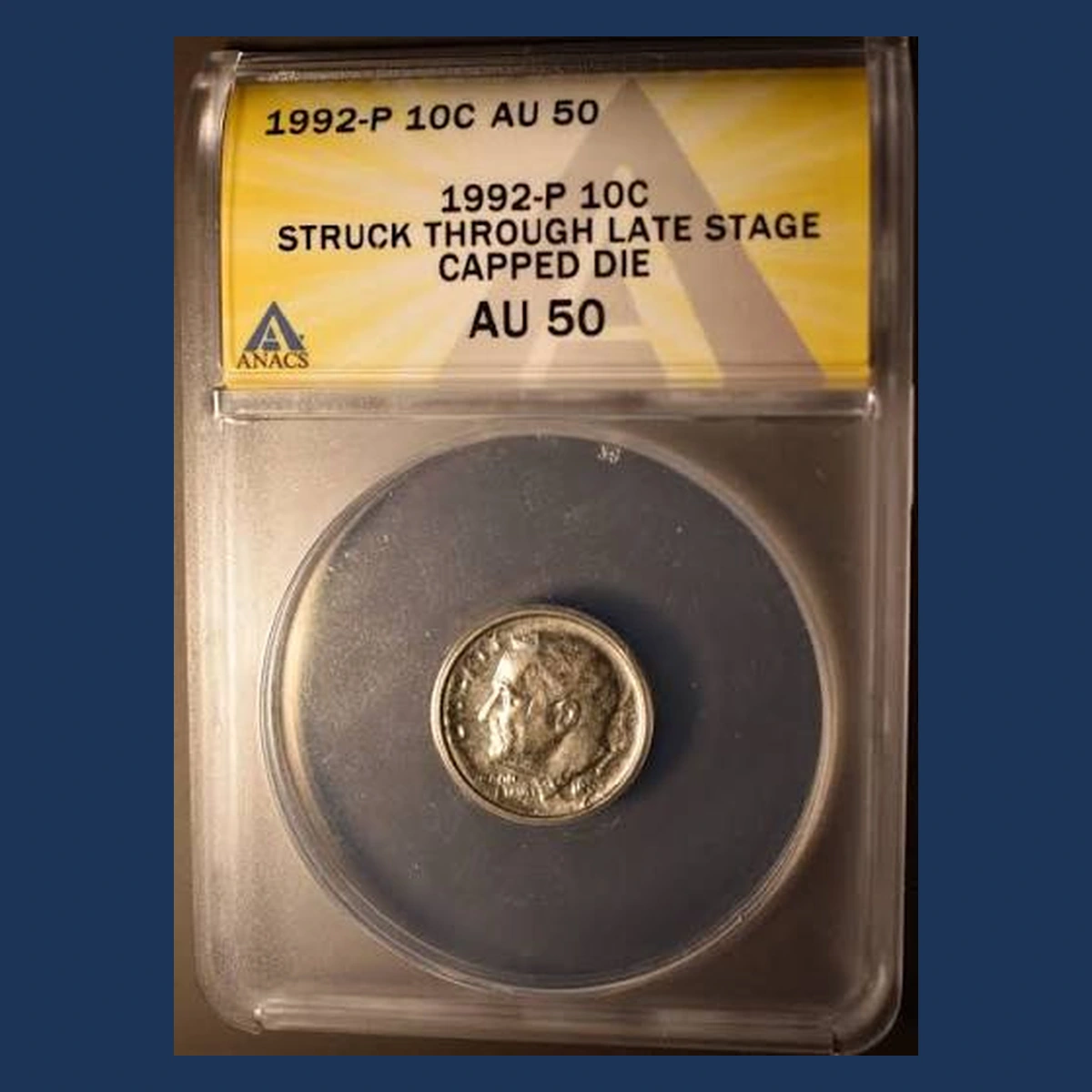
A struck coin can stick to a stamping tool and cover its design. Later blanks then meet that covering instead of contacting the tool directly.
The stuck coin becomes a die cap. A separate 1992-D dime was cataloged as struck through a late-stage cap and graded PCGS MS64, an unworn grade.
This dime received the blocked strike and is separate from the cap that covered the tool. The affected face needs to be identified from its photographs, and a weak design alone cannot establish that a covering coin caused it.
Estimated Value
For genuine comparable cap-blocked dimes, estimate $100–$1,000. Clear distortion on an otherwise original coin can be more interesting than a generally soft design.
Surviving letters and portrait details help buyers understand what happened during the strike. Heavy wear or polishing makes that comparison harder and can reduce appeal.
The upper end suits a convincing, visually distinctive example. Ordinary shallow striking does not become a cap error merely because one face is weak.
How to Identify
Compare the two faces, locating the softened side instead of assuming it must be Roosevelt’s portrait. A 10× magnifier can reveal remaining details within the area blocked by the cap.
A late-stage cap may become thin enough for parts of the tool’s design to show through. Those remaining shapes can help distinguish the effect from a surface simply worn smooth.
Move a lamp across the affected face to look for grinding or polishing scratches. Later abrasion can remove details without any covering coin having been present in the press.
Compare the distortion with the cataloged example and leave the surface untouched for specialist inspection. The flat coin that received the blocked strike is separate from the cap that covered the tool.
11. 1992 Roosevelt Dime Double and Triple Strikes
A dime that stays in the striking area can receive another blow after its first design has formed. Movement between blows can leave overlapping images on the same piece.
A 1992-D triple-struck example was graded NGC MS66. Its three strikes belong to one coin, not a set of three pieces.
A separate 1992-P double-struck dime has an off-center second strike and an NGC Uncirculated Details grade, meaning unworn but with a problem. Its back has a wheel mark, which is later damage rather than another strike.
Estimated Value
The Denver triple-struck example sold for $129 in June 2023. Comparable genuine repeated-strike dimes have an estimated range of $100–$1,500.
The modest recorded result shows that three blows do not guarantee an extreme price. Clear image separation, readable identity, and surface condition are central to the comparison.
The Philadelphia coin’s wheel mark affects its condition. Its Details description should not be replaced with the Denver coin’s clean numerical grade or sale price.
How to Identify
Trace a letter or portrait outline through its neighboring details with a magnifier, then locate another group in a different position. This is easier than counting isolated thick lines and calling each one another strike.
On the Philadelphia coin, follow where the off-center second strike crosses the first design. Turn it over to separate the overlapping images from the wheel mark, a patch of later surface damage.
The Denver coin needs its own comparison with the photographed triple-struck example, since its title does not establish exact directions or rotation angles. Look for connected groups of surviving details in each position, allowing for a later blow having flattened parts of earlier impressions.
12. 1992 Roosevelt Dime Strike on Solid Copper-Nickel Metal
One Denver dime looks close to normal size but has a different internal construction. It is solid copper-nickel metal rather than pale outer sheets bonded around a copper center.
The studied 1992-D coin weighs 2.51 grams and retains the full dime diameter. That makes it heavier than an ordinary clad dime.
Its blank’s original purpose has not been identified. The extra weight does not fit a simple missing-copper-core explanation.
Both nickels and this dime contain solid copper-nickel alloy, but that alone does not make its blank a nickel blank.
Estimated Value
An authenticated solid-alloy dime of this unusual kind is estimated at $500–$3,000. There is no recorded sale here for the studied 1992-D piece.
Readable identity, an original strike, and a reliable metal examination would be important to a buyer. Plating can hide the normal edge stripe without creating the same solid construction.
A plain explanation of what the coin actually contains is more useful than an unsupported story about a foreign blank or experimental Mint issue.
How to Identify
Weigh a loose candidate with a 0.01-gram scale and use calipers to check its diameter before naming the metal problem. The published examination gives 2.51 grams for this full-diameter Denver dime, heavier than the normal 2.268-gram clad coin.
Inspect the edge with a magnifier for a copper stripe, plating, or evidence that somebody altered the perimeter. A uniformly pale edge invites further examination but does not by itself establish solid copper-nickel metal.
An expert can test composition without cutting the coin, then compare the result with its weight and original design. Similar weight alone cannot turn this Denver specimen into a San Francisco silver Proof or identify the blank’s intended use.
Conclusion
For these 1992 dime errors, estimated values range from $2–$3,000. A small raised chip and a coin made from unusual metal need very different comparisons.
Use the shape and surviving design to choose the right explanation. Extra rim lines alone do not prove a second strike, and a dark face does not prove missing metal.
Keep each coin’s actual weight, mint, and condition with its photographs so separate examples do not become one misleading description.