1855 Dime Error List with Pictures

An 1855 dime with a doubled date sold for $16,800 in August 2023. It was a rare Proof, a specially made collector coin; an ordinary circulation strike can share the doubled date without sharing that price.
These 1855 dime errors also include cracks, missing edge pieces, and shifted designs. Estimates span $50–$5,000 for circulation errors and $15,000–$40,000 for the separate Proof group.
Read on to match the visible feature and coin type.
1. 1855 Liberty Seated Dime Obverse Die Cracks (Estimated Up to $500)
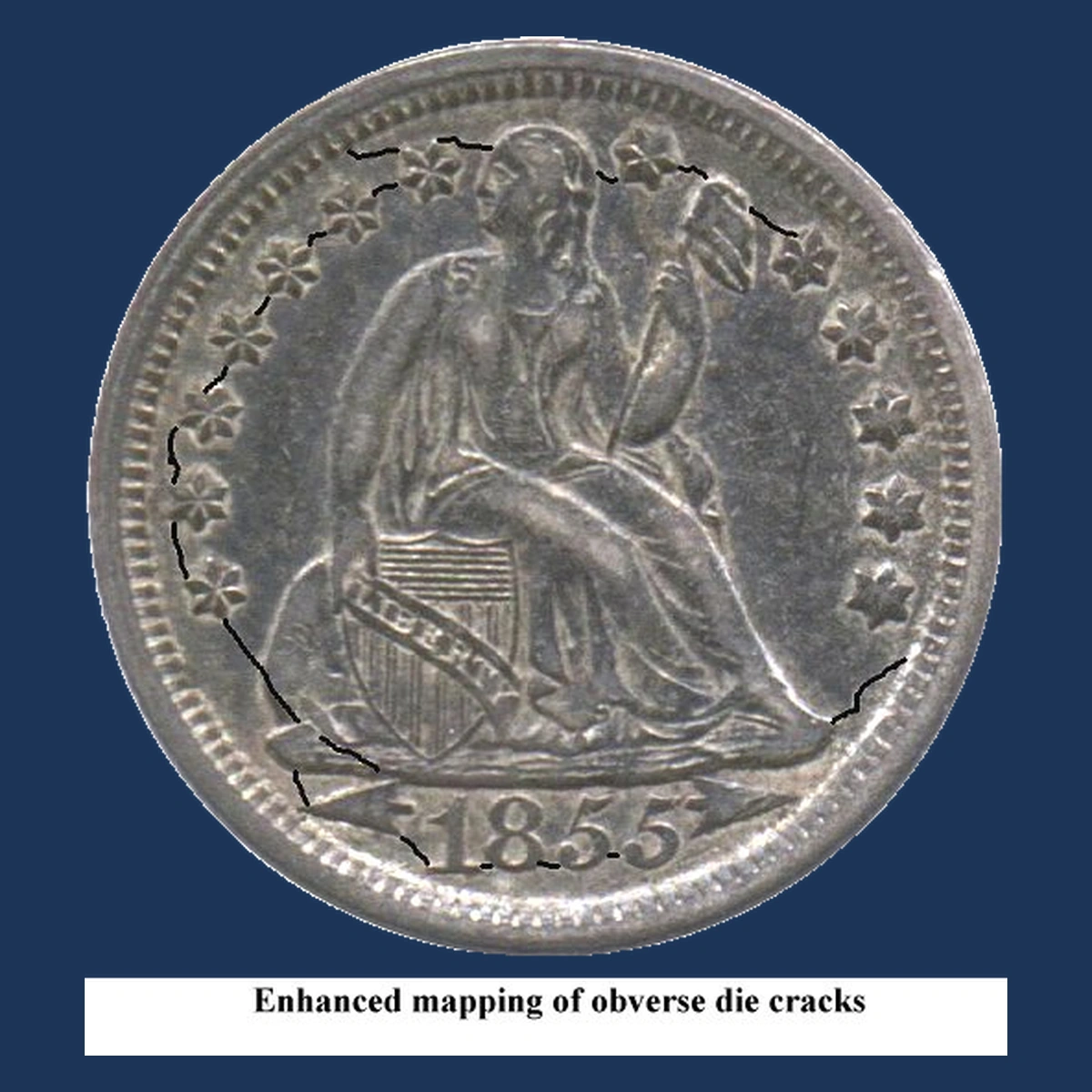
Raised lines connect the date, left arrow, and stars on the illustrated cracked-tool example. They record damage to the die, the steel tool that stamps the coin.
The route rises from the lower ends of the date through the arrow and base toward stars 1–7. Other lines cross Liberty’s head, star 8, the cap, and star 9.
The tool kept making coins as its cracks grew. The ridges do not mean the dime itself split along those paths.
Fortin’s pictured coin is worn but retains strong detail. Tiny border marks on its back also show wear in the stamping tool.
Estimated Value
Worn examples with a recognizable crack network have an estimated $50–$500 range. Clear lines and better-preserved surfaces help support higher values.
Fortin illustrates a coin graded EF45, meaning wear with strong detail, but gives no sale price for it. His table assigns no separate added value to this cracked-tool version.
The estimate therefore begins with the ordinary 1855 dime’s condition. A fine line does not receive the same value as a large raised break simply because both involve tool damage.
How to Identify
Follow the line from the date toward the left arrow with a 10× magnifier. Then compare the route around the stars, head, and cap.
Tilt the light to see whether the line rises above the silver. A scratch cuts into it and may leave rough raised metal at its sides.
The softened border marks on the back can support the comparison, but the raised front lines are the main feature. Keep both faces in the photographs.
Check ONE DIME on the back before measuring. A similar-looking half dime is a different coin.
Use a scale and calipers when safely accessible against 2.49 grams and 17.9 mm, and inspect the grooved edge. Matching raised lines along the documented route provide the clearest crack check.
2. 1855 Liberty Seated Dime Rim Clip (Estimated Up to $800)
The Rippere Collection included an 1855 dime with a rim clip. ANACS graded it VF35, meaning noticeable wear with substantial design still visible.
The missing part of the edge began before the coin received its picture. An incomplete blank, the metal disc used for the coin, entered the striking press.
Metal then moved around that existing gap as the design formed. A cut made after striking leaves a different relationship with the finished rim.
The catalog gives no percentage or clock position for the gap. Its photographs must provide those details rather than an example from another year.
Estimated Value
The VF35 example sold in November 2025, but the public listing does not show the winning amount. No transaction price is assigned to it here.
Use an estimated $75–$800 for genuine rim clips from worn through stronger, better-preserved examples. Published Seated-dime comparisons suggest $75–$250 worn and $300–$800 at higher grades.
Those figures price different levels of preservation. A tiny gap on a worn coin does not automatically qualify for the upper end.
How to Identify
Compare the catalog’s complete coin photographs and grading label before enlarging the gap. Keep the 1855 date connected to the same edge defect.
Use a 10× magnifier where the normal rim and grooves meet the missing section. Look for original struck metal rather than file lines or a fresh cut.
Calipers across an intact span can be compared with 17.9 mm. A scale reading should be considered against the original 2.49 grams, allowing for both missing metal and circulation wear.
Look opposite the gap for possible rim weakness left during manufacture. That clue need not be strong on every genuine clip.
The gap’s boundary and nearby struck rim should agree that metal was absent before the pictures were formed.
3. 1855 Liberty Seated Dime Clashed Dies (Estimated Up to $1,500)
Parts of Liberty’s shield appear where the back should show only its normal design. Fortin’s example has horizontal shield lines and lettering traces behind ON in ONE.
Faint back-design shapes also appear in the open area to Liberty’s right. The two stamping tools had hit each other without a blank between them.
Each tool picked up pieces of the opposite picture. Later coins copied those unwanted marks in addition to their normal designs.
The illustrated coin is graded MS63+, meaning unworn with visible marks. Its full ONE DIME back confirms the denomination needed for this comparison.
Estimated Value
Estimate $100–$1,500 for worn through lower-grade unworn examples with visible clashes. The upper portion allows for the preservation shown by Fortin’s MS63+ coin.
That is a condition comparison, not a recorded sale of the pictured example. His table gives no separate added value for this clash.
Begin with the normal 1855 dime’s grade and surfaces. Clearly readable transferred shapes can attract interest, but the complete price of an unworn dime is not solely payment for those marks.
How to Identify
Read ONE DIME before searching for faint marks. A half dime has a similar design but belongs to another denomination.
With a 10× magnifier, inspect behind ON for horizontal shield lines and traces of the front’s lettering. Then examine the open area to Liberty’s right for pieces of the back design.
Compare the two faces in their normal relationship. A recognizable transferred shape is more useful than an unrelated scratch in the same area.
A small line in the shield helps match the reference tool, but is not itself the clash. Use a scale and calipers when safely accessible against 2.49 grams and 17.9 mm, and inspect the grooved edge.
The opposite-design fragments behind ON provide the specific feature to find first.
4. 1855 Liberty Seated Dime Rotated Reverse (Estimated Up to $2,000)
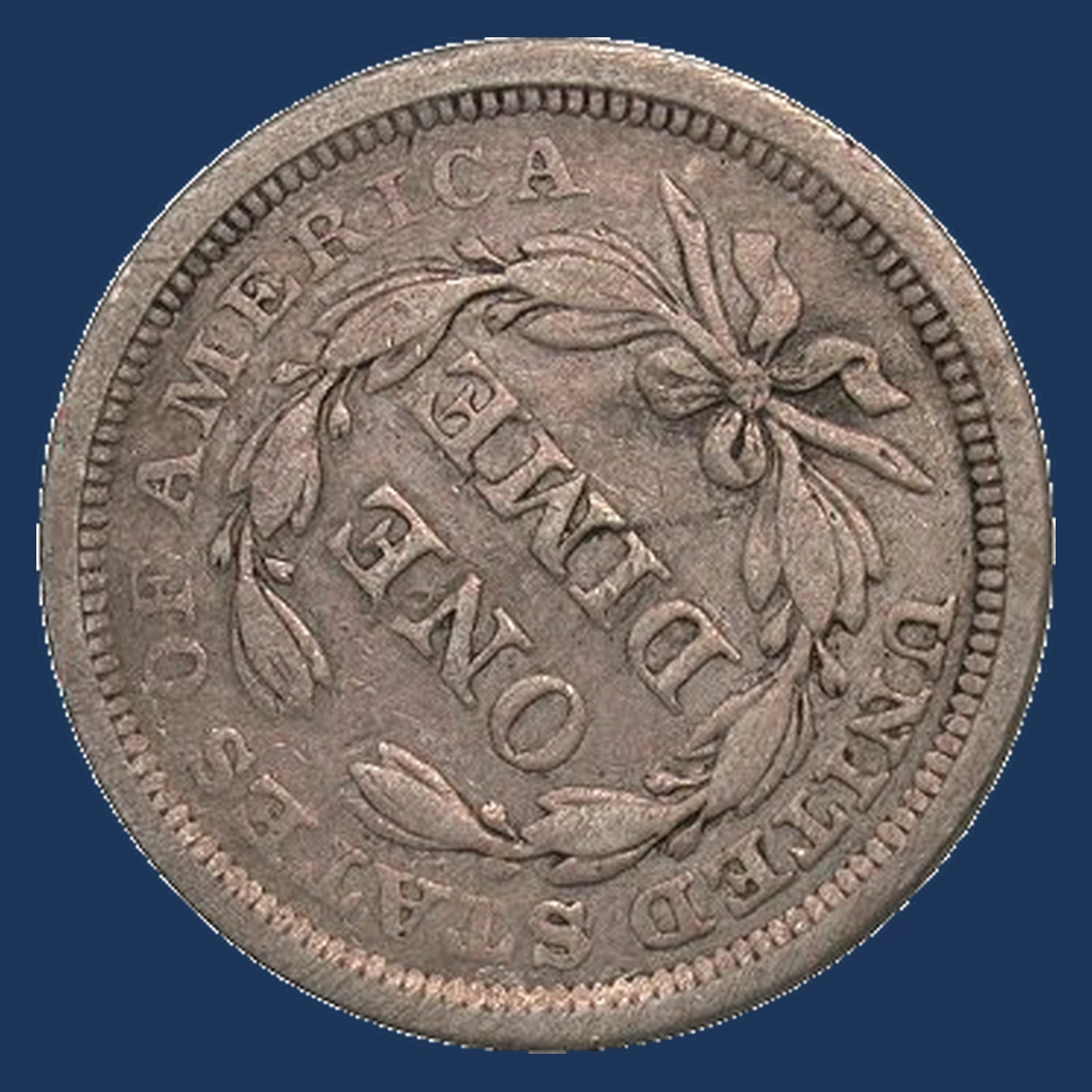
The wreath ends up far from upright after a normal flip of this dime. Fortin records the back as rotated 135 degrees to the right.
The error concerns how the two stamping tools pointed relative to one another. It does not require a second strike or doubled letters.
The example also has a weak date and weak back design. Those features help describe the coin but cannot establish the rotation by themselves.
If each photograph is turned upright separately, the unusual relationship disappears. Keep the two faces in the same physical relationship when checking the reported angle.
Estimated Value
Clearly identified worn examples have an estimated $200–$2,000 range. Better preservation and original surfaces affect where a particular coin belongs.
Fortin suggests a 200–400 percent premium over an ordinary coin in comparable condition. That is value guidance, not a completed auction result.
A heavily worn dime and one with only slight wear can have the same angle but different values. The measured rotation needs to remain with the condition of the whole coin when choosing a comparison.
How to Identify
Set Liberty upright in a transparent holder that prevents the coin from turning. Flip it straight from top to bottom without twisting sideways.
The back of a normal coin should finish upright. Use a fixed vertical line and protractor to measure the reported 135-degree rightward tilt.
Repeat the flip before recording the angle. A coin sitting crooked inside a holder does not prove that its two faces are misaligned.
A 10× magnifier helps read the weak date and inspect the edge grooves for alteration. Use a scale and calipers when safely accessible against 2.49 grams and 17.9 mm.
A repeatable back angle after the same controlled flip provides the evidence of rotation; separately straightened pictures do not.
5. 1855 Liberty Seated Dime Off-Center Strike (Estimated Up to $5,000)
Two reports describe separate off-center 1855 dimes. One dealer advertisement lists a ten-percent shift on a PCGS AU50 coin, meaning light wear.
An older catalog describes another coin shifted twenty-five percent toward nine o’clock. That larger shift and direction belong to the second example only.
In both cases, the blank sat partly outside the stamping tools. Some metal remained bare while part of the intended picture missed the edge.
The ten-percent advertisement also says Type I blank, meaning it lacked the raised rim normally prepared before striking. That wording does not mean foreign metal or another denomination’s blank.
Estimated Value
The ten-percent AU50 advertisement asked $2,700. That was a dealer’s price, not a recorded sale.
Use an estimated $1,500–$5,000 for substantial, readable-date examples from worn through slightly worn condition. The same-year asking price offers context for that range.
No sale amount is used here for the separate twenty-five-percent coin. Its larger shift does not let you add a fixed amount to the advertised coin’s price, and Type I does not justify a wrong-metal premium.
How to Identify
Look for bare metal beside the stamped design, rather than simply a gap in the outline. An off-center strike generally keeps the blank’s metal instead of removing a piece.
Use a 10× magnifier at the boundary and compare both faces. Their missing design should fit the same misplaced position.
Keep photographs of the two reported coins separate. The twenty-five-percent coin’s leftward direction cannot supply a missing direction for the ten-percent example.
Use a scale against 2.49 grams and calipers against 17.9 mm when safely accessible. Inspect the surviving edge grooves and check bare areas for grinding.
An original blank crescent beside corresponding missing design on both faces supports off-centering, with the readable date identifying the year.
6. 1855 Liberty Seated Dime Doubled Die Obverse (Estimated Up to $40,000 for Proofs)
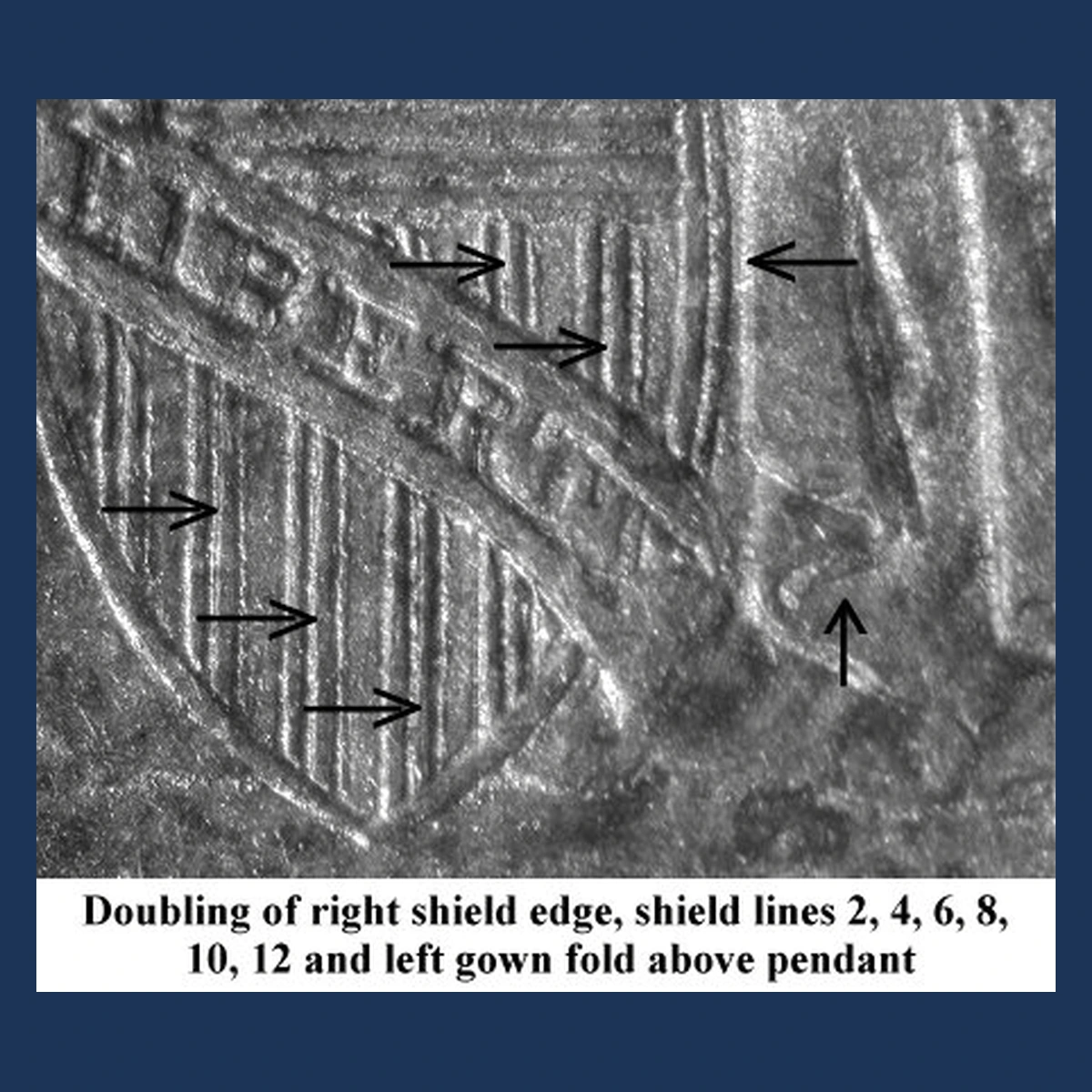
A repeated line at the shield’s right edge identifies one 1855 front tool. A separate tool has doubled date details and was used for rare Proofs.
The date and arrows were already part of the master design copied into the tools. Their extra outlines did not come from individually punching each digit into a finished working tool.
The Proof tool later made ordinary circulation coins too. A doubled date alone therefore cannot prove that a dime is a Proof.
Shield doubling and date doubling need separate comparisons. Each pattern should agree with the tool that made the particular coin.
Estimated Value
Estimate $100–$2,000 for worn through lower-grade unworn doubled dies. The separate rare Proof issue has a $15,000–$40,000 comparison range.
A PCGS PR64 Cameo with CAC approval sold for $16,800 in August 2023, as recorded by PCGS. Cameo describes frosted designs against reflective backgrounds.
That price belongs to the rare collector coin, including its condition and manufacture. It does not apply to an ordinary circulation strike simply because the date also looks doubled.
How to Identify
For the shield variety, use a 10× magnifier on its right outer edge. Compare the rounded repeated line with the matching reference.
For the date variety, inspect the numerals instead. Keep the rare Proof and later circulation coins made with the related tool separate.
A scale and calipers check safely accessible examples against 2.49 grams and 17.9 mm. Their grooved edges and normal measurements do not determine whether they are Proofs.
That decision requires the full surfaces, strike, and matching tool details. Polishing an ordinary coin until it shines does not change how it was made.
The extra shield line or date outline must match its own known pattern, while the complete coin supports any claimed Proof identity.
Conclusion
Estimated values run from $50–$5,000 for the circulation-error groups, with a separate $15,000–$40,000 Proof range. Match the visible line, missing edge, transferred shape, or shifted picture before choosing a price.
Preserve both faces when checking the 135-degree rotation. For a doubled date, the coin’s complete surfaces and manufacture decide whether it belongs with rare Proofs or ordinary circulation strikes.