1879 Dime Error List with Pictures

A normal 1879 dime graded NGC MS65 sold for $840 in September 2022. That whole-coin price helps set the scale before considering tiny extra date outlines or raised cracks.
The 1879 Liberty Seated dime errors below have estimated values of $150–$5,000, depending on condition and how the coin was made. Proofs are special collector coins, separate from ordinary circulation strikes.
Read on to compare the date and wreath without mixing features from different varieties.
1879 Liberty Seated Dime Repunched Date (Estimated Up to $5,000)
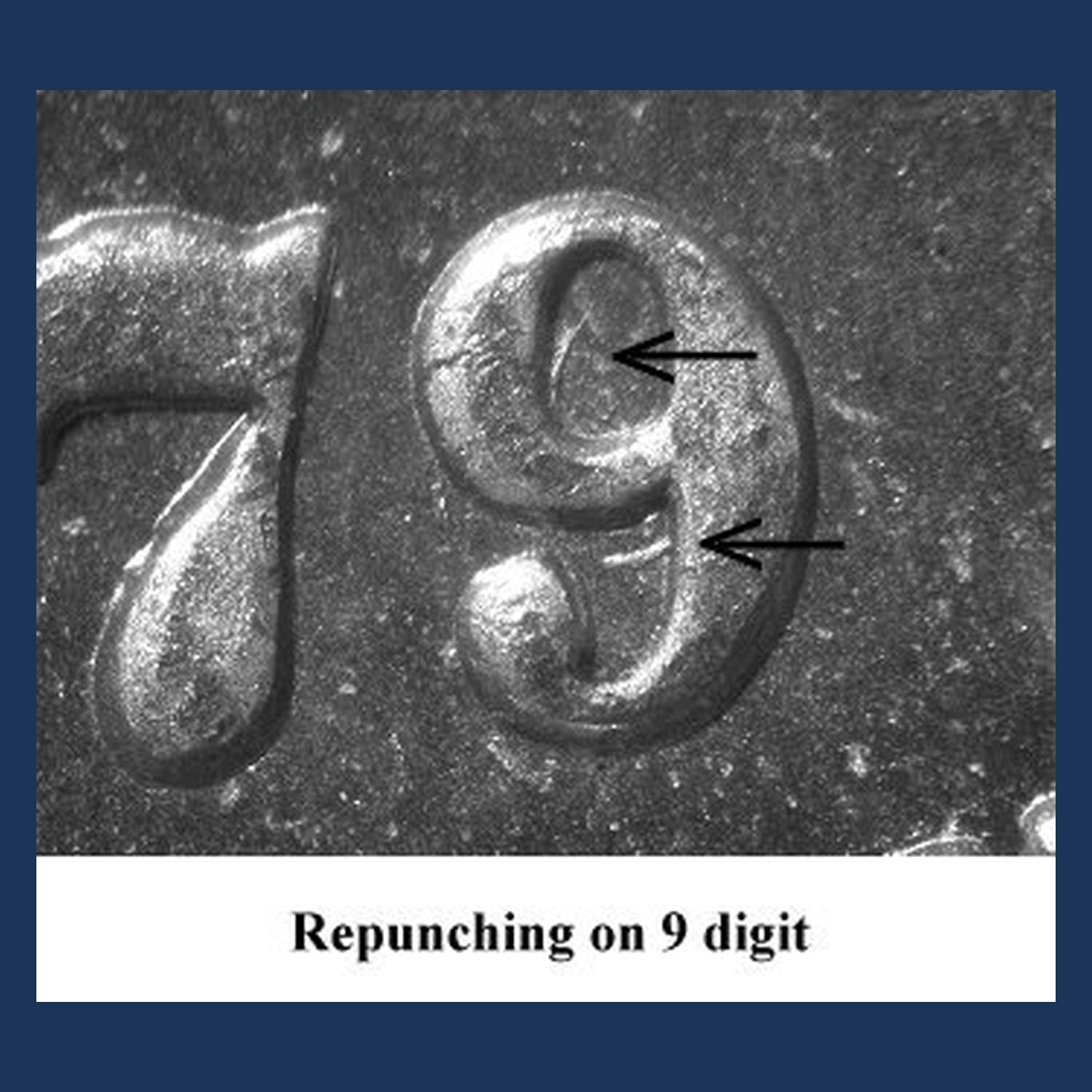
An extra curve inside the 9 or near its upper edge can reveal a date punched more than once. The surviving outlines passed from the steel stamping tool onto the coin.
This 9 appears on the F-103 Proof variety and the related F-103a circulation coin. The F numbers identify the different tool combinations.
Another date pattern has traces at the top and below the base of the 1, plus traces below the 8’s loops. These are separate examples.
Do not expect every repunched 1879 date to show all of those marks together.
Estimated Value
Estimate $150–$3,000 for worn through well-preserved unworn coins, or $400–$5,000 for collectible Proofs. These are whole-coin values, not separate fees for each repeated digit.
An ordinary NGC MS65 sold for $840 in September 2022, without an identified repunched date. MS65 describes a well-preserved, unworn coin.
An 1880 Proof graded PR68 brought $4,800 in November 2025. That exceptionally preserved, different-year coin gives only a Proof-market comparison, not a sale of this 1879 variety.
How to Identify
Start with a clear view of the whole date, then use a magnifier inside and above the 9. Compare the extra curves with a confirmed F-103 or F-103a photograph.
If the marks involve 1 and 8 instead, compare that separate pattern. A thick number, flat shelf, or bright reflection can resemble doubling without preserving the earlier punch shape.
Check that this Philadelphia dime has no mintmark. Its normal 90% silver alloy weighs 2.50 grams and measures 17.9 mm; use a scale and calipers.
Inspect the edge grooves for damage and compare the correct Proof or circulation finish. For a quick match, follow the extra outlines around the same digits in a confirmed example.
1879 Liberty Seated Dime Reverse Die Cracks (Estimated Up to $5,000)
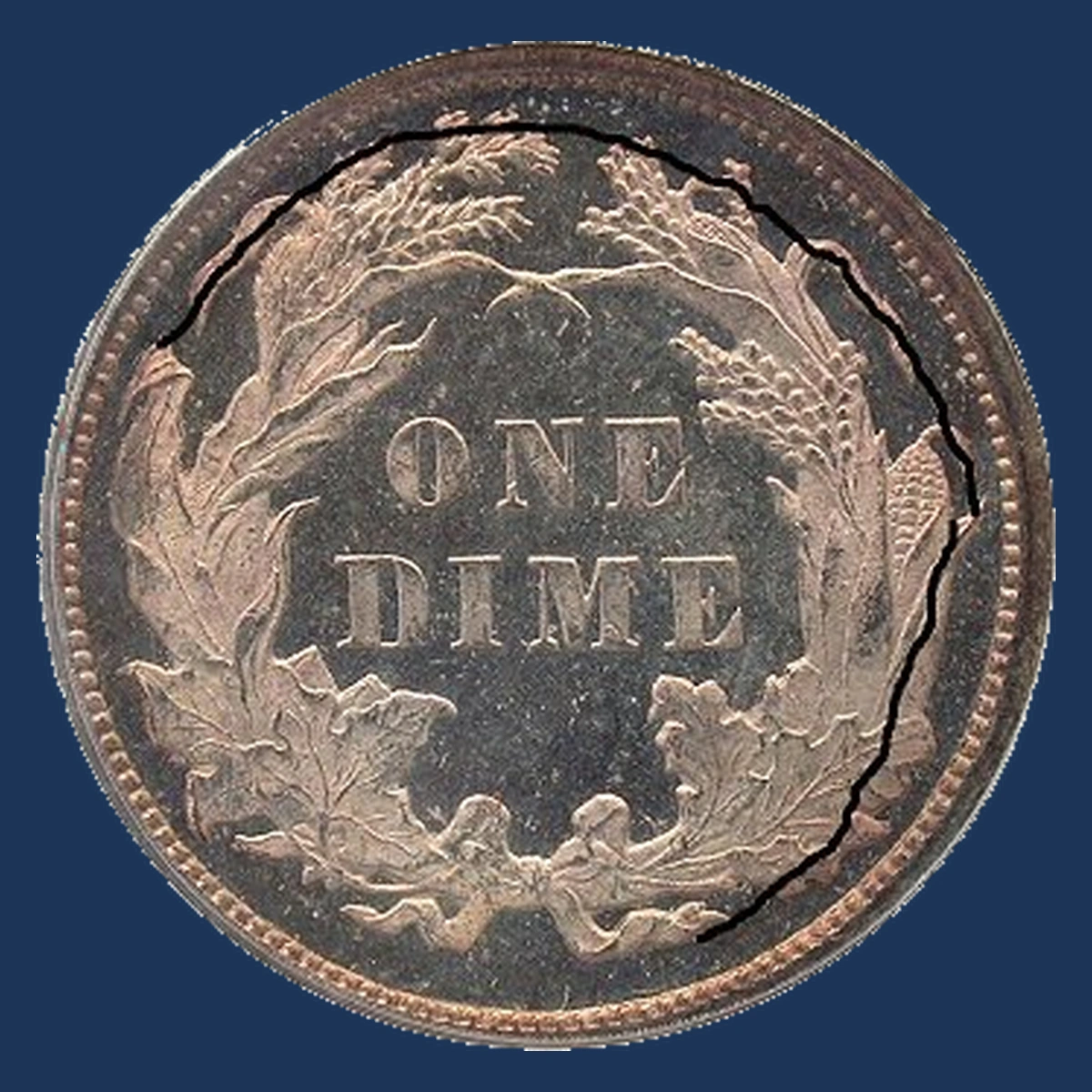
A thin raised ridge can follow a leaf edge or cross part of the wreath. It forms when silver enters a crack in the die, the steel tool stamping the coin.
The F-101 Proof has cracks along the outer leaf edges. The F-105 circulation variety has a different path through the wreath.
These are separate patterns, rather than one required network on every 1879 dime. The coin itself has not necessarily split.
The 1879 variety photographs also show marks made while preparing other tools, which should not be mistaken for these cracks.
Estimated Value
Estimated whole-coin values are $150–$3,000 for worn through attractive unworn coins and $400–$5,000 for Proofs. Condition and original surfaces usually matter more than these small cracks.
The 1879 MS65 sale at $840 was not identified with a matching crack pattern. It remains a general same-year comparison.
The $4,800 sale of an 1880 PR68 is a different-year Proof comparison. Neither amount measures a separate premium for a crack beside an 1879 leaf.
How to Identify
Use a magnifier and low-angle light to follow a suspected line through the wreath. Tilt the dime to see whether the line rises above the surface or cuts into it.
A sunken scratch and a split in the coin have different causes. Match a raised line to the correct Proof leaf-edge pattern or circulation pattern before tracing its full route.
Check the edge grooves for cuts or impacts. Then use a scale and calipers against the normal 2.50 grams and 17.9 mm, allowing for wear.
A nearby line from another cause should not be joined into the same crack. Begin by tracing one raised ridge along the same leaves shown on the matching variety photograph.
Conclusion
Estimated values for these 1879 dimes run from $150 to $5,000 for the whole coin. Repeated date outlines began when the tools were prepared; wreath cracks developed as those tools wore out.
Compare the correct Proof or circulation variety, then consider condition and original surfaces. A small mark can identify an interesting coin, but its shape and location need to match before a sale price becomes a useful comparison.