1964 Dime Error List with Pictures

Silver was still the normal metal for a 1964 dime, so a copper-alloy example presents an unusual puzzle. One graded PCGS MS64 sold for $3,450 in April 2010.
Other 1964 dime errors change the lettering, shape, or surface instead of the metal. The examples below have estimated values from $10 to $15,000, with ordinary and special collector coins kept distinct.
Read on for the visible clues, practical checks, and price differences that matter when examining this final regular silver-dime year.
1. 1964 Roosevelt Dime Thickened Lips from Tool Polishing
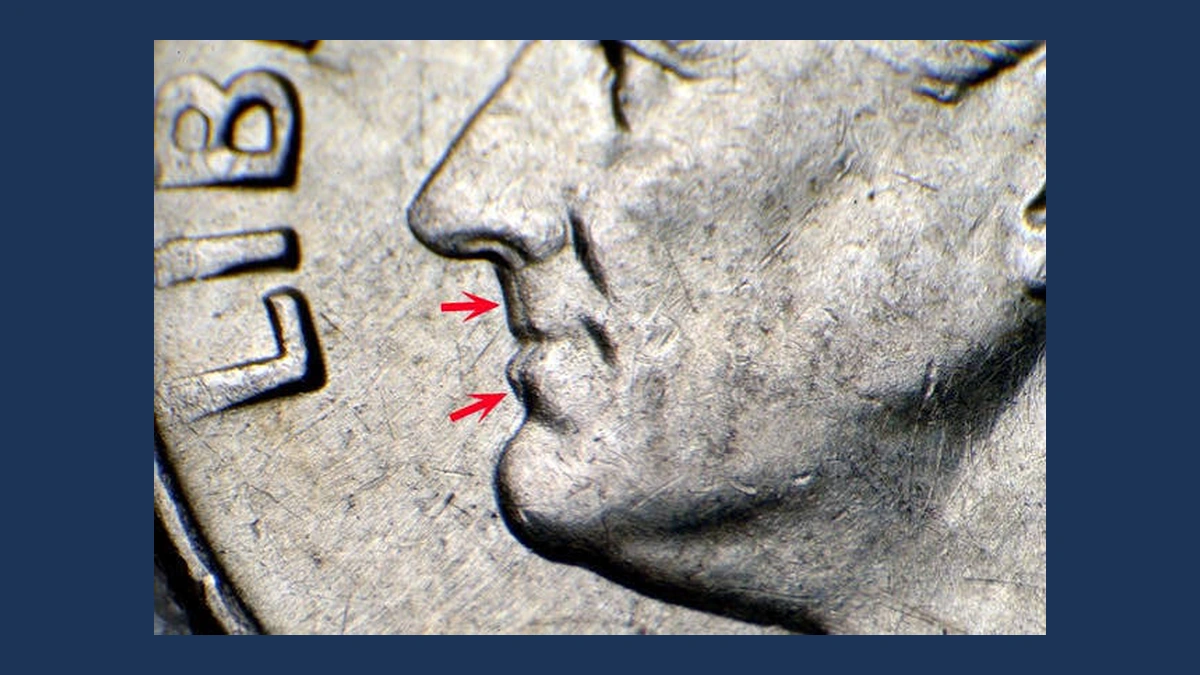
Roosevelt’s lips can look swollen or doubled even though the stamping tool was not made with two complete design impressions. Polishing of the tool can change the outlines around this small feature.
The nickname “Hot Lips” has been used for examples from both Philadelphia and Denver. Their older doubled-die listings were withdrawn and reclassified as abrasion doubling, meaning changes caused by polishing the tool.
That history matters when choosing a comparison coin. A familiar nickname does not turn the altered lip shape into genuine doubled-die lettering.
Look at the surrounding face as well as the mouth.
Estimated Value
An estimated $10–$75 covers ordinary collectible examples with clear polishing-related lip changes. This is a modest whole-coin estimate, not the price of a scarce certified doubled die.
The coin’s silver content and condition also contribute to its value. A strongly advertised “Hot Lips” name does not by itself justify a large premium.
Compare the actual mouth shape with the corrected variety description. A coin sold under an old name can still have the less valuable polishing-related feature.
How to Identify
Find the D on the back, to the lower left of the torch, or establish that the coin is the no-letter Philadelphia issue. Then select the matching mint’s mouth photograph.
With a 10× magnifier, examine the lip outline and nearby surface for the broad changes left by tool polishing. Do not demand the split letter tips that identify a different mechanism.
A scale and calipers should give about 2.5 grams and 17.91 millimeters for a loose normal disk. The edge should retain its regular grooves.
The practical distinction is the localized altered mouth shape, not two well-separated impressions of the whole design.
2. 1964 Roosevelt Dime Raised Cracks and Broken-Tool Lumps
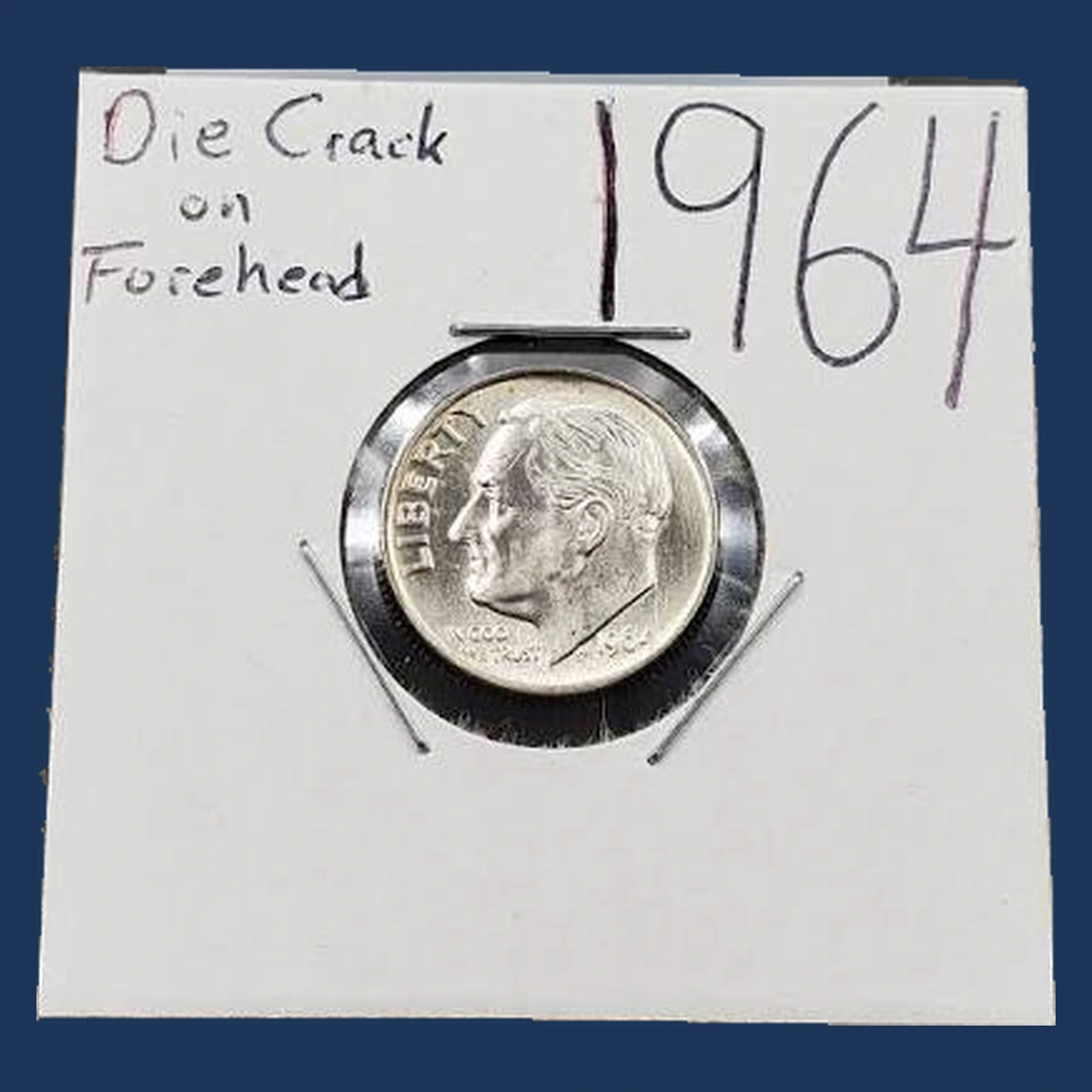
Thin raised lines across Roosevelt’s hair can come from cracks in the stamping tool. Larger broken areas leave raised lumps where coin metal fills the missing steel.
Known Denver examples include a long lump near the forehead and another among the branches on the back. Several hair cracks reach the rim in different directions.
These are different tools and stages of damage, not one universal pattern. A reported cud is a larger break joined to the rim.
A line merely reaching the edge does not make every cracked coin a cud.
Estimated Value
Small raised cracks are estimated at $10–$40, while clearer lumps or rim-connected breaks can reach $40–$200. Visibility and the coin’s overall condition shape the premium.
As a different-denomination comparison, a 1970-D nickel with two cuds sold for $63 in October 2022. That sale illustrates modest demand for visible breaks, not a price for a particular 1964 dime tool.
Several cracks on one dime belong to one coin and one total price.
How to Identify
Weigh a loose candidate and measure it first if the rim looks heavily battered. Normal readings near 2.5 grams and 17.91 millimeters on a scale and calipers help rule out major alteration.
Follow the raised lines through a 10× magnifier while turning the light. Denver examples can have cracks across the hair, a forehead lump, or a raised patch among the back branches, so match the actual pictured pattern.
Inspect the edge grooves near any claimed cud for crushing or added metal. A natural raised lump connected to the rim supports a cud, while a thin raised line identifies a crack.
3. 1964 Roosevelt Dime Peeling Silver Alloy
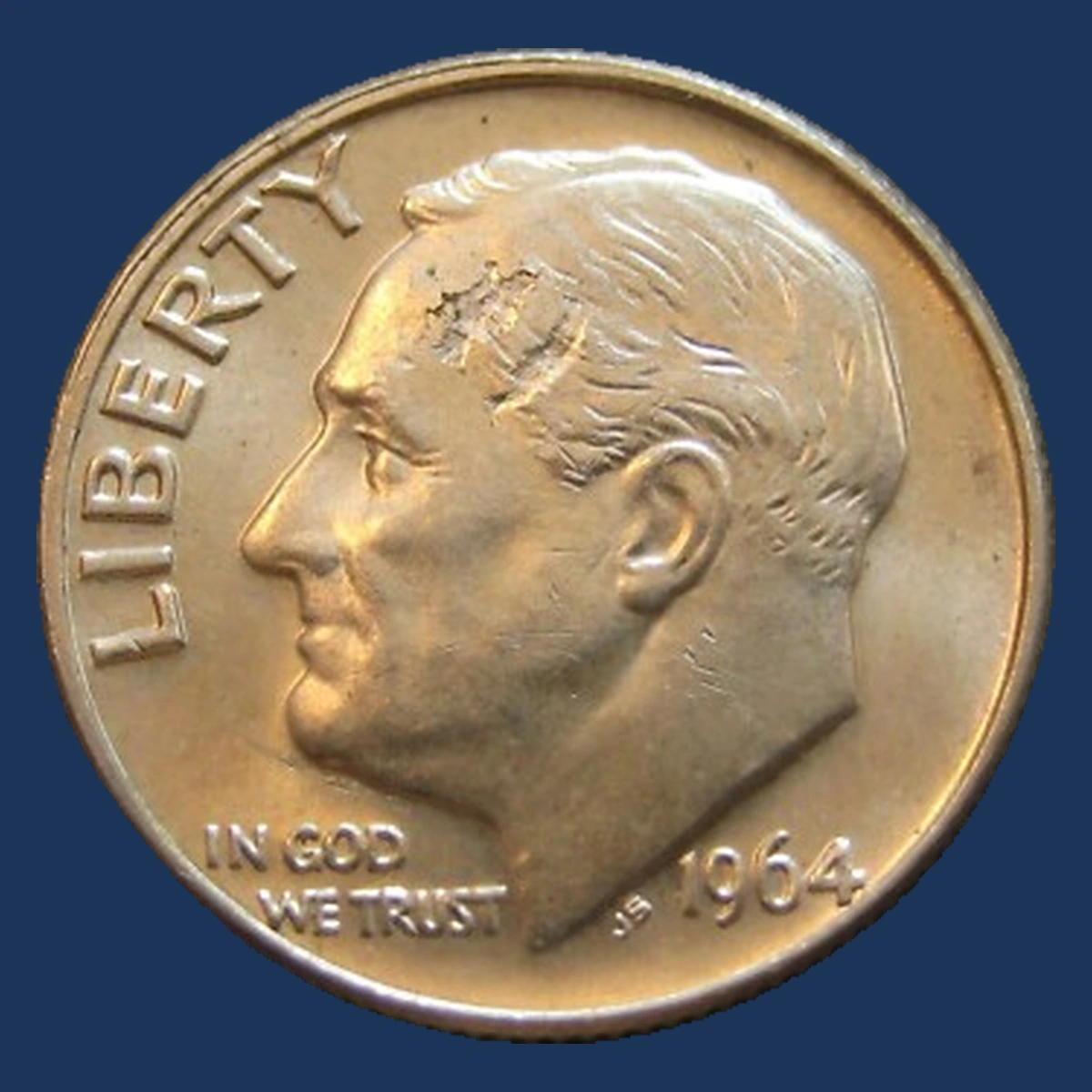
A rough patch or lifting flake can interrupt the front design without changing the coin’s overall outline. It can form when weakness inside the metal lets a shallow layer separate.
This error is called a lamination. A Philadelphia 1964 dime graded NGC MS63 is recorded with a front-side example.
The normal coin is 90% silver and 10% copper throughout its alloy. It does not have the copper center and pale bonded faces of later dimes.
A peeling area therefore needs to be explained as alloy separation, not as a missing modern clad layer.
Estimated Value
Genuine front laminations are estimated at $15–$200. Small rough patches on worn coins sit lower, while a larger clear peel on an attractive coin can bring more.
The recorded NGC MS63 specimen has no circulation wear but does have visible marks. Its preservation provides a useful comparison when judging how clearly a similar separation can be seen.
Silver content remains part of the whole coin’s value. Harsh cleaning or deliberate lifting of a flake can reduce collector interest.
How to Identify
Do not pick at a loose flake. Under a 10× magnifier, examine whether a natural separation follows the metal beneath the design.
A torn layer can interrupt letters or expose a rough surface. A smooth scoop with tool marks needs a different explanation.
If safe to handle, weigh the loose coin on a scale against 2.5 grams. Calipers should show width near 17.91 millimeters, although lost material can reduce weight.
Check that the surrounding edge grooves and unaffected surfaces remain normal for a silver dime.
A layer separating within the silver alloy, with no artificial cut around it, is the feature to identify.
4. 1964 Roosevelt Dime Design Blocked During Striking
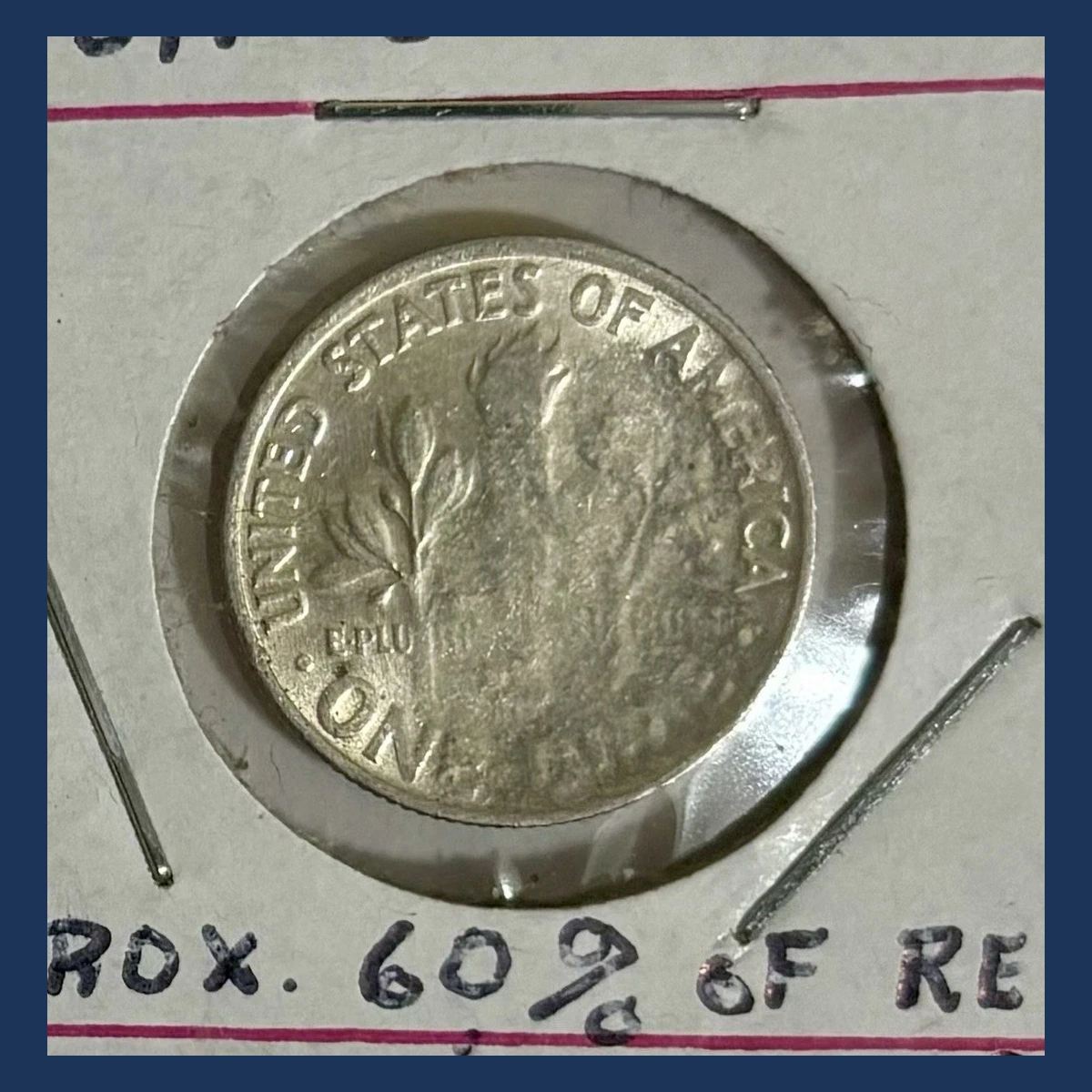
A patch of design can disappear when something lies between the metal disk and the stamping tool. The coin records the obstruction instead of the missing detail.
One Philadelphia example graded NGC MS64 has a blocked area on the back, with the obstructing material unspecified. It should not automatically be called grease or cloth.
Denver examples were struck through a coin that had stuck to the tool. That covering coin is called a die cap.
The receiving dime can show a softened or distorted design. It is a different object from the cap itself.
Estimated Value
Estimated values are $25–$300 for ordinary blocked strikes and $50–$400 for clearer examples struck through a covering coin. The obstruction’s size and appearance affect demand.
For comparison, a 1984-P dime described as a late-stage front blocked strike sold for $45 in January 2023. Its later date and different metal limit the comparison.
A faint patch is not worth the same as a dramatic distorted face. Prices apply to complete coins, not each affected area.
How to Identify
Compare the weak patch with the sharply formed design immediately beside it. A local interruption can point to an obstruction, while uniform wear gradually lowers the highest parts of both faces.
A loose normal dime should be near 2.5 grams and 17.91 millimeters on a scale and calipers. Inspect its edge grooves for evidence of later crushing.
Use a 10× magnifier to check whether the weak area has natural struck texture rather than scratches from grinding. For a cap-covered strike, compare the broader distorted design with a confirmed receiving coin.
Identify the blocked design and its boundary without naming an unseen material from guesswork.
5. 1964 Roosevelt Dime Unusually Weak Strike
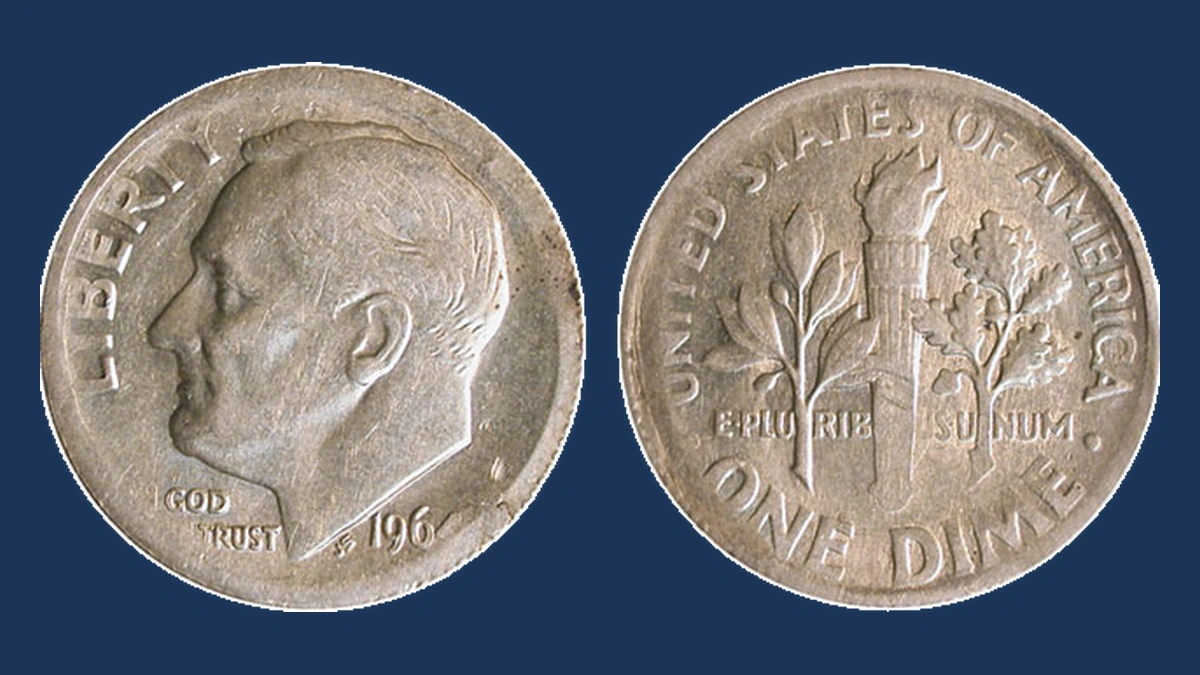
Some 1964 dimes have weakly formed details even though their surfaces have not been worn smooth. One Denver example was labeled a die-adjustment strike, suggesting unusually light striking pressure.
A different Philadelphia dime weighs 2.41 grams and has weakness around its outer design. It was struck inside the restraining ring.
That second coin may have entered the press without a sufficiently prepared raised border. Pressure, tool shape, or hard metal could also contribute.
These examples should not be presented as proof of one identical cause. Their visible weakness needs examination on each coin.
Estimated Value
Unusual weak strikes are estimated at $25–$400 when the weakness is an original production feature. Severe examples with clear professional identification generally attract more than lightly weak borders.
The 2.41-gram Philadelphia coin does not receive a large premium merely for being slightly light. Its surface and border explain why collectors examine it.
This range is an estimate for the whole coin, not a quoted sale for either recorded specimen. Ordinary wear must be excluded before using it.
How to Identify
Begin at the outer lettering and work toward the center with a 10× magnifier. On the 2.41-gram Philadelphia example, weakness at the perimeter contrasts with the coin’s contact inside the restraining ring.
Check for original texture in the shallow design rather than smooth wear on the highest points of both faces. Polishing, abrasion, and ordinary circulation can remove detail after striking, so the surrounding surfaces must fit the proposed sequence.
Use a scale and calipers on a loose example against the normal 2.5 grams and 17.91 millimeters, and inspect its edge grooves. Surviving original texture within weakly formed detail supports a weak strike more directly than a generally blurry appearance.
6. 1964 Roosevelt Dime Clipped Metal Disk
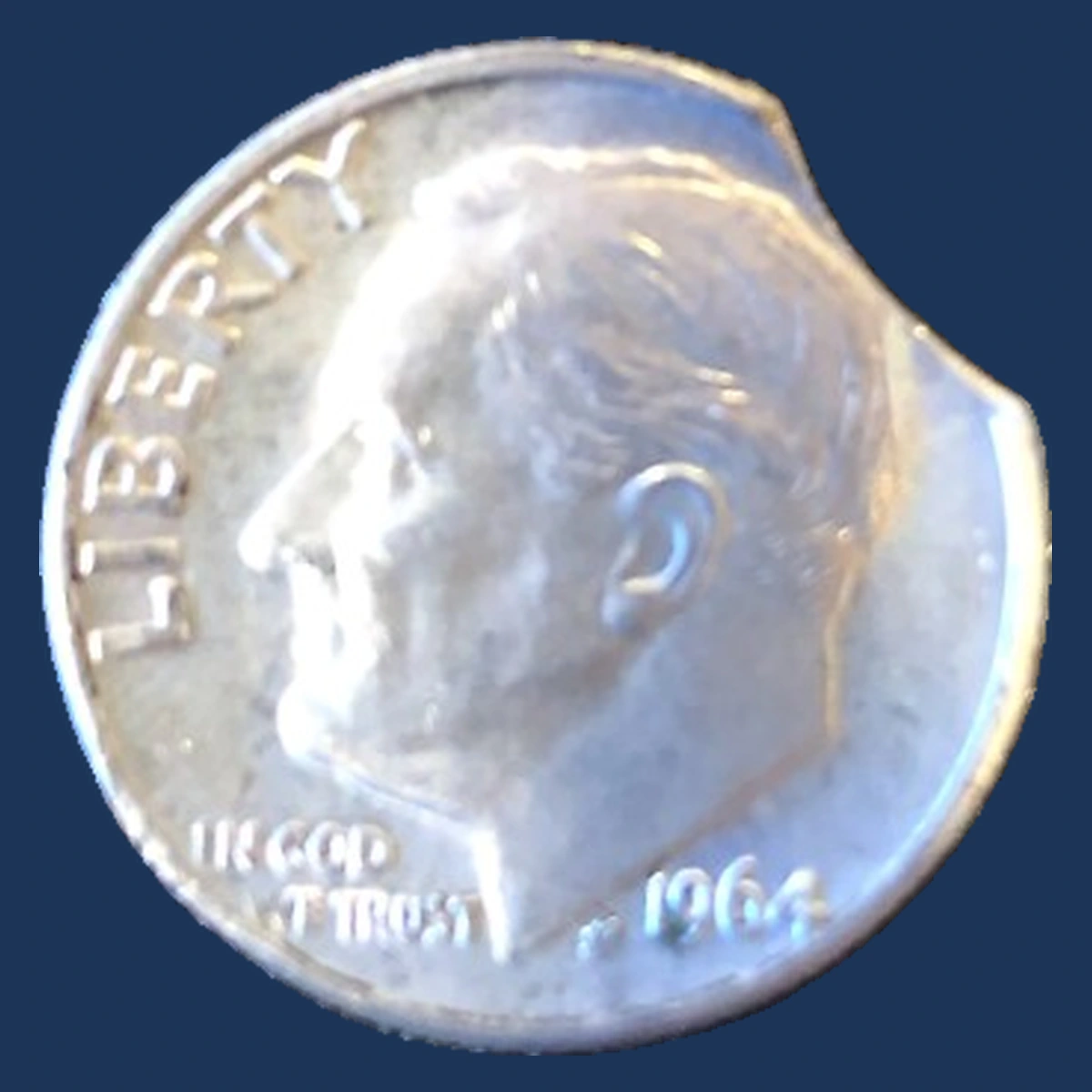
A missing part of the circular outline can begin before a coin is struck. The metal disk, or blank, may be punched across an earlier hole or the edge of its metal sheet.
1964 examples include single and double curved clips, a straight Denver clip, and a ragged Philadelphia clip. Their shapes describe different missing areas, not different denominations.
The straight 25% Denver example weighs 1.98 grams. A separate Philadelphia coin combines a 4% ragged clip with an expanded strike.
That combined coin should be judged as one object with both visible features.
Estimated Value
Clipped 1964 dimes are estimated at $25–$400, with large or double clips generally above tiny missing sections. Readable dates and attractive surfaces help.
A 1997-P nickel with a 20% clip sold for $124 in March 2025. It provides a recent comparison from a different year and denomination, not a result for the 1.98-gram Denver dime.
The ragged-clip coin also has an expanded strike. Its combined appearance can affect the price without creating two separate values.
How to Identify
Examine the ends of the missing section before deciding whether the shape is curved or straight. With a 10× magnifier, look for the rim fading into the gap rather than being sharply sliced through.
Inspect the opposite border for weakness, which can support a genuine clip.
A scale should usually show less than the normal 2.5 grams for a loose clipped coin. Record the actual weight rather than assuming that every clip matches the 1.98-gram example.
Calipers can compare surviving widths with 17.91 millimeters, while edge grooves can reveal fresh cuts.
Soft original borders beside missing metal provide a better test than a seller’s percentage alone.
7. 1964 Roosevelt Dime Thin Piece Struck After the Disk Split
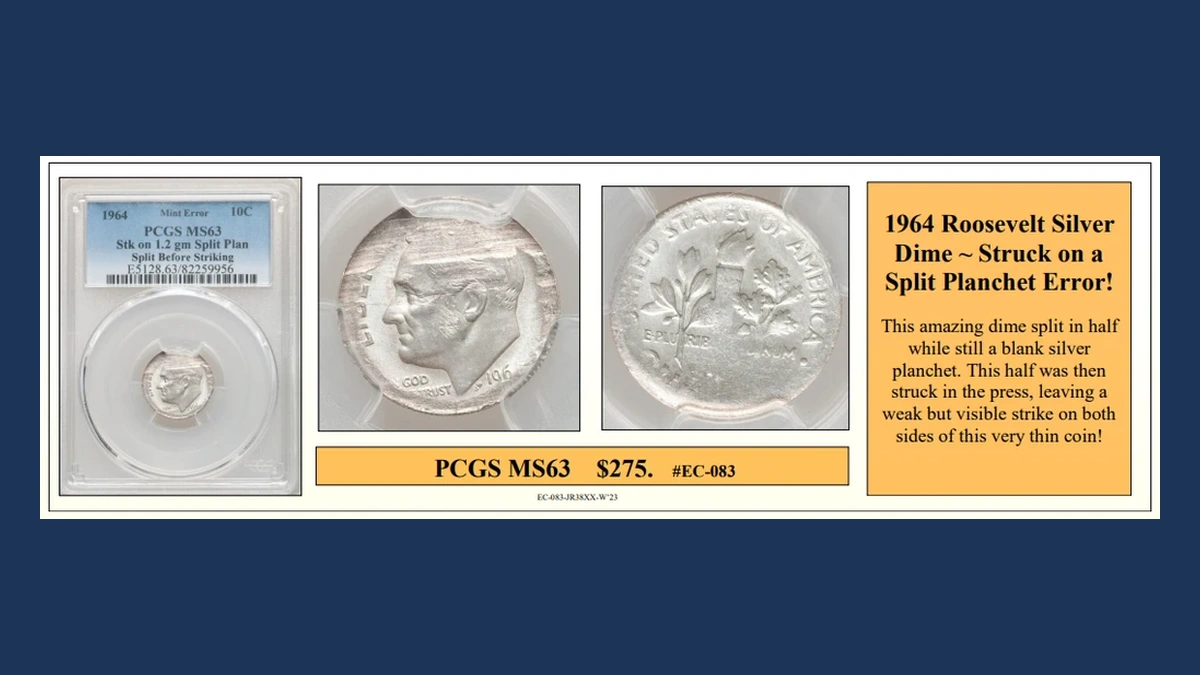
A surprisingly thin dime can still carry designs on both sides. Its original metal disk split through its thickness before it reached the press.
The exposed split face then received a new impression, unlike a piece that separates after the coin has been struck. That sequence explains why thinness and struck detail belong together.
Recorded Philadelphia examples weigh 1.2 grams and 1.7 grams. A Denver example weighs 1.2 grams, while another labeled Denver specimen has no stated weight.
Those measurements describe different coins. They are not one standard weight for the error.
Estimated Value
A genuine dime struck after its disk split is estimated at $50–$400. Clear designs and an identifiable date help, especially on a very thin surviving piece.
A 1968-D fragment weighing one gram sold for $141 in November 2013. That later coin was struck on a fragment, so its sale is only a broad comparison for unusual lightweight dime pieces.
The estimate does not price a complete normal silver dime or assume that the other half still survives.
How to Identify
Compare the actual weight with 2.5 grams on a scale, then check width with calipers against 17.91 millimeters. A thin piece can remain close to the normal diameter while losing much of the original mass.
The timing is crucial. Through a 10× magnifier, examine whether the once-exposed split face received a genuine struck design instead of remaining only a rough fracture surface.
Study the thin edge for natural remnants of grooves and for signs that someone ground the coin down. Both faces should fit the claimed before-strike sequence.
Freshly struck detail on the split face separates this error from an unstruck surface exposed after the coin was made.
8. 1964 Roosevelt Dime Expanded Strike Outside the Ring
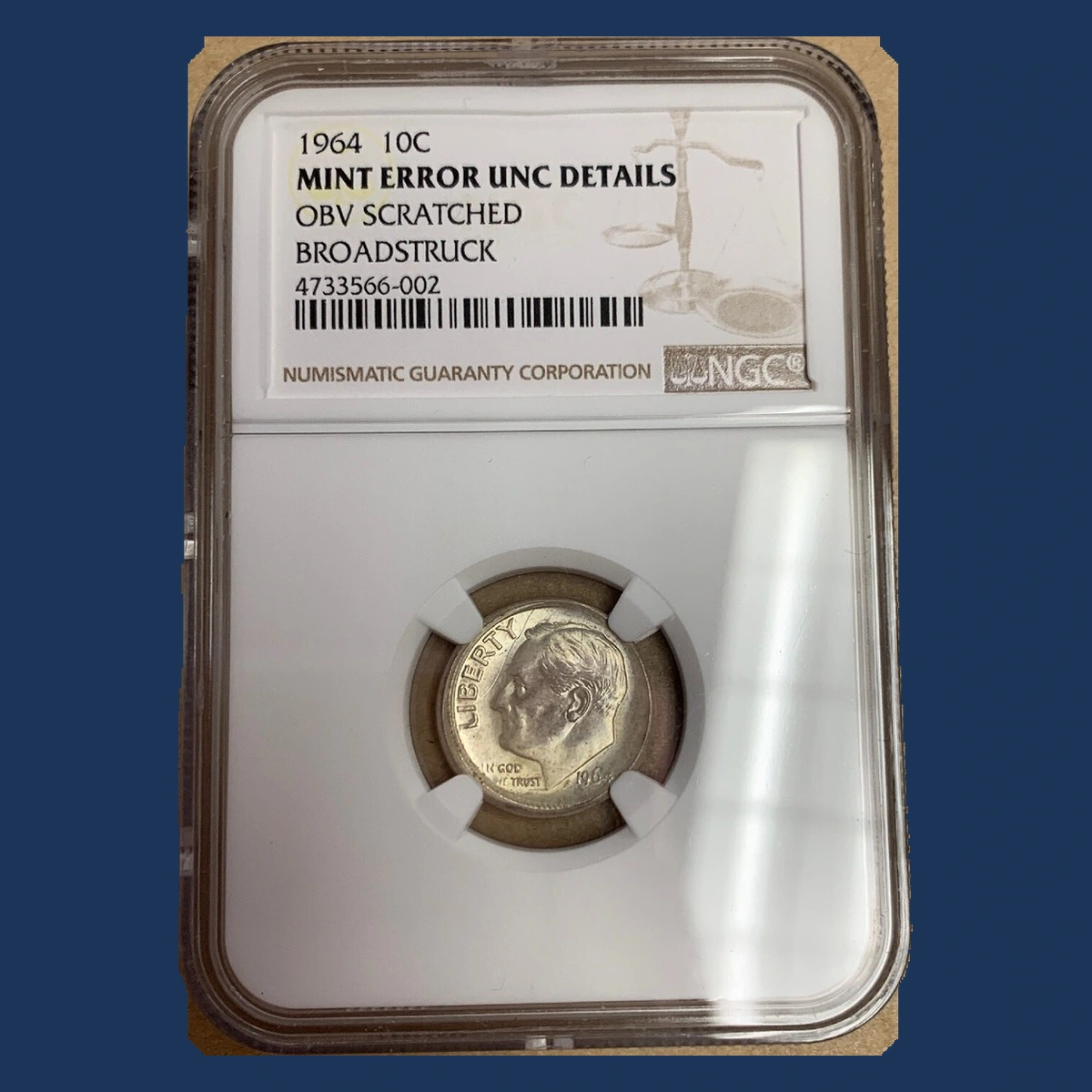
The design can spread across an oversized disk when the ring around the coin fails to hold it in place. The result is called a broadstrike.
An expanded border surrounds the design instead of a normal narrow rim. Some coins become noticeably cup-shaped as the metal spreads.
Recorded Philadelphia examples include ordinary expanded strikes and a large cupped piece graded PCGS MS65. A cup shape alone does not prove that the coin became stuck to a stamping tool.
That distinction separates an expanded strike from a true die cap, which has its own production history.
Estimated Value
Broadstruck 1964 dimes are estimated at $40–$500. A large attractive cup-shaped example can cost more than a modestly widened coin of similar condition.
For a different-year comparison, a 1988-P dime with a broadstruck second impression sold for $80.50 in May 2005. It also had overlapping strikes, so the price does not isolate expansion alone.
Judge the complete shape, preserved design, and surfaces together. Full Bands describes clear torch bands and is not an additional error.
How to Identify
Measure across several widths with calipers, comparing the outline with the normal 17.91 millimeters. Then check the loose coin on a scale against 2.5 grams, since spreading need not remove metal.
Place a normal dime beside it to compare the border beyond the lettering.
Under a 10× magnifier, inspect the enlarged rim for natural outward flow rather than battered high points. Reduced edge grooves can show where the restraining ring failed to hold the disk.
View the cup-shaped specimen from the side without flattening it or assuming that it stuck to a tool.
An enlarged disk retaining its intended design identifies expansion more clearly than width alone.
9. 1964 Roosevelt Dime Defective Metal Disk
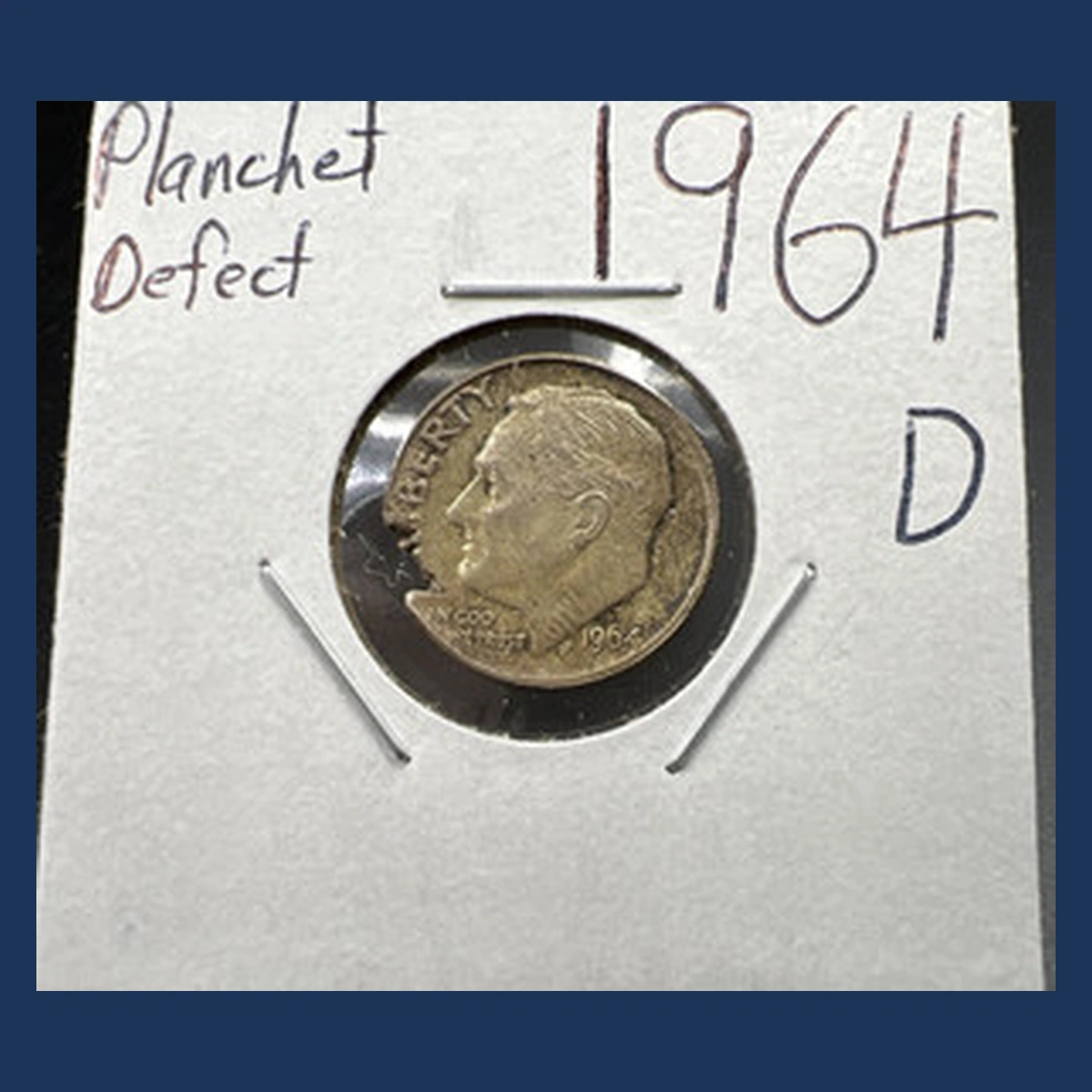
A coin can begin with flawed metal rather than a complete sound disk. Pits, gaps, or an irregular thin area may remain after the press adds its design.
One Philadelphia 1964 example graded NGC MS65 is recorded at 2.2 grams. A separate Denver example also weighs 2.2 grams and has an original hole.
The matching weights do not make them the same defect. The Denver coin was graded MS64 Full Bands, describing the clear bands across its torch.
A hole drilled into a finished dime is damage, so the boundary around it matters.
Estimated Value
Defective-disk examples are estimated at $50–$500, depending on how clearly the flaw formed before striking. An original hole can draw more interest than a small uneven patch.
The two recorded 2.2-gram coins show different flaws. Compare the surviving design and the defect’s boundaries instead of assuming that equal weight means equal collector interest.
The estimated range assumes an authentic production flaw and readable identity. Corrosion, drilling, or heavy scratches can lower the value even when the coin is also underweight.
How to Identify
For the holed Denver example, begin at the opening. A 10× magnifier can reveal metal and design formed around an existing gap rather than circular tool marks from drilling.
Turn the coin over and compare the hole’s two borders. Added burrs and displaced finished detail would call for closer examination.
For either loose example, record weight on a scale and dimensions with calipers. The reported 2.2 grams is below the normal 2.5 grams, while ordinary width is about 17.91 millimeters.
Inspect the remaining edge grooves and unaffected surfaces. Natural struck detail bordering the flaw is more persuasive than an underweight reading alone.
10. 1964 Roosevelt Dime Unusually Thick Disk
Extra thickness can make a normal-looking dime noticeably heavy. A recorded Philadelphia 1964 example weighs 3.1 grams instead of the usual 2.5 grams.
It was graded NGC MS65 Full Bands. Full Bands means the lines separating the torch’s bands remain clear.
The extra mass belongs to an unusually thick disk, but its exact source was not identified as a foreign coin blank. That claim should not be added from weight alone.
Plating or an attached second piece can also make a coin heavier. The original edge and metal need to explain the difference.
Estimated Value
A genuine thick-disk 1964 dime is estimated at $150–$750. The estimate reflects unusual original metal thickness rather than ordinary high-grade silver value alone.
A different-year 1968-D dime cut from quarter-thickness stock sold for $504 in October 2021. That coin weighed three grams and used layered metal, unlike the normal silver alloy of 1964.
The comparison supports interest in heavy dime-sized disks without proving the source of this 3.1-gram specimen’s metal.
How to Identify
Start with an actual scale reading for a loose coin. Compare it with the normal 2.5 grams, keeping the documented 3.1-gram specimen separate from other heavy coins or objects stuck to their surfaces.
Use calipers to compare both thickness and width with a normal dime about 17.91 millimeters across. A heavy dime-sized disk needs a different explanation from a complete larger-denomination blank, even if their weights happen to be close.
Under a 10× magnifier, follow the edge grooves and inspect both faces for a coating or joined seam. A single original disk with extra thickness and weight is the useful starting finding before professional composition testing.
11. 1964 Roosevelt Dime Repunched and Widely Separated D Mint Marks
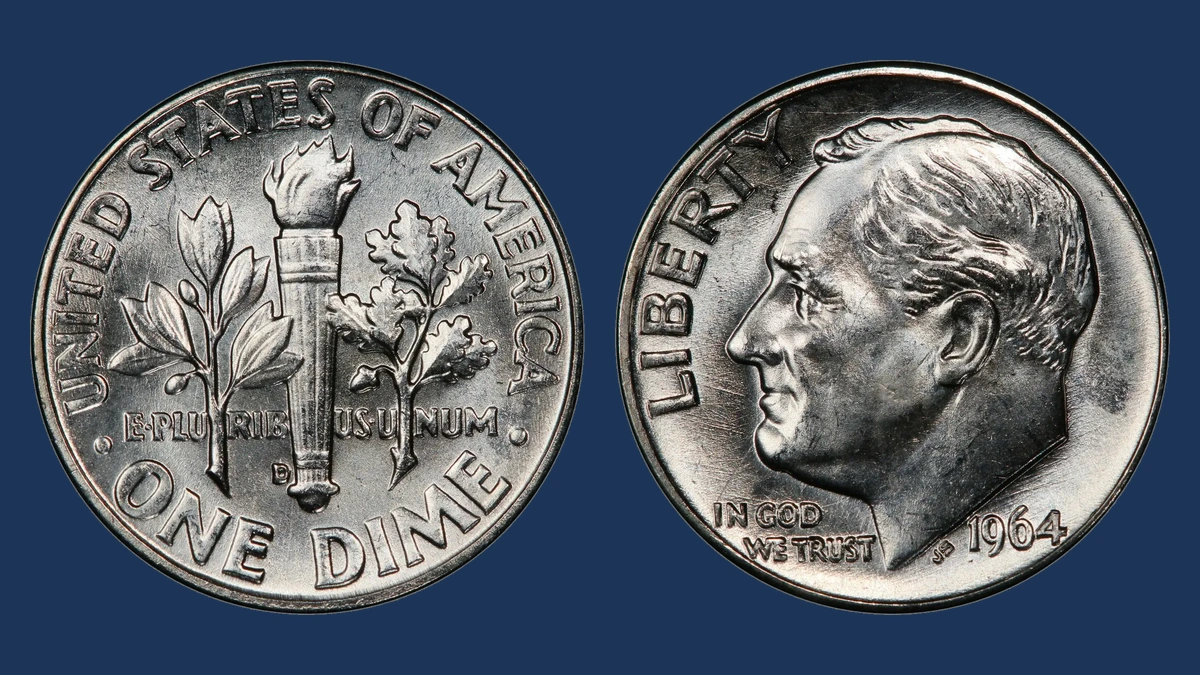
A second curve or upright stroke beside the D can show that the letter was punched into the stamping tool more than once. The earlier impression remained after the later one was added.
Some 1964-D patterns overlap closely. On FS-502, the extra D is widely separated toward the torch, which led to the older name misplaced mint mark.
Other patterns point in different directions or contain three impressions. Their exact shapes must be compared separately.
All appear on the back below and left of the torch. A normal Philadelphia dime has no mint mark there.
Estimated Value
Repunched D varieties are estimated at $15–$1,000, with worn examples at the lower end. Clear named varieties in attractive condition can sell for much more than a faint extra curve.
The widely separated FS-502 needs its own comparison rather than the price of an ordinary overlapping D/D. Its complete coin condition remains important.
This is an estimated range across several patterns, not a claimed sale for each catalog entry. Multiple impressions of the D do not create separate coin values.
How to Identify
Locate the D below and left of the torch on the back. Do not search above the date, where mint marks appear on later dimes, and use a 10× magnifier to examine the entire letter.
For FS-502, follow the separated extra D toward the torch; other varieties require their own directions and nearby markers. Check the local surface for dents or displaced metal that could imitate part of an earlier letter.
On a loose coin, use a scale and calipers against 2.5 grams and 17.91 millimeters, with grooves around the edge. A complete earlier letter shape matching the correct photograph establishes more than one damaged lump beside the D.
12. 1964 Roosevelt Dime Off-Center Strike
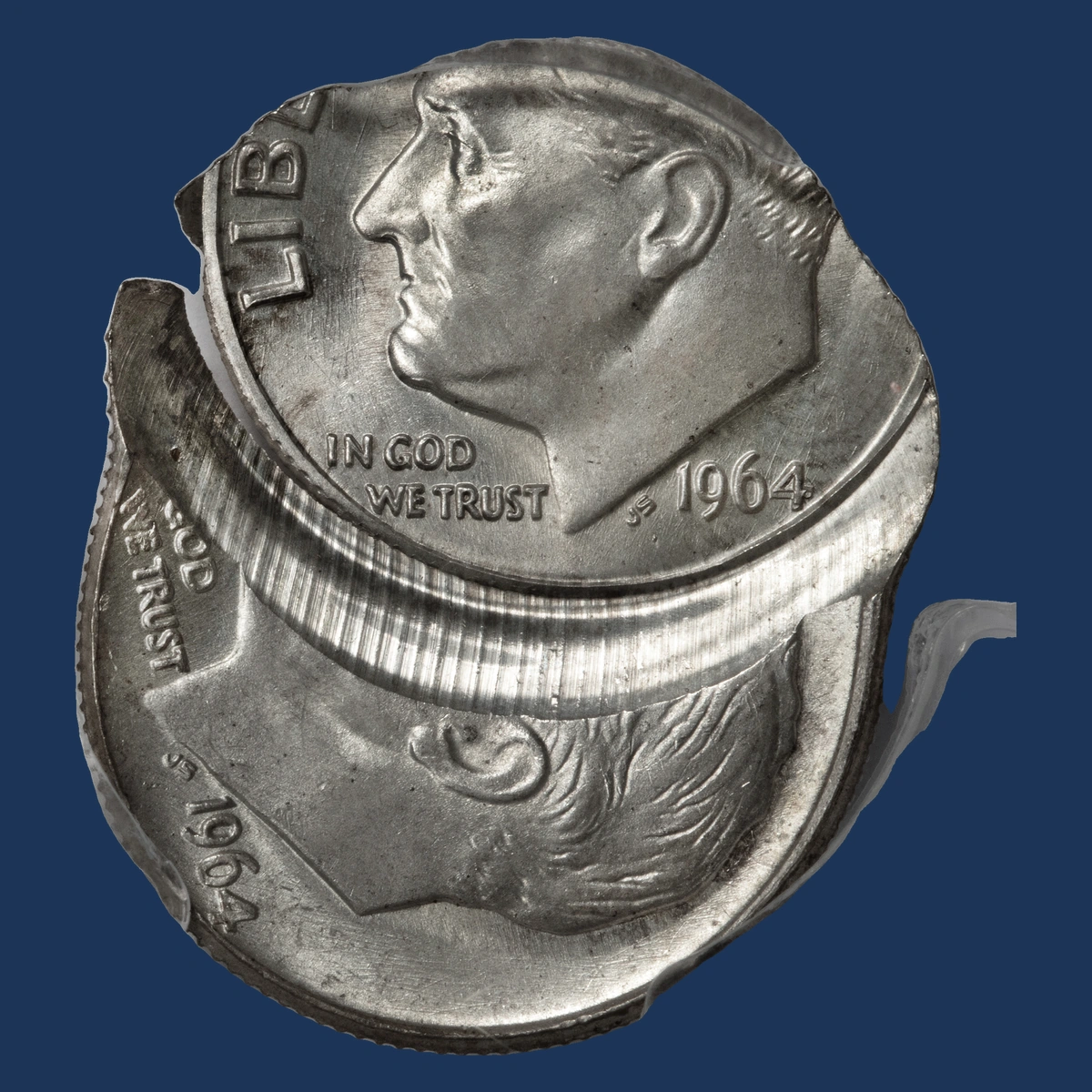
The design can miss part of the metal disk, leaving a blank crescent along one side. On the opposite side, some lettering or portrait detail lies beyond the edge.
This happens when the disk is not centered beneath the stamping tools. It is called an off-center strike.
Recorded Philadelphia 1964 dimes include shifts from 15% to 75%, with several different grades and appearances. A separate PCGS MS64 coin is described as 50% off center.
Those percentages belong to individual coins. The blank crescent should not be measured as if every example has the same missing design.
Estimated Value
Estimated prices are $75–$1,000 for genuine dated 1964 off-center dimes. A larger shift with a clear date usually attracts more attention than a slight shift on a worn coin.
For a recent different-year comparison, a 1977 dime struck 10% off center sold for $109 in June 2026. That later layered-metal coin does not set the value of a dramatic silver example.
Surface damage and a missing date can lower demand despite a large blank crescent.
How to Identify
Check the actual date before comparing the blank crescent with another coin. Under a 10× magnifier, examine the last digit and the transition between struck design and untouched metal on both faces.
Use a scale on a loose coin against 2.5 grams, and record several widths with calipers against the normal 17.91 millimeters. The disk can change shape while retaining its original mass, so an ordinary weight does not rule out a large shift.
Inspect the remaining edge grooves for later cutting or flattening, and distinguish a one-face tool shift from displacement of both designs. An original blank crescent opposite cropped design on both faces is the clearest check.
13. 1964 Roosevelt Dime Clashed Designs and a Fragment Impression
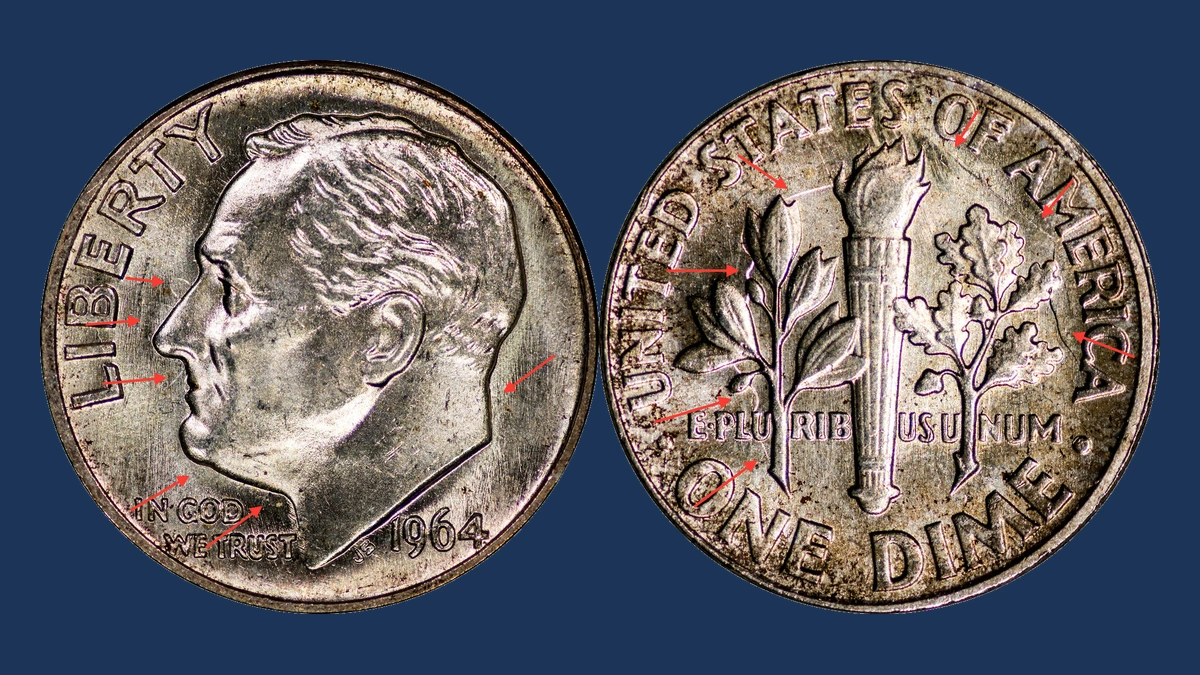
A faint outline from the opposite design can appear behind Roosevelt or near the torch and branches. The stamping tools collided without a coin disk between them, transferring marks onto each other.
Collectors call the result a die clash. Later coins can inherit the extra outlines from the marked tools.
Recorded 1964 examples come from both Philadelphia and Denver. Different tools show different locations, including nose-area marks or traces near the left branches.
One Denver coin combines strong clashes on both sides with a fragment impression on the back. That combination belongs to one specimen.
Estimated Value
Ordinary visible clashes are estimated at $15–$250. The more unusual fragment-and-clash combination is estimated at $100–$1,000, depending on how clearly its features appear.
A separate 2001-P dime combining a clash with a mirror-image striking error sold for $79 in November 2014. Its different metal and additional error make it only a broad comparison.
The estimated combination price covers the whole 1964-D coin. It should not be calculated by adding full prices for imaginary separate specimens.
How to Identify
Hold a normal dime beside the candidate and identify the opposite-side shape that could produce the extra outline. A random line across the face has no such match.
The normal specifications remain 2.5 grams and 17.91 millimeters on a scale and calipers, with grooves around the edge. Check a loose coin without pressing any unusual surface feature.
Use a 10× magnifier to compare the faint marks with a mirror image of the opposite design. Keep the Denver fragment impression distinct from the surrounding clash marks.
Several tools show different locations. A recognizable opposite-side outline, rather than a guessed nose or branch mark, is the useful first confirmation.
14. 1964 Roosevelt Dime Deep Impression from Another Blank
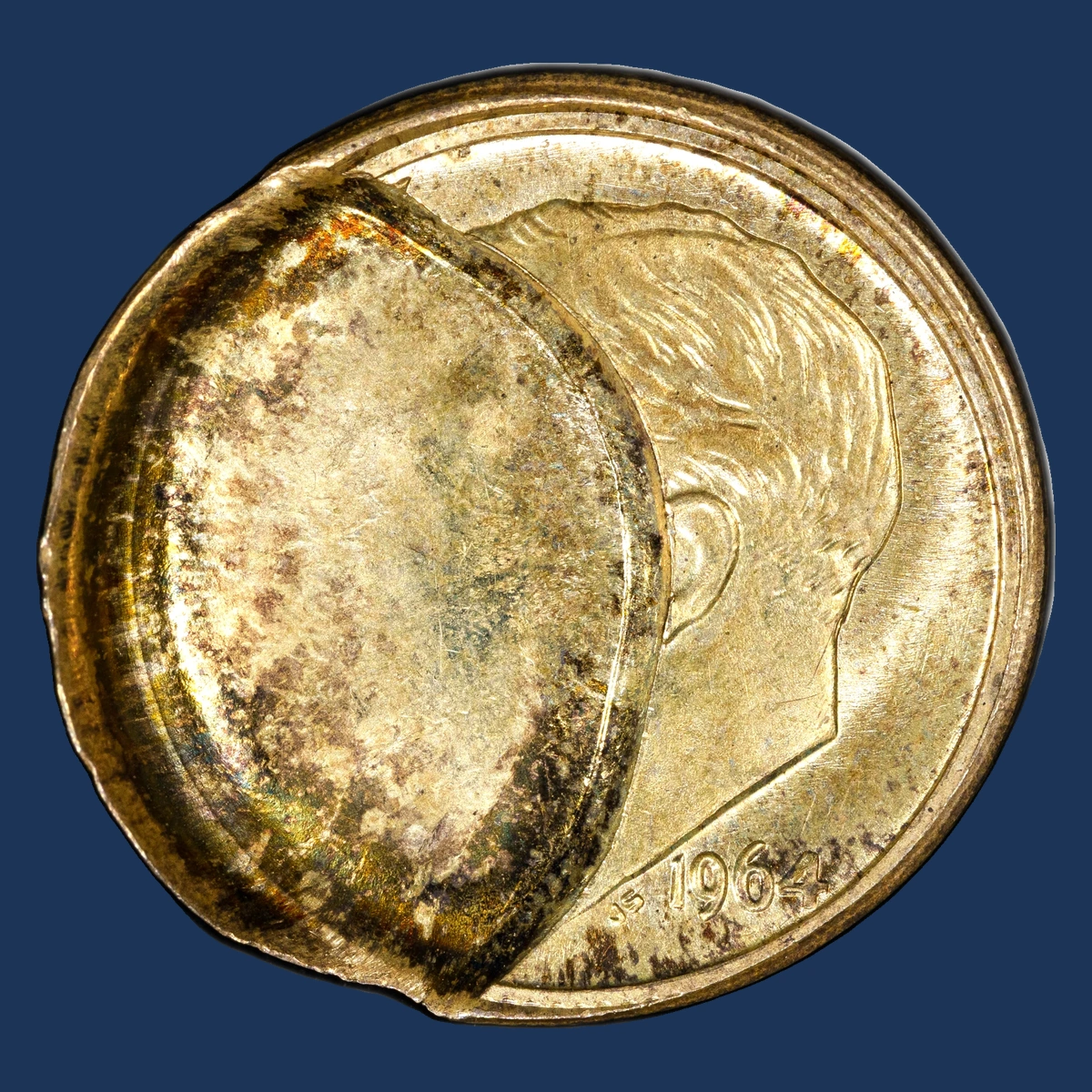
A broad sunken area can form when another metal disk overlaps the dime during striking. That disk blocks part of the normal design and presses its outline into the coin.
The result is called an indent. A Philadelphia example graded NGC MS65 has an indentation covering about 95% of its front.
Another Philadelphia dime combines a 50% indent with a partial-collar strike, meaning the edge ring held only part of the coin’s thickness. It was graded PCGS MS66.
These are separate examples. The depth and shape of each indentation need to be examined on its own.
Estimated Value
Genuine indented 1964 dimes are estimated at $100–$1,000. Large clear impressions and attractive surfaces can support stronger prices than small, weak overlaps.
The half-face indentation and partial-collar edge belong to one coin, so its value reflects their combined appearance. The 95% front indentation is a different specimen.
These are editorial estimates rather than quoted results for the two auction lots. Later dents and deliberately pressed coin outlines do not receive the same original mint-error premium.
How to Identify
Identify the sunken area from a shallow side view. Its boundary should fit a disk that overlapped the dime, not a small random impact.
A scale reading near 2.5 grams can fit an intact loose example. Calipers can document its altered shape against the normal 17.91 millimeters.
Inspect the indentation with a 10× magnifier for natural design flow around the obstruction. A finished blocking coin may leave a reversed design instead of a plain indent.
On the partial-collar example, examine the step between the ring-held edge and the expanded part, including the surviving grooves.
Struck details flowing around the sunken boundary explain the error more directly than depth alone.
15. 1964 Roosevelt Dime Design Struck on a Scrap Fragment
Only a small piece of metal was present when this dime design was struck. The recorded Philadelphia scrap weighs 0.4 grams, a fraction of a normal coin.
NGC graded it MS66, indicating an unworn piece with relatively few marks. The design occupies the fragment rather than a complete round disk.
A scrap strike differs from a finished dime cut into a small piece afterward. The way letters and other details end at the boundary helps separate them.
Its irregular outline does not identify the scrap’s original source. A machine part or another coin should not be named without evidence.
Estimated Value
A genuine 1964 struck scrap is estimated at $150–$1,000. Readable date details, clear struck surfaces, and secure identification matter more than the tiny metal value.
For a different-year comparison, a 1968-D dime struck on a one-gram fragment sold for $141 in November 2013. That larger, lightly worn fragment is not the 0.4-gram MS66 silver-year piece.
The range prices the surviving struck object. It does not assume that an intact companion coin or matching fragment exists.
How to Identify
The expected object is tiny, so begin by recording its weight on a suitable scale. The documented fragment weighs 0.4 grams, compared with 2.5 grams for a normal dime.
Use calipers gently to record its surviving dimensions. A complete 17.91-millimeter circle is not expected.
A 10× magnifier can show where design details end at the scrap’s original boundary. Fresh cutting through completed letters would suggest later alteration.
Any surviving edge grooves should fit the part reached by the coin press, rather than an invented complete rim.
Natural struck metal at the irregular boundary, together with recognizable dime details, provides the essential distinction from a clipped-out piece of a finished coin.
16. 1964 Roosevelt Dime Doubled Front and Back Designs
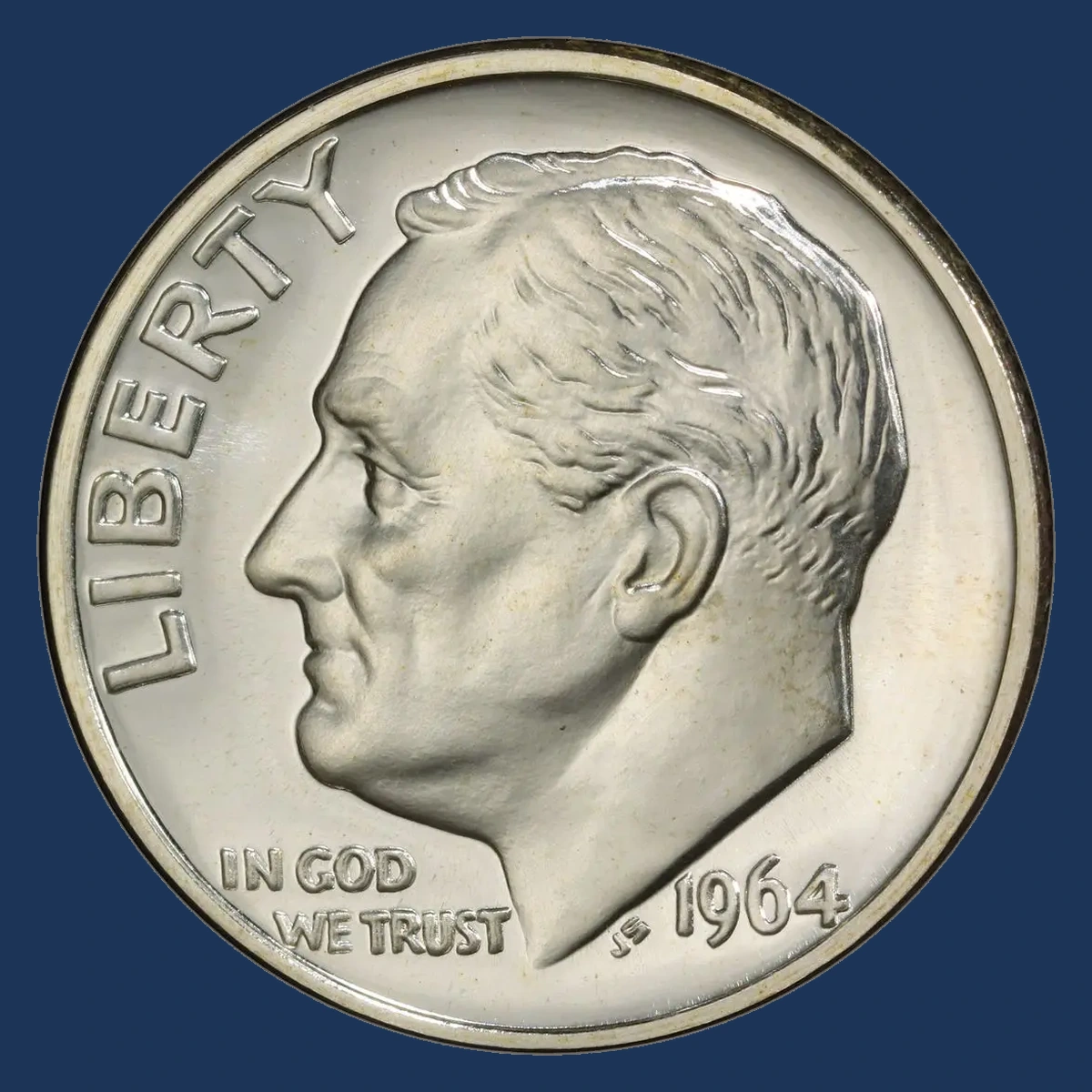
Extra rounded outlines or split letter tips can be part of the stamping tool’s design. A doubled die is a tool that already carries those repeated details before it strikes coins.
1964 examples affect the front, the back, or both sides through paired tools. Ordinary Philadelphia coins, Denver coins, and specially made collector Proofs have separate patterns.
Denver FS-801 and FS-802 repeat the back design in different directions. A Proof front variety is called FS-101.
A sharp or blunt tail on the date’s 9 is not itself an error. Neither is the Full Bands description.
Estimated Value
Minor matched doubled designs are estimated at $15–$100, while stronger named varieties can reach $100–$1,500. Finish, grade, and the actual pattern determine which comparison is useful.
The estimate spans many different tools rather than assigning the same premium to every catalog number. A strong Denver back variety is not a price guide for faint thickening on a Proof.
The whole coin is being valued. Flat mechanical shelves from movement during striking generally do not receive a true doubled-die premium.
How to Identify
Sort the coin by mint and finish before selecting a photograph. Denver’s D is below the torch on the back, while ordinary Philadelphia coins and Philadelphia Proofs have no mint mark.
A loose normal disk should be about 2.5 grams and 17.91 millimeters on a scale and calipers, with a grooved edge.
Examine several letters through a 10× magnifier, seeking rounded extra outlines and split tips rather than flat shelves.
Denver FS-801 and FS-802 require different back comparisons. Proof FS-101 instead calls for its specific front pattern.
Match several named details to one tool’s photograph rather than borrowing a thick numeral or catalog number from another variety.
17. 1964 Roosevelt Dime Mirror-Image Design Pressed into the Coin
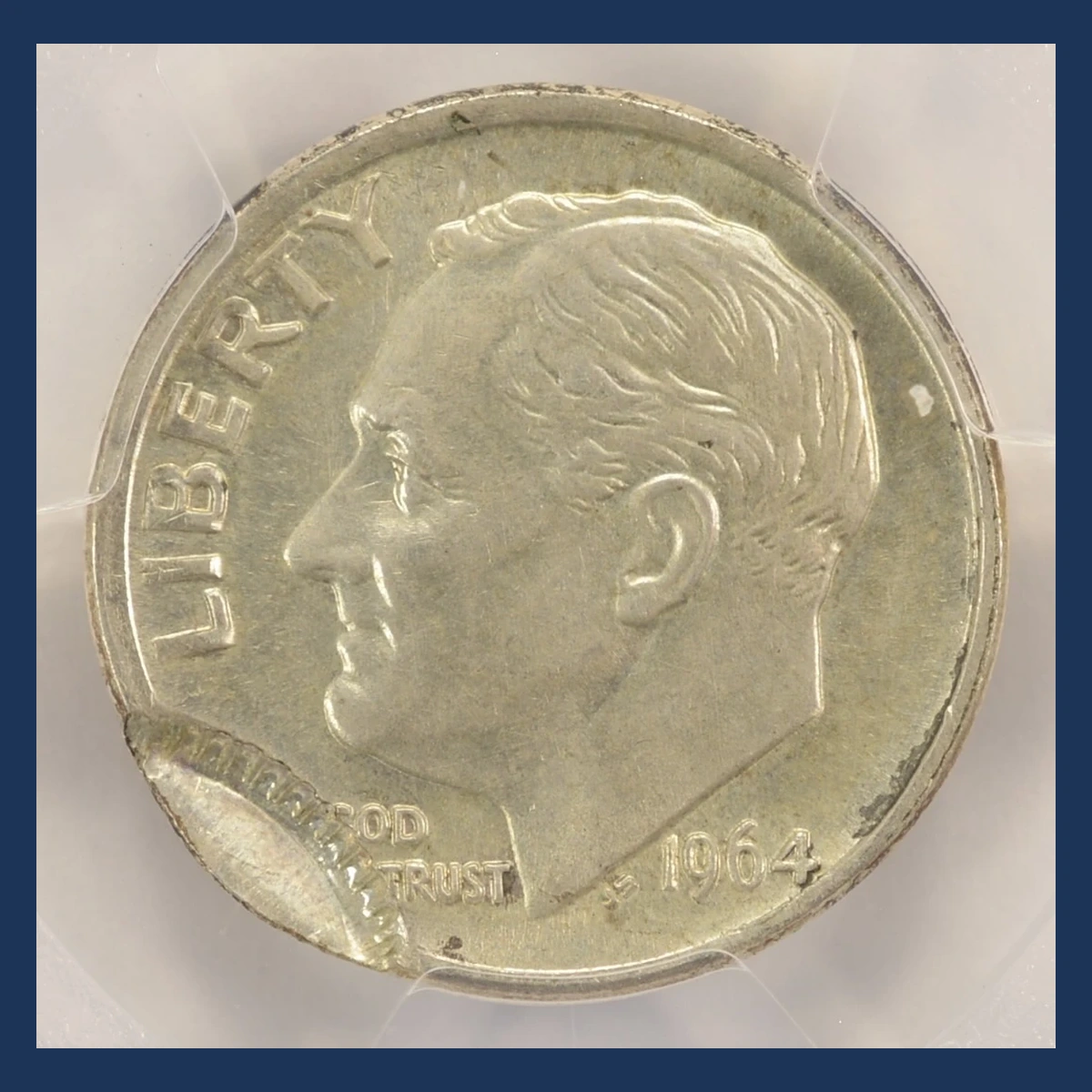
Reversed letters pressed into the surface can come from a finished coin blocking the stamping tool. Its raised design acts like a stamp and leaves a sunken mirror image.
This error is called a brockage. A Philadelphia example is recorded with a front brockage, while another has a 70% back brockage and an expanded strike.
Those are different specimens, not opposite views of one coin. The second coin’s off-center-looking expansion must be read together with its mirrored design.
A dent without recognizable reversed detail does not establish the same error mechanism.
Estimated Value
Recognizable 1964 brockages are estimated at $150–$1,500. Large clear mirrored designs usually attract more than small, faint transferred patches.
A 2001-P dime combining a partial front brockage with clashes sold for $79 in November 2014. That later coin is a limited comparison, not the value of the 70% silver-dime example.
An expanded shape can add interest to the same specimen. The estimate concerns the whole coin and should not be divided into separate full prices for each feature.
How to Identify
Read the unusual letters in a mirror and examine them with a 10× magnifier. The recognizable design should be reversed and pressed into the coin, rather than simply doubled in its normal reading direction.
Check the opposite face and the contact area around the mirrored design to see whether they fit the same strike. The 70% back example also spread outward, so its extra width is part of that particular coin’s appearance.
On a loose piece, use a scale and calipers against 2.5 grams and 17.91 millimeters, then inspect edge grooves for stretching or later squeezing. Sunken reversed lettering provides the strongest first clue to the brockage mechanism.
18. 1964 Roosevelt Dime Repeated Strikes and Matched Coin Pairs
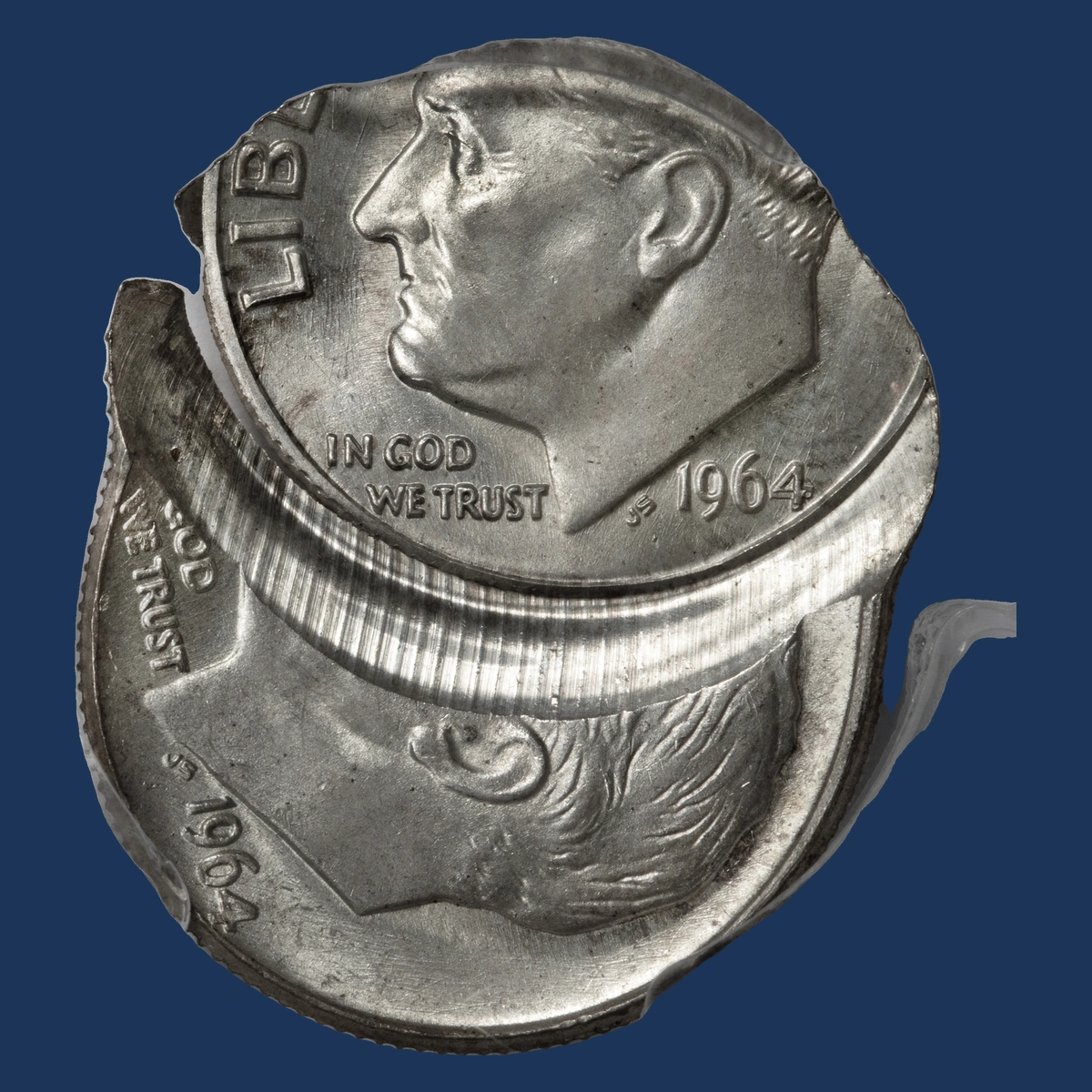
A second strike can place another portrait or date across the first design. Some 1964 dimes shifted far between impressions, while others received several overlapping strikes.
One Denver coin has a second strike 70% off center, with the date nearly upside down relative to the first. Other Denver examples have 75% second strikes.
Philadelphia pieces include both strikes off center, repeated expanded strikes, and a 90% second strike. Two recorded pairs preserve coins that struck against each other.
One pair combines a flipped double strike and a mirror-image receiving coin. These remain two separate objects.
Estimated Value
Single repeatedly struck dimes are estimated at $150–$2,500, while intact matched pairs are estimated at $500–$3,000. The combination and clarity of the impressions affect the price.
The Denver PCGS MS61 coin with a 70% second strike sold for $373.75 in September 2006. Its nearly inverted second date belongs to that specimen.
The paired coins require a combined comparison. Do not divide a pair’s value equally or treat its two coins as two photographs of one error.
How to Identify
Separate the objects before counting impressions. A matched pair contains two coins whose contact marks can be compared, not one unusually complicated disk.
For a single repeated strike, use a 10× magnifier to trace each portrait, date, and design border. Determine which impression crosses or flattens another.
A scale reading near 2.5 grams can still fit an intact single dime, while calipers record spreading beyond the normal 17.91 millimeters. Examine edge grooves and overlapping rims without forcing two pieces together.
A flipped coin can receive an opposite-side design, and a partner may show sunken reversed detail. Follow complete overlapping designs or matching contact areas rather than counting every doubled letter as another strike.
19. 1964 Roosevelt Dime Coin Stuck to a Stamping Tool
A coin can cling to a stamping tool instead of dropping out of the press. Further pressure can spread its edge and turn it into a cup-shaped covering.
That covering coin is called a die cap. It is different from another coin struck beneath the cap, which receives a blocked or distorted impression.
Philadelphia 1964 examples include a front cap graded NGC MS67 and a back cap graded MS66 Full Bands. They are separate coins.
A cup-shaped broadstrike can look similar, so the shape needs to agree with the way the design was altered.
Estimated Value
Genuine 1964 dime caps are estimated at $500–$3,000. A deep, recognizable cap with attractive surfaces generally draws more interest than a shallow distorted piece.
For a later-year comparison, a 1977-D front cap graded NGC MS69 sold for $1,725 in April 2006. It is a different composition and grade, not a sale price for either silver cap here.
The estimate concerns the cap itself. A receiving coin struck underneath it belongs to a different error category and price comparison.
How to Identify
Handle the cupped coin without pressing its walls together. A scale can compare a loose piece with 2.5 grams, and calipers can record expansion from the normal 17.91-millimeter width without compressing the shape.
From the side, examine the curved interior and walls through a 10× magnifier, following how the design spreads with the metal. A coin bent by tools can have sharp damaged folds instead of a naturally struck cup.
Inspect remaining edge grooves for stretching and compare the correct face with the separate front or back cap. A cup whose struck design fits continued attachment to a stamping tool supports a cap, rather than cup shape alone.
20. 1964 Roosevelt Dime Folded Disk Struck in the Press
A metal disk entering the press at an angle can fold under the striking pressure. The design is then forced onto an unusual bent or doubled-over shape.
Collectors call this a foldover strike. A Philadelphia 1964 example was graded PCGS MS65.
It is different from a finished dime simply bent in half. The fold and the struck design must belong to the same production event.
The recorded title does not give a folding direction or a precise angle. Those details should come from the actual piece, rather than from another year’s foldover photograph.
Estimated Value
A genuine 1964 foldover strike is estimated at $500–$3,000. Strong recognizable design on a clearly struck fold supports the upper part of the range.
The recorded PCGS MS65 example has no circulation wear and relatively few marks. Preserved surfaces help show that the design was made on folded metal, which is central to its appeal.
Bending a normal dime later does not create the same value. The sequence of folding and striking must be supported by the surfaces.
How to Identify
Leave the fold untouched. View it from several angles before choosing where to support the coin for closer examination.
A scale reading can be compared with the normal 2.5 grams. Calipers may record accessible dimensions, but the folded shape should not be forced into a 17.91-millimeter circle.
Through a 10× magnifier, follow the design across and beside the fold. Pressure should have formed the impressions while the disk was bending.
Check surviving edge grooves and avoid confusing torn metal from later bending with an original struck fold.
Design impressed into the folding metal is the key evidence separating this error from a finished dime bent afterward.
21. 1964 Roosevelt Dime Dime-Sized Disk Made from Cent Alloy
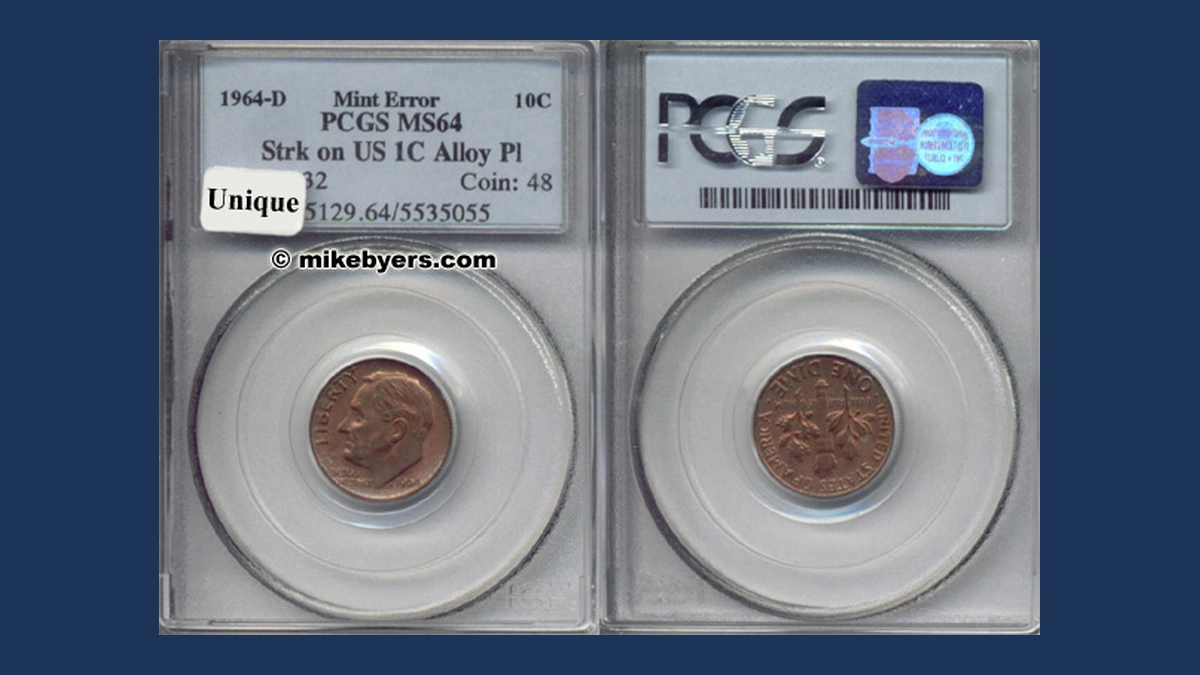
The dime’s outline is present, but its copper-based metal differs from the normal silver alloy. This recorded 1964-D coin was graded PCGS MS64 as struck on cent alloy.
Its disk is dime-sized rather than an ordinary full-size cent blank. That distinction changes the proposed explanation for how it was made.
Heritage suggested that cent metal may have passed through a cutting machine set for dime-sized disks. Dealer Mike Byers also retained an experimental-piece explanation.
The unusual metal is the central fact. Neither explanation should be treated as a proven account of the production event.
Estimated Value
The PCGS MS64 copper-alloy dime sold for $3,450 on April 29, 2010. An estimated $3,000–$12,000 allows for the unusual composition, specialist demand, and the coin’s preservation.
The dealer’s description preserves both an experimental-piece explanation and a mint-error explanation. The range does not assume that this question has been settled.
This is the price of the whole unusual coin. Copper color or an ordinary plated dime is not enough to support the same comparison.
How to Identify
Measure a loose candidate with calipers against the normal dime width of 17.91 millimeters, rather than a cent’s 19.05 millimeters. Record its actual weight on a scale without substituting the normal silver dime’s 2.5 grams.
A 10× magnifier can check the Denver mark, grooved edge, and documented front crack through IN toward the chin. Examine the surfaces for coating or trimming, since color alone does not establish the metal beneath it.
Nondestructive composition testing should show copper-based metal throughout the dime-sized disk rather than plating on silver. That combination identifies the unusual object, while the experiment-versus-error explanation remains a separate question.
22. 1964 Roosevelt Dime Reported Strike on a Later Layered Dime Blank
A later-style dime blank would place copper-nickel outer faces around a copper center beneath a 1964 design. This layered construction is called clad metal.
Normal 1964 dimes instead use a solid silver-copper alloy. Mint Error News price lists report a 1964 dime on a clad blank as a transitional error.
That report requires an actual coin with the right date, design, and tested metal before a specific example can be identified. A 1964 cent struck on a dime blank is a different coin.
A 1965 dime on old silver metal is also the reverse situation.
Estimated Value
For a professionally confirmed 1964 dime on a clad blank, use an estimated $5,000–$15,000. This is a conditional estimate for the reported error, not a claimed sale for an identified specimen.
The unusual date-and-metal combination would drive the premium. A copper-colored edge by itself would not justify it.
Published transitional-error guides provide the comparison category, while the coin’s actual identification and condition determine its value. Ordinary silver dimes altered by plating or cutting do not belong in this range.
How to Identify
Inspect the date first with a 10× magnifier. The claim requires a genuine 1964 Roosevelt dime design, without altered digits.
Check the edge for a copper center between pale outer faces and for original grooves. A coating can imitate a different metal color.
For a loose coin, take actual readings with a scale and calipers. A later clad blank normally starts at 2.268 grams and 17.91 millimeters, compared with the 1964 silver standard of 2.5 grams.
These measurements help screen the coin but do not establish its layers alone.
Nondestructive examination must confirm genuine clad construction beneath the authentic 1964 design before the reported transition can identify a specimen.
Conclusion
Estimated values for these 1964 dime errors range from $10 to $15,000. Small tool marks and cracks sit far below the unusual wrong-metal pieces.
Remember the normal silver-dime specifications: 2.5 grams, about 17.91 millimeters, and grooves around the edge. Denver’s D appears on the back.
Match the actual error before comparing prices, and keep paired coins together. A shiny surface or unusual tail on the 9 does not establish an error.