1980 Dime Error List with Pictures

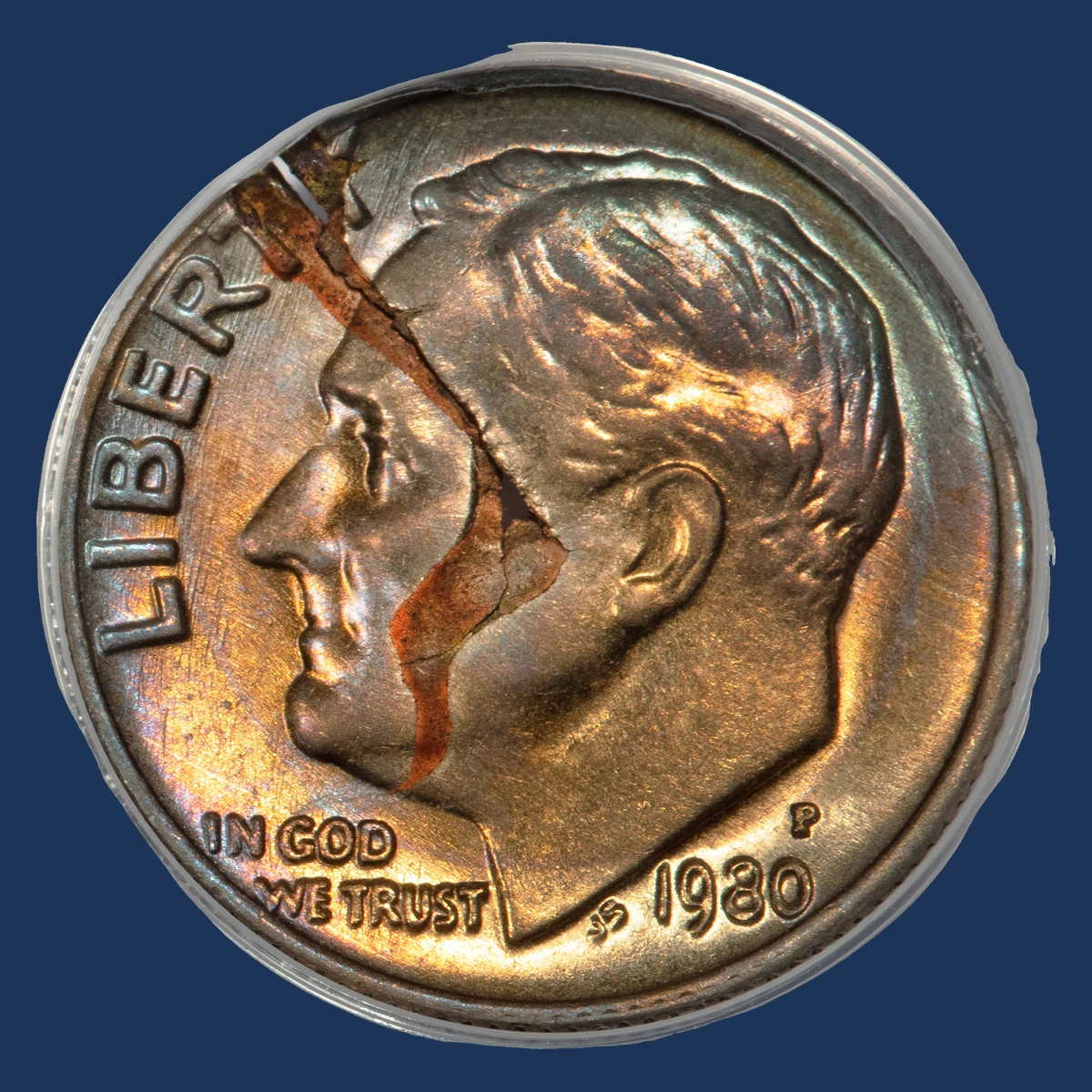
A broken stamping tool and an oversized strike left one 1980-P dime with a large raised patch. Auction records list its sale at $1,440 in January 2023.
The 1980 dime errors below also include copper-colored coins, backward impressions, and displaced designs. Estimated values run from $5 to $2,000, with very different explanations behind similar-looking flaws.
Follow the visible clues to separate missing layers from wrong metal, and a real blank gap from an untouched crescent.
1. 1980 Roosevelt Dime Doubled Die on the Front or Back
An extra rounded edge on a letter can begin in the stamping tool rather than during a second strike. A doubled die is a tool that carries a doubled design before it touches the blank.
Year reports list front and back doubling for 1980. The front checklist includes the date, LIBERTY, the motto, and portrait outlines.
On the reverse, inspect the torch, branches, and lettering. These are reported checking areas without a confirmed catalog number tied to each, so they do not establish several separate varieties or doubling on both faces of one coin.
Estimated Value
Modest, properly identified doubled dies fit an estimated $15–$100 range. This compares small modern dime varieties whose extra detail remains visible under ordinary magnification.
A clear split corner or separated design edge gives a collector something to match. Worn, blurry outlines deserve less attention, while flat doubling caused during the strike usually brings little extra; the strength of the actual feature matters more than photograph size.
How to Identify
Pick one suspected detail and compare it with the same detail on a normal dime through a 10× magnifier. Try the lamp from opposite directions to see whether a second outline stays fixed or changes with the shadow.
Record the mint letter and finish, since the reports do not identify one particular version. Ordinary P and D dimes and specially made S Proof collector coins share the clad standard of 2.268 g and 17.91 mm.
Use a scale and calipers to check loose coins, keeping sealed examples protected. Look for split corners or a separated outline that matches an identified doubled design, rather than accepting a generally thick letter as proof.
2. 1980 Roosevelt Dime Clipped Blank
A gap in a dime may have existed while the metal was still an unstruck blank. The cutting punch can overlap an earlier hole or meet the edge of the metal strip.
The incomplete piece can then receive the coin design. Its missing section may be curved or straight, depending on how the blank was cut.
Clipped blanks are reported for 1980 without a specific shape, mint, or percentage being established for the general listing. The gap must be checked for original metal surfaces, since a later cut can copy the outline.
Estimated Value
A readable date and a larger natural gap usually display better than a tiny notch on a worn dime. Original surfaces around the opening also make the coin easier to identify.
For those reasons, genuine clips can be estimated at $15–$100 using ordinary modern clad dime comparisons. Cut or corroded coins do not qualify for this range, regardless of how closely their outline resembles a clipped blank.
How to Identify
Look directly into the missing section with a 10× magnifier. Check its ends for a natural transition into the struck faces rather than sharp burrs or repeated file marks.
A loose clipped dime should weigh less than the normal 2.268 g, measured with a scale. Use calipers across an undamaged span to compare with 17.91 mm.
Inspect the rim opposite the opening for weakness that can accompany a genuine clip. It supports the identification when present, but not every example shows it.
Keep a sealed coin protected and photograph both faces through the holder. Avoid a crop that hides the date or half the gap.
Follow the original edge texture and the way struck detail meets the opening.
3. 1980 Roosevelt Dime Struck-Through Material
Something between the blank and the stamping tool can prevent a small area from receiving normal detail. The result may be a shallow weak patch or a more distinct depression.
Soft material can fill a recessed part of the tool, while harder debris can leave its shape in the coin. Neither effect requires the object to remain attached.
The 1980 year report lists strike-throughs without identifying a particular material, face, or position. A missing letter should therefore be examined in context rather than automatically named as a grease or wire error.
Estimated Value
Estimated values are $10–$150 for ordinary confirmed strike-throughs, with small weak patches near the lower end. A larger clear impression surrounded by sharp design can attract more interest.
The estimate uses comparable modern clad dime errors. Deep damage added after minting can look stronger than a genuine shallow interruption, so the original surface matters.
An unidentified groove should not receive an extra premium merely because a seller names an unusual object.
How to Identify
Compare the affected patch with nearby letters and the high parts of Roosevelt’s portrait. Uniform wear across the face offers a different explanation from one sharply defined interruption.
Under a 10× magnifier, move the light across the boundary and inspect for scraping or a raised impact lip. Check the back for corresponding crushing before accepting a deep depression as part of the strike.
A loose intact dime should stay near 2.268 g and 17.91 mm on a scale and calipers, although an attached object could affect weight. Leave any retained material untouched and look for original struck metal surrounding the interrupted area, without a later cut through the design.
4. 1980 Roosevelt Dime Front Indentation with a Partial Collar Strike
A smooth dent interrupts part of the front while the edge shows a step. Another blank overlapped the dime during striking, and the surrounding ring restrained only part of the edge.
That ring is called the collar. Partial contact can leave one narrow grooved band beside a broader section.
The documented 1980-P example was described as having a 10% front indentation and partial collar strike. It was graded PCGS MS63, an unworn coin with visible marks; the description does not say the dent contains a backward coin design.
Estimated Value
The PCGS MS63 example sold for $16 in October 2011. An estimated $15–$200 allows for different sizes, preservation, and how clearly both parts of the combination can be seen.
A well-defined indentation and a visible edge step are more convincing than a shallow dent alone. Marks or later bending can lower appeal, and the price remains one total for the dime rather than two separate premiums added together.
How to Identify
Inspect the edge first, using low side lighting and a 10× magnifier. A partial collar strike should show a step between the restrained grooved portion and the part that spread farther.
Now turn to the front dent and follow its boundary. It should join the original struck surface without fresh damage from squeezing or hammering.
A scale should place a loose example near the usual 2.268 g. Calipers help compare the narrower edge section with the normal 17.91 mm diameter.
Check whether the hollow is plain or holds recognizable backward detail. The combination here is an original indentation plus a stepped edge, so both features should remain visible in the same coin.
5. 1980 Roosevelt Dime Late-Stage Brockage
Backward design can become stretched and faint after a stuck coin has struck many new blanks. The stuck coin acts as a cap over the tool, and its outer surface changes with repeated blows.
The impressions it leaves are called brockages: coin details pressed into another coin in reverse. A late-stage example may show only fragments of that image.
A 1980-P dime graded ANACS AU58, meaning slight wear, was cataloged this way. Its precise affected face is not specified in the available description, so the actual surviving pattern must guide the comparison.
Estimated Value
The ANACS AU58 late-stage brockage realized $42 in March 2023. Its softened impression offers a less obvious picture of the error than a sharp early mirror image.
Wear and weak transfer can both blur details, so buyers need enough original surface to distinguish them. Allow an estimated $40–$250 for comparable examples with a recognizable transferred pattern; a generally flat face alone does not justify the range.
How to Identify
Examine both faces with a 10× magnifier and identify the side carrying the abnormal impression. Move the lamp low across it to separate sunken remnants from ordinary raised design.
Compare any readable fragment with the opposite coin design, remembering that the transferred image can be enlarged and distorted. Do not require a complete backward word on a late-stage example.
A scale and calipers provide the normal 2.268 g and 17.91 mm references for loose coins. Surface flattening from later pressure may preserve normal weight, so that check cannot decide the cause alone.
Look for the surviving sunken pattern within an original struck surface, rather than treating all worn detail as transferred design.
6. 1980 Roosevelt Dime Off-Center Strike
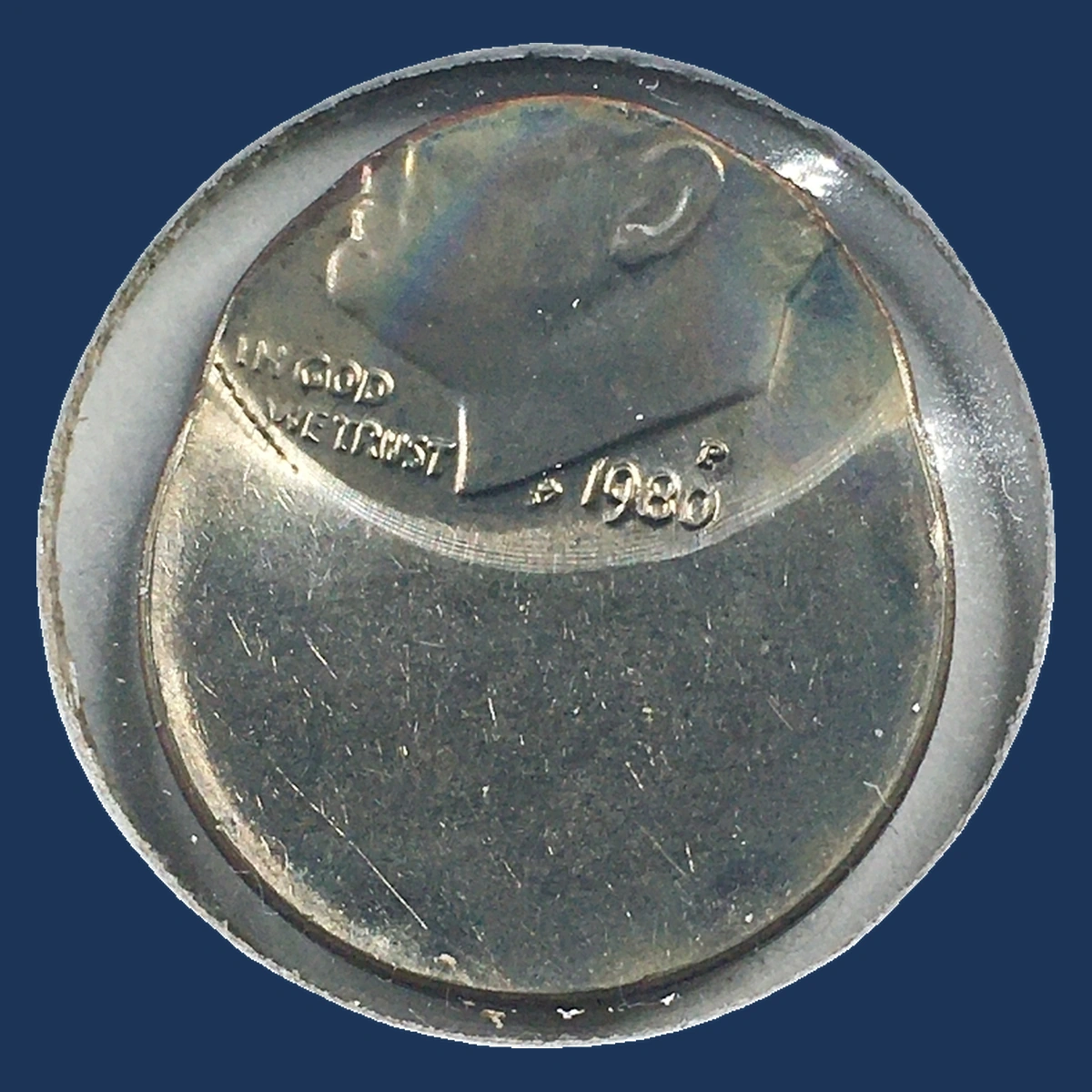
An untouched crescent sits beside a design that runs beyond the opposite edge. The blank entered the press away from the center, so only part of it received the design.
Several Philadelphia examples show this error. One is a 15% shift toward two o’clock graded ANACS MS64, while another is 45% toward 12:30 graded ANACS MS63.
A separate 15% example carries an NGC MS64 grade. These are different coins, and their directions or grades should not be swapped simply because each is a 1980-P off-center dime.
Estimated Value
The NGC MS64 15% example brought $109 in June 2026, while the ANACS MS63 45% coin sold for $49 in January 2022. The larger shift did not produce the higher result.
Date visibility, condition, appearance, and bidding all affect the price of one coin. An estimated $25–$300 covers useful comparisons, without treating each extra percentage of displacement as a fixed increase in value.
How to Identify
Read the entire date and P mint letter through a 10× magnifier before comparing percentages. Different grades and shift directions can identify separate coins in similar listings.
Turn the candidate over and locate the corresponding displaced design. An uneven border on only one face can result from a shifted tool.
The normal starting blank is 2.268 g and 17.91 mm. A scale and calipers can check a loose coin without treating its changed outline as missing metal.
Photograph the crescent under side lighting and look for grinding or thinning. The untouched metal should remain physically present.
Track that solid crescent to the opposite edge where the design runs off the blank.
7. 1980 Roosevelt Dime Ragged Clip with an Off-Center Strike
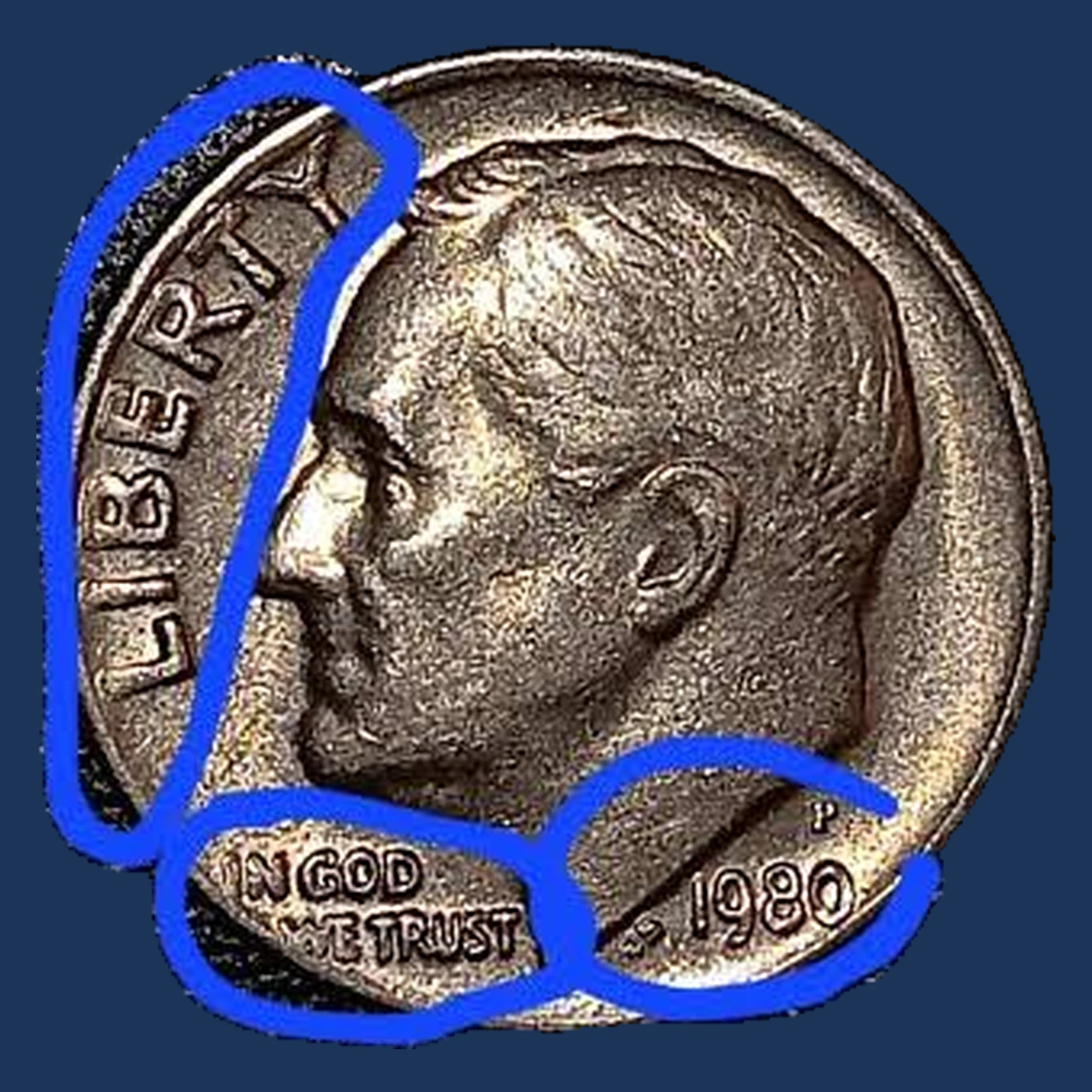
The uneven gap and the smooth blank crescent are different features on this coin. The gap is metal that was missing before striking, while the crescent is metal the tools did not reach.
A specialist dealer catalog lists a 1980-P dime with a ragged end clip and a 10% off-center strike. The irregular clip reflects an unfinished or damaged edge of the metal strip.
The catalog does not establish a grade or exact clock position in the available text. Those details must come from the coin rather than another year’s similar-looking combination.
Estimated Value
For this combined error, use an estimated $50–$350. As a comparison, a 1995-P dime struck off-center on a curved-clipped blank sold for $79 in December 2020.
That coin has a curved gap rather than a ragged one, so it illustrates a price level rather than an exact match. A clear irregular edge, readable date, and visible shift support value; corrosion or cutting marks make the combination less convincing.
How to Identify
Outline the empty gap and solid blank crescent on a full photograph, then check the matching displacement on the other face. This separates the missing metal from the metal left untouched by the off-center strike.
Weigh a loose coin against 2.268 g and measure an intact span with calipers against 17.91 mm. A clip reduces the available metal, while the shifted strike can alter the outline without removing another piece.
Use a 10× magnifier along the ragged boundary, looking for original struck surfaces rather than deep corrosion or fresh cutting marks. The irregular gap and displaced designs must coexist naturally on the same coin, with the date visible for the year comparison.
8. 1980 Roosevelt Dime Strike on a Defective Blank
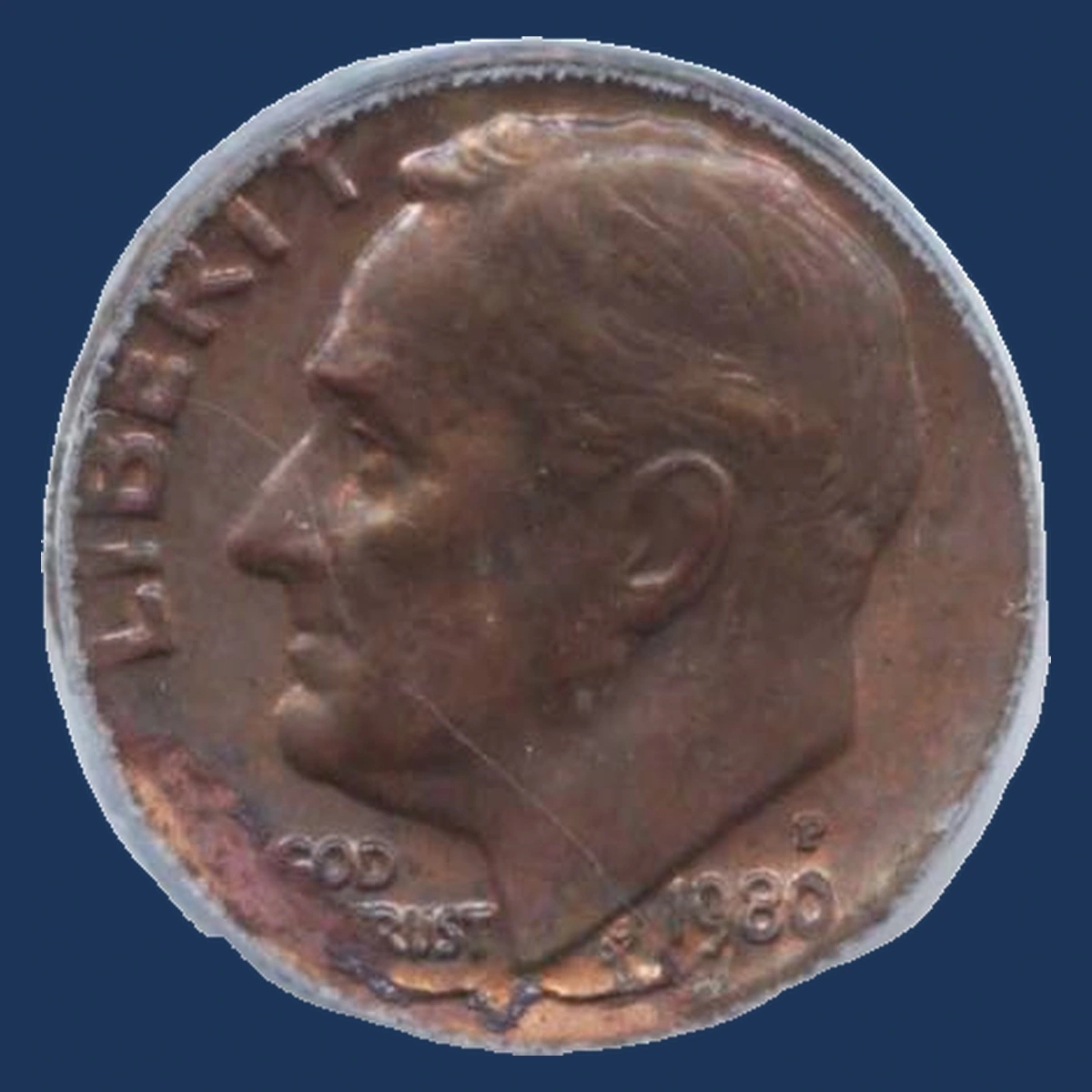
A flaw in the metal can survive after the blank receives a dime design. Depending on the original problem, the surface may have an uneven patch or another visible interruption.
A 1980-P example graded ANACS MS62 was specifically cataloged as struck on a defective blank. That description does not identify a particular chemical mixture or a complete missing outer layer.
The useful question is whether the flaw existed before the design was impressed. Calling it a defective blank does not automatically make it the separate 1.4 g copper-core coin discussed below.
Estimated Value
The ANACS MS62 coin realized $139 in March 2023. An estimated $50–$350 is suitable for comparable clearly identified blank defects, depending on their size and appearance.
A flaw that visibly interacts with the original design is easier to explain than a rough patch with an unknown cause. Surface damage can reduce value even on a genuine error, and a broad catalog description should not be priced as a rarer, specifically identified metal mistake.
How to Identify
Find where lettering or portrait detail meets the flaw under a 10× magnifier. A design impressed beside an original uneven area differs from detail sliced away by a later scratch.
Photograph both faces and the edge together. A local flaw need not mean the entire blank has the wrong metal.
Record a loose coin’s weight on a scale against the normal 2.268 g. Calipers provide the usual 17.91 mm size reference.
Do not substitute measurements from the separate copper-core coin. Keep a certified example sealed and use photographs or its own recorded measurements.
Follow the struck detail as it enters or crosses the flawed area; that relationship helps show whether the surface problem preceded the strike.
9. 1980 Roosevelt Dime Die Chips and Rim Breaks
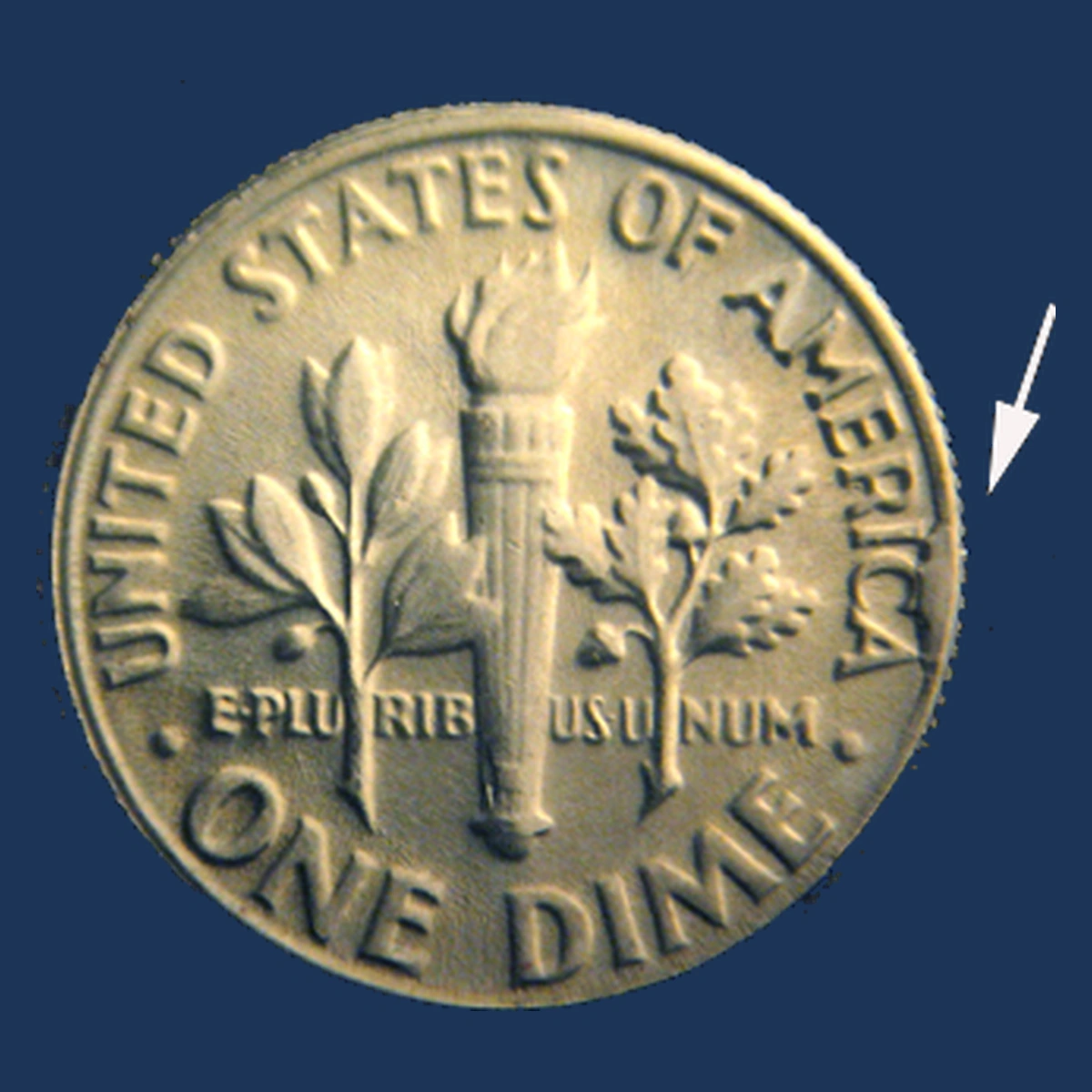
The opening inside a P can appear filled with raised metal. A small break in the stamping tool lets coin metal rise into the extra space.
A much larger break reaching the tool’s edge can create a raised patch joined to the coin’s rim. Collectors call that a cud.
The 1980 reports include a filled P and a separate cataloged Denver reverse cud. These differ greatly in size, but both involve metal filling damaged parts of a tool; a P weakened by grease would lose detail instead of gaining a raised center.
Estimated Value
A small filled P fits an estimated $5–$25, while an identified Denver rim cud can be estimated at $75–$500. The contrast reflects the size and visibility of the tool break.
A tiny raised spot inside a common mint letter usually attracts less attention than a clear rim-connected patch. Original surfaces and an identifiable date strengthen either coin, while dirt, added metal, or a crushed rim cannot support the same error prices.
How to Identify
For a filled P, illuminate the mint letter from the side and inspect its opening through a 10× magnifier. Raised original metal should differ from dirt lodged in the hole.
The Denver cud needs a separate comparison: inspect the reverse and follow the raised patch into the rim. Match it with the cataloged 1980-D example.
A scale and calipers should show near the ordinary 2.268 g and 17.91 mm on an intact loose dime. The damaged tool changes the surface without removing a piece from the coin.
Leave deposits untouched rather than digging at them. A raised filled opening identifies the small chip, while a raised patch joined to the rim identifies the larger break.
10. 1980 Roosevelt Dime Front Brockage with a Partial Collar Strike
Backward details pressed into the front show that another struck coin came between the blank and the tool. At the same time, partial collar contact left an abnormal step along the edge.
The mirror impression is called a brockage. The collar step records how the blank sat in the surrounding metal ring during the blow.
The documented 1980-P example received an NGC Uncirculated Details description, meaning no circulation wear but a condition problem. A wheel mark on the front was that damage, not another Mint error or part of the backward impression.
Estimated Value
This coin sold for $228 in November 2020. Estimate $150–$600 for comparable combinations, with the strength of the mirror impression and the edge step both affecting appeal.
The wheel mark helps explain why an otherwise unworn coin received a problem notation. Cleaner examples may bring more, but the visible Mint-made features still need to be clear; damage should neither be counted as another error nor ignored when comparing prices.
How to Identify
Separate the backward front impression from the wheel mark in enlarged photographs. A 10× magnifier and side lighting help distinguish sunken design from scraped metal.
Compare the impression with the normal reverse design. A plain dent cannot supply the recognizable backward details of a brockage.
Turn to the edge and follow its step between the restrained and expanded portions. Calipers can compare the narrower section with the normal 17.91 mm.
An intact loose dime should weigh near 2.268 g on a scale. Normal weight alone cannot distinguish an original strike from later pressure.
Leave graded coins sealed and match both the mirror-image impression and struck edge step, keeping the wheel damage out of that comparison.
11. 1980 Roosevelt Dime Double Strike with a Cupped Reverse
Two Roosevelt designs point almost opposite ways on this unusual dime. The coin turned between blows, leaving a second front impression nearly inverted relative to the first.
The reverse of the second strike was blocked, and the metal spread into a cup-like shape. The auction description identifies the result as a coin cap with an expanded reverse image.
The 1980-P example was graded NGC MS65, an unworn grade with relatively few marks. It is the distorted coin itself, not simply a normal flat dime struck beneath another coin cap.
Estimated Value
Use an estimated $300–$1,000 for a comparable clearly identified double strike with this cupped shape. The documented MS65 coin was offered in August 2004 but did not sell, so that listing supplies no realized price.
A separate 1986-P double strike with a blocked second impression brought $288 in April 2022. The different year and shape limit that comparison, while readable repeated designs and an intact cup can strengthen the 1980 example’s appeal.
How to Identify
View the coin from the side before studying the repeated portrait. Photograph the cup’s shape without pressing it flat or trying to make it fit an ordinary holder.
With a 10× magnifier, trace the two front impressions and compare their nearly opposite orientations. The reverse should agree with the expanded shape described for the coin.
Calipers can document width, but the shape no longer needs to match a flat 17.91 mm dime. A scale should relate to the original 2.268 g blank unless metal is missing.
Keep a certified coin sealed. Match the paired front designs together with the original cupped reverse, rather than treating a bent dime alone as evidence of a coin cap.
12. 1980 Roosevelt Dime Missing Outer Layers and Copper-Core Strikes
Copper can show on one face when a dime loses an outer copper-nickel layer before striking. Losing both outer layers leaves a much thinner copper center to receive the design.
Philadelphia examples include front-layer losses weighing 1.9 g and a separate reverse-layer loss. Their colors and grades belong to their individual coins.
The more unusual copper-core example weighs 1.4 g and was graded PCGS MS62. It is not a dime struck on a cent blank: the missing outer layers explain its light weight, while a normal 1980 cent blank is heavier.
Estimated Value
Single-face losses can be estimated at $60–$350; March 2025 sales included a reverse-layer example at $84 and front-layer examples at $139. These prices belong to separate coins.
For the 1.4 g copper-core type, estimate $600–$1,200. The PCGS MS62 copper-core example brought $822.50 in August 2016.
That result illustrates the stronger value of a clear two-layer loss. It does not price an ordinary stained or one-sided copper-colored dime.
How to Identify
A 0.01 g scale separates some very similar-looking loose copper coins: compare the normal 2.268 g with the documented 1.9 g front-loss and 1.4 g core pieces. Do not assign those exact measurements to the unweighed reverse-loss example.
Inspect both faces and the edge with a 10× magnifier to determine which outer layers remain. Single-face loss exposes copper on one side, while the core example has copper on both and lacks the normal layered edge.
Use calipers against the usual 17.91 mm diameter, leaving graded coins sealed and surfaces uncleaned. Original struck copper and the absent edge layers should agree with the reduced weight, rather than relying on color alone.
13. 1980 Roosevelt Dime Strike on a Cent Blank
Roosevelt’s design on metal intended for a cent would produce the wrong combination of image, weight, and composition. The unstruck metal disk is called a blank or planchet.
A 1980 year guide reports a cent-blank category without identifying a particular certified coin. Its copper color cannot establish the error by itself.
The correct cent comparison for this year is a bronze blank weighing 3.11 g, larger than a dime blank. That distinguishes the proposed error from a light copper-core dime and from later copper-coated zinc cents weighing only 2.50 g.
Estimated Value
An estimated $500–$1,200 applies to the reported category once the cent blank is identified. The estimate depends on original bronze metal and a readable dime design, with preserved surfaces around the portrait and lettering.
A clear dime design on properly identified bronze would support the comparison. Cleaning, clipped metal, or uncertain composition weakens it, while the normal weight difference must be explained before a copper-looking coin receives a wrong-blank premium.
How to Identify
The 1980 cent comparison starts with bronze, not the lighter zinc used in later years. Its normal blank weighs 3.11 g, compared with the dime’s 2.268 g.
Weigh a loose candidate on a scale before judging color. A very light copper-looking piece points away from an intact cent blank.
Calipers compare the cent’s normal 19.05 mm diameter with the dime’s 17.91 mm. The strike can change the outline.
Inspect the edge and both faces with a 10× magnifier for plating, missing layers, or older coin details. Those can explain a strange appearance through different processes.
Keep a certified coin sealed and match its dime design with recorded evidence of the heavier bronze blank.
14. 1980 Roosevelt Dime Broadstrike with a Major Front Die Break
A large smooth raised area replaces much of the front design, while the outer metal spreads beyond a normal dime. Part of the stamping tool broke away, leaving room for coin metal to rise.
The same coin was struck without normal collar restraint, producing the broad outline. Its auction description calls the front break 50% of the face.
The documented 1980-P example was graded NGC MS65. That percentage describes the break rather than the amount of off-center movement, and it does not establish a particular clock position without the coin’s image.
Estimated Value
Auction records list this combination at $1,440 in January 2023. An estimated range of $800–$2,000 reflects its large, easily visible break and the additional broadstruck shape.
Both features belong to one coin. Good original surfaces and surviving readable detail help explain the strong price.
Damage or a much smaller raised patch makes a weaker comparison. The amount should not be transferred to a tiny filled P or an ordinary broadstrike.
How to Identify
Study the raised patch where it meets the remaining design, using a 10× magnifier and side lighting. Original metal should rise into the area left by the broken tool rather than sit on the face like an added blob.
Inspect the spread outline separately and compare it with a 17.91 mm normal dime using calipers. An intact loose coin should remain near 2.268 g on a scale because the strike moves metal rather than adding it.
Keep a graded example sealed and examine both faces for later flattening or applied metal. The major raised front patch must join the original struck surface within the same coin’s expanded outline.
Conclusion
Estimated values for these 1980 dime errors extend from $5 to $2,000. The $1,440 broadstrike with a major front break and the $822.50 copper-core coin show how different mistakes can attract collectors.
Weigh copper-colored candidates, inspect both faces of displaced strikes, and study the edge alongside any backward impression. A tiny filled P and a large rim break share a cause, but their appearance and value are very different.