1998 Dime Error List with Pictures

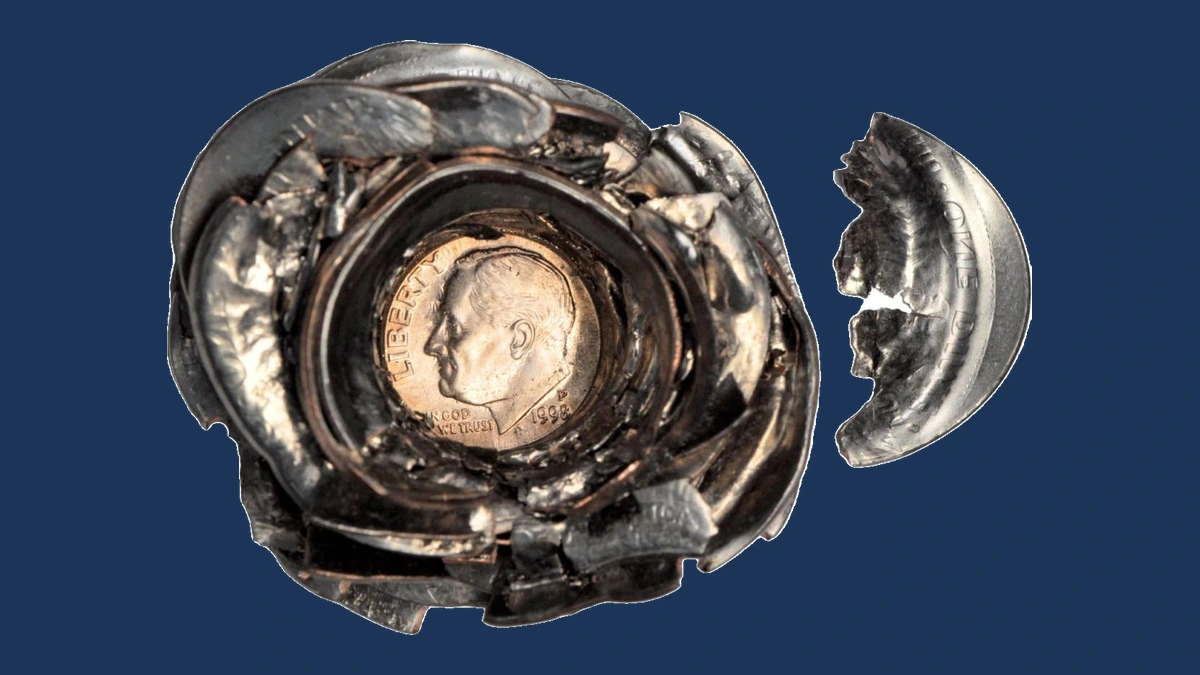
Imagine roughly 32 dimes squeezed into one twisted stack. A 1998-P bonded group weighing 72.3 grams sold for $9,200 in August 2011, as one intact, uncertified group.
Not all 1998 dime errors are that dramatic. A small raised crack and a copper-colored coin can also deserve a closer look, for very different reasons.
Estimated values below range from $5 to $12,000, including whole pairs and groups where stated. Read on to compare the visible details before choosing a price match.
1. 1998 Roosevelt Dime Reported Minor Doubling
A faint extra line beside a letter may look like a second copy of the design. The 1998 year guide reports minor doubling without naming one established position or mint.
True doubled dies carry repeated detail in the steel tools that stamp the coins. Each coin made by that tool can receive the same extra shape.
Other causes can look similar. Movement during striking can leave flat ledges, while worn tools and glare can make letters look thick without producing the specific repeated design needed for a doubled-die identification.
Estimated Value
For a genuine minor doubled-die example, estimate $15–$100. A clear, photographable extra shape is more appealing than general thickening around worn letters.
Condition matters because fine doubling can become difficult to see after circulation. A clean, unworn coin provides a better comparison with an identified example.
This estimate applies to confirmed repeated design from the stamping tool. It does not place a premium on every 1998 dime with flat ledges or blurry-looking lettering.
How to Identify
For a loose ordinary clad piece, check approximately 2.268 grams and 17.91 mm with a scale and calipers, including the edge grooves. Those checks identify the normal coin type; the extra design must be judged separately.
Choose one suspected shape and photograph it under two light angles. With a 10× magnifier, compare it with a normal 1998 dime rather than borrowing a doubled torch or date position from another year.
Look for a repeatable extra shape, not just a flat shelf beside a letter or general thickness caused by glare. A second coin with the same feature can help, but compare the surrounding design before calling the resemblance a doubled-die match.
2. 1998 Roosevelt Dime Die Cracks and Cuds
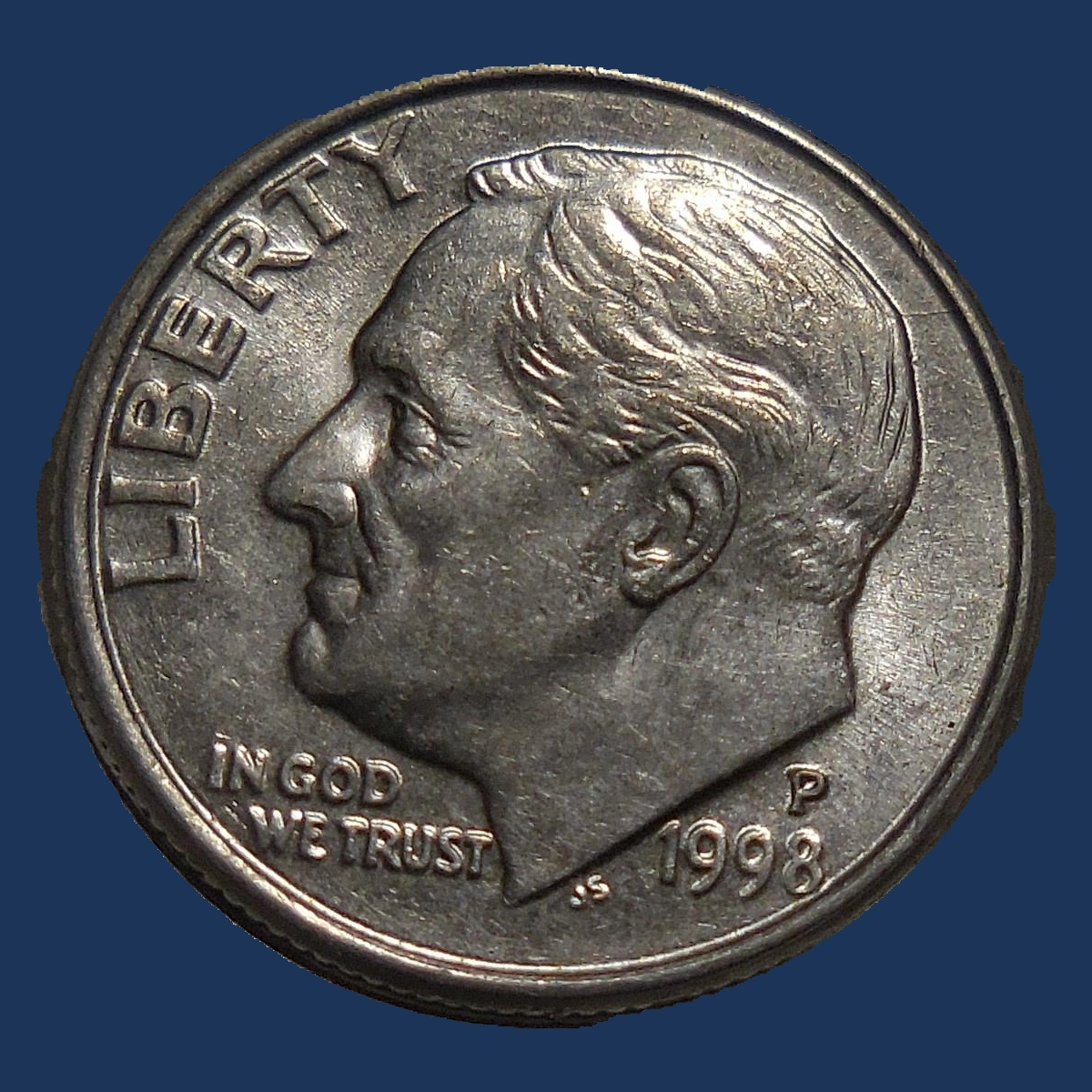
A thin raised line and a broad lump can both come from a damaged stamping tool. A crack makes a line; a broken-away piece lets more metal rise into the opening.
A large break that reaches the rim is called a cud. Small interior lumps are different shapes, even though damaged tools can produce both.
The 1998 guide reports cracks and cuds without one specific specimen location. The portrait and torch are possible areas to inspect, not established landmarks that every genuine 1998 example must display.
Estimated Value
Estimate $5–$200 for genuine examples, from small cracks to clear rim-connected breaks. Tiny lines on worn coins usually remain inexpensive.
A larger lump that interrupts the design can be much easier to appreciate. Its size, shape, and the coin’s remaining detail affect the price.
The range concerns metal raised by a damaged stamping tool. Corrosion, solder, and other material stuck to a dime do not become valuable cuds simply because they form a lump.
How to Identify
Added material can imitate a lump, so inspect its boundary before naming it a cud. For a loose clad dime, check 2.268 grams and 17.91 mm with a scale and calipers, including the edge grooves.
Now follow a suspected lump toward the rim. A cud connects to the rim and interrupts part of the struck design.
Use a 10× magnifier and side lighting on any nearby lines. A raised line supports a crack; a cut into the surface suggests a scratch.
Look at the opposite face for weak detail corresponding to a large break. Photograph the two areas together.
The general year report gives no fixed position for these features. Judge the actual raised metal rather than matching an invented portrait or torch location.
3. 1998 Roosevelt Dime Curved and Straight Double Clip
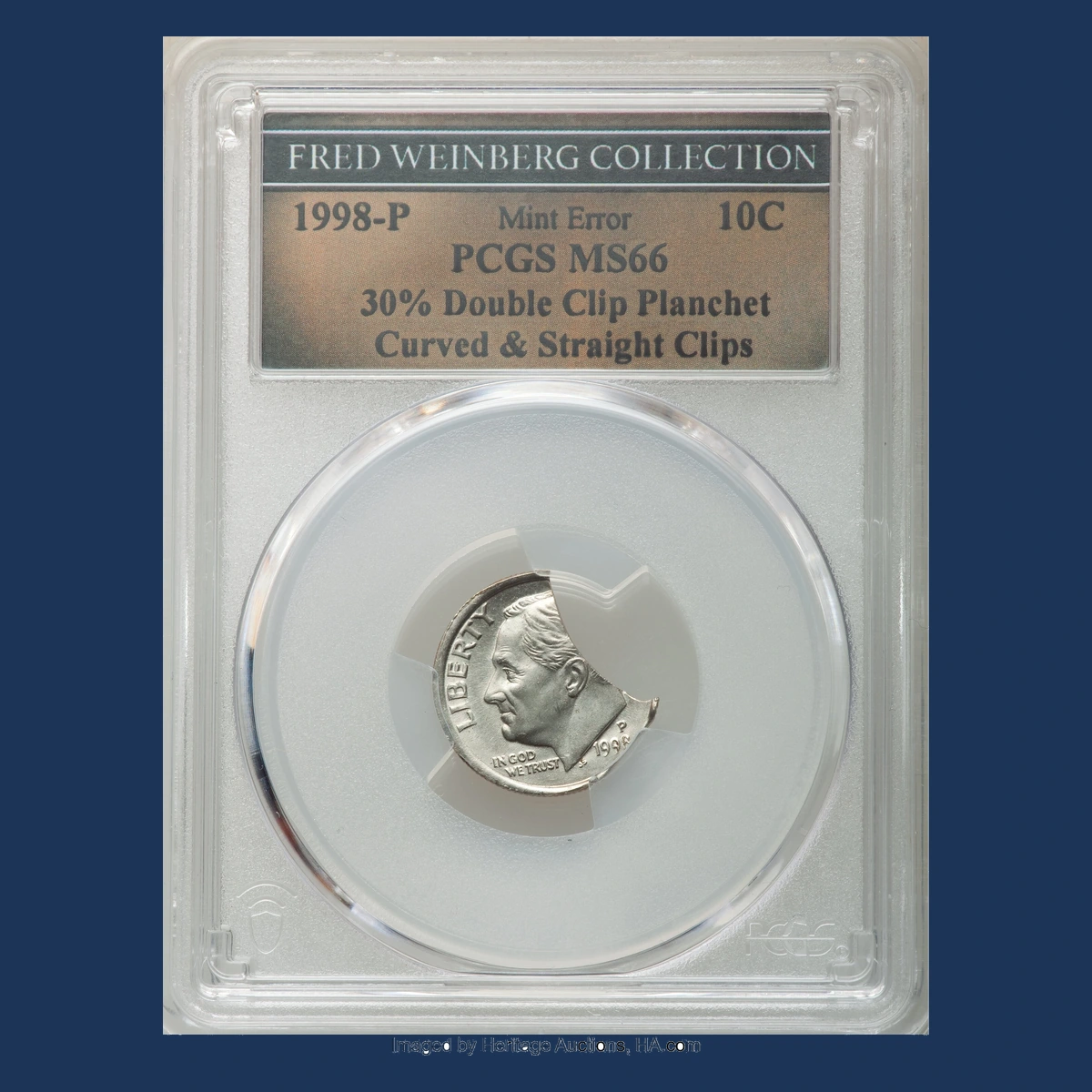
One missing section is curved and the other is straight on this Philadelphia dime. Its incomplete blank received the design after those shortages already existed.
Heritage described the combination as a 30% double clip. The coin came from the Fred Weinberg collection and received a PCGS MS66 grade, meaning unworn with relatively few marks.
The two shapes tell a different story from damage caused by cutting a finished coin. They also belong to one piece: a curved shortage and a straight shortage do not require separate prices or two trips through the press.
Estimated Value
Estimate $40–$300 for genuine examples with comparable missing sections. The recorded Philadelphia double clip sold for $114 on July 5, 2022.
That sale provides a price for the complete coin with both gaps. A different specimen can vary with its condition, readable date, and the amount of design that remains.
Large missing sections do not guarantee a large price. The $114 result is a useful reminder to compare actual coins rather than valuing each gap separately.
How to Identify
Weigh a loose coin against the normal clad 2.268 grams and measure intact spans against 17.91 mm with calipers. The catalog’s 30% describes the combined shortage, not an exact required scale reading.
Compare the two gaps: one follows a curve, while the other has a straighter boundary. Use a 10× magnifier where each gap meets the struck rim, checking the remaining edge grooves and cut surfaces for fresh tool marks.
Photograph nearby letters and the date alongside both gaps. Design formed around an original shortage differs from finished lettering cut through afterward; do not count the two gaps as proof of two strikes.
4. 1998 Roosevelt Dime Broadstrike
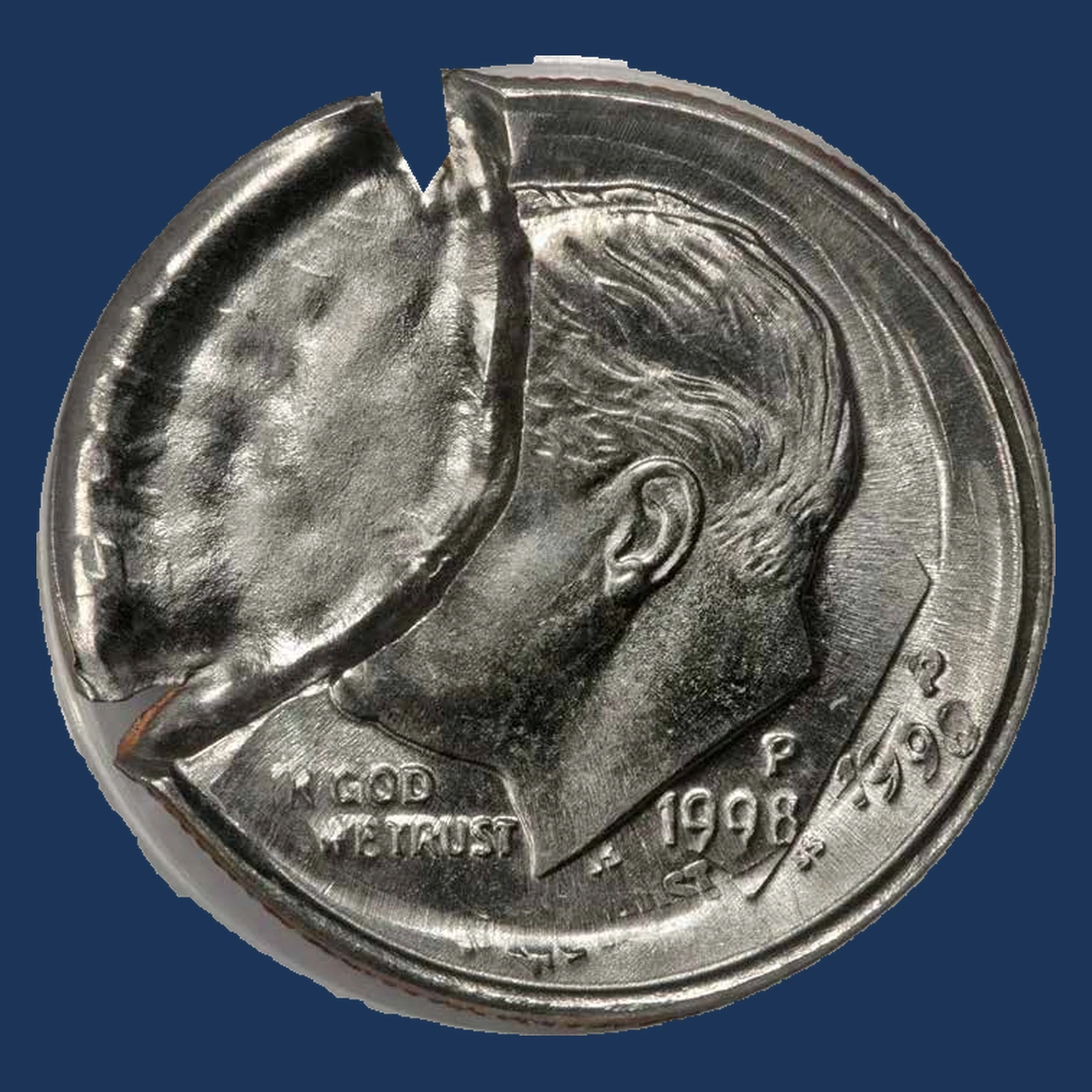
The metal ring around the blank normally limits its width during striking. A broadstrike occurs when that restraint fails and the metal spreads outward.
An APMEX listing identifies a 1998-P broadstrike. The coin should be compared by its expanded outline and complete design, rather than by a generic diameter printed in a product table.
That listing does not establish an individual grading-service certification for the piece. A wider shape also needs to be distinguished from later flattening, which can damage a finished dime while making it appear larger.
Estimated Value
For a genuine broadstrike, estimate $30–$300. Mild expansion lies near the lower end, while a clear spread around a complete design can draw more interest.
A separate 2000-P dime with multiple strikes and a broadstrike sold for $159 in September 2025. That comparison includes an additional striking error, so it is not an exact price match.
Judge the 1998 coin’s own width, detail, and marks. A product description alone does not establish how dramatic its expansion is.
How to Identify
Measure a loose candidate with calipers and compare it with the ordinary 17.91 mm diameter. Use a scale against the normal clad 2.268 grams, since outward spreading does not itself remove metal.
Now follow the design around both faces with a 10× magnifier. Complete lettering surrounded by extra metal supports a broadstrike; missing design beside a bare crescent calls for an off-center comparison.
Inspect the edge grooves and outer border for signs of later flattening. Crushed finished details or tool marks require a different explanation from metal flowing during the strike.
Use measurements taken from the actual coin. The normal diameter in a seller’s standard product specifications is not a measurement of that broadstruck example.
5. 1998 Roosevelt Dime Missing Front Clad Layer
A normal clad dime has pale outer layers bonded to a copper center. If the front layer is missing, that face can appear copper-colored while the back remains pale.
Philadelphia examples include a PCGS MS60 coin and a separate ANACS AU58 piece recorded at 1.86 grams. MS60 means unworn with many marks; AU58 means only slight wear.
A Denver AU58 example is also reported. Its weight is not established by the Philadelphia record, and the 1.86-gram figure should stay with the specific coin to which it belongs.
Estimated Value
An estimated $50–$400 covers genuine single-layer losses of this kind. A clean copper face with readable detail can be more appealing than a spotted or scratched piece.
For a recent different-year comparison, a 2018-P missing-layer dime sold for $384 in July 2021. That result does not set the price of either 1998 Philadelphia example.
Compare the missing face and the surrounding detail, as well as the grade. A stained or chemically altered dime should not receive the same mint-error premium.
How to Identify
A 1998-S silver Proof is a specially made collector coin that normally weighs 2.50 grams. Establish that distinction before comparing a copper-colored ordinary dime with missing-layer examples.
For a loose clad candidate, use a scale against 2.268 grams and calipers against 17.91 mm. The reported 1.86 grams belongs only to the separate Philadelphia AU58 specimen.
Photograph both faces under the same light. The copper front should differ from the back that retains its pale outer layer.
With a 10× magnifier, inspect the metal layers at the edge and the remaining grooves. Paint or added plating can collect around details without the same missing-layer structure.
Check for pitting and etched detail as well: chemicals can remove weight and change color without producing a mint error.
6. 1998 Roosevelt Dime Off-Center Strike
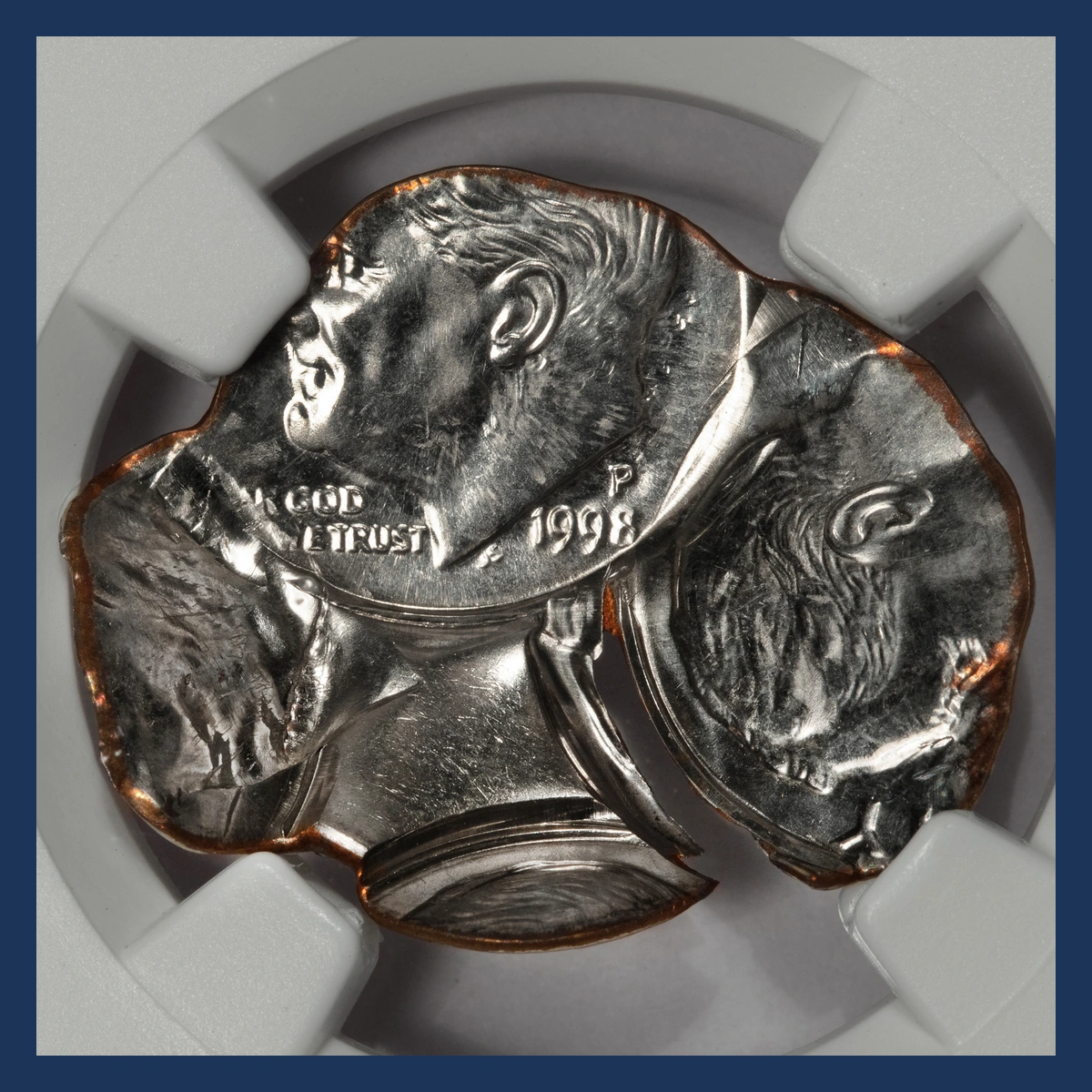
Most of the blank remained outside the striking area on the reported 1998-P example. It is described as 70% off center toward one o’clock.
The result combines a large unstruck area with only part of the design. ANACS graded the coin MS64, indicating an unworn piece with visible marks.
This is different from a shifted tool that leaves only one face off center. The blank’s position between both tools explains the missing design on a true off-center strike, so both faces matter when judging a possible match.
Estimated Value
Estimate $30–$600 for genuine off-center examples, depending on displacement, remaining date, and condition. More missing design does not always mean a better coin if its identity is hard to read.
A different 1977 dime with a modest 10% displacement sold for $109 in June 2026. The much larger 1998-P displacement needs its own comparison rather than a simple price multiplier.
Clean surfaces and understandable design fragments make an unusual strike easier for a buyer to appreciate.
How to Identify
Look for the date and P within the surviving design first. A large blank area has less meaning if the coin cannot be connected to its year and mint.
Orient the front upright before checking the reported one-o’clock displacement. Use a 10× magnifier to inspect the boundary between struck and unstruck metal for later grinding or scraping.
For a loose clad piece, weigh it against 2.268 grams and compare the blank’s dimensions with 17.91 mm using calipers. Edge grooves may survive only where the striking conditions allowed them to form.
Compare the back with the front. A centered opposite design would challenge an off-center explanation and instead call for a closer look at tool alignment.
7. 1998 Roosevelt Dime Multiple Strikes with a Front Brockage
This Philadelphia coin combines an expanded outline with multiple strikes and a mirror image pressed into its front. The mirror impression is called a brockage.
It forms when a struck coin acts as the surface that impresses another blank or coin. A brockage is sunken and reversed, unlike the normal raised design from a stamping tool.
Coin World’s auction record identifies the 1998-P example as NGC MS66, an unworn grade with relatively few marks. The description does not give the exact number or directions of the strikes, so those should not be assumed.
Estimated Value
Estimate $125–$800 for a comparable compound error. Coin World records a $164.50 Heritage result dated February 1, 2016, for the MS66 example.
That figure values one coin with all its features together. Adding a separate broadstrike price and a separate brockage price would overstate what the record shows.
A clearer mirror image or more readable overlapping strikes can increase appeal. Heavy marks and poorly defined impressions can reduce interest despite the impressive collection of error names.
How to Identify
Reverse a photograph of the sunken front image to see whether its lettering reads normally. A recognizable mirror design is more useful than a few reversed-looking scratches.
For a loose clad dime, a scale checks 2.268 grams and calipers compare the spread outline with the normal 17.91 mm. Inspect the surviving edge grooves for later pressure damage.
Use a 10× magnifier to trace the sunken image separately from the overlapping struck outlines. Do not count every doubled edge as another complete strike.
Compare the back with the front to understand how the same coin changed. Keep both faces in the photographic record.
A later vise impression can create mirror detail on an existing coin. The broad shape by itself does not prove that every feature came from the mint.
8. 1998 Roosevelt Dime Front Die Cap
The upper-left edge of this dime rises much higher than the lower-right edge. It is a front die cap: a coin that stuck to the front stamping tool and changed shape through repeated blows.
Heritage describes a pronounced wall near eleven o’clock on the 1998-P example. The front retains sharp, mirror-like detail, while the back design has been wiped out.
The grading service used an unusually thick holder to accommodate the shape. Its NGC MS66 grade describes an unworn coin, and the reflective front does not make this ordinary Philadelphia coin a Proof.
Estimated Value
Estimate $250–$1,000 for a cap with comparable depth and recognizable detail. The described Philadelphia example sold for $402.50 on July 10, 2009.
Its uneven wall and clear front make the accident easy to see. A shallower cap or one with less surviving design may have a different price.
The reflective face is part of the repeated-strike appearance, not a separate Proof premium. The whole coin’s shape and preservation need to be considered together.
How to Identify
Keep the cap in its holder if already sealed, and never force the wall flat. For a loose piece, a scale checks its weight against the normal clad 2.268 grams.
Record its footprint gently with calipers against the normal 17.91 mm diameter. Expansion means the cap need not retain that ordinary width.
Photograph the high wall near eleven o’clock from the side and compare it with the lower-right edge. Follow any surviving edge grooves into the curved metal.
Use a 10× magnifier on the inner front and outer back. The described example pairs sharp front detail with a back whose design has been wiped out.
A later bend may leave normal back detail and tool marks. Compare those surfaces before relying on the cup shape alone.
9. 1998 Roosevelt Dime Indent Errors and a Mated Pair
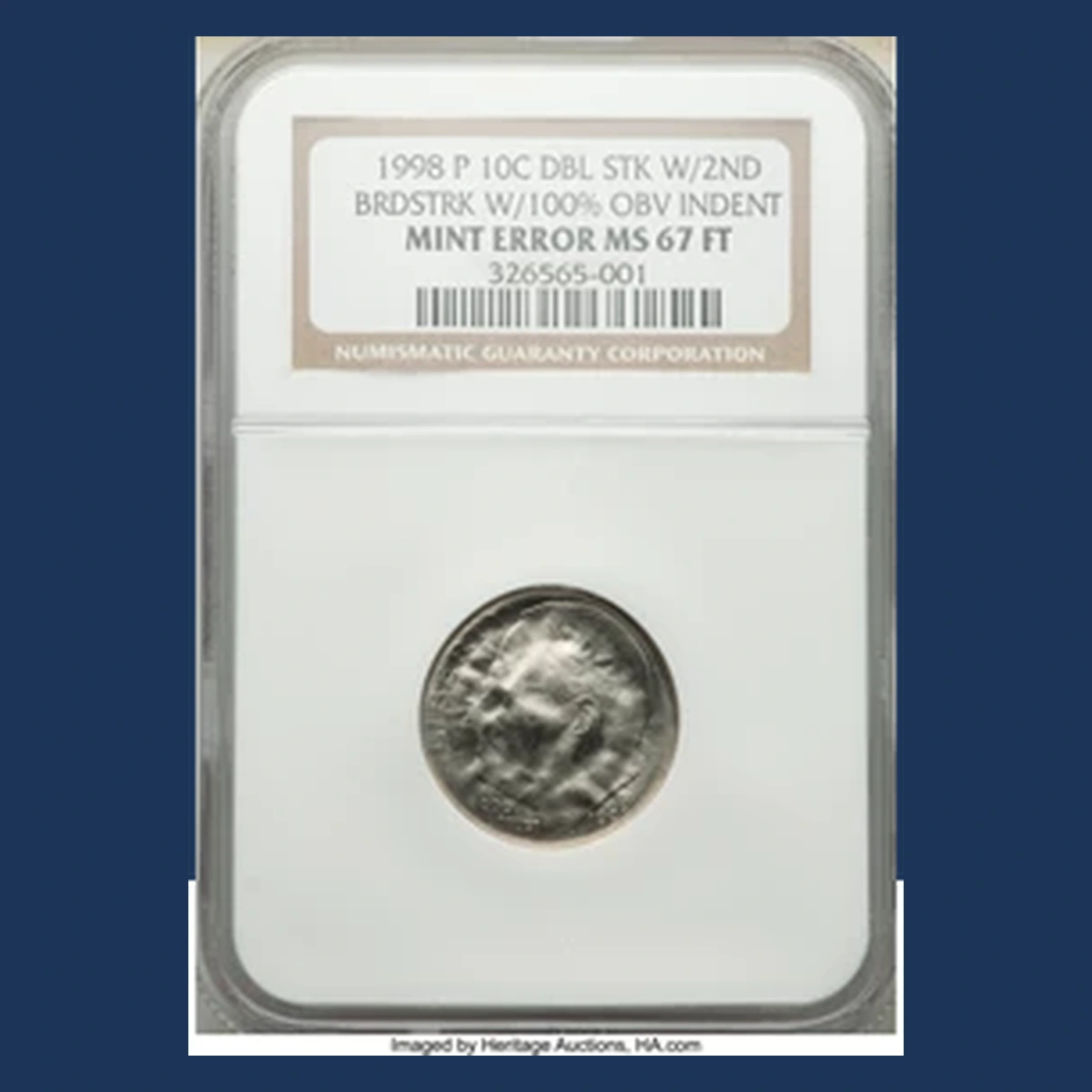
An extra blank in the striking area can block part of a coin and leave a depression called an indent. One 1998-P dime was struck twice, with the second blow producing a broadstrike and a completely indented front.
That coin is NGC MS67 Full Bands, a high unworn grade with strong torch-band detail. It is separate from a matched Philadelphia pair.
In the pair, one coin is double-struck and indented; the other is off center and indented. Their matching relationship is important, but neither object should be confused with the single fully indented dime.
Estimated Value
Estimate $150–$700 for a strong standalone indent example and $500–$1,200 for a comparable intact matched pair. The Philadelphia pair sold for $720 on July 15, 2021.
That result covers both coins together. It does not supply a $720 price for the separate MS67 Full Bands dime.
A pair that clearly explains the shared accident can have extra appeal. Keep the matching pieces together and judge the visibility of their impressions before making a comparison.
How to Identify
Start by separating the single-coin example from the matched pair. They have different grades and different arrangements of design and depression.
Weigh loose clad coins individually against 2.268 grams and measure them with calipers against 17.91 mm. Inspect surviving edge grooves without pressing the pieces together.
For the single dime, use a 10× magnifier to compare the depressed front with the struck back. Grinding away a face leaves abrasion rather than a depression made during the strike.
For the pair, photograph both objects together and compare their contact outlines. One is double-struck and indented; the other is off center and indented.
Do not force the pair into an assumed joining angle. Let the actual matching outlines show how the two coins met.
10. 1998 Roosevelt Dime Triple Strike with a Flip-Over Final Strike
Three strikes changed this Philadelphia dime in stages. After the first strike, the second landed off center; the coin then turned over before another off-center blow.
One face was blocked during that final strike. The catalog calls this uniface, meaning only one face received the normal tool’s design in that blow.
The 1998-P coin was graded ANACS MS61, an unworn grade with substantial marks. Its overlapping images belong to one complex press accident, so the flip, displacement, and blocked face should be read together when following what happened.
Estimated Value
The documented triple-struck dime sold for $990 on January 2, 2023. Estimate $500–$1,500 for a comparable example with a readable sequence of overlapping strikes.
Clear dates and design fragments help a collector understand the accident. A high condition number is not the only attraction when the strike pattern itself is unusual.
The $990 concerns the whole coin. Separate prices for the second strike, flip, and blocked face should not be added to that result.
How to Identify
Work on enlarged photographs when separating the three strikes. Mark readable parts of the portrait, lettering, and date on copies while leaving the coin untouched.
The final flip should place opposite-side details on a face that already carried the first design. Use a 10× magnifier to follow which impressions cover earlier ones.
For a loose clad piece, compare its weight with 2.268 grams using a scale. Record its dimensions against 17.91 mm with calipers without squeezing thin, spread metal.
Inspect surviving edge grooves and any blocked area. Grinding can erase a design later but leaves a different surface from one protected during striking.
The catalog gives no exact strike angles. Follow the actual overlaps instead of assigning three clock positions simply because three strikes are recorded.
11. 1998 Roosevelt Dime Struck on Cent Stock
This orange-red Philadelphia dime was struck on the wrong metal stock. Stock means the metal strip from which coin blanks are cut.
Heritage describes it as apparently made from a dime-sized blank cut from cent stock, rather than a complete larger cent blank. The distinction matters when interpreting its size.
The PCGS MS64 coin has a broad, dish-shaped front rim and a small metal separation above the second U in UNUM. MS64 indicates an unworn piece with visible marks; the surface color does not by itself establish the blank’s origin.
Estimated Value
The MS64 cent-stock dime sold for $4,465 on January 11, 2016. For a similarly identified example, estimate $2,500–$5,000.
The price belongs to a dime design struck on wrong stock. A cent design struck over a dime is a different error and needs a separate comparison.
Color, condition, and clear identification all affect the value. The small metal separation is part of this same coin, not an additional error price to add to its sale.
How to Identify
Check the design before the color: the coin must carry Roosevelt’s dime design, not Lincoln’s cent design over a dime. Photograph both faces and the mint letter.
For a loose piece, record actual weight and dimensions with a scale and calipers. The normal clad dime standards are 2.268 grams and 17.91 mm, but the catalog does not give measured figures for this specimen.
Use a 10× magnifier at the edge to distinguish its metal from surface staining or added copper plating. Professional metal testing is needed to support the wrong-stock identification.
The broad front rim and small separation above the second U in UNUM help compare the recorded coin. Do not replace the dime-sized-stock explanation with the dimensions or weight of a complete cent blank.
12. 1998 Roosevelt Dime Bonded Group of Dimes
This error is a stack of coins that became mechanically joined in the press. Successive blanks entered, failed to leave, and were forced together by further blows.
The 1998-P group weighs 72.3 grams, roughly the weight of 32 normal dimes. That number is an estimate from its mass, not a count made by pulling the group apart.
The auction sold it intact and uncertified, without a grading service’s assessment. Its unusual value comes from the joined stack and its press-made shape, rather than from the high condition grade of any one ordinary dime.
Estimated Value
The bonded group brought $9,200 at Stack’s Bowers in August 2011. Estimate $7,000–$12,000 for this scale of intact, well-documented press accident.
That range values the entire group. Dividing its auction price by approximately 32 would not establish a market price for ordinary individual dimes.
The size, visible joined layers, and reliable history are central to its appeal. Breaking it apart would destroy the relationship that makes the object collectible.
How to Identify
Keep the group supported and intact. Photograph the joined layers, exposed designs, and contact surfaces from several angles instead of trying to separate the pieces.
A scale records the whole object’s weight. Dividing 72.3 grams by the normal clad dime weight of 2.268 grams gives about 31.9, which explains the catalog’s approximate count.
Use calipers gently to record the outside dimensions without compressing the stack. A normal dime is 17.91 mm across with a grooved edge; those are comparisons for visible parts, not limits for the whole group.
A 10× magnifier helps inspect how struck metal flows between neighboring layers. Glue or solder joining finished coins later does not reproduce a genuine sequence of coins squeezed together inside the press.
Conclusion
Estimated 1998 dime error values range from $5 to $12,000, with whole pairs and bonded groups priced as complete objects. The $9,200 group is a very different collectible from a single clipped or missing-layer dime.
Look at the metal, outline, and relationship between designs before choosing a price comparison. Preserve connected pieces and unusual edges, and keep a wrong-stock dime separate from a cent struck over a dime.