1968 Dime Error List with Pictures

A missing letter can mean two very different things on a 1968 dime. Philadelphia coins normally lack a mint mark, but San Francisco’s special collector coins should carry an S.
The rare No S Proof has reached $48,875 at auction. Proof describes a coin specially made for collectors, usually with reflective surfaces.
This 1968 dime error list covers estimated values from $5 to $50,000, including doubled letters, missing metal layers, and unusual blanks. Read on to see which features separate these errors from ordinary coins and damage.
1. 1968 Roosevelt Dime Raised Cracks and Rim Breaks
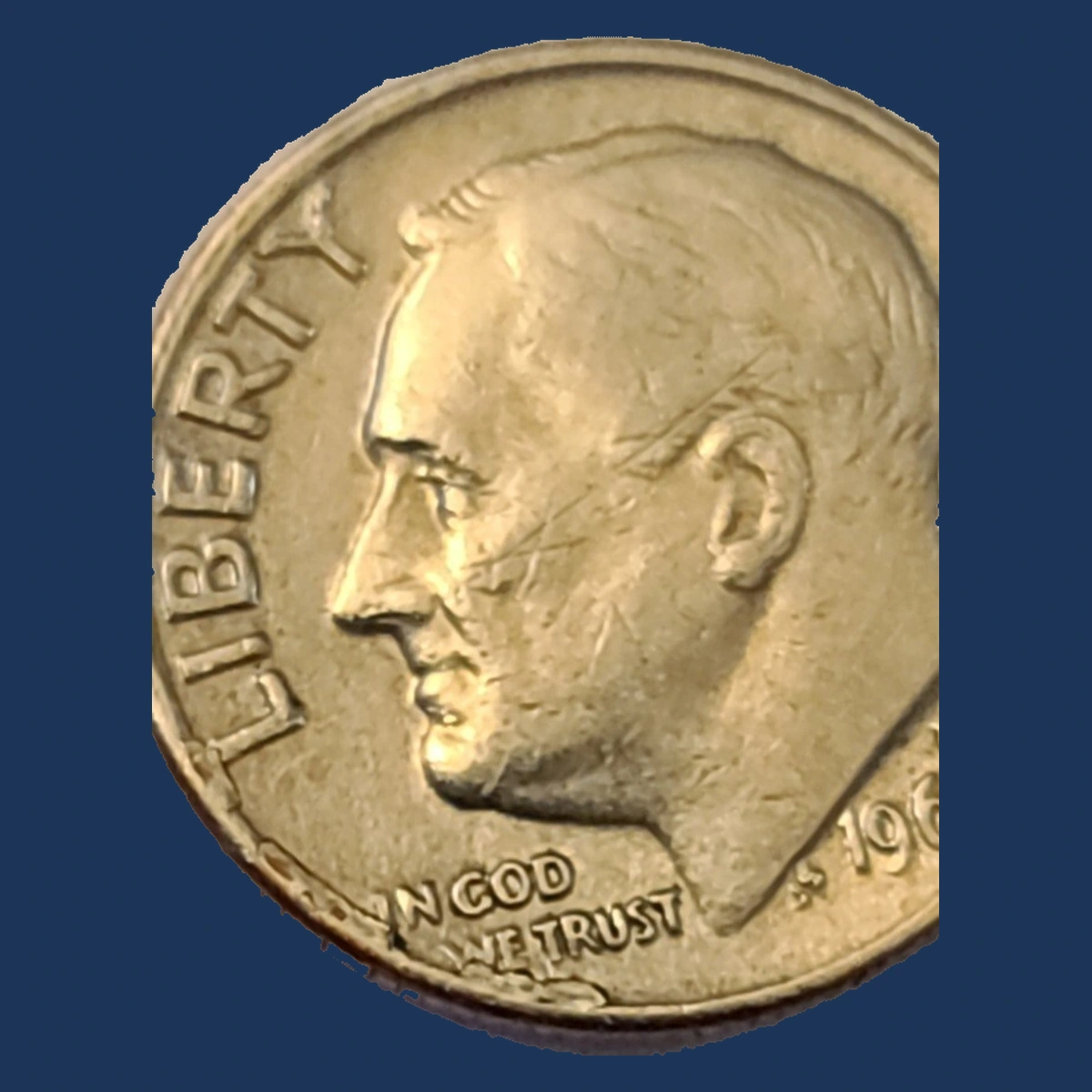
A narrow raised line may cross a coin when the steel stamping tool cracks. This tool is called a die, and metal enters its crack during striking.
A larger broken area can leave a raised lump joined to the rim. Collectors call this a cud.
The 1968 reports include cracks and a Denver rim break listed as CU-10c-1968D-01. The exact position must match the pictured example, rather than any random bump along a dime’s edge.
A dent from circulation presses metal inward and can push a rough lip beside it.
Estimated Value
Small genuine cracks are estimated at $5–$30, while clearer rim breaks can bring $30–$150. Size and visibility matter more than a dramatic seller’s nickname.
For a different-year comparison, a 1970-D nickel with two cuds sold for $63 in October 2022. Its larger coin size and different design limit the comparison.
These ranges price the complete 1968 dime. Several breaks on one coin do not create separate sale values.
How to Identify
A normal-sized disk is expected: compare a loose dime with 2.268 grams on a scale and 17.91 millimeters with calipers. A crack in the stamping tool does not remove part of the coin.
Now tilt the surface beneath a lamp and follow the suspicious ridge with a 10× magnifier. A genuine crack leaves raised metal, while a scratch cuts into the surface and may push up thin lips beside it.
For a rim break, check that the lump joins the border and that edge grooves remain natural away from it. Match the raised break to the pictured example, rather than treating a battered edge as the same error.
2. 1968 Roosevelt Dime Faint Impressions from the Opposite Side
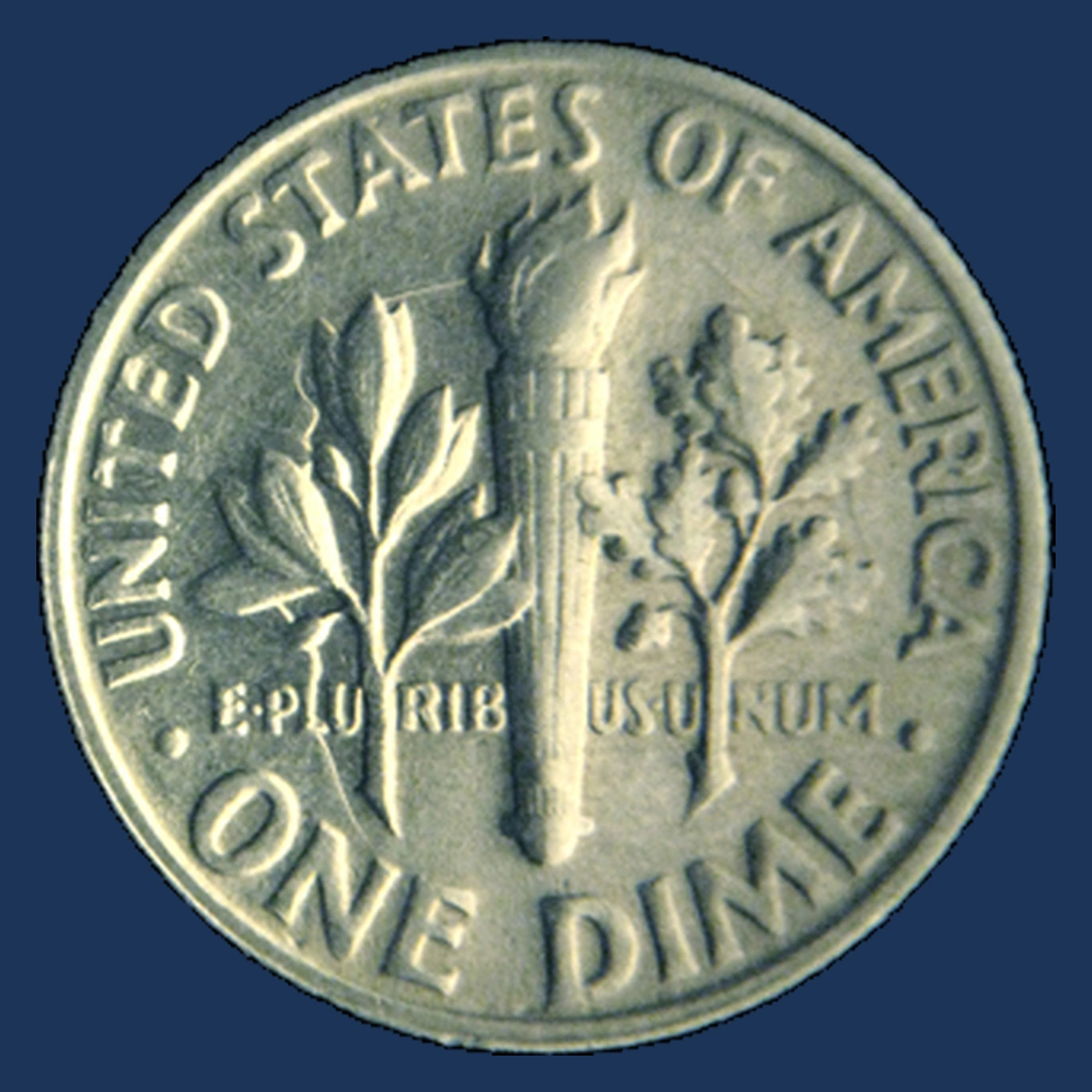
Unexpected fine outlines can appear behind the main design, almost like a faint ghost. They may come from the stamping tools striking each other with no metal disk between them.
That collision transfers parts of one design onto the opposite tool. Later coins can then show these extra marks, called a die clash.
Clashes are reported for 1968 dimes, without a specific mint or location established for every example. An unfamiliar line alone is not enough.
The outline should match something on the opposite face, rather than a random scratch.
Estimated Value
Allow an estimated $10–$150 for a genuine 1968 clash, with clear recognizable outlines bringing more than faint traces. The estimate assumes an otherwise ordinary circulation coin.
A 2001-P dime combining a clash with a mirror-image striking error sold for $79 in November 2014. That is a different year and a combined error, not a direct price for this one feature.
Heavy wear can hide the transferred design and reduce collector interest.
How to Identify
Place a normal dime beside the candidate and study both designs first. This gives you real shapes to compare with an unexpected line.
Check a loose coin with a scale and calipers against 2.268 grams and 17.91 millimeters. Its grooved edge should not show crushing from two coins being squeezed together.
Use a 10× magnifier and turn the light through several angles. Compare the extra outline with the opposite face as a mirror image.
The marks may be faint, but a random scratch does not become a clash merely because it crosses open space.
Identify the specific opposite-side design element that matches the extra outline before naming the error.
3. 1968 Roosevelt Dime Clipped Metal Disk
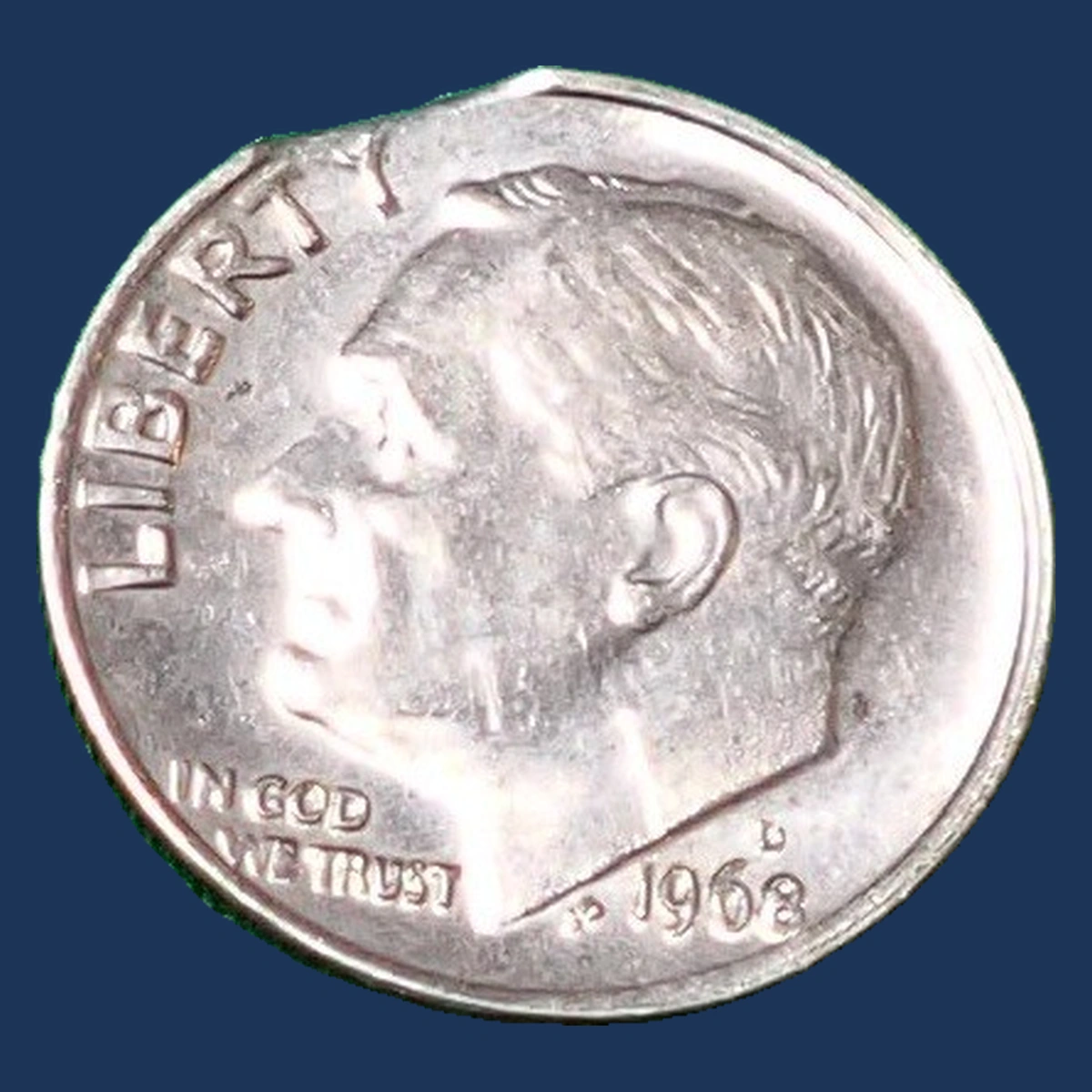
Part of the outline is missing before the design reaches the metal. A clipped blank is an incomplete metal disk cut from the sheet used to make coins.
A curved clip can result when the cutting punch overlaps an earlier hole. A straight clip can involve the edge of the metal sheet.
Both shapes appear in 1968 error reports, without a fixed mint or missing percentage attached to every coin. The important difference from damage is when the metal disappeared.
A true clip existed before the coin received its design.
Estimated Value
Estimated prices are $20–$150 for genuine curved or straight clips, depending on size, condition, and a readable date. Small clips on worn coins fall toward the lower end.
As a recent comparison, a 1997-P nickel with a 20% clip sold for $124 in March 2025. It is a larger denomination from another year, so that amount is not a 1968 dime sale.
A cut made after striking does not earn the clip premium.
How to Identify
Measure the remaining width with calipers against the normal 17.91 millimeters, then weigh the coin on a scale. A clipped disk should generally weigh less than 2.268 grams, although that alone does not prove a Mint error.
At both ends of the gap, use a 10× magnifier to look for a border that fades naturally into missing metal. A sharp cut across finished design or fresh tool marks points instead to damage after striking.
Inspect the surviving edge grooves and the rim opposite the gap, where weakness can support a clip. The most useful distinction is softly formed borders beside missing metal, rather than a fresh cut through a finished coin.
4. 1968 Roosevelt Dime Repunched Mint Mark
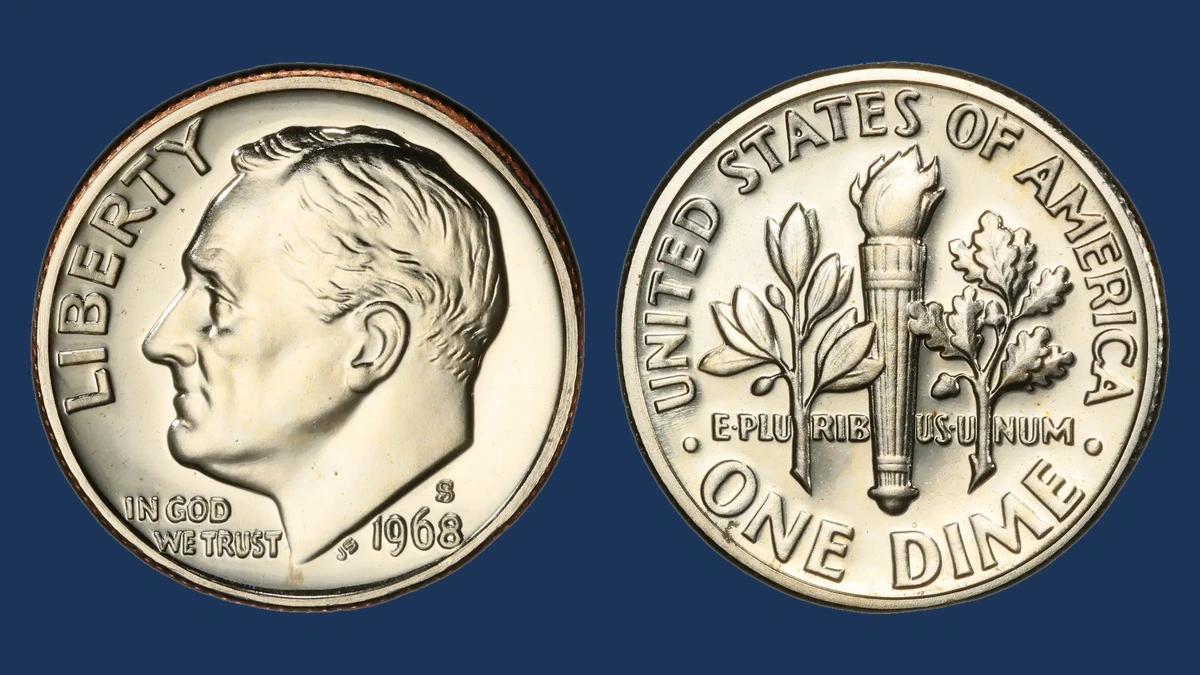
A small extra curve beside the D or S can be part of an earlier mint-mark impression. In 1968, workers could punch the letter into a stamping tool more than once.
A shift between those punches left overlapping letters on every coin made from that tool. This is a repunched mint mark.
Denver RPM-001 has an extra D toward the left. The Proof S/S variety FS-502 also has a leftward extra impression, plus related doubling elsewhere on the front.
Other listed D/D and S/S varieties must be matched separately, not assigned the same direction.
Estimated Value
Repunched marks are estimated at $10–$250, with clear, correctly identified Proof examples toward the upper portion. Faint overlapping curves usually attract less money.
The estimate separates ordinary Denver coins from San Francisco Proofs. A strong collector finish can raise the whole coin’s price in addition to the mint-mark feature.
FS-502 also has front-design doubling on the same coin. Do not add two independent prices together simply because two features are present.
How to Identify
Find the mint mark above the date before choosing a comparison photograph. A D needs a Denver example, while an S needs the proper San Francisco Proof variety.
For RPM-001 at either mint, inspect the letter’s left side through a 10× magnifier. The S/S FS-502 also shows a split at the lower end of the 9 and related thickening in the front design.
Do not transfer those markers to other catalog numbers. Flat shelves beside letters can come from movement during striking rather than another punch.
On a loose coin, a scale and calipers should give about 2.268 grams and 17.91 millimeters, with a grooved edge. Match the extra curved letter impression to the correct mint’s enlarged photograph.
5. 1968 Roosevelt Dime Disk Split After Striking
A thin piece can retain a finished coin design on one side and expose a rough split surface on the other. The metal disk separated through its thickness after striking.
A 1968-D example was graded ANACS MS60, meaning unworn but noticeably marked. The label describes the surviving piece, not a complete dime of normal weight.
This is different from a disk that split before striking, when the exposed surface could receive a fresh design. It also needs examination apart from a simple missing outer layer.
The broken interface helps explain where separation occurred.
Estimated Value
A separated 1968-D piece is estimated at $50–$250, depending on the surviving design, thickness, and condition. A readable date and mint mark help establish its identity.
For context, a 1968-D one-gram fragment struck as a dime sold for $141 in November 2013. That piece entered the press as a fragment, unlike a coin splitting afterward.
Use the comparison only as a broad guide to unusual dime pieces, not as an identical error sale.
How to Identify
Begin with the rough face rather than the date. A 10× magnifier should reveal a separation surface without a fresh, normally struck design.
Place the loose piece gently on a scale and record its weight. The normal 2.268 grams describes a whole dime, not the surviving fragment.
Turn it over to find the finished design and any readable date and D.
Calipers can compare its surviving width with 17.91 millimeters, while the thin edge may retain only part of the original grooves. Do not assume that a matching second piece still exists.
A finished outer design paired with a rough, unstruck separation face supports an after-strike split.
6. 1968 Roosevelt Dime Hinged Clamshell Layer
The front of this dime opens like a shell while remaining joined along a small part of the edge. Collectors call that a clamshell separation.
The metal layers did not bond properly. A large section lifted away without falling off completely.
A 1968-D example graded PCGS AU50 has about 90% of its front clad layer separated. Clad means bonded metal layers, here with copper-nickel outer faces over a copper center.
The percentage describes the extent of the separation, not the silver content. There is no normal silver layer to peel from this dime.
Estimated Value
An intact 1968-D clamshell is estimated at $50–$300. The attached layer, visible opening, and readable coin design make it more appealing than a damaged loose scrap.
The AU50 example appeared in Heritage’s March 31, 2025 auction. Its identity and large separation support the comparison, while the range here remains an editorial estimate.
Breaking the hinge can change the object collectors are buying. Do not force the layer open to make the error look larger.
How to Identify
Handling comes first: leave the opening untouched and keep calipers away from the fragile lifted layer. The normal dime measures 17.91 millimeters and weighs 2.268 grams, but weighing on a scale should wait if handling risks the hinge.
From the side, follow the gap around the coin with a 10× magnifier without inserting anything beneath the layer. Look for continuous metal at the connection rather than glue, a saw cut, or a flap bent from a damaged surface.
The original grooves around the edge may be divided by the opening between layers. A natural layer separation with an intact metal hinge identifies the clamshell feature without forcing it farther apart.
7. 1968 Roosevelt Dime Doubled Design
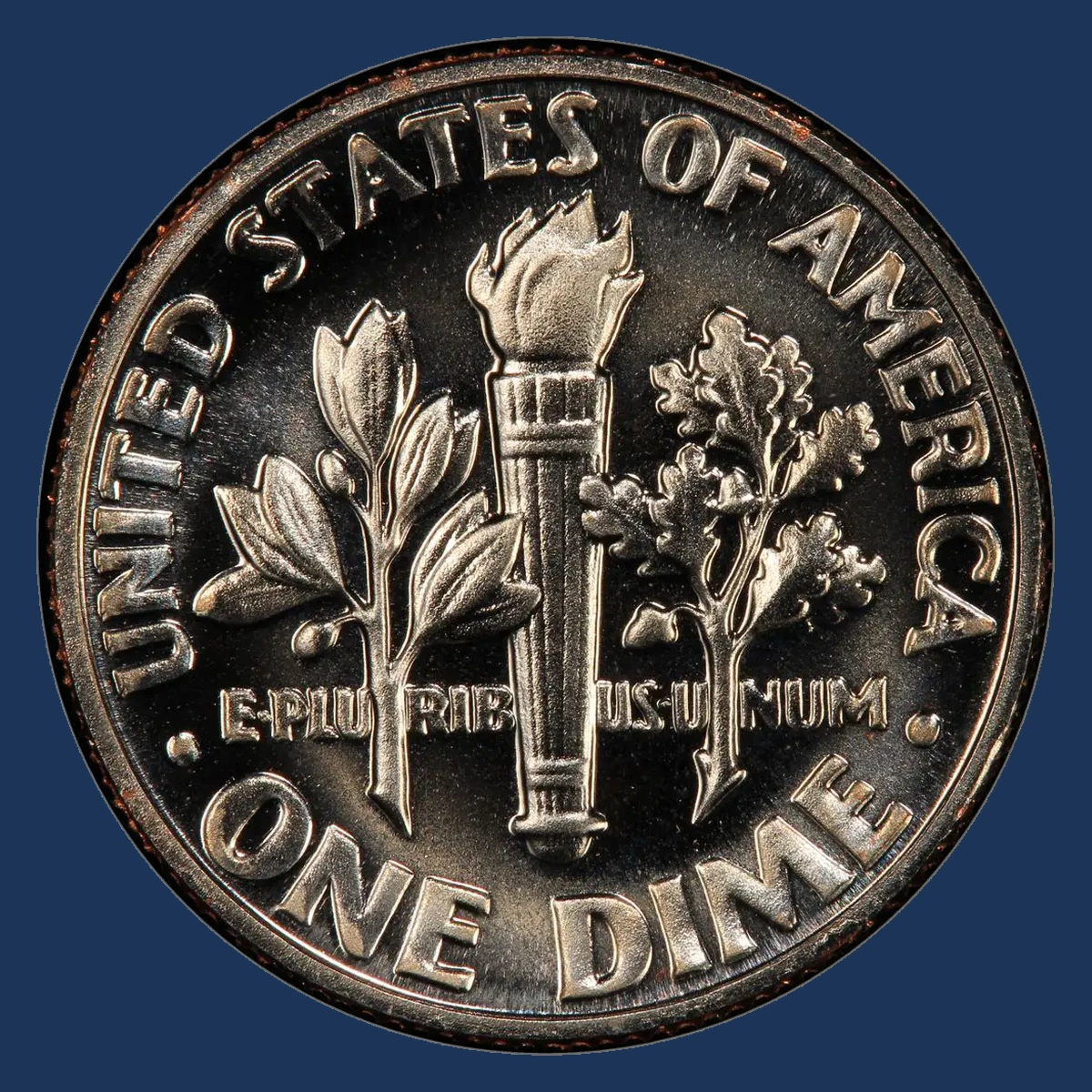
Letters may have split ends or extra rounded outlines because the stamping tool itself carried a doubled design. This is called a doubled die.
Philadelphia DDO-001 affects LIBERTY, IN GOD WE TRUST, JS, and the date. JS is the designer’s initials, not a mint mark.
Proof varieties include strong front doubling on FS-101 and back doubling on FS-801. The FS-801 back was paired with a front showing slight thickening in LIBERTY.
Other Proof numbers describe different patterns or catalog names for related coins. Denver doubling reports should not borrow Philadelphia’s exact pattern.
Estimated Value
Estimated values run from $15–$100 for minor confirmed doubling to $100–$500 for stronger, well-preserved Proof varieties. The range concerns the complete coin, including its finish and condition.
PCGS records an FS-801 dime graded PR69 at $429 in May 2018 through eBay. That is a recorded marketplace result, not a recent auction price for every doubled variety.
Soft, shelf-like doubling from movement during striking generally does not command the same premium.
How to Identify
Choose the finish and mint before comparing enlarged photographs. Philadelphia DDO-001 and Proof FS-101 have different patterns in the front lettering and date.
Weight and size cannot choose between them: a scale and calipers normally show about 2.268 grams and 17.91 millimeters, with a grooved edge.
Under a 10× magnifier, inspect the specific letters shown for the variety. Seek rounded extra detail and split tips rather than a flat shelf.
For Proof DDR-003, check UNITED and the split left stem; DDR-005 instead has thickening and small tool marks below AMERICA’s C. DDR-002 has lighter outward doubling.
Match several named details to one variety instead of combining features from different coins.
8. 1968 Roosevelt Dime Off-Center Strike
A smooth crescent beside a displaced portrait can show that the metal disk missed the center of the press. Part of the design then landed beyond the disk.
The result is an off-center strike. Both sides need examination, because a shifted design on just one face may have a different cause.
Off-center 1968 dimes appear in year-specific reports, without one fixed percentage or mint applying to all examples. A readable date is especially helpful on a large error.
The blank crescent should be original coin metal, not a section ground smooth afterward.
Estimated Value
For a genuine 1968 off-center dime, use an estimated $40–$500. Minor shifts sit lower, while a large blank crescent with the complete date can bring considerably more.
A later 1977 dime struck 10% off center sold for $109 in June 2026. That recent sale helps frame modest off-center errors but does not establish a 1968 mint or percentage.
Missing dates, harsh cleaning, and heavy wear can reduce the price even when the shift is dramatic.
How to Identify
Use a scale on a loose coin: its weight should usually stay near 2.268 grams unless another error removed metal. Calipers can record several widths against the normal 17.91 millimeters, but shape alone does not establish the cause.
Inspect both faces and the edge grooves where the restraining ring reached the disk. Displacement of both designs relative to the blank crescent supports an off-center strike, while a shift on only one face needs different examination.
With a 10× magnifier, read the actual 1968 date and check the boundary where the struck design ends. An untouched blank crescent opposite missing design is the combination to seek, rather than an area ground smooth later.
9. 1968 Roosevelt Dime Missing Outer Metal Layer
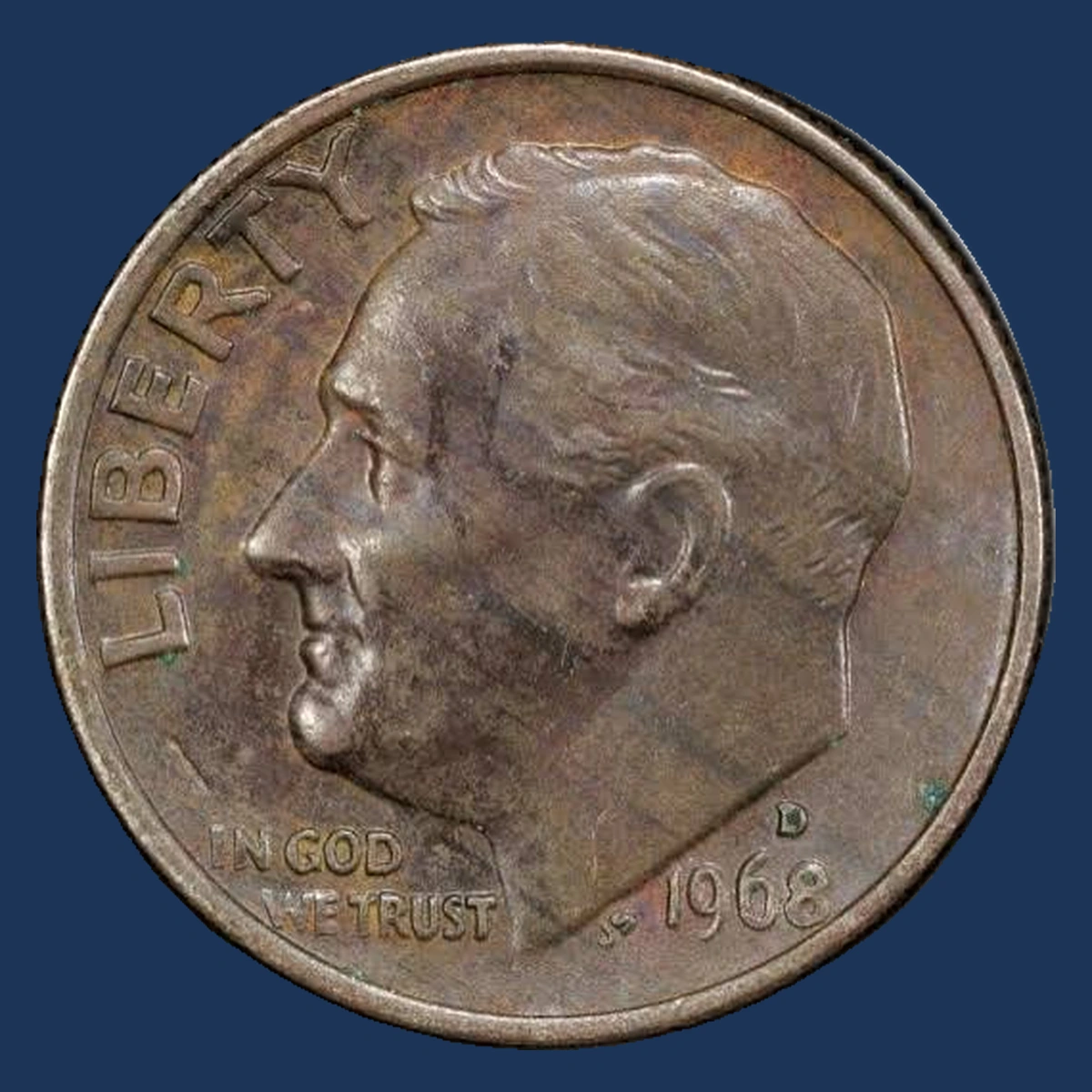
A copper-colored face opposite a normal silver-colored face can reveal a missing outer metal layer. The copper center has become the visible coin surface.
One 1968-D example graded ANACS MS62 has a red front and a bright back. Its border is somewhat weak because the disk was thinner than intended.
Another Denver coin, graded NGC MS63, is missing the back layer and weighs 1.8 grams. These are separate coins with opposite affected faces.
Dark staining or copper-colored plating can imitate the color. The exposed metal and reduced weight need to agree.
Estimated Value
Missing-layer 1968-D dimes are estimated at $50–$500, with condition and a clear exposed face affecting the result. The front-layer ANACS MS62 coin sold for $58.65 in August 2003.
For a more recent comparison, a 2018-P dime missing its front layer sold for $384 in July 2021. That later coin does not replace the individual grading and condition of a 1968 example.
A merely stained dime should not be priced as if a metal layer were absent.
How to Identify
Weigh a loose candidate before relying on its color. Compare it with the normal 2.268 grams, remembering that the recorded back-layer example weighs 1.8 grams.
Then inspect the edge with a 10× magnifier. The missing face should fit the exposed copper and the remaining bonded layer, rather than show a coating smeared over both sides.
Use calipers to check width near 17.91 millimeters. Lost thickness does not require the dime to shrink across its face.
Check the border and edge grooves for grinding or corrosive damage. Turn the coin from its copper-colored face to the intact pale face, then match that contrast with the weight and layer boundary.
10. 1968 Roosevelt Dime Design Struck on a Metal Fragment
An irregular piece of metal can receive only part of the dime design when it enters the press. A recorded 1968-D example weighs just one gram.
PCGS graded that piece AU58, meaning it shows light wear. Its identity comes from the surviving struck design and the metal fragment itself.
This is not automatically a dime cut into a strange shape after leaving the Mint. The design must have formed on the already irregular piece.
Nor does the outline identify which machine part supplied the metal. Its exact source requires separate evidence.
Estimated Value
The one-gram PCGS AU58 fragment sold for $141 on November 3, 2013, at Heritage. Similar genuine 1968 fragments are estimated at $100–$600 today.
The amount depends on how much readable design survives and how clearly the unusual piece can be identified. A stronger date can matter more than an especially jagged outline.
This is a value for the entire struck fragment. Its small metal content does not explain the collector premium.
How to Identify
Record a loose piece’s weight and widths using a scale and calipers. The auction example weighs one gram, compared with a whole dime’s 2.268 grams and 17.91-millimeter diameter.
An irregular fragment need not preserve a complete circle.
Under a 10× magnifier, trace the design toward its unusual boundary. Finished letters cut sharply by fresh tool marks suggest later alteration.
Read the surviving date and D directly, then compare their positions with the recorded example. Any surviving edge grooves should fit the struck portion rather than a newly cut edge.
Natural design flow ending at the fragment’s original outline distinguishes a struck fragment from a coin cut apart afterward.
11. 1968 Roosevelt Dime Cut from Quarter-Thickness Metal
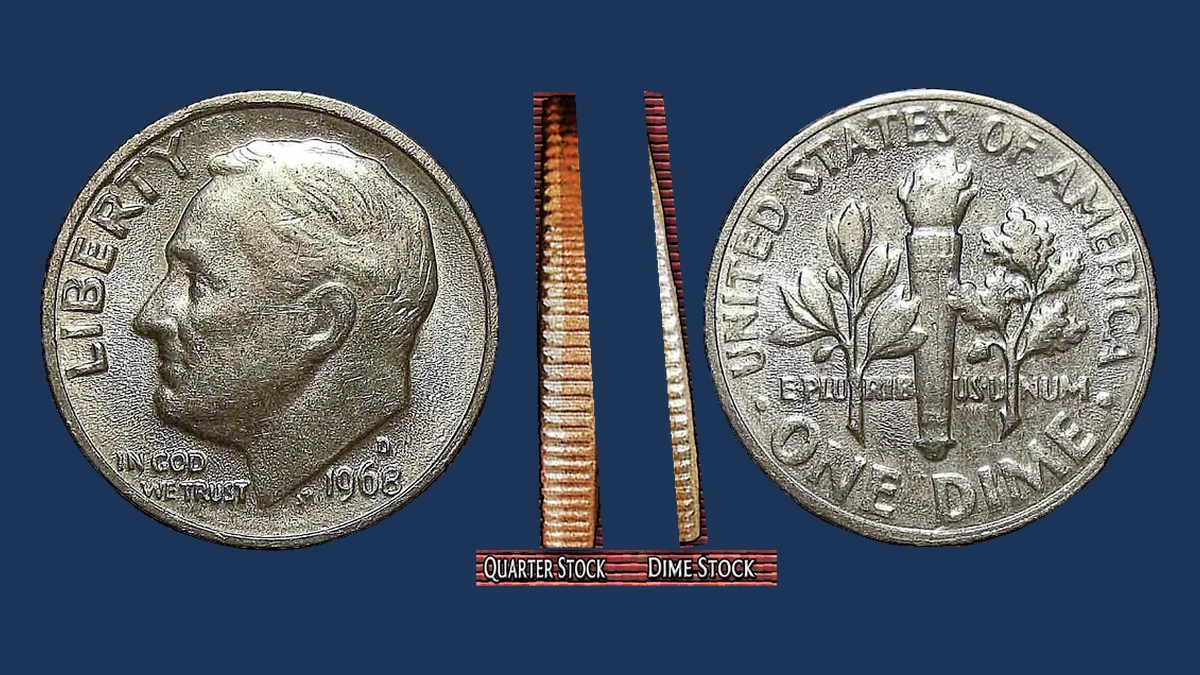
This coin keeps a dime-sized outline but contains too much metal. Its disk was cut from the thicker metal strip intended for quarters.
A recorded 1968-D example graded PCGS AU58 weighs three grams, compared with the normal dime’s 2.268 grams. The extra thickness helps explain that weight.
It was not struck on a full quarter-sized disk. Cutting a small circle from thick stock produces a different error from feeding a complete quarter blank into the press.
The date, D, edge thickness, and measured weight all belong in the comparison.
Estimated Value
A 1968-D dime made from quarter-thickness stock is estimated at $300–$1,000. A separate NGC AU55 example weighing three grams was recorded at $504 in October 2021.
That sale concerns the same kind of thick-stock error, but it is not the PCGS AU58 specimen. Better condition and convincing measurements can move a coin upward within the range.
An ordinary dime made heavier by plating should not receive this premium. The additional metal must come from the original disk.
How to Identify
Start with the scale. A three-gram dime is much heavier than the 2.268-gram standard, so first rule out an attached object or heavy added coating.
Calipers should show a dime-sized width near 17.91 millimeters while also revealing unusual thickness. A normal quarter is much wider, about 24.26 millimeters, which explains why a full quarter blank is a different claim.
Examine the D and the date with a 10× magnifier. Around the edge, look for natural grooves and bonded metal layers without plated buildup or tool marks.
Professional examination can establish the stock error. The useful first test is excess thickness and weight on a dime-sized disk.
12. 1968 Roosevelt Dime Strike on a Foreign Coin Blank
A dime design on a foreign coin blank can look unusually light, small, or different in color. The blank is the metal disk before its design is struck.
Two different Philippine blank reports concern 1968. One describes a Philadelphia dime on ten-sentimo alloy containing copper, zinc, and nickel.
Another pictures a Denver dime on an aluminum one-sentimo blank, graded NGC MS63. The aluminum piece must not be confused with the copper-based ten-sentimo report.
These errors require the metal and measurements to fit the claimed foreign blank, not merely an odd-looking dime.
Estimated Value
For confirmed foreign-blank examples, estimated values are $1,500–$5,000. The lower portion suits less dramatic pieces, while a clearly identified aluminum blank can attract stronger specialist interest.
This is an estimate, not a recorded 1968 sale for either Philippine report. Published modern dime wrong-foreign-blank price guides provide a broad comparison, with the exact metal and certification affecting the final value.
Original surfaces and enough surviving design to establish the date are particularly important on these unusual pieces.
How to Identify
Sort the two claims by metal before comparing the design. Aluminum should be distinctly light, while the reported ten-sentimo alloy is 70% copper, 18% zinc, and 12% nickel.
Use a scale and calipers to record a loose coin’s weight and width. Compare those readings with the normal dime’s 2.268 grams and 17.91 millimeters, then with the specific foreign blank standard.
Under a 10× magnifier, inspect the surviving date, mint mark, and edge. A foreign blank may lack the usual copper-centered layered edge, and its original size can limit the struck lettering.
Color alone cannot establish composition. A nondestructive metal test that matches the claimed Philippine blank is the decisive next step.
13. 1968 Roosevelt Dime Strike on an Old Silver Dime Blank
A 1968-D dime can have the old silver composition even though normal production had changed to layered copper-nickel metal. The recorded example is made from a 90% silver dime blank.
It weighs 2.5 grams and was graded NGC AU55. Its edge lacks the reddish copper center seen on ordinary 1968 dimes.
The coin carries the correct American Roosevelt design, not the design of a Canadian dime dated 1968. Silver-colored plating on a normal dime creates another easy source of confusion.
Metal testing and the date establish why this particular coin is unusual.
Estimated Value
A genuine 1968-D dime on a 90% silver blank is estimated at $3,000–$10,000. Its appeal comes from the wrong metal and date together, not simply the small amount of silver.
Heritage documented the AU55 example in May 2009. The range here is an estimate rather than a quoted result from that sale.
Wear, surface damage, and the strength of professional identification affect the complete coin’s price.
How to Identify
Inspect the edge all the way around. The silver example should not show the reddish central strip of a normal layered dime, although an edge coating can hide that strip.
Weigh a loose coin on a scale: the recorded silver piece is 2.5 grams, compared with 2.268 grams normally. Calipers should still indicate approximately 17.91 millimeters across.
Use a 10× magnifier to check the 1968 date, D, and unaltered grooves around the edge. Do not scrape the metal to reveal its color.
A normal weight or shiny surface alone settles nothing. Combine the 2.5-gram reading with a nondestructive test showing 90% silver before treating it as an old silver blank.
14. 1968 Roosevelt Dime No S Proof
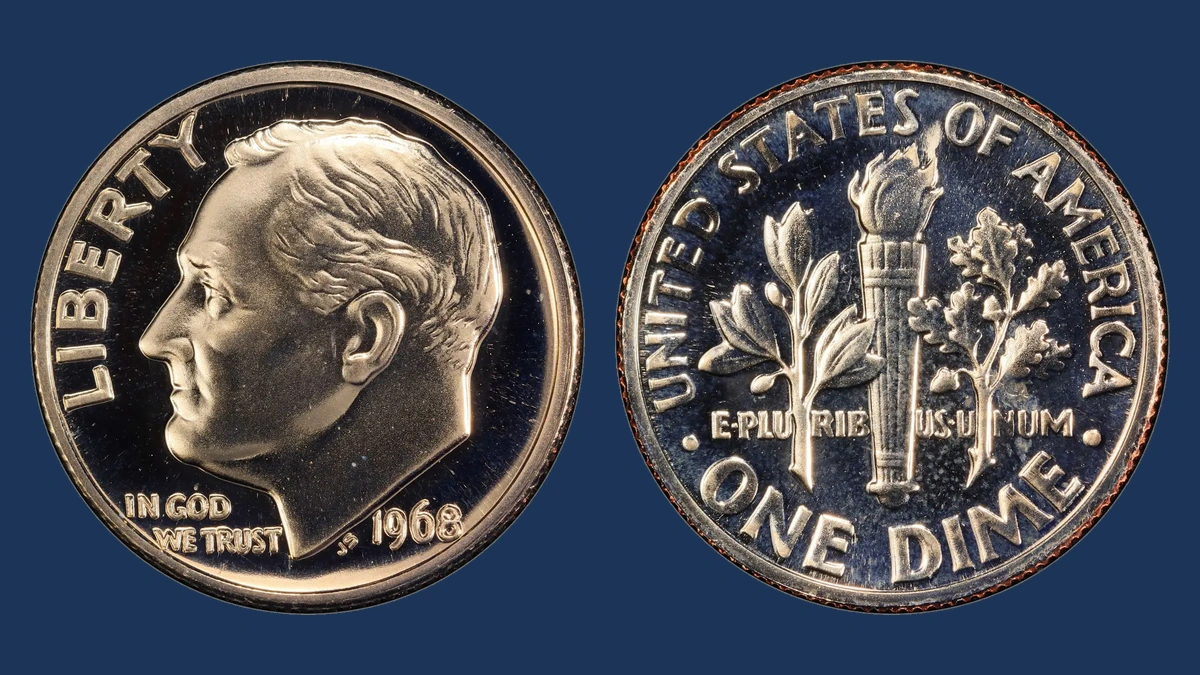
The space above the date is empty, but the coin has the special finish of a Proof made for collectors. That combination identifies the famous 1968 No S error.
San Francisco’s Proof dime should have an S. A stamping tool reached production without that letter, leaving it absent from every coin struck with the tool.
Ordinary Philadelphia dimes also have no letter, entirely by design. Their blank mint-mark position does not make them this rarity.
A shiny circulated coin is not automatically a Proof, either. Polishing can create reflections without the original collector finish.
Estimated Value
Certified No S Proofs have an estimated range of $15,000–$50,000. Exceptionally well-preserved surfaces and strong contrast between the portrait and background can lift a coin toward the upper end.
PCGS auction records include a $48,875 historical high from September 2006. More recently, an NGC PR68 example brought $19,520 in July 2026.
Those are whole-coin prices for the rare Proof. They do not apply to ordinary no-mint-mark Philadelphia dimes.
How to Identify
First establish that the coin is a Proof, using its original reflective surfaces, sharp details, and the judgment of a grading service. An original Proof set helps, but the coin still needs examination.
Only then inspect the empty area above the date through a 10× magnifier. Scratches, a hollowed surface, or disturbed texture can reveal removal of an S.
For a loose coin, compare scale and caliper readings with 2.268 grams and 17.91 millimeters. The grooved edge and layered copper-nickel construction should remain normal for this issue.
Keep it away from polish or cleaning cloths. The essential check is an authentic Proof finish together with an untouched, genuinely missing S position.
Conclusion
For 1968 dimes, the missing S matters only after the coin is identified as a Proof. Ordinary Philadelphia coins without a letter are normal.
The errors here have estimated values of $5–$50,000, from small raised cracks to exceptional No S Proofs. Check the metal, edge, and specific design details before comparing prices.
Keep loose layers intact, and let a grading service examine valuable wrong-metal or No S candidates.