1879 Nickel Error List with Pictures

The date deserves a close look on an 1879 Shield Nickel. Small extra strokes can show either repeated date punching or the older 8 beneath a 9.
An exceptional 1879/8 Proof sold for $84,000 in January 2019. This 1879 Nickel error list covers estimated values from $300 to $84,000, including that unusually well-preserved coin.
Both date varieties below concern Proofs, coins specially made for collectors. Read on to see which extra lines matter and how condition changes their prices.
1879 Shield Nickel Repunched Date
Tiny repeated strokes appear to the left of the 1, 8, and 9 on this Proof variety. They come from an earlier placement of the date in the steel tool that stamped the coins.
This is called a repunched date. The same numerals were punched again, with a small shift between impressions.
Some examples also show strong mechanical doubling, a flat extra edge caused by movement during striking. That flat shelf is a separate effect.
The rounded date remnants matter here; a wide, flat edge alone does not establish the repunched date.
Estimated Value
Allow an estimated $300–$3,500 for an identified repunched-date Proof, depending on surface quality. This prices the complete coin, not an added charge for each repeated digit.
As a condition comparison, a normal-date 1879 Proof graded PR67+ brought $3,055 in May 2021. That sale does not establish a separate repunched-date premium.
PR67+ describes exceptionally clean Proof surfaces. Scratches or cleaning can put a coin far below that level.
How to Identify
Flat doubling can look stronger than the actual date variety. Under a 10× magnifier, separate the flat ledges from small, rounded strokes beside the numerals.
The Shield Nickel variety listing places the repeated traces left of the 1, 8, and 9. Compare those three digits together instead of choosing the largest extra edge.
A loose coin should be near 5 g on a scale and 20.5 mm across with calipers. Check its plain edge for filing, and leave a certified coin inside its holder.
Proof identity requires more than shine; polishing can make an ordinary coin reflective. For this date variety, look specifically for rounded earlier strokes left of all three listed numerals.
1879 Shield Nickel 1879/8 Overdate
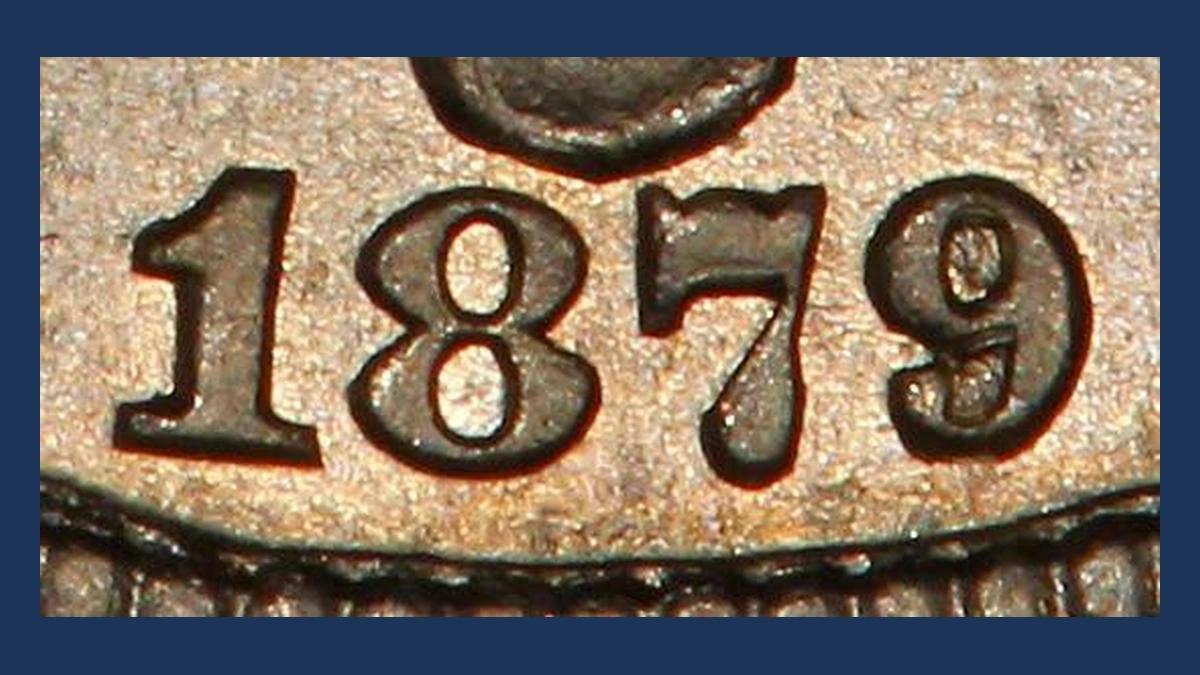
A small curved remnant inside the lower part of the 9 is the important clue to this overdate. It belongs to an earlier 8, rather than another impression of the same 9.
An overdate forms when a new numeral replaces an older one in the stamping tool. Part of the older shape remains and transfers to the coin.
The recognized 1879/8 variety is a Proof issue. It should not be confused with the separate repeated-date strokes beside several digits, or with dirt lodged inside the 9.
Estimated Value
PCGS records an $84,000 Heritage sale in January 2019 for a nearly flawless PR69 example. A PR68 brought $8,640 in December 2022.
Use $400–$10,000 as a broad estimate for lower through excellent grades, extending to $84,000 for the exceptional recorded coin.
These are whole-coin values. The enormous difference between those two sales shows how strongly preservation can affect the price of the same overdate.
How to Identify
First establish that the coin is a Proof Shield Nickel, not merely a polished circulation piece. Check the holder description and compare the full front and back with an identified example.
If loose, weigh it on a scale and measure it with calipers: the normal standards are 5 g and 20.5 mm. The edge should be plain.
Now examine the final 9 through a 10× magnifier. Follow the inner lower curve, changing the light to separate raised metal from dirt or a scratched groove.
Do not scrape the opening clean. The date and surrounding surface should remain untouched.
A remnant shaped like an 8 inside the lower 9, matching an identified Proof photograph, is the key check.
Conclusion
An extra stroke beside a date digit and an older numeral beneath it tell different stories. On these 1879 Proofs, separate rounded date remnants from the flat edges left by movement during striking.
Estimated whole-coin values run from $300 to $84,000, with the upper figure tied to an exceptional auction coin. Preserve the surfaces and compare the complete date before treating a tiny mark as a valuable variety.