2004 Nickel Error List with Pictures

A 2004-P Peace Medal nickel with doubled front detail sold for $185 in April 2021. The handshake on its back distinguishes it from the other 2004 design, which shows a boat.
Both have Jefferson’s older, left-facing portrait. This 2004 nickel error list covers estimated values of $10–$2,000, from weak details to designs struck on the wrong blank.
Check the back before comparing an example, then follow the visible clues below to identify what changed.
1. 2004 Jefferson Nickel Weak Keelboat Strike
A weak strike can leave both faces with shallow, poorly formed detail. The portrait, boat, lettering, and rim may all look less complete than on a normal nickel.
The reported 2004-D Keelboat example is described as a die-adjustment strike. That name suggests a press setup process, but the coin’s weak appearance does not prove why the pressure was low.
The visible feature is therefore the shallow strike itself. It should be separated from wear that flattened a once-complete design.
A blocked patch is different again: material between a tool and blank can interrupt only part of an otherwise stronger strike.
Estimated Value
Estimate $25–$150 for a genuine 2004-D Keelboat nickel with a clearly abnormal weak strike. A broad, consistent effect is more persuasive than slightly soft detail.
This is an estimate for the reported type, not a verified sale of the listed specimen. Calling a coin a setup strike does not add a guaranteed premium.
Remaining surface quality matters because circulation wear can imitate weakness. Buyers need to see that the design was never fully formed rather than simply worn down.
How to Identify
Compare several high and low points on both faces with a normal D Keelboat nickel. A weak strike should explain the shallow design beyond one isolated letter or small patch.
Look with a 10× magnifier for remaining original surface texture where detail failed to form. Wear instead smooths exposed high points and may leave contact damage nearby.
For a loose example, use a scale and calipers to compare the normal 5.00 grams and 21.21 millimeters. Inspect the plain edge for later flattening.
Photograph the portrait, boat, and rim together so the overall weakness can be judged. Record what the coin shows without assigning a specific Mint testing purpose from shallow detail alone.
2. 2004 Jefferson Nickel Blocked Design or Struck-Through Depression
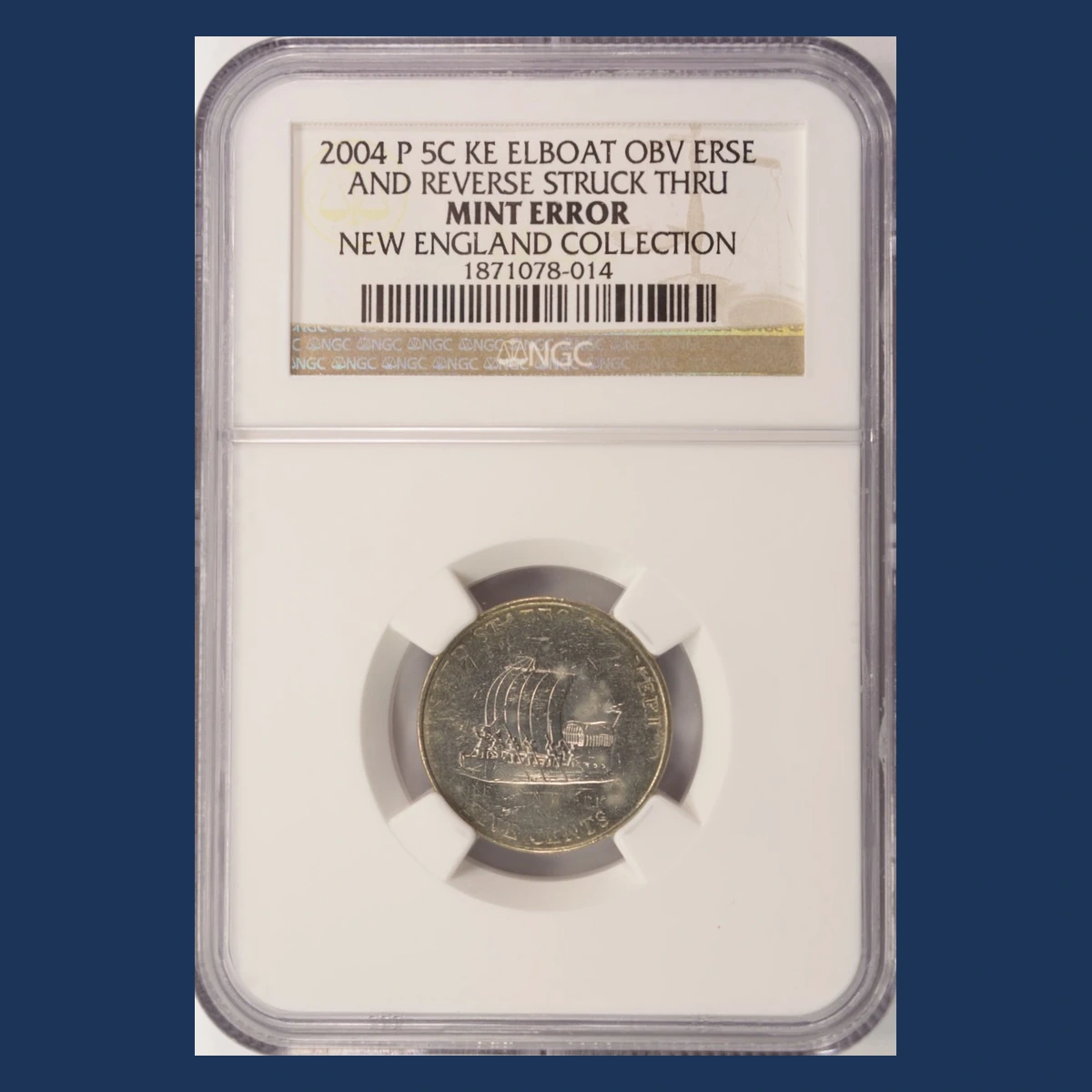
Part of a handshake, boat, portrait, or letter can fail to form when something lies between the blank and a stamping tool. Collectors call this a struck-through error.
The affected area may be weak, missing, or depressed. A firm object can leave a clearer outline than soft grease or loose debris.
The type is reported for 2004, including a collector Proof example, made with specially prepared surfaces. The exact material and back design must come from the individual coin.
Thread or cloth can explain some striking errors, but these examples do not identify the object on every 2004 nickel.
Estimated Value
For genuine 2004 struck-through errors, estimate $10–$250. Small weak patches tend to fall below strong, clearly shaped interruptions on attractive surfaces.
A 2000-D nickel struck beneath a coin stuck to a tool sold for $84 in September 2025. It is a different obstruction and year, offering a general blocked-strike comparison.
A Proof coin should be compared with other Proofs of similar condition. The reported category does not establish that a particular 2004 object remained embedded in the nickel.
How to Identify
Keep any attached material untouched while you inspect the surrounding design. Removing it could destroy the clue that explains the depression.
Use a 10× magnifier to trace the boundary from normal detail into the weak area. Look for scrape lines or displaced metal that could show later removal of the design.
Identify the back and finish before choosing a comparison. A mirror-like Proof surface is different from an ordinary circulation coin, and lighting can exaggerate small interruptions on it.
For a loose nickel, compare 5.00 grams and 21.21 millimeters using a scale and calipers, then check the plain edge for pressure damage. Let the visible shape guide identification rather than naming the obstruction as wire, cloth, or grease without evidence.
3. 2004 Jefferson Nickel Improper Annealing on Both Back Designs
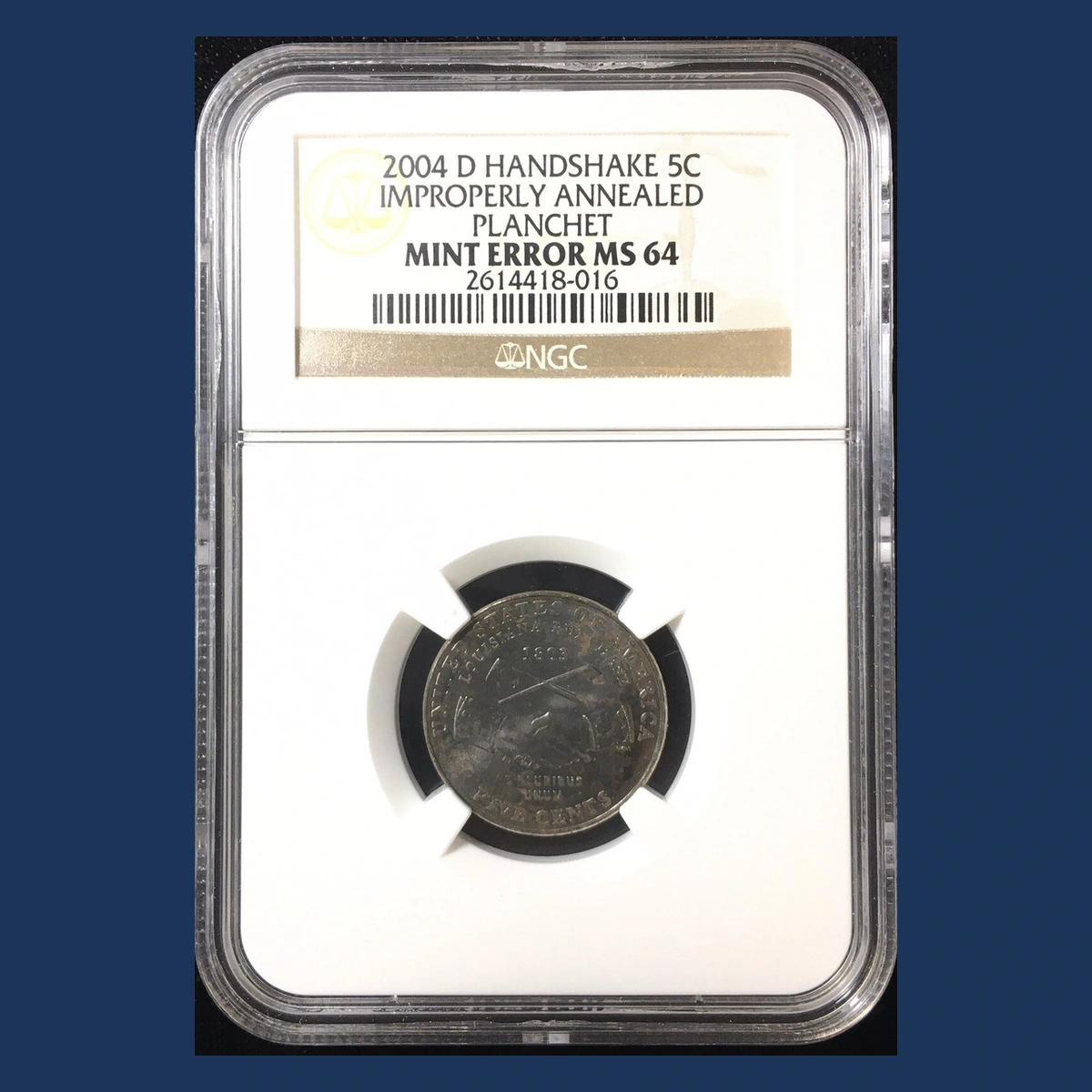
Certified 2004 examples show abnormal heating surfaces on both back designs. Annealing is the step used to soften metal blanks before striking.
A Denver Peace Medal coin and a Philadelphia Keelboat coin appear in auction records with this description. The change concerns the metal’s surface, not a missing outer nickel coating.
A Denver Keelboat example was also described as improperly annealed, with separate damage to its front. That damage is not part of the heating error.
Color provides a reason to inspect the coin, but later chemicals or heat can imitate it. The nickel’s normal copper-nickel alloy is uniform throughout.
Estimated Value
The D Peace Medal example brought $57 in December 2020, graded PCGS MS64. A P Keelboat graded MS65 also brought $57 in April 2022; both were unworn.
Estimate $30–$250 across attractive 2004 annealing errors. The stronger end needs more than unusual color.
The damaged D Keelboat appeared in a two-coin lot, so that lot’s price does not supply a separate value for it. Surface damage can reduce demand even when the heating error is genuine.
How to Identify
First separate the Peace Medal and Keelboat examples by turning the coin over. Check P or D beside the date before comparing a certification or auction photograph.
For a loose nickel, record weight and diameter against 5.00 grams and 21.21 millimeters using a scale and calipers. All these ordinary 2004 designs share the same basic alloy.
Examine both faces and the plain edge with a 10× magnifier under neutral light. Pitting, residue, or scratches may belong to later damage rather than abnormal blank heating.
Do not rub the surface to test the color. A proper assessment must separate the original striking surface from later exposure, just as the damaged D Keelboat’s front problem remains separate from its annealing description.
4. 2004 Jefferson Nickel Straight Clipped Peace Medal Blank
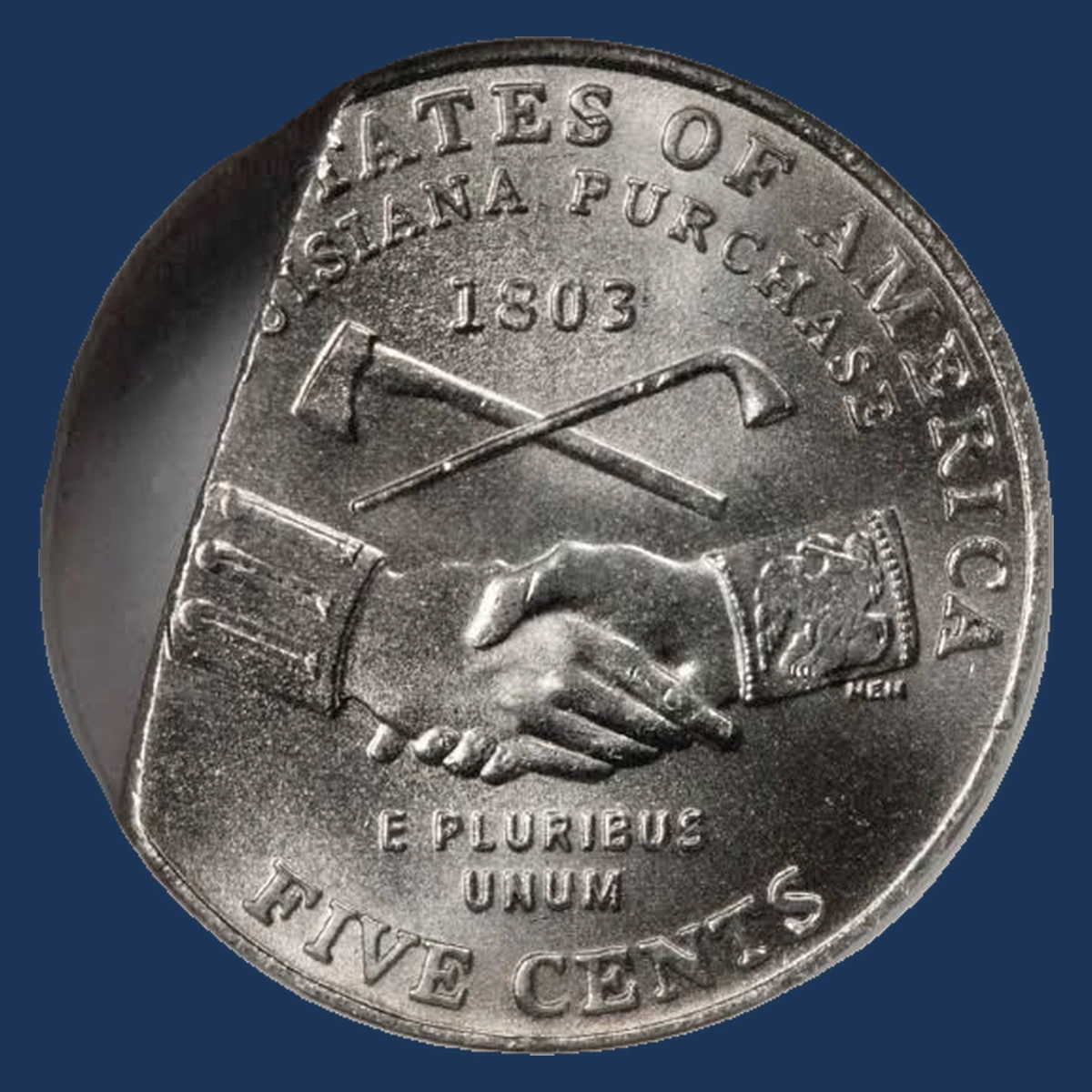
A straight missing section interrupts the edge of one 2004-P Peace Medal nickel. Heritage described it as a 6% clip extending from eight to ten o’clock.
The gap began in an incompletely cut metal disk. A straight clip can follow the edge of that strip rather than an earlier round hole.
PCGS graded the recorded coin MS65, an attractive unworn example. A separate Peace Medal nickel reported by Mint Error News has a 16% straight clip and NGC MS66 grade.
The two percentages describe different coins. Their mint letters and missing sections should not be combined into one example.
Estimated Value
The 6% P Peace Medal clip sold for $92 in February 2005. Its clear straight boundary and unworn surfaces provide a specific same-year reference.
For genuine 2004 straight clips, estimate $25–$300, depending on size, condition, and the remaining design. A larger missing section can be more noticeable but does not automatically multiply the earlier price.
The separate 16% example has no sale amount assigned here. Its grade and clip size identify a comparison, not a second quoted transaction.
How to Identify
With Jefferson upright, locate the recorded P coin’s straight gap between eight and ten o’clock. A 10× magnifier helps show how the struck surface meets each end of the opening.
Examine the plain edge along the gap for sawing or file marks. A fresh cut made after minting can also remove a neat straight section.
A loose clipped coin normally weighs less than 5.00 grams. Use a scale and measure the intact outline against 21.21 millimeters with calipers, avoiding any pressure on a fragile edge.
Compare the opposite rim for supporting weakness and retain a photograph of the Peace Medal back. Do not assume the larger 16% coin has the same mint letter or exact gap position as the 6% example.
5. 2004 Jefferson Nickel Doubled Peace Medal Front and Reported Keelboat Back
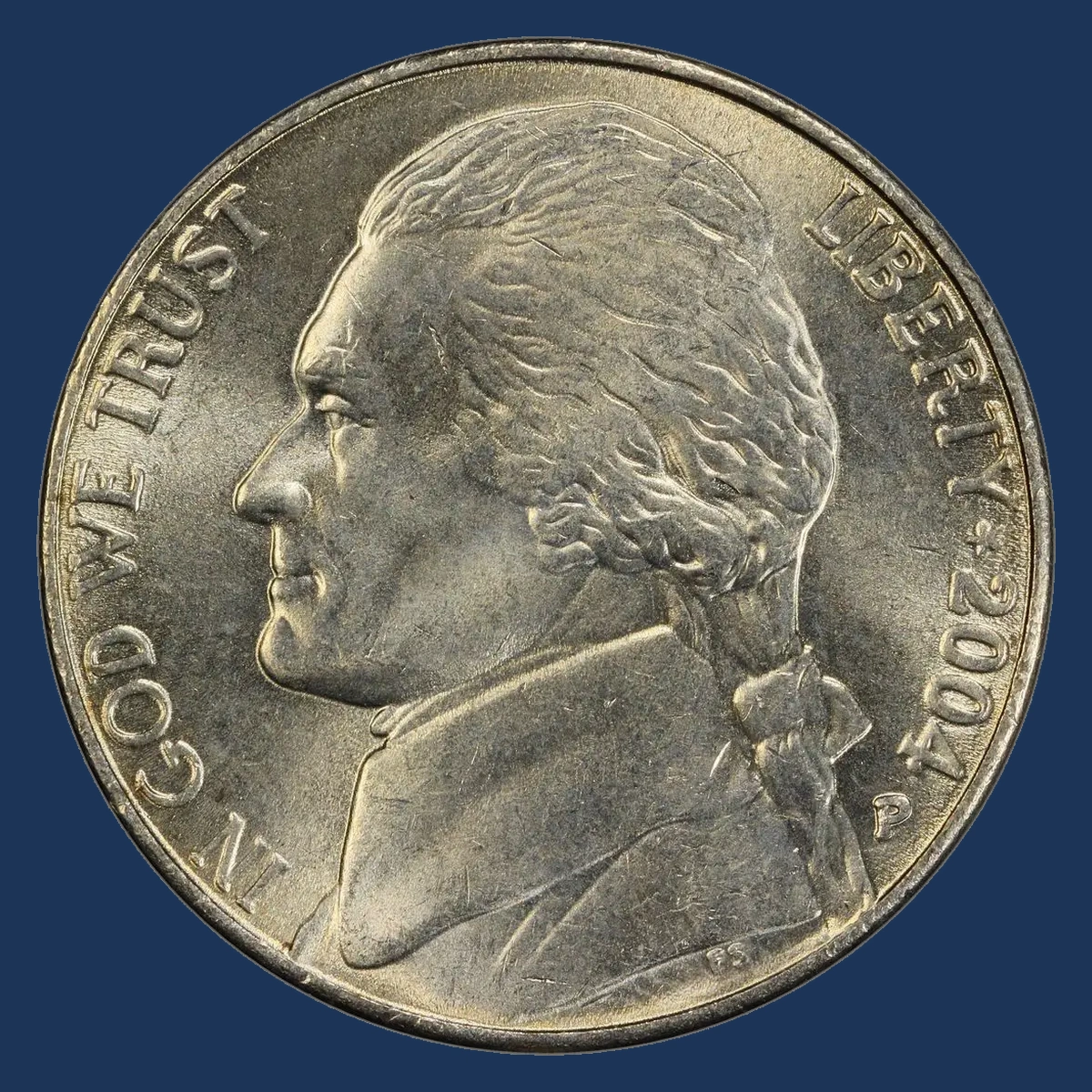
Extra outlines on the date and lettering identify a listed 2004-P Peace Medal front variety. The design was doubled while the die, the steel stamping tool, was made.
That tool repeated the added detail on coins it struck. The error is not caused by each finished nickel receiving extra blows.
The familiar catalog name FS-101 identifies this front variety. A separate Keelboat back-doubling report concerns the boat design rather than the same front diagnostics.
These are different coins sharing a tool-design mechanism. The 2004 portrait faces left; photographs of the later forward-facing portrait cannot identify this year’s front variety.
Estimated Value
PCGS records $185 in April 2021 for a P Peace Medal FS-101 coin graded MS65. That eBay sale concerns an unworn example of the identified front variety.
Estimate $25–$300 for matched Peace Medal front doubling across grades, and $10–$100 for a confirmed Keelboat back-doubling example. The latter range is an estimate for the reported type.
Do not transfer the Peace Medal price to an unmatched boat detail. Both the design and the particular extra shape matter.
How to Identify
Check which back is present before choosing the feature to compare. On the P Peace Medal variety, use a 10× magnifier on 2004, LIBERTY, and IN GOD WE TRUST.
Compare the added contours with the identified FS-101 variety. A flat shelf caused during striking should not be mistaken for the tool-made addition.
The Keelboat report requires a separate match to the boat; it does not gain a diagnosis from doubled front lettering. For a loose nickel, compare 5.00 grams and 21.21 millimeters using a scale and calipers and inspect the plain edge.
Keep the full back visible in any identification photograph. The wrong design can make an otherwise sharp close-up irrelevant to the claimed variety.
6. 2004 Jefferson Nickel Rim-Connected Tool Break
A raised, partly featureless patch against the rim can come from a broken stamping tool. Metal flowed into the space where a piece of steel had broken away.
The resulting edge-connected patch is called a cud. It can cover design that the missing steel could no longer form.
The type is reported for 2004 nickels without a mint or back design assigned here. The coin itself must supply those details.
A small bump entirely inside the design is not automatically a cud. A rim dent can also push metal above the face, but it leaves a different history of deformation.
Estimated Value
For a genuine 2004 rim-connected cud, estimate $50–$350. A substantial, clean patch covering visible design generally has more appeal than a tiny indistinct edge lump.
The range is an estimate for the reported type. It does not represent a sale assigned to an unspecified Peace Medal or Keelboat specimen.
Check condition as carefully as size: battered rims and corrosion can hide the boundary. A broad dent or attached lump does not receive the premium of a genuine broken-tool effect.
How to Identify
Trace the raised patch to the rim before judging its size. At 10× magnification, check whether intended design is missing beneath the area where steel no longer shaped the coin.
Look along the plain edge at that point. A later blow can leave a dent and push metal inward, producing an apparent raised patch on the face.
For a loose example, record its weight and width with a scale and calipers against 5.00 grams and 21.21 millimeters. Then inspect the boundary for attached material or evidence of a repair.
Matching color alone proves little. Photograph the edge connection together with nearby intact design so the raised area can be distinguished from a displaced rim or a blob added later.
7. 2004 Jefferson Nickel Off-Center Strike
A displaced blank can leave part of the nickel design outside the metal disk. The opposite portion remains unstruck, making a crescent beside the surviving design.
A 2004-P Keelboat example is reported as thirty percent off-center. That is the source’s description rather than a measurement for all coins of this type.
The two faces should show effects consistent with the same displaced blank. An uneven border on one face alone can result from tool misalignment.
The empty crescent still contains metal. It should not be confused with a clip, where part of the original disk is physically missing.
Estimated Value
Estimate $30–$500 for genuine 2004 off-center nickels, with larger clear shifts and a readable date supporting stronger prices. The design type should remain identifiable.
A 1999-P nickel described as 15% off-center sold for $64 in March 2025. That is a different-year, smaller-shift comparison, not the price of the reported thirty-percent Keelboat.
The actual condition and remaining detail matter more than a percentage alone. A dramatic error with a lost date can be harder to place than a smaller complete-year example.
How to Identify
Find the surviving boat details and the date first. Keep those features connected in the same photograph rather than identifying the design from a separate normal coin.
Compare both faces against the same physical edge. At 10× magnification, check that the empty area has original unstruck texture instead of flattened letters or scraped metal.
For a loose example, weigh it against 5.00 grams on a scale and compare the outline with 21.21 millimeters using calipers. Some spreading can accompany the strike.
Inspect the plain edge for trimming and count only the design that truly missed the blank. A wide border produced by one shifted tool does not establish the same off-center relationship on both faces.
8. 2004 Jefferson Nickel Broadstrike and Stepped Collar Edge
A broadstrike lets the nickel spread outward while keeping the complete intended design. The collar, a surrounding metal ring, failed to contain the blank normally.
The 2004-P Peace Medal report also uses the name railroad rim for a stepped edge. That step usually describes partial collar support, where one portion is constrained and another expands.
These terms should be distinguished by the actual coin’s shape. An expanded outline and an edge step do not automatically prove one combined event.
The ordinary nickel already has a plain edge. The relevant clues are size and sidewall shape, not whether grooves are absent.
Estimated Value
Use an estimated $40–$600 for genuine 2004 collar-related errors, from modest expansion to a strong, clearly explained effect. The actual broadstrike or partial-collar shape determines the comparison.
A 1999-P broadstruck nickel graded PCGS MS63 sold for $89 in March 2025. It was an unworn coin with noticeable marks and a different design from the Peace Medal.
That sale does not establish a railroad edge on the 2004 report. A line on the side alone does not earn the estimated range.
How to Identify
Record the face and side of the nickel separately. A broadstrike is judged from complete designs within an expanded outline; a partial collar is judged from the actual sidewall step.
For a loose example, use calipers against 21.21 millimeters and a scale against 5.00 grams. Examine the normally plain edge at 10× magnification.
Look for a level change rather than merely a scratch running around the side. Later grinding or compression can create lines without the original striking relationship.
Check whether all intended design remains visible on both faces before calling it broadstruck. Describe only the features present, rather than forcing an oversized coin and a stepped edge into one explanation without seeing both.
9. 2004 Jefferson Nickel Backward Sunken Design
A brockage has a sunken, backward copy of a coin design. Another already struck coin pressed its raised design into the fresh blank during minting.
The opposite face may receive its normal image directly from a steel tool. The transferred design can cover part of a face rather than the entire surface.
A 2004-D example is reported in this category. The surviving design must establish whether the piece belongs to the Peace Medal or Keelboat issue.
The mechanism does not require each coin to come from a coin stuck around the upper tool. The visible transfer starts the identification.
Estimated Value
For an authenticated 2004-D brockage, estimate $100–$1,000. Large, clear reversed designs generally attract more interest than small or badly distorted impressions.
An undated Jefferson nickel with a 30% brockage from an off-center strike sold for $336 in June 2024. Its missing year means it is a general comparison, not a 2004 transaction.
The size of the transfer and the coin’s surfaces both affect the price. A later squeeze between two coins does not qualify for the same error valuation.
How to Identify
Reverse a photograph horizontally to see whether backward lettering becomes readable. A true transferred design should correspond to a real part of the coin that supplied the impression.
Use side light and a 10× magnifier to confirm that the copied image is pressed into the surface. Raised doubled outlines point toward another mechanism.
Inspect both faces and the plain edge for compression damage from coins squeezed together after minting. For a loose piece, a scale and calipers provide comparisons with the ordinary 5.00 grams and 21.21 millimeters.
Distortion can change the outline, so normal dimensions are not an absolute requirement. Keep enough of the original design in view to identify the back type, and seek authentication of the transferred image before assigning the estimate.
10. 2004 Jefferson Nickel Struck on a Cent Blank
A nickel design on a cent blank can be copper-colored and incomplete around the outside. The smaller blank was intended for a one-cent coin rather than a five-cent piece.
The type is reported for 2004 nickels, without a specific mint or back design assigned here. The actual coin must establish those details.
A modern cent blank normally weighs about 2.50 grams and has a copper coating over zinc. That differs from the five-gram solid copper-nickel blank intended for a nickel.
Striking can spread the smaller blank. Its finished width need not remain exactly the diameter of an ordinary cent.
Estimated Value
For an authenticated 2004 nickel on a cent blank, estimate $250–$2,000. A readable date, clear back design, and attractive surfaces support the stronger end.
A 1981-P nickel on a cent blank sold for $372 in September 2025. That older blank used the heavier copper-rich cent alloy, unlike the modern copper-coated zinc blank described here.
The sale is a related wrong-blank comparison. Copper color by itself does not make an altered or plated 2004 nickel worth this range.
How to Identify
Weigh the loose coin first: compare the normal nickel’s 5.00 grams with about 2.50 grams for a modern cent blank. A low weight is a clue, not a complete identification.
Use calipers to record the diameter against the nickel standard of 21.21 millimeters. Do not reject a candidate solely because striking spread it beyond a cent’s usual size.
With a 10× magnifier, inspect the cropped outer design and plain edge for filing, deliberate thinning, or added plating. Check that the surviving portrait and back actually belong to 2004.
Have the metal examined without scratching or cutting the coin. The weight, composition, and striking pattern must agree before a copper-colored piece is identified as a nickel on the wrong blank.
Conclusion
These estimated values run from $10–$2,000, across weak strikes, changed outlines, doubled designs, and wrong blanks. Matching the Peace Medal or Keelboat back comes before comparing a price.
The $57 annealing results, $92 straight clip, and $185 doubled-design record describe different 2004 coins. None sets a universal price for the whole year.
Keep the date, mint letter, both faces, and edge in your photographs, especially when one feature overlaps another.