1838 Cent Error List with Pictures

A cracked stamping tool left bold raised marks on an 1838 cent that sold for $1,762.50 in September 2016. Its smooth brown copper and unworn detail mattered alongside those unusual marks.
This 1838 penny error list covers estimated values of $25–$5,000. Some features require a magnifier; others become clear when you turn the coin over or follow a depression near its edge.
Use the examples below to decide what to examine first, before attaching a price to your find.
1. 1838 Coronet Head Cent Missing Detail from a Blocked Tool
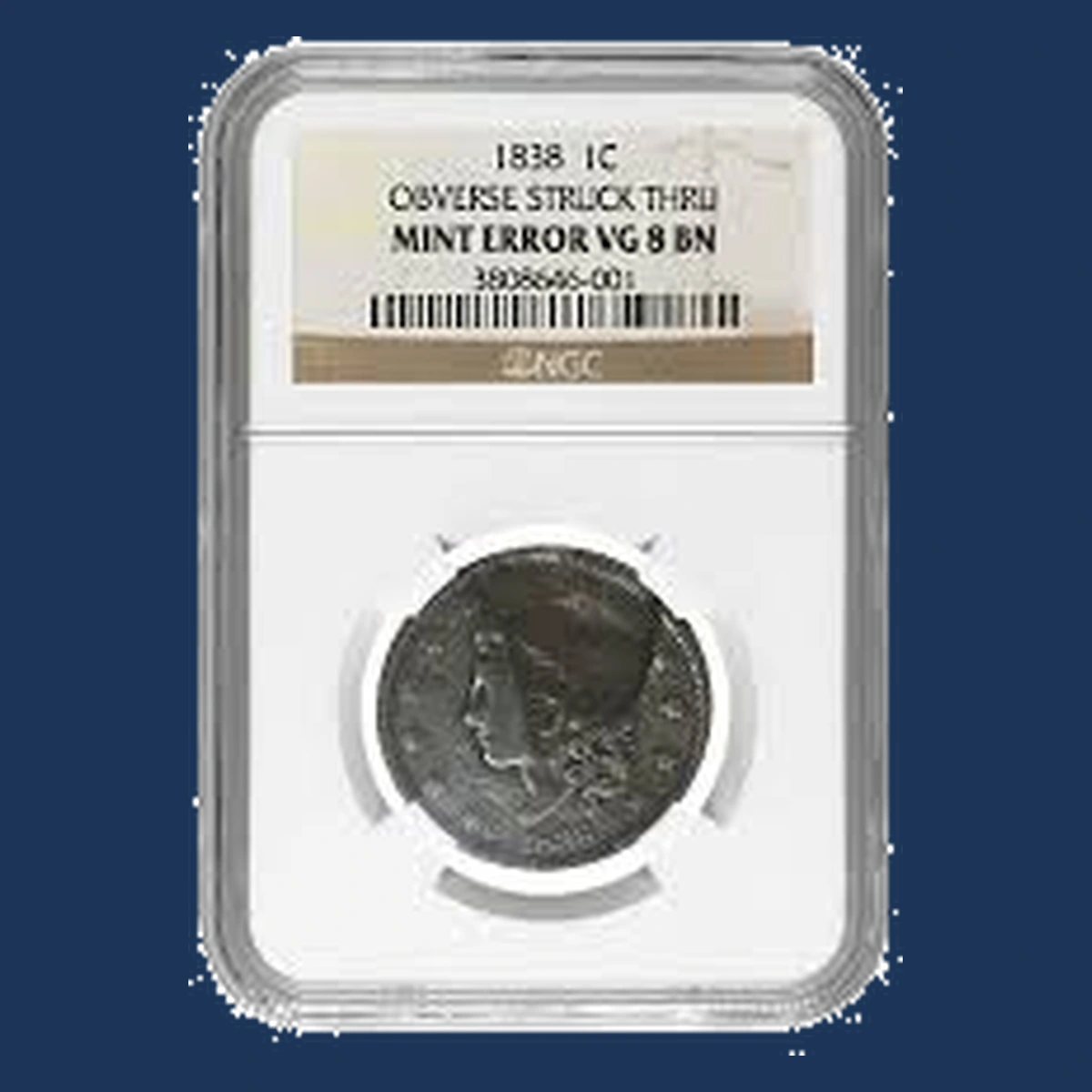
An area of missing detail can begin inside a stamping tool rather than on a finished coin. Material filling a recessed part of the tool stops copper from entering that space.
The coin then receives less detail in the blocked area. Collectors call this a filled-die error; a die is the steel tool that stamps the design.
The year guide describes an 1838 example graded Good 6, a heavily worn coin. It does not identify a particular missing letter.
Wear makes the distinction harder to see. Nearby preserved detail is essential when judging whether something blocked the original strike.
Estimated Value
For a genuine local blockage on a worn 1838 cent, estimate $25–$150. A stronger, clearly explained missing area on a better-preserved coin can fit an estimated $150–$600 range.
These are whole-coin estimates, not a recorded price for the guide’s Good 6 example. Heavy wear can leave little visible evidence of the original blockage.
A coin needs more than faint lettering to earn an error premium. The affected patch should differ meaningfully from ordinary wear elsewhere.
How to Identify
Compare the weak area with exposed parts of the portrait and lettering. If all high points are equally smooth, circulation wear may explain the appearance without any blockage.
Use a 10× magnifier across the boundary between weak and sharp detail. Look for a local interruption rather than scraped copper, polishing lines, or widespread corrosion.
The plain edge can reveal squeezing or other later damage. For a loose coin, a scale and calipers provide comparisons with 10.89 grams and roughly 28 millimeters.
Keep a full photograph beside the enlargement so the amount of overall wear remains visible. Avoid naming grease or another material from the missing detail alone; the shape may show a blocked strike without identifying what caused it.
2. 1838 Coronet Head Cent Peeling within the Copper
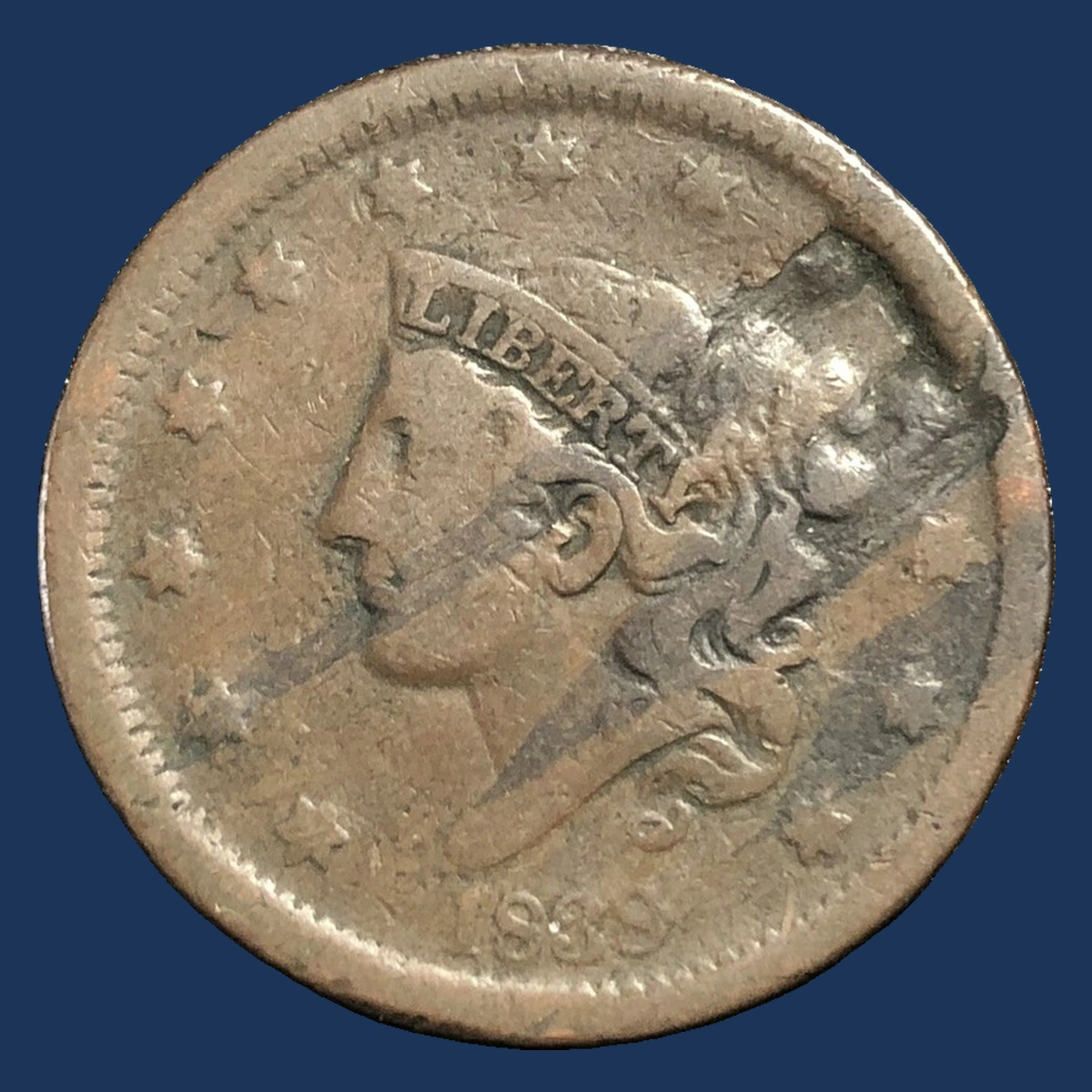
A thin flap of copper can lift away from an otherwise solid-looking cent. The metal separated within the blank, the disk that was struck to make the coin.
Collectors call this lamination. It can leave attached metal, a shallow opening, or an uneven boundary where a piece has fallen away.
An 1838 seller listing describes a mint-made lamination without locating it on the portrait or wreath. Each candidate therefore needs its own surface check.
A drilled hole is a different feature. Roughness from corrosion or a scrape also needs to be distinguished from a layer splitting inside the copper.
Estimated Value
Estimated values for genuine 1838 laminations are $40–$300 on worn coins and $300–$1,000 on attractive unworn examples. The surviving design and the size of the separation both affect interest.
For comparison, an unworn 1841 large cent with front laminations sold for $564 in December 2021. Its different date and condition are part of that result.
A lamination does not always improve a coin’s value. Missing copper across important details can reduce its appeal despite the unusual appearance.
How to Identify
Leave an attached flap in place and photograph it before moving the coin. Pulling at the edge can turn a small separation into lost design.
Use a 10× magnifier and low light from the side to follow the meeting point of the layers. Compare that boundary with a nearby scratch or corrosion pit.
If weighing is safe, use a scale against the normal 10.89 grams. A missing piece can reduce weight, while an attached layer may change it very little.
Calipers can compare the intact outline with roughly 28 millimeters, without touching fragile copper. Include the plain edge if the separation reaches it.
Follow the opening far enough to see whether it runs between layers of copper. Stop handling the coin if the loose flap begins to move.
3. 1838 Coronet Head Cent A Back Design That Does Not Stand Upright
Hold Liberty upright and turn the cent from top to bottom. The wreath should also appear upright if the two designs have their usual relationship.
A rotated stamping tool changes that relationship while leaving each individual design normal. The back may appear tilted after the same controlled turn.
An 1838 seller report describes a rotated back but supplies no measured angle. A specific quarter-turn or direction should come from examining the coin.
This differs from a design sliding toward one edge. It also differs from a photographer simply turning the back image before placing it beside the front image.
Estimated Value
For a genuine 1838 rotation, estimate $40–$400 on worn coins and $400–$1,500 on attractive examples with little or no wear. The amount of tilt and the coin’s condition both matter.
These ranges are estimates for the reported type, not a sale price for the seller’s specimen. A slight departure can add little beyond the value of the ordinary cent.
A larger angle must be demonstrated with a controlled turn. Separate photographs can make the apparent rotation misleading.
How to Identify
Begin with an ordinary U.S. coin to practice turning it top to bottom without twisting it sideways. Repeat that motion while keeping the 1838 portrait upright at the start.
Observe where the wreath points and repeat the turn to see whether the result stays consistent. A short video preserves the relationship better than two separately rotated pictures.
Check the date through a 10× magnifier, and inspect the plain edge for a joining seam. Two altered faces can imitate an unusual alignment.
On a loose example, use a scale and calipers to compare 10.89 grams and roughly 28 millimeters. Record those measurements separately from the angle; a normal weight does not prove that the two faces are genuinely misaligned.
4. 1838 Coronet Head Cent An Extra Stroke on the I of UNITED
One letter can reveal a change made during tool preparation. The reported N-1 variety has a recut upright stroke on the I of UNITED.
N-1 is a catalog label for a particular pair of front and back tools. It does not mean a different year or denomination.
Recutting left an additional trace that could pass from the tool onto later coins. It is different from a finished cent receiving two separate blows.
A scratch beside the I can resemble another stroke at first glance. The added feature needs to belong to the letter’s shape rather than cross it randomly.
Estimated Value
Estimate $30–$350 for worn 1838 examples with a clear matching letter feature. Better-preserved coins can fit an estimated $350–$2,000 range, depending heavily on their surfaces and overall detail.
The small extra stroke does not account for the entire price. Much of an attractive unworn large cent’s value comes from its condition.
These are estimated whole-coin ranges rather than a reported sale of the recut-letter example. A mark beside UNITED must first match the actual variety.
How to Identify
A normal loose 1838 cent weighs about 10.89 grams and measures roughly 28 millimeters across. Record these with a scale and calipers, and check that the edge is plain.
Then turn to the wreath side and find UNITED. A 10× magnifier should show the upright stroke of I together with the neighboring letters.
Place a clear photograph of the N-1 variety beside your coin, with both views at the same angle. Compare the extra stroke itself, not a bright line created by the lighting.
Tilt the coin gently to see whether the mark belongs to the letter or cuts across the surface. The published description gives no direction for the extra stroke, so a matching photograph is needed before naming the variety.
5. 1838 Coronet Head Cent Raised Cracks and Patches from Broken Tools
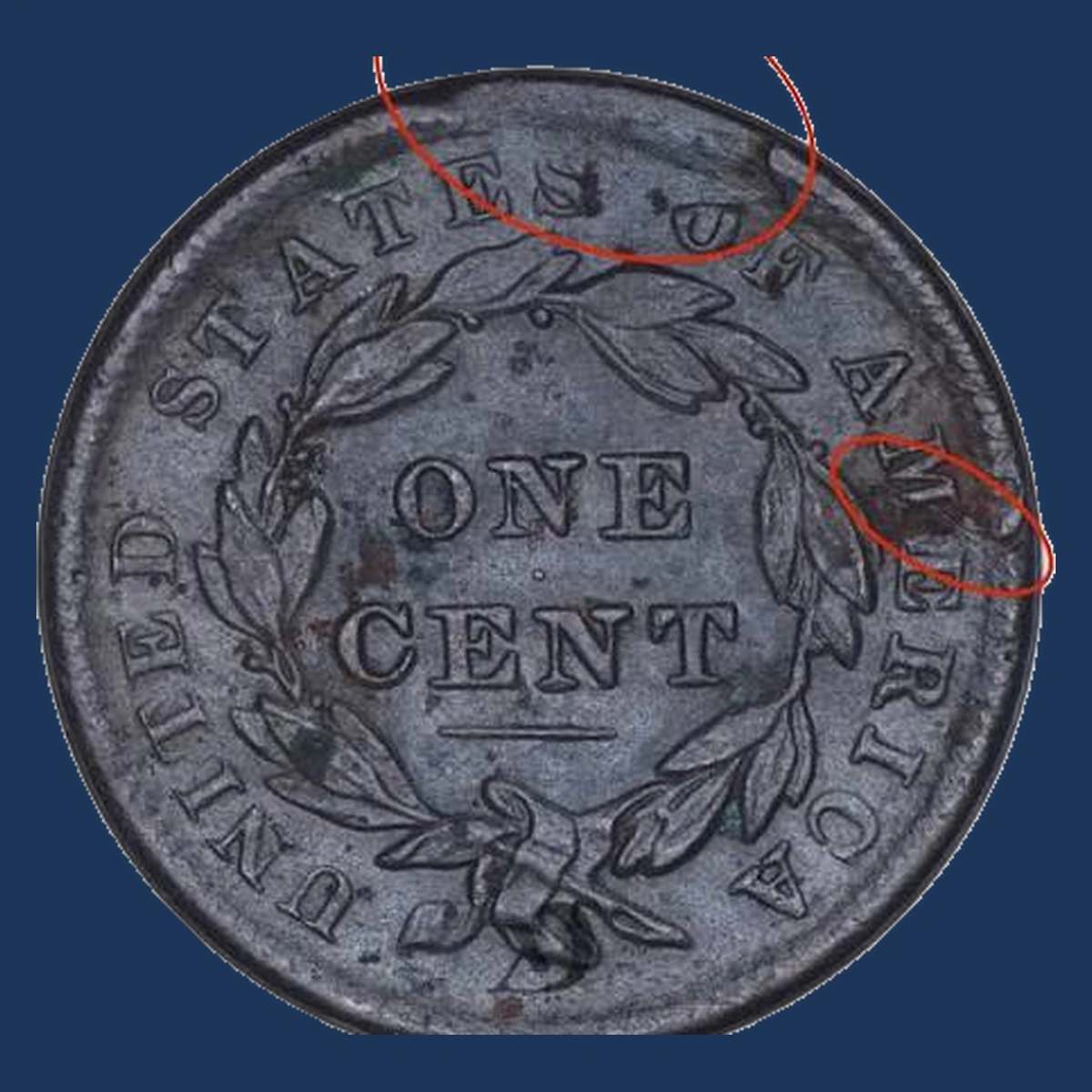
A thin raised line on a cent can trace a crack in the tool that struck it. When part of that steel breaks away, the coin can receive a broader raised patch.
The recorded N-4 example has breaks by the curl below the bust and beneath 83 in the date. Other damage appears near stars nine and twelve.
A rim-connected break is called a cud. An interior patch does not become a cud merely because it is raised.
A separate reported example has a break near star one. Those positions belong to different examples and should not be combined automatically.
Estimated Value
The N-4 cent brought $1,762.50 in September 2016. PCGS graded it MS65 Brown, meaning a well-preserved unworn coin with brown copper.
Estimate $30–$750 for worn examples with recognizable cracks or breaks and $750–$4,000 for attractive unworn pieces. The stronger patches are generally easier to display than faint lines.
The auction result includes the coin’s preservation and variety. It is not an amount to add to every 1838 cent with a tiny crack.
How to Identify
A raised line and a scratch can look alike in a flat photograph. Move the light while viewing the copper through a 10× magnifier; a scratch has a cut floor between its edges.
For the N-4 example, count the stars from the lower left with Liberty upright. Compare the curl below the bust, the area below 83, and stars nine and twelve.
Inspect the plain edge beside any raised patch for an impact or added metal. A loose coin can be checked with a scale and calipers against 10.89 grams and roughly 28 millimeters.
Now follow the patch toward the rim: a cud must reach that border. A first-star break belongs to a separate reported example, so do not require it on the N-4 coin.
6. 1838 Coronet Head Cent A Sunken Overlap near Two O’Clock
A curved depression can form when a second blank overlaps a cent during the strike. The overlapping disk blocks part of the tool and presses into the coin beneath it.
This produces an indent, rather than removing a piece of copper. A clipped blank has missing metal instead.
A catalog in Mint Error News lists an 1838 cent with a ten-percent front indent near two o’clock. It describes brown copper and a VG08 grade, meaning substantial wear.
That location belongs to the cataloged example. A random dent or a hollow made after minting needs a different explanation before it qualifies.
Estimated Value
The 2006 catalog entry gave a $260 minimum bid. That figure is an opening requirement, not a recorded winning price.
For genuine 1838 indents, estimate $250–$1,500 on worn examples and $1,500–$5,000 on sharper, attractive pieces. A clear curved boundary helps collectors understand the overlapping strike.
The location and ten-percent description do not establish a modern sale value. Surface quality, readable design, and the strength of the depression remain important parts of the comparison.
How to Identify
An indent should leave metal beneath the hollow rather than an open gap through the coin. Check this before comparing its shape with the cataloged example.
For a loose cent, record its weight with a scale and its width with calipers. The normal figures are 10.89 grams and roughly 28 millimeters; inspect the plain edge for cutting too.
Hold Liberty upright and examine the area near two o’clock through a 10× magnifier. The cataloged hollow covers about ten percent of the portrait side.
Follow where the curved hollow interrupts the design, then check the same area on the back. Fresh cutting, scraped walls, or a blow that crushes an already formed design would suggest later damage instead.
Conclusion
For these 1838 cents, estimated whole-coin values span $25–$5,000. A small extra stroke, a raised crack, and a sunken overlap each tell a different story about how the coin was made.
Check the shape in good light, preserve fragile copper, and compare both faces. When testing rotation, keep control of the turn.
The clearest match comes from the actual feature and the surrounding surface, rather than a dramatic error name attached to an ordinary worn coin.