2009 Nickel Error List with Pictures

A coin that stays in the press can become a small metal cap. One 1977-D Jefferson cap brought $487.20 at Heritage in July 2021, a comparison for the cap reported in this year’s list.
For 2009 nickel errors, the estimated ranges below extend from $10–$1,500. They cover small doubled details, displaced strikes, missing metal, and more dramatic changes in shape.
Follow the visible metal first, then compare the date, mint letter, and finish using the checks below.
1. 2009 Jefferson Nickel Doubled Die
The year guide describes a Denver nickel with doubling on both faces. On the front, its reported areas are the motto, date, and eye; on the back, MONTICELLO and the building.
A doubled die is a steel stamping tool made with an extra part of the design. It can pass that added outline to coins during an otherwise ordinary strike.
The two faces describe one reported coin, not two independently priced errors. A flat shelf from movement during striking can look similar.
Matching the actual extra shapes is more useful than calling every thick letter doubled.
Estimated Value
For minor, clearly identified doubling, use an estimated $10–$100. The year guide reports $410 in 2021 for a 2009-D example with both faces doubled, graded MS60 or unworn with substantial marks.
That is a secondary report without an original listing matched to the details here. It does not establish an automatic premium for every thick letter.
Small varieties that need strong magnification should be judged more conservatively than a bold, easily photographed example.
How to Identify
Begin with a clear photograph of the whole coin rather than a tightly cropped letter. The date and D must identify the same piece whose doubled detail is being offered.
With a 10× magnifier, compare the motto, date, and eye one area at a time. Then inspect MONTICELLO and the building, keeping the direction and shape of any extra lines separate from reflections.
Use a scale and calipers on a loose specimen to check about 5.00 grams and 21.21 millimeters. No missing metal is required for this error.
On each face, change the light and look for actual extra raised design. A flattened ledge beside an otherwise normal letter is not enough.
2. 2009 Jefferson Nickel Improper Annealing
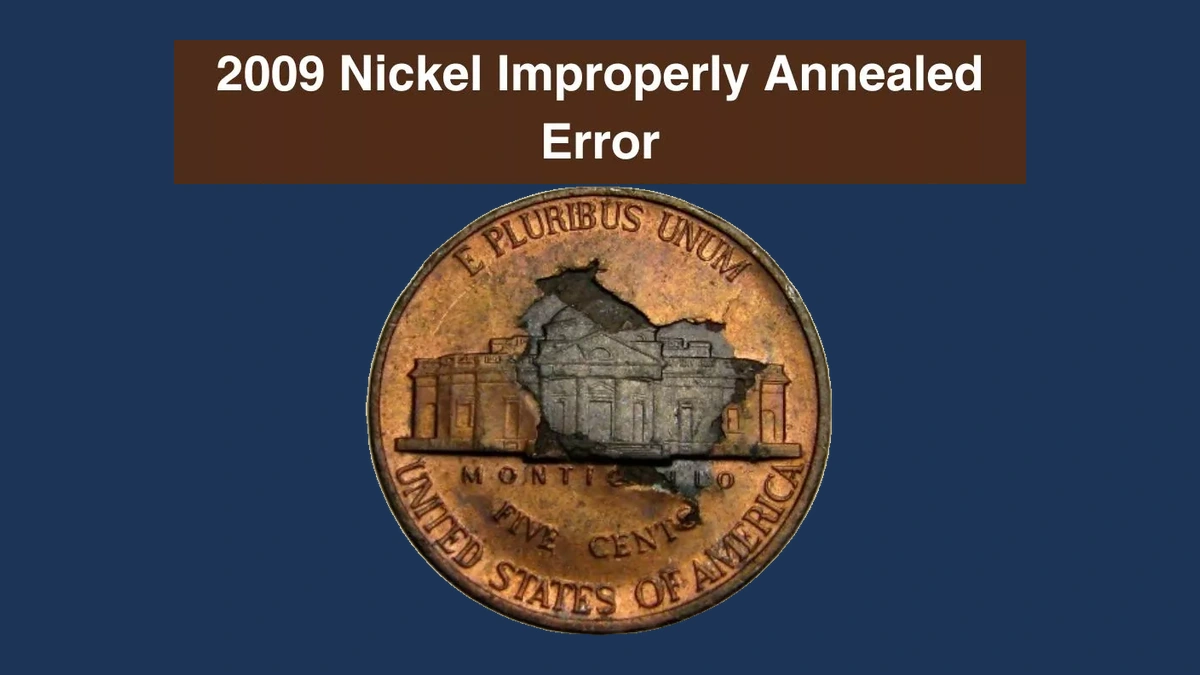
Dark or colorful metal may draw attention before any unusual design does. The 2009-D report describes a coin whose color was linked to improper annealing.
Annealing is a heating step used to soften the metal blank. If its surface changes during that step, the color can remain after striking.
The claim needs more than a dark shade. Later heating, chemicals, and long exposure to damp conditions can also change a nickel’s appearance.
Ordinary and satin-finish Philadelphia and Denver coins exist for 2009, along with specially made San Francisco Proof coins. Different original finishes should not be mistaken for damage.
Estimated Value
An estimated $30–$200 suits a clearly identified heating-related error with attractive original surfaces. The year guide’s $515 figure for a Denver coin is a reported amount, not a price for every dark nickel.
The estimate is deliberately tied to the actual surface and its condition. A vivid color does not by itself establish the minting cause or justify a large premium.
Compare like finishes and similar preservation before using another coin’s price.
How to Identify
Confirm the mint letter and original finish before judging color. A satin collector coin has a different surface from a regular circulation strike, so compare it with the same kind.
View both faces under neutral light with a 10× magnifier. Check whether color follows an intact struck surface or covers crust, pits, scratches, or an added coating.
Keep the surface untouched, including the edge. Cleaning a dark patch destroys useful evidence about how it formed.
For a loose coin, use a scale and calipers to check 5.00 grams and 21.21 millimeters. Normal size and weight cannot establish the cause, so have the original colored surface examined before paying an annealing premium.
3. 2009 Jefferson Nickel Off-Center Strike
The Philadelphia example in the year list is described as ten percent off center. That means some of the intended design missed the blank when the press closed.
The result is displaced lettering or a portrait beside an empty crescent of metal. A genuine off-center strike affects the relationship between the whole blank and both stamping tools.
The report does not fix a compass direction for this example. Its shape should be read from the actual coin rather than an illustration.
A narrow border on only one face may instead show a single tool set slightly off its normal center.
Estimated Value
Estimate $50–$650 for a readable, genuine 2009 off-center nickel, depending on preservation and how clearly the shift shows. The upper end is for a particularly appealing example, not a guaranteed price for a small displacement.
The guide reports $600 in 2020 for a ten-percent Philadelphia coin graded MS65, an unworn grade with relatively few marks. That remains a secondary eBay report.
Judge the date and actual strike together rather than multiplying a common-year price by a fixed factor.
How to Identify
The blank crescent should contain metal, even though it lacks the intended design. With a 10× magnifier, inspect it for original surface instead of sanding or cuts through finished letters.
A scale normally still reads near 5.00 grams because displacement does not remove the blank. Measure its outline with calipers against the ordinary 21.21-millimeter nickel.
Turn the coin over while keeping track of the same physical edge. The back must fit the same misplaced blank, rather than remain fully centered opposite a shifted front.
Keep the date and P in the full photographs. The clearest distinction from broadstrike is intended design missing beyond one edge, with unstruck metal left on the other side.
4. 2009 Jefferson Nickel Struck Through Grease
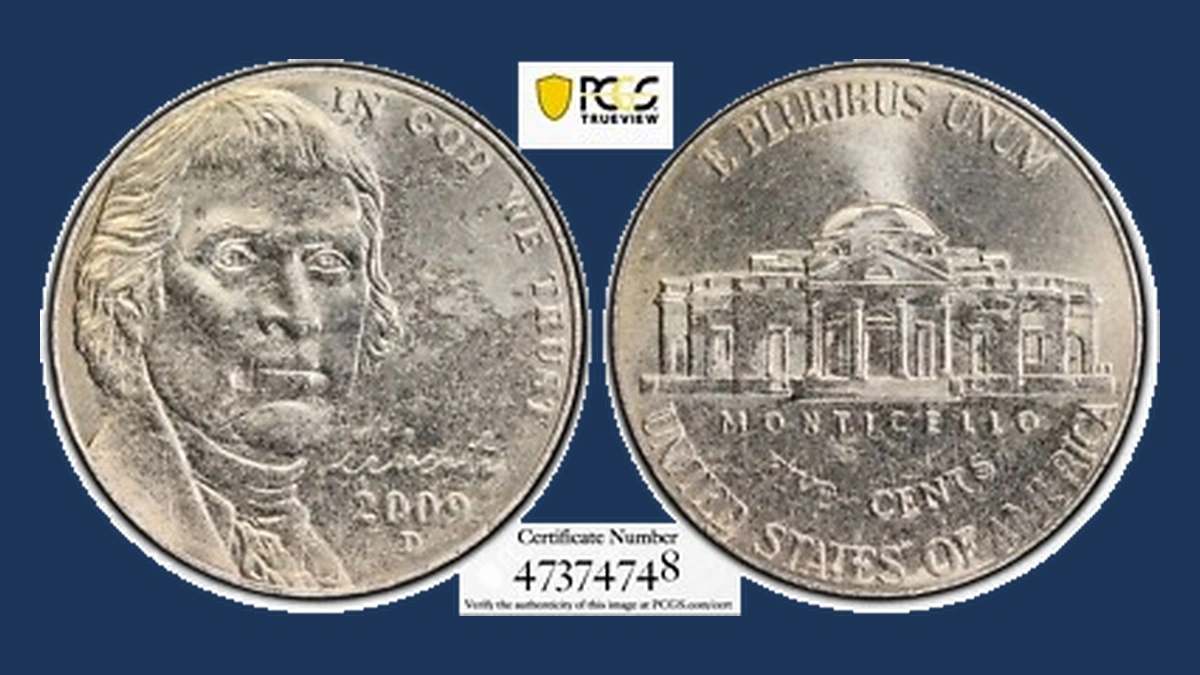
A broad area of missing detail can form even though the rest of the nickel is normally shaped. Grease in the stamping tool prevents metal from taking the intended design.
This is a strike through grease. It can soften details or leave a patch that looks nearly blank.
The year list reports a large affected area on a 2009-P nickel without establishing its precise position. A claim about a particular part of Jefferson or Monticello needs the coin’s own photograph.
Uniform wear is different. Wear reduces exposed parts through use, whereas this error blocks detail during the original strike.
Estimated Value
A small weak patch can fit an estimated $20–$100; a much larger, convincing interruption can fit $100–$650. These ranges depend on the coin’s actual appearance and condition.
The year guide reports $630 in 2021 for a Philadelphia specimen graded MS64, an unworn coin with some noticeable marks. An original auction lot is not identified in that report.
The figure should not be transferred to ordinary worn steps or a generally weak portrait.
How to Identify
Compare the high points on both faces before selecting a weak area. Wear usually affects several exposed features, so a coin worn everywhere needs a different comparison from a sharp coin with one blocked patch.
Under a 10× magnifier, inspect where good detail fades into the smooth area. Scraping or abrasive lines suggest design removed after striking.
A normal-weight result is compatible with grease blocking a tool. Use a scale and calipers on a loose coin to record about 5.00 grams and 21.21 millimeters.
Photograph the whole face with light from two directions, keeping nearby details sharp. The useful evidence is localized design loss beside features that formed normally.
5. 2009 Jefferson Nickel Lamination
A flap of metal or a split can show a weakness inside the original blank. The flaw may lift during striking or separate later along that existing weakness.
This is lamination, a separation within the alloy. The year list describes a Philadelphia example, without giving a firm position for its affected area.
The coin is not built from separate outer layers around a copper core. Its seventy-five percent copper and twenty-five percent nickel are mixed together.
A large peel therefore does not mean a missing clad layer. A coating applied after minting can also peel, but has a different cause.
Estimated Value
Estimate $25–$750, with tiny original flakes near the low end and large, well-preserved separations higher. A damaged or corroded surface should not receive the same treatment.
The guide reports $715 for a 2009-P coin graded MS61, meaning unworn with substantial marks. That secondary figure describes a reported specimen, not a standard premium for every crack.
An attached flap can make the defect easier to understand, but lifting it further can reduce the coin’s value.
How to Identify
The rough opening and any surviving flap must be examined together, because a pit alone can come from corrosion. Illuminate the opening from the side and use a 10× magnifier to follow a thin split into the surrounding metal.
If a loose coin is stable enough to handle safely, weigh it against the normal 5.00 grams on a scale. Measure intact parts with calipers against 21.21 millimeters, keeping both tools away from an attached flake.
Paint or added plating can peel from the surface without exposing a separation inside the original alloy. At the flake’s attached end, inspect whether the boundary continues within the coin rather than sitting on top.
6. 2009 Jefferson Nickel Double Curved Clip
Two curved gaps interrupt the outline of the Denver nickel described in the year list. They result from an incomplete blank entering the press.
When blanks are punched from a strip, an overlap with earlier holes can leave curved sections missing. The press then strikes the remaining metal.
Each gap needs examination. Two later cuts do not become a mint error merely because they have similar curves.
A weak border opposite a clip may support the identification, but two clips do not guarantee two weak spots. Their boundaries and the nearby design carry more useful evidence than that shortcut alone.
Estimated Value
For a genuine two-clip example, estimate $50–$850, depending on clip size, preserved detail, and condition. The guide reports $810 in 2021 for a 2009-D graded MS63, an unworn coin with visible marks.
As a lower-priced comparison, a 1961 nickel with two small clips sold at Heritage for $61 in September 2024. That older PCGS MS65 example had only about two percent missing.
Neither the number of gaps nor the year alone guarantees a large premium.
How to Identify
Map both gaps on a full photograph, then check the design beside each one under a 10× magnifier. A missing section made before striking should fit the surrounding original metal, rather than slice cleanly through a finished design.
Compare the two cut faces for saw marks or repeated filing strokes. Also examine the opposite border for possible weakness, without requiring it at both positions.
A scale should register less than the normal 5.00 grams if enough metal is missing to measure. Use calipers across intact parts against the usual 21.21-millimeter outline.
Do not rely on low weight alone, since later cutting also removes metal. Both curved boundaries must support formation before the strike.
7. 2009 Jefferson Nickel Die Clash
A faint design fragment where it does not belong can come from a die clash. The front and back stamping tools struck each other without a blank between them.
The damaged tools then passed unwanted traces onto later coins. The 2009-P report describes portrait-like lines near Monticello and architectural traces on the front.
Jefferson faces forward on this year’s nickel. A comparison based on the older side-facing portrait can put the expected marks in the wrong places.
The trace should match a piece of the opposite design. A few stray scratches or polishing lines cannot establish that relationship.
Estimated Value
Use an estimated $30–$850, with faint traces near the low end and exceptional, clearly identified examples higher. The wide range reflects the importance of visibility and condition.
The guide reports $830 in 2022 for a Philadelphia coin graded MS63, an unworn grade with noticeable marks. That is secondary price information, not a guaranteed result for another 2009 coin.
A crisp fragment that matches the correct design is more persuasive than a vague outline given a catchy name.
How to Identify
The portrait changed long before 2009, so start with a normal forward-facing Jefferson comparison. An older side-facing portrait cannot establish the expected clash pattern for this coin.
Take full photographs of both faces, then compare the extra lines near Monticello with the opposite design. A 10× magnifier helps resolve curves and corners that resemble parts of the portrait or building.
An intact loose nickel should weigh about 5.00 grams and measure 21.21 millimeters, checked with a scale and calipers. Include the plain edge in the photographs to help rule out later coin-to-coin squeezing.
The marks need not outline an entire design. Test one distinctive fragment against the correct opposite feature instead of connecting unrelated scratches into an imagined picture.
8. 2009 Jefferson Nickel Broadstrike
An enlarged nickel may still contain all of Jefferson and Monticello, along with the surrounding lettering. That combination can indicate a broadstrike.
The collar, the ring that restrains the blank during striking, failed to contain the metal normally. The blank spread outward under pressure.
The 2009-P broadstrike appears in the year list without a confirmed measurement for the particular specimen. Its diameter should not be copied from a general example or another year.
The smooth edge is normal for a nickel. Extra width, original metal flow, and complete design are the relevant features, not an absence of edge grooves.
Estimated Value
The year guide reports $1,040 in 2020 for a Philadelphia broadstrike graded MS62, an unworn but noticeably marked coin. It does not provide an original auction page establishing the specimen’s measurements.
Use an estimated $50–$1,100 for genuine examples, depending on expansion and preservation. Most modest broadstrikes belong below the dramatic upper end.
A wide, battered nickel does not qualify simply because its diameter exceeds that of a normal coin.
How to Identify
A scale can show whether an oversized coin still has the nickel’s normal 5.00 grams of metal. Record several widths with calipers against 21.21 millimeters, rather than treating one wide point as the whole shape.
Now follow the outer lettering on both faces under a 10× magnifier, checking that the intended design remains complete. Smearing, hammer marks, or a rim folded into the face suggest flattening after the original strike.
Side photographs help show how the expanded edge joins the two designs without pressing or bending the metal. Look for outward spread formed while the design was struck, rather than damaged lettering stretched by a later blow.
9. 2009 Jefferson Nickel Die Cap
A coin can stay attached to a stamping tool and meet fresh blanks instead of leaving the press. Repeated pressure spreads it and can turn its edge upward into a cup.
The stuck coin is a die cap. Other coins struck by it may receive distorted impressions, but those receiving coins are not the cap itself.
The year guide names a 2009-D reverse cap, while also describing effects on later coins. The actual piece must show which object is being discussed.
Cup shape, surviving design, and metal stretched by repeated striking matter more than the name in a sale description.
Estimated Value
For an authenticated cap, estimate $300–$1,500. A clearly shaped, undamaged piece can be much more appealing than a flat coin with a weak transferred image.
Heritage sold a 1977-D obverse cap graded NGC MS67 for $487.20 in July 2021. That was a highly preserved older-design example, not the reported 2009 reverse cap.
The year guide’s $1,010 amount remains a secondary report. The estimate applies to the actual cap only after its identity is established.
How to Identify
View the object from the side first, looking for walls or an edge raised by repeated spreading. A simple bent nickel will not explain the same pattern of stretched design.
With a 10× magnifier, inspect the inner and outer faces without pressing the walls. Compare their remaining details with Jefferson and Monticello on a normal 2009 nickel.
An original nickel blank begins around 5.00 grams and 21.21 millimeters. A scale can record its present weight, while photographs or careful caliper measurements show expansion.
Leave a cap in its graded holder rather than risk bending it. Mint Error News explains a modern cap’s formation.
The physical distinction is the expanded cap itself versus a flatter coin that received its impression.
Conclusion
The estimated $10–$1,500 range spans minor doubled details through a genuine, clearly identified die cap. A high guide figure does not give every coin of the same year the same value.
Preserve loose flakes, examine both clip boundaries, and compare complete designs when checking an expanded nickel. For a clash, use Jefferson’s correct forward-facing portrait.
Always separate the cap that struck other blanks from the flatter coins that received its impressions.