1988 Nickel Error List with Pictures

The D beside Jefferson does not tell the whole story of one 1988 nickel. An earlier 1988-D cent design remains underneath, and the unusual coin sold for $600 in September 2024.
This 1988 nickel error list ranges from faint transferred lines to extra strikes that reshape an entire coin. Estimated individual values span $5–$2,500; a large group’s auction total is treated separately.
Use the examples below to compare design, weight, and edge shape before deciding which error best describes your find.
1. 1988 Jefferson Nickel Portrait Traces around Monticello
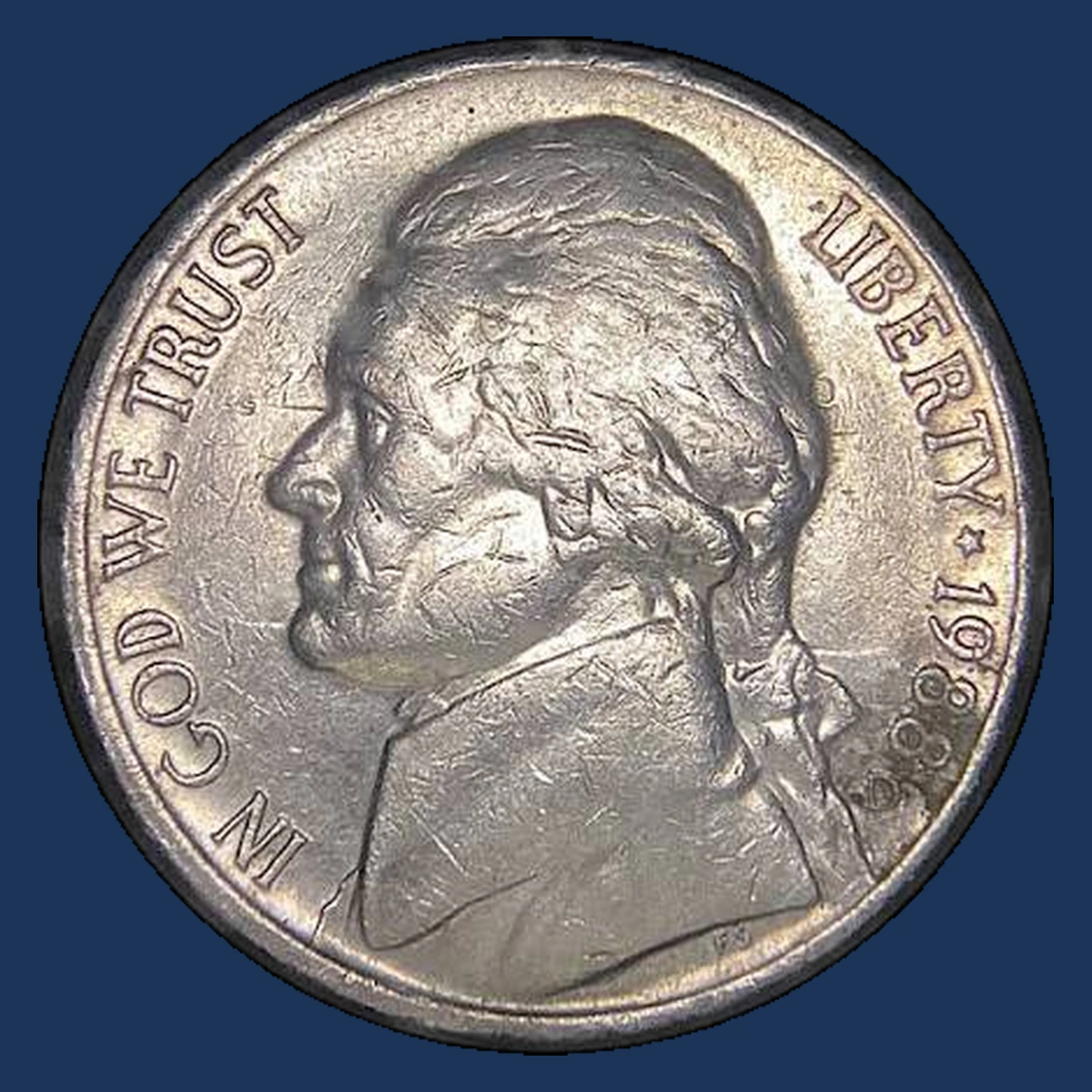
A faint head outline beneath FIVE CENTS belongs to the wrong side of a nickel. A clash can transfer such a fragment from one stamping tool to the other.
The tools, called dies, met with no blank between them. Coins struck afterward could receive traces of the opposite design.
A reported Philadelphia example shows a head outline below FIVE CENTS and coat traces above Monticello. The identification came from discussion of the owner’s photographs, rather than a grading-service certificate.
These faint transferred marks should not be confused with an entire second portrait impressed into the coin.
Estimated Value
Estimate $5–$50 for faint recognizable clashes and $50–$200 for stronger examples with clear design relationships. These ranges apply to genuine clashes, not random scratches near the building.
The reported 1988-P example has no established auction result here. A recognizable fragment is more useful than a dramatic name without visible support.
Wear and busy surface marks can make subtle clashes difficult to display, limiting their appeal even when the explanation is correct.
How to Identify
Locate FIVE CENTS before looking for the reported head outline below it. With a 10× magnifier, compare that curve with the top of Jefferson’s head on the other face.
Next look above Monticello for the separate coat traces. A second related feature can support the match better than one unexplained line.
A clash affects the tools rather than requiring missing coin metal. Check a loose specimen with a scale and calipers against 5 grams and 21.21 millimeters, and inspect its plain edge for damage.
Do not draw an imagined portrait through unrelated scratches. The actual surviving fragments should follow the opposite design closely enough to explain where the tools touched.
2. 1988 Jefferson Nickel An Extra Mint-Letter Outline
The small P or D identifies the Mint that made the coin. In 1988, these letters could be added to individual working tools with a punch.
A repeated punch in a different position could leave part of an earlier letter beside the final one. This is called a repunched mint mark.
The year source raises this possibility for 1988, but does not establish a particular example or direction. A candidate should therefore be examined rather than assigned an invented variety number.
A shadow, a scratch, or movement during striking can also make a mint letter look doubled.
Estimated Value
For an authenticated minor repunched mint letter of this date, use a conditional estimate of $10–$75. A clear, attractive example could fit $75–$250.
These are estimates for a candidate that proves genuine, not evidence that a particular 1988-P or 1988-D variety has been certified. No specific sale is established by the year source.
The first task is demonstrating a real earlier punch impression; ordinary glare or a flat shelf earns no such premium.
How to Identify
The source gives no established 1988 variety to match, so start by documenting the candidate rather than naming it. Photograph the P or D with the date still visible.
At 10× magnification, move the light across the extra-looking stroke. A shadow that follows the light is not an earlier letter punched into the tool.
Compare the fixed shape with the main P or D. A random scratch alongside it does not establish a repeated letter.
For a loose coin, record 5 grams and 21.21 millimeters as the normal weight and width using a scale and calipers. Inspect the plain edge too.
Keep the photograph and measurements together for a specialist examination. Do not borrow a catalog number or extra-stroke direction from another date.
3. 1988 Jefferson Nickel Missing Letters on the Back
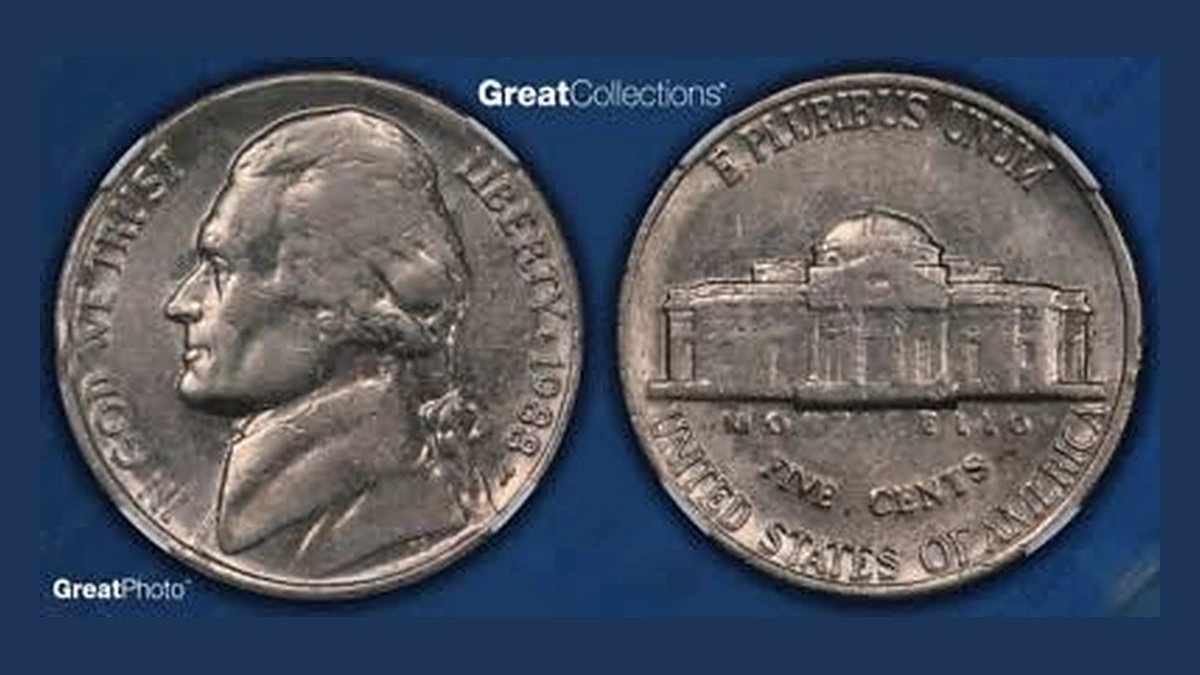
An obstruction between a blank and the stamping tool can keep letters from forming. Collectors call the result a struck-through error.
A seller described a 1988-P nickel with missing back lettering and an NGC AU Details label. That label indicates an almost-unworn level of detail with a problem noted, rather than a numerical condition grade.
The listing does not identify the exact missing letters or the obstructing material. Those details should come from the coin itself.
Weak lettering can also result from wear, a weak strike, or deliberate smoothing after minting.
Estimated Value
Estimate $10–$100 for a genuine local interruption and $100–$300 for a strong, clearly visible obstruction on an attractive coin. A problem noted on a grading label can reduce value.
The seller’s 1988-P description does not supply a completed sale here. For comparison, a 2000-P front struck-through nickel sold for $84 in February 2015.
That different-year, different-face example helps place the type in context without pricing every missing letter alike.
How to Identify
If a coin carries an AU Details label, read the accompanying problem description before studying its missing lettering. The wording must not be treated as a problem-free numerical grade.
Record a loose candidate’s weight and diameter with a scale and calipers against 5 grams and 21.21 millimeters. Photograph its plain edge and both faces, keeping normal wear visible alongside the weak area.
Now read the back inscription through a 10× magnifier and mark precisely which letters are interrupted. Look for polishing lines, scraped metal, or impacts crossing finished details.
Compare the weak patch with adjacent sharp features. A surface that never received full detail needs to be separated from one that lost it later, and the missing letters alone do not identify grease.
4. 1988 Jefferson Nickel Repeated Detail in Jefferson’s Portrait and Lettering
An extra eye or lip outline may be part of a repeated design in the tool, rather than evidence of two blows on the coin. Collectors call this a doubled die obverse, or DDO.
A year report describes Philadelphia doubling around the eye, lips, and chin, with effects in LIBERTY and IN GOD WE TRUST. It does not supply a precise catalog number to use here.
The repeated design begins when the stamping tool is made.
Movement during a single strike can instead leave flat shelves, and damage can push up extra-looking edges around letters.
Estimated Value
Estimate $20–$100 for identifiable minor doubling and $100–$350 for stronger, attractive examples with little wear. These are estimates for the reported Philadelphia type, not a verified sale of a named catalog variety.
Portrait detail that can be shown clearly is more useful than lettering that merely looks thick. A matching example is needed before applying an error premium.
Flat shelves from striking movement and damaged letter edges should not receive doubled-tool values.
How to Identify
A second-looking eye is easiest to judge beside the other portrait details, not in isolation. Use a 10× magnifier to compare its extra outline with the reported effects around the lips and chin.
Check LIBERTY and the motto next. Move the lighting to see whether a bright edge is a reflection rather than a fixed part of the metal.
An attributed Philadelphia example is needed to establish the actual variety. The year description does not supply a catalog number to assign automatically.
Weigh a loose nickel against 5 grams and use calipers against 21.21 millimeters, then inspect its plain edge. These measurements establish basic identity, not doubling.
Examine whether the apparent extra detail forms a rounded outline or a flat shelf cutting into the main design. Those shapes can have different causes.
5. 1988 Jefferson Nickel A Wide Strike with the Design Intact
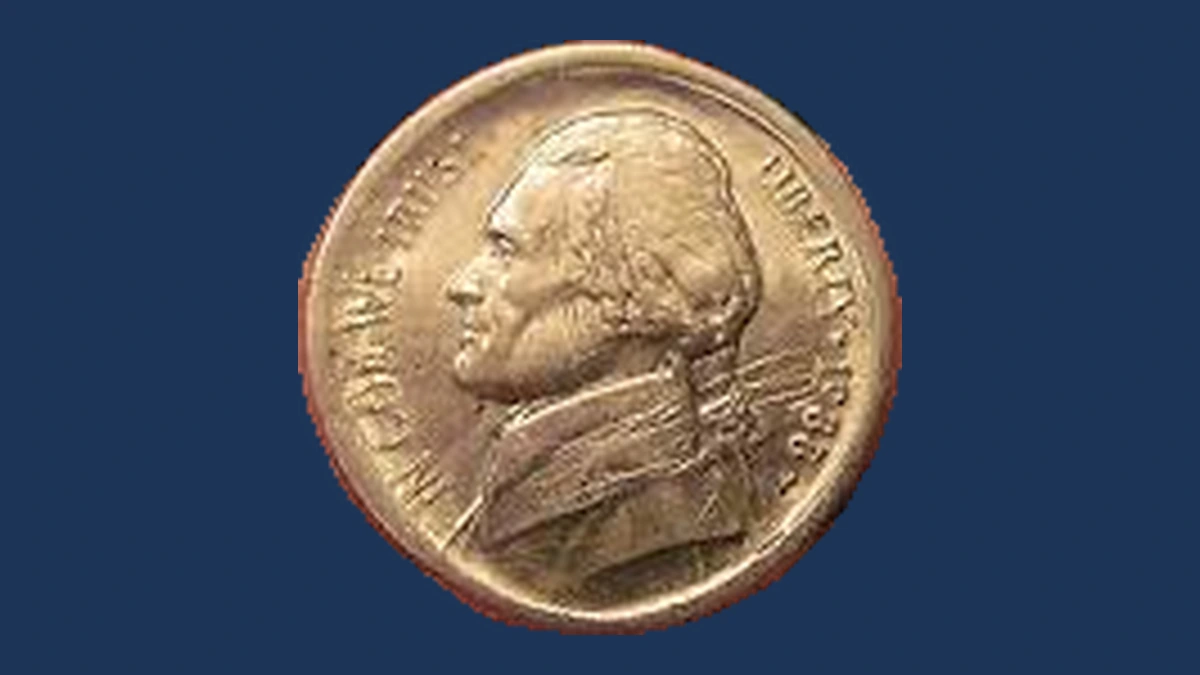
A ring called the collar normally restrains the blank while the design is impressed. Without that restraint, the metal can spread and form a broadstrike.
A Philadelphia example was cataloged with an ICG MS65 grade, indicating good unworn preservation. Other examples appeared in a nineteen-coin group that also contained several different errors.
The full design is the important feature of a simple broadstrike. Missing outer design beside a blank crescent instead suggests an off-center strike.
Because a nickel already has a plain edge, the absence of grooves says nothing about whether its collar worked.
Estimated Value
Use an estimated range of $20–$125 for ordinary broadstrikes and $125–$400 for strong, attractive spreads. These are individual-coin estimates rather than a division of the nineteen-coin group’s total.
A different-date Philadelphia broadstrike from 2000 sold for $51 in July 2022. It provides a modest same-design comparison.
The 1988 ICG example’s description establishes its error and grade, but no sale amount is assigned to it in this comparison.
How to Identify
Compare the outer lettering with an ordinary nickel before concentrating on size. Every part of a simple broadstrike’s design should remain on the metal, even where it spreads unusually far.
For a loose coin, calipers can show how its width differs from 21.21 millimeters. A scale can check whether it still weighs near 5 grams.
Inspect the plain edge and the portrait’s high points through a 10× magnifier. Hammering after minting may enlarge a disk while crushing details that were already present.
An unevenly expanded border does not by itself prove an off-center strike. Look for genuinely absent design beyond the blank before replacing the broadstrike explanation with a different one.
6. 1988 Jefferson Nickel Curved, Straight, or Multiple Gaps
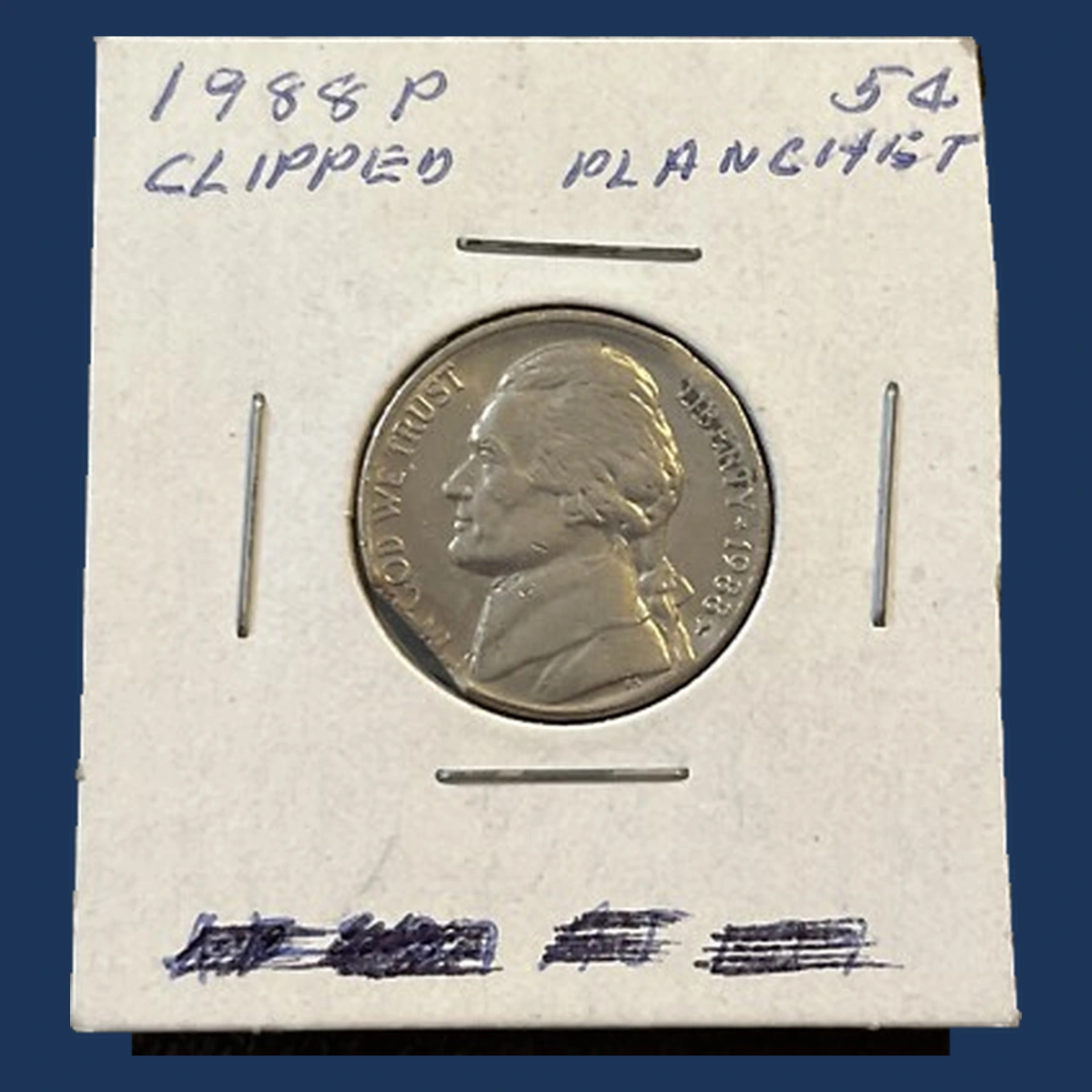
A clipped blank has missing metal before it receives its design. The punch may overlap an earlier hole or cross an edge of the metal strip.
A cataloged 1988-P curved clip weighs 4.61 grams and was graded ANACS MS62, an unworn grade with noticeable marks. Another group includes double clips, triple clips, and a straight clip.
Some coins combine their missing metal with expansion or an off-center strike. Each combination still represents one physical coin.
Gaps cut into finished nickels can imitate these shapes, so the boundary and nearby design require examination.
Estimated Value
Estimate $25–$150 for straightforward clipped blanks and $150–$600 for attractive multiple clips or clear combinations. The number of gaps alone does not determine the price.
A 1997-P twenty-percent curved clip sold for $124 in March 2025, offering a different-year comparison. The 1988 nineteen-coin group included several clip forms but did not price each separately.
Keep the coin’s surface quality and the visibility of each original gap in the comparison.
How to Identify
The 4.61-gram reading belongs to the cataloged curved-clip specimen, not to every 1988 clip. Weigh a loose candidate against the ordinary 5 grams and note whether the missing area plausibly explains the difference.
Use a 10× magnifier along each gap, checking for sawing, filing, or a cut through already formed lettering. Photograph both ends rather than only the deepest part.
Calipers can compare an intact span with 21.21 millimeters, and the untouched edge should be plain. Weakness on the opposite rim can help, but need not appear on every genuine example.
For a clipped off-center coin, separate absent metal from the unstruck portion that is still there. Do not add separate prices for those two features.
7. 1988 Jefferson Nickel The Design Struck Away from the Center
When only part of a blank lies between the stamping tools, the design misses the center. An unstruck crescent remains beside the displaced impression.
The Denver example was cataloged as sixty percent off center toward eleven o’clock, with an ANACS MS63 grade. That is an unworn grade with some marks.
Philadelphia examples include a ten-percent shift and other off-center forms in the nineteen-coin group. Their different layouts should be examined individually.
A single displaced strike differs from another design impressed over an earlier strike, even if both coins have similarly shaped blank areas.
Estimated Value
Estimate $25–$150 for modest clear shifts and $150–$750 for striking examples with a readable date and attractive surfaces. These are individual-coin estimates.
The Denver sixty-percent coin sold with a 1994-P off-center nickel for $49 in January 2022. That total covers both coins and is not a price for the 1988 example alone.
The Philadelphia nineteen-coin group likewise does not establish a separate selling price for its ten-percent specimen.
How to Identify
Hold Jefferson upright before using a clock position to describe the shift. The cataloged Denver design moves toward eleven o’clock; that direction does not apply automatically to Philadelphia examples.
Inspect both faces under a 10× magnifier and look for one corresponding unstruck area on each. A second set of surviving normal design may instead show an additional blow.
Use a scale on a loose example to compare 5 grams, then record its outline with calipers against the normal 21.21 millimeters. The edge is plain, although striking can distort its shape.
Keep the date and mint letter visible in the photograph. If either is missing, the outline alone cannot identify an otherwise undated coin as this exact specimen.
8. 1988 Jefferson Nickel A Depression from an Overlapping Object
A curved hollow can form when another object overlaps a blank as the tools close. The object presses into the nickel and prevents the normal design from forming underneath it.
This is an indent. The Philadelphia nineteen-coin group includes expanded coins with indents and an off-center coin with an indent.
Those combinations are different objects, not one coin carrying every listed feature. The auction description does not provide a shared clock position or one percentage for their hollows.
A sunken mirror design would indicate contact with a struck coin, rather than merely an unspecified smooth obstruction.
Estimated Value
For genuine 1988 indents, estimate $50–$250, rising to $250–$800 for dramatic, attractive combinations. These ranges price each complete coin rather than adding an indent charge to an off-center price.
As a different-year example, a 1996-P multiply struck nickel with a front indent brought $373.75 in September 2010. Its repeated blows make it a distinct comparison.
The nineteen-coin 1988 lot establishes examples but supplies no individual indent sale price.
How to Identify
With a 10× magnifier, inspect the inside of the hollow before comparing its outline. A recognizable reversed design would suggest a struck coin acted as the obstruction rather than an unidentified smooth object.
Check that metal remains beneath the depression, then photograph the matching area on the other face. A clipped gap is missing metal and should not be identified as a hollow simply because both boundaries curve.
For a loose coin, use a scale and calipers against the normal 5 grams and 21.21 millimeters. Expansion can change the width without removing metal, so include the nearby plain edge in the photograph.
Follow the surrounding design into the affected area. A later impact crushes details that already existed, while an obstruction can stop those details from forming in the first place.
9. 1988 Jefferson Nickel Extra Strikes That Shift or Cup the Coin
If a nickel remains in the press, another blow can place a design across the first one. It may shift before the tools close again.
A Denver example was cataloged as multiply struck and sixty percent off center. Philadelphia records include a displaced second strike and another coin whose second strike formed a cap.
A cap develops when the coin sticks to a tool and its metal rises around it. That cup-shaped object is the struck coin, not a separate coating.
Read each sequence from its surviving impressions. Doubled-looking nickels do not all follow the same path through the press.
Estimated Value
The Denver multiple strike sold for $104 in October 2010. NGC graded it MS67, describing very strong unworn preservation.
Estimate $100–$600 for clear repeated strikes and $600–$1,500 for exceptional layouts or strong cap combinations. These ranges are estimates for complete coins.
The Philadelphia cap and other doubles appeared in the nineteen-coin group without individual prices. A high grade or another strike does not automatically multiply the value of the Denver comparison.
How to Identify
Compare the coin’s shape with the proposed sequence before counting every extra-looking letter. A cup wall requires a different explanation from two designs crossing on a flat disk.
Photograph a cap-shaped example from the side without flattening it. For a loose coin, a scale can compare 5 grams while calipers gently record width and height.
The original disk was 21.21 millimeters across with a plain edge. Repeated striking can change that outline without making it a different blank.
Now trace the oldest visible design with a 10× magnifier, then follow the later portrait and lettering. One flat ledge does not establish another full blow.
Keep the Denver sixty-percent description separate from the Philadelphia layouts. The surviving impressions and shape must explain the same sequence on the coin in front of you.
10. 1988 Jefferson Nickel A Strike on a Dime Blank
A dime blank can enter a nickel press and receive Jefferson’s design on a disk intended for a different denomination. The smaller size cuts off outer nickel lettering.
The Philadelphia nineteen-coin group specifically includes a nickel struck on a dime blank. The group was sold uncertified, rather than with an individual grading-service guarantee for every coin.
A normal dime blank weighs about 2.27 grams, much less than a nickel blank. It also has layered metal rather than the nickel’s uniform alloy.
This description does not require any Roosevelt design beneath Jefferson because the starting disk was unstruck.
Estimated Value
For an authenticated 1988-P nickel on a dime blank, estimate $300–$1,000, or $1,000–$2,000 for outstanding preservation and strong presentation. These are individual-coin estimates.
The nineteen-coin group brought $2,562 in June 2026, including the wrong-blank example and eighteen other errors. That is not the price of the dime-blank coin.
Nor does dividing the total by nineteen account for the very different pieces in the group.
How to Identify
Weigh a loose candidate before deciding which blank was used. A dime blank starts near 2.268 grams, compared with the nickel’s normal 5 grams.
Calipers can compare its outline with the dime’s original 17.91 millimeters and the nickel’s 21.21 millimeters. The later blow can spread a smaller blank, so diameter and weight should be considered together.
Under a 10× magnifier, examine the cut-off outer nickel design and the layered metal at the edge. Dime edge grooves are not required because an unused blank has not yet received them in a dime collar.
Check for acid damage or grinding that could make an ordinary nickel smaller and lighter. Surviving Roosevelt design would instead raise the separate possibility of an already struck dime underneath.
11. 1988 Jefferson Nickel The Nickel Design over a Finished Lincoln Cent
Jefferson can share a coin with Lincoln when an already struck cent passes through the nickel press. The later design partly covers the cent while leaving portions of its original image visible.
The documented Denver coin combines a 1988-D nickel strike with a 1988-D cent underneath. It was graded NGC MS66 Red, meaning strong unworn preservation with retained copper color.
The cent began as copper-plated zinc, so its metal and weight differ from an ordinary nickel.
This is not just a copper-colored nickel or a nickel design placed on an unused cent blank.
Estimated Value
The 1988-D nickel over the 1988-D cent sold for $600 in September 2024. That is an actual individual-coin result, separate from the Philadelphia nineteen-piece group.
Estimate $400–$1,200 for clear examples with comparable preservation and $1,200–$2,500 for exceptional surfaces and especially visible lower design. Those upper amounts are estimates.
Readable parts of both denominations help explain the coin’s appeal; the two face values do not determine its collectible price.
How to Identify
Identify an unmistakable Lincoln cent feature first, using a 10× magnifier to trace it beneath the nickel design. Read each surviving date and D separately instead of assuming both impressions belong to the same issue.
For a loose example, compare its weight with a cent’s normal 2.50 grams rather than a nickel’s 5 grams. Calipers can record the expanded outline against the cent’s original 19.05 millimeters and the nickel’s 21.21 millimeters.
Examine the plain edge for joining seams or an added coating. A plated ordinary nickel may look copper-colored without carrying any genuine lower cent design.
If only Jefferson and Monticello survive, color and size may support a wrong blank but cannot alone establish an already struck cent as the host.
Conclusion
These 1988 nickel errors carry estimated individual values of $5–$2,500. A faint clash may need careful magnification, while an off-center strike or cent overstrike can change the coin’s appearance immediately.
Use the surviving design to explain the object before comparing prices. Some coins combine a clip, expansion, or an extra blow, and their values should stay attached to the whole coin.
Keep large auction-group totals separate from the price of any one example.