1829 Cent Error List with Pictures

A date on both sides is possible on an 1829 cent: one reads normally, while the other is a sunken mirror image. Other pieces have missing edges or extra struck designs.
This 1829 cent error list spans estimated whole-coin prices of $35–$35,000. A Proof, a specially made collector coin, with a turned back sold for $23,000 in November 2006; its rare manufacture accounts for much of that price.
Learn which clues separate these coins, and which prices fit ordinary circulated examples.
1. 1829 Coronet Head Cent Crack in the Copper Blank
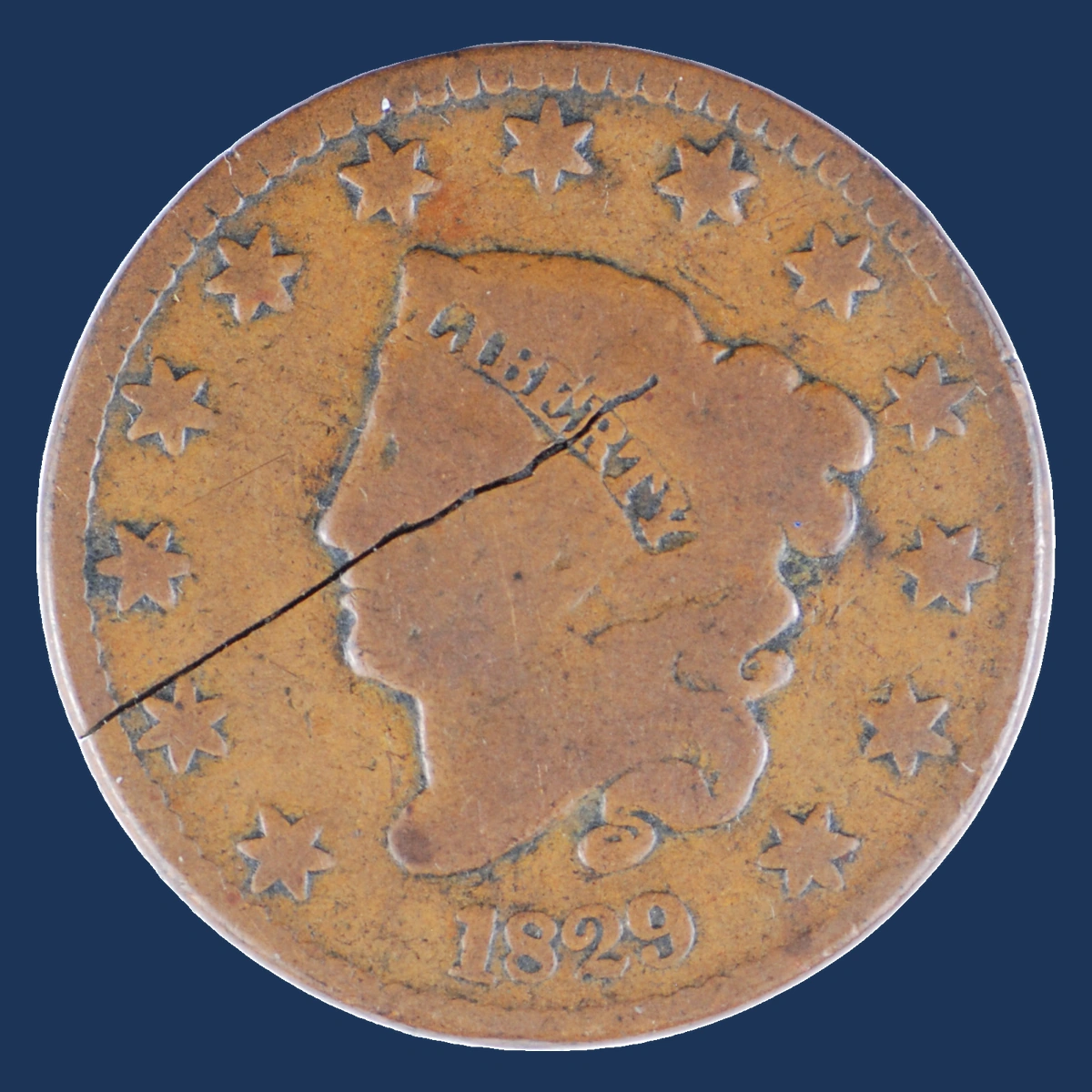
An opening in the copper itself differs from a raised line copied from a cracked stamping tool. The first is a cracked planchet: the metal blank has split.
A coin dealer lists an 1829 Large Letters example with this defect and circulation wear. The seller records a diameter of 29 mm.
The listing does not place the opening beside a particular star or letter. It also does not establish precisely when the copper split.
The useful question is whether striking shaped the crack or later force tore through a finished coin. A seller’s short label cannot settle that by itself.
Estimated Value
The dealer’s 1829 cracked-blank listing asks $395 for a coin described as Very Good, a heavily worn grade. That is a selling price, not a completed auction result.
An estimated $100–$600 whole-coin range suits worn examples with a clear original crack. Better detail and a convincing strike around the opening support the upper end.
A later split caused by bending is damage. It should not receive the same estimate just because its opening looks dramatic.
How to Identify
Opening a crack wider can destroy evidence, so do not bend the coin. Under a 10× magnifier, compare the gap on both faces and along the plain edge where it reaches the border.
Calipers record the diameter on sound areas, usually around 28 mm for this type, while the dealer lists 29 mm. A scale checks against 10.89 g; a split without lost copper may hardly change the weight.
Photograph the gap under side lighting so a specialist can examine how the surrounding design meets it. A raised line over unbroken copper indicates a different feature, while a crease and sharply torn finished lettering can point to later bending.
2. 1829 Coronet Head Cent Missing Edge Section on an Off-Center Coin
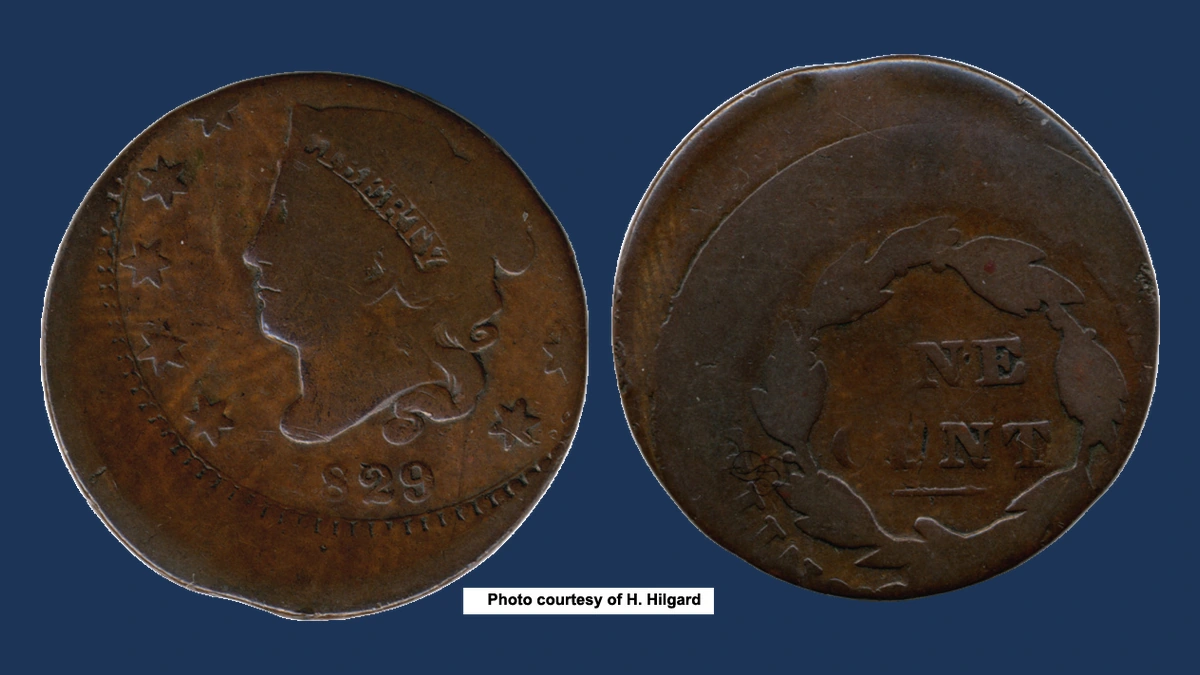
The incomplete edge and the shifted design are two different features on this cent. Henry Hilgard described the 1829 example after its appearance in an August 2002 auction.
The missing section lies near six-thirty on the front and eleven-thirty on the back. It began with an incomplete blank, before the coin received its design.
The blank also entered the striking position off center. This left a separate unstruck area.
The description calls the result a double error because it combines two problems. It does not mean the coin necessarily received two strikes, and it does not supply a clip percentage.
Estimated Value
For a worn 1829 cent with a modest original clip, estimate $75–$500. A clear clip combined with an off-center strike can fit roughly $500–$2,500 for the complete coin.
Hilgard’s article names an auction appearance but gives no sale price used here. The combined range is therefore an estimate, not the price of his pictured example.
Assess the missing edge and shifted strike together. Adding a full clip price to a full off-center price would count the underlying cent twice.
How to Identify
Turn the coin over and find the same missing piece from each side. The clock positions change from about six-thirty on the portrait side to eleven-thirty on the wreath side.
A scale may show less than the original 10.89 g if copper is missing. Use calipers across undamaged spans near the type’s usual 28 mm diameter, without forcing the incomplete coin into a circular measurement.
With a 10× magnifier, inspect the ends of the gap for strike-shaped metal. Saw cuts, file marks, or a freshly sheared wall cutting finished details suggest removal after striking.
The blank area from off-center striking still contains copper. Separate that unstruck surface from the actual missing piece before estimating how large the clip is.
3. 1829 Coronet Head Cent Raised Star Lines and Rim Breaks
Lines joining the stars and raised patches at the rim can come from damage to the dies, the tools that stamp coins. Copper fills openings in those tools during striking.
An N-2 example has front lines joining stars one through four and eleven through thirteen. A separate N-7 report describes spoke-like cracks on the back.
The N-8 has three rim-connected breaks, called cuds. Two sit beside the upper stars, and one lies above CA in AMERICA.
These are different tool pairs and different examples. A coin does not need all of these marks to show genuine tool damage.
Estimated Value
A three-cud N-8 graded PCGS AU50 sold for $810 in September 2020. AU50 indicates light circulation wear.
Estimated whole-coin prices run $35–$400 for modest cracks on worn cents, and about $250–$3,000 for clearer rim breaks or stronger preservation. The number of cuds alone does not set the price.
Compare how much of each patch survives, along with corrosion and wear. Three faint remnants can be less appealing than one bold, undamaged break.
How to Identify
Count the front stars from the lower left to locate the N-2’s two crack paths. Use a 10× magnifier to follow stars one through four, then eleven through thirteen.
The N-7’s spoke-like pattern belongs to the back of a separate example. Its lines cannot be joined to those front paths.
For N-8, examine the plain edge beside the raised patches rather than starting with thin surface lines.
The front cuds lie between stars seven and eight and between nine and above ten, with another above CA on the back. A scale and calipers check the 10.89 g and roughly 28 mm standards on a loose cent.
Tilt each patch under light to distinguish strike-formed copper from a rim blow that folded metal onto the face.
4. 1829 Coronet Head Cent Hair-Bun Outline inside the Back Wreath
A curve inside the wreath can belong to Liberty’s hair rather than to a leaf. An old auction-catalog description identifies hair-bun outlines on the right inner side of an 1829 N-1 wreath.
The cause is a die clash. The stamping tools hit each other without a blank between them, marking their working faces.
Later coins can carry traces of the design from the opposite tool. No extra portrait needs to be struck directly onto the finished cent.
The example was graded MS62 Brown, meaning it had no circulation wear. Its faint clash should not be confused with normal wreath curves.
Estimated Value
An estimated $75–$600 suits recognizable clash marks on worn 1829 cents. Unworn examples with attractive surfaces can fit roughly $1,000–$4,000, largely because of the cent’s overall preservation.
The old catalog text was reproduced by a collector and listed the MS62 Brown N-1 at $2,800. That historical listed price is not a newly verified auction sale.
Compare the hair outline’s clarity without ignoring scratches or rough copper. A faint clash alone does not turn a worn coin into an unworn-price example.
How to Identify
Photograph the front hair bun and compare its mirrored outline with the curves inside the right-hand wreath. A 10× magnifier helps separate those faint curves from the normal leaves.
For a loose cent, a scale and calipers can confirm its size is consistent with copper large cents of 10.89 g and about 28 mm. These tools cannot establish whether the thin curves came from a clash; leave a sealed example in its holder.
Tilt the back under a low light and follow the extra contour through the spaces between leaves. A connected hair shape supports the comparison, while a lone scratch or a curve already belonging to the wreath does not.
5. 1829 Coronet Head Cent Blurred UNIT from Material in the Press
Part of UNITED looks blurred on an 1829 N-1 from the Twin Leaf Collection. The auction description identifies material between the coin blank and the stamping tool.
This is a struck-through error. Something blocks the tool from pressing its full design into the copper.
The catalog suggests grease as the material, rather than naming it as a proven substance. UNIT is the affected part of the word.
This matters because some coins from the same tool pair normally show weak back details. The catalog distinguishes this particular patch from that general weakness, and the surrounding coin retains an unworn appearance.
Estimated Value
For worn 1829 cents with a clear localized struck-through patch, estimate $50–$400. An unworn example can fit roughly $1,000–$5,000 when its overall preservation supports that level.
The described Twin Leaf coin was PCGS MS63 Brown, a coin without circulation wear. Its sale amount is not assigned here; these are estimated whole-coin ranges.
Compare the weak letters with the rest of the surface. Missing detail can reduce appeal, so the blocked area does not automatically create a large premium.
How to Identify
Begin with the unaffected lettering beside UNIT and then examine the portrait. General circulation wear should also soften high points elsewhere, rather than selecting only these four letters.
Use a 10× magnifier to inspect the weak patch for smooth loss of struck detail. Abrasive cleaning may instead leave scratches across the surrounding copper.
Grease itself usually will not remain available for testing. The visible check concerns the interrupted design, not a claim about the exact substance.
For a loose coin, a scale and calipers compare 10.89 g and about 28 mm. An ordinary weight does not rule out this error because a temporary blockage need not remove copper.
Compare UNIT with a normally weak N-1 before paying extra for missing lettering.
6. 1829 Coronet Head Cent Two Back Impressions beneath a Centered Front
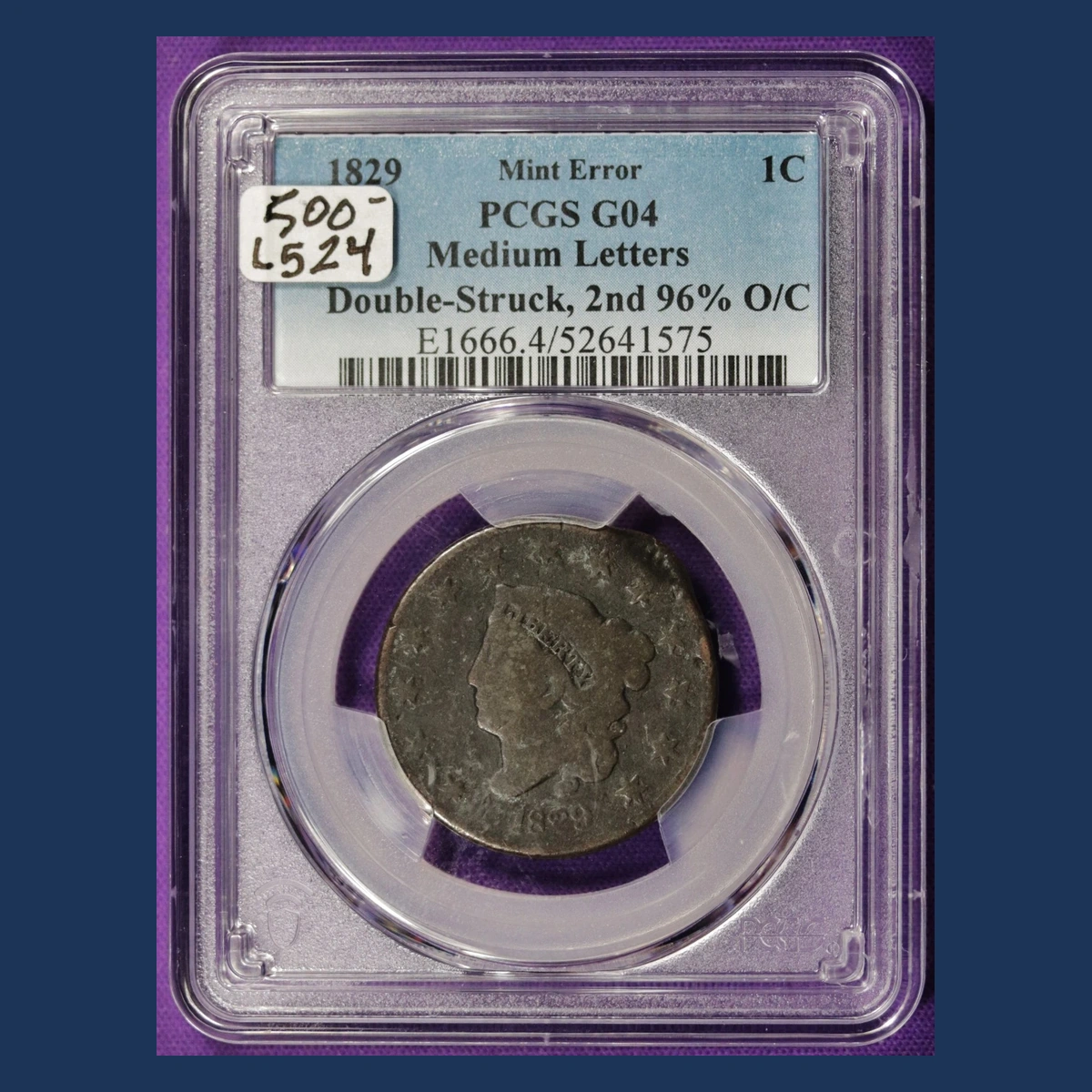
An extra group of design details at the lower right of the back reveals an earlier strike. Heritage described this feature on an 1829 cent graded PCGS VF20, meaning moderate wear.
The catalog proposed that the first back strike was 40% off center toward six o’clock. It suggested another blank blocked the front tool during that blow.
A later centered strike then produced the main design on both faces. Some of the first back impression survived.
The proposed blocking blank explains why the two faces differ. It is the auctioneer’s reconstruction, not a separately confirmed extra error on this coin.
Estimated Value
Worn 1829 double strikes can fit an estimated $400–$2,500. Better-preserved pieces with clearly separated impressions may reach roughly $2,500–$6,000.
The PCGS VF20 example was listed as not sold in Heritage’s July 2002 archive, so it supplies no completed sale comparison. A separate dealer listing displayed $500 for a heavily worn PCGS G4 double strike.
That $500 is a listing amount, not a verified sale. The amount of visible second design matters more than an unexplained percentage in a seller’s title.
How to Identify
The important remains lie beneath the later centered back design, so the coin may lack a conspicuous bare crescent. Enlarge the lower-right area with a 10× magnifier and identify the earlier letters or wreath details.
Now compare the front, where flattening or contact marks might support the catalog’s suggested blocking blank. A scale and calipers record a loose copper cent against 10.89 g and roughly 28 mm, although repeated blows can spread its outline.
Draw the two back design positions on copies of the same photograph, leaving the original image untouched. A specialist should be able to explain which impression overlaps the other before accepting the proposed sequence inside the press.
7. 1829 Coronet Head Cent Shifted Design and an Unstruck Crescent
A bare area beside a shifted portrait shows that the blank was not centered under the stamping tools. Some of the design landed beyond its edge.
An 1829 Large Letters cent graded PCGS VG10 was cataloged as 25% off center. Its substantial wear still left the error recognizable.
A different 1829 example described by Henry Hilgard also has an incomplete edge. The missing metal is a clip, while the blank crescent still contains copper.
Neither the 25% measurement nor a particular striking direction should be transferred from the auction coin to Hilgard’s example. They are separate cents with different features.
Estimated Value
The 25% off-center PCGS VG10 sold for $1,380 on December 23, 2024. It provides a direct comparison for a heavily circulated 1829 error.
Estimate $500–$2,500 for recognizable worn examples, or roughly $2,500–$8,000 for stronger pieces with more detail and better surfaces. A readable date and attractive outline can help.
The Hilgard coin’s extra clip changes the whole-coin comparison. Its off-center portion is not priced separately and then added to a second full estimate for the clip.
How to Identify
The first photograph should include the entire edge and the readable date. Cropping out the bare crescent can hide the main evidence for an off-center strike.
Inspect both faces with a 10× magnifier. A blank that sits outside the striking position normally loses corresponding parts of both designs, unlike one shifted tool.
On a loose cent, weigh against 10.89 g with a scale. Off-center striking by itself moves the design rather than removing copper, though a separate clip or wear can lower the weight.
Use calipers to record the outline against the type’s roughly 28 mm size. Then distinguish a smooth unstruck area from flattened finished detail or a newly cut edge.
8. 1829 Coronet Head Cent Full Mirror Image Replacing the Back
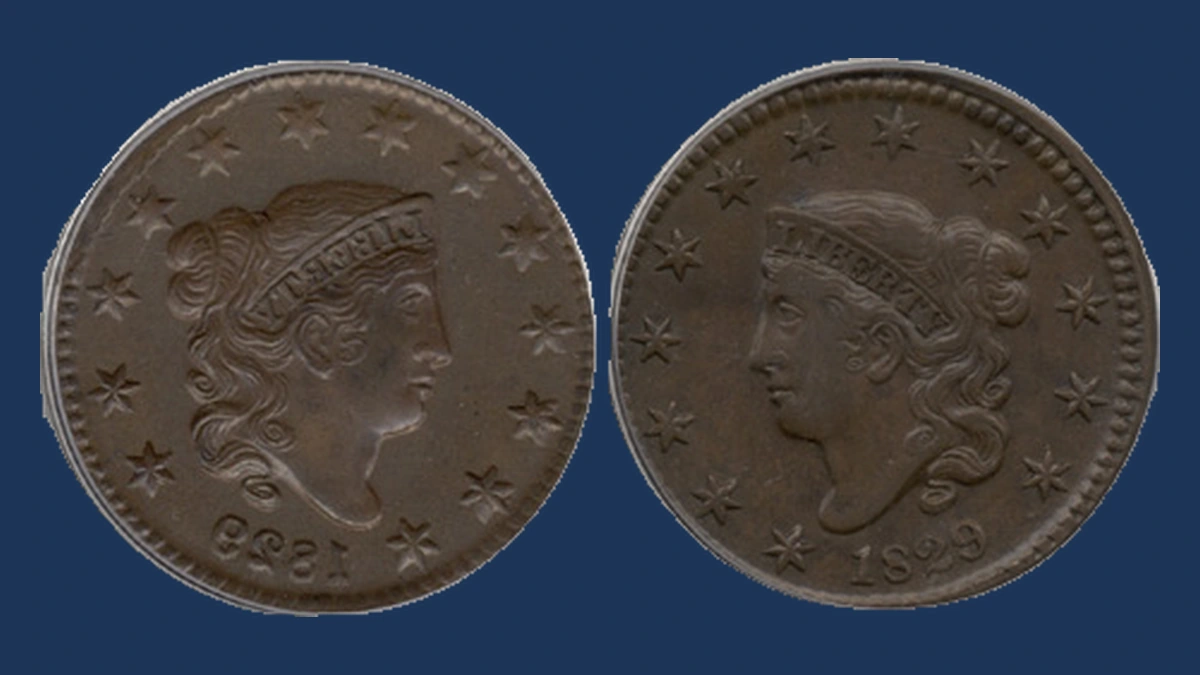
The back carries another portrait and another date instead of the wreath and ONE CENT. Both are reversed and sunk into the metal.
This is a full mirror brockage. A struck coin remained in the press and pressed its front design into the next blank.
Mint Error News illustrates an 1829 example graded PCGS AU55, showing only light wear. The normal front date and mirrored back date are both visible.
Heritage also cataloged an AU55 reverse brockage as N-8. The error replaces the normal back design, so its ordinary lettering size cannot be read from wreath lettering that is absent.
Estimated Value
Estimate $3,000–$8,000 for worn but clear 1829 reverse brockages, rising to about $8,000–$15,000 for stronger lightly worn examples. Original surfaces and a complete mirror image matter.
A PCGS AU55 N-8 sold for $6,900 at Heritage on April 29, 2006. Mint Error News separately printed a $12,500 value for its illustrated AU55 example.
The magazine amount is a published valuation, not an auction result. Those two figures should not be presented as two confirmed sales of one identified coin.
How to Identify
Side lighting makes the two dates easier to compare: one stands above the copper and the other sinks into it. Use a 10× magnifier to check that the recessed digits and surrounding portrait are mirrored.
The normal wreath should be replaced by the complete reversed front design, rather than merely covered with another raised portrait. Compare the surrounding stars and portrait as well as the date, because one backward mark is not a full brockage.
A loose copper cent can be checked on a scale against 10.89 g and with calipers around 28 mm. For an expensive example, ask a specialist to inspect the edge and metal flow for signs that finished coins were squeezed together later.
9. 1829 Coronet Head Cent Turned Back on Ordinary and Proof Coins
A back design can lean even when both faces were struck centrally on the blank. This happens when the two stamping tools are set at different angles.
A collector records a slight five-degree turn on an ordinary 1829 N-2. Such a small difference should not be called a dramatic striking accident.
A different N-6 Proof, a specially made collector coin, was described with about thirty degrees of counterclockwise rotation. Its special manufacture and larger turn are separate facts.
Another seller reports an ordinary rotated example without a measured angle. A shiny surface does not turn that cent into a Proof.
Estimated Value
Ordinary circulated 1829 cents with visible rotation fit an estimated $50–$600 range; a slight five-degree lean may add little. Strong unworn examples can reach roughly $600–$3,000.
The NGC PR64 Brown Proof sold for $23,000 on November 29, 2006. A separate $15,000–$35,000 whole-coin estimate fits that rare collector-coin category.
Most of the Proof’s value comes from its rare manufacture and preservation. The thirty-degree angle is not a $23,000 surcharge on an ordinary cent.
How to Identify
A Proof label establishes a manufacturing category, while a rotation measurement describes alignment. Keep those two checks separate before comparing prices.
For alignment, hold Liberty upright and flip the coin top to bottom against a fixed vertical line. A protractor measures the back’s lean; use a 10× magnifier if wear makes its center hard to locate.
Repeat the same movement instead of straightening each photograph independently. The reported five-degree ordinary example and thirty-degree Proof should not produce the same measurement.
The copper standard is 10.89 g and roughly 28 mm, checked with a scale and calipers on loose coins only. Leave a certified Proof sealed and confirm its label and surface characteristics with a specialist, rather than judging by shine alone.
Conclusion
Two dates, two strikes, and two errors describe different things on an 1829 cent. A mirrored date belongs to a brockage, while an off-center coin can also have a clipped edge.
The estimated $35–$35,000 range includes worn ordinary coins and a rare Proof category. Compare those separately.
For your own coin, record the visible feature and both faces before choosing a price comparison. A shiny surface alone never establishes that a cent is a Proof.