2019 Nickel Error List with Pictures

Not every collectible nickel needs a spectacular mistake. A broadstruck 1999-P example sold for $89 in March 2025, a useful comparison for an error that can also appear on a modern date.
For 2019 Jefferson nickel errors, estimated prices here range from $3 to $500. Monticello’s doorway, the eyes, and the coin’s outline give you several places to start.
The guide below explains which shapes matter and why a colorful nickname or unusual color is only the beginning of identification.
1. 2019 Jefferson Nickel Filled-Looking Eyes
The eyes may look unusually filled, swollen, or blank in a close photograph. Some collectors call this appearance “Zombie eyes,” but the name does not identify what happened.
Softly formed details, wear on the stamping tool, and extra raised metal can produce different-looking eye changes. Material attached after the coin left the Mint can also fill a small hollow.
Treat the visible shape as the feature to examine. A raised lump is not the same thing as a weakly formed eye, even when both attract the same nickname.
Estimated Value
For a repeatable, mint-made eye feature, allow a modest estimated $3–$20. The range values a clearly visible collector curiosity, not a confirmed rare variety with an established auction record.
Unworn surfaces make the difference easier to show. A low-quality photograph or nickname alone adds little to a normal five-cent coin.
The estimate excludes glue, dirt, or other added material. Establishing that the eye shape belongs to the struck design comes before assigning any premium.
How to Identify
Compare the eyes with an ordinary 2019 nickel under the same light. The normal forward-facing portrait already has small shadows and raised edges that change with the viewing angle.
A 10× magnifier helps distinguish a raised lump from a shallow or weakly formed detail. Turn the lamp, not just the coin, and photograph the eyes from more than one direction.
On a loose example, use a scale and calipers to compare 5 g and 21.2 mm. Examine the plain edge and nearby cheek for other damage.
Added material may have a different texture or a visible boundary. Do not pick at it; keep those close-ups for an expert instead of trying to reveal a valuable feature by cleaning.
2. 2019 Jefferson Nickel Parallel Raised Lines
A narrow band of parallel lines may cross the portrait or Monticello on a reported 2019-P example. Their height matters more than the nickname attached to them.
A feeder finger is the machine part that moves blanks into position. If it scrapes a stamping tool, the resulting grooves can leave raised lines on later coins.
If it drags directly across a finished coin, it instead leaves scratches. These two routes should not be confused, and ordinary cleaning or tool-polishing marks can also create groups of fine lines.
Estimated Value
Expect an estimated $5–$30 for a convincing band of mint-made raised lines. Clear repeated lines on an unworn coin belong above a faint mark that is difficult to see.
This is a small-error estimate, not a claimed auction result for a particular 2019-P coin. A buyer should be able to follow the band across the photographed surface.
Cut-in cleaning scratches receive no such error premium. A feeder-finger label cannot change later damage into a minting mistake.
How to Identify
Use side lighting before trying to trace the entire band. Under a 10× magnifier, check whether each line stands above the surface or cuts into it.
Raised parallel lines can support damage to the stamping tool. Direct scratches on the coin need a different explanation, especially when they cut across raised letters and leave disturbed metal beside them.
Compare the band with another 2019-P example, keeping its width, direction, and endpoints in view. Repeating the same pattern is more helpful than simply finding several parallel marks.
The coin should retain its normal plain edge. Record a loose example with a scale and calipers against 5 g and 21.2 mm, and photograph both faces to show whether more widespread cleaning lines are present.
3. 2019 Jefferson Nickel Small Raised Blobs and Crack Lines
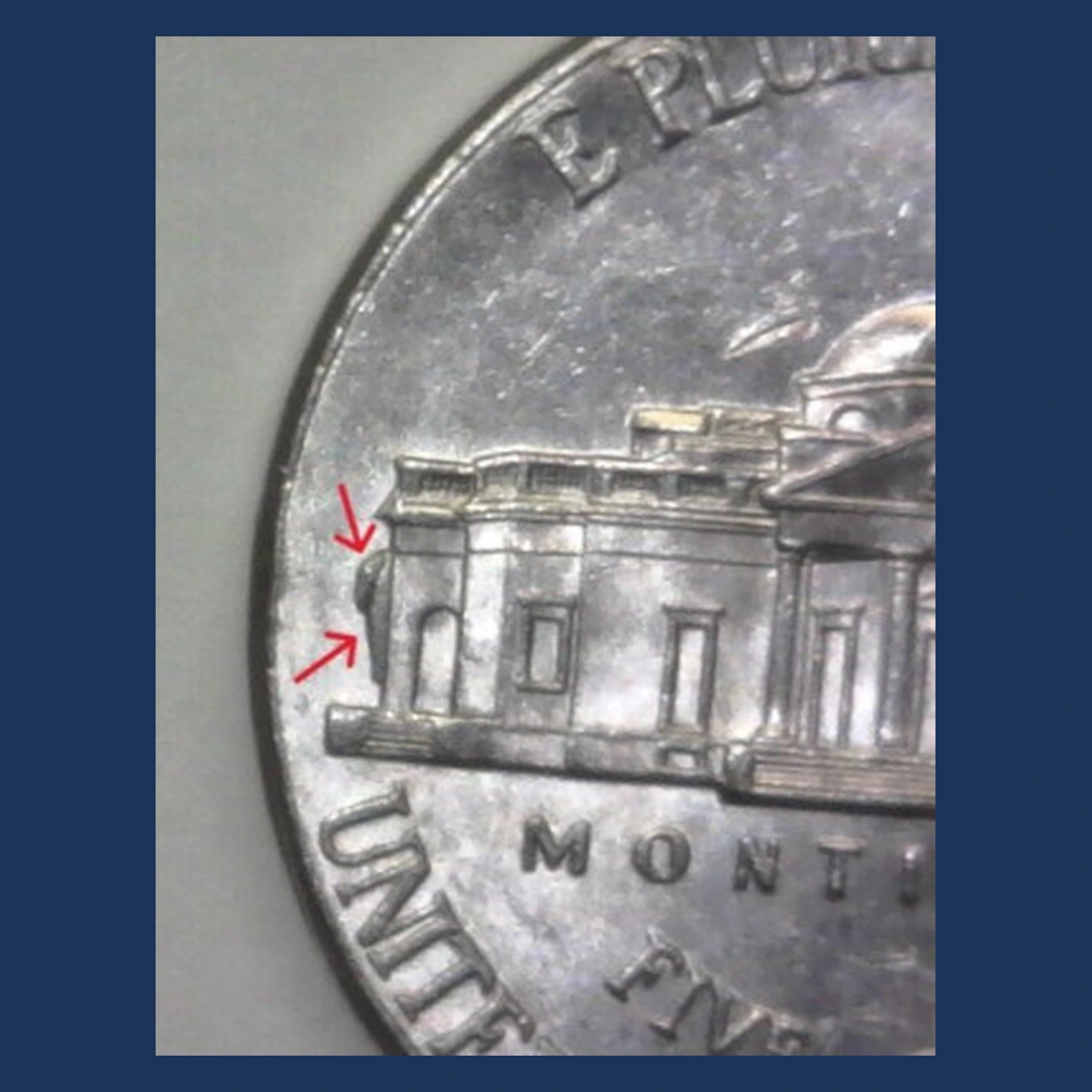
A raised blob can interrupt a column or fill a small space near Monticello’s steps. The reported 2019 features are inside the design, rather than necessarily touching the coin’s outer rim.
They can form when a small piece chips out of a die, the steel tool that stamps coins. Metal fills the opening and copies it as a raised lump.
A narrow tool crack leaves a line instead. The term cud belongs to a larger break connected to the rim, so it should not replace every small interior chip.
Estimated Value
An estimated $3–$40 covers recognizable small chips and crack lines on 2019 nickels. Most minor examples remain inexpensive because the affected area is small.
Clean, unworn building details help buyers see where the extra metal begins. Larger, distinct shapes can bring more than a tiny dot hidden among the columns.
These are estimated collector prices for genuine tool damage. They do not apply to attached material, ordinary architecture, or dents that have pushed the coin’s metal sideways.
How to Identify
Find the same column or step on a normal nickel before judging the extra lump. Architecture includes many small raised lines that look unfamiliar under strong magnification.
Examine the added shape with a 10× magnifier. Its surface should belong naturally to the struck coin, with no seam, flaking coating, or glue boundary around it.
If a raised line leads into the lump, trace both together. Keep an interior chip separate from a rim-connected break when choosing comparison photographs.
Use calipers on a loose coin to check 21.2 mm and a scale to compare 5 g. Inspect the plain edge last: an impact there may push metal inward and create a misleading raised area beside otherwise normal details.
4. 2019 Jefferson Nickel Extra Shapes around the Doorway
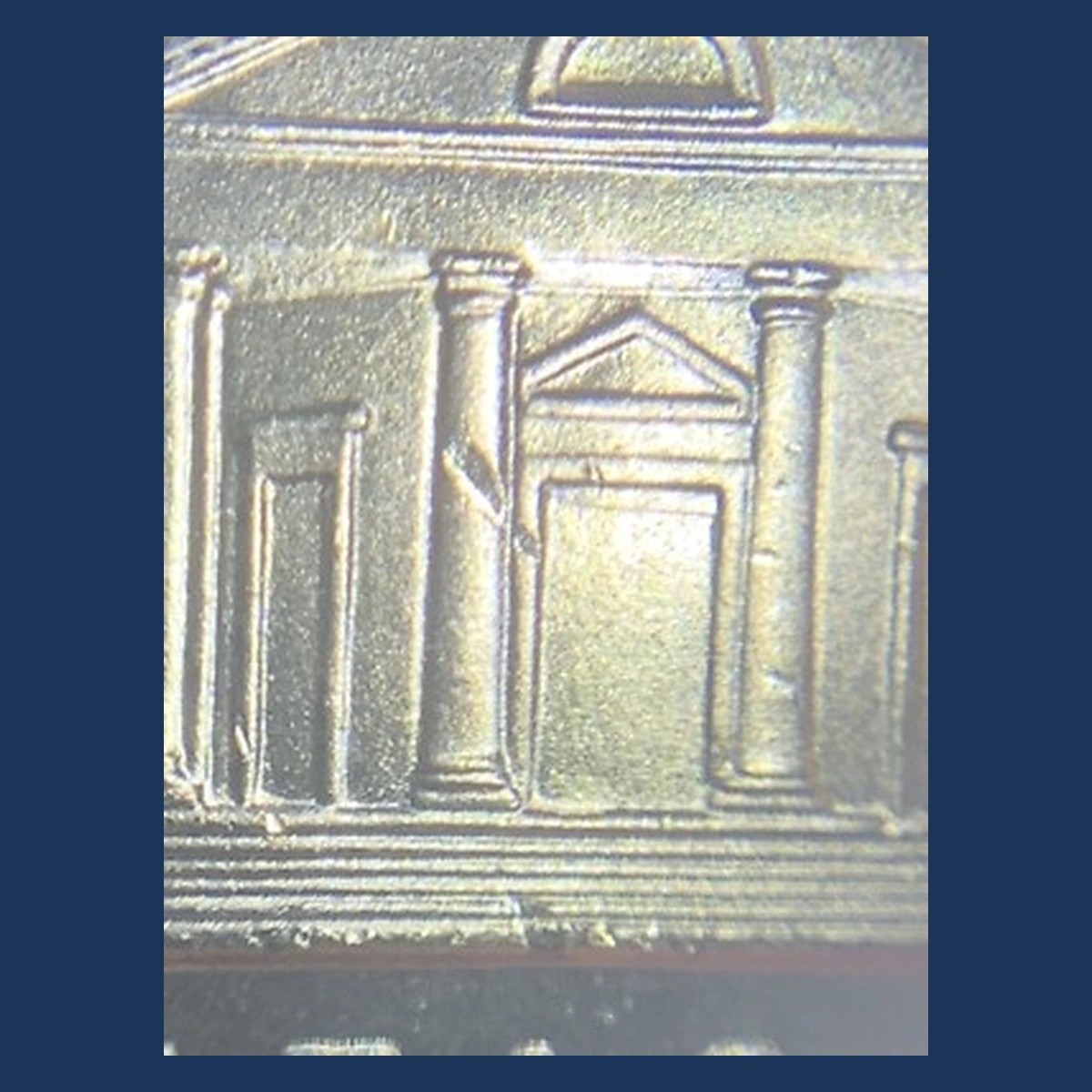
Extra raised shapes can appear beneath the upper-left part of Monticello’s central doorway. Other recorded details include the triangle over the door and the space inside the left column.
These small features belong to a doubled die: a stamping tool made with a partly duplicated design. Coins from that tool can repeat the same additions.
The listed examples are 2019-P nickels. Bright reflections from the building’s ordinary edges can imitate doubling, so the extra shapes need to match a clear photograph rather than simply look thick.
Estimated Value
Use an estimated $5–$75 for a matched 2019-P doubled-doorway variety. Clear extra shapes on an unworn coin support the upper part of the range.
The estimate concerns these small modern features, not the much higher prices sometimes paid for dramatic doubling on older nickels. Identification and condition work together.
A common mechanical shelf or reflection does not earn the same premium. Buyers need to see the particular doorway addition, not just a photograph of the complete back.
How to Identify
Check the P beside the date before turning to Monticello. The 2019 variety photographs provide the correct doorway shapes to compare.
View the upper-left doorway and nearby triangle through a 10× magnifier. Then examine the inner space beside the left column, keeping ordinary column edges in the same photograph.
Change the direction of the light. Reflections shift or disappear, while an extra piece of raised design keeps its position.
A loose nickel normally weighs 5 g, measures 21.2 mm with calipers, and has a plain edge. Use the scale and calipers without rubbing the surface; broad wear can erase the tiny additions that would otherwise identify the variety.
5. 2019 Jefferson Nickel A Flap or Missing Patch of Metal
A thin sheet of metal can lift from the front, leaving an opening beneath it. If the sheet detaches, a shallow missing patch remains.
This separation is called lamination. A weakness inside the original metal allows the surface to split instead of remaining solid.
Jefferson nickels use a mixture of 75% copper and 25% nickel throughout. They do not have a copper core sandwiched between outer layers, so this is not a missing-clad-layer error.
The 2019 reports concern surface peeling, not proof that an entire coin split into two discs.
Estimated Value
A 2019 lamination has an estimated value of $10–$100. An attached flap and readable surrounding design can make the flaw easier to appreciate than an empty rough patch.
The range is an estimate for this modest surface error. It is not based on treating the nickel as a missing-layer dime or quarter.
Large defects can reduce appeal even when the separation happened at the Mint. Leave the metal as found instead of removing a flap to enlarge the opening.
How to Identify
Check the entire front before enlarging the peeling area. A coating lifting from several letters is different from a thin layer separating within the coin’s own metal.
Use a 10× magnifier at the opening and any point where it reaches the plain edge. Look for a split entering the metal, without pulling at the flap or pressing a tool underneath it.
A loose nickel normally measures 21.2 mm with calipers and weighs 5 g on a scale. Missing metal can lower that weight, but an attached flap may leave it unchanged.
Photograph the connection from the side.
Scattered corrosion pits and ridges pushed up by scraping should be considered separately from a naturally separating sheet.
6. 2019 Jefferson Nickel Weak Details and Impressions from Debris
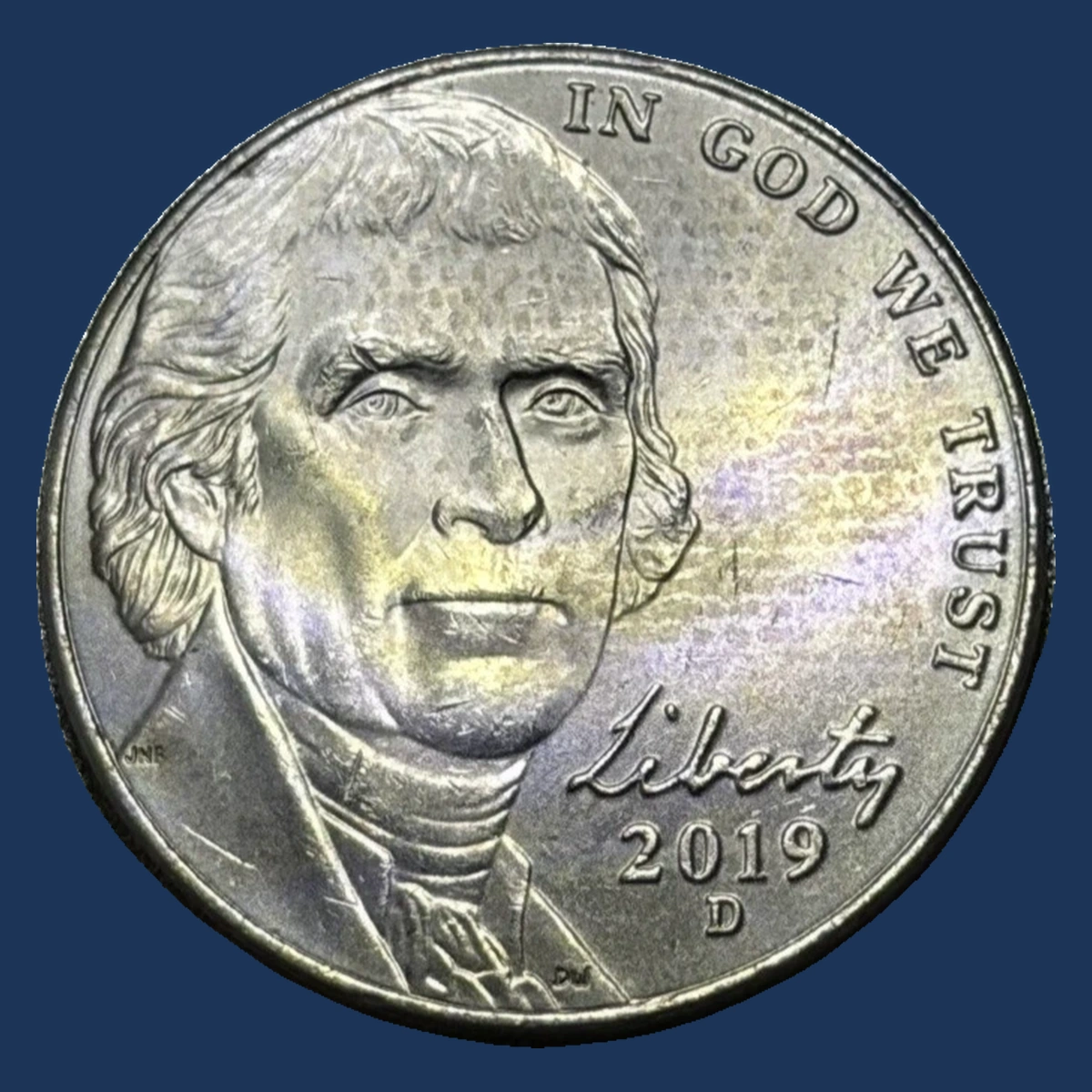
A softened area around Jefferson’s face or Monticello can look very different from a sharply outlined depression. Both can arise when unwanted material blocks the normal stamping process.
Grease in a tool recess may prevent a letter or facial detail from forming. A solid object between tool and blank can leave a clearer impression with a distinct boundary.
The nickname “Smoking Jefferson” describes an appearance near the mouth, not a proven material or cause. Neither that name nor a dent alone establishes that the coin was struck through debris.
Estimated Value
Small grease-filled areas have an estimated range of $3–$25; clearly defined object impressions can bring roughly $25–$200. The shape, size, and condition of the coin explain much of that difference.
A 2000-D nickel struck through a coin covering the stamping tool sold for $84 in September 2025. That is a different obstruction and year, so it provides only broad price context.
For 2019, price the actual impression instead of assuming that every weak mouth detail represents the same error.
How to Identify
Begin by deciding what is missing: a softly formed design element or a distinct area pressed below the surface. Use a 10× magnifier around the boundary before choosing an error name.
Weak details should be compared with nearby sharp lettering and with ordinary wear on the portrait. A solid-object impression should interrupt the struck design naturally, without the sharp scraping and displaced metal of a later gouge.
The normal loose coin is 5 g and 21.2 mm across; record it with a scale and calipers and inspect the plain edge. These measurements support identification but do not reveal what material blocked the strike.
Photograph any mouth feature under side light. A raised line may need a tool-crack explanation instead of a grease explanation.
7. 2019 Jefferson Nickel Expanded Coin with a Complete Design
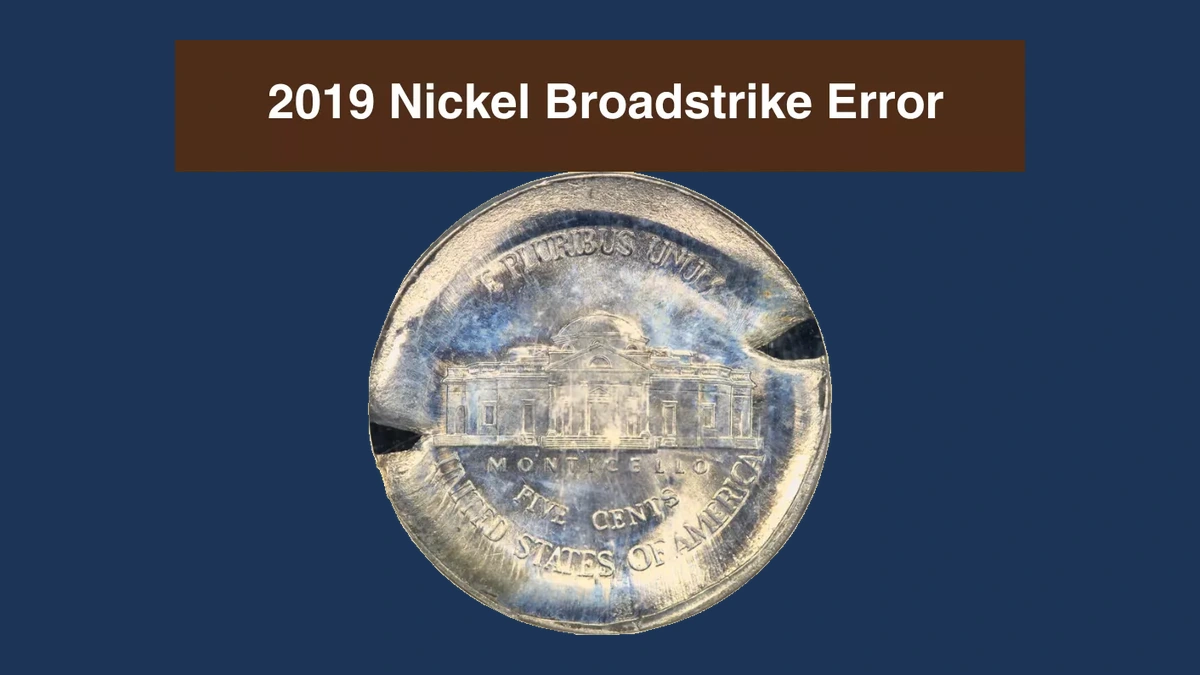
The coin may look wider than a normal nickel while keeping its main portrait, lettering, and building. A broadstrike occurs when the ring that normally contains the metal fails to hold it during striking.
Metal can then spread outward instead of staying within the normal outline. The result may have a wider, uneven border or an enlarged diameter.
Both faces must be examined. A design cut off on one side points toward a different problem, and the nickel’s naturally smooth edge is not evidence of a broadstrike by itself.
Estimated Value
A 1999-P broadstruck Jefferson nickel graded PCGS MS63 sold for $89 in March 2025. That unworn earlier coin offers a practical comparison for the same general mistake.
For 2019 examples, estimate $25–$250. Obvious natural expansion and attractive surfaces support the higher end.
The main design should remain present. A coin flattened after minting may be equally wide but belongs outside this error range, especially when its lettering and portrait show matching damage from the pressure.
How to Identify
Use calipers in several directions to compare the outline with a normal 21.2 mm nickel, since expansion may be uneven. A scale should still read close to 5 g unless the coin has also lost metal.
Inspect both faces and the perimeter with a 10× magnifier, looking for complete main designs and natural outward metal flow. A wide coin with flattened lettering on both faces may have been squeezed after it left the Mint.
The denomination normally has a plain edge, so the absence of grooves provides no evidence of a broadstrike. Photograph the enlarged outline beside a normal nickel while keeping the date, portrait, and outer letters in view.
8. 2019 Jefferson Nickel Shifted Designs and a Blank Crescent
The date or lettering may disappear over one edge while a smooth crescent remains opposite it. The blank entered the press out of position, so the stamping tools covered only part of its surface.
This is an off-center strike. Unlike a clipped coin, it can keep the original metal even though part of the design is missing.
An uneven rim on just one face is not enough. The reported 2019 category concerns a displaced blank, rather than a slightly misplaced stamping tool or an ordinary broadstrike.
Estimated Value
An estimated $30–$500 covers minor through dramatic 2019 off-center strikes. A readable date and clean, unstruck crescent make a stronger display piece.
For comparison, a 1999-P nickel listed as 15% off center brought $64 in March 2025. That sale shows why a modest shift need not have a huge price.
The larger estimate allows for more dramatic 2019 examples with good surfaces. It does not assign a particular percentage to the year’s reported coins.
How to Identify
Check whether enough of the date survives to read 2019. A modern portrait alone cannot place an undated off-center coin in this year.
Align the two faces and compare where the design runs off the edge. A wide blank crescent paired with missing design on both faces supports a misplaced blank.
Use a 10× magnifier where the struck design meets the blank metal. Look for a natural transition rather than grinding marks that removed the lettering after minting.
Weigh a loose example against 5 g and record its outline with calipers, using 21.2 mm as the normal blank diameter. The strike may spread the metal; inspect the plain edge for cuts before using its final size to judge the error.
9. 2019 Jefferson Nickel Unusual Metal Mixture
A reported 2019 nickel has an unusual brass-like color and was described as having an incorrect alloy. An alloy is a mixture of metals; the normal nickel mixture is 75% copper and 25% nickel.
An actual composition error would require a different mixture in the coin itself. An odd surface color cannot establish that.
Plating, chemicals, soil, or a heating problem can change the appearance without creating the claimed alloy. Even uniform color and normal weight leave those possibilities open until the metal is examined properly.
Estimated Value
For a verified composition error, allow an estimated $100–$500. This conditional range applies to genuinely abnormal metal, not to every brass-colored 2019 nickel.
A 2005-D nickel with a heating-treatment error sold for $119 in December 2022. That different error illustrates why color needs an explanation before a price comparison is useful.
The 2019 estimate depends on reliable metal testing and attractive condition. Ordinary staining or plating would not qualify for the composition-error range.
How to Identify
Record the loose coin’s weight with a scale and diameter with calipers before assessing color. The normal targets are 5 g and 21.2 mm, but matching them does not establish the metal mixture.
With a 10× magnifier, inspect the plain edge and worn high points for a coating, exposed underlying metal, or chemical damage. Photograph the coin beside a normal nickel under the same light.
A specialist can test the metal without cutting or scratching the coin. Several test locations help distinguish a surface coating from the original alloy.
Keep the results tied to this particular coin. A coppery photograph or a grading-style number in a listing cannot substitute for measured evidence of an abnormal metal mixture.
Conclusion
Estimated prices for these 2019 Jefferson nickel errors run from $3 to $500. Modest eye or line features belong well below a confirmed metal-composition error or a dramatic displaced strike.
Read the coin before relying on its nickname. Compare the doorway, surface level, and overall outline with a normal nickel, and use weight and size to support what you see rather than treating either measurement as proof by itself.