1835 Cent Error List with Pictures

Extra stars near the edge can reveal that an 1835 cent was struck twice. One remarkable example also carries sunken star impressions on its back, left by another coin.
This 1835 Coronet Head cent error list covers estimated values of $30–$20,000. For a large-cent comparison, an 1811 double strike sold for $16,200 in September 2025; that is a different year, not an 1835 sale.
Read below to separate extra strikes from missing copper, raised tool breaks, and a mildly tilted back.
1. 1835 Coronet Head Cent Rotated Dies — Estimated Up to $250
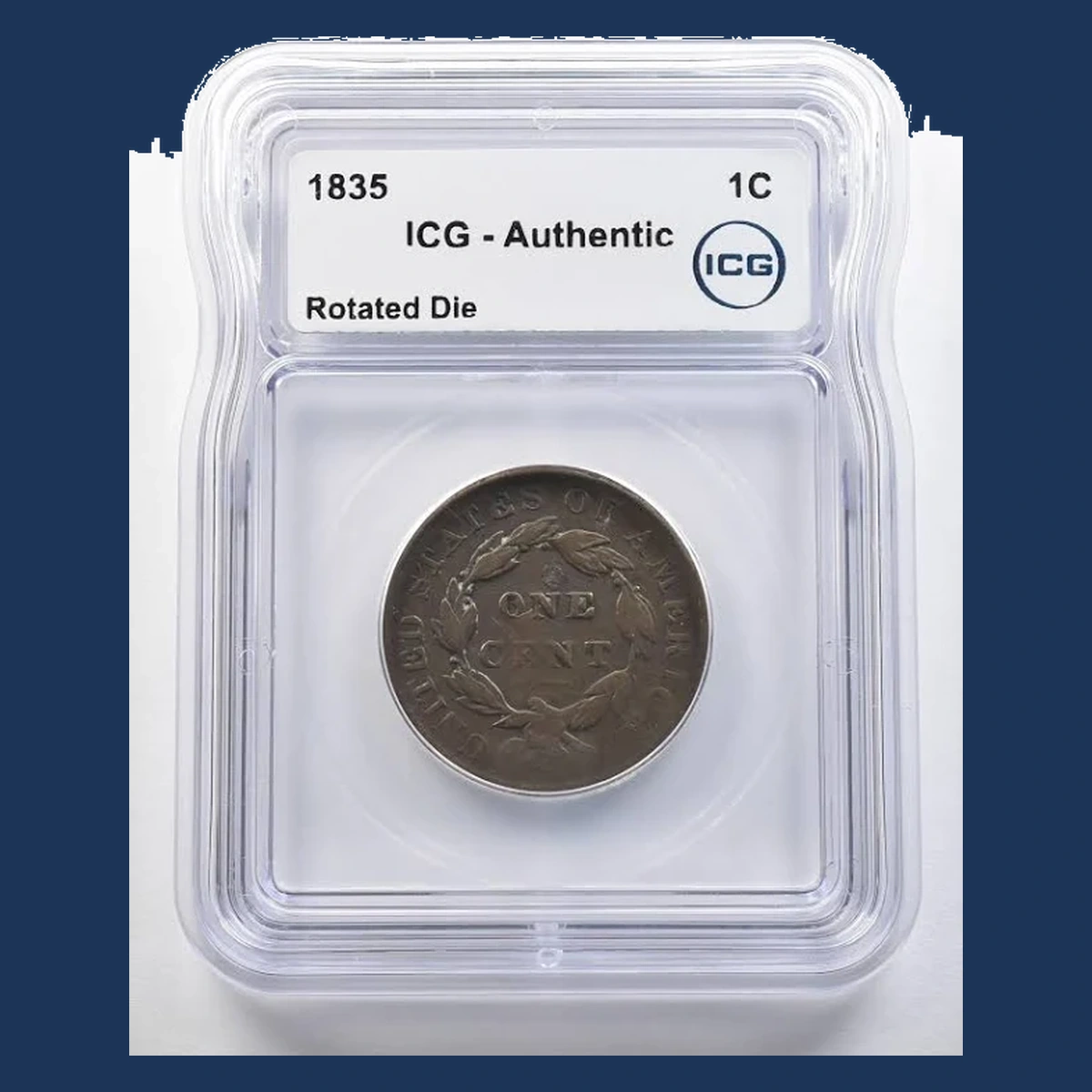
The back leans slightly to the right after the portrait is held upright and turned over. A reported 1835 example has about 15 degrees of clockwise rotation and circulated Very Fine detail.
The stamping tools, called dies, were not aligned at the normal angle to each other. The design can remain complete on both faces.
This is a modest rotation, rather than a dramatic quarter-turn or half-turn. Its small size makes careful handling important: twisting the coin while turning it can create the same apparent tilt.
Estimated Value
For a genuine example with mild rotation, estimate $30–$250. Much of a worn coin’s price may come from the ordinary 1835 cent itself rather than the small alignment error.
A rotated 1858 Flying Eagle cent graded ANACS F12 sold for $154 in June 2026. That later copper-nickel coin provides a useful comparison, but its different design and actual angle must be considered before applying the result to this copper issue.
How to Identify
Use the upright lettering to set your starting position, rather than the portrait’s natural lean. Hold that position over a vertical line and turn the coin top to bottom.
About 15 degrees is a small departure. Repeat the turn several times without twisting to see whether the back consistently ends clockwise from upright.
A 10× magnifier helps check the plain edge for a seam or alteration. Compare the usual 10.89 grams on a scale and roughly 28 mm diameter with calipers.
Photographs should not be rotated independently before comparison. Watch the back settle at the same slight clockwise angle on repeated controlled turns.
2. 1835 Coronet Head Cent Die Cracks and Retained Rim Breaks — Estimated Up to $1,500
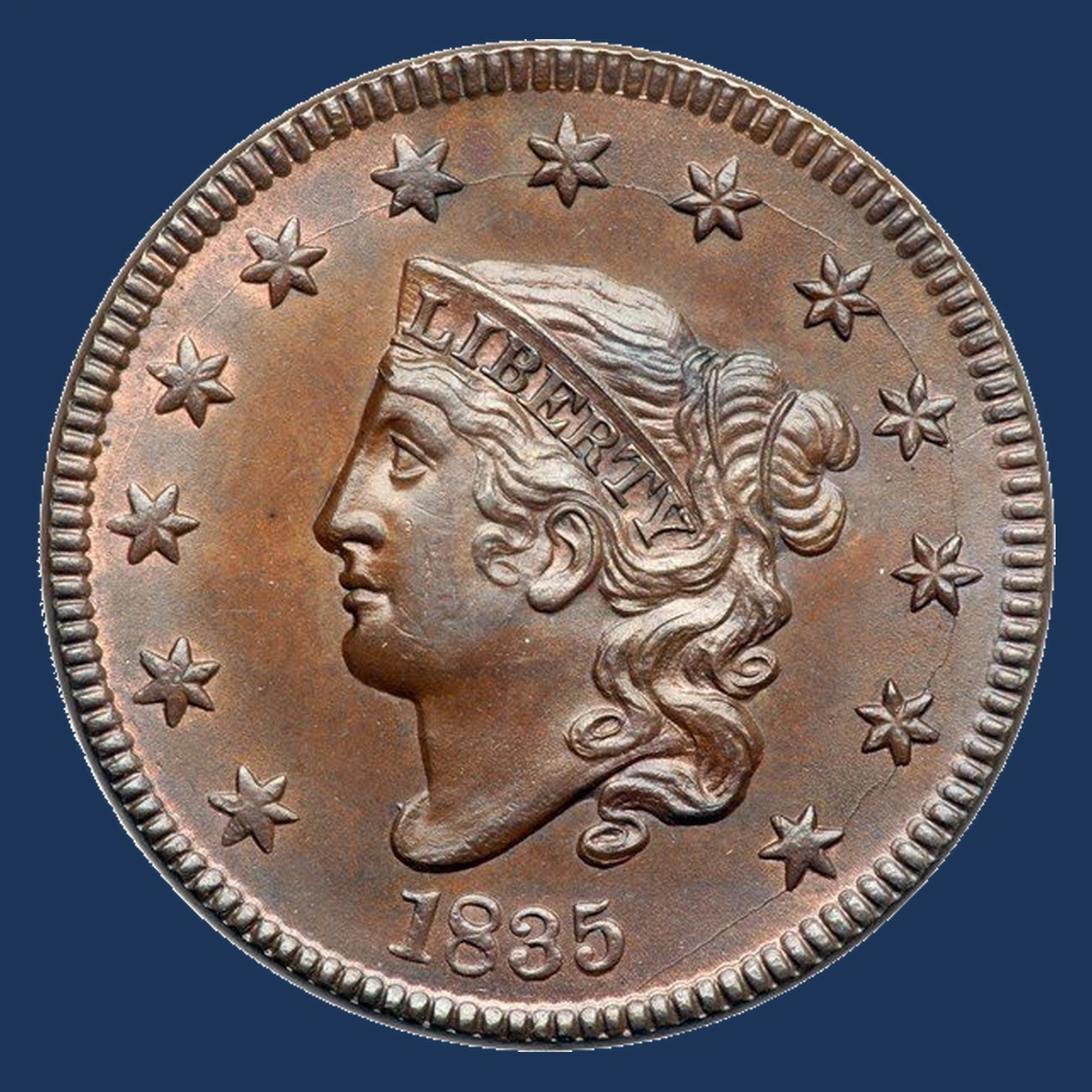
A raised area near the left stars shows where a broken piece of the stamping tool shifted but stayed in place. This is a retained cud, or retained rim break.
The 1835 N-13 example uses the Small 8 and Small Stars design. Its break lies between stars four and six, meeting star five; the surface is higher near star four and lower near star six.
A separate Large 8, Large Stars N-1 cent has a thin raised crack connecting stars eleven and twelve. These are different tool failures on different coins.
Estimated Value
Fine raised cracks on circulated coins may fall within an estimated $30–$500 whole-coin range. A clearly defined retained rim break can justify an estimated $100–$1,500, depending on preservation and size.
An 1864 copper-nickel cent combining a retained rim break with a broadstrike brought $646.25 in 2016. Because that later coin has two errors and different metal, its result is a general comparison rather than a price for either 1835 specimen.
How to Identify
Check the date and star size against the appropriate variety photograph. A Small 8, Small Stars N-13 break should not be matched to the right-side crack on Large 8, Large Stars N-1.
For the retained break, inspect stars four through six under a 10× magnifier. Follow the boundary into the plain rim area and compare the higher side near star four with the lower side near star six.
A scale and calipers check the normal 10.89 grams and approximately 28 mm size. For N-1, trace the raised copper between stars eleven and twelve, rather than a groove cut through them.
3. 1835 Coronet Head Cent Curved Clip — Estimated Up to $1,500
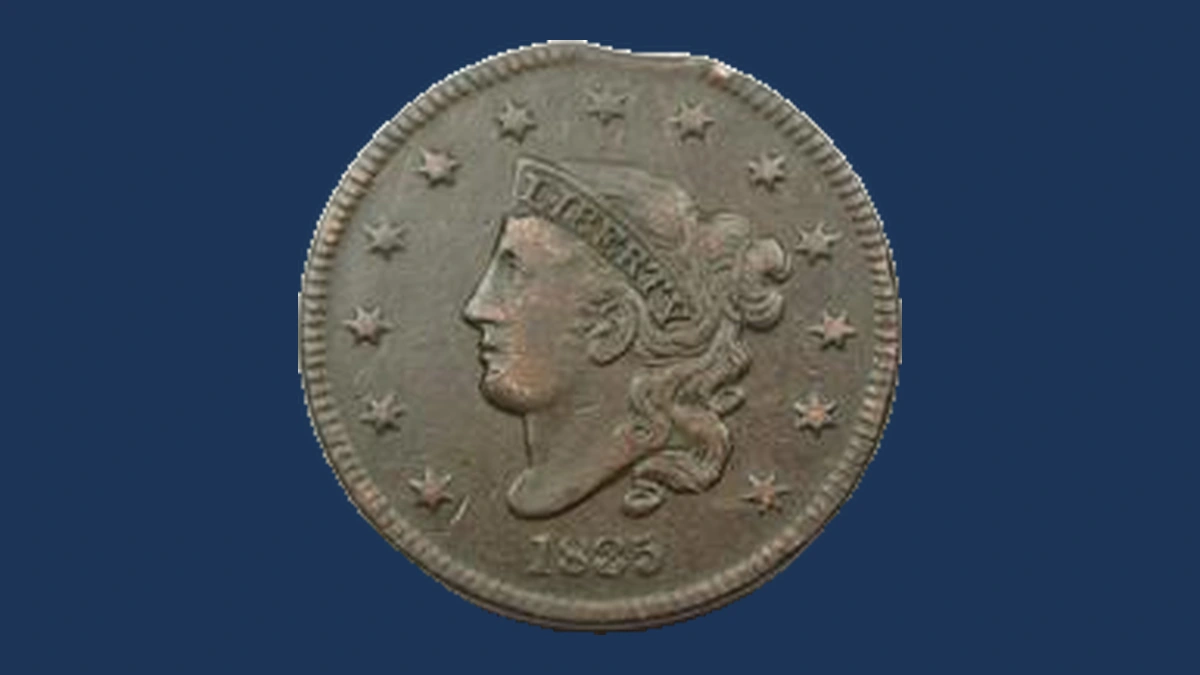
The edge has a curved bite near the ninth star, corresponding to IC in AMERICA on the back. The N-16 example uses the portrait known as Head of 1836, despite its 1835 date.
The missing curve formed when the metal disc was cut from the copper strip before striking. A disc cut across a previous hole can emerge incomplete.
On this coin, the border teeth opposite the gap are weak near stars one and two. That opposite weakness supports the explanation but cannot prove a clip without examining the gap itself.
Estimated Value
Genuine curved clips have an estimated $80–$1,500 range across circulated and better-preserved examples. The clear gap and supporting rim features are more important than a seller’s percentage alone.
An 1842 large cent with a straight clip was recorded at 10.63 grams, but its sale amount is not used here. A priced comparison is a much later 1939 clipped cent, MS64 Brown, which brought $180 in 2023; the older large cent requires its own condition allowance.
How to Identify
Orient the ninth star beside the gap, then locate IC on the back. That checks whether the missing section agrees with the described N-16 coin.
Compare the border teeth near stars one and two with the surrounding teeth. Opposite weakness is helpful, but wear can also erase small details.
At 10×, examine both ends of the curve for naturally formed rim transitions rather than a sharp sawed edge.
The remaining plain edge should lack fresh file marks. Record the weight against 10.89 grams and use calipers across intact areas against about 28 mm.
Follow the struck design into the curved gap on both faces before accepting the clip as original.
4. 1835 Coronet Head Cent Pre-Strike Metal Fissure — Estimated Up to $2,500
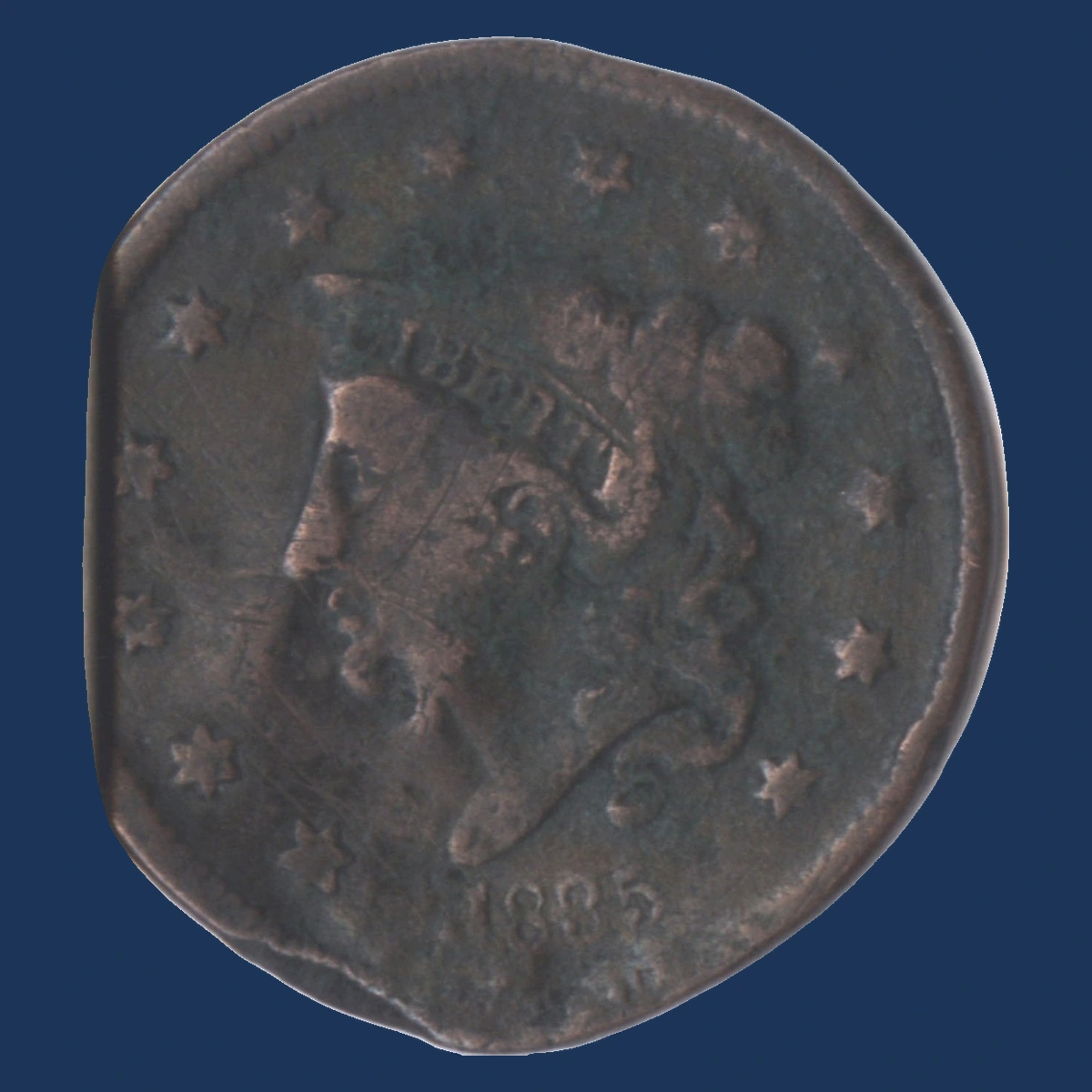
A narrow vertical opening runs along the cheek on an N-1 cent described in a Goldberg auction. The catalog suggested that it began as a defect in the metal before striking.
The pressure of the strike did not completely close the gap. A planchet is the prepared metal disc used to make a coin, and such a disc can contain a flaw before entering the press.
This explanation must be distinguished from a scratch made later. A thin cheek fissure also does not mean that the whole cent separated into two halves.
Estimated Value
Estimate $30–$2,500 for an authenticated early metal flaw, with a wide spread because grade and surface quality strongly affect old copper. The flaw itself need not add a premium.
For a nearby-year comparison, an 1842 cent with a rim-layer flaw sold for $750 in September 2021. A layer flaw is not identical to a narrow fissure, but that sale illustrates how a mint-made metal defect can coexist with valuable preserved detail.
How to Identify
Tilt the cheek under a 10× magnifier before deciding whether the line is an opening or a fresh cut. A sharp displaced lip and scraped copper can suggest later damage.
Compare the Large 8, Large Stars N-1 portrait with the described example. Its separate raised crack between stars eleven and twelve is not the cheek fissure.
Keep measurement tools away from the opening. Weigh against 10.89 grams and measure an intact span against roughly 28 mm with calipers.
Inspect the plain edge for broader damage as well. Look for original struck detail meeting the fissure naturally, without fresh cutting or pushed metal along its sides.
5. 1835 Coronet Head Cent Split Planchet — Estimated Up to $3,000
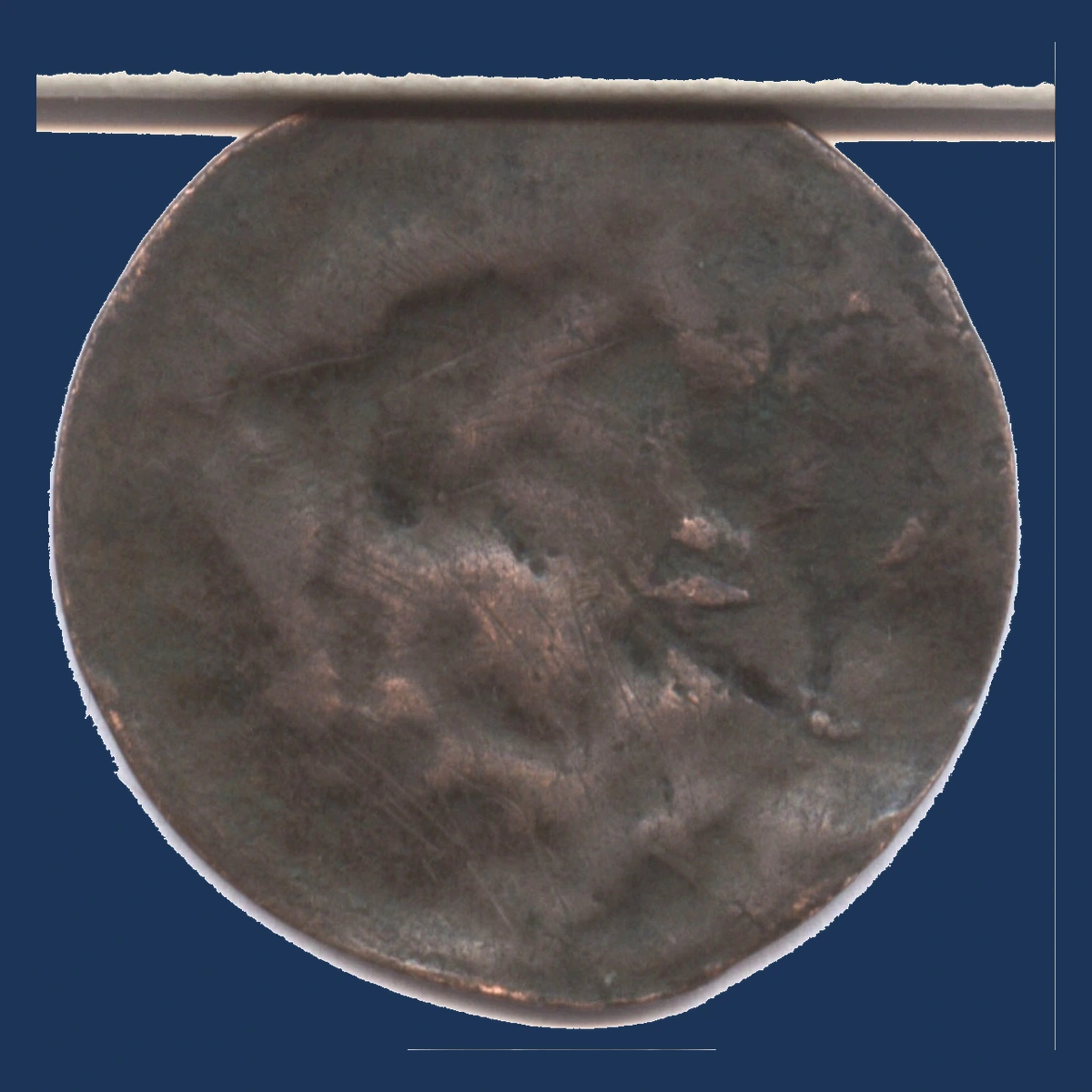
Only the front portion survives in the reported split-cent example. The other side of that piece exposes the inside of the copper rather than a normal complete back design.
The metal separated along an internal weakness. This is a split planchet, which differs from a small flake peeling from one spot.
The front half does not establish that a matching back half is available. Its actual weight, thickness, and the timing of separation must be judged from the piece; the ordinary full-coin weight should never be presented as its measured weight.
Estimated Value
For an authenticated dated front half, use an estimated $150–$3,000. Readable design, convincing separation surfaces, and the absence of later cutting are central to its appeal.
An undated Lincoln Memorial cent back half, graded NGC MS66 Red and Brown, sold for $89 in September 2025. That recent split-planchet result shows the basic mechanism’s market, but its common small-cent design and missing date make it a limited comparison for an 1835 large cent.
How to Identify
Start with a scale: a surviving half should be compared with the full coin’s normal 10.89 grams, not expected to equal it. Do not assume exactly half that weight.
Use calipers gently to record thickness and the surviving diameter relative to about 28 mm.
Under a 10× magnifier, inspect the exposed inside for a rough, layered surface. Parallel tool marks or an evenly machined surface point toward later alteration.
Check the remaining plain edge and read the date on the surviving front. There need not be a matching second piece.
Compare the intact struck face with the natural separation surface on the other side before calling it a split cent.
6. 1835 Coronet Head Cent Off-Center Strike — Estimated Up to $6,000
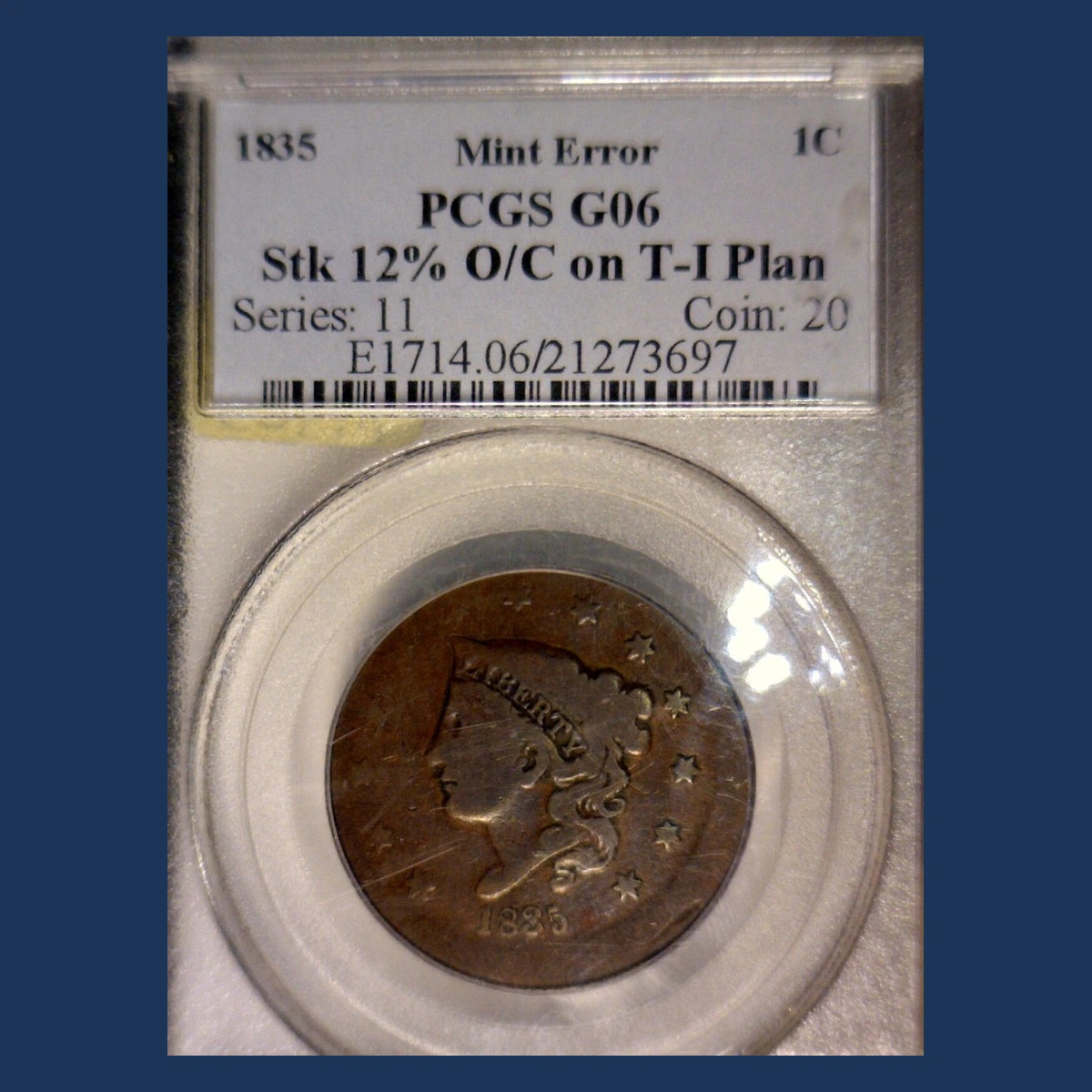
The design runs beyond the available copper while part of the disc remains unstamped. Two different 1835 examples illustrate how much the displacement can vary.
One was described as PCGS G6, struck about 12% off center at ten-thirty on a Type I blank. Here, Type I means a disc without a previously raised rim.
The other is a Head of 1836 coin graded PCGS AU58 with about 30% displacement. Its better-preserved surfaces and larger shift should not be combined with the first coin’s angle or blank description.
Estimated Value
An estimated $500–$6,000 covers varied readable-date off-center examples, from worn smaller shifts to attractive larger ones. The PCGS G6 and AU58 reports describe very different levels of wear.
A large-cent comparison is an 1854 coin struck about 50% off center, which sold for $1,527.50 in 2016 at ANACS VF20. That actual sale helps frame the estimate, but it does not establish either 1835 coin’s own realized price or current market value.
How to Identify
Read the date first and check which portrait appears on the coin. Head of 1836 is a design name here, not a reason to change the readable year from 1835.
Compare the original plain edge and unstruck crescent under a 10× magnifier. On the 12% example, the reported displacement is at ten-thirty; do not transfer that angle to the separate 30% coin.
A scale checks against 10.89 grams, while calipers record the outline against a normal size around 28 mm. Find where the design is cut off opposite untouched copper, then check the other face for the same off-center strike.
7. 1835 Coronet Head Cent Double Strikes, Including Brockage Traces — Estimated Up to $20,000
Extra raised stars remain at the front rim of the PCGS MS66 Brown Pogue cent. Its back has sunken, reversed stars, called a brockage.
The catalog explains that another struck coin blocked the back tool during the first strike. A later strike covered much of that impression, leaving both sets of traces on one coin.
A separate N-5 cent shows doubled and tripled outlines from crown to chin and around stars seven through twelve. Those repeated outlines need their own explanation; they do not establish the Pogue coin’s exact sequence.
Estimated Value
The Pogue catalog estimated its combined double-strike and brockage coin at $5,000–$7,500; this was not a realized price. Across varied repeated strikes, use an estimated $500–$20,000.
An 1811 large cent double struck with its second impression 50% off center brought $16,200 in September 2025 at PCGS VF30. That dramatic error is a comparison, while the Pogue specimen’s two linked effects must never be priced separately and added together.
How to Identify
Examine both faces before naming the extra marks. On the Pogue example, a 10× magnifier shows older raised stars at the front rim and sunken, reversed stars at the back.
The difference in height matters: another coin pressed its raised stars into the back. Ordinary raised ghost lines would need a different explanation.
For the separate N-5 example, follow repeated outlines from crown to chin and around stars seven through twelve.
Check the plain edge, and compare 10.89 grams and approximately 28 mm using a scale and calipers. Pair the Pogue coin’s raised front stars with its sunken back stars, keeping N-5’s repeated profile separate.
Conclusion
On an 1835 cent, separate the shape of the disc from the designs impressed into it. A missing curve, an exposed inner layer, and a repeated star each point to a different process.
Estimated values range from $30 to $20,000 across the examples discussed. Check the portrait variety and condition, and remember that the Pogue double strike and brockage describe one coin whose features cannot be priced separately.