1840 Cent Error List with Pictures

A ninety-five-degree twist is easy to notice when you flip an 1840 cent. Earlier date strokes are smaller targets, yet an exceptional Small-over-Large 18 example sold for $16,100 in December 2013.
This 1840 cent error list covers estimated whole-coin prices from $20 to $18,000. Size differences between ordinary Small Date and Large Date cents are not errors by themselves.
Compare the features below to find the right explanation for an unusual date, edge, surface, or alignment.
1. 1840 Braided Hair Cent Copper Layers Separating near the Back Rim
A loose layer can begin at the back rim and extend into the design. The copper separated along a weakness within the blank, producing a flaw called lamination.
The 1996 Early American Coppers catalog describes a Small Date example near the back’s one-o’clock border. A different Large Date example has a separation running from seven o’clock toward the ribbon.
Those paths belong to two coins. The date sizes help keep the examples apart but do not cause the peeling.
An attached flake may carry struck detail. Scraping or a sticky deposit can imitate its outline without forming a copper layer.
Estimated Value
Estimate $20–$150 for worn 1840 laminations, or $150–$750 for more distinct examples with better-preserved surfaces. These ranges value the whole coin.
A separate Large Date example, cataloged VF30, sold for $108 including the buyer’s premium in May 2025. It had a lamination below 84 and other surface issues, rather than either back-rim location described above.
Metal separation does not erase scratches or residue from the comparison. More peeling may reduce the remaining design as much as it adds visual interest.
How to Identify
Identify Small Date or Large Date before choosing a photograph for comparison. Use a 10× magnifier around one o’clock on the Small Date back, or seven o’clock toward the ribbon on the Large Date back.
Tilt the lamp to reveal the edge of a thin layer. Leave every attached flap in place.
A scale compares a loose cent with 10.89 g, while calipers measure intact edges against 27.5 mm. A small lost flake need not create a large difference.
Look along the peeling edge for original lettering or border detail that continues onto the flap. Wax sitting on top of the copper does not form a metal layer beneath that struck detail.
2. 1840 Braided Hair Cent Original Hollows beside the Stars and Portrait
Three shallow hollows interrupt the front of one Large Date cent. One sits left of star 11, another on the cheek, and the third beside the chin.
The auction description identifies these as flaws already present when the coin was struck. It does not identify a trapped bubble or a particular impurity as their cause.
The same cent has later contact marks, including a fine scratch extending toward star 13. That scratch is separate from the original hollows.
Examine each pit separately. Being near a known original flaw does not make surrounding damage part of the minting process.
Estimated Value
The Large Date N-7 with three original hollows sold for $576 including the buyer’s premium in May 2025. The catalog assessed it as EF45 after allowing for the flaws.
For comparable circulated 1840 blank defects, estimate $30–$300 in lower grades and $300–$1,000 for better-preserved examples or scarcer varieties. These are whole-coin estimates.
The hollows reduced the catalog’s condition assessment rather than automatically increasing the price. Compare the remaining portrait, surface quality, and variety before using the $576 result.
How to Identify
Photograph the cheek, chin, and star 11 under angled light, then examine the walls of each hollow with a 10× magnifier. Pressure from a later blow can leave a raised lip around a dent.
A uniform scatter of pits across the cent may instead suggest corrosion. The cataloged coin has three specifically located original hollows, not a general claim that every pit is mint-made.
For a loose copper cent, weigh it against 10.89 g on a scale and measure 27.5 mm with calipers. Compare the separate scratch toward star 13 with the hollows themselves; an engraved channel through finished detail has a different origin from a depression already present at striking.
3. 1840 Braided Hair Cent Back Turned Ninety-Five Degrees Clockwise
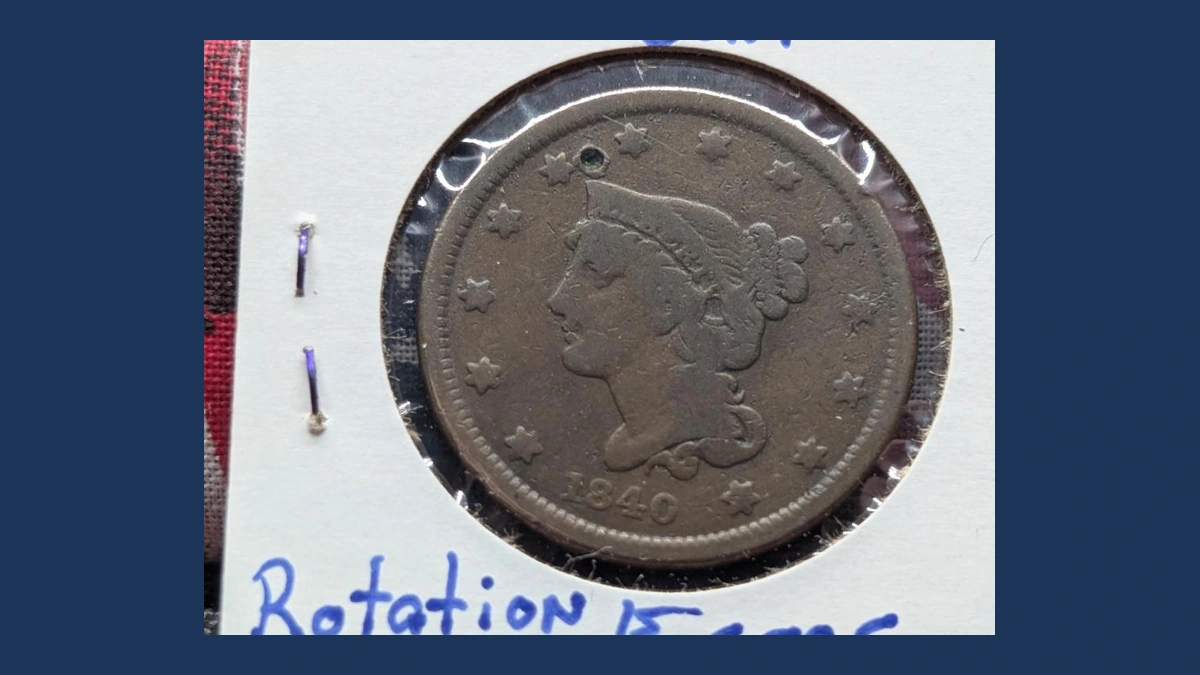
After the portrait is held upright and the coin is flipped top to bottom, the back can remain almost sideways. One Small Date example has a ninety-five-degree clockwise rotation.
The stamping tools had the wrong relative angle. The date and portrait can look normal even though the wreath points sideways after the flip.
Early Cents Auctions described the coin as F15, a circulated grade with substantial wear. Other rotated examples of this variety were reported turning in the opposite direction.
The direction and angle belong to each individual coin. A separately rotated photograph can hide or imitate the same effect.
Estimated Value
The described Small Date F15 sold for $72 including the buyer’s premium in May 2025. Its ninety-five-degree clockwise rotation therefore has a direct circulated sale comparison.
Estimate $40–$300 for similar worn 1840 rotations. Better-preserved examples with a clear, substantial turn can fit roughly $300–$1,500.
Angle alone does not set the price. Contact marks, remaining portrait detail, and attractive surfaces still matter, and a counterclockwise coin should be measured separately rather than assigned the same direction from its variety name.
How to Identify
The back should be upright after you turn an upright portrait top to bottom. On the ninety-five-degree example, the wreath instead lies just beyond a quarter turn clockwise.
Photograph that flip with a fixed horizontal guide, using a 10× magnifier to locate the worn wreath’s center if necessary. For a loose cent, a scale and calipers also check the normal 10.89 g and 27.5 mm.
Put a protractor against the guide line in the back photograph and record the direction as well as the angle. Keep the camera and holder level; a tilted photograph changes the reading even when the coin itself has not moved.
4. 1840 Braided Hair Cent Incomplete Rim from a Missing Part of the Blank
A small missing portion of the blank can leave an opening in the cent’s outline. The defect starts before the design is struck, rather than when somebody cuts a finished coin.
GreatCollections recorded an 1840 rim clip graded ANACS VF30 in the Rippere Collection. VF30 indicates a circulated coin with considerable design detail still visible.
The summary does not specify the clip’s size or clock position. A dramatic crescent should not be assumed from the label alone.
Weakness on the rim opposite a clip can support the diagnosis. It is a supporting sign, not proof by itself.
Estimated Value
For an 1840 rim clip of modest size, estimate $50–$350 in worn condition. Clearer or larger examples with better preservation can fit approximately $350–$2,000.
The ANACS VF30 listing gives a useful condition comparison, but its completed price is not used here. These figures remain estimated whole-coin ranges.
A readable date and an edge that clearly formed before striking matter more than a dramatic-looking cut. Later filing can remove metal too, without creating a collectible mint-made clip.
How to Identify
Keep an ANACS-graded example in its holder, using clear photographs of the rim opening. For a loose coin, record its weight on a scale against 10.89 g and intact widths with calipers against 27.5 mm.
The size of the missing segment matters when interpreting any weight loss. A tiny rim clip may remove very little copper.
With a 10× magnifier, examine where the struck border meets each end of the opening, then inspect the opposite rim for weakness. Straight filing marks through finished detail point toward later work; a naturally incomplete blank should show edges shaped by the original strike instead.
5. 1840 Braided Hair Cent Cracks across the Front and Rim Breaks below the Date
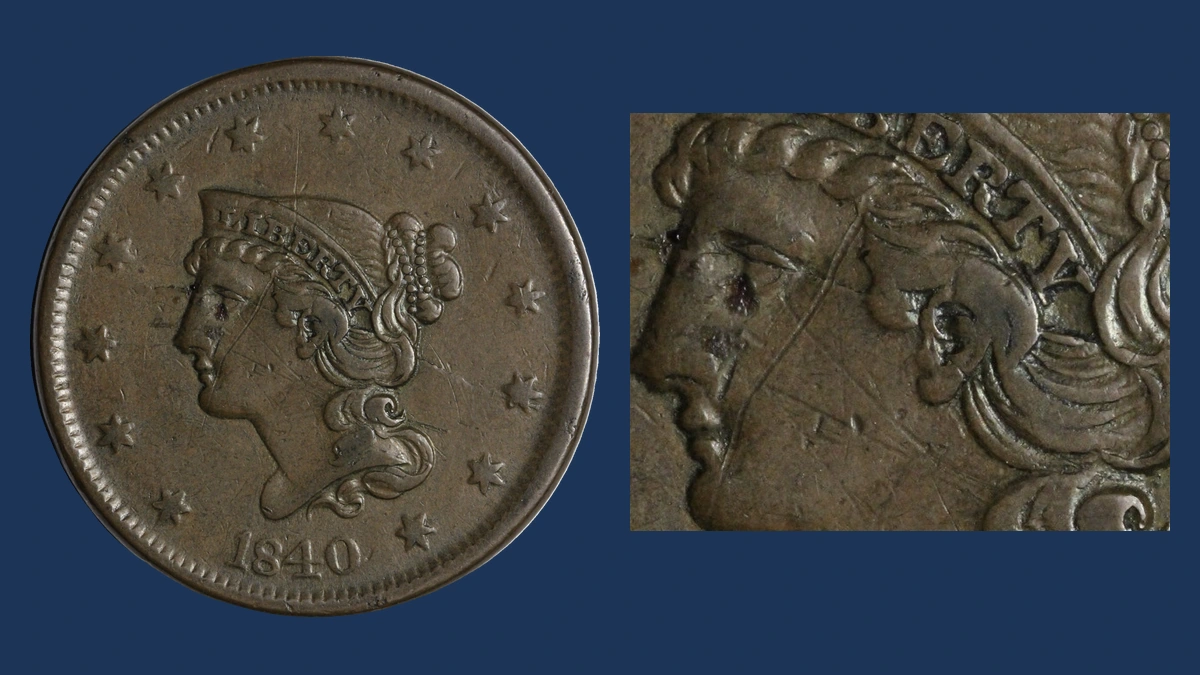
A raised ridge can divide the portrait side when a stamping tool cracks across its face. The Hall of Fame catalog describes a strong front-crossing crack on a Large Date cent.
The written account does not name every star or curl along its route. A matching photograph is needed to follow the complete line.
Other examples have raised patches joined to the rim, called cuds. These form where a larger piece of the stamping tool has broken away.
One Small Date cent has a cud below 840; a Large Date example has narrow lower-front rim breaks. They are separate coins.
Estimated Value
A Large Date VF35 with the strong front-crossing crack sold for $288 including the buyer’s premium in May 2025. Its condition assessment included a small area of smoothed metal on the back.
Estimate $25–$250 for modest cracks and roughly $100–$2,500 for stronger breaks across suitable conditions. A separate AU55+ example with lower rim cuds and a repunched 0 brought $780 at the same sale.
That $780 values one coin with both features. Their prices should not be added together.
How to Identify
Before magnifying a line, turn the entire cent under a low lamp. A raised ridge across the front will catch light above the surrounding copper, while an ordinary scratch cuts below it.
Use a 10× magnifier to follow the ridge from one end to the other. Examine its crossings over portrait details for a raised line rather than a cut.
For a patch below the date, examine whether it reaches the original rim and whether the nearby design fades into it.
Weigh a loose coin on a scale against 10.89 g and check 27.5 mm with calipers across an unaffected span. A folded edge or added lump can mimic a cud, so inspect the patch from the side as well as above.
6. 1840 Braided Hair Cent Part of the Design Missing the Blank
An off-center strike leaves some of the blank bare while cutting off part of the design on the opposite side. Both faces reflect the blank’s misplaced position between the stamping tools.
The 1840 year guide includes this error without specifying a percentage or direction. It does not identify a Small Date or Large Date example.
A dateless Braided Hair cent cannot settle those questions. The design spans several years, so a similar displaced portrait alone does not identify 1840.
An intact date is especially helpful when comparing these coins. The bare crescent must belong to the original strike.
Estimated Value
Estimate $500–$2,500 for circulated 1840 off-center cents with readable dates, and $2,500–$8,000 for dramatic examples with better preservation. These estimates require a coin whose year is identifiable.
As an other-year comparison, a thirty-percent off-center 1848 cent graded PCGS XF40 sold for $1,980 in December 2023. That result is not a sale record for the guide’s 1840 report.
Do not transfer the thirty-percent measurement to an unidentified example. Compare its own displacement, wear, date visibility, and surface condition.
How to Identify
Find all four digits of 1840 before measuring the error. Under a 10× magnifier, check that the last digit has not been altered or partly lost beyond the struck area.
Photograph both faces with the untouched crescent included. The missing design should fit one misplaced blank, not just a front tool shifted against a centered back.
On a loose cent, a scale compares 10.89 g and calipers record widths against the ordinary 27.5 mm diameter. Missing design need not mean missing metal.
Inspect the bare area for grinding, flattening, or polished tool marks. A readable original date beside a genuinely unstruck crescent is the useful starting point for this year-specific comparison.
7. 1840 Braided Hair Cent Small 18 over Large 18 and Other Repeated Digits
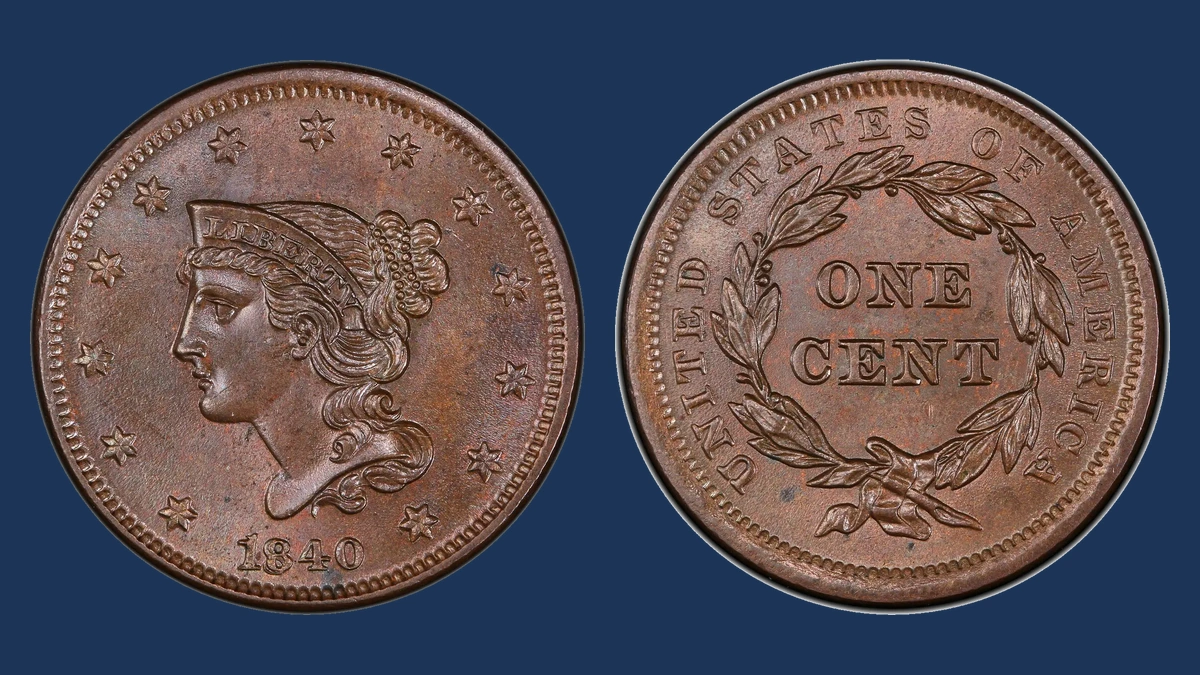
The opening 18 can retain traces of larger digits beneath the smaller final ones. This happens when a stamping tool receives a second date impression before the first is fully removed.
The Small-over-Large 18 variety is identified as N-2. Other 1840 tools show repeated strokes on the 8, the 0, or both digits of 40.
Small Date and Large Date alone are ordinary design choices. Extra strokes are what identify the repunching.
Another variety was once called 1840/39 because of raised lumps near the date. The catalog identifies these as tool defects, not remains of an earlier year.
Estimated Value
PCGS records $16,100 for a Small-over-Large 18 graded MS66 Brown at Legend in December 2013. MS66 describes an exceptionally preserved coin without circulation wear.
Estimate $50–$750 for many circulated repunched dates, and roughly $750–$18,000 across better-preserved examples and the exceptional Small-over-Large 18 grades. In May 2025, a cataloged MS60 repunched 40 brought $2,160 including premium.
The different digit patterns need their own comparisons. The finest Small-over-Large 18 price does not apply automatically to every repeated 0.
How to Identify
For Small-over-Large 18, place a 10× magnifier over the first two digits and compare the larger strokes with the final smaller shapes. Keep 40 visible to show the complete date arrangement.
The repunched 0 can show extra detail at its upper left. Wear may make that detail faint without changing where it belongs.
Check a loose cent’s 10.89 g weight with a scale and its 27.5 mm diameter with calipers, then return to the digit shapes.
A scratch through the date or a random raised lump is not enough.
Match strokes that actually form part of an earlier numeral, including their direction and spacing. A Small Date cent with no such remnants is simply the normal Small Date design.
Conclusion
An 1840 cent can show missing copper, extra raised copper, or a design facing the wrong direction. Each feature calls for a different check.
Estimated whole-coin prices run from $20 to $18,000, with exceptional repunched dates at the upper end. Small Date and Large Date remain normal designs unless an additional error is present.
Keep existing damage in the comparison, and use the actual date strokes or metal boundaries rather than an old nickname alone.