1847 Cent Error List with Pictures

An 1847 large cent can have both a mint error and later damage. A carved letter or corrosion does not erase the original mistake, but it changes how the coin should be valued.
At the other extreme, a well-preserved cup-shaped die cap sold for $28,800 in August 2021. This 1847 Braided Hair cent error list spans estimated whole-coin values of $10–$45,000.
Work through the visible differences below, keeping each coin’s condition attached to its error rather than pricing the name alone.
1. 1847 Braided Hair Cent Lamination — Estimated Value $10–$750
A rough surface can contain more than one kind of damage. Thin copper layers may have separated from the original blank, while later exposure also corroded the coin.
An 1847 listing describes severe lamination on both faces and VG8 Details condition with environmental damage. VG8 indicates substantial wear, while Details flags a separate condition problem.
The reported lamination concerns separation within the copper. It does not establish that the coin split into two complete halves.
Corrosion can hide or imitate a flaky surface, so the boundary of the actual metal separation matters more than the general rough appearance.
Estimated Value
For worn 1847 laminations, estimate $10–$750, with environmental damage lowering the useful comparison. More peeling does not automatically mean more value.
A better-preserved 1855 large cent with a thin lamination and a separate rim break sold for $460 before the buyer’s fee in January 2011. Its cataloged MS62 condition is very different from VG8 Details.
That sale concerns the entire 1855 coin. It should not be treated as a standard price for every copper flake on the damaged 1847 example.
How to Identify
Map the corrosion before identifying a lamination. General pitting spread across both faces can explain roughness without a thin layer separating from the original copper.
Under a 10× magnifier, look for a distinct layered boundary or lifted edge within that rough surface. Photograph it without picking off any remaining flake.
The listing does not place the defect beside a particular letter, so follow the actual boundary on each face. Do not extend one small separation into a claim that the whole coin split.
For a loose cent, check its plain edge and compare scale weight with 10.89 g and caliper width with 27.5 mm. Corrosion can also remove weight, making a low reading insufficient by itself.
2. 1847 Braided Hair Cent Clipped Planchet — Estimated Value $20–$1,000
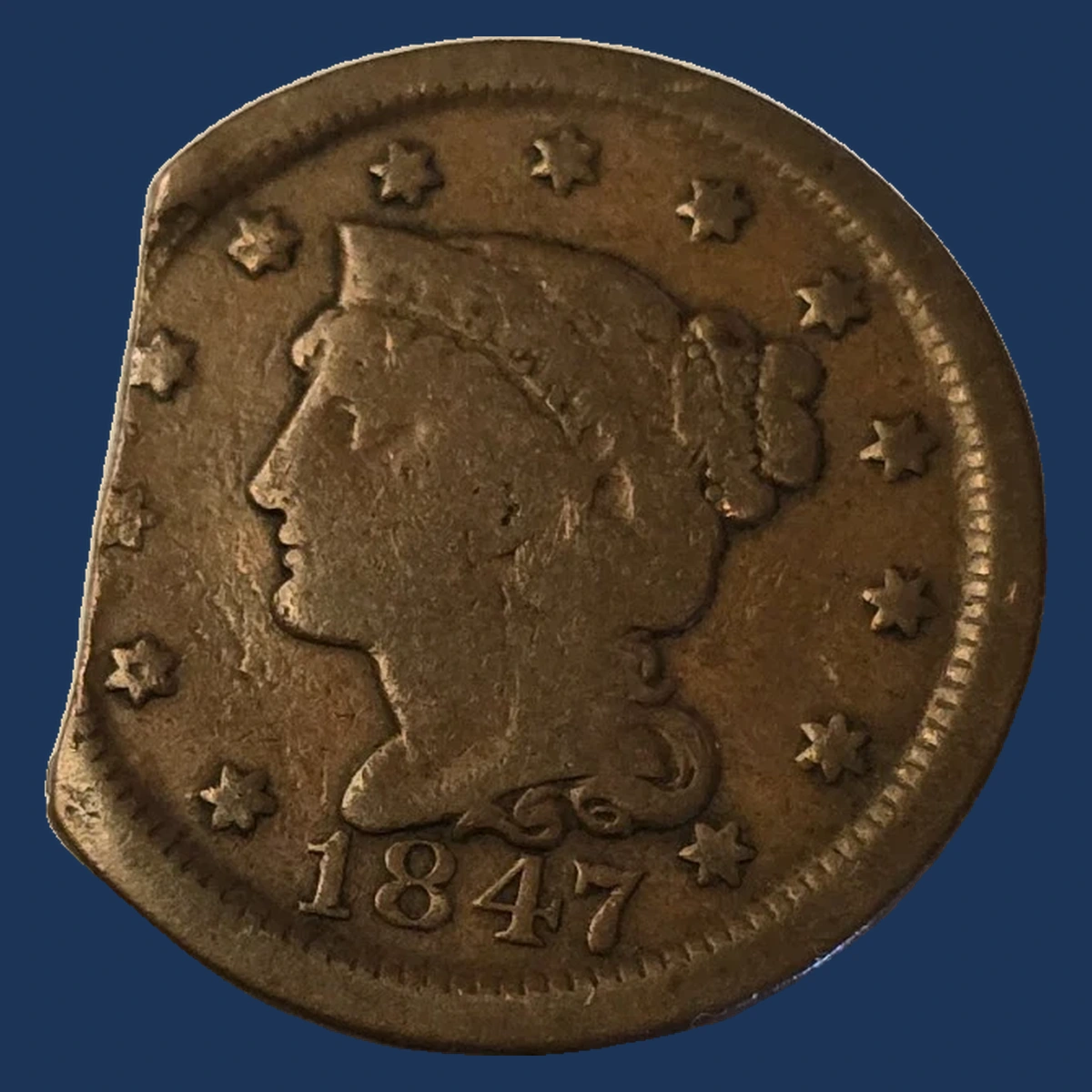
The clipped 1847 cent in a 2023 Stenzel catalog also has a W carved on the face. Those two features require separate explanations.
A genuine clip begins with an incomplete blank before striking. The carved letter is damage added to the finished coin.
The catalog identifies both the clipped-planchet claim and the damaged condition. It does not establish a particular shape or clock position for the opening.
A later scratch does not automatically disprove an original mint error elsewhere on the coin. Equally, calling the coin clipped does not make the carved W a feature produced at the Mint.
Estimated Value
Estimate $20–$1,000 for genuine 1847 clips across damaged circulated coins and clearer, better-preserved examples. The carved W is a reason to lower the comparison, not add an engraving premium.
An unworn 1852 Braided Hair clip graded NGC MS63 Brown sold for $384 in June 2024. That is a different date and condition.
The Stenzel listing has no realized price used here. Its damaged coin should not receive the unworn specimen’s result simply because both descriptions mention a missing piece.
How to Identify
Keep the carved W and the edge gap in separate close-ups. The W documents later damage; it cannot determine whether the missing edge existed before or after striking.
At the opening, use a 10× magnifier to check how the original rim ends. Saw cuts or a filed surface suggest later removal, while soft rim formation can support an incomplete blank.
A curved gap may also weaken the opposite rim, but that clue is not universal.
For a loose coin, use a scale to compare the remaining weight with 10.89 g. Measure surviving spans with calipers against 27.5 mm and inspect the plain edge.
The physical gap, rather than the catalog label or the unrelated carving, must support the clip identification.
3. 1847 Braided Hair Cent Struck Through a Metal Flake — Estimated Value $40–$1,500
A thin piece of metal between the blank and stamping tool can prevent part of the design from forming normally. The flake leaves an impression where it interrupts contact.
A dealer’s 1847 example is graded ANACS VF35, a circulated coin with clear remaining detail. The reported obstruction lies near the last star beside the 7 in the date.
This describes material caught during striking, rather than a layer peeling out of the coin afterward. The source does not say that the flake remains attached.
Its position and the interrupted design are the main visible clues to examine.
Estimated Value
The dealer displayed $60 for this ANACS VF35 coin on an out-of-stock page. That archived asking price is not proof of the final amount paid.
Estimate $40–$1,500 for genuine 1847 struck-through errors, depending on the size and clarity of the impression and the coin’s condition. The documented flake belongs to a different comparison from an obstruction covering much of the portrait.
Keep the material identification with this example. A random dent elsewhere on another 1847 cent does not inherit it.
How to Identify
Locate the final star beside the date’s 7, then compare that area with the ANACS VF35 example. Use a 10× magnifier to see how the surrounding design approaches the impression.
A dent made later may flatten already formed detail and push metal outward around its edge. A struck-through area should instead fit an interruption while the design was forming.
For a loose coin, compare its scale weight with 10.89 g and its caliper width with 27.5 mm. Inspect the plain edge as well.
A thin obstruction need not change the coin’s weight appreciably.
Do not lift any material if present. Whether a fragment remains or has fallen away must be established on the actual surface.
4. 1847 Braided Hair Cent Die Cracks and Cuds — Estimated Up to $3,000
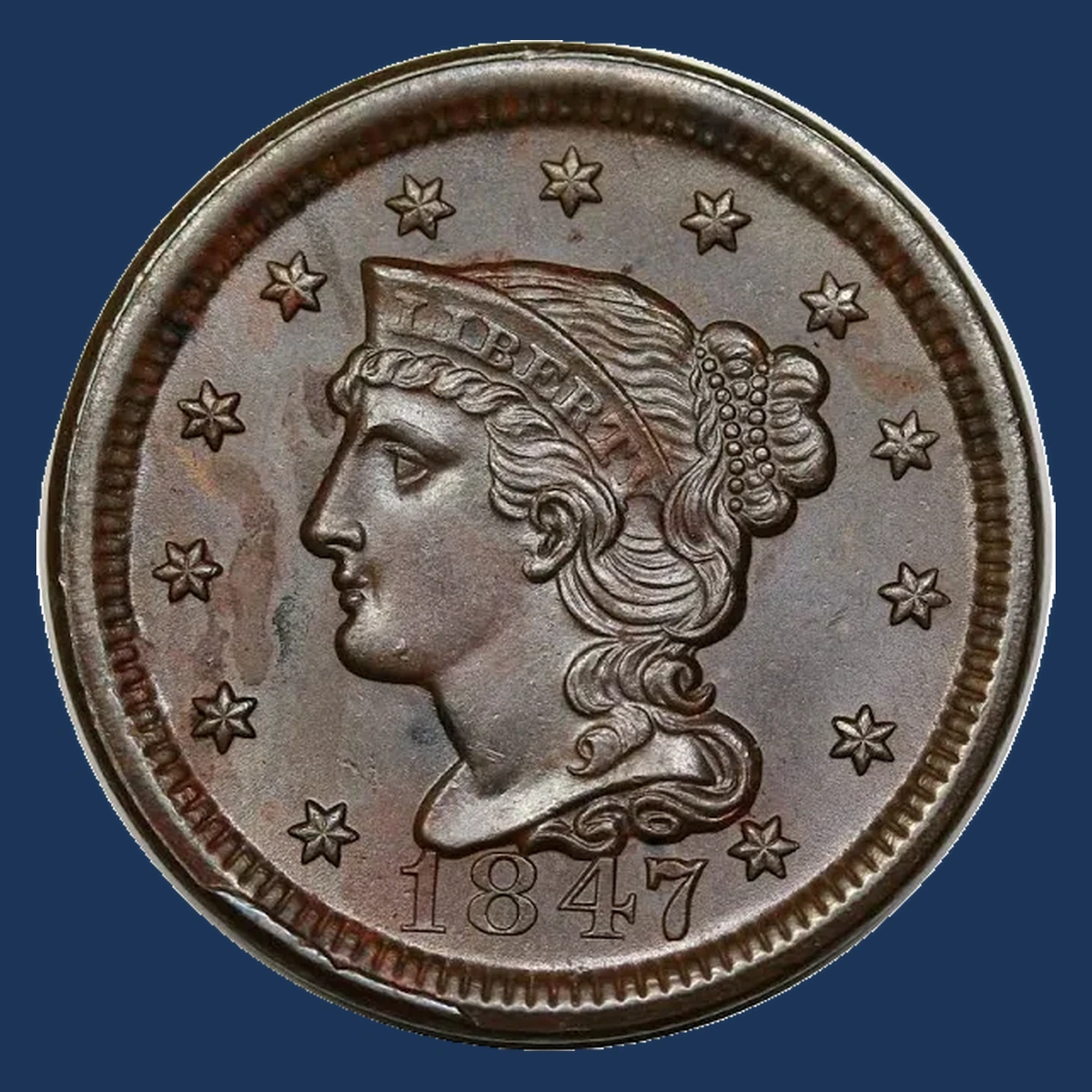
A raised line through MER in AMERICA can record a crack in the die, the steel tool that stamps the back design. Copper entered that opening as the coin was struck.
A missing edge piece leaves a raised rim-connected patch called a cud. One 1847 example has that feature above R in AMERICA.
Other coins have front breaks near the first star or between stars nine and ten. These occur on separate examples.
The crack and the solid patch show different amounts of tool failure. Thin lines can leave the design readable, while a missing edge piece can erase detail.
Estimated Value
Whole-coin estimates run about $15–$750 for recognizable cracks and $75–$3,000 for stronger rim breaks. A small line on a worn cent may add little beyond the ordinary coin’s value.
For comparison, an 1855 large cent with a cud above E in STATES and a thin lamination sold for $460 before the buyer’s fee in January 2011. That is a different year’s combined-feature coin.
Do not transfer its price to every raised patch. Condition and the extent of tool damage matter.
How to Identify
Choose one reported location before comparing photographs. A back cud above R does not need to accompany the front breaks near star one or stars nine and ten.
A loose coin’s basic identity can be checked with a scale and calipers: about 10.89 g and 27.5 mm, with a plain edge. These measurements do not identify which tool broke.
Now use side lighting and a 10× magnifier around MER. A tool crack should rise above the surface, unlike a scratch’s central groove.
For the larger patch, inspect where the raised metal meets the rim and look for any folded edge or added material. Match the shape to its own example instead of joining several distinct breaks into one imaginary pattern.
5. 1847 Braided Hair Cent Off-Center Strike — Estimated Value $100–$5,000
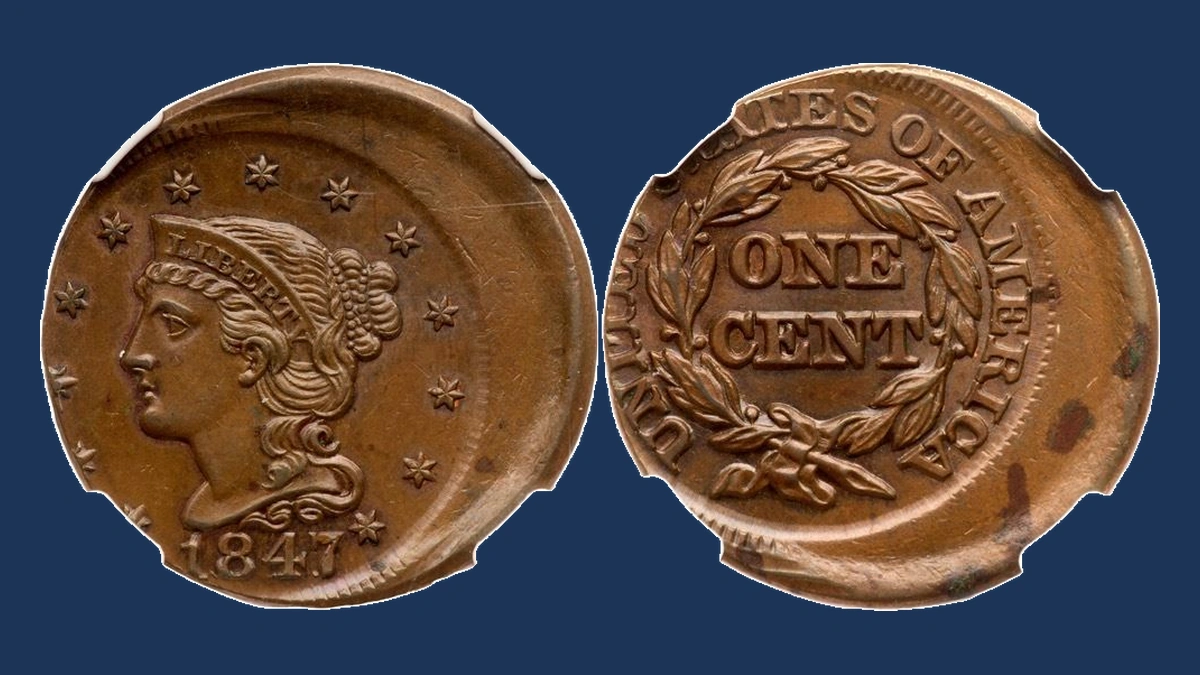
A coin struck off center has unused metal beside the design and missing detail on the opposite side. The blank was not in the correct position when the press struck it.
A seller lists an 1847 example graded PCGS VF25 as 5% off center. That is a modest displacement on a circulated coin.
A collector separately reported owning a 30% example. Neither text establishes a direction that should be copied onto all 1847 off-center photographs.
The amount matters because a slight shift and a large bare crescent leave very different appearances. Both still require evidence of the original striking process.
Estimated Value
For readable, genuine examples, estimate $100–$5,000 according to displacement, condition, and surface problems. The reported 5% VF25 coin and the collector’s 30% example belong to separate comparisons.
A much more dramatic 1855 large cent, graded PCGS Fine 15 and struck 70% off center, brought $1,092.50 in January 2009. It is a different date and has a much larger shift.
That auction result provides a same-series reference. It does not establish a sale amount for either of the reported 1847 coins.
How to Identify
The 5% example needs particular care because a wide rim alone can suggest a small offset. Compare the outer design on both sides and look for the part that actually ran beyond the blank.
At the opposite edge, identify the unused crescent rather than a worn or polished patch. Keep the complete date visible in the photograph.
For a loose coin, weigh it against the original 10.89 g standard and record several widths with calipers beside the normal 27.5 mm. An off-center blow need not remove copper.
Check the plain edge for grinding or cutting. For the larger reported 30% example, use its own surfaces and photographs to establish the direction, rather than assuming it matches the smaller shift.
6. 1847 Braided Hair Cent Repunched Date — Estimated Value $30–$7,500
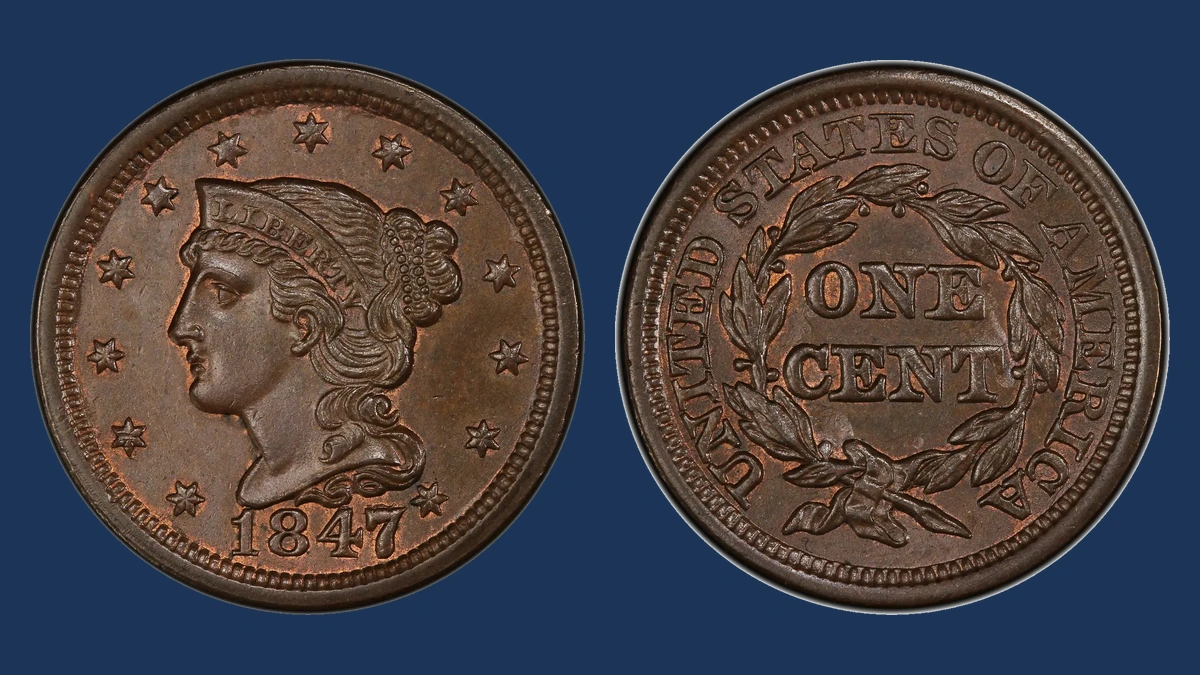
Extra strokes above the date can show an earlier, higher position of the date punch. The worker lightly punched all four digits too high, then placed the same date lower and struck it more deeply.
The shallow earlier digits can look smaller than the deeper final ones. This helps explain the familiar Large 7 over Small or Medium 7 names without requiring a different year beneath 1847.
Another recorded pattern emphasizes the 1, with weaker repunching at the 8. That is a separate comparison.
The size-based names should not replace examination of the actual leftover digit strokes.
Estimated Value
Estimate $30–$7,500 across minor repunchings and more desirable, well-preserved 1847 varieties. The exact pattern and its condition determine which part of that broad range is useful.
A different 1851/81 large cent graded PCGS MS62 Brown brought $823 in February 2018. Its earlier digits were inverted, unlike the high-then-low punching described here.
The cataloged 1847 N-18 MS64+ Brown example documents the date pattern without a realized price used here. Its quality should not be assumed for an ordinary worn repunching.
How to Identify
Do not begin by deciding whether the 7 is large or small. Under a 10× magnifier, trace the earlier strokes above each of the four final digits and compare their positions.
The light upper impression and deeper lower one should explain the apparent size difference. A separate pattern with strong repunching on 1 and weaker detail on 8 needs its own photograph.
Check a loose cent’s 10.89 g copper weight, 27.5 mm diameter, and plain edge with a scale and calipers. These checks help keep the comparison within the correct large-cent issue.
Lastly, distinguish raised remnants from freshly cut grooves beside a numeral. A date repaired or strengthened after minting does not reproduce the original punched-tool pattern.
7. 1847 Braided Hair Cent Die Cap — Estimated Value $15,000–$45,000
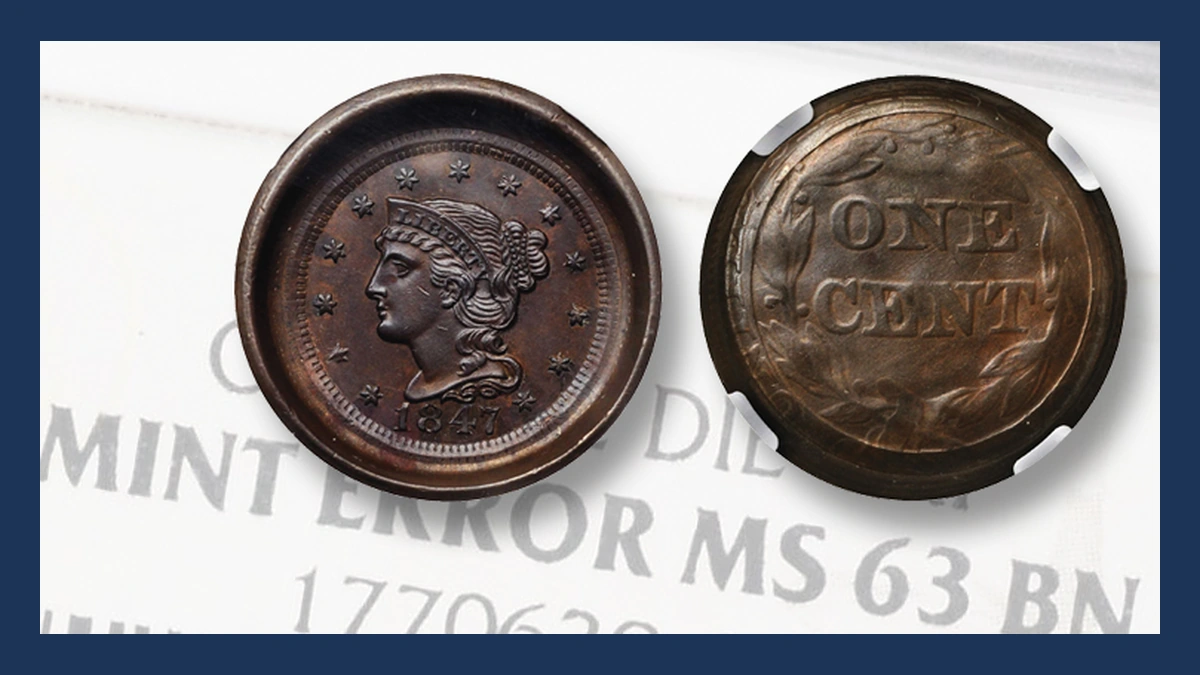
The high walls make this cent look more like a container than a flat coin. It remained attached to the front stamping tool after receiving its first design.
Repeated blows against incoming blanks pushed its rim upward around the tool. The back spread and flattened, although ONE CENT and parts of the wreath remained recognizable.
The documented 1847 example is graded NGC MS63 Brown, an unworn coin with some marks. Its portrait stays clear inside the deep cup.
This is the trapped coin itself. The later blanks it contacted are different pieces, not additional examples shown by this one cap.
Estimated Value
The NGC MS63 Brown cap sold for $28,800 on August 19, 2021 at Stack’s Bowers, reported by Coin World. Its depth and well-preserved inner design are important parts of that result.
An estimated $15,000–$45,000 frames a genuine 1847 cap of comparable significance. This range should not be extended to a cent merely bent into a bowl later.
The complete pattern of metal movement matters. Sharp inner detail and a stretched back must support the cup’s mint-made origin together.
How to Identify
Begin with the back rather than the dramatic rim. Look for the flattened, spread-out remains of ONE CENT and the wreath, then compare them with the crisp portrait inside the cup.
That difference between faces explains how the coin stayed on one tool while repeatedly contacting new blanks. A later bend alone would not produce the same series of design changes.
Keep the cap in its holder if it is certified. For a loose piece, a scale can compare the remaining copper with the original 10.89 g.
Calipers should record the altered width and wall height, not require a flat 27.5 mm disc.
Inspect the former plain edge under magnification for cuts or a joined rim. Do not bend the walls to test them.
Conclusion
For an 1847 cent, first separate the original mint-made feature from any later carving, corrosion, or cleaning. A damaged coin can still show a genuine error, but it needs a different price comparison from an attractive unworn specimen.
Estimated values range from $10–$45,000. The $28,800 die-cap result belongs to that extraordinary whole coin, while smaller date and edge features call for their own measured comparisons.