1956 Penny Error List with Pictures

ONE DIME running through a Wheat cent’s design is a clue worth following. A 1956 penny struck over a finished dime, with an added scrap-metal impression, sold for $6,660 in May 2022.
This 1956 penny error list also covers simpler finds, including raised letter-space chips and small overlapping mintmarks. Estimated values extend from $2 to $10,000.
Compare the visible feature first, then follow its identification steps. These pennies have Wheat ears on the back, not the later Lincoln Memorial.
1. 1956 Lincoln Penny Lamination (Estimated Up to $250)
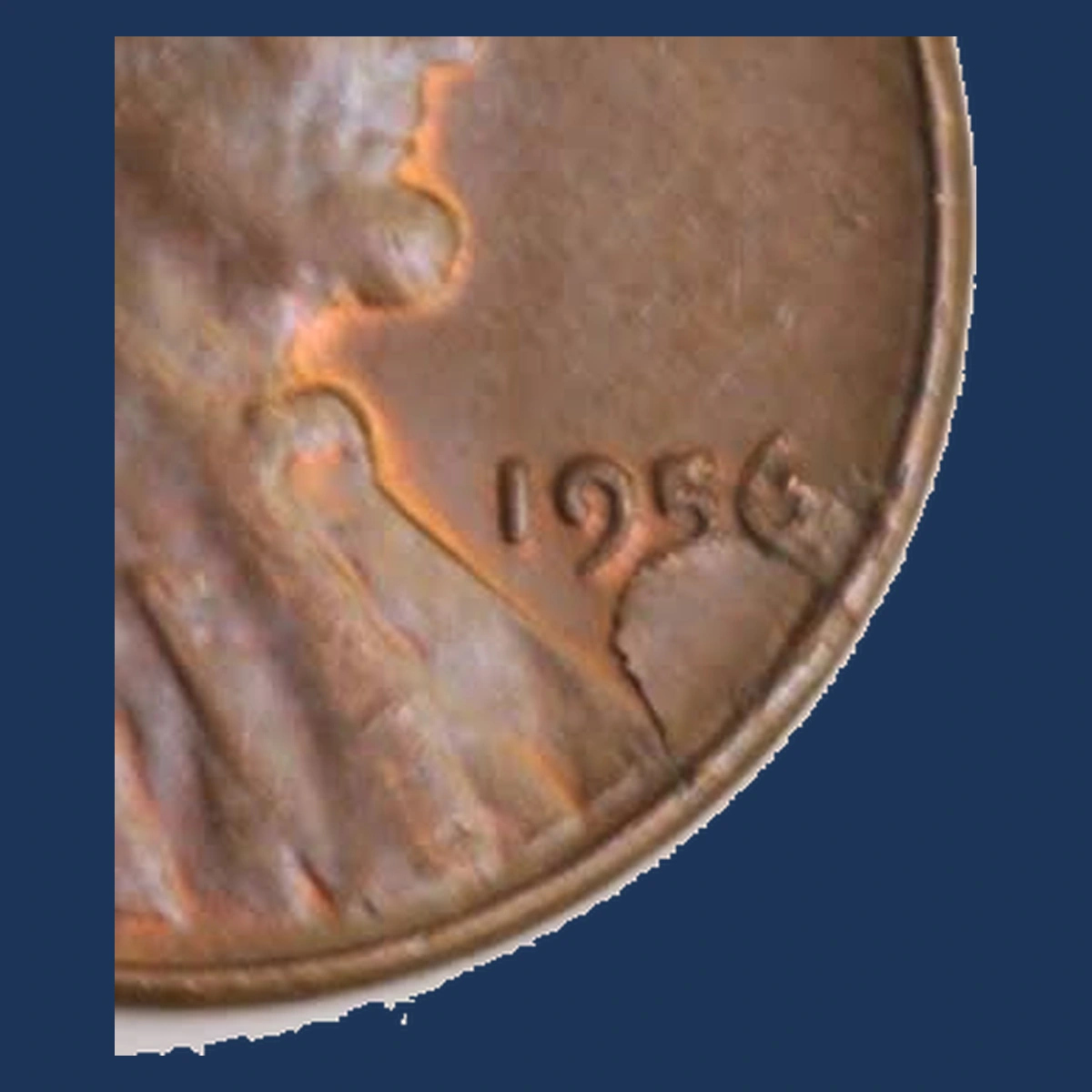
The surface can lift like a thin flake instead of wearing down evenly. A weak area inside the alloy lets one metal layer separate from another.
This is called lamination. A documented Denver example has the feature on its Wheat-ear side and was graded ANACS AU50, indicating wear.
A separate no-mintmark example is reported with a detached front layer. Its missing area should not be assumed to cover the whole face.
The 1956 cent uses copper alloy throughout. This peeling metal is different from the loss of copper coating found on later zinc-centered pennies.
Estimated Value
Estimate $5–$250 for an original lamination, depending on its size and the surviving design. An intact peeling edge can make the separation easier to understand.
A 1966 cent with a front separating layer sold for $61 in July 2021. That later copper-alloy coin supplies a related sale, while the reported 1956 front and back examples remain separate specimens.
The range does not apply to every rough patch. Corrosion, scraping, and loose material attached after striking need different explanations.
How to Identify
Do not pull at a loose flap. Its connection to the coin can show more about the error than the empty patch left after removal.
Use a 10× magnifier along the separation boundary. Look for layers within the original metal, rather than repeated scraping lines or corrosion eating into the surface.
A normal penny weighs 3.11 grams and measures 19.05 mm, with a smooth edge. A scale and calipers help document an accessible coin, but a small flake may barely change its weight.
Keep the Denver back-side example separate from the reported front loss. An original peeling boundary that follows the metal layer is the useful feature.
2. 1956 Lincoln Penny Repunched or Misplaced Mint-Letter Marks (Estimated Up to $300)
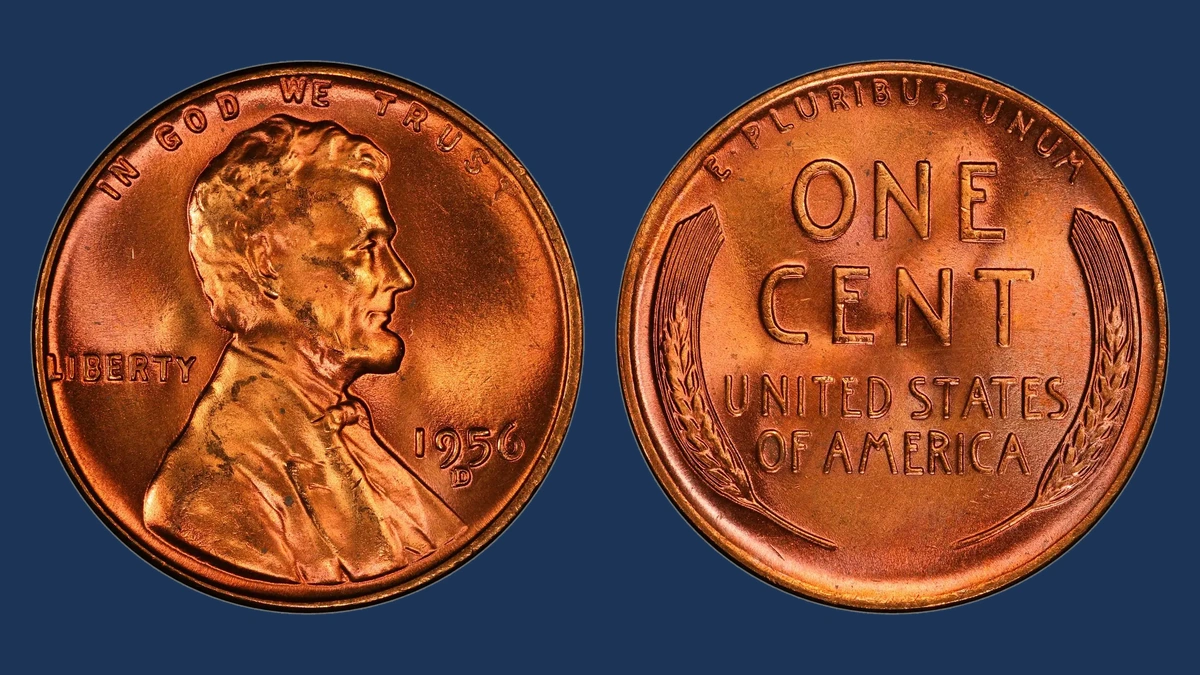
An extra D outline can remain when a mint-letter punch is placed twice on the stamping tool. The tool then repeats that overlap on its coins.
One unusual Denver report places another D high enough to extend toward the date’s 5. Other repunches remain closer to the main D.
A different mark below 19 and left of D has been described as an S. Specialists disagree, and one catalog withdrew that identification.
This does not create a regular 1956-S issue. The genuine Denver repunches and the disputed S-shaped mark require different comparisons.
Estimated Value
Identified D repunches can fit an estimated $5–$300. Clear extra letter strokes and original unworn surfaces provide stronger comparisons than faint bumps.
For the disputed S-shaped mark, use approximately $5–$50 as a collectible marked-tool comparison. That estimate does not assume the mark is a genuine second mint letter.
The broader D range should not be borrowed simply because a seller calls the mark D over S. Establish the actual shape before paying for a particular letter-punch explanation.
How to Identify
Locate the normal D below the date before tracing anything around it. The high second-D report extends toward 5; the disputed S-shaped mark lies elsewhere, below 19.
Use a 10× magnifier and photographs of the specific pattern. A curved bump is not enough to prove an S, and the withdrawn identification should not be treated as settled.
The ordinary cent is 3.11 grams and 19.05 mm, with a smooth edge. A scale and calipers check an accessible coin for physical alteration.
Inspect the surrounding date for squeezed or added metal. Recognizable matching letter strokes are more useful than a seller’s label for an unexplained mark.
3. 1956 Lincoln Penny Broadstrike (Estimated Up to $350)
An unusually wide penny can still show all its outer lettering. The blank spread beyond its intended limit while the design was being struck.
The edge normally sits inside a restraining ring called the collar. Without that support, the metal can flow outward and form a broadstrike.
This type is reported for 1956 without one fixed mint or amount of expansion. The actual penny needs its own outline measured.
Width alone is not enough. Hammering a finished coin can also enlarge it, but usually changes the already-raised design rather than creating an original expanded strike.
Estimated Value
For a genuine 1956 broadstrike, estimate $10–$350. Greater visible spread with clear original lettering usually makes the error easier to compare.
A 1946-S Wheat cent broadstrike sold for $89 in December 2024. That earlier copper-alloy coin provides a recent same-design-family comparison, not an auction result for the reported 1956 type.
The estimate assumes original striking. A widened coin with crushed lettering, fresh edge marks, or later pressing should not receive the same value simply because its diameter is larger.
How to Identify
Check the actual size with calipers before judging the extra border from a photograph. A normal cent measures 19.05 mm, and a tilted view can exaggerate its shape.
Weigh an accessible coin against 3.11 grams. Outward spreading alone should not remove much of the original metal.
Now trace the outer words on both faces. A simple broadstrike retains the intended design inside the expanded outline; an off-center strike loses part of it beyond the blank.
Examine the smooth edge for hammer marks and the high details for flattening. Complete original designs surrounded by natural outward spread support the broadstrike explanation.
4. 1956 Lincoln Penny BIE Chips and Larger Tool Breaks (Estimated Up to $600)
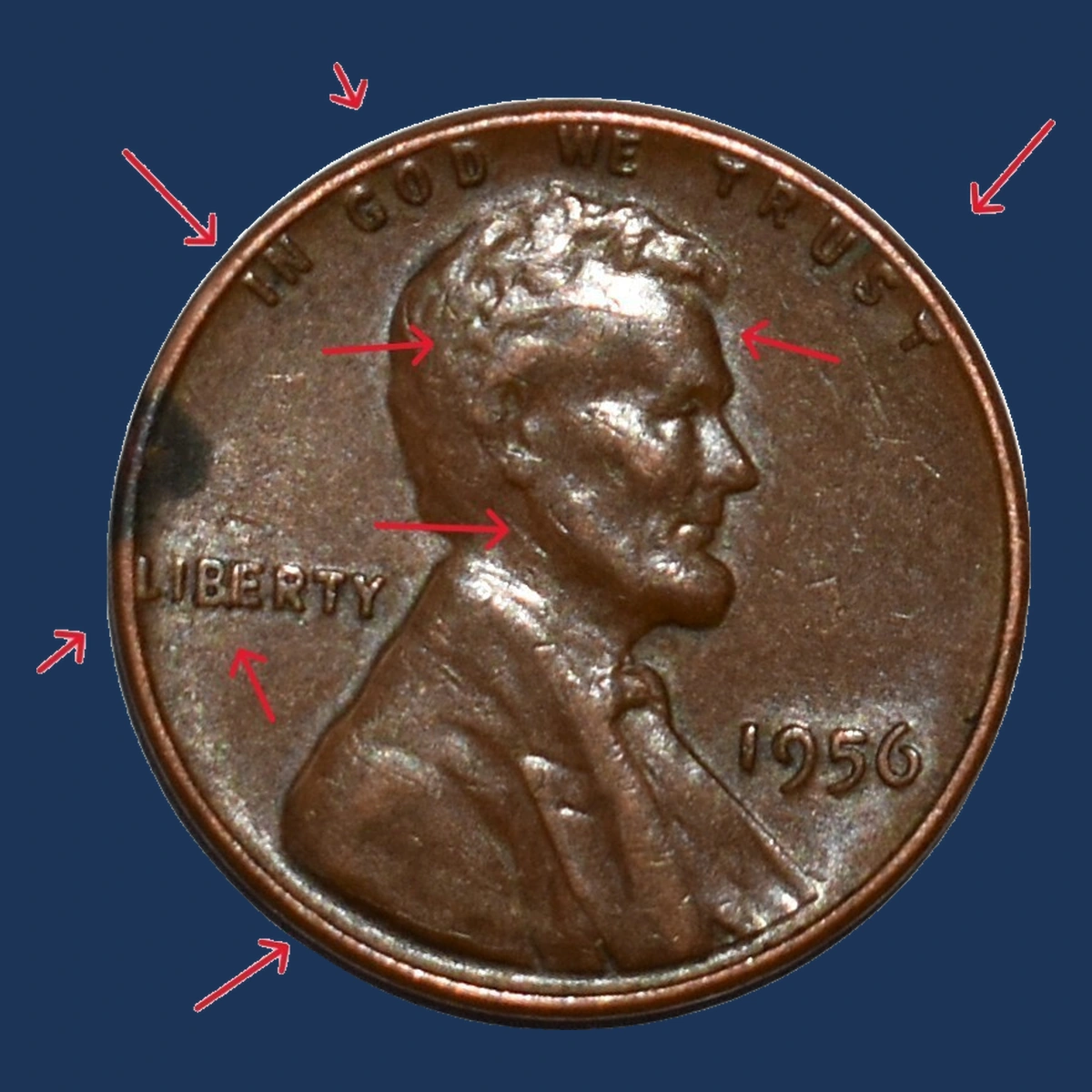
LIBERTY can appear to contain an extra I between B and E. A small piece chipped out of the die, the steel stamping tool, leaving a gap for metal to fill.
That raised bar is called a BIE chip. Larger tool failures leave different shapes.
A reported 1956 example has a broken section within Lincoln’s head that remained in the tool. It can leave some design on a raised area.
A missing section at the rim instead creates a lump called a cud. An internal retained break does not need to reach the coin’s edge.
Estimated Value
Small BIE chips can fit an estimated $2–$40. Clear larger retained breaks or cuds can be compared within approximately $30–$600.
A 2021-D retained cud sold for $186 in September 2025. That later zinc-centered penny supplies a related tool-break comparison, not the price of the 1956 head-break example.
The location and amount of raised metal matter more than the number of catalog names. A tiny letter-space bar should not automatically receive the price of a broad patch replacing several design details.
How to Identify
For a BIE, examine the space between B and E in LIBERTY. The extra bar should rise from the surface rather than cut into it like a scratch.
The head-break example needs its own photograph, showing the raised boundary and any design retained inside it. A rim cud follows a different test: trace the lump to the edge.
Check the smooth edge for solder, pressure, or attached material. Calipers and a scale can compare an accessible coin with 19.05 mm and 3.11 grams.
Correct measurements do not prove a tool break. The raised area’s connection to the original letters, portrait, or rim supplies the more useful evidence.
5. 1956 Lincoln Penny Struck Through a Late Die Cap (Estimated Up to $650)
Lincoln’s front design can look softened while the opposite face remains clearer. A previously struck coin covered the front stamping tool and interfered with the new impression.
That covering is called a die cap. Repeated striking thins it, allowing more of the tool’s design to press through.
The documented 1956-D example is a late-stage cap strike graded PCGS AU50. It shows circulation wear as well as the mint-made effect.
The penny is the coin struck through the covering. It should not be expected to have the cup-shaped walls of the object that stuck to the tool.
Estimated Value
The recorded Denver example sold for $54 in December 2024. Its AU50 grade indicates wear, which should remain part of the price comparison.
Estimate $30–$650 across clear late-cap receiving coins with different preservation and strength. Better-preserved or more distinctive covered designs may attract greater interest.
The range concerns the softened strike itself. A face rubbed flat after circulation or a normal weak impression should not inherit a cap-strike premium without the corresponding original pattern.
How to Identify
Compare the front and back under the same light. A covered tool can weaken one design while the opposite tool leaves stronger detail.
Wear still needs to be considered on the AU50 example. Inspect Lincoln’s high points and the affected area with a 10× magnifier rather than treating all softness alike.
An accessible cent normally compares with 3.11 grams on a scale and 19.05 mm using calipers. Inspect the smooth edge for squeezing or grinding.
There is no need to find a tall cup rim on this receiving penny. A connected covered-strike pattern beside the clearer opposite design is the feature to match.
6. 1956 Lincoln Penny Off-Center Strike (Estimated Up to $750)
The design can miss part of the blank when the disc is not centered under the tools. The opposite portion of the metal remains untouched.
A Denver example is described as fifty-five percent off center toward ten o’clock. Its date and D remain visible.
Separate no-mintmark examples have smaller shifts: twenty percent toward eight o’clock and fifteen percent toward one o’clock. Those positions belong to different specimens.
More displacement means less design reaches the blank, not that the same percentage of metal disappears. Readable identity and an original surface are still important on a dramatically shifted penny.
Estimated Value
Dated 1956 off-center pennies can fit an estimated $25–$750. The preserved year, mint letter, amount of shift, and surface condition guide the comparison.
A 1964-D cent struck fifty percent off center sold for $114 in March 2025. Its later Memorial back differs from the Wheat design, but the copper-alloy striking mechanism is comparable.
The different 1956 clock positions do not establish fixed prices. A clear original coin with a smaller shift can be more appealing than a damaged dramatic example.
How to Identify
Read the surviving date and D before comparing the coin with the Denver photograph. The two no-mintmark examples need their own direction and percentage checks.
Follow the transition between struck and untouched metal on both faces. The blank crescent should explain where the disc lay outside the striking area.
A normal cent starts at 3.11 grams and 19.05 mm. A scale checks for removed metal, while calipers record the changed outline when safely accessible.
Inspect the remaining smooth edge and empty surface for grinding. Original blank metal beside compatible displaced designs on both faces separates a true off-center strike from later removal.
7. 1956 Lincoln Penny Clipped or Elliptical Blank (Estimated Up to $900)
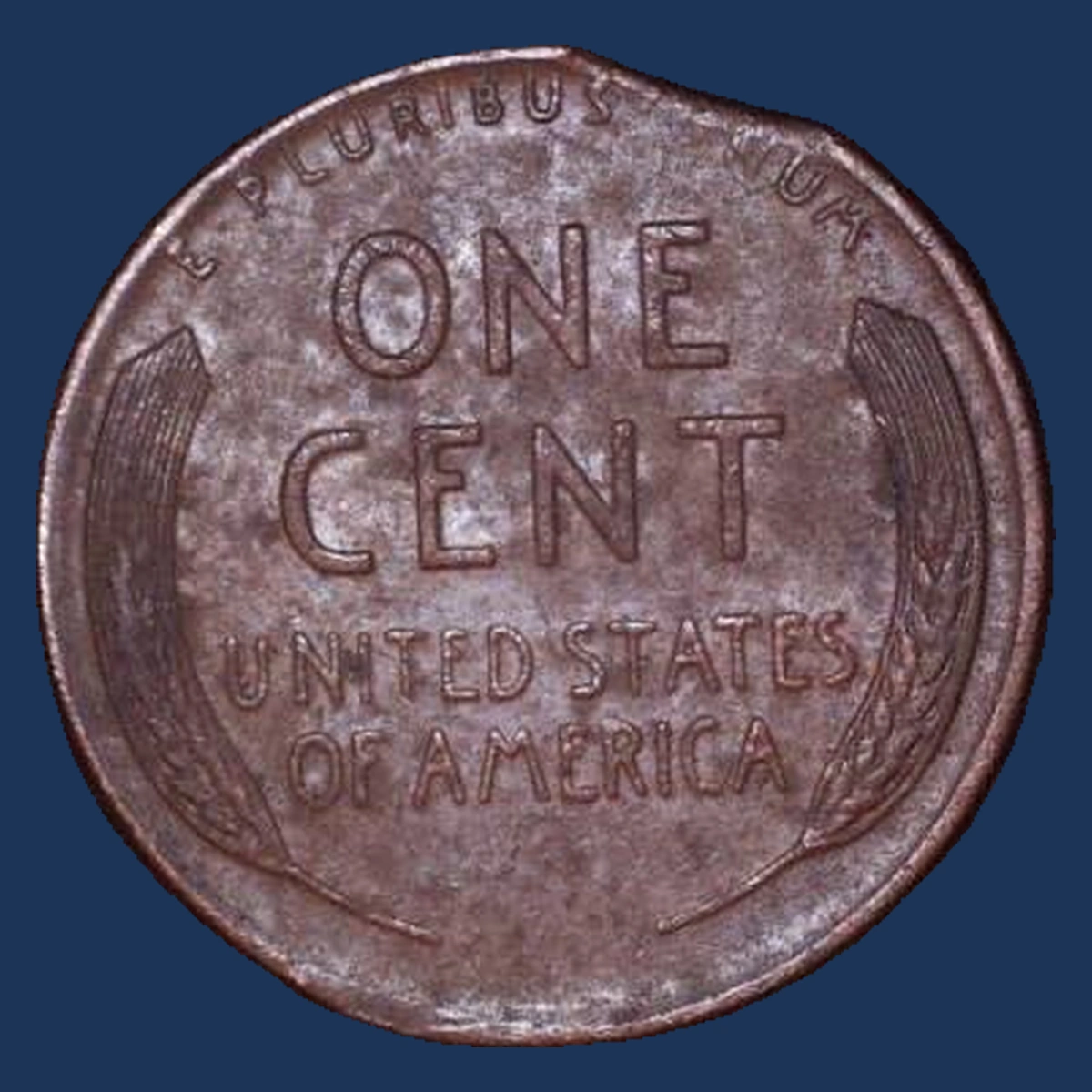
Some incomplete blanks keep most of a round penny’s outline. Others leave only a narrow oval, sometimes compared with a football.
The documented 1956 oval example weighs 1.3 grams and was graded NGC MS63. Its remaining metal received the Wheat-cent design.
This is an elliptical clip, not two separate error coins. The missing portions began when the blank was cut from the metal strip.
Other 1956 reports include curved and straight gaps. Their exact shape should be checked on the individual coin rather than borrowed from the narrow oval example.
Estimated Value
Ordinary original clips can fit an estimated $10–$200. A clear elliptical remaining blank can be compared within approximately $150–$900.
A 1960 Large Date cent with a 0.9-gram elliptical clip sold for $660 in April 2022. That lighter Memorial-cent example is a related shape comparison, not the price or weight of the 1956 Wheat cent.
The visible date and original boundaries help explain the unusual outline. Later cutting or grinding should not receive the same premium.
How to Identify
Weigh the accessible coin first and record its shape alongside the reading. The 1.3-gram example is far lighter than a complete 3.11-gram penny, but low weight alone cannot prove an original clip.
Calipers document the surviving lengths against the normal 19.05-mm diameter. An oval should not be measured across its narrow middle and treated as a smaller complete round blank.
Inspect each curved boundary and the remaining smooth edge with a 10× magnifier. Fresh cuts or filing can explain an artificially made oval.
Follow the original struck details into the incomplete outline. Natural design and rim formation at the missing boundaries are the more useful clues.
8. 1956 Lincoln Penny Blank Back from One-Sided Striking (Estimated Up to $1,000)
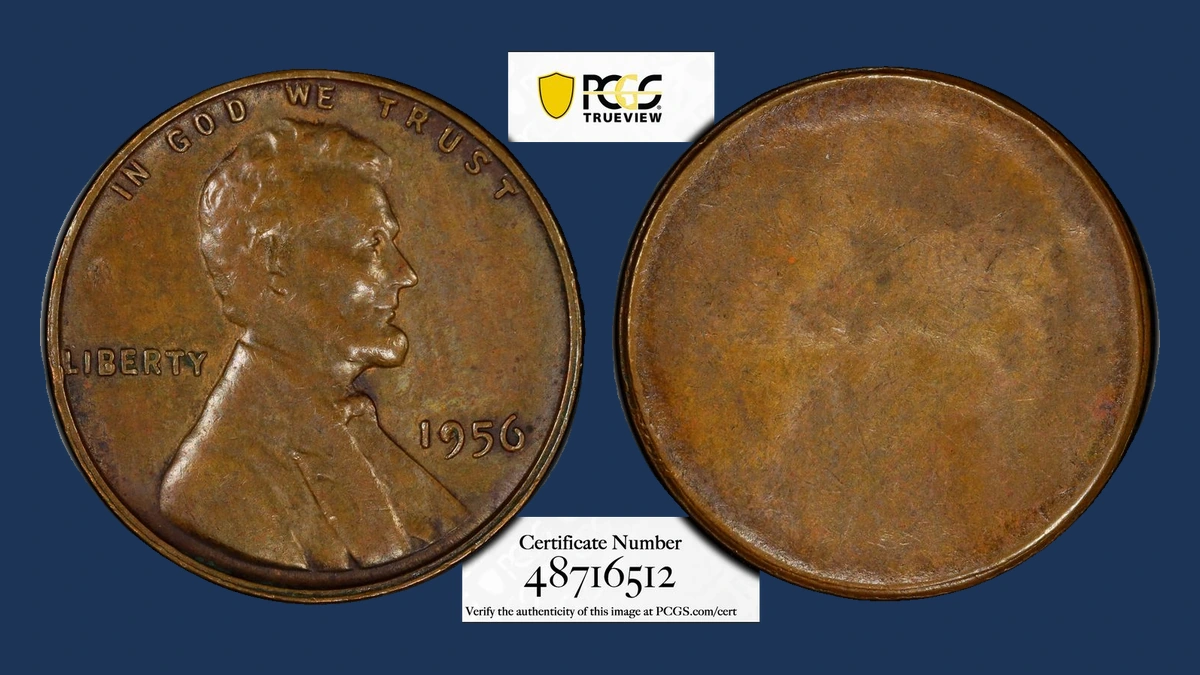
A penny may carry a recognizable front but lack its normal back picture. Another blank can block one side from touching the stamping tool.
The result is called a uniface strike, meaning only one face received the normal design. A collector display identifies a 1956 example with a blank back.
It is described as AU53 Brown, indicating some wear and brown copper surfaces. The reported appearance still needs to be compared with the actual coin.
Grinding away a finished back can imitate this broad shape. The thickness, edge, and remaining surface help separate a blocked strike from removed design.
Estimated Value
For an authenticated one-sided 1956 strike, estimate $75–$1,000. A clear date and an original blocked back support a stronger comparison than a heavily worn or altered piece.
This is a mechanism-based estimate rather than a verified selling price for the collector-displayed AU53 coin. Its stated grade does not establish an auction result.
The blank face needs to survive naturally. A ground-off Wheat design or a joined two-piece object should not receive the same estimate merely because one side appears empty.
How to Identify
Compare the empty back’s surface with the edge before searching for a faint Wheat stalk. Grinding can leave circular lines, an unusually thin coin, or an abrupt change at the border.
Use a scale and calipers on an accessible specimen. The normal cent weighs 3.11 grams and spans 19.05 mm; record thickness too when assessing possible metal removal.
The edge normally is smooth. A seam or attached face would require another explanation.
Examine Lincoln and the date under magnification, then inspect how the opposite blank area meets the rim. An original blocked surface beside a normal struck front is more convincing than simply having no readable back design.
9. 1956 Lincoln Penny Flipover Double Strike in the Collar (Estimated Up to $1,200)
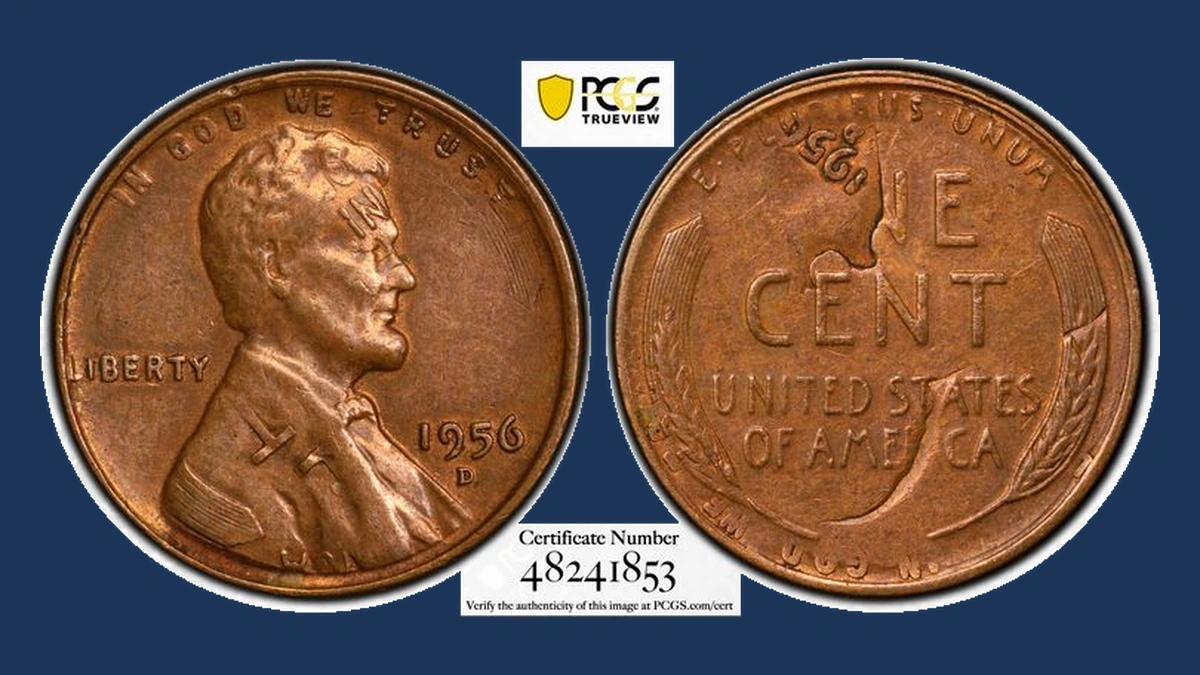
Lincoln and Wheat-cent details can occupy the same face when the coin turns over before another strike. The tools then press opposite designs over the first impressions.
The documented 1956-D example received its second strike inside the collar, the ring that restrains the edge. It need not have a large blank crescent.
PCGS described the coin as AU Details with cleaning. That means wear is present and its surface was altered after minting.
The cleaning is a condition issue, not another mint error. The original overlapping designs still explain the flipover sequence.
Estimated Value
The cleaned Denver example sold for $456 in June 2024 through Stack’s Bowers. Use an estimated $250–$1,200 for confirmed in-collar flipover strikes with differing preservation.
Its surface problem is part of that actual result. An original, uncleaned coin needs its own comparison rather than an automatic increase by a fixed amount.
Two designs on one face do not create two separate coin prices. Readability of the overlap and clear evidence of the second strike guide the overall value.
How to Identify
Find a Wheat or lettering fragment where only Lincoln’s front design should appear. Then turn the coin over and look for the corresponding mixture on the other face.
A 10× magnifier can help trace which details cross or cover others. The two strike positions should explain both faces together.
Because the second strike occurred inside the collar, a near-normal 19.05-mm outline does not rule it out. Check an accessible coin with calipers and a scale against 3.11 grams.
Examine the smooth edge for seams and the surfaces for later pressed copies. Opposite original designs overlapping within the restrained outline are the features to match.
10. 1956 Lincoln Penny Doubled Front or Back Design (Estimated Up to $1,500)
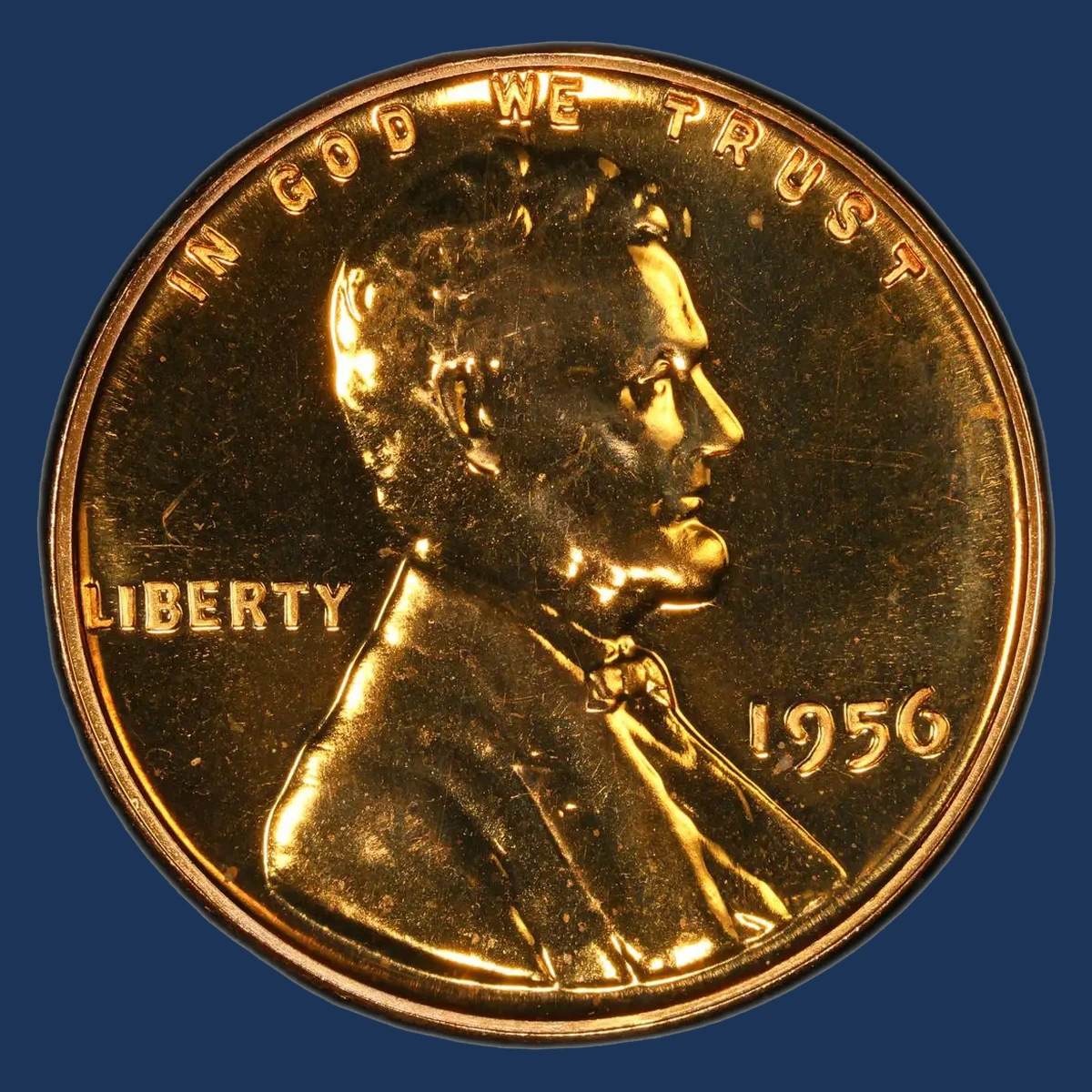
An eyelid, numeral, or letter can have another raised edge beside its normal one. A doubled design was copied into the stamping tool before the penny was made.
Philadelphia and Denver ordinary front varieties are reported, alongside Philadelphia Proof examples. Proofs are specially made collector coins and need their own comparisons.
Back doubling is also reported, including a Proof variety called FS-801. Its identity should not be transferred to an ordinary coin just because both have the same year.
The affected parts differ among tools. Not every doubled penny shows an extra eyelid, doubled date, and doubled Wheat ears together.
Estimated Value
PCGS records a $995 eBay sale in November 2022 for a Proof FS-801 graded PR68 Red. It was a highly preserved collector coin, not an ordinary circulation strike.
Estimate $5–$300 for identified minor ordinary varieties and $50–$1,500 for clearer Proof examples. The correct pattern and condition determine the comparison.
The Proof result does not value every thick letter. Flat shelves or glare need to be excluded before using a doubled-tool price.
How to Identify
Choose the mint and finish before choosing a close-up. A Proof back-variety photograph cannot establish an ordinary front-variety identification.
For front candidates, inspect the specific reported eyelid, date, or letters. For back candidates, compare E PLURIBUS UNUM, ONE CENT, and the Wheat details as appropriate to that variety.
Normal weight is 3.11 grams and diameter 19.05 mm, with a smooth edge. Calipers and a scale help check the original coin when accessible but do not identify its doubled tool.
Change the light to separate real rounded edges from shadows or flat strike shelves. The same extra shape at the same location on a correctly matched coin is the useful test.
11. 1956 Lincoln Penny Silver Dime Blank (Estimated Up to $3,500)
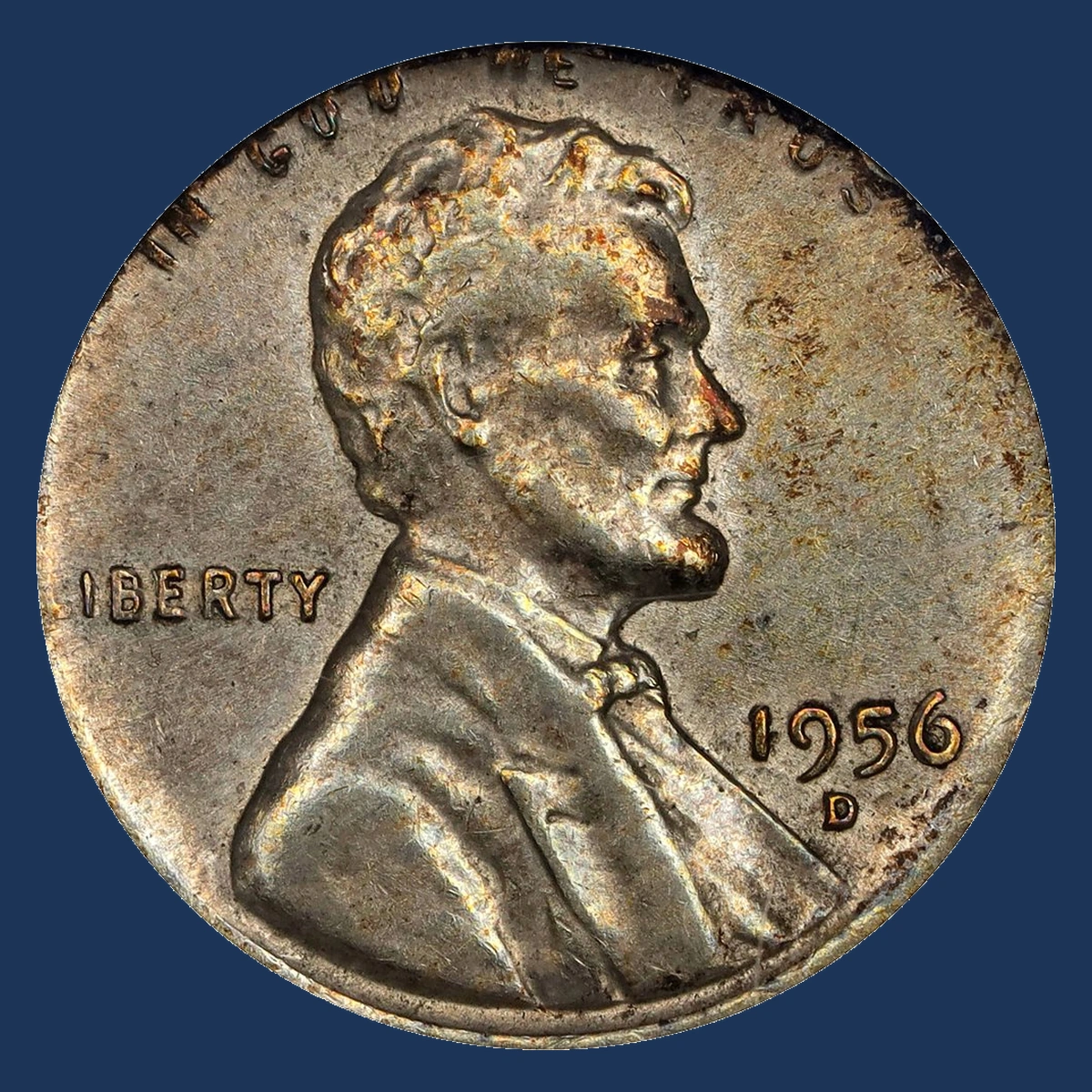
The cent design can reach beyond its blank even when Lincoln sits near the center. A smaller silver dime blank entered the cent press instead of the normal copper-alloy disc.
No-mintmark and Denver examples are reported for 1956. The unfamiliar pale color is only one clue to the metal change.
A silver dime blank normally weighs 2.50 grams, compared with 3.11 grams for a complete cent. These are starting standards, not measured weights for every reported coin.
The unused blank has no earlier dime picture. Roosevelt or torch details beneath Lincoln would point to a finished-coin overstrike instead.
Estimated Value
Estimate $500–$3,500 for an authenticated 1956 cent on a silver dime blank. Readable year, mint, and original metal help establish the closest comparison.
A 1964 no-mintmark cent on a silver dime blank sold for $1,260 in May 2022, graded PCGS MS64. That later Memorial-cent example supplies a same-metal comparison rather than a 1956 transaction.
The estimate should not be given to a plated ordinary cent. Pale color must agree with the blank’s weight, dimensions, and silver alloy.
How to Identify
A precise scale is a useful first tool for a pale penny. Compare an accessible coin with the silver dime standard of 2.50 grams and the cent standard of 3.11 grams.
Calipers can document a smaller outline against the normal cent diameter of 19.05 mm. Some expansion during striking is possible.
Examine the smooth or reshaped edge for plating and a copper-colored core. Do not scratch the surface to reveal the metal.
Then inspect both faces for earlier dime detail. A plain silver blank needs no Roosevelt picture.
Original cent designs on a smaller disc whose silver metal has been confirmed provide the strongest match.
12. 1956 Lincoln Penny Honduran One-Centavo Blank (Estimated Up to $5,000)
Only 195 fits comfortably on this small penny’s front. Most of the final 6 extends beyond the blank, along with the L in LIBERTY and the upper motto.
The coin was struck on a Honduran one-centavo blank. The auction recorded a weight of 1.5 grams and a diameter of 15 mm.
The thinner blank also left weak outer detail and lost lower parts of the Wheat ears. It had not previously received a Honduran coin design.
This example is a Lincoln cent on foreign metal, not a normal Honduran coin or the separate 1956 dime wrong-blank error.
Estimated Value
The NGC MS64 Brown example sold for $2,070 in April 2010. Its grade describes an unworn coin with some marks and brown copper color.
Use an estimated $1,500–$5,000 for comparable identified foreign-blank cents. The recorded partial date belongs to this coin’s small striking surface.
A clipped ordinary penny can also be light, but needs a different price comparison. The blank’s Honduran identity and original reduced design must be established before the foreign-blank range is applied.
How to Identify
The 1.5-gram weight and 15-mm diameter are actual measurements reported for this example. Compare an accessible candidate with a scale and calipers, rather than treating every low-weight coin as the same foreign blank.
A normal 1956 cent is 3.11 grams and 19.05 mm. Its smooth edge provides a starting comparison for signs of later trimming.
Inspect the right end of the date, missing L, and absent front motto. On the back, compare the reduced lower Wheat ears and weak outer detail.
A polished-down coin may lose size without showing those original striking relationships. The measured small disc and matching missing peripheral design need to agree.
13. 1956 Lincoln Penny Dime Overstrike with a Scrap-Metal Impression (Estimated Up to $10,000)
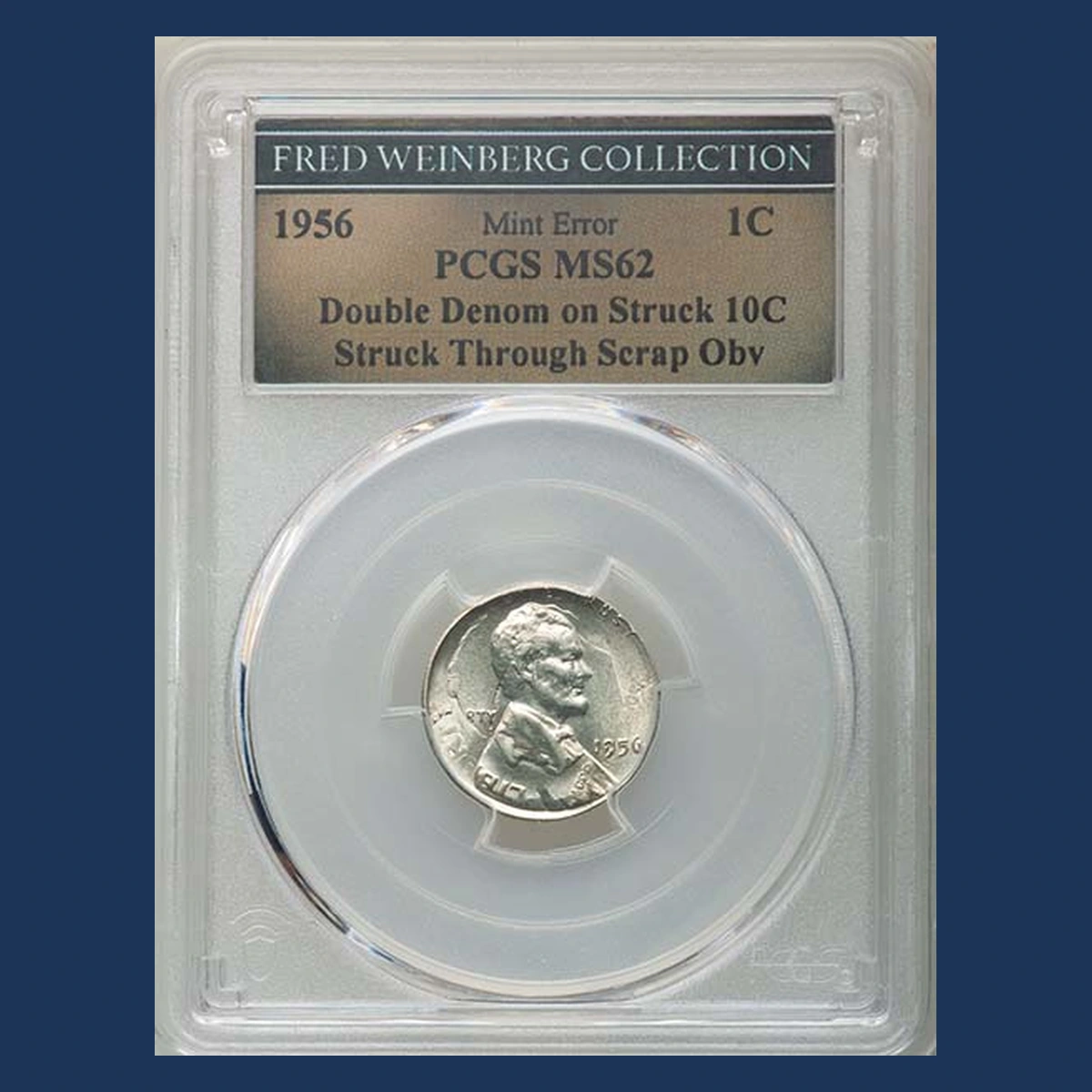
ONE DIME crosses the left Wheat ear, and AMERICA appears through the right one. A finished Roosevelt dime received a newer Lincoln-cent strike.
The older portrait points downward and slightly left relative to Lincoln. Its date remains near the cent’s three-o’clock area, while the 1956 cent date is bold.
The same coin also met a slender metal scrap between the dime and the front stamping tool. That piece left an impression through the Y in LIBERTY.
Two minting problems therefore appear on one object. The scrap mark is not a separate coin or an extra denomination.
Estimated Value
The complete PCGS MS62 coin sold for $6,660 in May 2022. MS62 describes an unworn object with noticeable marks.
An estimated $4,000–$10,000 covers comparable overstrikes with clearly visible older design and an original scrap impression. The actual result values both features together.
The price should not be divided between the two descriptions or increased by adding a separate full struck-through estimate. The surviving dime details and narrow obstruction mark explain one combined striking event.
How to Identify
Start with ONE DIME through the left Wheat ear and AMERICA through the right. These words identify an older finished dime more clearly than silver color alone.
Turn to the front and locate the dime date near three o’clock. Keep it separate from the bold 1956 cent date.
Next trace the narrow scrap impression through LIBERTY’s Y with a 10× magnifier. Do not assume loose metal still survives merely because an impression is visible.
A normal cent weighs 3.11 grams, measures 19.05 mm, and has a smooth edge. A scale and calipers can document this different host when safely accessible.
Older dime design plus the separate Y-crossing impression identifies the recorded combination.
Conclusion
A pale color, a peeling layer, and a raised letter-space bar come from different kinds of problems. Compare the design and metal together before naming a 1956 error.
Estimated values span $2–$10,000, from small tool chips to the dime-overstrike combination that sold for $6,660. Its two features share one price.
Leave fragile layers and unusual surfaces untouched. A clear photograph of the date, Wheat back, and edge is a useful next step for any promising example.