1903 Dollar Coin Error List with Pictures

A tiny S can make an enormous difference on this silver dollar. A 1903-S Micro S graded PCGS MS65+ brought $194,062.50 at GreatCollections in September 2025.
The 1903 Morgan Dollar errors below also include extra impressions, missing metal, and a rare cup-shaped coin. Estimated whole-coin values span $75–$200,000, with mint, wear, and the exact mistake driving the price.
Read on to see which marks deserve a closer look.
1. 1903 Morgan Dollar Clashed Design Marks
Fine extra lines near Liberty’s neck, chin, or cap can come from the design on the other side. They look out of place because they belong to the opposite face.
The two dies, the steel tools that stamp coins, sometimes strike each other without a blank between them. Their damaged surfaces then leave extra marks on later coins.
1903-O dollars also have a reported form involving material caught between the tools. This can leave matching raised areas on the two faces, beyond the usual thin clash lines.
Estimated Value
Allow an estimated $100–$600 for a genuine 1903-O clash coin in worn to modest unworn condition. This is the value of the entire dollar, including its date and condition.
Faint lines may add little. Strong, recognizable transferred details are easier to sell than marks that need a lengthy explanation.
An identified special variety can command more, but an ordinary line near Liberty’s neck does not earn that premium by itself.
How to Identify
Use a normal 1903-O dollar beside the suspect coin. Locate the unexpected lines near the neck, beneath the nose, and behind the cap before studying tiny scratches elsewhere.
A 10× magnifier helps you follow each line through the open background. Compare its shape with the opposite face’s design, allowing for how the two tools faced each other.
Surface scratches can cross nearby details with torn or displaced metal. A clash mark should fit a transferred design, rather than merely look unusual.
Do not identify the special raised-area variety from one neck line. For that claim, compare both faces with a confirmed example showing the matching raised areas.
2. 1903 Morgan Dollar Raised Lines from a Scratched Die
A scratch in a steel stamping tool can leave a raised line on a coin. Silver fills the cut in the tool when the coin is struck.
Philadelphia examples have been reported around DOLLAR on the back. A separate New Orleans variety, VAM-22, also has a reported scratch in the back tool.
These are marks made during production, rather than scratches dug into a finished dollar. Their outlines need not be perfectly straight or equally wide, and a raised line alone does not prove a coin is genuine.
Estimated Value
The estimated whole-coin range is $75–$1,000 for these raised-line varieties across ordinary worn and unworn grades. A faint mark on a common condition coin usually brings only a small extra amount.
A clear, correctly identified pattern is more appealing than an unexplained bump. Much of the price still comes from the coin’s grade and mint.
Cleaning, heavy scratches, or a questionable mintmark can outweigh any interest in the small raised feature.
How to Identify
The first question is whether the whole dollar is genuine; counterfeit coins can also show raised lines. Check its design against a known genuine example before focusing on the small mark.
Now tilt the back beneath a lamp. A line that rises above the surrounding silver behaves differently from a cut dug into the surface.
Philadelphia reports place the feature around DOLLAR. Examine that area with a 10× magnifier, checking the shape and surrounding details against a matching example.
An O beneath the wreath means New Orleans. Its VAM-22 raised-line pattern needs its own comparison photograph.
Use the correct mint’s matching pattern, rather than treating every raised line as the same variety.
3. 1903 Morgan Dollar Struck Through an Object
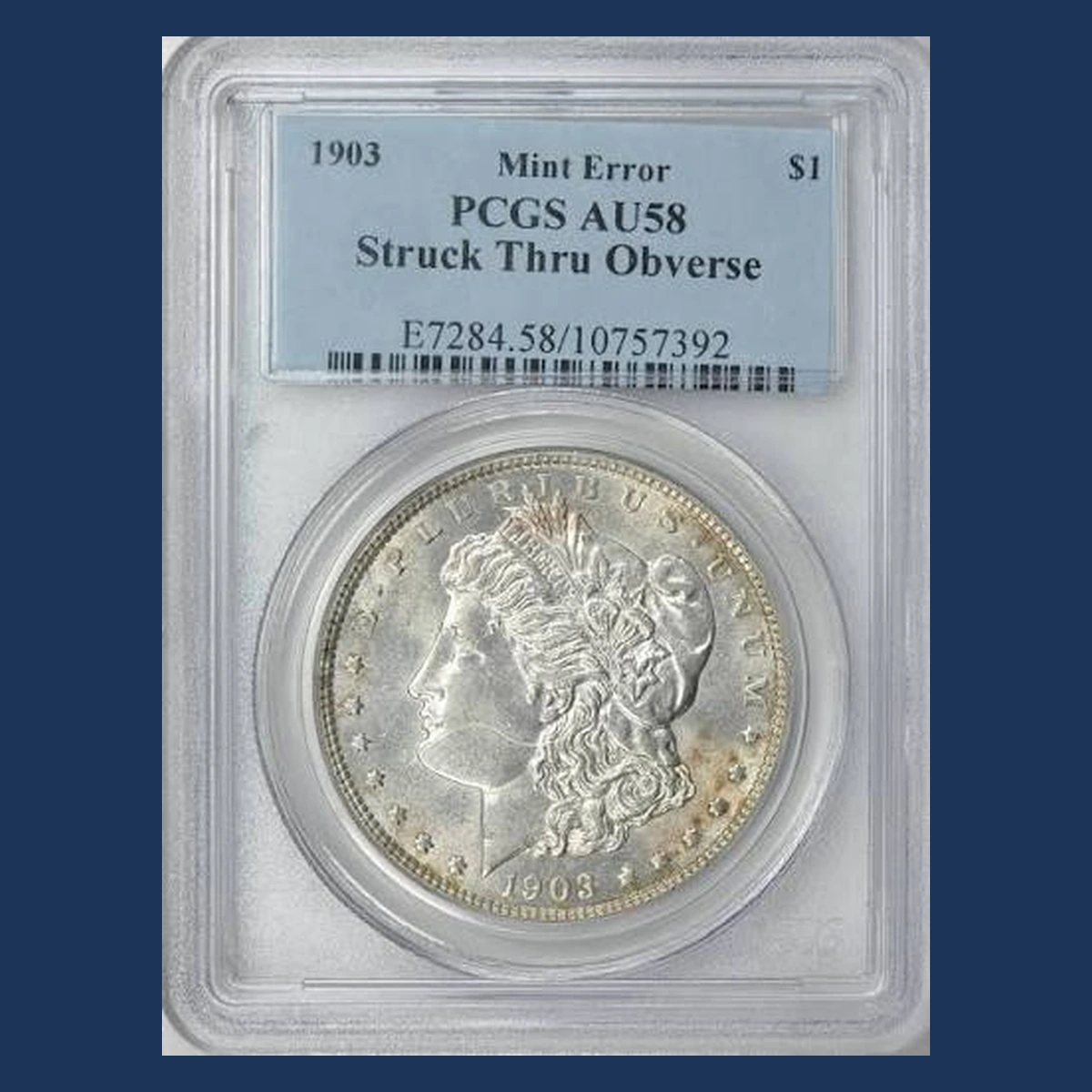
A deep hollow running from the eagle’s tail feathers toward AM in AMERICA marks one 1903 Philadelphia example. ANACS graded that coin MS62, an unworn grade with noticeable marks.
Something lay between the coin and the stamping tool. The object took up space and stopped that area from receiving the normal design.
This mistake is called a struck-through error. The hollow’s shape does not identify the object by itself, and a separate reported front-side example should not be treated as the same coin or the same obstruction.
Estimated Value
An estimated $200–$3,000 covers genuine 1903 struck-through dollars, from small visible hollows to large, dramatic impressions. The depth, shape, and remaining design all matter.
For a silver-dollar comparison, a 1922 Peace Dollar struck through on both faces sold for $552 in November 2024. That is a different year and design.
A clear object-shaped impression can attract stronger bidding than general weakness, while later gouges or cleaning reduce the whole coin’s value.
How to Identify
Look at the boundary of the hollow, not just its depth. A blow after minting often pushes metal into a fresh lip or damages nearby detail.
Under a 10× magnifier, follow the eagle’s tail feathers toward AMERICA on the documented back-side example. Note where the normal design stops and how the surrounding silver meets the depression.
Photograph the coin under low light from two directions, since a single shadow can exaggerate the depth. Leave any attached material in place; picking at it destroys useful evidence.
For a front-side coin, use photographs of that actual example rather than assuming the same shape. Trace an uninterrupted, naturally struck boundary around the missing design.
4. 1903 Morgan Dollar Repunched S Mintmark
A repunched mintmark has part of an earlier S beside the final letter. It forms when a worker punches the mintmark into a steel tool more than once in slightly different positions.
The tool then puts both outlines onto the dollars it strikes. A second S outline has been reported on 1903-S pieces, but no specific direction is established here.
This is separate from the famous Micro S, which concerns the letter’s size. A small S with one clear outline is not automatically a repunched mintmark.
Estimated Value
For a confirmed 1903-S repunched mintmark, use an estimated whole-coin range of $200–$5,000 across worn through lightly worn examples. The scarce San Francisco issue accounts for much of that amount.
The estimate assumes a genuine second punched outline, not a small normal letter or a flat shelf. Clear separation and an accepted variety identification support an added premium.
An exceptionally well-preserved coin needs a separate grade-based appraisal beyond this working range.
How to Identify
Find the S beneath the wreath’s bow on the back. Start with sharp photographs at the same size as a normal 1903-S mintmark; enlargement differences can be misleading.
Use a 10× magnifier to look inside the S curves and along its outside edges. A second punched outline should preserve part of the letter’s shape.
A flat ledge can come from movement during striking. Also watch for a seam, disturbed silver, or odd texture around the letter that could indicate an added mintmark.
No particular doubling direction is required by this general report. Compare the actual second outline with an authenticated repunched-S example before assigning the variety premium.
5. 1903 Morgan Dollar Clipped Rim
A small missing piece at about 9:30 distinguishes a recorded 1903-S dollar graded PCGS XF40. That grade describes a worn coin with much of its detail remaining.
The missing metal belongs to the blank, the metal disc prepared before striking. An incomplete disc can result when blank cutting overlaps an earlier hole or an edge of the metal strip.
The dollar is then struck with that shortage already present. This differs from a later bite or file mark, even though both can make the outer outline look incomplete.
Estimated Value
Estimate $500–$6,000 for an authenticated 1903-S clipped dollar across worn to lightly worn grades. Its scarce date and mint make this a whole-coin estimate, not a clip surcharge.
The same year’s AU55 partial-collar dollar brought $3,231.25 in 2012, showing how the underlying 1903-S coin affects error prices. A clip is a different mistake.
A small, clear rim clip may bring less than a dramatic missing section in equally good condition.
How to Identify
Examine the edge at the gap before weighing the dollar. File strokes, a fresh cut face, or bent silver suggest metal was removed after the coin was made.
The recorded example has a small gap near 9:30 when the front is upright. Study both ends with a magnifier, looking for an edge shaped during striking rather than freshly severed.
A scale may show a shortage below the normal 26.73 grams, but wear also removes weight. The normal diameter is 38.1 millimeters; measurements alone cannot establish a clip.
Look across the coin for a weak area of rim, a helpful feature that is not always obvious. Begin confirmation with the gap’s rounded transition into the original edge.
6. 1903 Morgan Dollar Partial Collar and Stepped Edge
This dollar’s edge changes from grooves to a smooth band across its width. On the recorded PCGS AU55 example, the grooved half lies nearer the back face.
The retaining ring, called the collar, normally surrounds the blank and forms the edge during striking. Here it held only part of the coin’s thickness.
Silver spread beyond the ring and created a step, often called a railroad rim. The same 1903-S coin also has a thin, high rim on the left front and right back, rather than uniform damage around both faces.
Estimated Value
Heritage sold the PCGS AU55 example for $3,231.25 on October 19, 2012. An estimated $1,500–$6,500 is useful for genuine 1903-S partial-collar dollars of broadly comparable preservation.
The value combines a scarce San Francisco dollar with an unusual edge. A sharply visible step and undamaged surfaces help the result.
Extensive wear can hide the feature, while later edge filing harms both the error appeal and the value of the underlying coin.
How to Identify
Ask for an edge photograph before buying from face-on pictures alone. The documented dollar has a smooth band beside a grooved band, with the grooves nearer the back face.
Follow that change around the circumference and look for a natural step between the bands. The accompanying thin, high rim is strongest at the left front and right back.
Inspect any rough stretches with a 10× magnifier; filing leaves cut marks that interrupt the original edge. Keep a graded coin in its holder and use angled photographs where its edge is visible.
On a loose coin, turn the edge slowly under a lamp. Confirm that the smooth and grooved bands join as struck metal rather than a later scraped strip.
7. 1903 Morgan Dollar Double Strike in the Collar
Extra outlines spread across the design on a 1903 Philadelphia dollar graded PCGS XF45. The coin received a second strike while still held inside the retaining ring.
Because it remained in the ring, its round outline did not need to grow into a large blank crescent. The two impressions instead overlap within the normal coin shape.
This is a double strike: the coin itself was hit twice. It differs from a doubled die, where a single strike copies a doubled design already present on a stamping tool.
Estimated Value
A working estimate is $2,000–$10,000 for a genuine overlapping double strike on a 1903 Morgan Dollar. The pictured XF45 example brought a $2,000 winning bid in April 2008, before buyer’s fees.
Wide separation between recognizable design parts makes the mistake easier to appreciate. Surface damage or heavy wear can hide those clues and lower demand.
The price should follow the visible second strike, rather than the mere presence of extra lines.
How to Identify
Two strikes need a connected set of clues, not one doubled letter. Follow the portrait outline into nearby lettering and see whether the extra impressions share the same shift.
Compare both faces using sharp photographs taken straight on. At crossing points, a second strike can partly flatten or overwrite the earlier design; a 10× magnifier helps reveal those relationships.
The retaining ring can leave the coin round and close to its normal diameter. Do not reject an overlapping double strike simply because the dollar lacks a large unstruck crescent.
There is no fixed rotation angle to require here. Pick out two nearby repeated design parts that clearly belong to the same second impression.
8. 1903 Morgan Dollar Off-Center Strike
A broad blank crescent beside an incomplete design is the main sign of an off-center strike. The metal disc sat too far from the center when the tools came together.
Both faces should show the effect of that misplaced disc. A reported New Orleans example has an O mintmark, but its date lies outside the struck area.
That O identifies the mint, not the year. It cannot establish 1903 by itself, so the dollar needs a reliable match to known stamping tools before it can receive a year-specific identification.
Estimated Value
For an authenticated, correctly dated 1903 off-center Morgan Dollar, estimate $3,000–$25,000. That conditional range covers a substantial visible displacement, rather than a slightly uneven border.
A different silver-dollar design provides perspective: a 1922-S Peace Dollar struck 15% off center sold for $32,200 in 2003. It is not a sale of the undated New Orleans coin.
Readable dates, clear mintmarks, and strong remaining detail generally help the whole coin’s value.
How to Identify
Read the date first. An O beneath the wreath identifies New Orleans, but that mint made Morgan Dollars in many different years.
When the date is missing, leave the year open. A specialist may be able to match surviving tool details with a dated coin.
To test the error itself, compare both faces for missing outer design beside an unstruck crescent. A shift on only one face suggests a different problem.
Weigh a loose coin against the normal 26.73 grams, allowing for wear. This checks whether much metal was removed later, but it cannot establish the missing date.
Match the surviving details to an authenticated 1903 example before accepting a year-specific identification.
9. 1903 Morgan Dollar Cup-Shaped Die Cap
A coin can cling to a stamping tool instead of leaving the press. Continued striking pushes its silver outward and upward, eventually making a cup-like shape.
This trapped coin is called a die cap. Its faces change as it keeps meeting the tool and the next coins entering the press.
PCGS has described a 1903 example graded AU50, meaning it shows some wear. The exact height and back-side pattern must be judged from that coin, rather than borrowed from the more widely pictured 1886 Morgan die cap.
Estimated Value
The estimated value for the rare 1903 die cap is $40,000–$125,000, subject to its remaining shape, surfaces, and confirmed identity. This is a comparison-based estimate.
The famous 1886 Morgan cap, graded PCGS MS64, sold for $129,515.62 including fees at GreatCollections in January 2026. That is a different, better-preserved coin.
Its result shows the scale of demand for major Morgan caps, but the 1903 piece should be appraised on its own merits.
How to Identify
View the coin from the side and then from above, keeping it inside any grading holder. A cap has metal drawn upward around the tool, rather than a simple fold crossing an otherwise flat dollar.
Look next at how the surviving design stretches toward the wall and how the opposite face was affected. A 10× magnifier can help separate struck surface changes from scratches made while someone bent the coin.
The 1903 example has no fixed wall height or strike count established here. Compare its wall and both faces with photographs of the certified 1903 cap, rather than copying features from the famous 1886 coin.
10. 1903 Morgan Dollar Micro S Mintmark
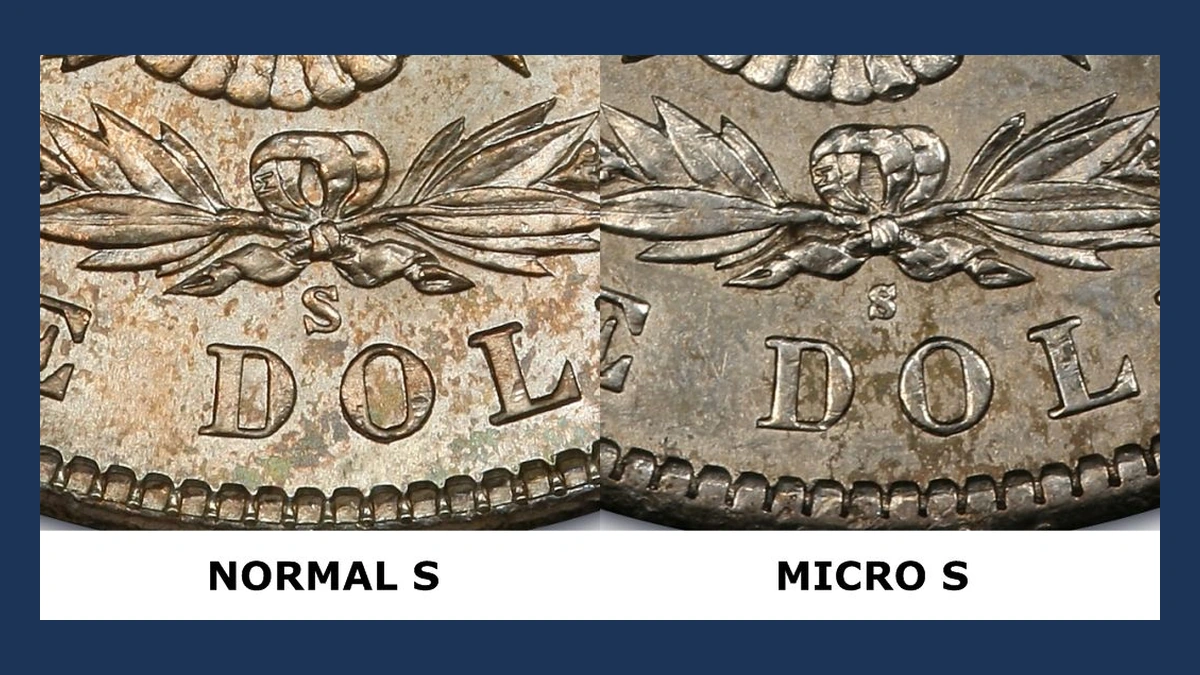
The Micro S is much smaller than the usual S beneath the wreath’s bow. The difference concerns the whole letter, not an extra line beside it.
Collectors call this major variety VAM-2. VAM numbers identify particular Morgan Dollar tool combinations and help collectors compare matching coins.
The small letter is similar in size to a quarter-dollar mintmark. A worker most likely selected the wrong punch while preparing the tool, and the tiny S then appeared on every dollar struck from it, including the rare surviving unworn examples.
Estimated Value
Estimated values span $250–$200,000, from heavily worn Micro S dollars to exceptional unworn coins. Most worn examples sit far below the upper end.
A PCGS MS65+ example sold for $194,062.50, including fees, in September 2025. Its unusually strong preservation drove that result.
This wide range is for the entire rare variety, not an amount added to every 1903-S dollar. A tiny-looking letter still needs a genuine Micro S identification.
How to Identify
Use the wreath and bow as a scale reference in two photographs: one normal S and one suspected Micro S. Resize the images until those surrounding features match, then compare the complete letters.
A Micro S is smaller as a whole, not merely weak at one end or doubled along an edge. Wear can blur an ordinary S, so check its full outline under a 10× magnifier rather than judging one faded curve.
Examine the letter’s base for disturbed silver that could reveal an added mintmark. Finish by matching its size, shape, and placement with an authenticated VAM-2 photographed at the same scale.
Conclusion
Check the small details before chasing a big price. The tiny Micro S, a stepped edge, and a second set of design outlines each tell a different story.
Estimated values run from $75–$200,000 across these 1903 Morgan Dollar errors and varieties. The expensive San Francisco coins already carry strong value without an error.
Keep photographs of both faces and the edge, and leave every surface untouched.