1980 Dollar Coin Error List with Pictures

A small mint letter can hide a modest variety, while the wrong metal can change the whole coin. A 1980-S dollar struck on a nickel blank sold for $6,900 in April 2021.
These 1980 Susan B. Anthony dollar errors have estimated values from $20 to $12,000, depending on the mistake and condition. The wide border near the date is normal for this year.
Read on to separate doubled letters, missing metal, and striking errors from everyday damage.
1. 1980 Susan B. Anthony Dollar Doubled Die
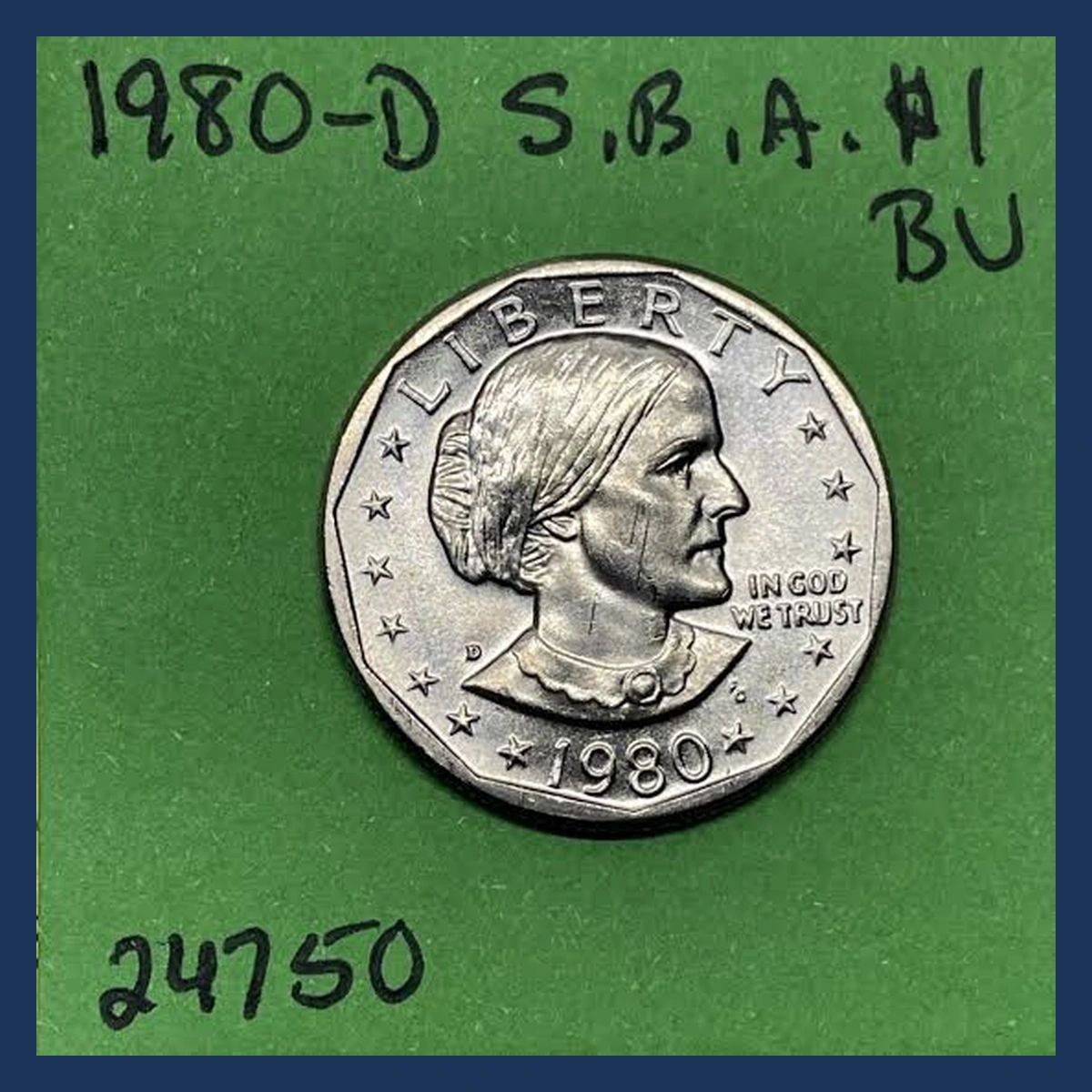
Tiny forks at the ends of letters can reveal a doubled design. Reports for the ordinary 1980-S dollar describe these splits in LIBERTY and IN GOD WE TRUST.
The cause is a doubled die, the steel tool that stamps a coin. A shifted design entered that tool during its preparation and then appeared on coins it struck.
This report concerns ordinary San Francisco dollars, rather than specially prepared collector Proof coins. Flat ledges beside letters are a different effect, caused by movement during striking.
Estimated Value
Allow an estimated $20 to $100 for an authenticated example of the reported lettering variety. Small splits visible only under magnification belong near the lower end.
A clean, unworn coin with clear separation has more appeal than a worn example. This range builds on published estimates for minor 1980-S doubling, rather than the prices of spectacular doubled designs on other dates.
How to Identify
Place an ordinary 1980-S dollar beside the coin you are checking. Compare the tiny ends of the same letters before examining their overall thickness.
Use a 10× magnifier and a lamp that you can move. Look for a small notch where one letter end separates into two raised tips.
Work through LIBERTY and then the motto. Photograph each suspect letter from straight above so tilted lighting does not create a false second edge.
Flat, low shelves usually point to movement during striking. A convincing match needs repeated raised splits in the reported lettering, with the original letter shape still intact.
2. 1980 Susan B. Anthony Dollar Repunched Mintmark
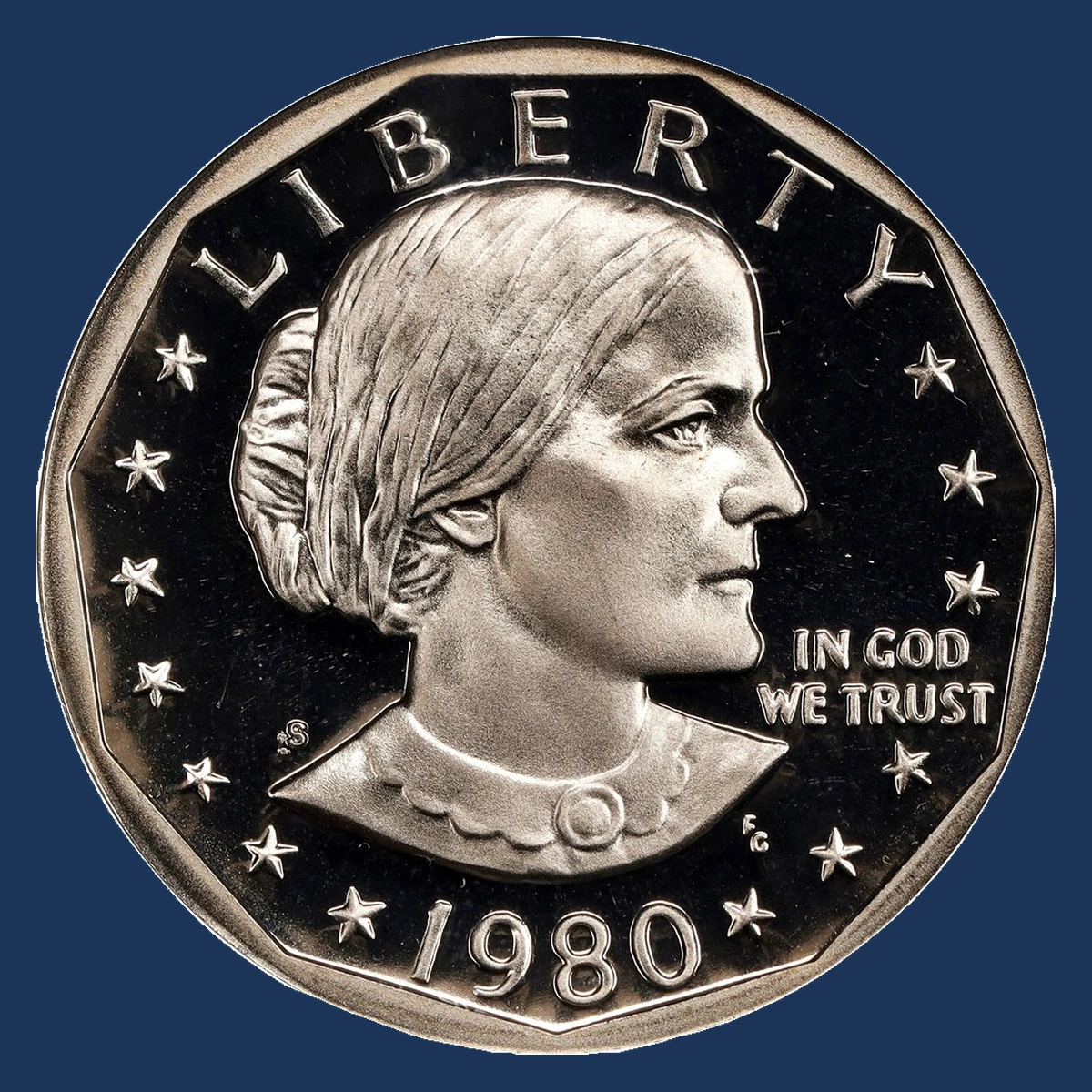
An extra curve beside the mint letter can come from two punches made into the stamping tool. This is called a repunched mintmark, often shortened to RPM.
PCGS discusses repunched mintmarks on 1980-S Proof dollars. These are collector coins made with specially prepared tools and blanks.
Denver reports describe extra traces to the left of the D on ordinary coins. The San Francisco report instead describes an extra S below and to the left, so the two patterns need separate comparisons.
Estimated Value
The estimated range is $20 to $200, with minor Denver examples generally around $20 to $100. A clear S on a well-preserved Proof can fall toward the upper end.
Distinct extra curves matter more than a thick-looking letter. Scratches, cloudy surfaces, and weak separation lower the appeal, while clean fields make the small feature easier to see in a photograph.
How to Identify
Find the letter to the left of Anthony’s shoulder. A D identifies Denver, while an S identifies San Francisco; the S alone does not prove a Proof finish.
For Denver coins, sketch the normal D first, including its straight stem and curved right side. Then compare the reported extra traces along its left edge under a 10× magnifier.
For the S Proof, follow both curves of the letter and inspect below and to its left. Compare against a normal Proof photographed at the same angle, since a thick punch can produce broad ends.
A genuine extra punch should follow part of the letter’s shape. An isolated lump or a filled center cannot establish the variety.
3. 1980 Susan B. Anthony Dollar Heat-Treatment Color and Copper Wash
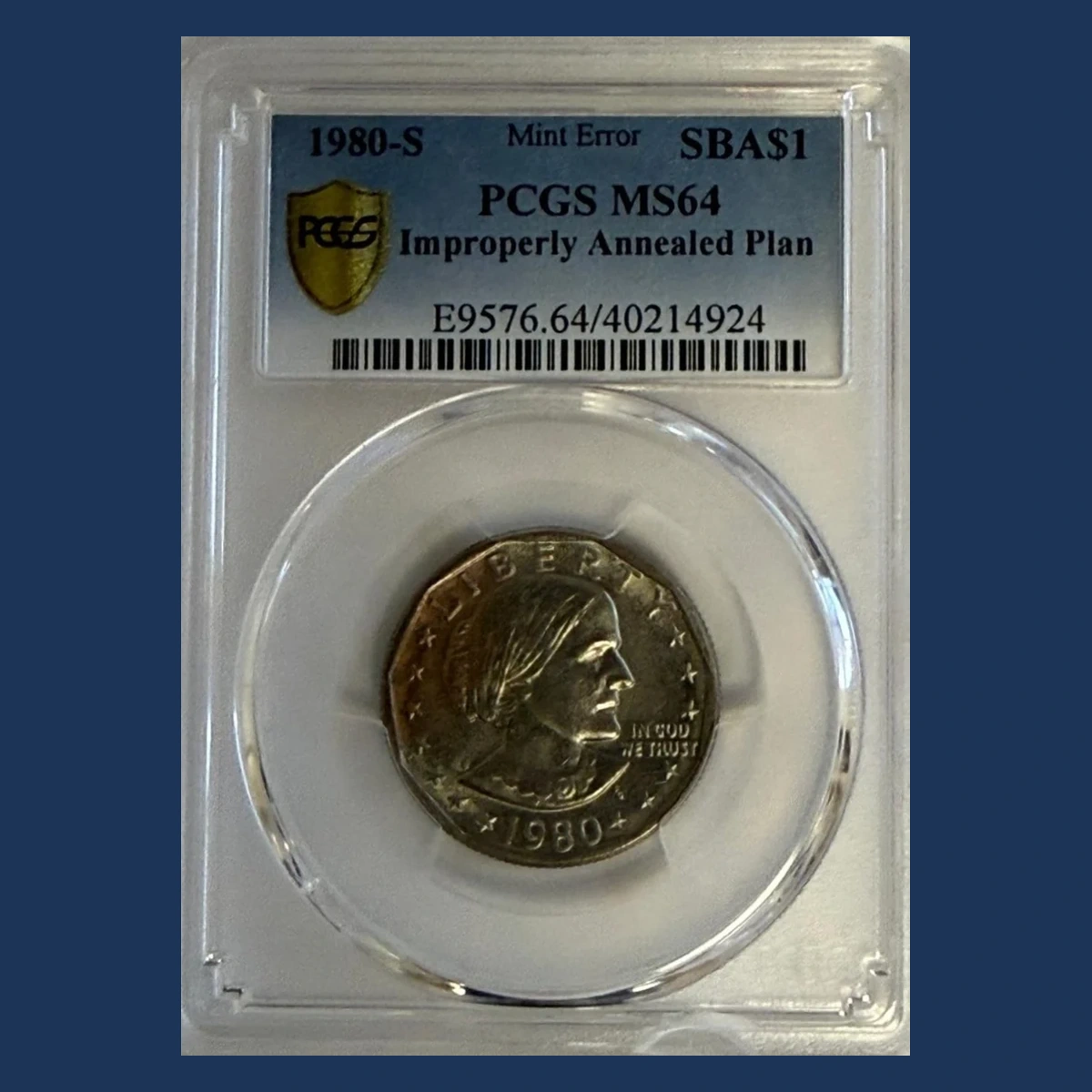
Brown streaks across a silver-colored dollar can look striking. Some 1980-S dollars have been certified for improper annealing, a problem during the heating used to prepare blanks for striking.
Other certified examples carry the description copper wash, meaning a thin copper-colored surface covering. Records include a coin with color on both faces and another with most of the back covered.
These appearances belong together for comparison, but the labels do not prove an identical cause. Neither automatically means that a whole outer metal layer is missing.
Estimated Value
An estimated $30 to $350 covers authenticated color errors of these kinds. A PCGS MS65 copper-wash coin sold for about $100 in September 2024, according to the auction index.
MS65 means an unworn coin with relatively few marks. Broad, attractive color with clear certification can bring more than faint streaks, while stains or corrosion do not earn the same premium.
How to Identify
Do not clean the color away. Tilt the dollar slowly under a lamp and watch whether the original shine continues beneath the brown or copper-colored areas.
Compare the front, back, and edge in the same light. A thin surface wash can cover a face without removing its design or the metal beneath it.
If the coin is loose, weigh it on a digital scale. A normal dollar is about 8.10 grams; a substantial loss needs a different explanation from color alone.
Surface chemicals can imitate unusual Mint color remarkably well. Check a certified example’s photographs for its exact pattern and finish, rather than treating any brown 1980 dollar as a heating error.
4. 1980 Susan B. Anthony Dollar Clipped Blank
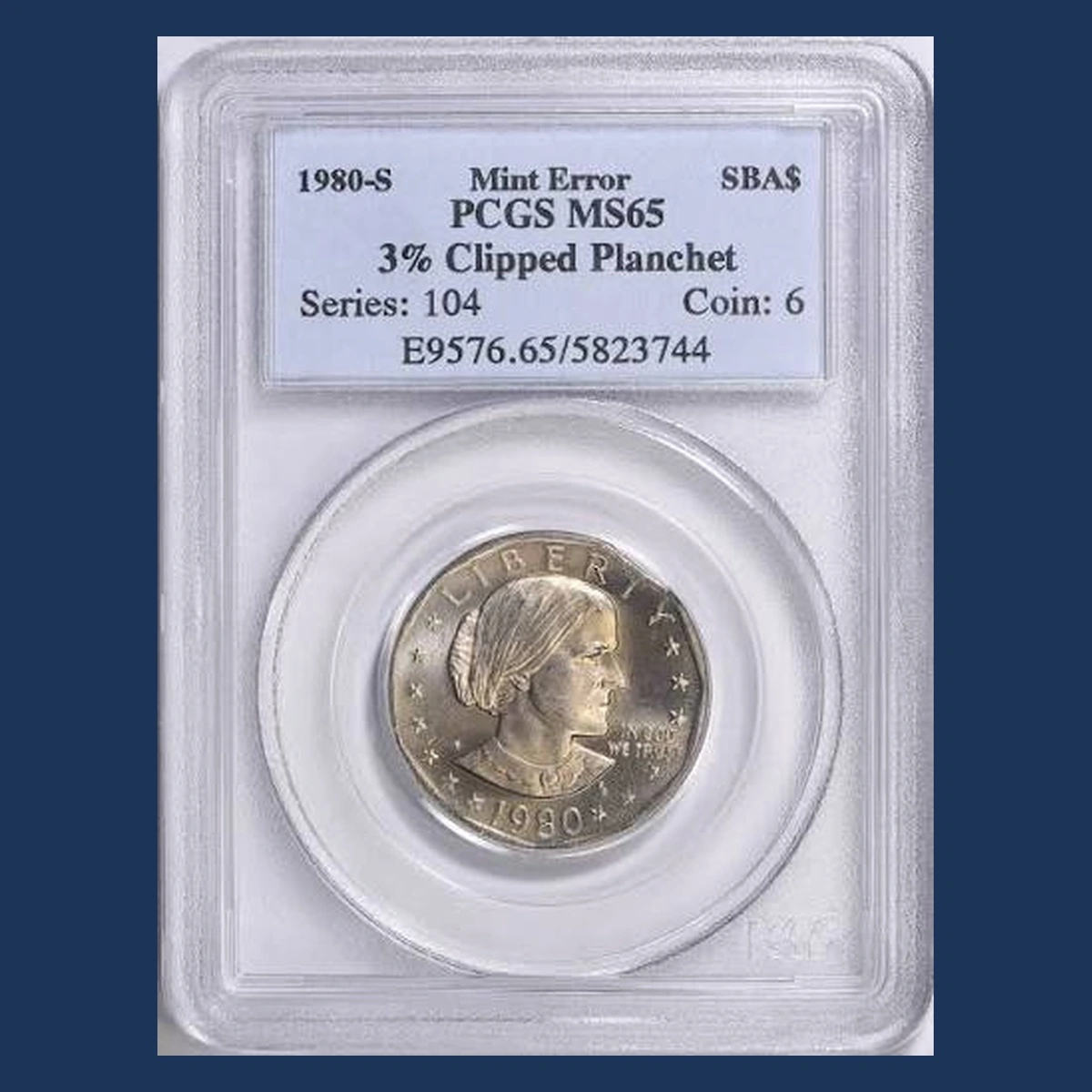
A section missing from the edge can begin before the dollar receives its design. A blank cut across an earlier hole in the metal strip emerges with a piece already absent.
The striking press then stamps that incomplete blank. Letters close to the missing section can look stretched or weak because the metal flows differently there.
An ANACS-certified 1980-S example establishes a clipped dollar for this date. Its listing does not specify a clip percentage, so generic photographs of larger clips should not define that particular coin.
Estimated Value
Estimate $20 to $500 for genuine clipped examples, depending on the missing area and condition. Small clips sit near the lower end, while larger, obvious gaps on unworn coins can cost considerably more.
A complete date and readable S help buyers identify the coin. Smooth, original surfaces also matter: a dramatic cut made after the dollar left the Mint adds no error value.
How to Identify
Study the cut surface from the side before judging the missing area from above. Saw marks, fresh burrs, or scraped metal suggest that someone removed a piece after the coin left the Mint.
Follow the rim toward each end of the gap, watching for a fading border and letters stretched toward the missing section. Then look across the coin for a weak spot on the opposite rim, which can support a genuine clip.
For a loose coin, a scale can show the expected loss from its normal 8.10-gram weight. Neither a low reading nor an opposite weak spot proves a clip without the right edge and surface features.
5. 1980 Susan B. Anthony Dollar Blocked Design and Struck-Through Material
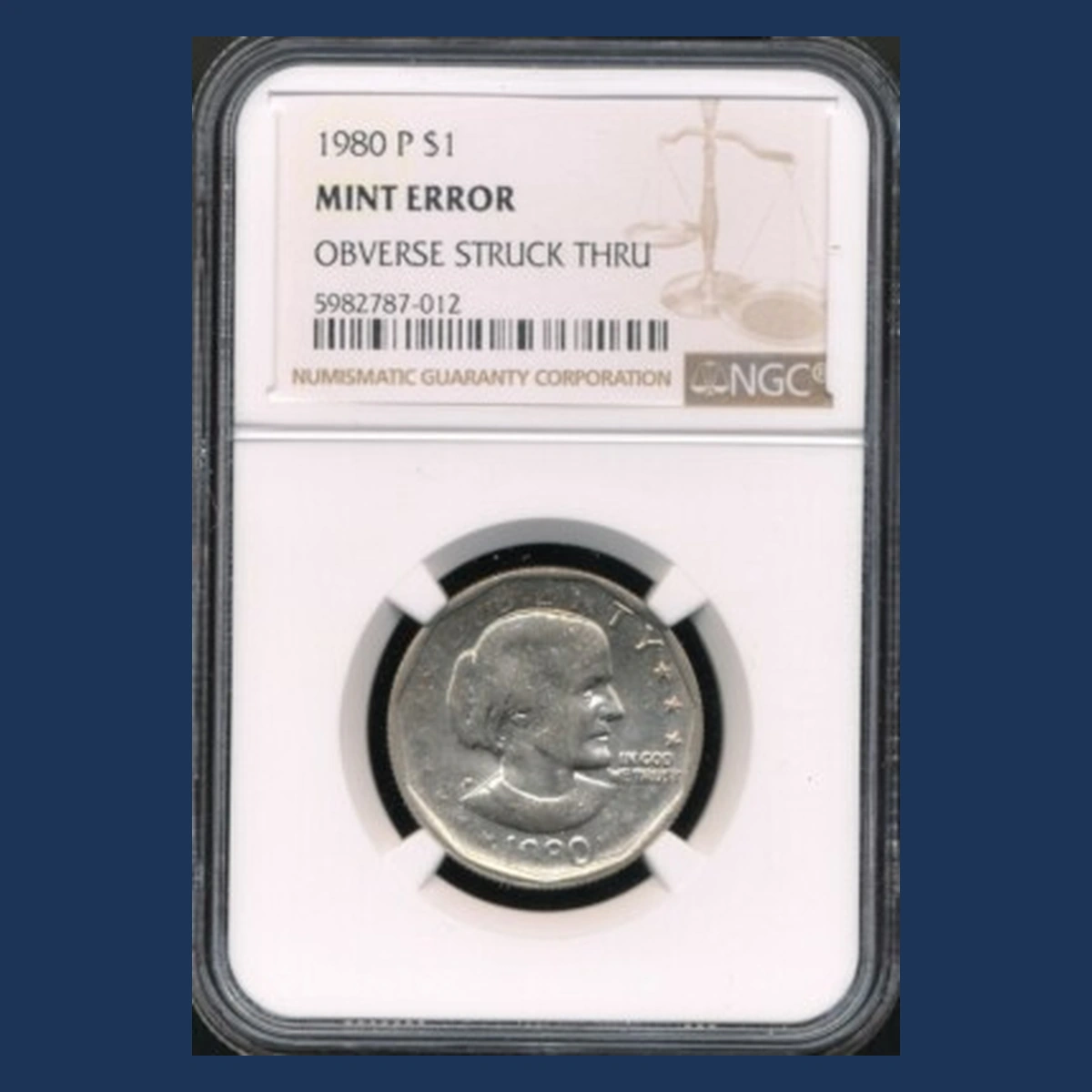
Fading letters can occur when grease or other material blocks the tool that stamps a coin. The metal underneath then receives little of the intended design.
A 1980-D dollar certified by ANACS has grease weakness on the back. An S example sold by APMEX has weak outer stars on the front, while an NGC-certified P coin has extensive weakness on both faces.
These are separate coins. The material responsible for the S coin’s weak stars was not identified, so that example should not automatically receive the grease label.
Estimated Value
These errors have an estimated range of $25 to $750. The 1980-D back-grease example sold for $312 in March 2023; another S front struck-through coin brought about $55 in September 2023.
A few faint stars usually have less visual impact than large missing areas. Clear remaining lettering helps show the contrast, while ordinary circulation wear across the whole coin reduces both clarity and value.
How to Identify
Choose the feature that should be present: an outer star on the S coin, or lettering on the affected face. Compare that spot with a normal dollar under a 10× magnifier.
Weakness from blocked tools can sit beside sharp, unworn details. Wear instead tends to flatten the exposed high points, including Anthony’s cheek and hair.
On a P example with both faces affected, compare the remaining details on each side. Do not expect the D back pattern or the S star pattern to appear on that same coin.
Check the weak patch at a low lighting angle for scraping. A smooth depression or softly fading design differs from metal removed with harsh, parallel scratches.
6. 1980 Susan B. Anthony Dollar Broadstrike
A broadstrike can give a dollar more room around its design. It happens when the surrounding metal ring, called the collar, fails to hold the blank during striking.
The blank spreads outward under pressure instead of staying at its intended diameter. The whole design can remain on the coin, unlike an off-center strike that cuts part of it off.
This error is reported for 1980 Susan B. Anthony dollars without a specific mint or finish attached. A worn, smooth edge alone does not establish the broader shape required for the error.
Estimated Value
Use an estimated $50 to $750 for an authenticated broadstrike. Published estimates place modest expansion around $50 to $100, while a much wider, attractive coin can reach the upper part of the range.
The visible spread must be easy to distinguish from an ordinary dollar. Buyers also favor a full date, complete lettering, and an original surface without damage from rolling or hammering.
How to Identify
For a loose coin, measure its widest points with calipers and compare them with the normal 26.5-millimeter diameter. Take more than one measurement because the spread may be uneven.
Next, trace the entire design on both sides. All the main lettering should remain within the metal, even if the border is wider on one side.
An off-center strike loses design at one edge. A dollar squeezed or hammered after striking can also widen, but its existing details will show flattening or distortion.
Examine the edge grooves and their meeting with the faces under a magnifier. The combination of outward spread and a complete stamped design is more useful than an edge that merely looks smooth.
7. 1980 Susan B. Anthony Dollar Missing Outer Layer
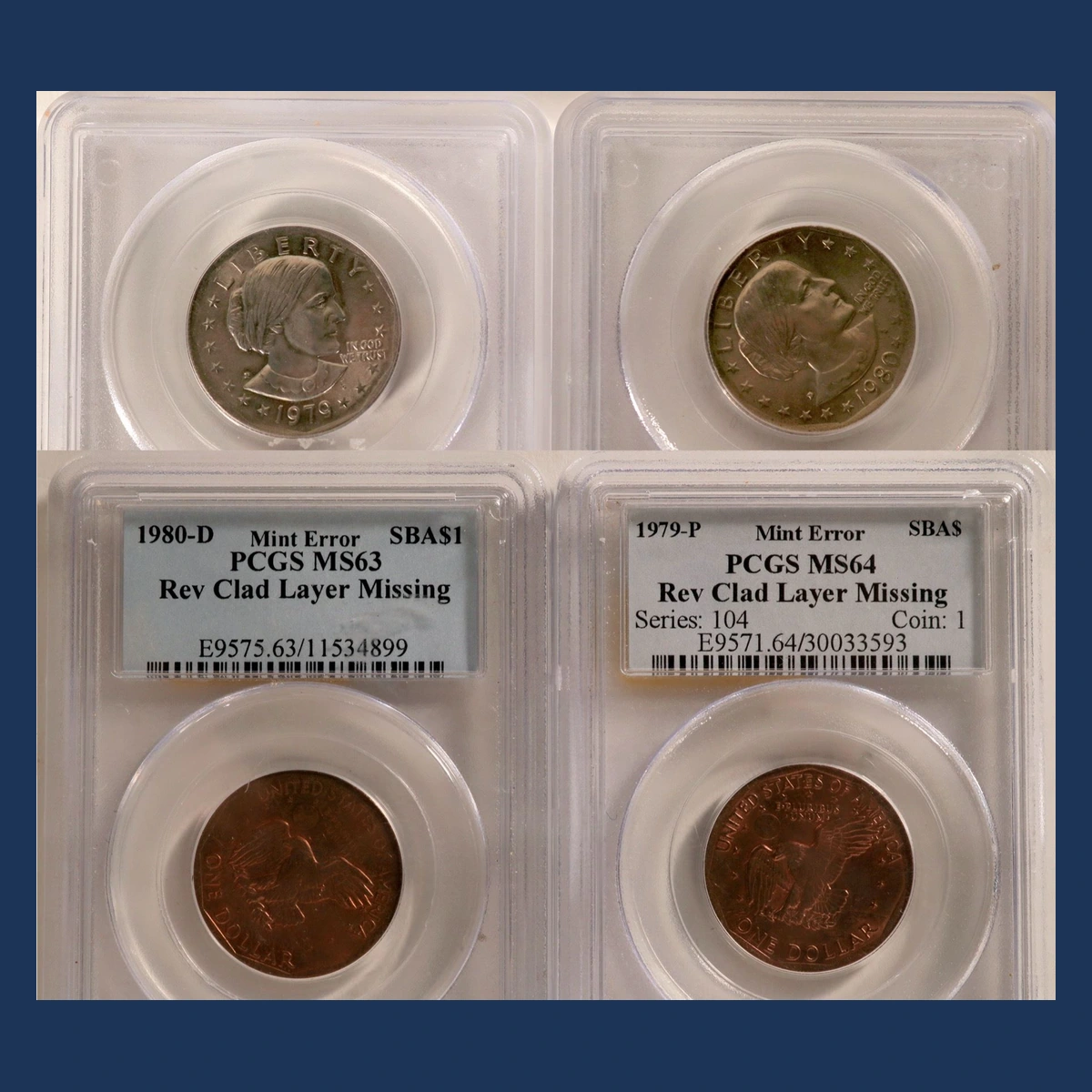
One copper-colored face can mean the dollar has lost an outer metal layer. Normal Susan B. Anthony dollars have silver-colored copper-nickel layers bonded to a copper center.
The 1980-D examples include a PCGS-certified coin missing the back layer. A different published coin lacks its front layer and weighs 6.0 grams; that example was described as cleaned.
The exposed copper is part of the coin’s structure, rather than a thin surface wash. Keeping that distinction matters because a colored surface can leave the normal layers and weight intact.
Estimated Value
An estimated $150 to $1,500 applies to authenticated examples, with the size of the missing area and surface quality setting the level. A complete missing face on an attractive, unworn coin usually brings more than partial loss.
The published 6.0-gram front example has a cleaning problem, which lowers its appeal. The back-layer coin appeared in a two-coin lot, so that lot cannot establish its individual price.
How to Identify
A 6.0-gram reading would be a major departure from the normal 8.10 grams. Weigh a loose candidate before using its color to identify the missing layer.
Inspect the copper-colored face and its border with a magnifier. A genuine layer loss should have a physical relationship with the coin’s layered edge, not just a stain crossing it.
The published light front example and the certified back example are different coins. Do not expect a front defect simply because the back comparison has the same date and mint.
A grinding wheel can remove metal and lower weight too. Check for parallel scratches, damaged lettering, and an unevenly shaved face before treating a copper-colored surface as a Mint error.
8. 1980 Susan B. Anthony Dollar Off-Center Strike
A broad blank crescent beside a crowded portrait is the clearest sign of an off-center strike. The blank sat too far from the center when the stamping tools came together.
Only the area between the tools received the dollar design. The untouched area remained blank, and some intended lettering fell beyond the edge.
An NGC-certified 1980-S dollar is described as 45% off center. A separate PCGS-certified example was listed as 75% off center, showing why the amount of missing design must be judged for each coin.
Estimated Value
An estimated $150 to $2,000 covers moderate to dramatic examples with useful identifying detail. The 45% off-center 1980-S, graded MS64 by NGC, sold for about $881 in August 2012.
A full date on a strongly displaced strike makes an appealing combination. Heavy scratches, a missing date, or damage in the blank crescent can reduce the price even when the shift looks impressive.
How to Identify
Find the date first and check how much of it remains on the struck area. Then locate the mint letter if that part of the portrait border survived.
Follow the untouched crescent around the coin and compare it with the design that disappears beyond the opposite edge. Some intended picture or lettering must miss the blank; a wide border around a complete design instead suggests a broadstrike.
Examine the untouched metal under a magnifier for flattening, tool marks, or another coin’s design. The crescent should belong to the same piece of metal as the visible strike, with an original surface rather than an altered one.
9. 1980 Susan B. Anthony Dollar Multiple Strike
Two overlapping portraits would tell a different story from tiny doubled letter tips. A multiple strike occurs when a coin stays in the press or returns between the tools and receives another blow.
The coin can shift or turn between those blows. Parts of the first design may remain beneath the second, sometimes with a second rim or date.
Multiple strikes are reported for 1980 dollars without a specific mint, finish, or number of blows established. The extra impression must therefore be demonstrated on the individual coin, rather than assumed from a doubled-looking letter.
Estimated Value
For an authenticated multiple strike, estimate $500 to $4,000. The lower end fits a less dramatic extra impression, while a clear second portrait or widely separated strikes can bring much more.
These are estimates for the reported type, based on comparable Susan B. Anthony striking errors. Readable dates, distinct overlapping designs, and attractive surfaces increase demand; severe damage can obscure the very features that make the coin interesting.
How to Identify
Make a simple map of each visible impression. Mark a recognizable piece of portrait, a letter, or a date digit, then look for other details that belong to the same picture.
The second design should form a believable shifted or turned arrangement. Random flattened marks do not make a second strike.
Inspect the back for overlapping details too, while remembering that another object could block part of an extra blow. A magnified photograph is useful for following where one impression crosses another.
Proof dollars normally receive repeated blows in the same position. Their normal sharpness is not this error; look for a separate displaced impression or other evidence of an abnormal extra strike.
10. 1980 Susan B. Anthony Dollar Struck on the Wrong Blank
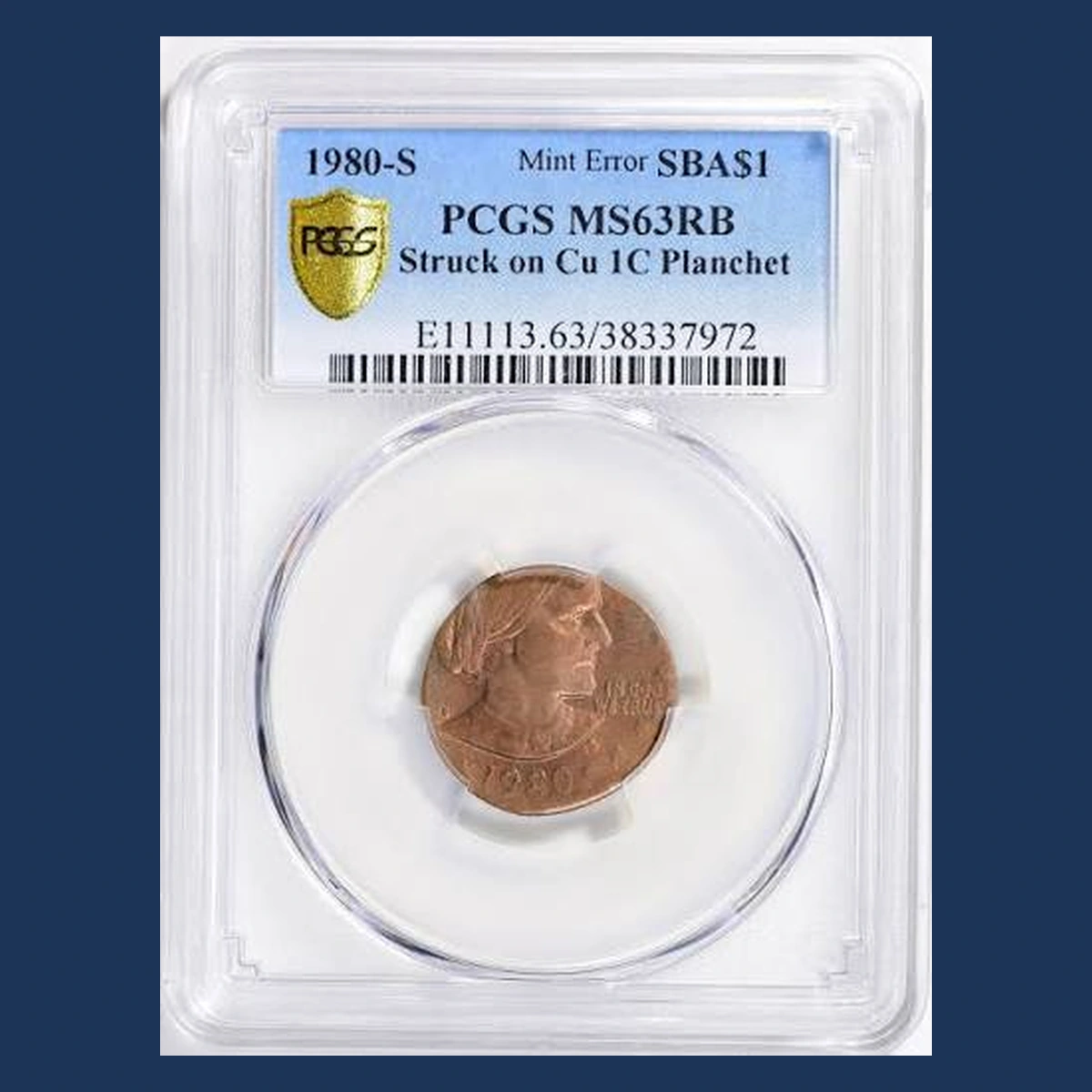
The dollar design does not fit properly when the press receives a blank intended for a smaller coin. Outer lettering can disappear, and the metal may differ from the normal dollar.
Certified 1980-S examples include quarter and nickel blanks. Copper cent blanks are documented for both Denver and San Francisco dollars.
A dime-blank error is also reported for the year, but without a confirmed mint or certified example identified. It remains a type to check through its physical features, not a reason to relabel a known dime-blank dollar from another year.
Estimated Value
Estimated values are $900 to $3,500 on quarter blanks, $2,500 to $8,000 on cent blanks, and $4,000 to $12,000 on nickel blanks. Allow $4,000 to $12,000 for an authenticated dime-blank candidate.
The 1980-S nickel-blank dollar brought $6,900 in April 2021. Its AU58 condition grade indicates only very slight wear; a contemporary report places a quarter-blank sale at $977.50 in 2002.
How to Identify
A scale is the starting point for a loose candidate. Compare its weight with 8.10 grams for the normal dollar, then examine the metal and missing design.
The intended blanks provide useful targets: a quarter is 5.67 grams, a nickel 5.00, a copper cent 3.11, and a clad dime 2.27. Those are standards, not measurements of every recorded error.
Use calipers to record diameter, but remember that striking can spread a smaller blank. A normal dollar measures 26.5 millimeters.
Check for the copper center along a quarter or dime blank’s edge, versus solid metal on a nickel blank. A copper cent blank should also differ in color.
Look for older coin designs beneath Anthony or the eagle. Their presence would suggest a dollar struck over a finished coin, rather than an unused blank.
Conclusion
A thick mint letter, brown surface, and copper-colored face need different checks. Compare the raised design for small varieties, the metal layers for color changes, and the whole outline for striking errors.
The estimated span is $20 to $12,000, with wrong-blank dollars at the expensive end. Keep Proof and ordinary examples separate, and remember that the near-date border is normal on every 1980 dollar.