2006 Dollar Coin Error List with Pictures

A dollar design squeezed onto a quarter blank brought $7,800 in April 2021. That auction coin was a 2000-P Sacagawea, an older comparison for the possible wrong-blank error discussed here.
This 2006 Sacagawea dollar error list covers five types with estimated values from $30–$12,000. One documented double strike has extra letters tangled across LIBERTY.
The edge deserves attention too: a plain edge is normal for 2006. Read on to separate damaged tools, incomplete blanks, and misplaced strikes.
1. 2006 Sacagawea Dollar Clipped Blank
A gap in the edge can begin before a dollar receives its design. The cutting equipment may remove an incomplete disc from the metal strip, leaving too little metal for the intended picture.
Collectors call that incomplete disc a clipped blank. A 2006-P year guide reports this type without identifying the size or position of a particular clip.
The nearby rim may weaken as the metal spreads during striking. Weakness on the opposite rim can provide another clue.
A curved missing section is not enough by itself. Someone can cut a similar gap into a finished dollar.
Estimated Value
For an authenticated 2006-P clipped dollar, estimate $30–$500. A small gap on a marked coin generally offers less visual interest than a larger clip with the date intact.
These are estimated whole-coin prices based on comparable modern-dollar clips. They do not describe a verified sale of the year-guide example.
Natural rim details around the gap matter more than a neat curved outline. Later cutting or filing removes metal without creating a collectible clipped blank.
How to Identify
Follow the raised rim toward each end of the gap under a magnifier. Look for a natural change in the struck detail where the blank was incomplete.
Turn the coin to see the inside surface of the missing section. Parallel file marks, saw lines, or sharp burrs can reveal later cutting.
Inspect the opposite rim for a weak area and compare both faces with a normal 2006-P dollar. That supporting weakness is not equally clear on every genuine clip.
A digital scale can check a loose candidate against the usual 8.1 grams. A light reading only shows missing weight, so the surfaces beside the gap still need to explain when that metal was lost.
2. 2006 Sacagawea Dollar Raised Crack Lines and Possible Rim Breaks
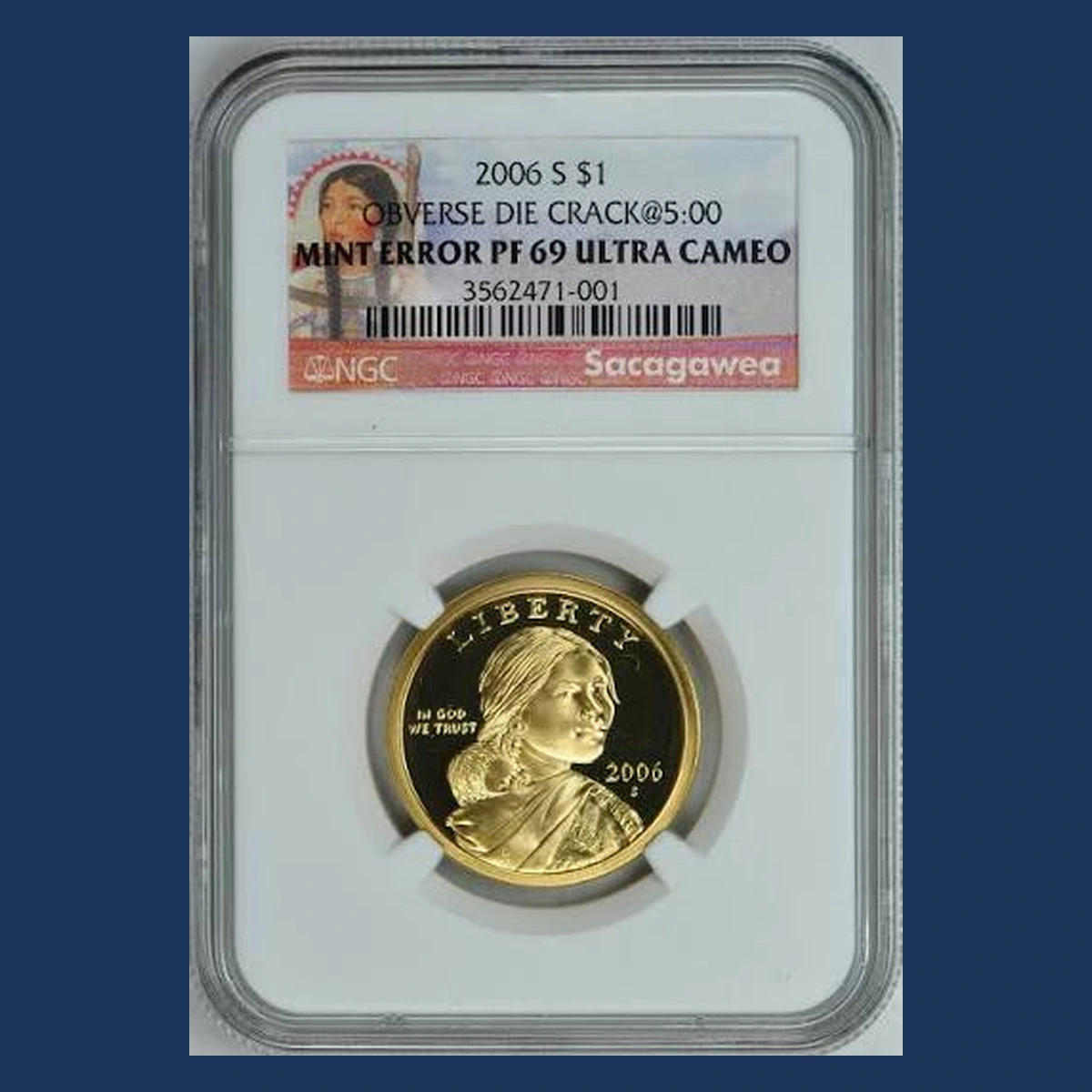
On a 2006-S Proof, a raised line runs toward the rim near five o’clock, beside the portrait. A Proof is a specially made collector coin with carefully prepared surfaces.
The line comes from a crack in the steel stamping tool, called a die. Metal pressed into that crack leaves a ridge on later coins.
A larger piece breaking away at the rim could instead leave a broad raised patch, called a cud. A 2006 cud remains a possible type without a confirmed same-year specimen here.
The known thin crack does not prove that such a rim block developed.
Estimated Value
The documented NGC Proof-69 Ultra Cameo crack example sold in August 2012, but its price is not public. Its grade describes a nearly flawless Proof with strong contrast between the portrait and background.
Estimate $30–$250 for comparable cracked Proofs. A genuine large rim cud, if authenticated on a 2006 dollar, has a separate estimated range of $100–$1,000.
The size of the raised feature and preservation determine which comparison fits.
How to Identify
Read the S below the date before comparing the documented Proof crack. Under angled light, follow the lower-right portrait edge toward the rim near five o’clock.
A magnifier should reveal a raised ridge, not a cut into the golden surface. A scratch may have pushed-up sides, so examine the middle of the line as well.
A possible cud needs a different shape: broad raised metal connected to the rim, with the normal design absent inside it. Check for a dent or an added lump that could imitate this feature.
Keep the reflective surfaces untouched while changing the lamp angle. The thin five o’clock ridge and a wide rim block require separate comparisons.
3. 2006 Sacagawea Dollar Off-Center Strike
Sacagawea and the eagle can both move toward one side when the blank sits partly outside the striking area. An untouched crescent remains where the stamping tools did not reach.
Some of the intended artwork falls beyond the opposite edge. This combination produces an off-center strike.
A published guide reports the type for 2006-P ordinary dollars. It does not establish one percentage or direction for all examples.
The blank crescent helps separate this error from a merely uneven border. A dollar retaining its complete design may instead have spread outward without proper support around its edge.
Estimated Value
A readable date beside a strong shift makes an off-center dollar especially easy to display. An authenticated 2006-P example has an estimated value of $100–$2,000, depending on condition and the amount of design lost.
The estimate concerns a single displaced strike. A second blow creates different overlaps and needs a double-strike comparison.
A small border difference should not receive the same price as a clear untouched crescent. Original surfaces and surviving identity support the upper part of the range.
How to Identify
Place front and back photographs in the same alignment and compare where the design runs out of metal. The shift should affect both sides, while an error in one tool’s position may affect only one.
Inspect the crescent under low light to see whether it retains original unstruck texture. Scraping a finished dollar can erase detail, but leaves altered surfaces rather than an untouched part of the original blank.
Check that part of the intended picture is actually cut off, and retain the date and P in your photographs. If all the design fits inside a wide border, compare a broadstrike before calling the coin off-center.
4. 2006 Sacagawea Dollar Double Strike within the Edge Ring
Extra letters crowd LIBERTY on a documented 2006-P dollar. Its first, faint impression survived beneath a second strike, leaving repeated features on both faces.
The Stack’s Bowers catalog describes a PCGS MS65 example struck twice within the collar. The collar is the ring that controls the coin’s edge during striking.
The first impression was slightly displaced, described as perhaps fifteen percent. That figure is approximate and does not measure a rotation angle.
The date also retains traces of the earlier blow. This is a repeated picture caused by two strikes, rather than a single thick letter copied from one tool.
Estimated Value
For an authenticated 2006-P double strike of this kind, estimate $300–$4,000. Clear overlapping words and recognizable remnants on both faces make the sequence easier to follow.
The cataloged MS65 has no circulation wear and relatively few marks. Its listing confirms the error’s form without supplying a price used in this estimate.
Faint extra outlines should be compared with equally subtle examples. A dramatic second image across the portrait can attract stronger interest than a small doubled-looking patch.
How to Identify
LIBERTY is the most direct starting point for the cataloged coin. Use a magnifier to separate letters from the faint first impression and the stronger later one.
Continue to the date instead of judging one crowded letter. Repeated digits should connect with the same displaced first picture.
Compare the eagle side while keeping the coin’s alignment unchanged. The original description reports repeated details there too.
A backward sunken copy may come from pressing finished coins together after manufacture. Look instead for surviving raised portions of the earlier struck design beneath the later impression.
Photograph the edge and both sets of details for specialist review. The overlapping word and date together are more useful than trying to reproduce the catalog’s approximate percentage.
5. 2006 Sacagawea Dollar Possible Strike on the Wrong Blank
A smaller disc gives Sacagawea’s design less room, so outer letters can disappear beyond its edge. Different metal can also change the coin’s color and weight.
The word planchet means the prepared blank waiting to be struck. A wrong-planchet error occurs when a blank intended for another coin enters the dollar press.
This remains a possible 2006 type, without a confirmed same-year specimen in the cited account. Its illustrated quarter-blank example is dated 2002-D.
That older coin shows what the mechanism can produce. It cannot establish a matching 2006 coin, mint, grade, or sale price.
Estimated Value
A different-year comparison sold at Heritage for $7,800 in April 2021: a 2000-P Sacagawea on a quarter blank, graded PCGS MS68. That grade indicates exceptionally well-preserved unworn surfaces.
For an authenticated 2006 wrong-blank dollar, a conditional estimate is $2,000–$12,000. The actual metal, readable date, and surviving design would determine the closest comparison.
This is a proposed range for a confirmed discovery, not a recorded 2006 result.
How to Identify
A normal 2006 dollar weighs about 8.1 grams and measures 26.49 millimeters across. Record a loose candidate’s weight on a digital scale before comparing its color.
Use calipers to measure its width, then inspect where the dollar lettering meets the edge. A smaller blank can spread during striking, so its final diameter may exceed that of the intended coin.
For a quarter-blank possibility, the usual 5.67-gram standard offers a weight comparison. It is not a measured weight for a known 2006 example.
Have the alloy checked, especially if the only apparent difference is color. Plating, acid damage, or a trimmed border can produce misleading measurements.
The wrong metal or size must accompany an original dollar strike and a readable date.
Conclusion
The plain edge and the soft texture of a satin collector dollar are normal for 2006. Neither feature needs an error explanation.
The five groups above range from a narrow Proof crack to a possible wrong-blank discovery, with estimates of $30–$12,000. Keep the reported examples separate from candidates still needing authentication.
Clear views of the date, mint letter, and unusual feature provide the best starting record.