2010 Presidential Dollar Error List with Pictures

A dollar’s thin edge can carry most of the clues to its mistake. GreatCollections records a missing-edge Franklin Pierce dollar graded MS68 at $517.50.
In this 2010 Presidential dollar error list, the text may be shallow, partly absent, completely absent, or repeated. Estimated values across these types run from $10–$1,500.
Fillmore, Pierce, Buchanan, and Lincoln do not share every reported error. Follow the surviving inscriptions below to compare the right president and finish.
1. 2010 Presidential Dollar Philadelphia Weak Edge Lettering
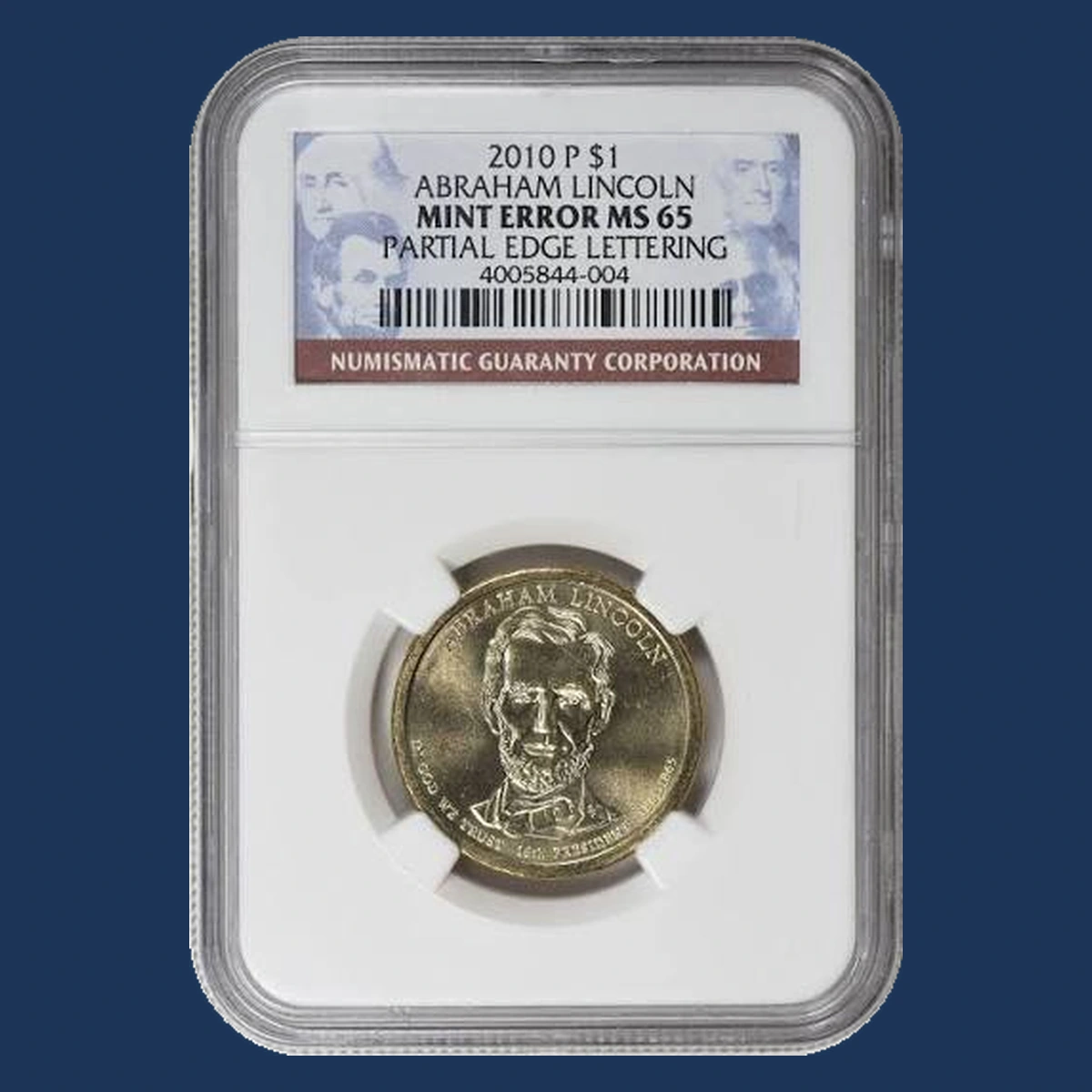
The edge date and motto can look faint while the presidential portrait remains well formed. Edge lettering was added after the two faces, so the depth of those letters reflects a separate operation.
Weak-edge reports cover ordinary Philadelphia issues for all four 2010 presidents: Fillmore, Pierce, Buchanan, and Lincoln. A Fillmore Position B example graded PCGS MS64 appeared in a specialist collection.
Some letter strokes may be much shallower than their neighbors. That does not require a matching weak area on the face.
Wear can also soften edge words. Original shallow impressions need to be distinguished from later rubbing.
Estimated Value
Clearly identified weak-edge dollars have an estimated range of $10–$500. The upper end needs a desirable combination of president, strong overall preservation, and an easy-to-see edge feature.
MS64, the grade of the reported Fillmore example, means no circulation wear but noticeable small marks. A higher number alone does not tell you how shallow the lettering is.
Compare similar coins rather than assuming all four presidents bring the same amount. Scraped edges should not be valued as original weak lettering.
How to Identify
Examine the portrait for wear before studying the edge, since rubbing may have softened both. A worn coin can still carry a genuine mint feature, but the surrounding surfaces help explain what happened.
Use a magnifier to compare deep letter strokes with faint ones around the same coin. Change the lamp angle until the bottoms of shallow impressions become visible.
Now compare an ordinary Philadelphia dollar showing the same president. Differences in photographic glare should not be mistaken for different lettering depths.
Read the P and date wherever they survive, and inspect any smooth patches for abrasion. Original shallow lettering should still trace recognizable recessed strokes instead of stopping only where scratches have removed the edge surface.
2. 2010 Presidential Dollar Pierce and Buchanan Partial Edge Lettering
Some words remain on a partial-edge dollar while other intended characters never appear. A section of properly impressed text can sit beside a blank part of the circumference.
The documented catalog scope includes Philadelphia Franklin Pierce in Position A and James Buchanan in Positions A and B. Those direction labels do not describe how much text is missing.
Partial omission differs from uniformly shallow lettering and from losing the complete edge inscription. The surviving words provide the distinction.
A filed patch can create a similar gap later. Its surface must be checked before treating missing characters as a production error.
Estimated Value
An estimated $25–$750 covers authenticated Pierce and Buchanan partial-edge examples. A large omission with a clear boundary beside readable original text gives collectors an understandable display.
The estimate allows for different amounts of missing inscription and different levels of preservation. It does not assign a sale price to every listed Position A or Position B combination.
Keep the surviving letters in your comparison photographs. A dark image that merely hides faint strokes provides a weaker basis for valuing the coin.
How to Identify
Read as much of the inscription as possible and note where individual words disappear. Then turn the coin through a full circuit so one blank section is not mistaken for an entirely unlettered edge.
Use low light and a magnifier at the transition from letters to blank metal. Look for shallow remnants that could make the feature weak lettering rather than a true omission.
Compare that transition with the edge’s shape. A flat spot, parallel scratches, or a reduced band can indicate metal removed after striking.
Check Pierce or Buchanan on the face and P on the surviving edge before matching the cataloged type. The key is retained original text meeting an original blank section without filing or grinding.
3. 2010 Presidential Dollar Completely Missing Edge Lettering
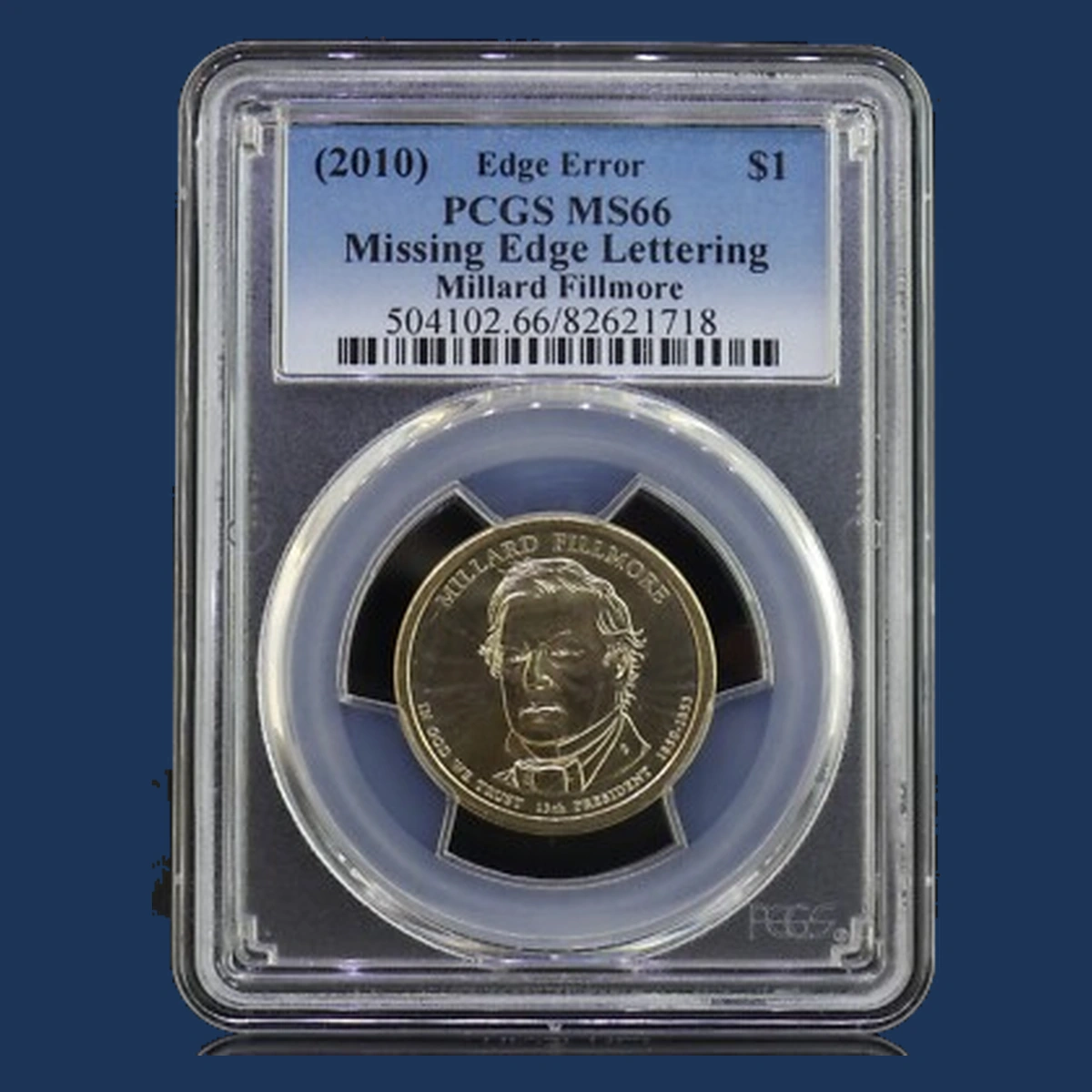
The president’s term dates are still on the face, but the actual minting date disappears with the edge inscription. An unlettered 2010 dollar therefore needs to be identified by its design and finish.
Missing-edge reports cover ordinary Fillmore, Pierce, and Buchanan dollars. Fillmore and Buchanan also have reported satin-finish examples, made with a softer-looking collector surface for Mint Sets.
The missing mint letter cannot identify Philadelphia or Denver on its own. Original packaging may provide information that the bare coin no longer carries.
IN GOD WE TRUST remains on the face. Its absence from the edge is normal for 2010.
Estimated Value
Estimate $20–$600 for ordinary missing-edge examples and $50–$1,000 for comparable satin-finish candidates. Identify the finish before choosing a price comparison.
GreatCollections records a Pierce PCGS MS68 at $517.50. A Buchanan PCGS MS64 sold for $35 at Heritage in April 2020.
Those are different ordinary-strike coins with different grades, not two prices for one specimen. Higher preservation can matter greatly, while a satin finish requires its own comparison rather than an automatic premium.
How to Identify
Preserve any original Mint Set packaging while deciding whether the surfaces have the satin collector finish. Compare with a normal satin dollar of the same president under matching light.
Check the whole edge, not the dates printed beside the president’s name. Those face dates describe his time in office.
A magnifier should reveal any remaining bottoms of letters or numbers. Even a short surviving original inscription changes the identification from complete omission.
Weigh and measure a loose coin with a digital scale and calipers against about 8.1 grams and 26.49 millimeters. These checks can expose removed metal but cannot prove authenticity alone.
Inspect the plain edge for grinding lines or a flattened band. An untouched full circumference is the essential missing-lettering feature.
4. 2010 Presidential Dollar Overlapping and Inverted Doubled Edge Lettering
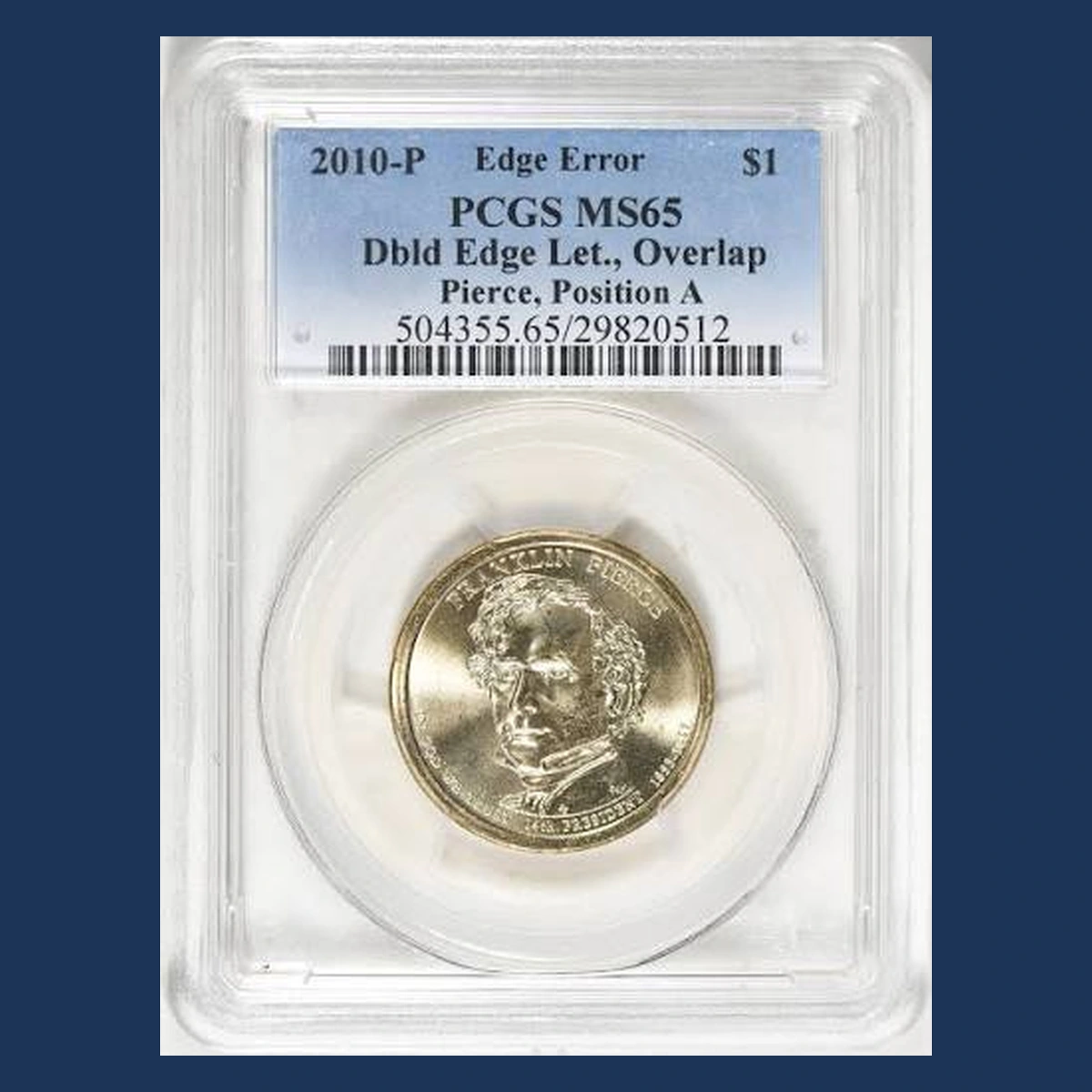
Letters can cross other letters when a dollar passes through edge-lettering equipment again. A second pass may repeat the text in the same direction or place it upside down against the first.
Same-direction overlap is reported for ordinary Philadelphia dollars of all four 2010 presidents. A Lincoln Position A example graded PCGS MS65 appeared in a specialist collection.
Opposite-direction listings cover Philadelphia Pierce Position A and Buchanan Position B. They are not established here for every president.
Both errors require two sets of recessed text. One inscription facing either direction is simply a normal edge-lettering position.
Estimated Value
For authenticated double-edge examples, estimate $50–$1,500. Clear readable repetition across several characters is a stronger display than a small ambiguous extra line.
The president and the relationship between the two inscriptions matter alongside condition. An inverted example should show text running both ways, while overlap should preserve two impressions facing the same way.
These are estimated ranges rather than recorded sales of the cataloged combinations. A normal single inscription in Position A or B carries no double-edge premium.
How to Identify
Start with the direction of each set of words, keeping the portrait in view for orientation. With a magnifier, follow a second line of recessed characters through the first instead of judging one isolated letter.
If the inscriptions face opposite ways, turn the coin to read the second sequence and check several neighboring characters. If both face the same way, compare their spacing where the two impressions cross and partially obscure one another.
Random contact marks may resemble one letter, but they should not form a second readable phrase around the edge. The quick distinction is two readable sets of sunken characters, rather than a single inscription read with the coin turned over.
Conclusion
The amount and arrangement of surviving edge text are more useful than which way one inscription faces. Shallow strokes, blank sections, and a second complete set each tell a different story.
Estimated values span $10–$1,500. Check the president and finish alongside the edge, especially when comparing ordinary dollars with satin collector coins.
Preserve clear photographs of the whole circumference before making a high-value comparison.