2014 Presidential Dollar Error List with Pictures

One 2014 dollar carried a Presidential-series back without carrying a president at all. Sacagawea appeared on the other side, and the mismatched coin brought $84,000 in April 2021.
The 2014 Presidential dollar error list also includes faint edge words, a Coolidge dollar with no edge text, and a possible Hoover die clash. Estimated values span $10–$100,000.
Some clues are large; others need magnification. Work through the designs and edges below to see what each type should show.
1. 2014 Presidential Dollar Philadelphia Weak Edge Lettering
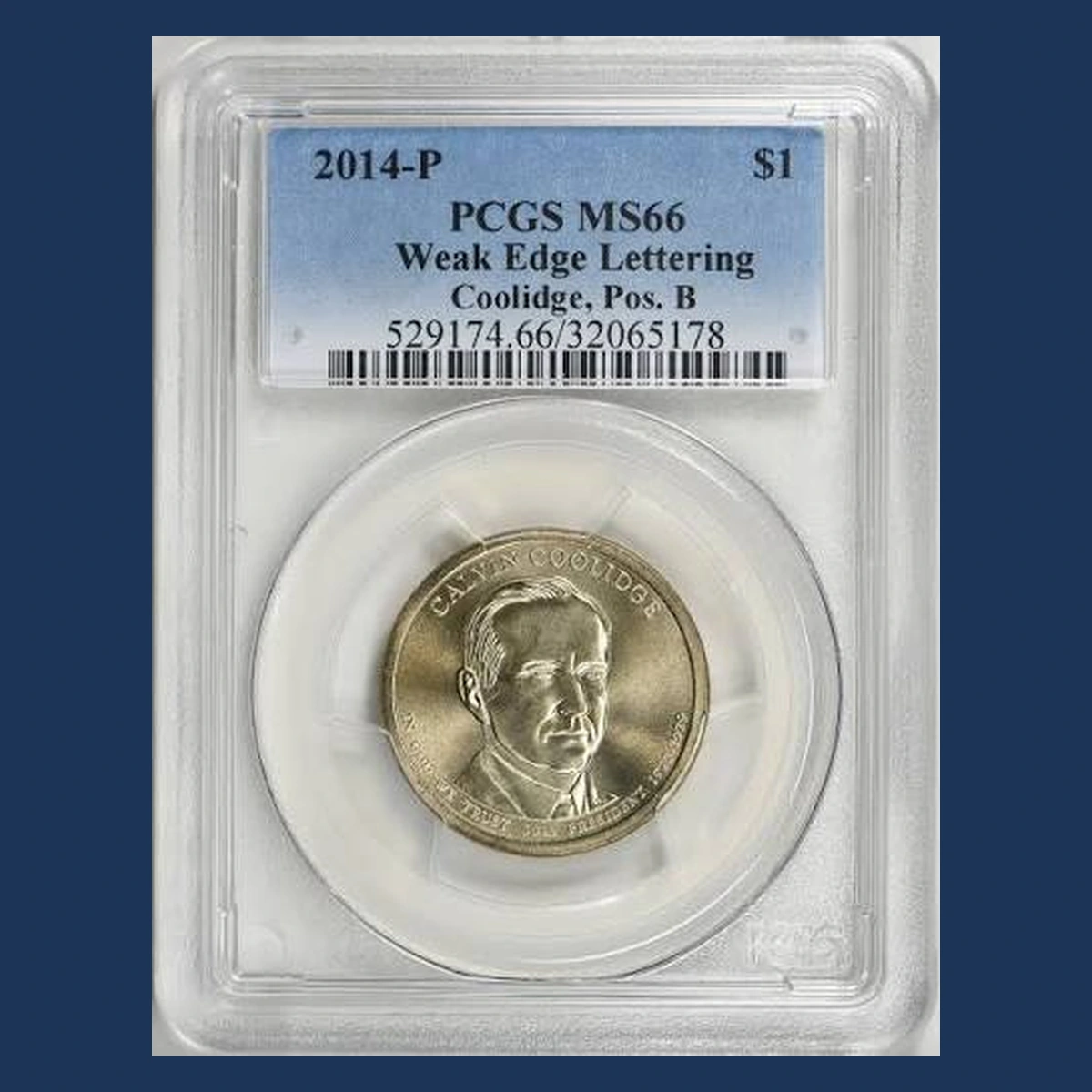
Some edge letters appear shallow even though nearby strokes remain readable. The edge-lettering equipment did not press the full intended impression into the metal.
PCGS lists this feature on Philadelphia dollars honoring Warren Harding, Calvin Coolidge, Herbert Hoover, and Franklin Roosevelt. Each president’s coin needs its own comparison rather than one assumed weak letter for all four.
The inscription may face either way relative to the portrait. Those normal directions, called Positions A and B, are not errors by themselves.
Weakness leaves traces of the lettering. A completely unlettered edge is the separate error described later.
Estimated Value
For identified Philadelphia weak-edge examples, an estimated $10–$200 covers modest through clearly visible lettering weakness. Attractive faces and an edge that clearly shows the shallow strokes improve the comparison.
PCGS lists a Coolidge Position B MS66 result of $95 in October 2015. That published record concerns an unworn coin with relatively few marks.
It does not establish the value of every president or grade. Ordinary wear that smooths lettering is a different cause.
How to Identify
Choose a normal coin showing the same president and compare the edges under similar light. Start with the deepest remaining letters, then follow them into the shallower area.
A magnifier can reveal the bottoms of strokes that are almost invisible from directly above. Move the lamp instead of rubbing the edge to make the letters easier to see.
Check 2014 and P wherever those markings remain readable. The four documented Philadelphia designs do not automatically establish this variety on Denver or San Francisco coins.
Look at adjacent metal for scratches and rounded surfaces that could explain weak words through wear. The most useful comparison is a shallow original stroke beside an undamaged part of the same edge.
2. 2014 Presidential Dollar Possible Hoover Die Clash
An unexpected outline near Hoover could come from the design on the other stamping tool. If the tools hit each other without a coin between them, they can mark one another.
Later coins may carry faint pieces of that transferred picture. Collectors call this a die clash, with die meaning the steel stamping tool.
The Hoover possibility has no confirmed example or exact outline established here. It should be treated as a candidate needing a design match, not a named variety.
A scratch or ordinary design detail is not enough. The unusual mark must make sense as transferred artwork.
Estimated Value
If a 2014-P Hoover clash is authenticated, estimate $25–$300. A recognizable portion of Liberty’s design would be more informative than a faint line with no clear connection.
The range is an estimate from comparable modern-dollar tool-contact errors, not a sale price for an established Hoover specimen. No premium should be based only on an unusual label or an isolated mark.
Wear, cleaning, and scratches can obscure the transferred detail. A clear design match is what gives this candidate potential interest.
How to Identify
Lay clear photographs of Hoover and the Statue of Liberty side by side before studying the suspect line. Try to find the corresponding shape on the opposite design.
The match must fit the coin’s normal alignment, allowing for the reversed outline transferred when the tools met. A vaguely similar curve is not enough.
Use a magnifier to examine how the line meets the original artwork. Scratches often cut across details with a narrow groove and pushed-up edges.
Check the same area on an ordinary Hoover dollar to avoid calling a normal fold or letter stroke an error.
Photograph the whole suspect area rather than one bright fragment. A repeated recognizable piece of the opposite design provides the useful clash clue.
3. 2014 Presidential Dollar Coolidge Missing Edge Lettering
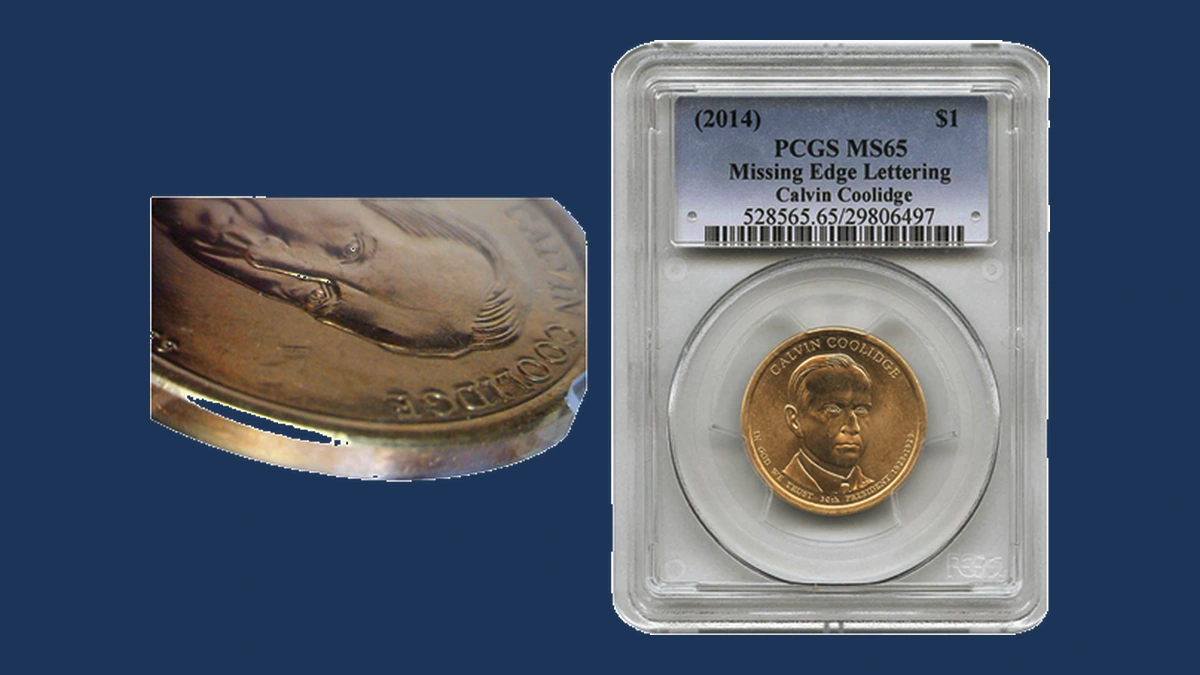
A Coolidge dollar discovered in a Denver roll had none of its required edge inscription. The other coins in that roll retained their lettering.
The discovery was reported in 2014 and graded PCGS MS65, an unworn grade with relatively few marks. Its Denver connection came from the Mint-wrapped roll, since no D could be read on the coin.
The missing text includes the year, mint letter, and E PLURIBUS UNUM. IN GOD WE TRUST is on the face of a 2014 dollar, so its absence from the edge is normal.
Completely missing lettering differs from faint surviving strokes.
Estimated Value
A genuine Coolidge missing-edge dollar has an estimated range of $1,000–$5,000. Original edge surfaces and a clear history of the find strengthen confidence in the identification.
For comparison, a different 2016 Reagan missing-edge dollar graded MS65 sold for $3,881 in January 2019. That result concerns the same general error on another president’s coin.
It is not a sale of the Coolidge discovery. The estimated range allows for condition and demand without treating every smooth-edged dollar as equally valuable.
How to Identify
First distinguish a truly plain edge from very shallow lettering. Turn the coin through a full circle under side lighting and magnification, looking especially for the bottoms of date digits.
Keep the Coolidge portrait in your comparison photographs. The missing year cannot be read directly, so identifying the president connects the coin to its issue.
For a loose coin, a digital scale and calipers can help expose grinding that removed edge metal. Normal dollars weigh about 8.1 grams and measure 26.49 millimeters.
The documented Denver origin depends on the original roll, not on a plain edge alone.
Examine the border for filing lines, rounding, or a flattened band. A genuine candidate needs intact original metal around the full unlettered edge.
4. 2014 Presidential Dollar Mule with a Sacagawea Front
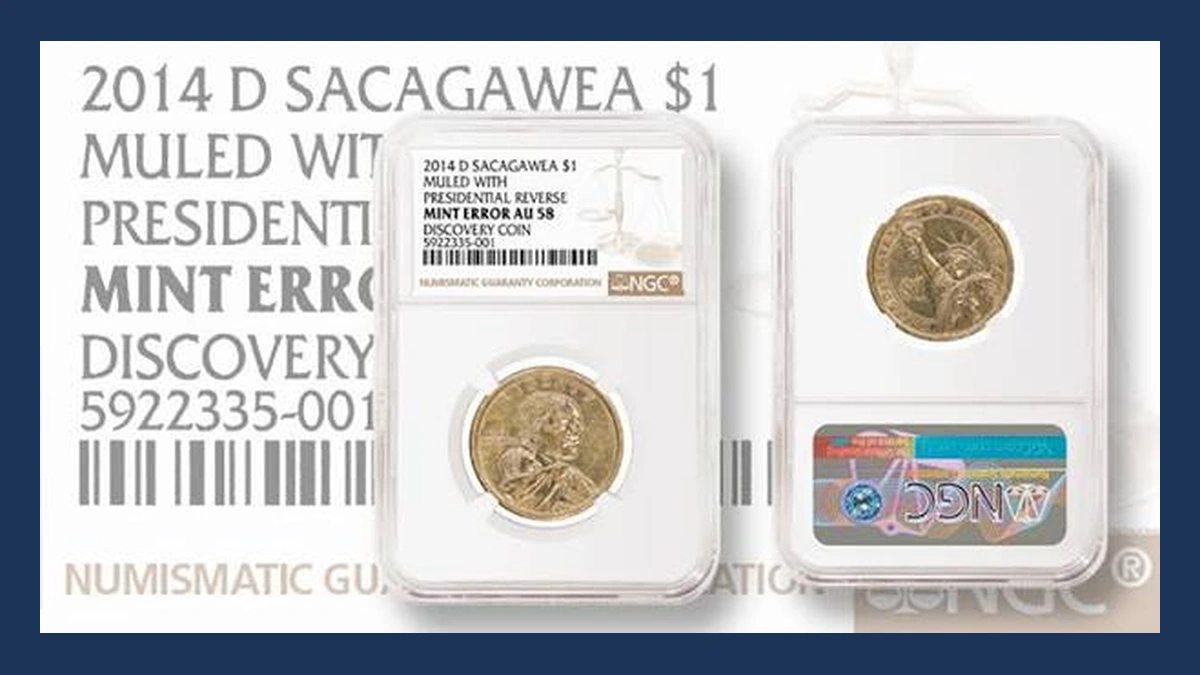
Instead of Harding, Coolidge, Hoover, or Franklin Roosevelt, this dollar shows Sacagawea carrying her infant. The other side has the Presidential series’ Statue of Liberty.
That combination joins stamping tools from two different dollar series. It is called a mule.
The edge reads 2014 and D, tying the coin to Denver. NGC certified the discovery AU58, a grade indicating slight wear.
A collector found it in a mixed bag of dollars in 2019. The coin had already picked up light wear before its mismatched pictures drew attention during an ordinary search through change.
Estimated Value
The NGC AU58 discovery sold for $84,000 on April 24, 2021. A comparable authenticated mule has an estimated value of $60,000–$100,000.
Light circulation wear did not prevent that strong result. The unusual pairing and the discovery’s history drew attention beyond the coin’s surface condition.
This estimate applies to the complete Sacagawea-and-Liberty combination. A normal dollar with one polished or altered face does not become comparable simply because the other side remains genuine.
How to Identify
Turn the physical coin over in your hand so both designs can be checked together. Sacagawea with her infant must share one coin with the standing Statue of Liberty.
The 2014-D discovery has readable edge lettering, unlike a missing-edge error. Inspect those characters under a magnifier while checking for a seam around the edge or rim.
A seam may indicate two altered coins were joined. Do not pry at the edge or scrape it as a test.
Both dollar series use the same basic blank, about 8.1 grams and 26.5 millimeters. A scale and calipers can find suspicious differences, but ordinary measurements cannot prove this pairing.
A grading service must confirm that both designs were struck onto one original blank.
Conclusion
Harding, Coolidge, Hoover, and Franklin Roosevelt dollars all have documented Philadelphia weak-edge varieties. The fully missing-edge discovery belongs to Coolidge, while the rare mule joins two different dollar series.
Estimated values range from $10–$100,000, depending on the type and condition. A possible Hoover clash still needs a convincing match to the opposite design.
Compare the entire coin before assigning value to one unusual detail.