1849 Half Dollar Error List with Pictures

A raised line crosses Liberty’s face and arm on an 1849-O half that sold for $15,275. Heritage sold the finely preserved NGC MS65 CAC coin in October 2014.
Philadelphia coins offer a different search: extra pieces of numbers around the date. These 1849 half dollar errors have estimated ranges totaling $350–$16,000 across the specific conditions discussed here.
Examine the number fragments and the long crack below to see which comparison fits your coin.
1. 1849 Liberty Seated Half Dollar Misplaced Date Error (Estimated Up to $750)
An extra piece of a number can remain outside the normal 1849 date. It comes from an early date punch that landed in the wrong place.
The punch marked the die, the steel tool that stamps coins. Correcting the date’s position did not always remove every trace of the first attempt.
Collectors call this a misplaced date. WB-10 is the catalog name for one Philadelphia example identified in a Stack’s Bowers sale.
Its extra fragment differs from close doubling right beside the normal digits. Look for a number shape in the correct location, not just any bump near the date.
Estimated Value
The PCGS AU50 WB-10 sold for $432 in August 2025. AU50 means a lightly worn coin with much of its original detail.
For comparable identified examples, the estimated range is $350–$750. Surface quality and the clarity of the extra number fragment help determine where a coin fits.
The range applies to this misplaced-date variety around that condition. A more dramatic repunched date is a different comparison, even though the year is the same.
How to Identify
A useful photograph includes the whole date, the nearby seat, and the border. The extra fragment needs those landmarks to show where it sits.
Use a 10× magnifier beside a clear WB-10 reference. Decide whether the raised shape follows part of a number, rather than a border tooth or a small lump from a broken die.
Philadelphia coins have no mintmark below the eagle. The normal unworn weight is 13.36 grams, and the diameter is about 30.6 millimeters.
When safely accessible, compare those figures with a scale and calipers, and inspect the edge grooves. The strongest match combines the fragment’s number shape with its position relative to the normal date.
2. 1849 Liberty Seated Half Dollar Repunched Date Error (Up to $9,400)
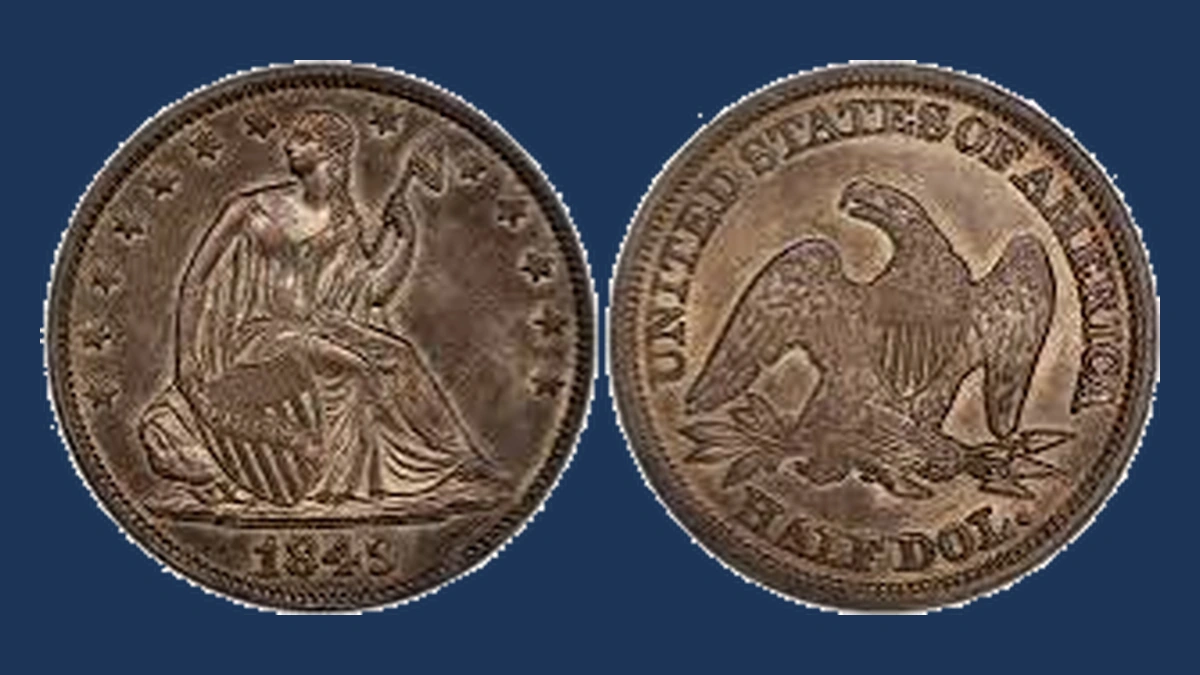
Pieces of an earlier date appear to the left of all four final numbers on the dramatic 1849 variety. Their lower ends make a repeated pattern across the date.
The first punch landed too far left. After the date was punched again, parts of that earlier impression remained on the die.
Every coin made from it could pick up those extra number bases. This is a repunched date, not a second strike of the whole coin.
Other 1849 date varieties show different strengths of doubling. Their extra lines need their own comparison rather than the most dramatic variety’s photograph.
Estimated Value
The dramatic FS-301 variety sold for $9,400 as an NGC MS64 in October 2014. A different repunched date, WB-3, reached $2,220 in MS63 in October 2023.
Both were Heritage sales of unworn coins. For those kinds of examples, estimate $2,000–$9,500.
FS-301 and WB-3 name different varieties, so condition is only part of the price difference. Stronger, more desirable extra numbers also matter; the range is not an automatic bonus for every thick-looking digit.
How to Identify
Trace the earlier date from the first number to the last. On the dramatic variety, the surviving bases lie left of the final numbers.
Strong examples may show them without magnification. A magnifier helps compare weaker pieces with a properly identified photograph.
The earlier shapes should form a consistent pattern. Flat shelves caused by movement during striking do not recreate four clearly shifted number bases.
Check that the photo shows a Philadelphia half dollar dated 1849. The normal coin weighs 13.36 grams when unworn, measures about 30.6 millimeters, and has grooves around the edge.
Use a digital scale and calipers when safely accessible. All four matching number remnants are more convincing than one doubled-looking digit.
3. 1849-O Liberty Seated Half Dollar Die Crack Error (Up to $15,275)
The long raised line starts near star 8 and travels through Liberty’s portrait. It crosses the back of her head, ear, cheek, and chin before following the shoulder and arm toward her hand.
Heritage described this path on an 1849-O coin, along with several cracks on the back. The catalog calls its set of dies Die Pair 13.
Silver entered fractures in those tools during striking. This left raised lines across the coin, including its higher design details.
The coin itself stayed intact. The line records damage to the tool, not a scratch across Liberty after the coin was made.
Estimated Value
The NGC MS65 CAC coin sold for $15,275 on October 27, 2014. An estimated $12,000–$16,000 applies to similarly fine, unworn examples with original surfaces.
New Orleans halves are difficult to find in that condition. The price therefore reflects much more than the crack.
A worn coin with the same line needs a different condition comparison. Following the right path across Liberty does not by itself make that coin worth five figures.
How to Identify
The O below the eagle identifies New Orleans. Establish that mint first, because a similar mark on a Philadelphia coin cannot identify this variety.
Now follow the line from star 8 through the ear, chin, shoulder, and arm. A 10× magnifier and light from the side should reveal raised metal rather than a cut.
Inspect the back for the other cracks shown on the same reference coin. Do not borrow their locations from a different example.
For a safely accessible coin, use a scale and calipers against 13.36 grams when unworn and about 30.6 millimeters, and check the edge grooves. The full head-to-hand route, together with the O, provides the clearest comparison.
Conclusion
A wide photograph is often more useful than an extreme close-up on these coins. It shows whether an extra number is misplaced, closely repunched, or simply a mark in the wrong spot.
The comparisons run from $350–$750 for lightly worn misplaced dates to $12,000–$16,000 for exceptional cracked-die New Orleans halves. The intervening $2,000–$9,500 date-variety range covers unworn examples, so keep condition attached to every estimate.