1819 Half Dollar Error List with Pictures

LIBERTY appears twice on an 1819/8 half dollar that sold for $2,280 in July 2025. The eagle on its back has no matching second outline.
A moving stamping tool left this unusual clue.
This guide to 1819 half dollar errors covers repeated designs, a changed date, and reported missing edge lettering. Estimated values range from $150 to $2,500; read on to see where to look and what each feature can tell you.
1. 1819 Capped Bust Half Dollar Missing Edge Lettering Error (Estimated Up to $1,500)
The edge should read FIFTY CENTS OR HALF A DOLLAR. A collector reported an 1819 half dollar without that lettering, although the report does not establish professional authentication.
Early half dollars received their edge lettering in a separate step before the faces were stamped. Skipping that step could leave the edge plain.
A documented 1812 example shows this kind of error. It is a different coin, not proof of the reported 1819 piece.
Check the whole edge. Heavy wear, filing, or use in jewelry can remove lettering and make an ordinary coin look similar.
Estimated Value
The estimated value is $500–$1,500 for an authenticated circulated 1819 example. This is an estimate, not a sale price for the reported coin.
For context, a 2007 Jefferson dollar with missing edge lettering sold for $84 at Heritage in July 2025. It was graded PCGS MS66, an unworn grade.
That modern dollar is only a different-series comparison. An early silver half dollar’s scarcity and condition need their own assessment.
How to Identify
Every part of the edge matters here. Rotate the coin completely and take overlapping photographs so no section is hidden.
With a 10× magnifier, look for faint letter bottoms and straight filing marks. A former jewelry mount may leave a seam or damaged metal where the edge meets the faces.
The documented 1812 plain-edge half dollar provides a useful visual comparison. Keep its date separate from the reported 1819 coin.
An unworn half dollar should weigh about 13.48 grams and measure 32.5 millimeters; check with a digital scale and calipers. Have a specialist examine the complete edge alongside clear date photographs to distinguish a missed lettering step from later removal.
2. 1819/8 Capped Bust Half Dollar Overdate Error (Up to $2,040)
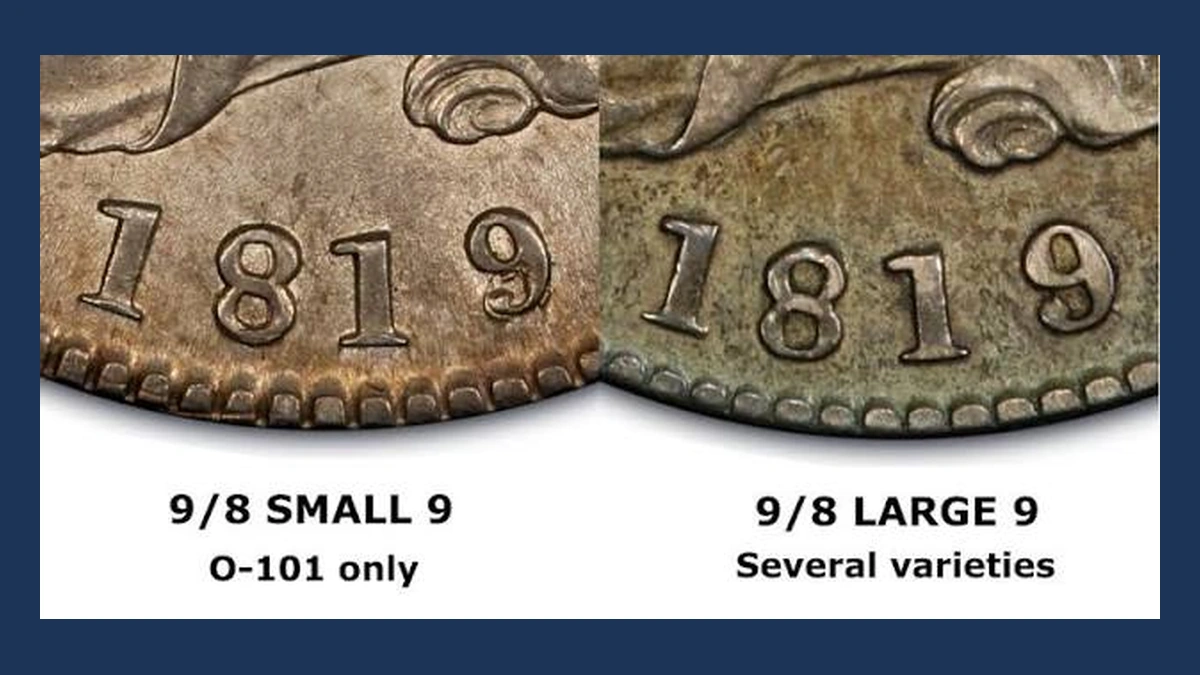
Part of an 8 shows beneath the final 9 in the date. The old digit remained after a 9 was punched over it in the die, the steel tool used to stamp coins.
Collectors call this an overdate and write it as 1819/8. Both Small 9 and Large 9 versions exist, so the visible shape depends on the version.
The extra curves belong to the date alone. They differ from the repeated stars and letters caused by a second strike.
One coin can have both features. The double-struck example below was also made with an overdated tool.
Estimated Value
A PCGS MS61 Small 9 O-101 brought $2,040 at Heritage in April 2019. MS61 means the coin had no circulation wear, though its surfaces could show marks.
An estimated $150–$2,200 covers common 1819/8 varieties from worn coins through lower unworn grades. A heavily worn example belongs nearer the lower end.
Rare varieties and additional mint errors need separate comparisons. Seeing an 8 beneath the 9 does not by itself justify the top price.
How to Identify
Inspect the lower part of the 9 with a 10× magnifier. Look for raised curves left by the 8, keeping the full date visible in your photograph.
The 1819 variety listing separates Small 9 and Large 9 overdates from normal dates. Choose the matching version before comparing small details.
Try light from two directions. A scratch cuts into the metal, while an old digit forms raised detail.
The coin normally has a lettered edge, weighs 13.48 grams before wear, and measures about 32.5 millimeters. Use a scale and calipers for these checks; matching the old 8 beneath the correct 9 shape is the direct way to confirm the overdate.
3. 1819/8 Capped Bust Half Dollar Double Strike Error (Up to $2,280)
Two widely separated sets of stars appear on the front, and LIBERTY also repeats. The back looks different: the eagle has no similar second outline.
The auctioned 1819/8 Small 9 O-101 received two strikes. Between them, the front stamping tool shifted southeast while the back tool stayed in place.
That movement explains why only one face shows clear separation. Both faces do not have to look equally doubled.
The date contains another clue, but it has a different cause. Its old 8 came from changing the date on the tool, not from the second strike.
Estimated Value
Heritage sold the PCGS XF45 example for $2,280 in July 2025. XF45 describes a coin with light wear and much detail remaining.
The catalog also cited an 1823 XF40 double strike sold for $1,645 in October 2016. That sale belongs to a different year.
These comparisons support an estimated $1,500–$2,500 for similarly clear circulated examples. Strong separation and good surfaces help, while damage can lower the price.
How to Identify
Use several stars and LIBERTY to check the repeated design. A real second impression should show a consistent shift across those details, not one odd-looking letter.
A 10× magnifier helps reveal the gap between the outlines. Flat, shelf-like edges can come from a tool slipping during a single strike instead.
Check the back next. On this documented coin, its lack of matching duplication fits the explanation rather than ruling out the error.
A loose example should have a lettered edge and measure about 32.5 millimeters with calipers. Its original weight was 13.48 grams, checked with a digital scale.
Compare the repeated stars and LIBERTY directly with the auction photographs to confirm the same pattern.
Conclusion
Estimated values for these 1819 examples run from $150 to $2,500. Start with the visible clue: an old 8 beneath the 9, repeated stars and letters, or a completely plain edge.
The auctioned double strike also has an overdate, showing that two features can share one coin. The reported plain-edge piece still needs its edge examined before it can be treated as an authenticated example.