1866 Half Dollar Error List with Pictures

Does the back say IN GOD WE TRUST? San Francisco made normal 1866 half dollars both with and without those words.
One With Motto coin with a doubled back sold for $3,055 in September 2015. That result belongs to a well-preserved unworn example.
The 1866 half dollar errors below have estimated values from $200 to $3,500. First identify your back design, then follow the guide to repeated outlines, stray digits, and raised cracks.
1. 1866 Liberty Seated Half Dollar Philadelphia Doubled Die Obverse Error (Estimated Up to $400)
Repeated outlines on the front identify the Philadelphia variety listed as WB-5 by PCGS. They were already present in the die, the steel tool used to stamp the coin.
Coins made with that tool could copy the repeated pattern. This is called a doubled die.
A tool slipping during one strike can produce a different effect, often with flat ledges beside the design. A second bright edge in a photograph does not distinguish the two.
The catalog does not name exact affected letters or stars. Compare a documented WB-5 coin rather than assuming any doubled-looking feature belongs to this variety.
Estimated Value
Estimate $200–$400 for an identified WB-5 around Very Fine condition, with moderate wear. Clear doubling and undamaged surfaces support a stronger comparison.
An ordinary Philadelphia With Motto half graded ANACS VF35 sold for $202.52 at Heritage on April 8, 2026. That is a same-year coin value, not a WB-5 sale.
PCGS lists no auction record for this variety. The range is therefore an estimate, with the normal coin providing a starting point.
How to Identify
Find the motto above the eagle and check that there is no S below it. Those details establish the Philadelphia With Motto version covered by the PCGS WB-5 entry.
Next compare the front with a clearly identified WB-5 photograph at the same image size. A 10× magnifier helps separate rounded extra outlines from flat ledges.
The exact shapes matter. A thick numeral or a reflected edge alone is not enough.
Normal measurements are 12.44 grams before wear and about 30.6 millimeters, checked with a scale and calipers, with a ridged edge. A direct match to the known WB-5 front provides the useful confirmation.
2. 1866-S Liberty Seated Half Dollar Extensive Die Crack Error (Estimated Up to $450)
A diagonal raised line crosses Liberty’s head on the late WB-2 example. Other lines appear around the rock and foot, giving several places to compare.
The back also has large cracks near TRUST, AMERICA, and the denomination. These marks show that both stamping tools had deteriorated.
As cracks opened in the steel, silver entered them during striking and formed ridges on the coin. Scratches made later instead cut into its surface.
WB-2 names the particular pair of tools. The whole pattern helps identify it, while a single unrelated line on another coin would not establish the same variety.
Estimated Value
Use an estimated $200–$450 for circulated examples around Very Fine with the named cracks visible. The range depends on readable paths and overall surface condition.
A different 1866-S With Motto variety, with a misplaced date, sold for $216 at Stack’s Bowers in April 2025. PCGS graded that coin VF35.
It provides a same-year, same-mint circulated comparison. The sale does not show that its coin carried the extensive WB-2 crack pattern.
How to Identify
Trace the line across Liberty’s head under a 10× magnifier. Then inspect the rock and foot before turning to the back.
Look near TRUST, AMERICA, and the denomination for the matching raised lines on that face. The Bugert reference shows the appropriate WB-2 comparison.
Change the lamp’s angle to separate ridges from scratches. Check the S and the motto so both faces belong to the correct version.
Calipers and a scale check about 30.6 millimeters and 12.44 grams before wear; the edge has ridges. Matching the head crack together with the back pattern is more decisive than finding one similar-looking line.
3. 1866 Liberty Seated Half Dollar Misplaced Date Error (Estimated Up to $600)
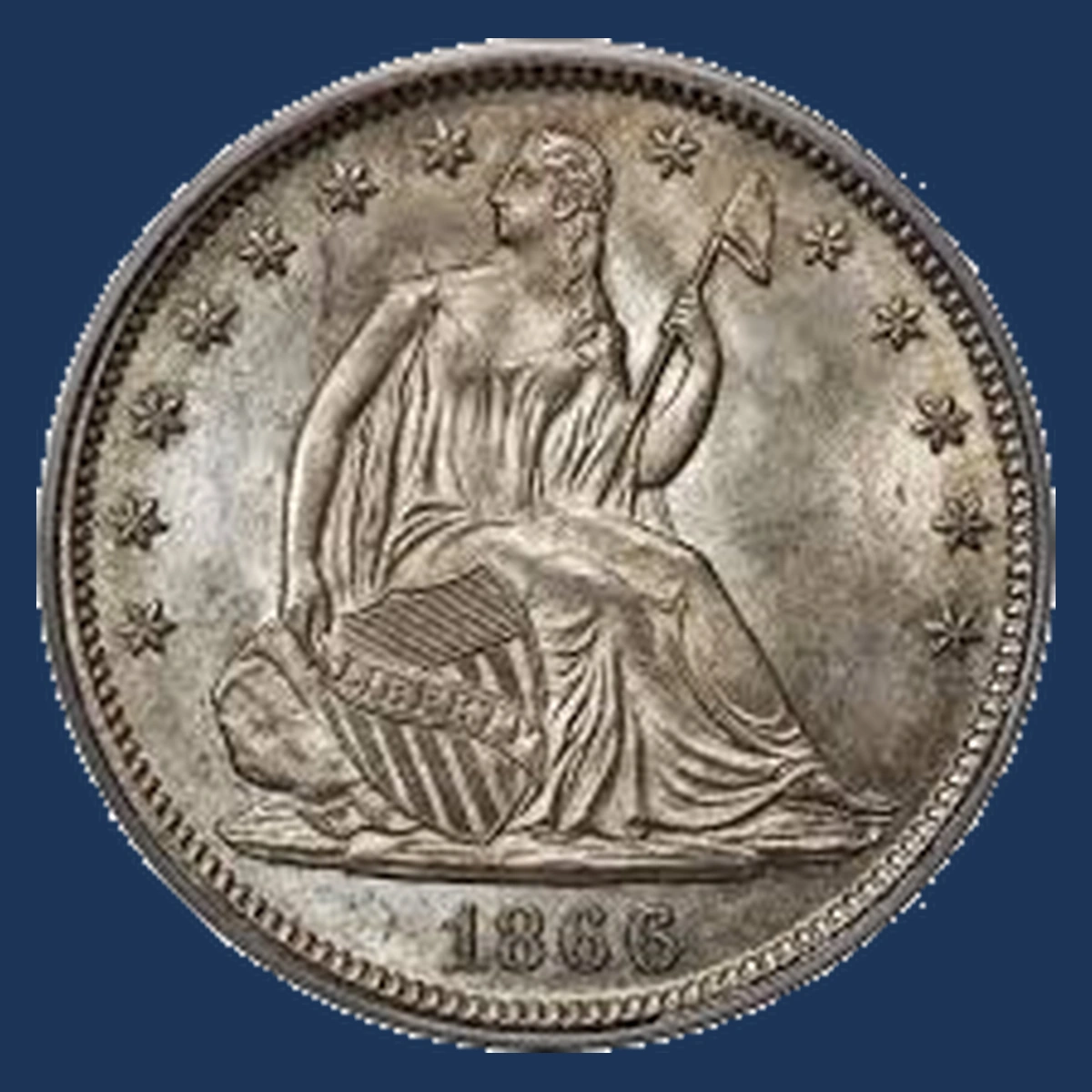
A piece of a 1 near Liberty’s hand is the reported clue on the Philadelphia coin. It lies away from the normal date because the date punch landed in the wrong place.
San Francisco With Motto examples show a different clue. Parts of 86 appear among the small tooth-like border details, called dentils, below the date.
The two locations belong to different mints. They should not be combined into a single picture of one coin.
These are misplaced date fragments. A date sitting slightly higher than usual, or a digit punched twice beside itself, needs a different explanation.
Estimated Value
Circulated misplaced-date examples have an estimated range of $200–$600. Mint, condition, and the clarity of the extra digit help determine the comparison.
Stack’s Bowers recorded $216 for an 1866-S With Motto WB-9 in PCGS VF35 in April 2025. That is an actual misplaced-date sale.
For Philadelphia, the $202.52 ordinary VF35 sale offers a lower starting point for the estimate. The two mints’ varieties do not automatically command the same added value.
How to Identify
Check below the eagle for an S before choosing where to look. Philadelphia has no mintmark, and its reported extra 1 sits near Liberty’s hand.
On a San Francisco example, photograph the whole date and the border immediately below it. Use a 10× magnifier to see whether the extra marks form parts of numerals.
A damaged border tooth or a nick beside the hand can look suggestive. It must match the known digit shape, not merely occupy the expected area.
Confirm the motto, ridged edge, and roughly 30.6-millimeter diameter with calipers; a scale checks the original 12.44 grams. A mint-matched image of the extra numeral is the quickest focused test.
4. 1866-S Liberty Seated Half Dollar Doubled Die Reverse Error (Estimated Up to $3,500)
Small repeated outlines appear on the back of this 1866-S variety. The doubling is minor, so it should not be expected to turn every letter into a clearly separated pair.
Bugert’s reference identifies the back stamping tool as reverse C. It was used with two different front tools, which explains why matching backs can come with different front details.
The repetition was already in the tool before the coin was struck. An ordinary scratch does not create the same pattern.
Heritage sold an example called WB-104, Die Pair 3. That coin gives collectors a specific comparison for the doubled back.
Estimated Value
The PCGS MS64 doubled reverse brought $3,055 at Heritage on September 20, 2015. MS64 describes an unworn coin with some surface marks.
Estimate $2,500–$3,500 for comparable examples at that quality level. The auction price covered the whole coin, including its appearance and preservation.
A worn coin from the same tool does not inherit this value. The result is not a separate $3,055 charge for doubling alone.
How to Identify
Identify the back design first: it needs an S below the eagle and the motto above it. A normal No Motto 1866-S is a different version.
Check a loose coin with a scale and calipers against 12.44 grams and about 30.6 millimeters, with a ridged edge.
Now compare the back with a known WB-104 image through a 10× magnifier. Move the light gently because glare can hide the small extra outlines.
The front need not match every example. Two front tools were paired with the same doubled back tool.
Match the repeated back outlines to the documented WB-104, rather than relying on a front detail, for the clearest confirmation.
Conclusion
Estimated values range from $200 to $3,500 for the coins and conditions covered here. First separate the normal With Motto and No Motto designs, then compare the right mint’s features.
Stray digits, repeated outlines, and raised cracks offer different clues. The $3,055 doubled-reverse sale belongs to an unworn MS64 example, while the lower circulated comparisons are more useful for coins that show wear.