1919 Half Dollar Error List with Pictures

For comparison, a 1942 Walker struck on a quarter blank sold for $18,000 in January 2022. That is a different-year example, not a recorded 1919 discovery.
A second D beside the mint letter and a peeling silver layer are two starting points in this 1919 Walking Liberty half dollar error list. More dramatic possibilities need measurements as well as photographs.
Estimated ranges below span $60–$25,000. Read on to match each feature with its own evidence and price comparison.
1. 1919 Walking Liberty Half Dollar Lamination Error (Estimated Up to $600)
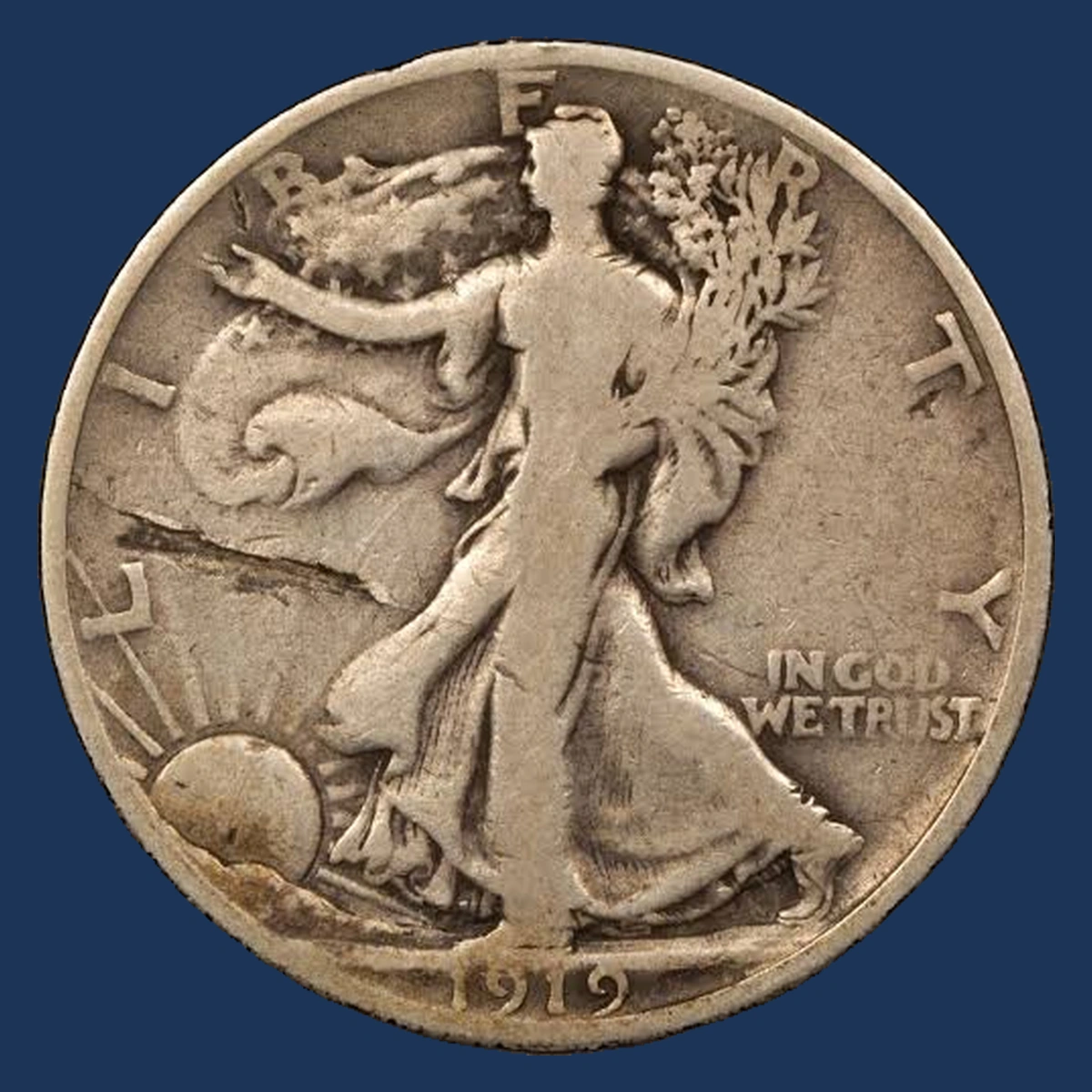
A large patch of the front is described as separating on a reported 1919-S. The coin was called Fine, meaning well worn with the main design still visible.
The feature is lamination: a thin layer lifts or falls away where the metal mixture does not hold together properly. It begins within the silver rather than as an extra design impression.
The account does not establish an attached flap or a coin split into two discs. Those are different physical outcomes.
Compare the boundary and surface. A large missing patch alone cannot explain whether the metal peeled or was damaged later.
Estimated Value
The reported Fine 1919-S was advertised for $110. That is an asking price, not an auction result.
It supports an estimated $100–$600 range for worn examples with visible separation. The collectible half dollar underneath the flaw contributes to the value.
A dramatic attached layer may interest error collectors, while surface loss can reduce a scarce date’s appeal. More missing silver therefore does not automatically mean a higher price for the coin.
How to Identify
Start where intact silver meets the disturbed patch. A 10× magnifier can show whether a thin layer separates beneath the original stamped surface.
Leave any attached flap untouched. Lifting it can remove evidence and permanently change the coin.
Compare an accessible coin on a digital scale with 12.50 grams; a lost layer can reduce weight, while an attached one may not. Calipers check the normal 30.6-millimeter width, and edge views show grooves, cuts, or artificial thinning.
Keep the date and back-side S in the photographs. A natural separation within the metal supports lamination more directly than a scooped hollow or rough corrosion pit.
2. 1919 Walking Liberty Half Dollar Die Crack and Cud Error (Estimated Up to $1,000)
A fine raised line and a broad raised patch can both come from a damaged die, the steel tool that stamps coins. Silver fills the damaged part during stamping.
A narrow crack leaves a ridge. If a piece at the tool’s edge breaks away, the larger opening can produce a raised area joined to the rim.
That edge-connected feature is called a cud. An isolated bump inside the design is not automatically one.
The 1919 year list includes cracks and cuds without naming a particular mint or authenticated example. Their locations therefore need to come from the coin being examined.
Estimated Value
An estimated $60–$1,000 covers small cracks on ordinary worn coins through conspicuous confirmed rim breaks. Scarce mint issues in better condition need their own underlying value comparison.
A 1976-D Kennedy with a die break sold for $256 at Heritage in June 2026. NGC graded it MS65, an unworn condition.
That different-series result gives context for visible die damage. It is not evidence of a 1919 cud sale or a premium for every raised lump.
How to Identify
Turn the coin under one light and follow the mark with a 10× magnifier. A die crack rises above the surface, while a scratch usually cuts into it.
Added material may show a seam or different texture. For a possible cud, trace the raised patch all the way to the rim and inspect the opposite side for related weakness.
Check an accessible coin with a digital scale and calipers against 12.50 grams and about 30.6 millimeters. Photograph the edge grooves too.
Continuous raised metal joined to the rim supports a cud. A separate lump inside the design may be a smaller die chip and should not receive the same name.
3. 1919-D Walking Liberty Half Dollar Repunched Mintmark Error (Estimated Up to $2,000)
Look to the right of the Denver D. Wexler’s reference calls this variety D/D East, meaning an extra D impression survives on that side.
The mint letter was punched into the die separately from the main design. A second punch in a shifted position could leave part of the earlier letter visible.
This is a repunched mintmark. It does not come from the same process as doubling in the larger design.
The reference gives no additional marks elsewhere for identification. A thick or smeared D still needs to match the pictured second contour, rather than being accepted from thickness alone.
Estimated Value
Use an estimated $150–$2,000 for a worn 1919-D with clear repunching. The scarce Denver date may account for much of that whole-coin value.
A different Walking Liberty variety, the 1939-D/D graded PCGS MS64+, sold for $1,292.50 at Kagin’s in September 2017. Its year, variety, and unworn condition differ.
That result provides context, not a direct 1919-D sale. Exceptional preservation can place a 1919-D above the worn-coin price range used here.
How to Identify
Find D below the small branch at the lower left of the back. Keep the eagle upright before deciding which side of the letter carries the extra shape.
The Wexler photographs show the rightward impression. Under a 10× magnifier, look for part of a second D rather than a flat shelf broadening the first.
Inspect nearby metal for an added mint letter and check the edge grooves. A digital scale and calipers compare accessible coins with 12.50 grams and 30.6 millimeters.
The matching D-shaped contour on the right identifies the variety. Softness from wear cannot supply an earlier punch shape that is no longer visible.
4. 1919 Walking Liberty Half Dollar Broadstrike Error (Estimated Up to $7,000)
A coin can spread wider while keeping all its lettering. This happens when the collar, the ring that normally controls its width, fails to restrain the metal during stamping.
The error is called a broadstrike. Its complete design differs from a strike that runs partly off the blank.
The 1919 account explains what such a coin would look like but does not present a certified dated specimen. A candidate needs physical confirmation rather than a name based on size alone.
Price comparisons therefore come from the wider Walking Liberty series. They do not establish a previously recorded 1919 auction coin.
Estimated Value
The July 2025 specialist guide estimates broadstruck Walkers at $3,000–$4,000 in lightly worn through nearly unworn condition. Unworn examples are listed at $5,000–$7,000.
That supports a $3,000–$7,000 comparison range for a successfully authenticated coin. Expansion and preservation affect where it fits.
These are series estimates, not realized auction prices. No documented 1919 sale is assigned, and readable identity plus original surfaces remain essential to the comparison.
How to Identify
Measure the width in several directions with calipers and compare with the normal 30.6 millimeters. Check that the date, lettering, and outer design remain complete despite the larger outline.
A digital scale should remain near 12.50 grams when safely accessible, allowing for wear. Broadstriking spreads existing metal rather than removing it.
Use a 10× magnifier around the edge to inspect missing or interrupted grooves from the lack of collar restraint. Later pressure can also widen a finished coin, but often flattens design and leaves damage.
Complete design on naturally spread metal, with an edge consistent with unrestricted stamping, supports a broadstrike. Large diameter alone cannot explain how the coin became wider.
5. 1919 Walking Liberty Half Dollar Off-Center Strike Error (Estimated Up to $12,000)
A bare crescent beside a cut-off design can show that a blank entered the press out of position. The blank is the metal disc before stamping.
Both sides should tell the same story. Design is lost where the disc missed the tools, while metal outside the stamping area stays bare.
The 1919 sources report this category without linking their illustrative percentages to a certified example. They establish no exact mint or direction for an individual coin.
Those details must be read from the surviving design. An uneven border on just one side can have a different cause.
Estimated Value
A clearly dated, authenticated example has an estimated $300–$12,000 range. It stretches from modest worn offsets to exceptional well-preserved coins.
A 1918 Walker struck 10% off center sold for $10,575 at Heritage in April 2013. Its PCGS MS65 grade describes a very well-preserved unworn coin.
That different-year sale illustrates the effect of condition and rarity. It does not price a specific 1919 mint or shift, and a larger percentage alone need not be worth more.
How to Identify
Align photographs of both sides before judging the shift. One misaligned die can crowd a border without moving the whole blank off center.
Under a 10× magnifier, inspect the bare crescent for original texture where it meets the stamped design. Ground or flattened metal after minting may show different surfaces.
A digital scale compares accessible coins with 12.50 grams, while calipers record the outline against the normal 30.6 millimeters. Edge photographs show where grooves formed and where they did not.
A missing mint-letter area cannot establish Philadelphia if that part never received the design. Matching cut-off design on both sides beside untouched blank metal gives the strongest initial off-center check.
6. 1919 Walking Liberty Half Dollar Double Strike Error (Estimated Up to $15,000)
Two different design positions can survive on a coin struck twice. A half dollar that stays in the press may move before another blow lands.
The second strike can flatten part of the first. Surviving overlaps should explain that sequence rather than merely show two close edges beside one letter.
The 1919 source lists double strikes but discusses the year-specific example as a possibility. It does not establish a certified dated coin.
Spectacular double-struck Walkers from other years provide comparisons, not proof of a 1919 discovery. A dated candidate still needs evidence of separate blows on its own metal.
Estimated Value
Estimate $8,000–$15,000 for a substantial authenticated double strike with attractive worn surfaces. An undated San Francisco Walker sold for $11,400 at Heritage in August 2025.
That PCGS AU53 coin had a second strike 90% off center. Its missing date means it cannot be identified as a 1919 coin.
This price range assumes clear surviving impressions and recognizable identity. A faint second blow, serious damage, or exceptional unworn condition would require a different comparison.
How to Identify
Trace part of Liberty or the eagle into a second shifted impression. Use a 10× magnifier at overlaps to see whether one blow flattened detail from the earlier one.
A single doubled letter is less useful. Several related pieces should fit one second design position.
Check the edge grooves for changes that may reflect different contact during stamping. Weigh an accessible coin against 12.50 grams and measure its largest dimensions with calipers against a normal 30.6-millimeter half.
Pressing finished coins together can leave sunken mirror images after minting. Later dents do not form the same pattern as a second strike.
Look for recognizable parts of a second stamped design that all shifted together.
7. 1919 Walking Liberty Half Dollar Wrong Planchet Error (Estimated Up to $25,000)
The half-dollar design may be too large for a blank intended for another coin. Only the parts that fit can be stamped onto the smaller disc.
Weight and metal composition then matter as much as the surviving date. They help identify what kind of blank entered the press.
The 1919 guide uses a dime blank to explain the possibility. It does not establish an actual 1919 half dollar struck on dime metal.
That illustration does not tell us which blank a real coin used. The candidate’s measurements, metal, and naturally cut-off design need to support the same explanation.
Estimated Value
An undated Walker on a silver quarter blank sold for $15,000 at Heritage in May 2022. It was graded PCGS MS64.
A dated 1942 quarter-blank example graded NGC MS64 brought $18,000 that January. These support an estimated $10,000–$25,000 comparison range for a substantial authenticated candidate.
Neither sale proves a 1919 example or a dime blank. The type of blank, condition, and surviving date must remain attached to the correct coin.
How to Identify
Begin with a digital scale when the coin is safely accessible, comparing with the normal 12.50 grams. Calipers should record width and thickness against the usual 30.6-millimeter half-dollar size.
A smaller blank may expand during stamping, so its final width need not equal an unused disc exactly. Inspect the entire edge through a 10× magnifier for filing or machining.
Check the surviving design and any edge grooves. A metal-composition measurement can help when weight and appearance suggest a blank intended for another denomination.
The correct alternative metal, weight, and naturally formed design boundary should agree. That combined evidence helps identify the original blank more reliably than small size or a dramatic photograph alone.
Conclusion
The right-hand D remnant and a peeling layer give specific places to begin, while major striking claims need both sides and the edge. Keep the full date visible before making close-ups.
Estimated values span $60–$25,000. The large auction comparisons belong to later or undated Walkers, so they help frame prices without proving a 1919 specimen; each candidate still needs its own matching physical evidence.