1958 Quarter Error List with Pictures

A backward Washington portrait takes the eagle’s place on one remarkable 1958 quarter. The full-image error sold for $12,337.50 in January 2017, despite visible surface marks.
Not every 1958 quarter error is so dramatic: this guide includes small extra letter outlines and missing flakes of silver. Estimated values extend from $20 to $20,000.
Follow the feature you can actually see, then compare the coin’s finish, original surface, and any unusual blank measurements.
1. 1958 Washington Quarter Reported Die Cracks and Cuds
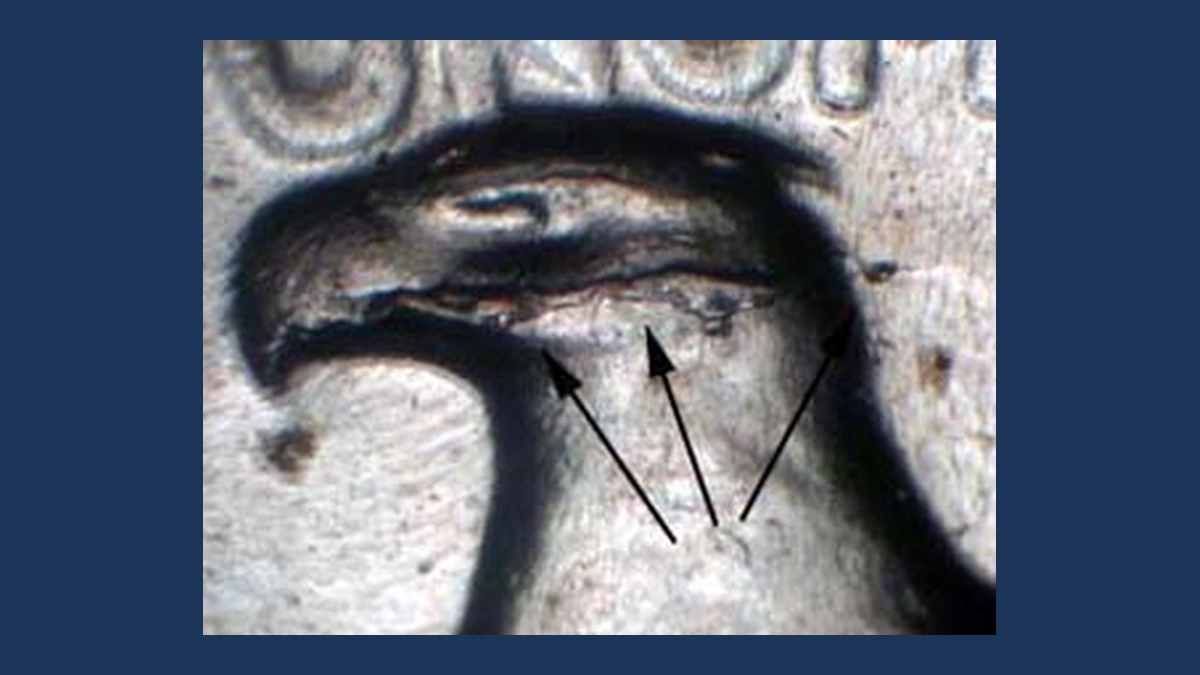
A narrow raised line can show where a crack developed in a die, the steel tool that stamps coins. Silver enters that opening during the strike and leaves a ridge on the finished quarter.
A larger broken section reaching the edge can produce a raised patch called a cud. Its shape replaces detail that the missing part of the tool could no longer stamp.
Both forms are reported for 1958 quarters. A raised feature supports a different explanation from a scratch cut down into the coin after minting.
Estimated Value
Allow an estimated $20 to $300 for a genuine small crack through a more obvious rim-connected break. The visible size and condition of the feature matter more than its dramatic nickname.
A faint line on a worn silver quarter often brings only a modest extra amount. A clear raised patch interrupting recognizable design is easier to display.
Large dents or added metal are different problems. They do not earn the same estimate merely by touching the rim.
How to Identify
Shine a lamp across the surface from the side and follow the suspected line. Check whether it rises above the surrounding silver or cuts down into it.
A thin ridge should continue as a feature of the struck surface, rather than as a scrape with pushed-up metal beside it. Examine any junction with a letter or the portrait.
For a larger patch, look for a connection to the edge and missing design within the raised area. A broad dent depressed below the surrounding surface does not fit that explanation.
Compare the feature under a second light angle before photographing it. Avoid cleaning the area, because surface damage can make the original ridge harder to assess.
2. 1958 Washington Quarter Clipped Blank
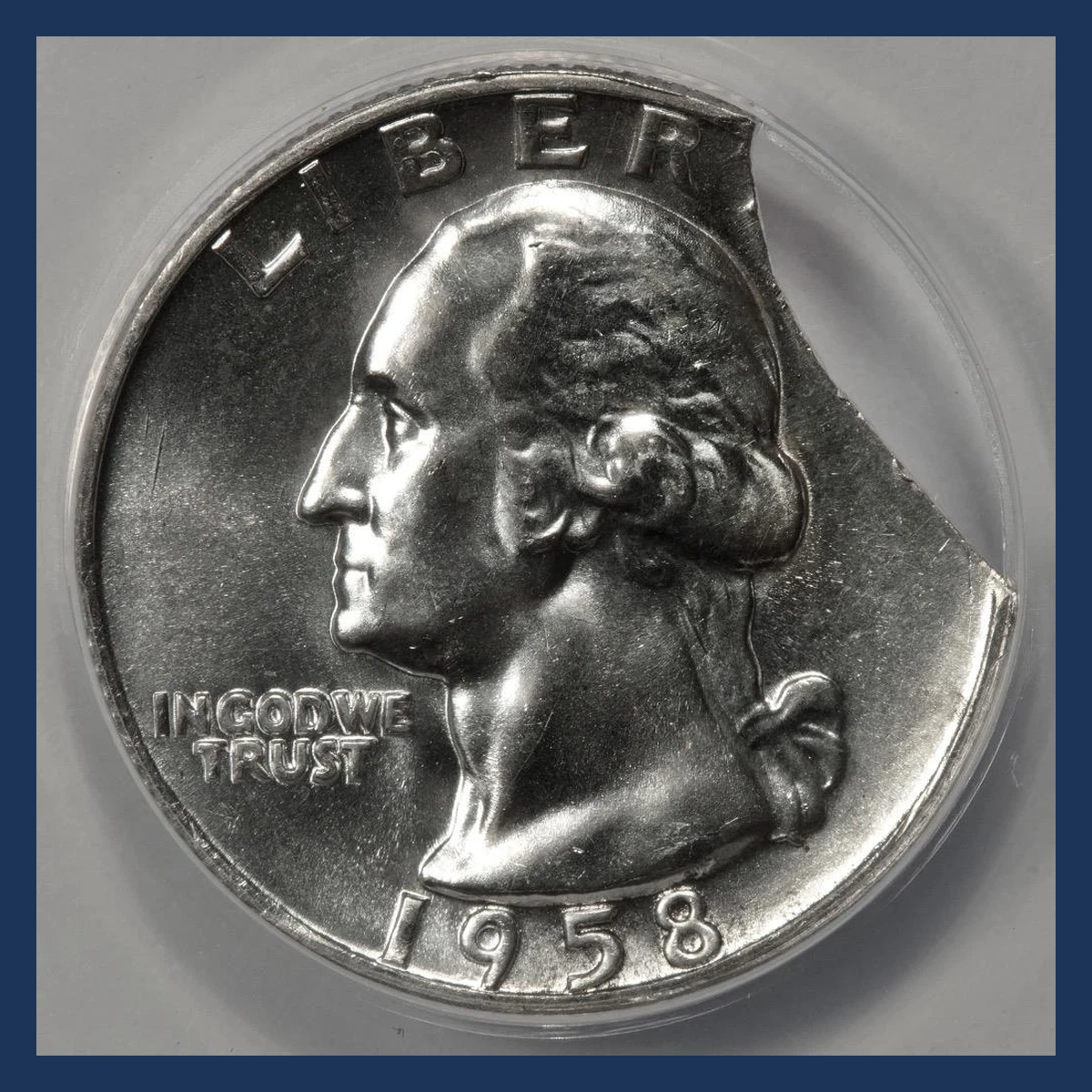
The blank used for a quarter can be incomplete before it reaches the press. A curved or straight missing section then interrupts the finished coin’s outline.
Collectors call this a clipped blank. Reports for 1958 include a curved example, while the wider category also allows other genuine blank-cutting shapes.
The design and rim formed around the missing metal during striking. This timing matters: a finished coin cut with a tool can look similar from above, but its exposed boundary may slice through detail that had already been fully formed.
Estimated Value
An estimated $25 to $400 covers ordinary genuine clips across different sizes and conditions. A clear date and an undamaged boundary make the error more useful to a collector.
For a different-metal comparison, a 1966 clad quarter with a twenty-percent straight clip sold for $124 in June 2024. It is not a sale of a 1958 silver coin.
A tiny gap on a worn example generally attracts less attention than a prominent original missing section.
How to Identify
Photograph the entire outline before enlarging the gap. This shows how much metal is missing and whether the date still identifies the year.
Examine each end of the gap, where the ordinary rim gives way to the incomplete blank. Look for original tapering and struck details rather than a sharp saw cut through finished design.
The opposite rim may be weak, but that effect is not compulsory on every genuine clip.
For a loose coin, a scale can measure the loss against the normal 6.25 grams. Judge the reading together with the edge, since filing or grinding also lowers weight.
Keep any visible tool marks in the photographs instead of trying to remove them.
3. 1958 Washington Quarter Reported Repunched D Mintmark
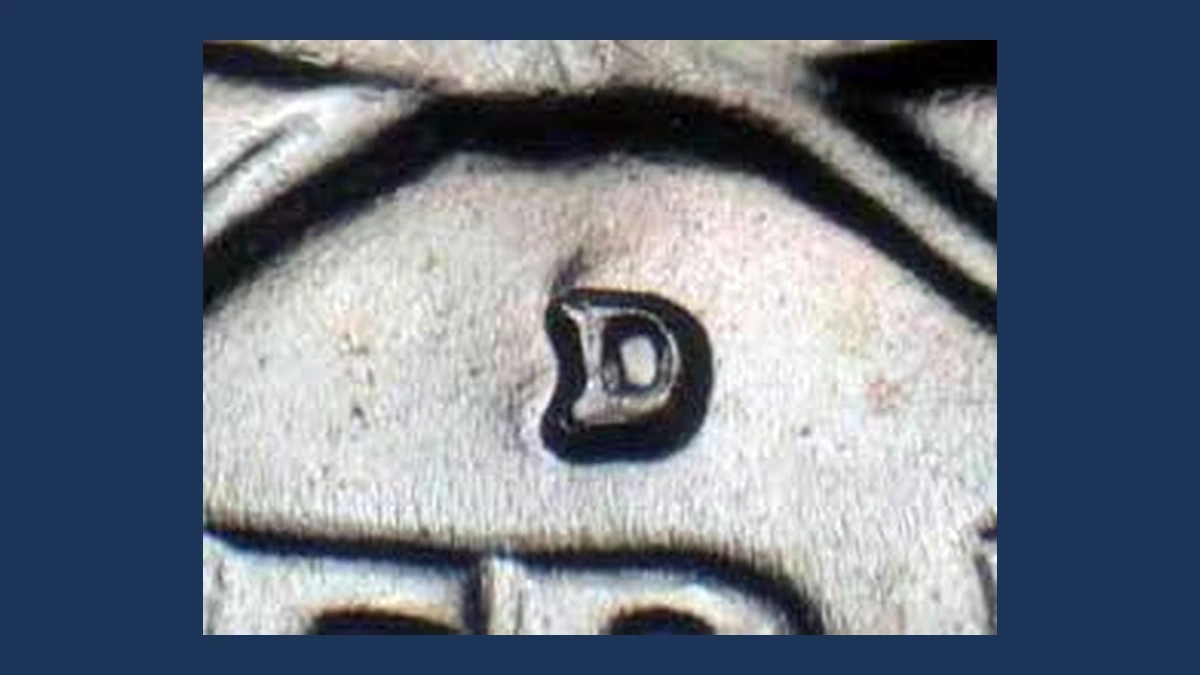
A repunched mintmark comes from placing the mint letter into the stamping tool more than once in slightly different positions. The earlier outline can remain beside the final letter.
For 1958, the reported mintmark to examine is the D below the eagle on the back. It identifies Denver production.
This small letter feature does not require the portrait or nearby words to be doubled. A thick D, a reflection, or a flattened edge from movement during striking can imitate the effect without preserving a real earlier punch.
Estimated Value
Estimate $25 to $500 for a confirmed repunched-D example with a clear match. Wear and marks near the small mint letter can quickly reduce its appeal.
A different-year comparison is the 1962-D variety recorded by PCGS at $495 on eBay in August 2021. That coin was graded MS65, meaning unworn with relatively few marks.
The 1958 estimate depends on its own visible punch pattern. A vague lump beside a D is not an equivalent variety.
How to Identify
Trace the main D below the eagle before looking for a second outline. Note where its upright and curved side begin and end.
Use a 10× magnifier to examine extra metal around those same parts of the letter. An earlier punch should form recognizable portions of another D, rather than an unrelated bump.
Compare with an attributed 1958 Denver example photographed from the same direction. Do not borrow the punch position from a 1962 coin used only as a price comparison.
Tilt the light and check for a flat shelf or a scratch beside the letter. If the apparent second outline vanishes with the reflection, take clearer photographs before treating it as a repunched mintmark.
4. 1958 Washington Quarter Reported Broadstrike
A coin may become wider because the surrounding collar did not hold its blank during striking. The collar is the metal ring that normally controls the diameter and shapes the edge.
The resulting broadstrike can keep the complete portrait and lettering while extra metal spreads outward. Its edge grooves may be missing or incomplete.
Broadstrikes are reported for 1958, without one fixed amount of expansion. The important relationship is the intact design within the larger outline, not a particular percentage or a broad rim produced by later hammering.
Estimated Value
For an authenticated broadstrike, estimate $50 to $500. Moderate spreading on a circulated example sits below a dramatic, well-preserved coin with complete readable details.
A 1966 uncentered broadstrike graded AU58 sold for $222 in June 2024. That slightly worn clad coin provides a different-year comparison, not a silver 1958 sale.
The expanded edge should remain original. Heavy flattening and surface marks can make even a genuine broadstrike less attractive and harder to explain.
How to Identify
A loose candidate can be compared with the normal 24.3-millimeter diameter using calipers. Measure gently and leave a coin in its grading holder if it is already sealed.
Then work inward from the expanded edge to the outer lettering. The intended design should remain on the metal; a missing section opposite an empty crescent suggests an off-center strike instead.
Inspect the portrait and eagle for crushing from later pressure. An expanded outline accompanied by hammered-flat details needs a different explanation from original spreading in the press.
Check the edge grooves in side photographs as well as the broad front border. Uneven expansion is possible, so the two sides need not have equally wide margins.
5. 1958 Washington Quarter Silver Flakes Lost after Striking
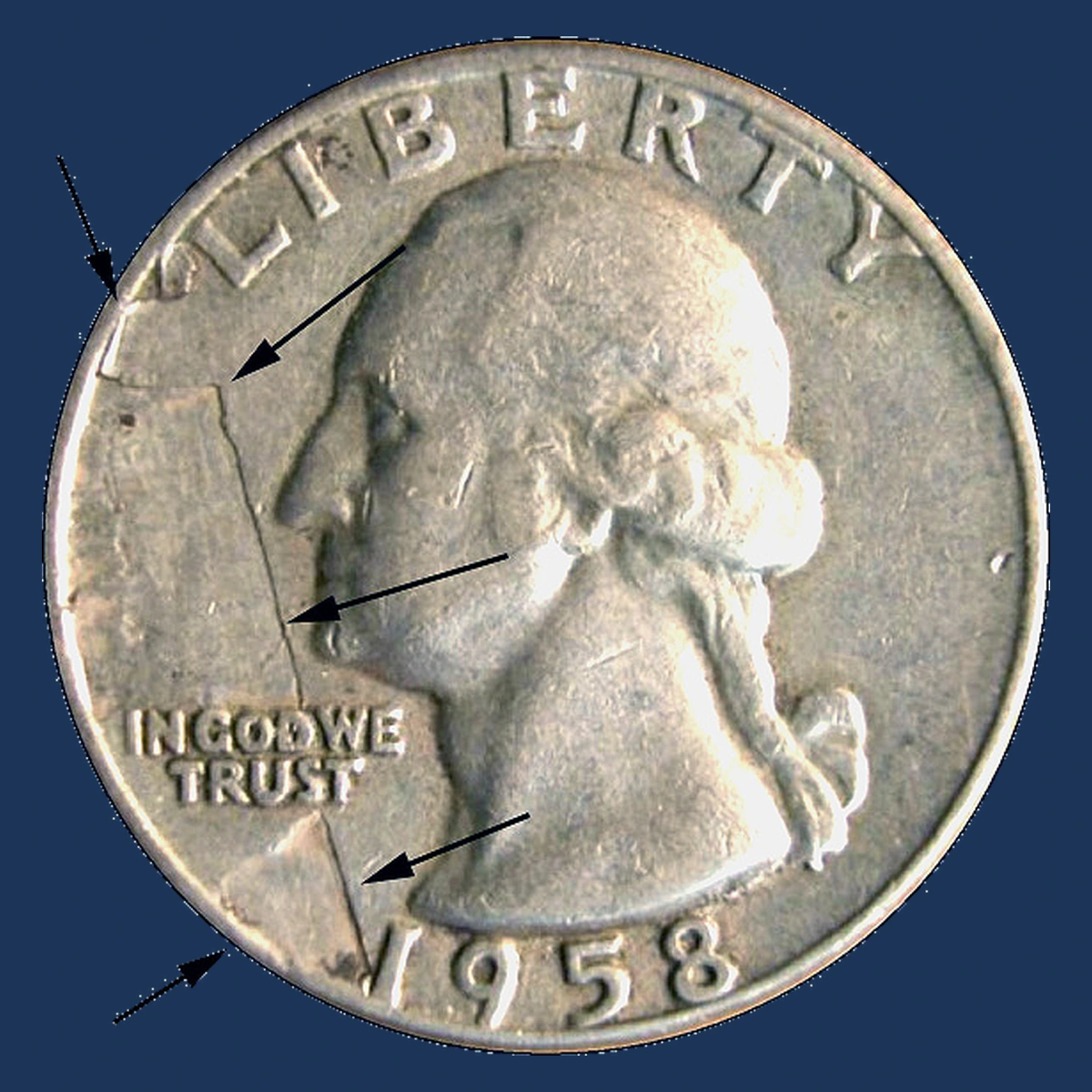
Two pieces of the surface came away from the left side of a 1958-D quarter after it was struck. One larger and one smaller flake left recesses above and below IN GOD WE TRUST.
This is a lamination error: part of the metal separates along a weak layer inside the blank. It is not the loss of a separate outer covering on a modern clad coin.
The illustrated Denver example shows where the flakes detached. Its placement should not be confused with unrelated peeling coins from other years.
Estimated Value
Estimate $30 to $500 for genuine lamination loss, depending on the size, appearance, and condition. Two clearly visible original recesses can be more interesting than a tiny flake near the edge.
A large missing piece does not automatically guarantee a high price. Severe surface disruption can make the design less attractive, even when the metal defect is genuine.
Preserving the boundaries matters. Cleaning or digging into a recess can erase the evidence that explains how the silver separated.
How to Identify
Locate the two recesses around IN GOD WE TRUST on the illustrated Denver coin. Compare their edges and the surviving letters with the full photograph before examining a similar-looking candidate.
The missing flakes separated after the design was struck. Look at how the remaining design stops at the exposed boundaries rather than assuming every hollow formed under a foreign object.
Inspect the base of the recess for signs of peeling metal, then check for gouges or fresh tool marks. A scooped-out impact has a different origin even if it occupies the same general area.
Do not lift any remaining attached edge. Its connection to the surrounding surface can help an expert distinguish an original weak layer from later damage.
6. 1958 Washington Quarter Reported Doubled Dies
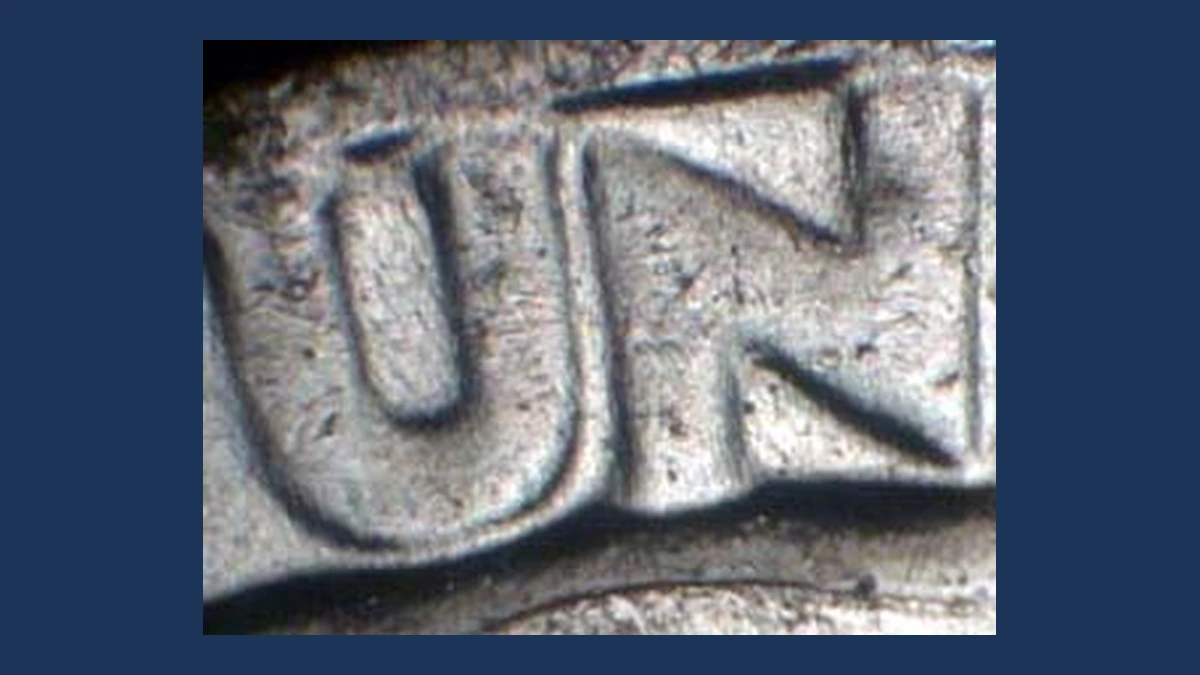
An extra design outline can originate on the stamping tool rather than from a second blow to the coin. Coins carrying that repeated tool design are called doubled dies.
Reports for 1958 include front and back candidates, but they do not establish one coin doubled on both faces. Each candidate needs its own matching features and correct issue.
Front reports point toward the date and lettering; back reports concern the words and eagle. These locations guide the search, but a thick letter or soft feather alone does not establish a doubled-tool variety.
Estimated Value
For an authenticated minor doubled die, estimate $30 to $600. A clear, repeatable outline with well-preserved corners generally attracts more interest than slight thickening on a worn coin.
The 1962 Philadelphia FS-101 variety reached $3,290 in July 2016. That stronger, separately identified variety should not set the price for a generic 1958 candidate.
The estimate applies after a proper match. Flat strike-related shelves, reflections, and isolated dents do not provide the same basis for value.
How to Identify
Choose the side that actually shows the unusual feature and photograph it straight on. Keep the other face available to identify the coin, without assuming it carries the same error.
Compare several letter corners or nearby design lines with a normal example of the same issue. Genuine doubled-tool detail should form a consistent pattern, not scattered damage.
Now compare that pattern with an attributed 1958 example. The mint and finish must match before a variety name is transferred.
Use another light angle to rule out a reflected edge, and inspect for flattened shelves from movement during striking. A blurred photograph can hide the difference, so improve the image before drawing a conclusion from one apparently doubled letter.
7. 1958 Washington Quarter Reported Struck-Through Error
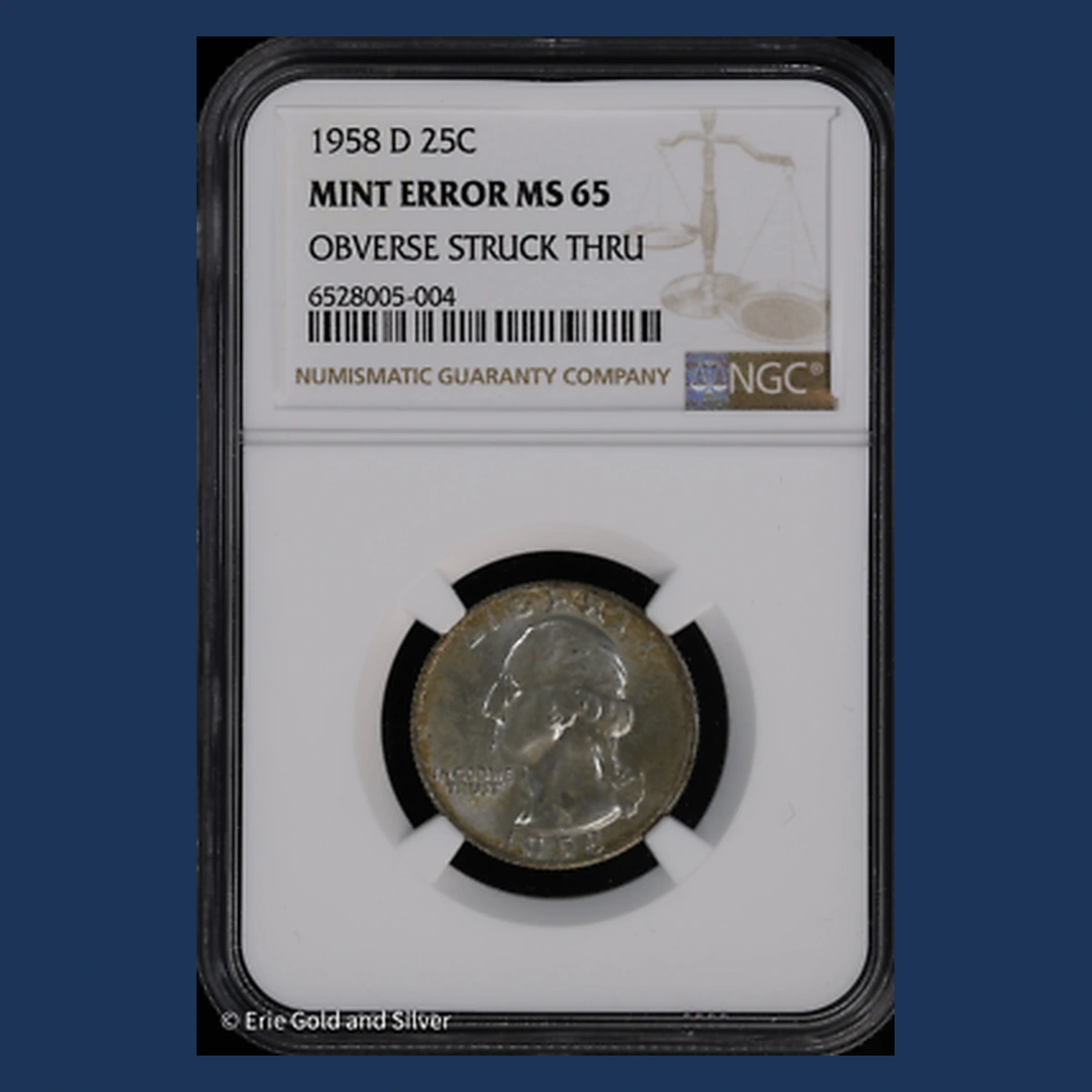
Something between the blank and the stamping tool can stop part of the design from forming. Grease may leave weak or missing detail, while a solid fragment can produce a more distinct depression.
This is called a struck-through error. Reports for 1958 include weak grease-obstructed areas and an MS62 coin described with debris affecting the front.
The outline of the interruption helps explain the difference from wear or a later impact. The report does not establish that an object remains attached, so a hollow alone should not be described as retained debris.
Estimated Value
An estimated $20 to $1,000 covers modest grease interruptions through more visible object impressions. The shape and clarity of the affected area help determine where an example belongs.
A published year guide reports a 1958 MS62 front-side debris example at $735 in 2022. That reported price concerns a specific impression, not every weak letter.
Original surrounding detail improves the comparison. A vague worn patch or a later gouge does not support the same error value.
How to Identify
Compare the weak patch with neighboring high points before deciding what caused it. If the surrounding detail remains sharp, a local obstruction may explain the interruption better than general circulation wear.
Follow the boundary with a magnifier. A solid object can leave a shaped impression, whereas grease often prevents detail without producing a clear object outline.
Look for impact marks and metal pushed aside by a later hit. Also inspect for scratches crossing both the hollow and the normal design.
Photograph any attached material without pulling it away. Keeping the surface intact allows an expert to assess the original strike, while removing an object can destroy information needed to explain its presence.
8. 1958 Washington Quarter Tapered Blank
A tapered blank grows thinner toward one side instead of having an even thickness throughout. The thinner part may not fill the stamping tools as well, leaving weaker design there.
A dealer inventory records a 1958 quarter graded PCGS MS66 with this blank defect. The listing does not establish a particular side or amount of taper for every example.
The useful clue is the gradual relationship between thickness and weak detail. A normal-thickness quarter with one worn patch, or a coin ground thinner after striking, requires a different explanation.
Estimated Value
Estimate $100 to $1,000 for a confirmed tapered-blank quarter. A visible, gradual thickness change with corresponding weak design makes the defect easier to demonstrate.
The recorded MS66 example is an unworn coin with very few marks. Comparable surface quality can support more interest than a worn or scratched piece whose weak details are difficult to interpret.
The range favors original metal and a clear taper. Artificial thinning or isolated strike weakness does not carry the same premium.
How to Identify
For a loose candidate, compare thickness at several points with gentle caliper readings, without clamping the edge. A smooth change across the disk is more useful than one dented or low-looking rim.
Match the thinner sector to weak design on both faces, using side photographs to keep the measurements connected to the coin. Weak lettering alone could come from an obstruction during striking and does not establish a tapered blank.
Inspect the thin area for filing or grinding that crosses already finished details, since later removal can imitate the measurements. A sealed coin should stay in its holder while an expert compares its visible edge with the weakly struck areas.
9. 1958 Washington Quarter Reported Off-Center Strike
An off-center quarter carries the design toward one edge while a crescent of the blank remains unstamped. Part of the portrait or lettering may fall beyond the available metal.
This happens when the blank is not properly positioned between the stamping tools. The percentage of displacement describes the individual strike, not a separate variety for each possible amount.
The error is reported for 1958 quarters. A readable date and any surviving mint letter are essential when choosing a comparison, since the missing outer design can remove the very details that identify a coin.
Estimated Value
Estimate $50 to $1,500 for a genuine 1958 off-center quarter. Greater displacement can increase visual appeal, particularly when the full year remains readable.
As a different-year comparison, a 1943-S silver quarter struck 35% off center sold for $2,640 in July 2022. That older San Francisco coin is not a price record for a 1958 example.
Wear, scratches, and missing identity can reduce interest. An attractive original blank crescent is more useful than an area flattened by later damage.
How to Identify
Read the year inside the struck area before estimating how much design is missing. Include the back-side mintmark area in the photographs if it survives.
Then pair the untouched crescent with the lost design on the opposite side. Both should follow from the same displacement, rather than from a normal coin placed inside an added metal ring.
Compare both faces to see how their boundaries meet the same blank. A complete design within an expanded border points toward a broadstrike instead.
Check the empty surface for grinding, seams, or erased letters. A plain-looking area is not necessarily unstruck if someone removed its original design after the coin left the Mint.
10. 1958 Washington Quarter Struck on a Nickel Blank, Including a Rotated Back
A nickel blank is smaller than the silver blank intended for a quarter. Washington’s design can therefore lose parts of LIBERTY and the date around its edge.
A dealer described an NGC MS60 example with about 95% of its date showing. Another listing describes a nickel-blank coin of that grade with the back turned thirty degrees from its normal position.
The rotation and wrong blank belong together on that listed piece. They should not be converted into two separately priced coins or assumed present on every 1958 nickel-blank quarter.
Estimated Value
Comparable authenticated nickel-blank quarters have an estimated range of $300 to $1,500. Readable identity and original surfaces help separate stronger examples from heavily marked ones.
The old listing for the thirty-degree rotated example asked $650. Another dealer listing asked $700 for an MS60 nickel-blank coin with most of its date visible.
These were asking prices, not confirmed auction results. The estimate for a coin with both features applies to the complete piece, including its rotation.
How to Identify
Check the remaining digits before treating a cropped date as 1958. The description “95% visible” belongs to one listed specimen, not a guarantee of a completely readable year.
For a loose candidate, compare the metal with a nickel blank’s usual five grams and 21.2-millimeter starting diameter. Striking can spread that blank; a normal silver quarter weighs 6.25 grams.
On the rotated example, hold Washington upright and turn the coin top to bottom without twisting it sideways. The eagle should remain tilted by about thirty degrees after that controlled flip.
Use matched photographs or a short video to document the turn. Two independently rotated photographs cannot demonstrate the relationship between the faces.
11. 1958 Washington Quarter Struck on a Silver Dime Blank
Both a normal quarter and a dime blank contain ninety-percent silver in 1958. Color will not reveal which blank went into the quarter press.
A dime blank supplies much less metal, so the larger quarter design cannot fit around its entire edge. Missing outer letters and a crowded portrait can show the mismatch.
An old dealer listing illustrates a PCGS MS63 example of this error. MS63 means an unworn coin with noticeable marks; its small silver blank must be distinguished from a normal quarter cut down after striking.
Estimated Value
A 1958 silver-dime-blank quarter graded MS63 sold for $810 in July 2022. An older dealer listing asked $1,695 for an MS63 example; that asking price was not a completed sale.
Estimate $500 to $2,500 across comparable authenticated pieces. Readable digits and recognizable quarter details make the error easier to identify.
A strong, original edge supports the comparison. Heavy wear or later trimming can reduce appeal even when the central portrait still looks clear.
How to Identify
Look for quarter lettering and Washington’s design on a disk that is too small to hold them normally. Read the surviving date under magnification rather than assuming that a holder’s year is visible in full.
The weight offers another useful check on a loose example. A silver dime blank normally starts near 2.50 grams, compared with 6.25 grams for the quarter.
Its starting diameter is about 17.9 millimeters, but the larger stamping tools may spread it.
Inspect the edge and any cut-off letters for signs of filing or a later cut. The design should reach an originally struck boundary, not one carved through the finished quarter afterward.
12. 1958 Washington Quarter Denver Strike on a Cent Blank
The date and D remain complete on this small brown 1958 quarter. It was struck on a cent blank instead of the larger silver blank meant for the denomination.
The NGC MS65 Brown example weighs 3.05 grams. Rose and orange color remains over its brown surface, while partial rims appear at the bottom of the front and top of the back.
The grade describes an unworn coin with relatively few marks. Its surviving identity makes the wrong-blank strike especially easy to understand despite the outer design that could not fit.
Estimated Value
The 3.05-gram NGC MS65 Brown coin sold for $1,380 in February 2011. A separate PCGS MS64 Brown example brought $1,680 in January 2018.
Estimate $800 to $3,000 for comparable authenticated Denver cent-blank quarters. A complete date and mintmark can be especially appealing on the undersized disk.
Original copper color and minimal damage support stronger prices. Added plating or artificial brown color on a normal silver quarter does not create a comparable wrong-blank error.
How to Identify
Find the complete date and D, then compare the partial rim positions with the documented NGC example. Its front rim appears below the date, while the back has a rim segment at the top.
For a loose coin, weigh the piece and examine its edge. The recorded 3.05 grams is close to the period cent standard of 3.11 grams, far below a normal quarter.
Check whether the copper-based metal continues through the exposed edge rather than appearing only as surface plating. Use the remaining quarter letters to establish the struck design.
Keep the coin uncleaned. Color changes and scrape marks can conceal original surfaces that help distinguish this small copper blank from an altered silver coin.
13. 1958 Washington Quarter Type B Back Design on a Circulation Issue
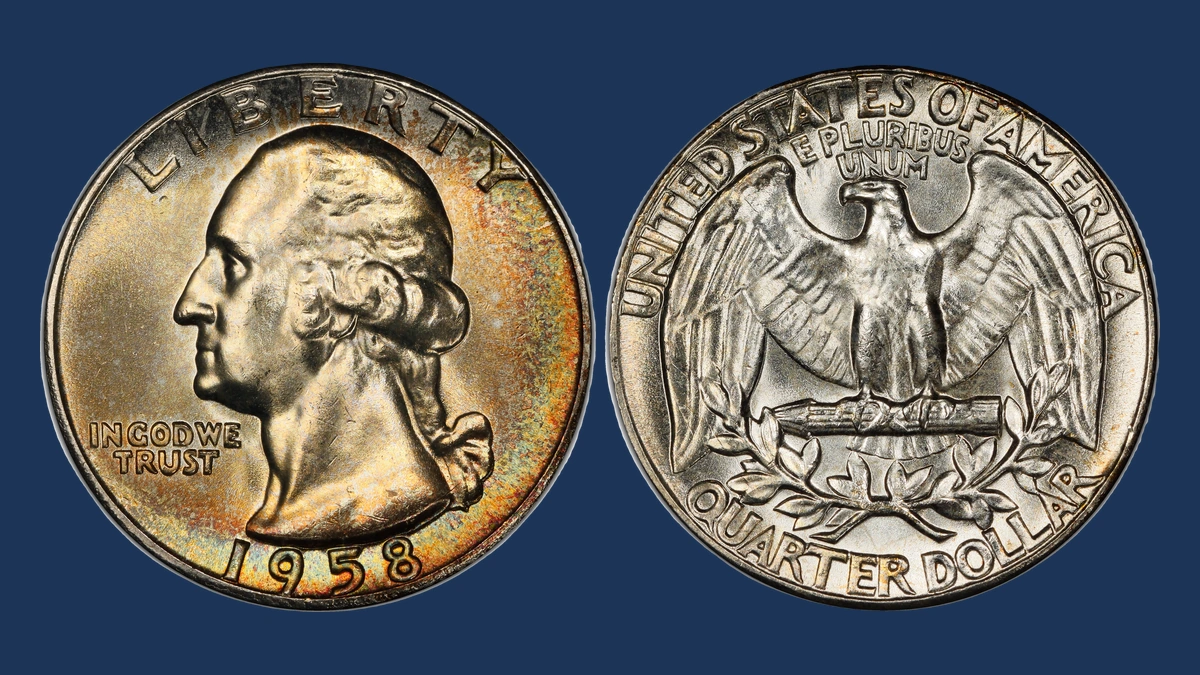
The letters E and S in STATES stand apart on a Type B back design. Ordinary circulation quarters usually show those letters much closer together.
Type B was the design intended for Proofs, collector coins made with special preparation. Some ordinary Philadelphia quarters also received it in 1958.
On a circulation coin, that different back design creates the collectible variety. On a normal Proof, the same lettering is expected; the small gap does not turn every shiny 1958 quarter into an error or establish how the coin was originally made.
Estimated Value
The estimated range is $20 to $5,000, with exceptional preservation driving the upper end. PCGS records an MS67+ example at $4,800 in March 2019.
A more recent MS66+ example brought $666 at GreatCollections in October 2025. Both are clean, unworn coins, rather than typical circulated examples.
Compare the issue and condition before using either result. A normal Proof with Type B lettering does not receive the same circulation-variety premium simply because its surfaces are reflective.
How to Identify
Place a photograph of the candidate’s back beside a confirmed 1958 Type B example. Match the E-S gap at the same image scale, so enlargement does not exaggerate an ordinary separation.
Inspect the surrounding letters to make sure wear or scraping has not artificially widened the space. Several intact letter edges provide a better comparison than one damaged corner.
Then establish that the coin is a Philadelphia circulation issue. A Proof normally carries this back design and requires no accidental use of the wrong tool.
If the surface looks polished, rely on expert examination or a trustworthy grading description to determine the original finish. Shine by itself cannot settle that question.
14. 1958 Washington Quarter Proof with a Full Backward Portrait on the Back
Turn this Proof quarter over and another Washington portrait appears where the eagle should be. The second portrait and its lettering are backward and sunken into the silver.
A previously struck coin lay against the blank inside the press. Its raised front design pressed into the blank’s back while the normal tool struck the other face.
This transferred image is called a brockage. The recorded PCGS PR62 example preserves the complete image without stretching, and its small front-side abrasion is a condition mark rather than another minting error.
Estimated Value
The PR62 full brockage sold for $12,337.50 in January 2017. An estimated $7,500 to $20,000 applies to comparable authenticated Proof examples with a complete transferred image.
PR identifies a Proof grade, and 62 reflects noticeable surface imperfections. The unusual error remained valuable despite those marks.
Clear, undistorted backward detail is central to the comparison. A partial or stretched impression, or a coin squeezed against another outside the Mint, requires a different assessment.
How to Identify
The back of the coin should show Washington instead of the eagle, with the transferred letters reading backward. Side lighting must also show that this second design is sunken, since its direction alone does not prove a brockage.
Compare the full outer lettering and portrait with the normal front design to judge whether the impression is complete and unstretched. The recorded Proof has that full pattern, rather than an isolated copied patch near one edge.
Keep the reflective surfaces untouched and provide clear photographs of both faces for an error specialist to examine. Coins squeezed together outside the Mint can also copy a design, but their surrounding damage and metal movement may reveal the later operation.
Conclusion
These 1958 errors have estimated values from $20 to $20,000. Small raised lines and weak details occupy a very different market from the complete backward portrait on a Proof quarter.
A useful comparison preserves the coin’s mint, finish, and actual physical feature. The 3.05-gram cent-blank example, the rotated nickel-blank coin, and the silver dime-blank piece should each keep their own measurements and price history.