1934 Quarter Error List with Pictures

Bold motto letters are normal on some 1934 quarters. Split lettering is a different clue: a doubled-die example sold for $10,350 in March 2005.
This 1934 quarter error guide separates genuine mistakes from the year’s normal lettering styles. Estimated values run from $25 to $11,000, including exceptional coins whose condition accounts for much of the price.
Read on to compare the doubled motto, spread-out strikes, and other reported features.
1. 1934 Washington Quarter Clipped Blank
A quarter can leave the mint with part of its original disk missing. The defect begins when a cutting machine makes an incomplete blank rather than a full circle.
The 1934 year table reports clips for Philadelphia and Denver quarters. It does not establish one shared gap shape or location.
When the incomplete disk is struck, its design forms around the missing metal. Nearby rim detail may weaken or change shape.
A later cut can create a similar outline. The way the struck detail approaches the gap matters more than simply seeing a piece missing from the edge.
Estimated Value
Genuine clipped 1934 quarters can be estimated at $25 to $400 for ordinary circulated to modestly unworn examples. The size of the gap, visible date, and surrounding condition all affect the price.
A straight-clipped 1966 quarter brought $124 in June 2024, providing a later, different-metal comparison. A small 1934 clip should not automatically be priced above it just because the coin is older.
Exceptional condition or a scarce underlying variety needs separate consideration.
How to Identify
Ask for an edge photograph through the missing section, not only a front view. Look for saw marks, filing, or sharp sheared metal from a later cut.
Next follow the raised rim toward each end of the gap. A genuine incomplete blank can develop soft or interrupted rim detail there during striking.
Check the opposite edge for a weaker section too. That effect supports some clips but is not required on every genuine example.
For a loose coin, record the weight and compare the visible loss with the normal 6.25 grams. Low weight alone cannot distinguish mint-made missing metal from a later cut.
Keep both faces in the comparison so a date, mint letter, and damaged edge are not judged from unrelated cropped images.
2. 1934 Washington Quarter Reported Repunched D
Denver quarters used more than one normal D size in 1934. A larger or smaller letter is therefore not, by itself, evidence of an error.
A repunched D requires another impression of the letter. Workers punched mint letters into the die, the steel tool that stamps the design, and a shifted second punch could leave an extra outline.
A seller described a 1934-D quarter as an AU repunched-mint-mark example. AU means that the coin has only limited wear.
That report supports looking for a repeated D, but the actual raised shapes still need to match the claimed feature.
Estimated Value
Allow an estimated $40 to $600 for a genuine identified repunched D, depending on clarity and condition. A seller’s AU example was listed at $95; that listing is not a verified auction result.
Expect an obvious second letter on an attractive coin to draw more interest than a faint extra edge. Ordinary differences between the large and small D punches do not justify this error premium.
Compare the coin’s underlying grade before paying for the extra feature.
How to Identify
Choose a normal 1934-D comparison with the same D size. Otherwise, a simple change in the punch style can look like an abnormal letter.
Trace the D’s upright and rounded side under magnification. Look for an additional raised portion that could belong to another D, rather than judging the letter by overall thickness.
Photograph that feature with light from both sides. A dent, shadow, or flat shelf caused during striking can imitate one doubled edge.
Then compare the entire extra outline with an identified repunched example, including where it meets the main letter. Keep the full quarter and date in view when seeking that match; a variety number belonging to another denomination does not identify a quarter.
3. 1934 Washington Quarter Uncentered Broadstrike
A design can sit off to one side without losing any of its outer details. That is the important distinction in the reported 1934 uncentered broadstrikes.
The metal spread beyond its usual border because the collar did not contain it normally. This collar is the surrounding ring that controls width and forms the edge grooves.
The Coins Value guide describes two Philadelphia examples sold in 2024, graded MS63 and MS64 by PCGS. Both grades describe unworn coins with noticeable marks.
The uneven placement should not automatically be called an off-center strike. The completeness of the design decides that distinction.
Estimated Value
Coins Value reports June 2024 Stack’s Bowers sales of $360 for an MS64 example and $192 for an MS63 example. These are reported results for separate coins.
An estimated $100 to $1,000 allows for differing spread, surfaces, and condition. A clean, wide border around a complete design is generally more appealing than slight spreading on a marked coin.
Large differences in border width should be assessed from full photographs rather than a close-up of just one side.
How to Identify
Read every outer letter on both faces before measuring anything. If the complete design survives within the metal, an unevenly placed broadstrike remains possible.
For a loose example, measure the widest and narrowest directions with calipers and weigh it. A normal silver quarter is about 24.3 millimeters wide and 6.25 grams; spreading changes shape without adding silver.
Examine the widened area beyond the struck design for evidence that metal flowed there during the strike. The edge may lack the regular grooves formed by a properly working collar.
Compare the portrait and letters with the border for signs of later flattening. Hammer damage crushes an existing coin, whereas an original broadstrike forms its design at the same time as its expanded shape.
4. 1934 Washington Quarter Minor Blank Defect
A small irregularity in the original metal can qualify as a blank defect without being a clip. The name describes where the problem began, before the coin was struck.
GreatCollections offered a 1934 Philadelphia quarter labeled Minor Planchet Defect by PCGS. A planchet is the prepared metal disk ready to receive the design.
The coin was graded MS66, an unworn example with very few marks. The brief label does not specify peeling, a missing edge, or a particular defect shape.
Examine the surface to understand the defect. A shallow irregularity should not become a claim of major missing metal.
Estimated Value
For minor original blank defects, estimate $30 to $1,000 across ordinary worn examples and attractive higher-grade coins. An MS66 quarter can carry substantial value from its condition before the small defect is considered.
The GreatCollections example sold in October 2025, but its publicly visible page does not display the paid amount. It establishes a graded example, not a price to copy.
A tiny flaw should receive a modest premium compared with a similar normal coin.
How to Identify
Begin with the full holder label and matching coin photographs. The words Minor Planchet Defect identify a broad category, so do not assume they describe a particular missing piece.
Find the actual irregularity and inspect how the surrounding design crosses or stops at it. A feature present before striking may affect the way nearby letters, rim, or open surface formed.
If the mark appears to peel, obtain a side-lit close-up without touching any loose metal. If it reaches the edge, photograph that edge to distinguish a missing section from a shallow surface flaw.
Keep the coin sealed when it is already certified. An error specialist can narrow the description from clear photographs without removing a high-grade coin from its holder.
5. 1934 Washington Quarter Die Crack Through the Hair
A horizontal raised line crosses Washington’s hair on a documented 1934-D Heavy Motto quarter. The line belongs to a crack in the striking die, not an incision cut into the finished coin.
Silver pressed into the opening in the die and formed the raised line. The normal hair design remains the background through which it runs.
PCGS describes this feature on a particularly well-preserved example sold by Heritage in 2025. It does not appear simply because a quarter has the Heavy Motto lettering style.
Other coins of that normal style need their own surface examination.
Estimated Value
The documented MS67 coin, an exceptionally clean unworn example, sold for $8,700 in August 2025. That is the whole coin’s price, strongly influenced by condition, not an $8,700 crack premium.
Estimate $40 to $300 for ordinary worn or modest-grade examples with a similar small crack. Exceptional coins approaching the cited MS67 condition can fall around $8,000 to $10,000.
Compare overall preservation before treating the raised line as the reason for a large price.
How to Identify
Use the documented Denver coin’s photographs to locate the horizontal line across Washington’s upper hair. Confirm that your suspected mark follows the same path instead of assuming every Heavy Motto quarter shares this crack.
Next examine the center of the line with light coming from the side. A die crack produces raised silver, while a scratch has a sunken main channel even when displaced metal rises along its edges.
Follow the line across several hair strands to see how it intersects the original design. Keep the complete portrait visible in your photographs, since a tiny close-up may conceal whether the mark is simply a normal strand of hair.
6. 1934 Washington Quarter Doubled Die Obverse
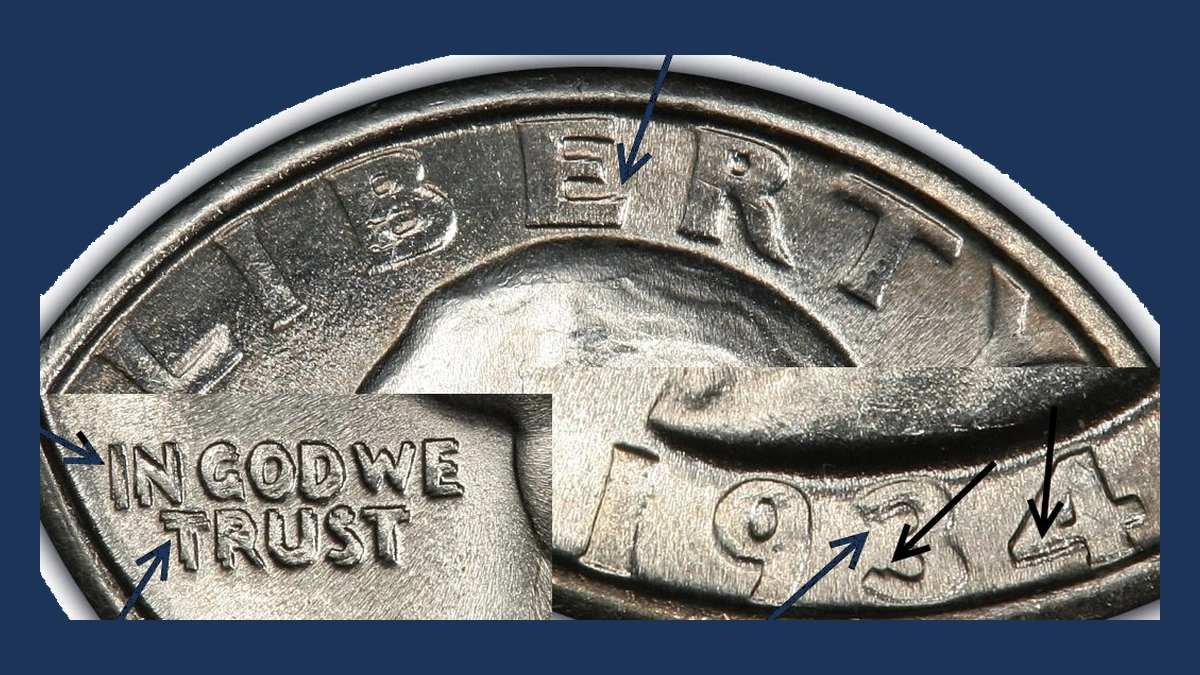
The motto looks split on the major 1934 doubled-die quarter. IN GOD WE TRUST shows the strongest effect, while LIBERTY and the date carry less dramatic doubling.
The repeated image was already in the front die before it struck coins. Collectors call this a doubled die obverse; obverse simply means the front.
This Philadelphia variety belongs to the Medium Motto style. It differs from the normal Heavy Motto, whose letters are bold without needing a second outline.
An unworn example sold by Heritage shows the same hierarchy of clues: the motto first, then the other front lettering.
Estimated Value
The estimated range is $50 to $11,000, from well-worn identified examples to exceptional coins. PCGS records an MS65 sale of $10,350 at American Numismatic Rarities in March 2005.
A separate MS65 example sold at Heritage for $3,220 in July 2012. MS65 describes an attractive unworn coin with some marks.
The different results show why a grade alone does not fix the price. Strength of detail, surfaces, and demand at the particular sale all matter.
How to Identify
Put a normal Medium Motto photograph beside an identified doubled-die example, then add a photograph of your coin. The normal comparison prevents the year’s ordinary lettering changes from being mistaken for an error.
Use IN GOD WE TRUST to make the first match, checking split raised strokes across several letters. Follow that with LIBERTY and the date, where weaker doubling should fit the same known variety rather than an unrelated thick edge.
Change the lighting and inspect any apparent second outline for a flat shelf caused by movement during striking. An ordinary Heavy Motto remains bold without those matching repeated shapes, so thickness alone does not settle the identification.
Conclusion
A normal heavy motto or large D is not automatically an error. The useful clues are repeated design edges, an original blank defect, or metal shaped abnormally during striking.
Estimated values here span $25 to $11,000. Compare the exact variety and condition before applying a high auction result, especially for the beautifully preserved cracked coin whose price was not simply payment for its raised line.