1927 Quarter Error List with Pictures

A line crossing Liberty’s head on a 1927-D quarter can come from a cracked piece of the stamping tool. One MS65 Full Head example was offered at $3,000, a historical dealer asking price rather than a sale.
The 1927 quarter errors below have estimated whole-coin values of $25–$5,000. Read on to compare that retained break with doubled details, an extra mint letter, and coins whose designs formed weakly or out of position.
1. 1927 Standing Liberty Quarter Peeling Metal
A thin flap or shallow peeled patch can interrupt the design while the rest of the quarter remains intact. This separation within the alloy is known as a lamination.
The 1927 Philadelphia issue has reports of this type of flaw. Its position and size depend on the individual blank, so the same peeled area should not be expected on every example.
These quarters contain silver mixed with copper throughout. The separation is not a missing outer sheet from a modern layered coin, and a later scrape needs to be distinguished from a thin weakness inside the original metal.
Estimated Value
Estimate $25–$300 for a genuine lamination on a 1927 Philadelphia quarter, with surface quality and the visible separation affecting appeal. A small worn patch can add little to the coin’s ordinary collector value.
A 1932-S Washington quarter with a front lamination sold for $228 in September 2023. That later coin belongs to a different series and scarce mint issue, so its full price should not be treated as the value of peeling metal alone.
How to Identify
Check an attached flap without moving it, using a magnifier and light aimed across the surface. Its thin edge may show where a weak layer separated from the metal below.
Follow any surviving gown line or lettering toward the flaw. The relationship between design and separation helps distinguish a split from a sharp scrape made after the coin was finished.
If the piece is gone, inspect the exposed patch for a shallow layered boundary instead of parallel cutting marks. Keep a whole-face photograph with the readable date rather than cleaning deposits away to make the coin look clearer.
The report gives no fixed location for the peeling, so examine the actual boundary on your coin.
2. 1927 Standing Liberty Quarter Doubled Front Details
The lower-left corner of S in TRUST can show a clear notch instead of a single smooth outline. It is one of the useful details on Philadelphia WDDO-001.
The repeated design spreads inward on IN, TRUST, the date, the lower gown, and the lower stars. Several front features also appear unusually thick.
This pattern was present in the steel stamping tool, called a die, before coins were struck. It is not evidence that each coin received two separate blows, and ordinary wear or movement during striking can produce different thick or doubled-looking edges.
Estimated Value
Use an estimated $50–$1,200 for a correctly matched 1927 Philadelphia WDDO-001, depending on wear and clarity. A crisp notch and several matching details make the variety easier to recognize than vague thickening.
For another silver-quarter comparison, a 1945 Philadelphia FS-101 graded MS65 sold for $552 in March 2018. That Washington quarter has a different design and doubled-tool pattern, so its sale is context rather than a price assigned to the 1927 Standing Liberty variety.
How to Identify
Begin with S in TRUST under a 10× magnifier. Compare its lower-left notch with the Wexler WDDO-001 photographs, then check the nearby repeated details rather than stopping at one letter.
Look inward from the lower gown edge and the lower stars to see whether the extra design agrees with that pattern. The date and IN provide further comparison points.
Use side lighting to distinguish rounded separation from a flat shelf beside a letter. Wear can make edges wider without reproducing the documented notch.
Keep the whole front in your photographs to establish the year and Philadelphia identity. A matching group of features is more persuasive than one thick-looking S.
3. 1927 Standing Liberty Quarter Repunched D Mint Mark
A small extra stroke can appear to the left of D on the front of a Denver quarter. The cataloged 1927-D WRPM-001 is a D over another D shifted westward.
The mint letter was punched into the working tool separately from the main design. A second impression in a slightly different position left a shape that later appeared on the coins.
The extra outline should be checked as a letter remnant, not simply as a rough spot beside D. Impact damage, dirt, or reflections can imitate a small projection without matching the cataloged repeated punch.
Estimated Value
An authenticated 1927-D repunched mint mark has an estimated whole-coin range of $75–$1,500. Grade and strike quality account for part of that spread, even before considering how clearly the extra D survives.
A 1949-D Washington D/D FS-501 in MS65 sold for $384 in March 2018. That later variety provides a useful comparison for mint-letter collecting, but it has its own pattern and should not supply a catalog number or guaranteed price for this Standing Liberty quarter.
How to Identify
Find the small D on the front near the base of the design, keeping the coin upright. The listed extra D is to the left, so begin with that outer contour rather than searching every direction equally.
Examine it with a magnifier and compare the full letter with a confirmed WRPM-001 image. Change the light angle to check that the extra line is raised metal rather than a shadow.
Look for a nearby impact that might have pushed part of D sideways. A random lump does not have the same letter shape.
Photograph the main D and its left-side remnant together. The surviving extra outline, not an assumed polishing line elsewhere, establishes the proposed variety.
4. 1927 Standing Liberty Quarter Very Weak Strike
Liberty and the eagle can appear only as faint shapes, fading toward the rims. A documented 1927 Philadelphia example shows that very weak design together with visible texture from the original blank.
Stack’s Bowers cataloged it with the NGC label Die Adjustment Strike. That label describes the coin’s classification, while its appearance alone cannot prove exactly what an operator intended during production.
A weak strike forms little detail in the first place. A heavily worn quarter loses detail afterward, so the original surface beneath the faint design becomes especially important when telling the two apart.
Estimated Value
For a genuine, substantially understruck 1927 quarter, estimate $300–$2,000, depending on the surviving identity and original surface. Clear blank texture with faint struck figures can show the error more convincingly than ordinary softness.
The NGC-labeled coin appeared as lot 4333 in the Winter 2014 Baltimore catalog. The estimate here applies to the complete weakly struck coin; it does not assume an auction result or give a heavily worn piece the same value merely because its design is faint.
How to Identify
Compare the protected low areas with the high points before calling the coin worn. The cataloged NGC example retained visible blank texture beneath faint central figures that disappeared toward the rims.
Under a magnifier, look for that original surface instead of smooth polishing or rubbed-down detail. Later abrasion can erase design but leaves a different texture.
Examine both faces, since a broadly weak strike should be assessed as a complete coin rather than one faint letter. Preserve the date and other surviving identity in photographs; neither a weak image nor the catalog label alone proves that the coin was deliberately made during press setup.
5. 1927 Standing Liberty Quarter Clashed Designs
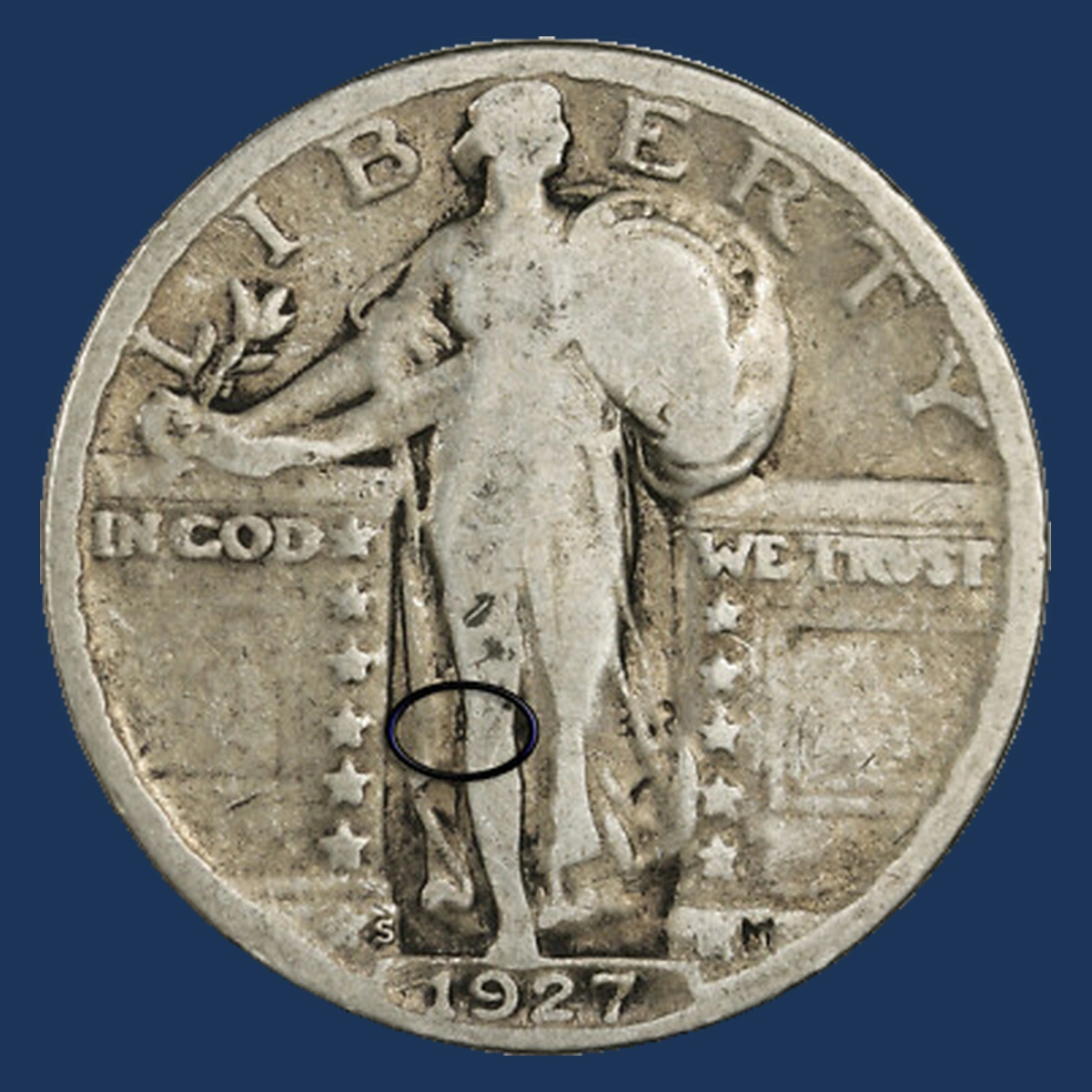
Faint shapes from the eagle side may appear around Liberty or across the nearby gown. They can form after the two stamping tools meet without a blank between them.
That contact marks the tools, which then pass portions of the opposite design to later coins. This is called a die clash.
Clashes are reported for 1927-S and Philadelphia quarters. Fine polishing lines can occur nearby after tool maintenance, but they are not all fragments of the opposite design.
The transferred shape needs to match something recognizable on the other face, even when it is faint or partly erased.
Estimated Value
Estimate $30–$400 for ordinary Philadelphia examples with clear clash traces, and $100–$3,000 for comparable worn-to-well-preserved San Francisco pieces. The scarce S issue can contribute much of the whole-coin value.
A tiny clash does not independently justify the higher range. Compare the coin’s grade, original surfaces, and actual mint identity first.
Then judge whether the extra design is clear enough to interest a specialist. A patch of polishing lines is not the same feature.
How to Identify
Use a normal quarter’s opposite face as a pattern reference and compare it with the unexplained trace near Liberty. A real clash should relate to part of the other design, rather than an arbitrary group of lines.
Change the light to separate the transferred outline from fine straight polishing marks. Do not assume every line in the gown came from the eagle-side tool.
Keep the mint letter visible because the San Francisco and Philadelphia reports concern different coins. A clashed S quarter’s scarcity does not establish that a no-letter example has the same value.
Photograph enough surrounding design to show where the extra trace sits. Its recognizable relationship to the opposite face is the useful identification test.
6. 1927 Standing Liberty Quarter Off-Center Strike
The standing figure and the eagle can land partly outside the available metal if the blank is not centered between the tools. An unstruck crescent remains beside the shifted design.
This is an off-center strike. The missing outer details and unused metal should fit the same displacement on both faces.
The 1927 reports do not establish a single percentage or mint for all examples. A wide rim on one face alone needs a different explanation, and a readable recessed date is especially helpful when assigning a displaced coin to this particular year.
Estimated Value
For a genuine dated Philadelphia 1927 off-center quarter, estimate $150–$3,000, with displacement and preservation setting the comparison. A verified scarcer mint requires its own whole-coin assessment.
A 1965 Washington quarter struck 25% off center sold for $180 in December 2025. That later copper-nickel coin illustrates the same striking mistake, while the Standing Liberty quarter’s silver metal, remaining date, wear, and original design need to be judged separately before choosing a price.
How to Identify
Locate the recessed date before estimating how much of the design missed the blank. A large empty crescent does not identify the year if the date is missing or altered.
Compare Liberty’s side with the eagle side to check that both designs fit one displaced metal disk. A complete design inside a wide border may instead be a broadstrike.
Inspect the empty area for hammering or grinding that could make a finished surface look blank. The original transition into the struck design should remain natural.
An absent mint letter cannot prove Philadelphia if its part of the design missed the metal.
Keep photographs of both complete faces together so the surviving date, blank area, and missing outer details can be compared directly.
7. 1927 Standing Liberty Quarter Retained Break across Liberty’s Head
A cracked piece at the edge of a stamping tool can remain in place instead of falling away. The coin may then show a boundary across an area that still retains part of its normal design.
This is called a retained cud. The described 1927-D example has a strong break across the top, running from the rim just right of B through Liberty’s head to the rim left of E.
The dealer described a PCGS MS65 Full Head coin, meaning strong head detail, while noting that the error was not named on its holder.
Estimated Value
For a comparable high-grade 1927-D retained-break quarter, estimate $2,000–$5,000 for the whole coin. Its Denver identity, preservation, and strong head detail contribute substantially to that price.
The historical Fred Weinberg listing asked $3,000 and also quoted $3,000 as the normal coin’s guide value at that time. It therefore does not establish a separate $3,000 error premium or a completed sale, even though the unusual break was described clearly.
How to Identify
Begin at the top rim just right of B and follow the described boundary through Liberty’s head toward the rim left of E. Compare the entire route with the dealer’s specimen rather than matching a random scratch across the portrait.
Use light from the side to see the surface levels and surviving design within the bordered area. A retained tool piece can keep supplying detail, unlike a completely missing piece that leaves a plain raised mound.
Check the small D separately and keep the head detail visible in photographs. The holder’s MS65 Full Head grade describes preservation and strike quality; the retained break still needs to be identified from the actual coin.
Conclusion
The estimated $25–$5,000 range covers the 1927 quarter errors discussed here, from a small surface separation to a high-grade retained tool break. Mint and condition remain part of each whole-coin price.
Use the specific feature to choose your next check: the notch in TRUST, the left side of D, a crossing line above Liberty’s head, or texture beneath a weak design. Preserve the surface rather than cleaning away clues.