1899 Quarter Error List with Pictures

Backward detail pressed into a small patch of silver makes an unusual 1899 quarter worth a closer look. A historic catalog describes a fifteen-percent partial mirror-image error, with comparable genuine examples estimated at $1,000–$10,000.
These 1899 quarter errors also include raised tool breaks, extra date traces, and displaced designs. Estimated whole-coin values span $25–$10,000.
Check whether the unusual feature rises above the metal or sinks into it, then follow the matching section below.
1. 1899 Barber Quarter Raised Metal from a Broken Stamping Tool
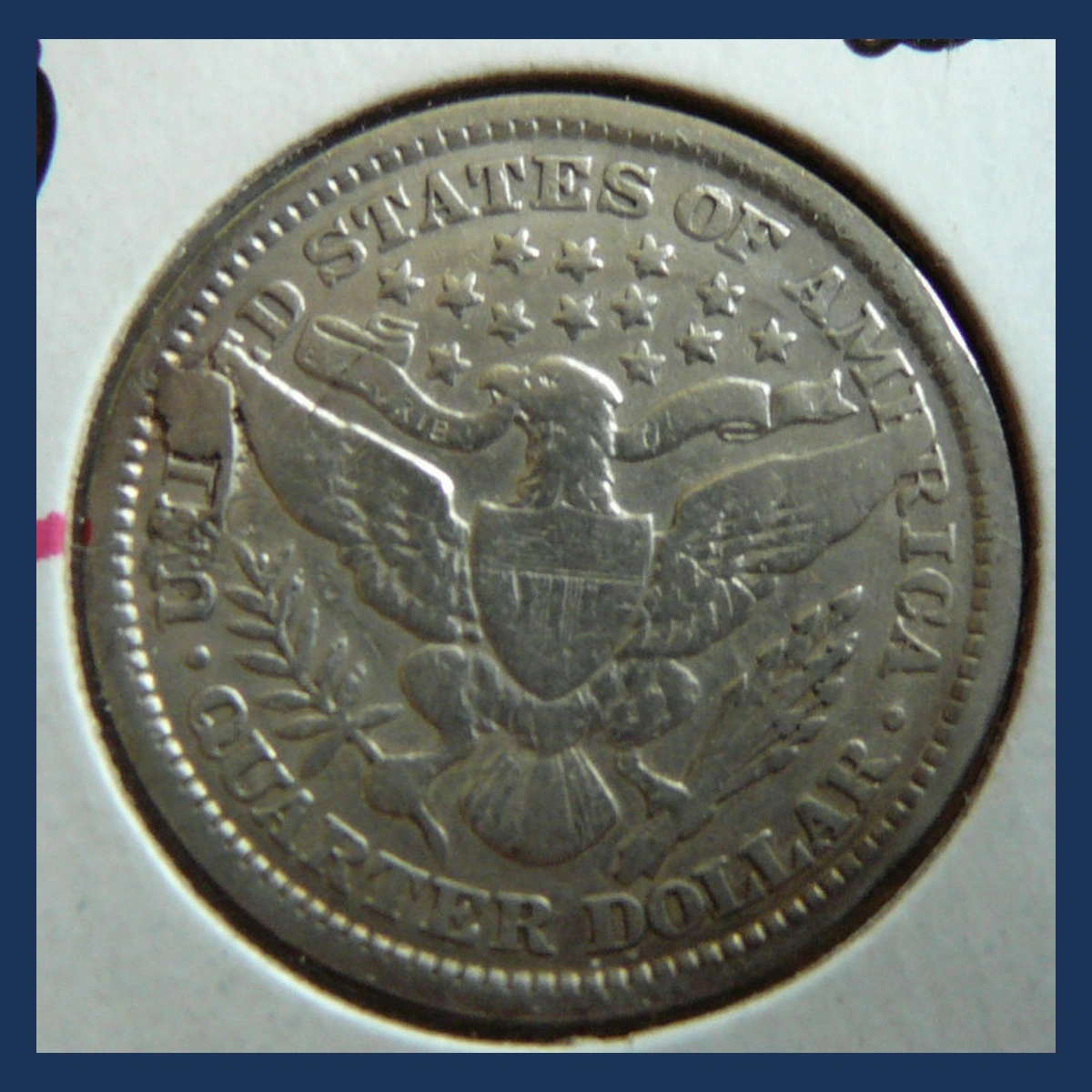
A rounded patch of extra metal can replace details where a piece breaks from a stamping tool. During striking, the coin metal fills the newly opened space.
A Philadelphia report for 1899 describes a raised feature extending from the eagle’s wing toward UNITED. Its relationship to the outer rim needs to be checked on the actual example.
A break that reaches the rim is called a cud, while one entirely within the design is an interior break. Both come from tool damage, but a raised blob alone does not establish that it reaches the edge.
Estimated Value
For a confirmed modest 1899 tool-break feature, estimate $25–$1,000. A strong raised patch with a clear boundary is generally easier to appreciate than a tiny irregularity.
The amount of replaced design and the condition of the whole coin help explain the range. A genuine connection to the rim can also change the comparison.
Added solder, stuck dirt, and metal pushed up beside an impact do not qualify merely because they create a raised shape.
How to Identify
Compare the eagle’s wing and UNITED with a normal Philadelphia quarter first. Find which expected details disappear into extra raised metal rather than assuming every broad feather is abnormal.
Follow the patch toward the rim and see whether the connection is continuous. If normal design remains between the patch and the edge, it should not be called a rim-connected cud.
Use light from the side to check the height and examine the base for dirt, added material, or a nearby impact hollow. Do not scrape the patch to test it; a close photograph with the entire wing and border visible is a safer starting point.
2. 1899 Barber Quarter Doubled Motto or Hair Details
Two rounded edges in a letter can come from a repeated image on the stamping tool. The same extra shape may then appear on multiple coins made with that tool.
This is called a doubled die, with die meaning the steel tool that stamps the design. The 1899 front-doubling report points to IN GOD WE TRUST and the hair as places to examine.
Those areas do not establish a specific mint or catalog number on their own. A flat shelf beside a letter can arise during striking without the tool itself carrying a doubled image.
Estimated Value
An identified 1899 doubled-front quarter has an estimated range of $50–$1,500. Clearly separated lettering on a well-preserved coin is more appealing than vague thickness caused by wear.
A different silver-quarter variety, the 1945 Philadelphia FS-101 in PCGS MS65, sold for $552 in March 2018. That sale provides a comparison for tool doubling, not a transaction involving the reported 1899 pattern.
Use matching mint and design details before choosing where a candidate belongs in the range.
How to Identify
Photograph the whole motto under soft light before selecting individual letters for a closer view. This helps show whether the extra shapes repeat in a related way across the words.
With a 10× magnifier, examine letter corners for rounded separation or small notches. Then compare the hair with a normal coin of similar wear, since its overlapping strands already contain many narrow lines.
Rotate the light rather than the coin to see whether a bright outline disappears. A reflection is not additional metal.
Include a back photograph showing any mint letter below the eagle. A reference from another mint or a different year cannot establish the reported 1899 variety just because one letter looks alike.
3. 1899 Barber Quarter Extra Traces near the Final 9
An earlier date-punch impression can leave a small arc beside the final digit after the punch is applied again. The result is called a repunched date.
Reports for 1899 describe extra traces near or below the final 9 on Philadelphia and San Francisco quarters. These need separate matching examples rather than one assumed direction shared by both mints.
The unusual part should follow the shape of an earlier numeral. Wear, a scratch, or a thick ordinary 9 may make the date look strange without showing any repeated punch impression on the tool.
Estimated Value
For a confirmed 1899 repeated-date quarter, estimate $50–$2,000. The mint and overall preservation can matter as much as the size of the visible earlier trace.
A clear raised piece of another 9 helps a collector recognize the feature. A vague line without a matching numeral shape is a weaker basis for a premium.
These are whole-coin estimates for identified examples. Ordinary worn dates and later engraving should not be priced as original date-punch varieties.
How to Identify
Read the mint letter before comparing the last 9. A San Francisco coin has S below the eagle, while Philadelphia quarters normally have no mint letter.
Keep all four date digits in the photograph so the extra trace can be judged at the correct scale.
Examine beside and below the final 9 under changing light. Look for a raised curve that follows a numeral shape rather than a cut made into the finished surface.
Compare the entire date with a documented example from the same mint. Do not move a useful-looking line from a Philadelphia reference onto a San Francisco identification.
Check for nearby scratches or flattened edges that could explain the appearance before treating it as an earlier punch.
4. 1899 Barber Quarter Displaced Design with a Bare Crescent
A portrait can sit too close to one edge when the metal disk is not centered during striking. Part of the intended image misses the disk, while plain metal remains on the opposite side.
An off-center error is reported for 1899 Barber quarters without an established percentage or mint for a particular example. The actual blank area and displaced design must therefore be examined together.
A missing piece of metal is different: that calls for a clipped-blank comparison. An uneven border on just one face may instead result from a stamping tool sitting out of position.
Estimated Value
Comparable genuine 1899 off-center quarters have an estimated value of $500–$5,000. A readable date and an obvious unused crescent can make the error easier to display.
For an older-quarter comparison, a 1907-S PCGS AU53 example shifted three percent is offered at $2,250 by Sullivan Numismatics. That is a different year’s asking price, not an 1899 sale.
Wear, cleaning, and the size of the shift all affect which comparison is useful for an individual coin.
How to Identify
Inspect the bare crescent closely before estimating any percentage. Grinding can erase a finished design, but it usually leaves surface marks that differ from untouched metal never reached by the stamping tools.
Next compare both faces and relate their displaced designs to the same outline. A centered back with only the front shifted needs a different explanation from the entire blank being out of position.
Read the date and photograph the full coin without cropping its border. If the mint-letter area is missing, leave that identity unresolved rather than treating the absence as proof of Philadelphia origin; the surviving design must support any mint assignment.
5. 1899 Barber Quarter Partial Backward Image Pressed into the Metal
A finished coin can act like a stamp if it meets another blank inside the press. Its raised design presses a backward image down into the new piece of metal.
That transferred image is called a brockage. A 1978 catalog reproduced in Mint Error News describes an 1899 Barber quarter with a fifteen-percent partial brockage near eleven o’clock.
The description also notes an expanded border on the back. The partial transfer and expanded metal belong to the same example, rather than two separate coins or a normal quarter with a reflection on its surface.
Estimated Value
Estimate $1,000–$10,000 for a comparable authenticated 1899 partial-brockage quarter. Recognizable backward letters or design parts can draw greater interest than an indistinct hollow.
A much later and smaller coin, a 2000-D dime with a back brockage and front damage, sold for $1,080 in June 2018. That comparison illustrates the process, not the value of the older Barber quarter.
Condition, the clarity of the transferred image, and the surviving original date all influence the estimate.
How to Identify
Find a recognizable piece of design inside the affected area near eleven o’clock. A genuine brockage needs a copied image, not merely a smooth depression made by a blank object.
Tilt the coin under a small light to confirm that the copied detail sinks into the surface. Any transferred letters should read backward, unlike ordinary raised lettering.
Compare the copied shapes with the coin design that could have pressed them there. Several connected details are more convincing than one accidental curve.
Inspect the expanded back border and the surrounding surface for later impacts. A specialist should distinguish a strike-time transfer from coins squeezed together afterward, using the complete coin rather than the hollow alone.
Conclusion
The estimated $25–$10,000 range covers very different 1899 quarter errors. A raised patch from a broken tool is not the same as a backward design pressed into the metal by another coin.
Keep that distinction in mind as you inspect the date, motto, and edge. Clear photographs of both faces help preserve the coin’s identity and keep a small unusual feature in its proper context.