1896 Quarter Error List with Pictures

The eagle’s shield belongs on the back. Yet fine lines from that shield appear inside Liberty’s ear on some 1896-S quarters.
One lightly worn example sold for $8,812.50 in January 2013, including the value of its scarce date and mint. Other 1896 quarter errors involve repeated date strokes or reported shapes that need specialist confirmation.
The estimates below range from $40 to $25,000, with the highest range conditional on a reported design combination being confirmed. Follow the visible features to see what each name means.
1. 1896 Barber Quarter Clipped Planchet
A genuine clip leaves part of the coin’s outline missing before the design is struck. The unfinished metal disc is called a planchet.
A curved gap can form when the blanking punch overlaps a hole already cut in the metal strip. Other incomplete blanks can have a straighter missing edge.
The remaining silver receives the coin design afterward. This order matters.
A piece cut from a finished quarter can look similar at first glance. The 1896 clip is a reported possibility, so a candidate needs examination of its edge and metal flow.
Estimated Value
For a confirmed clip on an ordinary Philadelphia 1896 quarter, estimate $50 to $750. A small missing piece on a worn coin belongs nearer the lower end.
A larger, clearly formed clip is more attractive when the date survives and the surface has not been altered. Several strong signs of an original incomplete blank support the higher end.
This estimate excludes the scarce 1896-S and exceptional condition grades. It is not a recorded 1896 clip sale.
How to Identify
For a loose coin, use a scale before judging the missing edge. A complete silver Barber quarter normally weighs 6.25 grams, so a substantial clip should reduce that weight.
Then inspect the gap with a 10× magnifier. Saw marks, a sharp cut through already finished letters, or a scraped edge suggest later removal.
On a struck incomplete blank, nearby letters or the rim may weaken as metal spreads toward the gap. A weak rim directly opposite the clip can also help, though it is not always obvious.
Photograph both ends of the gap and the opposite rim. An error specialist should assess those areas together; low weight alone also occurs on badly worn or damaged coins.
2. 1896 Barber Quarter Repunched Date
A small extra curve beside a date digit can come from an earlier impression of the date punch. The punch was used on a die, the steel tool that stamps coins.
If another impression landed slightly away from the first, parts of both could survive. Coins struck with that tool then carried the repeated strokes.
Greysheet lists Lawrence L-101 for the Philadelphia 1896 quarter. This is a repunched date, rather than a date added to an individual coin.
Exact digit shapes matter more than a general impression of doubling.
Estimated Value
An estimated $40 to $1,500 covers worn through attractive unworn Philadelphia examples with the date variety confirmed. Strong repeated strokes are easier to show and usually more appealing.
As a related comparison, a 1908 Philadelphia quarter with a misplaced date sold for $432 in March 2024. It received an ANACS grade of MS63, meaning unworn with noticeable marks.
That different date-punch mistake offers context, not an 1896 L-101 auction record. Wear and cleaned surfaces can reduce the price substantially.
How to Identify
Obtain a clear L-101 comparison photograph before assigning the name. A general 1896 date photograph cannot show which small remnants belong to this particular variety.
Place your coin and the comparison at the same angle, with the four digits equally large. Work across 1, 8, 9, and 6 rather than choosing whichever stroke looks most unusual.
Check that each suspected remnant rises above the surface. A sharp groove may be a scratch, while a flat shelf beside a digit may come from movement during striking.
Turn the coin over as well. This listing concerns Philadelphia coins without a mint letter below the eagle, not every 1896 quarter with an irregular date.
Keep the whole date visible in your photograph so a specialist can compare the shapes and their spacing.
3. 1896 Barber Quarter Off-Center Strike
An off-center quarter has design missing at one edge and an unstruck crescent at the opposite edge. The blank was not properly centered when the tools came together.
Both faces usually show the displacement. This differs from a small shift involving only one stamping tool.
A complete date makes the coin easier to identify, even when much of Liberty or the eagle falls beyond the blank. A large empty area can make the mistake obvious.
For 1896, this remains a reported possibility rather than a documented example with an established mint and grade.
Estimated Value
A confirmed ordinary Philadelphia example could fall in an estimated $300 to $5,000 range. Slight displacement on a worn coin would have less appeal than a bold, dated error.
A 1900 Barber quarter struck 15% off-center sold for $920 in September 2002. That moderately worn coin provides a same-design comparison from another year.
The 1896 estimate assumes genuine missing design from striking. It does not cover the separate rarity value of an 1896-S or coins altered after leaving the Mint.
How to Identify
Set photographs of the front and back beside each other. Each should show missing design at the edge, with corresponding unstruck space elsewhere on the coin.
If only one face is displaced and the other is centered, ask about a misaligned stamping tool instead. Also distinguish a broad, flattened border from a truly off-center design.
The silver should still form an intact blank. A quarter cut smaller after striking loses metal rather than gaining an original unstruck crescent.
Check the date and the mint area below the eagle before naming the issue. If displacement removes those details, do not fill them in from a seller’s guess.
A 24.3-millimeter diameter is the normal starting point, but an unusual shape needs interpretation alongside both faces.
4. 1896 Barber Quarter Clashed Dies
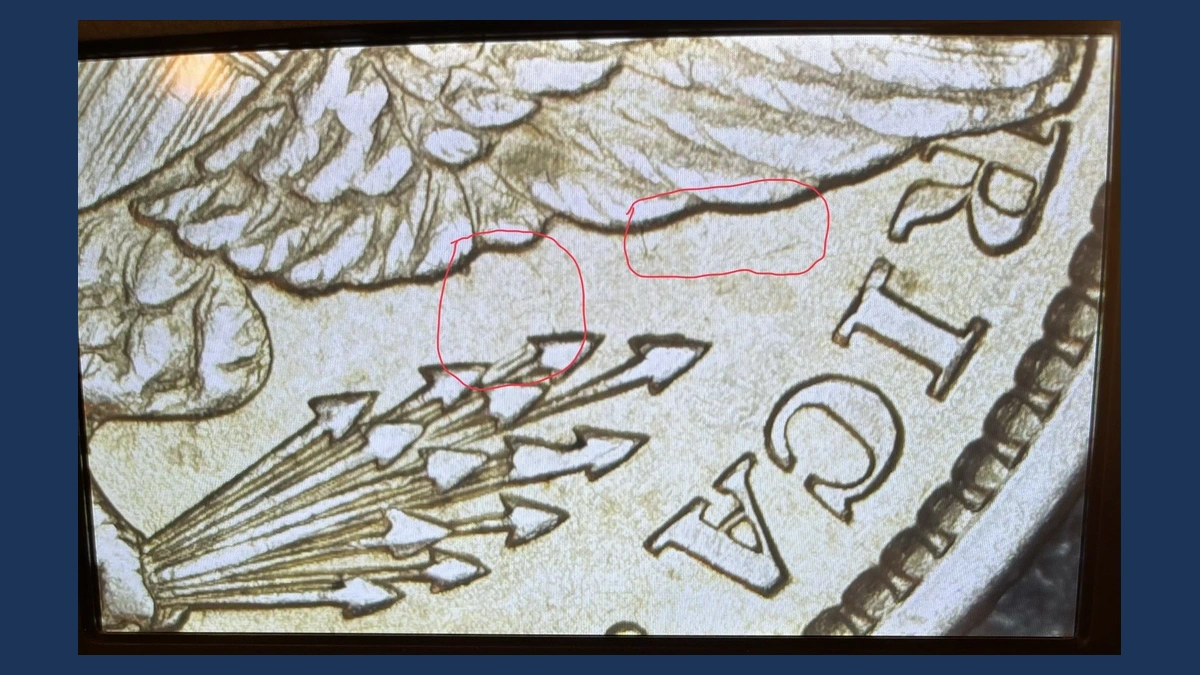
Look inside Liberty’s ear for fine horizontal lines. They copy part of the shield carried by the eagle on the other side.
The tools struck each other when no blank lay between them. This die clash transferred small parts of the opposite design onto the tools and then onto later coins.
The Barber Coin Collectors’ Society describes this feature on both known front tools used for 1896-S quarters. Different date and mintmark positions help distinguish those tools.
Those normal positions are not separate mistakes. The unusual feature is the shield detail appearing inside the ear.
Estimated Value
Heritage sold an example for $8,812.50 on January 9, 2013. PCGS graded it AU55, indicating light wear.
The catalog specifically described shield lines inside the ear. The price bought the entire scarce 1896-S quarter, not an $8,812.50 clash premium.
For genuine circulated examples with visible clash detail, allow an estimated $1,000 to $20,000. Wear, surface quality, and the underlying date rarity dominate that wide range; fine lines alone do not explain the coin’s value.
How to Identify
The S deserves attention before the ear. Added mint letters can turn a commoner Philadelphia quarter into a false 1896-S, so valuable candidates need authentication.
Find the letter below the eagle, between QUARTER and DOLLAR. Compare its shape and position with an authenticated coin from the same tool pair.
Now enlarge Liberty’s ear and look for several fine horizontal lines within it. Compare those lines with the shield’s horizontal detail on the back, allowing for the transferred image.
Cleaning can leave parallel scratches, but those cut into the silver and need not follow the expected shield pattern. Ordinary ear detail has its own shaped outline.
Clear ear lines can support the match. Their absence alone does not prove an 1896-S is false, since wear or a different tool state can hide them.
5. 1896 Barber Quarter Reported Later Design Combination
One reported 1896 Philadelphia quarter pairs later front and back designs. These are called Type II front and Type III back.
The front has clear inner ear detail. On the back, the left wingtip extends past the E in UNITED.
A Barber Coin Collectors’ Society survey recorded one collector’s report of this combination. Its author also noted the problem: the newer designs are normally associated with 1900 onward.
That four-year gap requires proof from the actual coin. The report does not establish that this unexpected pairing was genuinely struck in 1896.
Estimated Value
If an authentic 1896 coin with this later design pairing is established, a provisional estimate is $2,000 to $25,000. This is an editorial estimate for the confirmed unusual combination, not a published sale result.
Clear design details, an original surface, and convincing authentication would be essential. A coin merely described as this variety should not receive that premium.
The normal value of its date and condition remains the starting point until the claimed pairing is demonstrated.
How to Identify
Begin with a full, sharp photograph of the date. An altered date on a later quarter could create the appearance of a design arriving years early.
Next compare the ear with labeled Type I and Type II examples. Type II has distinct inner ear detail; wear or poor lighting can make that small area misleading.
On the back, enlarge the left wingtip and the E in UNITED together. The Type III wingtip extends beyond the E, rather than merely hiding part of its middle bar.
Both design features must appear on the same coin. Separate front and back photographs without a secure connection cannot establish the pairing.
Take the intact coin to a specialist for date and design checks before treating the reported combination as genuine.
Conclusion
From extra date strokes to shield lines in an ear, these features demand different kinds of inspection. Estimated values span $40 to $25,000, with the upper figure reserved for a reported design pairing only if confirmed.
The 1896-S clash example’s $8,812.50 sale also reflects a scarce date in attractive condition. Establish the mint, examine the visible feature, and judge the whole coin before assigning an error premium.