1869 Quarter Error List with Pictures

One 1869-S quarter with a crack across its upper design brought $2,764.60 in February 2012. The coin still retained much of its original detail.
Two different features appear in this 1869 quarter errors guide: a curved raised crack on San Francisco coins and a doubled front design on Philadelphia Proofs. Proofs were specially made for collectors.
The estimated whole-coin range is $300–$6,000 for the conditions discussed. Compare the visible lines and doubled details with the examples below.
1869 Liberty Seated Quarter Circular Die Crack
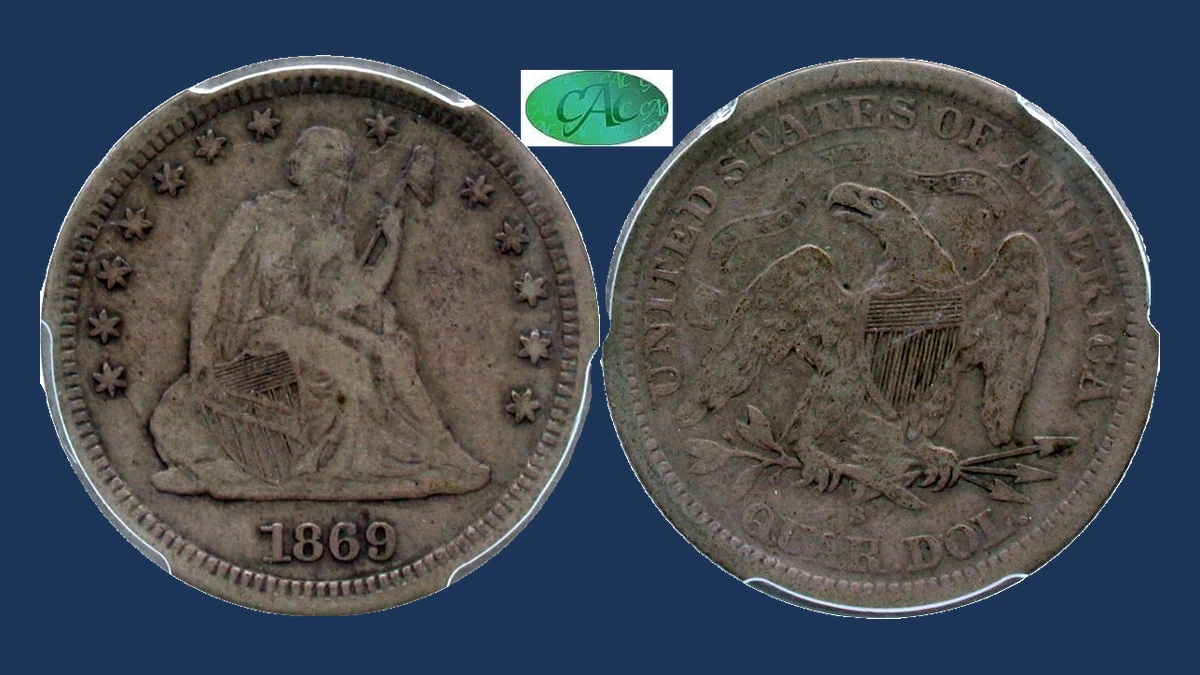
A curved raised line starts to form around the upper part of the front on the reported 1869-S quarter. The line comes from a crack in the die, the tool used to stamp the design.
Silver enters the split during striking and leaves a narrow raised ridge on the coin. The line can become stronger as the tool continues to break.
Gerry Fortin described an example graded PCGS VF25, a worn coin with substantial detail. Its characteristic circular crack was only beginning to develop.
The die pairing is called Briggs 1-A.
Estimated Value
An 1869-S quarter graded NGC AU55 sold for $2,764.60 in February 2012; its catalog described a crack at the top of the front. AU55 indicates light circulation wear.
Estimate $300–$4,000 for worn through lightly worn examples with this characteristic crack. The scarce San Francisco issue and overall condition account for much of the price.
The VF25 example was listed with a $950 reserve and no bids, which is not a completed sale.
How to Identify
Follow the curve under low, sideways light, beginning in the upper part of the front. A magnifier should show a narrow ridge standing above the background rather than a cut into it.
Look at how the line continues between or through nearby design. Do not expect a bold complete circle on every example: the documented VF25 coin shows an early stage.
Gerry Fortin’s photographed example provides the comparison. Keep its full date and reverse mintmark in view when checking the identity.
The S and lower reverse lettering can fade with wear on this issue. Trace the actual raised curve instead of treating any circular scratch as the same tool crack.
1869 Liberty Seated Quarter Proof Doubled Front Design
The front design on this Proof variety was doubled in the stamping tool before the coin was made. Coins from that tool can therefore repeat the same extra raised detail.
Heritage cataloged an NGC PR64 example as Flynn DDO001, also called Briggs 2-B. PR64 describes a collector Proof with some visible imperfections.
The catalog name identifies a particular variety, but its short description does not specify the exact doubled letters or other features. A close-up match is needed before applying that name to another coin.
The separate 1869-S circular crack is not its identifying feature.
Estimated Value
For a correctly identified Flynn DDO001 Proof in ordinary collector grades through well-preserved condition, estimate $600–$6,000. Reflective surfaces, sharp detail, and freedom from cleaning strongly affect the whole-coin value.
Heritage’s PR64 listing describes an actual coin bearing this variety name. Matching its doubled feature alone does not place another example at the upper end of the estimate.
Doubling does not cancel the effect of scratches, haze, or disturbed surfaces.
How to Identify
Begin with a confirmed photograph or specialist reference for Flynn DDO001. The variety name alone does not tell you where to find the extra outline.
Compare the whole front, then enlarge the same small area on both coins with a 10× magnifier or clear close-up photographs. The repeated shape and its position must agree, rather than simply looking thick.
Change the lamp angle without changing the coin’s orientation. A reflection moves as the lighting changes, while genuine raised separation remains fixed.
Keep a graded Proof inside its holder. For a loose coin, avoid touching the reflective backgrounds or rubbing any apparent line.
Ask a variety specialist to check unmatched doubling; the useful evidence is a repeated raised pattern in exactly the same location as the reference coin.
Conclusion
Keep the two 1869 varieties separate: the circular crack belongs to San Francisco quarters, while the listed doubled design belongs to a Philadelphia Proof. Their estimated whole-coin values span $300–$6,000 for the conditions discussed.
A raised crack should be traced across the surface. Doubled design needs an exact pattern match, especially where reflective Proof surfaces can make a normal edge look doubled.