1861 Quarter Error List with Pictures

The date survived when one 1861 quarter was struck fifteen percent off center toward four o’clock. That lightly worn coin sold for $3,450 in January 2009.
Smaller details also matter in this 1861 quarter error list: a repeated 6, reported doubling, and an unusual pairing of old and new designs. Estimated whole-coin ranges span $50–$10,000 for the conditions discussed.
Examine the full design first, then follow the smaller features in the checks below.
1. 1861 Liberty Seated Quarter Repunched 6
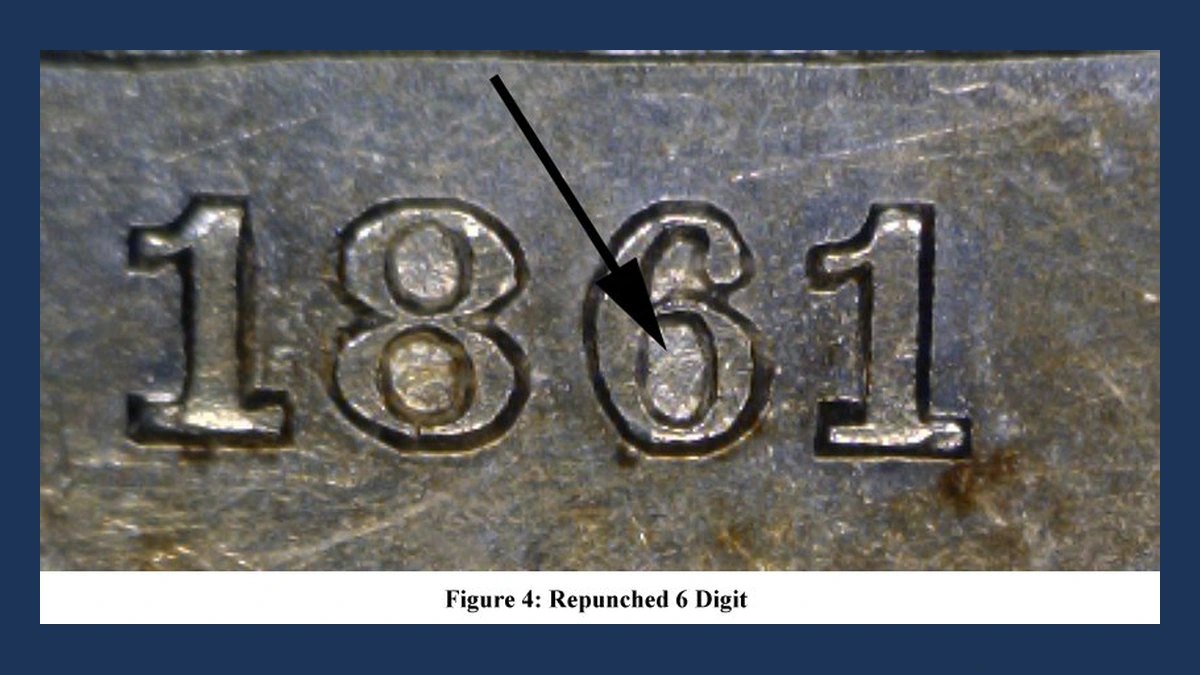
The 6 in one 1861 quarter variety retains traces of an earlier impression. The numeral was entered again in the die, the stamping tool, leaving part of the previous outline.
Greg Johnson’s study of Seated quarter dates identifies this coin as Briggs 4-C. His illustrated list calls the feature a repunched 6.
The earlier mark and the final digit belong to one repeated date entry. Part of the first outline remained visible after the tool received the 6 again.
The surviving earlier outline needs to match the illustrated 1861 example, rather than any unusual-looking 6.
Estimated Value
For a matching repunched-6 quarter in worn through lightly worn condition, estimate $50–$1,500. Clear remnants beside the final numeral make the feature easier to appreciate.
Original color and undamaged surfaces help preserve the small outlines. A scratch beside the digit or a thick edge caused by wear does not carry the same meaning.
This range is a whole-coin estimate rather than a recorded sale for Johnson’s illustrated example. Exceptionally preserved unworn coins require separate price comparisons.
How to Identify
Find the 6 between the 8 and the final 1, then inspect its entire outline with a 10× magnifier. Keep the other digits visible so that a close-up does not hide the date.
Compare the surviving extra shape with Figure 4 in Greg Johnson’s study of repunched and misplaced 6s. The written description does not establish a direction, so identify the actual matching remnant before assigning one.
Change the light and check whether the feature rises from the surface or cuts into it. A scratch, small bump, or reflection can sit beside a numeral without belonging to an earlier digit.
The earlier shape should fit the same repeated 6 shown on the documented 1861 coin.
2. 1861 Liberty Seated Quarter Reported Doubled Design
A doubled die can leave extra raised outlines because the stamping tool already carries repeated detail. This differs from movement during striking, which can flatten part of a design into a shelf.
An 1861 Philadelphia circulation variety is cataloged under FS-101. However, PCGS calls it a doubled back, while another catalog calls it a doubled front.
The labels therefore do not give a reliable face to inspect by themselves. Both sides need to be checked against an identified specimen.
This is one reported variety with conflicting names, not evidence for two separate doubled designs.
Estimated Value
A confirmed 1861 doubled-design variety in worn through modest unworn condition has an estimated range of $75–$2,500. The estimate depends on a recognizable repeated pattern and the coin’s preservation.
PCGS lists the variety, but a name alone does not establish that any particular thick letter belongs to it. Clear separation should be matched before paying a premium.
Flat strike doubling, cleaning scratches, and blurred worn edges are weaker comparisons than distinct original raised details.
How to Identify
Photograph both complete faces before selecting the most interesting letter or star. This avoids assuming that the doubled area must be on the side named by one catalog.
Use a magnifier to examine the suspected extra outline. Note which part is raised and whether neighboring details show a consistent repeated shape.
A flat ledge beside a letter may come from movement during the strike. That feature is different from a second rounded outline already present in the stamping tool.
Compare the photographs with an identified 1861 Philadelphia example and ask a variety specialist to resolve the face and pattern.
An exact arrangement of matching raised details is the useful evidence; the FS-101 label by itself is not a physical test.
3. 1861 Liberty Seated Quarter New Front with Old Reverse Design
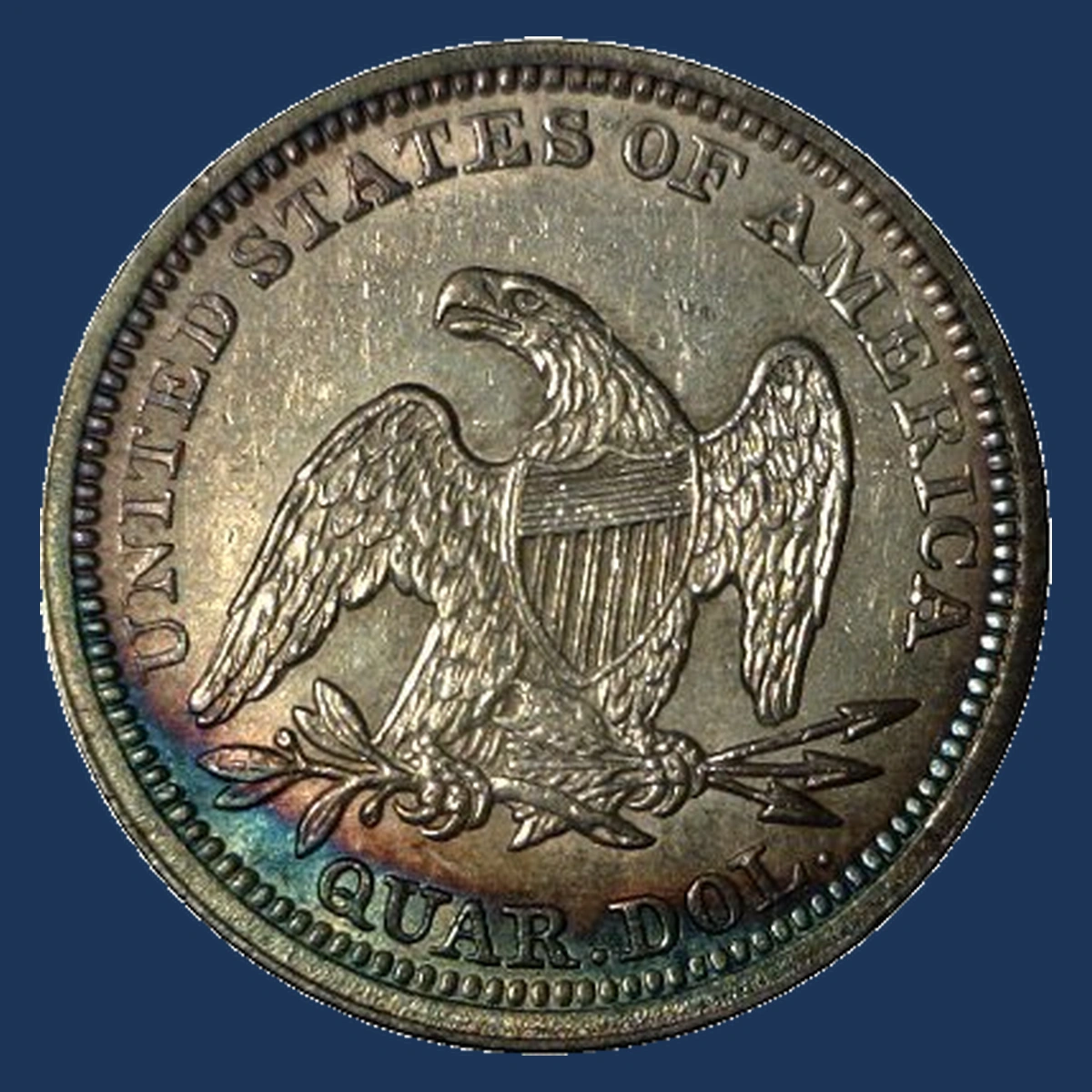
The front and back of this quarter belong to two different design generations. The newer front, called Type II, is paired with the earlier Type I eagle side.
The newer front has shield lines above the E in LIBERTY. On the earlier back, the eagle’s eye is recessed and the last A in AMERICA sits lower than nearby letters.
Collectors sometimes call this pairing a mule. The visible combination is established, but it does not by itself prove an accidental tool installation.
Specialists have identified two pairs of working tools that made this old-and-new design combination.
Estimated Value
Estimate $150–$5,000 for correctly identified examples across worn through modest unworn condition. The strongest comparisons preserve enough detail to demonstrate both design types.
Collectors seek this pairing because the earlier reverse is unusual on an 1861 Philadelphia quarter. Its value cannot be judged from the eye or final A alone if the front is not a match.
The range is an editorial whole-coin estimate. Heavy wear, altered surfaces, and incomplete identification reduce the usefulness of higher-priced comparisons.
How to Identify
Turn to the eagle and inspect its eye and the final A in AMERICA under a magnifier. The earlier reverse combines a recessed eye with that last A sitting lower than the other letters.
Then examine the shield on Liberty’s front side, looking for lines above the E in LIBERTY. The specialist variety guide pairs this newer front detail with the older eagle features.
Check all three points on the same coin and photograph both faces without mixing examples. Wear can soften the eye and shield lines, so use an ordinary comparison coin of similar preservation when judging what remains.
4. 1861 Liberty Seated Quarter Fifteen Percent Off-Center Strike
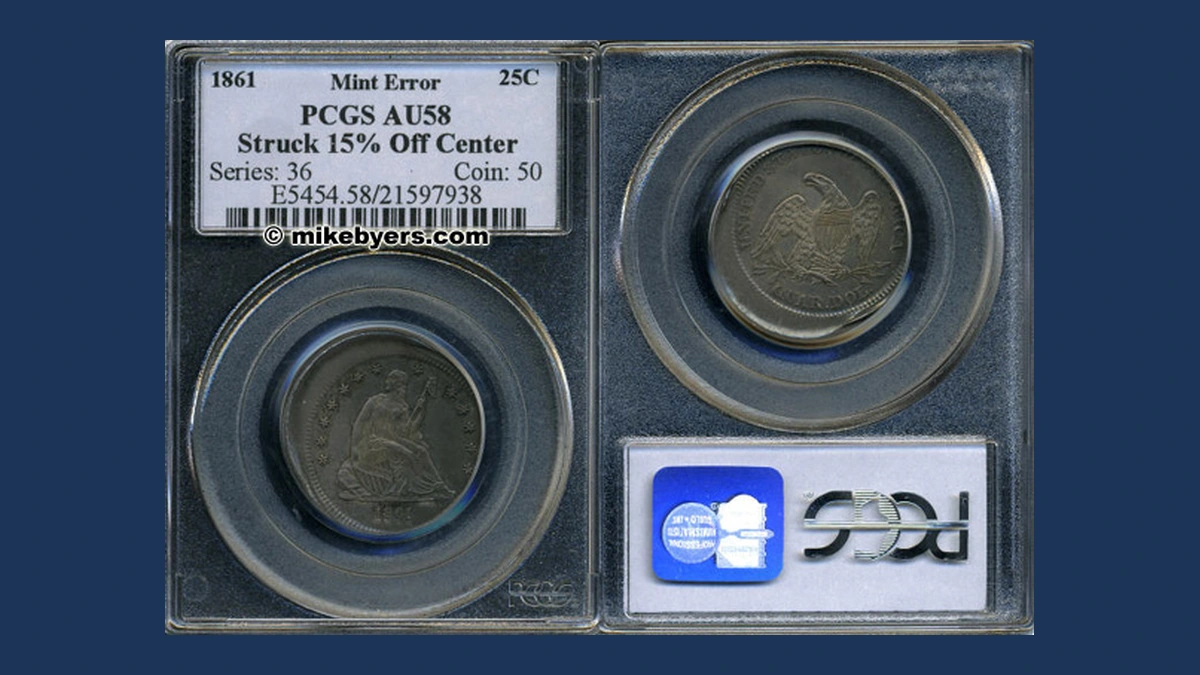
A documented Philadelphia quarter shows its design shifted toward four o’clock, leaving unused metal on the opposite side. The blank was not centered between the stamping tools when they came together.
Heritage described the shift as fifteen percent. Most of the design, including the full date, remains visible on the coin.
The example was graded PCGS AU58, meaning very light circulation wear. Its dark gray original color accompanies strongly impressed surviving detail.
A displaced blank affects the relationship between both faces and the outer edge. One uneven border on an otherwise centered coin is a different situation.
Estimated Value
Heritage sold the AU58 example for $3,450 on January 10, 2009. That is a realized price for a clearly identified 1861 quarter with a readable date.
Estimate $1,000–$10,000 for genuine examples of comparable early silver off-center striking, depending on preservation and displacement. The whole design’s appearance matters as much as the percentage.
A cleaned or damaged coin should not be compared directly with the original, lightly worn auctioned piece.
How to Identify
Keep the front upright and compare the four-o’clock side with the opposite blank crescent. The design should run off the edge in the direction of the shift rather than merely sit within an unusually wide rim.
Inspect the reverse next. Both faces should agree with the same misplaced blank, while a shift limited to one face suggests a misaligned tool.
The date should remain readable on a match to this example. Look along the untouched blank area for later cuts, flattening, or a pressed-in edge.
For a loose candidate, a scale and calipers can check against the normal 6.22 grams and 24.3 millimeters. The main visual check remains the displaced original design and its corresponding unstruck crescent.
Conclusion
The estimated $50–$10,000 range includes very different kinds of 1861 quarters. A displaced strike, a repeated digit, and an old-and-new design pairing each need their own comparison.
The doubled-design listing also needs an exact specimen match because its front-versus-back name conflicts. Keep photographs of both faces, retain the full date, and judge the coin’s condition alongside the feature that first caught your attention.