1843 Quarter Error List with Pictures

A jagged line across an eagle can be part of the coin’s original design as struck. The 1843 “Lightning Bolt” quarter shows this clearly: an AU58+ example brought $2,640 in August 2020.
This guide to 1843 quarter errors covers striking-tool cracks, a reported smooth edge, and off-center claims. Estimated whole-coin values run from $100–$15,000, with confirmation especially important for the last two types.
Read on to learn which raised lines, edge features, and shifted designs deserve a closer look.
1. 1843 Liberty Seated Quarter Cracked and Shattered Dies
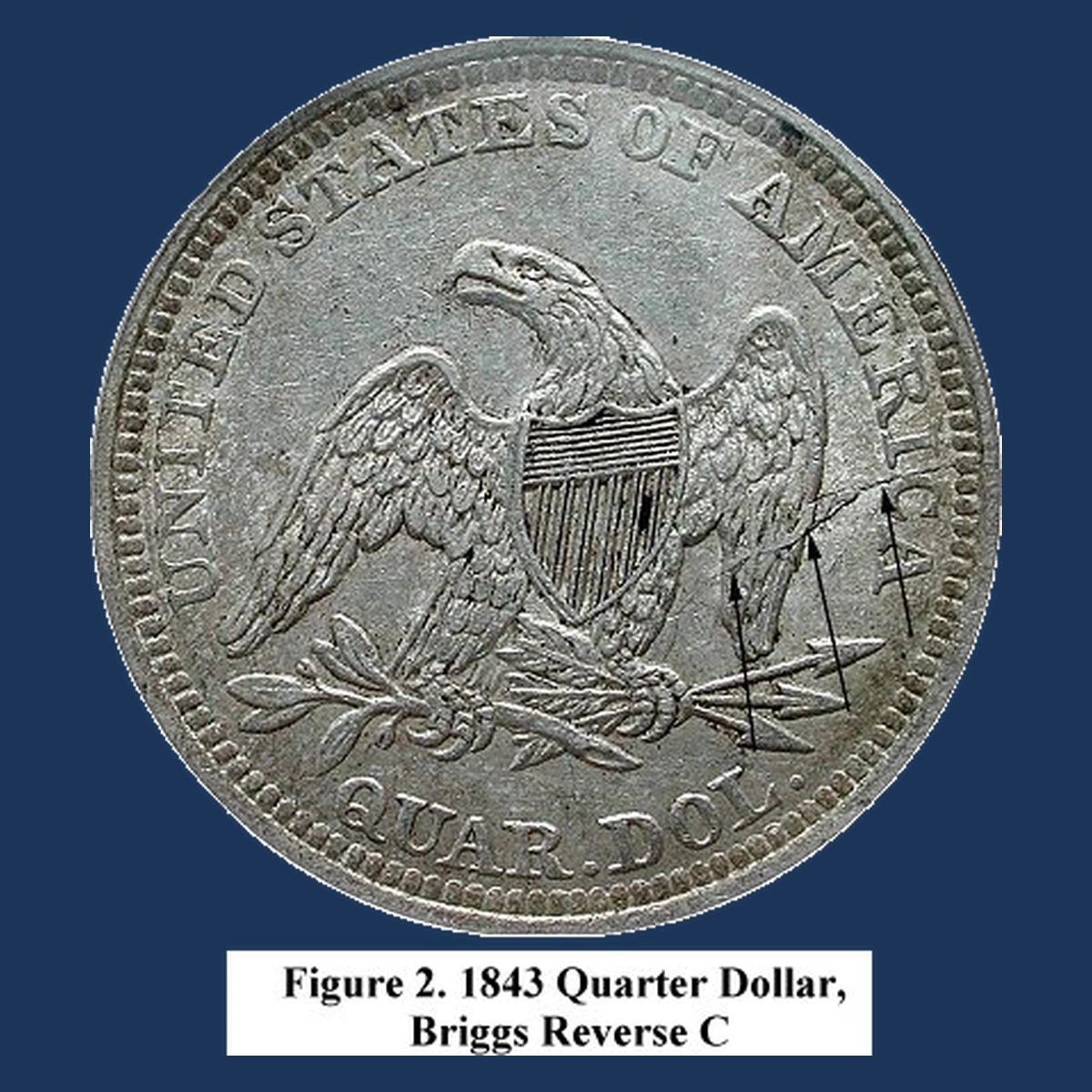
Raised lines cross the back of these quarters, but they do not mean the coins themselves broke apart. The cracks formed in dies, the steel tools that stamped the design.
Silver entered those openings during striking. It left raised lines on the finished coins.
Greg Johnson illustrates two different patterns in his 1843 quarter study. Back A has a branching network resembling slices of pie, while back C carries the better-known lightning-shaped crack.
They come from separate tools and should be compared with their own photographs.
Estimated Value
The lightning-shaped variety provides a useful actual sale: PCGS records $2,640 for an AU58+ coin at Stack’s Bowers in August 2020.
An estimated whole-coin range of $100–$3,500 suits worn through lightly worn examples with clear cracks. Better surfaces and stronger detail support higher prices.
The branching pattern is a different variety. Its value should reflect its own condition and collector demand, rather than automatically copying the lightning coin’s result.
How to Identify
Put the back beside the correct reference photograph before focusing on a single line. Decide whether you see branching divisions or a jagged lightning shape.
Use a 10× magnifier and light from the side to check whether each line stands above the surface. A scratch usually cuts downward, sometimes pushing metal up along its edges.
Follow the raised pattern across the design. Its turns and junctions should match the pictured variety, not merely look dramatic.
Check the front date and the back’s mintmark area as well. These two varieties belong to Philadelphia quarters, which have no O below the eagle.
A matching raised network on a correctly dated quarter gives you the strongest starting point for identification.
2. 1843 Liberty Seated Quarter Reported Plain Edge
A normal 1843 quarter has small grooves around its edge. A historical auction catalog instead described an 1843-O quarter with a plain edge and a heavily worn Good grade.
That description tells us what the edge looked like, but not what caused it. Heavy wear or later smoothing can erase grooves.
A striking problem is another possibility that needs examination. The collar, a ring surrounding the coin during striking, normally forms the grooved edge.
This report alone does not establish that the collar failed or that the coin spread beyond its normal size.
Estimated Value
For an 1843-O quarter confirmed to have a Mint-made plain edge, a conditional whole-coin estimate is $500–$5,000. Clear evidence of its origin matters more than a smooth edge alone.
Normal circulated 1843-O quarters already vary greatly in value with wear and mintmark variety. The estimate therefore includes the underlying coin’s value.
A filed edge should not receive the same premium. Strong, undamaged detail and convincing original edge surfaces would favor the upper end.
How to Identify
The edge needs a complete inspection, not one photograph. Turn a loose coin slowly under a light, or ask for overlapping edge photographs if it is enclosed.
Look for surviving grooves, filing lines, flat spots, and a rolled lip. Any of these may explain why part of the edge appears smooth.
Measure with calipers without scraping the surface, then weigh the coin on a suitable scale. The normal standards are about 24.3 mm and 6.68 g, though wear can reduce weight.
Read the date and find the O below the eagle. An error specialist should examine the entire edge before calling this a Mint-made plain-edge quarter.
3. 1843 Liberty Seated Quarter Reported Off-Center Strike
An off-center strike leaves part of the coin blank while cutting off part of the design elsewhere. It happens when the metal disc sits out of position between the stamping tools.
The displaced design should appear on both faces. An uneven rim on just one side can have another cause.
For 1843 quarters, an individual coin still needs firm identification before an off-center claim earns an error premium. General descriptions of Seated quarter errors do not establish a dated example.
A readable year and enough quarter design must survive to identify the coin itself.
Estimated Value
A genuine, clearly dated example would have a conditional estimated value of $1,500–$15,000. The amount of missing design, surface quality, and remaining date would shape its price.
For comparison, a published auction summary reports $10,200 for an 1891 quarter struck thirty-five percent off center, graded NGC MS61. That is a later-year example, not an 1843 sale.
A slight shift on a worn coin would normally attract less than a dramatic, well-preserved example.
How to Identify
Read 1843 on the coin itself before judging its shape. Check that the surviving seated figure and eagle belong to a quarter rather than another denomination.
Next, compare the two faces while keeping their positions aligned. Both designs should be displaced, with part of the intended image missing beside an unstruck area.
An oversized rim surrounding a complete design is different. So is a shifted front paired with a normally centered back.
Inspect the blank area for normal metal surfaces rather than grinding or fresh cuts. Scraping can remove a design but does not reproduce a natural unstruck surface.
The key combination is a readable 1843 date, displaced designs on both faces, and a genuine unstruck area.
Conclusion
The two crack patterns give 1843 quarter collectors a clear place to start: raised lines should match the correct reference coin. A plain edge or shifted design takes a different set of checks.
Estimated whole-coin values span $100–$15,000, depending on condition and the confirmed error. Keep both faces and the edge available for examination, and separate a striking problem from damage before paying an error premium.