1842 Quarter Error List with Pictures

A depressed patch in an eagle’s shield can belong to an unusual 1842-O quarter rather than a later blow. One Small Date example with this feature sold for $74,750 in August 2006.
This 1842 Liberty Seated Quarter error guide separates that scarce coin from a reported repunched 8 on Large Date quarters. Estimated whole-coin values span $150–$80,000.
First establish which date style you have, then read on for the marks that distinguish each error.
1842 Liberty Seated Quarter Repunched 8 on the Large Date
An extra outline around the 8 can come from placing the date punch into the steel stamping tool twice. The first position leaves a trace after the worker adjusts the punch.
That tool then repeats the same detail on the coins it strikes. Collectors call the result a repunched date.
The reported 1842-O example concerns the Large Date design. The normal difference between Large Date and Small Date coins is a separate matter, not evidence of repunching.
Look for a second part of the numeral itself, rather than simply a thick or damaged 8.
Estimated Value
Use an estimated $150–$6,000 for identified Large Date examples from worn through attractive unworn condition. The value includes the complete 1842-O quarter.
For comparison, an 1846 quarter with a repunched date in PCGS MS65 brought $9,106.25 in December 2014. That was a different year and a well-preserved unworn coin.
The comparison shows how strongly condition can influence a date-variety price. A small extra outline on a worn 1842-O should not inherit that result.
How to Identify
Place a normal Large Date example beside the coin before enlarging the 8. Comparing it only with the Small Date can make ordinary differences in the numeral’s shape look suspicious.
The O should sit below the eagle on the back. The reported repunched 8 belongs to this New Orleans Large Date issue.
Use a magnifier and shift the light across both loops. Seek a smaller repeated contour that follows part of the 8, rather than a flat shelf around the entire numeral.
Check for cuts or dents that pushed metal against the digit. A photograph of an identified example should match the actual outline before the mark is priced as repunching.
1842 Liberty Seated Quarter Sunken Shield Area on the Small Date
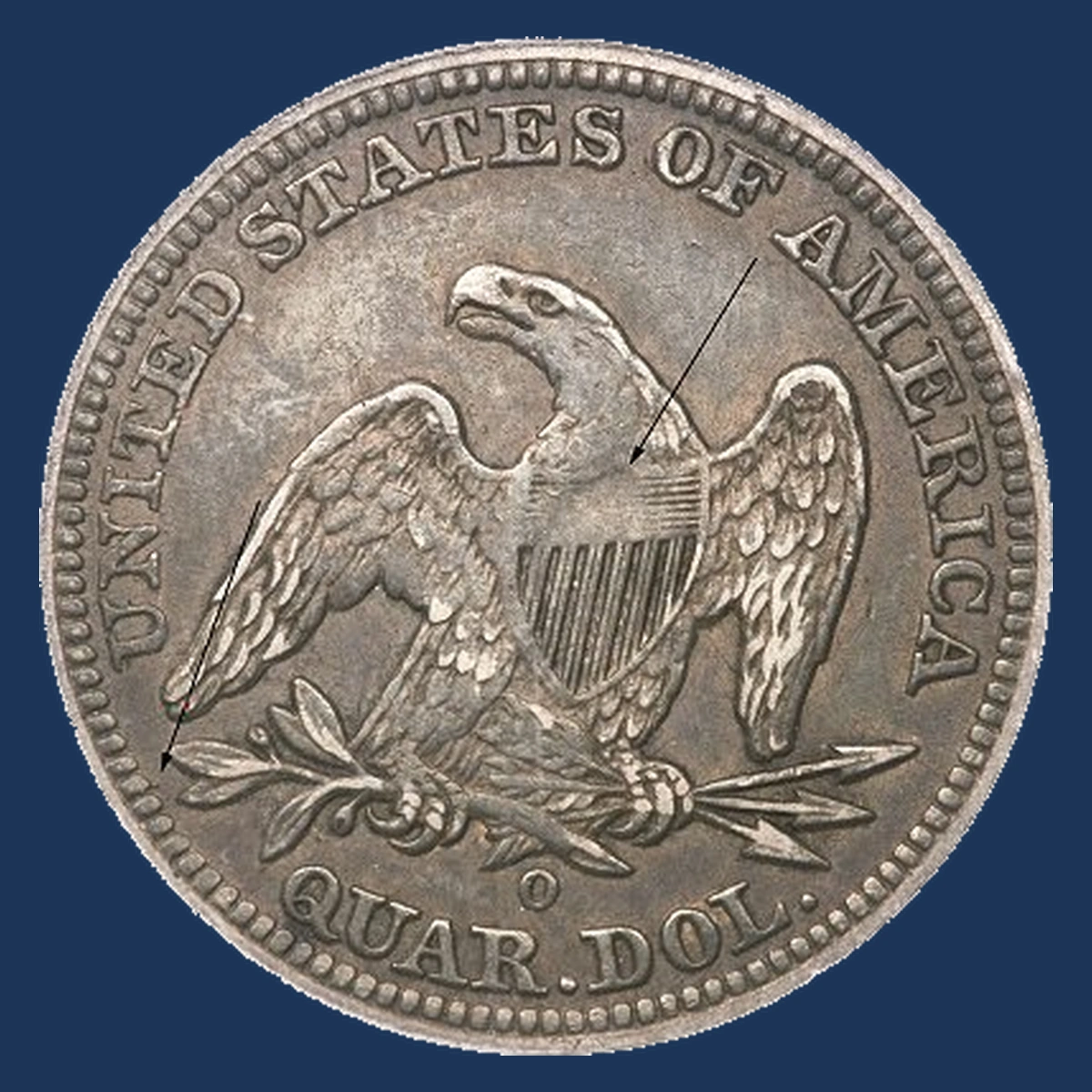
The affected Small Date coins have a depression across part of the eagle’s shield and nearby neck. Design detail within that patch is reduced.
This unusual appearance came from a problem with the back stamping tool. It should not be pictured as a raised lump simply because many other tool defects produce raised metal.
The feature appears on some 1842-O Small Date coins; examples made before the tool developed the problem lack it.
Auctioned coins include both a worn VF30 and an unworn MS63 with the depressed area. Those are different examples.
Estimated Value
The NGC MS63 example brought $74,750 on August 14, 2006 at Heritage. A worn PCGS VF30 with the depression sold for $3,407.50 in March 2013.
Estimate $1,500–$80,000 across worn and exceptional unworn examples. The rare Small Date issue and its condition account for much of that spread.
These prices value whole coins. The shield depression is not a separate five-figure addition to an ordinary Large Date quarter.
How to Identify
Start with the small depression under side lighting, then check the date before naming its cause. A random dent on a Large Date quarter is not this Small Date feature.
The Small Date comparison shows a shorter, straighter flag at the top of the 1. Confirm the O below the eagle as well.
Now compare the upper-left shield and nearby neck with a photographed example that has the depression. Follow its boundary and the way it affects the shield lines.
A later gouge can leave sharp cuts or displaced metal that do not match that recurring patch. Ordinary weak striking may soften detail without producing the same boundary.
Keep the date and complete eagle visible in your pictures. The correct Small Date paired with the matching shield depression is the key combination.
Conclusion
On an 1842-O quarter, the date style determines where to start: inspect the 8 on a Large Date or the shield on an affected Small Date. A larger-looking numeral alone is not an error.
The estimated whole-coin range is $150–$80,000. The $74,750 auction result reflects an exceptionally scarce unworn Small Date coin, while a worn example with the same shield feature sold much lower.